Recognition: unknown
NH-CROP: Robust Pricing for Governed Language Data Assets under Cost Uncertainty
Pith reviewed 2026-05-10 15:54 UTC · model grok-4.3
The pith
NH-CROP lets platforms price language data assets under uncertain costs by gating verification to only when it clearly adds value.
A machine-rendered reading of the paper's core claim, the machinery that carries it, and where it could break.
Core claim
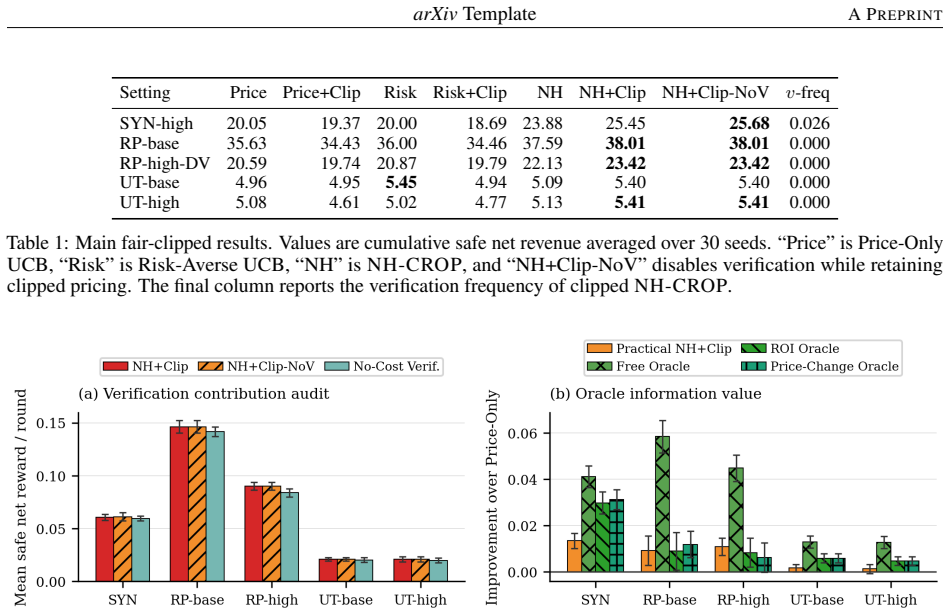
NH-CROP is a clipped robust pricing framework equipped with a no-harm information-acquisition gate. At each round the platform sees a task, asset, and coarse cost signal, then decides whether paying for a refined signal improves the subsequent pricing decision enough to justify the cost. The framework compares direct pricing, risk-aware pricing, and verify-then-price strategies inside the gate. Experiments show that clipped NH-CROP variants improve or remain competitive with baselines, while the strongest learned policies often elect not to verify; oracle diagnostics confirm that refined signals retain substantial local value even when global verification is not used.
What carries the argument
NH-CROP is the clipped robust pricing framework with a no-harm information-acquisition gate that compares the estimated decision value of a refined cost signal against the best no-verification pricing alternative before deciding to pay.
If this is right
- Clipped NH-CROP variants improve or remain competitive with price-only and risk-aware baselines on synthetic, real-proxy, and downstream-utility benchmarks.
- Strongest learned policies frequently choose not to verify, showing that paid verification is not the main source of gains in real-proxy and utility-grounded settings.
- Oracle and high-decision-value diagnostics indicate refined cost information still carries substantial local value even when global verification is skipped.
- Governed language-data platforms should calibrate pricing under uncertain access costs first and verify only when information is cheap and decision-actionable.
Where Pith is reading between the lines
- The no-harm gate may transfer to pricing other governed data types such as images or tabular records that also carry coarse-to-refined cost signals.
- If verification costs fall substantially, the threshold for acquiring information would need re-calibration to keep the gate effective.
- Testing the framework on sequential tasks where cost estimates evolve over time could reveal whether the current single-round decision-value estimate remains sufficient.
Load-bearing premise
The estimated decision value of refined cost information can be computed reliably enough to gate verification without creating new errors, and the chosen benchmarks adequately represent real governed language data scenarios.
What would settle it
A new benchmark or live platform deployment in which NH-CROP variants are consistently outperformed by either always-verify or never-verify policies across multiple cost distributions.
Figures




read the original abstract
Language data are increasingly acquired and governed as assets, yet platforms often price candidate resources before knowing their true privacy or access costs. We study online pricing for governed language data assets under cost uncertainty. At each round, a platform observes an NLP task, a candidate asset, and a coarse cost estimate, may pay for a refined cost signal, posts a price, and receives safe net revenue. We introduce \textsc{NH-CROP}, a clipped robust pricing framework with a no-harm information-acquisition gate. The method compares direct pricing, risk-aware pricing, and verify-then-price, and acquires information only when its estimated decision value exceeds the best no-verification alternative. Across synthetic, real-proxy, and downstream-utility-grounded benchmarks, clipped \textsc{NH-CROP} variants improve or remain competitive with price-only and risk-aware baselines. Causal ablations show that paid verification is not the main source of gains in real-proxy and utility-grounded settings: the strongest learned policies often choose not to verify. Oracle and high-decision-value diagnostics show that refined cost information can still have substantial local value. Overall, governed language-data platforms should calibrate pricing under uncertain access costs first and verify only when information is cheap and decision-actionable.
Editorial analysis
A structured set of objections, weighed in public.
Referee Report
Summary. The paper introduces NH-CROP, a clipped robust pricing framework with a no-harm information-acquisition gate for online pricing of governed language data assets under cost uncertainty. At each round the platform observes an NLP task, candidate asset, and coarse cost estimate; it may pay for a refined cost signal, posts a price, and receives safe net revenue. The approach is compared against direct pricing, risk-aware pricing, and verify-then-price baselines. Across synthetic, real-proxy, and downstream-utility-grounded benchmarks, clipped NH-CROP variants improve or remain competitive with price-only and risk-aware baselines. Causal ablations indicate that paid verification is not the main source of gains in real-proxy and utility-grounded settings, with strongest learned policies often choosing not to verify; oracle diagnostics show local value for refined information.
Significance. If the empirical claims hold, the work offers a practical, conservative method for data platforms to price language assets under access-cost uncertainty, with explicit guidance to prioritize robust pricing calibration before verification. Credit is due for the causal ablations that isolate the contribution of the verification gate and for the modest phrasing of results that avoids overclaiming. The no-harm gate and clipping mechanism extend standard online pricing ideas in a manner that appears internally consistent.
major comments (1)
- Experimental Evaluation section: The central claim that clipped NH-CROP variants improve or remain competitive rests on performance tables and ablations, yet the manuscript provides no details on benchmark construction, number of independent runs, statistical significance tests, or controls for potential confounds. This absence prevents verification of the reported competitiveness and of the finding that verification is rarely chosen by strongest policies.
minor comments (2)
- Abstract and §1: The description of the no-harm gate would benefit from a brief pseudocode outline or explicit decision rule to improve readability for readers unfamiliar with online pricing literature.
- Notation: The distinction between coarse and refined cost signals is clear in the abstract but could be reinforced with consistent symbols (e.g., C_coarse vs. C_refined) throughout the method description.
Simulated Author's Rebuttal
We thank the referee for the detailed and constructive report. The feedback on the Experimental Evaluation section highlights a genuine need for greater transparency in our empirical setup. We address this point directly below and will incorporate the requested details in the revised manuscript.
read point-by-point responses
-
Referee: [—] Experimental Evaluation section: The central claim that clipped NH-CROP variants improve or remain competitive rests on performance tables and ablations, yet the manuscript provides no details on benchmark construction, number of independent runs, statistical significance tests, or controls for potential confounds. This absence prevents verification of the reported competitiveness and of the finding that verification is rarely chosen by strongest policies.
Authors: We agree that the current Experimental Evaluation section lacks sufficient methodological detail to allow full verification of the reported results. In the revised manuscript we will expand this section (and move supporting material from the appendix into the main text where appropriate) to include: (1) explicit descriptions of how each benchmark was constructed, including data sources, task definitions, cost-estimate generation procedures, and any preprocessing steps for the synthetic, real-proxy, and downstream-utility-grounded settings; (2) the exact number of independent runs (with random seeds) performed for every method and setting, together with mean performance and standard-error bars; (3) the statistical tests used (paired t-tests or Wilcoxon signed-rank tests with Bonferroni correction) and the resulting p-values for all pairwise comparisons; and (4) a dedicated paragraph discussing potential confounds (e.g., data leakage, hyper-parameter tuning bias, or non-stationarity) and the controls applied to mitigate them. These additions will directly support the competitiveness claims and the causal-ablation finding that strongest policies frequently elect not to verify. revision: yes
Circularity Check
No significant circularity identified
full rationale
The manuscript introduces NH-CROP as a clipped robust pricing policy with an explicit no-harm information-acquisition gate that compares direct pricing, risk-aware pricing, and verify-then-price options, acquiring a refined cost signal only when its estimated decision value exceeds the best no-verification alternative. All central claims rest on reported performance tables across synthetic, real-proxy, and downstream-utility benchmarks plus causal ablations; these are empirical comparisons rather than derivations. No equations reduce a claimed prediction to a fitted parameter by construction, no load-bearing premise depends on a self-citation chain, and the method is presented as an extension of standard online pricing ideas without renaming known results or smuggling ansatzes. The modest empirical phrasing and explicit oracle diagnostics further confirm the derivation chain is self-contained against external benchmarks.
Axiom & Free-Parameter Ledger
Reference graph
Works this paper leans on
-
[1]
Data cards: Purposeful and transparent dataset documentation for responsible ai
Mahima Pushkarna, Andrew Zaldivar, and Oddur Kjartansson. Data cards: Purposeful and transparent dataset documentation for responsible ai. InProceedings of the 2022 ACM Conference on Fairness, Accountability, and Transparency, pages 1776–1826,
2022
-
[2]
Documenting large webtext corpora: A case study on the colossal clean crawled corpus
Jesse Dodge, Maarten Sap, Ana Marasovic, William Agnew, Gabriel Ilharco, Dirk Groeneveld, Margaret Mitchell, and Matt Gardner. Documenting large webtext corpora: A case study on the colossal clean crawled corpus. In Proceedings of the 2021 Conference on Empirical Methods in Natural Language Processing, pages 1286–1305,
2021
-
[3]
Datacomp- LM : In search of the next generation of training sets for language models
Jeffrey Li, Alex Fang, Georgios Smyrnis, Maor Ivgi, Matt Jordan, Samir Gadre, Hritik Bansal, Etash Guha, Sedrick Keh, Kushal Arora, et al. Datacomp-lm: In search of the next generation of training sets for language models.arXiv preprint arXiv:2406.11794,
-
[4]
Smith, and Yejin Choi
8 arXivTemplateA PREPRINT Swabha Swayamdipta, Roy Schwartz, Nicholas Lourie, Yizhong Wang, Hannaneh Hajishirzi, Noah A. Smith, and Yejin Choi. Dataset cartography: Mapping and diagnosing datasets with training dynamics. InProceedings of the 2020 Conference on Empirical Methods in Natural Language Processing, pages 9275–9293,
2020
-
[5]
Text Embeddings by Weakly-Supervised Contrastive Pre-training
Liang Wang, Nan Yang, Xiaolong Huang, Binxing Jiao, Linjun Yang, Daxin Jiang, Rangan Majumder, and Furu Wei. Text embeddings by weakly-supervised contrastive pre-training.arXiv preprint arXiv:2212.03533,
work page internal anchor Pith review arXiv
-
[6]
Sarah Holland, Ahmed Hosny, Sarah Newman, Joshua Joseph, and Kasia Chmielinski. The dataset nutrition label: A framework to drive higher data quality standards.arXiv preprint arXiv:1805.03677,
-
[7]
everyone wants to do the model work, not the data work
Nithya Sambasivan, Shivani Kapania, Hannah Higham, Diana Akrong, Praveen Paritosh, and Lora M. Aroyo. “everyone wants to do the model work, not the data work”: Data cascades in high-stakes ai. InProceedings of the 2021 CHI Conference on Human Factors in Computing Systems, pages 1–15,
2021
-
[8]
The Pile: An 800GB Dataset of Diverse Text for Language Modeling
9 arXivTemplateA PREPRINT Leo Gao, Stella Biderman, Sid Black, Laurence Golding, Travis Hoppe, Charles Foster, Jason Phang, Horace He, Anish Thite, Noa Nabeshima, et al. The pile: An 800gb dataset of diverse text for language modeling.arXiv preprint arXiv:2101.00027,
work page internal anchor Pith review arXiv
-
[9]
Manning, Andrew Ng, and Christopher Potts
Richard Socher, Alex Perelygin, Jean Wu, Jason Chuang, Christopher D. Manning, Andrew Ng, and Christopher Potts. Recursive deep models for semantic compositionality over a sentiment treebank. InProceedings of the 2013 Conference on Empirical Methods in Natural Language Processing, pages 1631–1642,
2013
-
[10]
Carer: Contextualized affect representations for emotion recognition
Elvis Saravia, Hsien-Chi Toby Liu, Yen-Hao Huang, Junlin Wu, and Yi-Shin Chen. Carer: Contextualized affect representations for emotion recognition. InProceedings of the 2018 Conference on Empirical Methods in Natural Language Processing, pages 3687–3697,
2018
-
[11]
=σ logit (β0 +β relrel(xt, dt) +β qq(dt)−β pρ(xt)pt −β cκ(xt)ˆct),(34) where rel(xt, dt) is task–asset relevance, q(dt) is asset quality, ρ(xt) controls price sensitivity, κ(xt) controls cost sensitivity, andˆct is the platform’s current cost proxy. 9.3 Real-Proxy Benchmark The real-proxy benchmark constructs candidate assets from SST-2, AG News, and an e...
2013
-
[12]
Price” denotes Price-Only UCB, “Risk
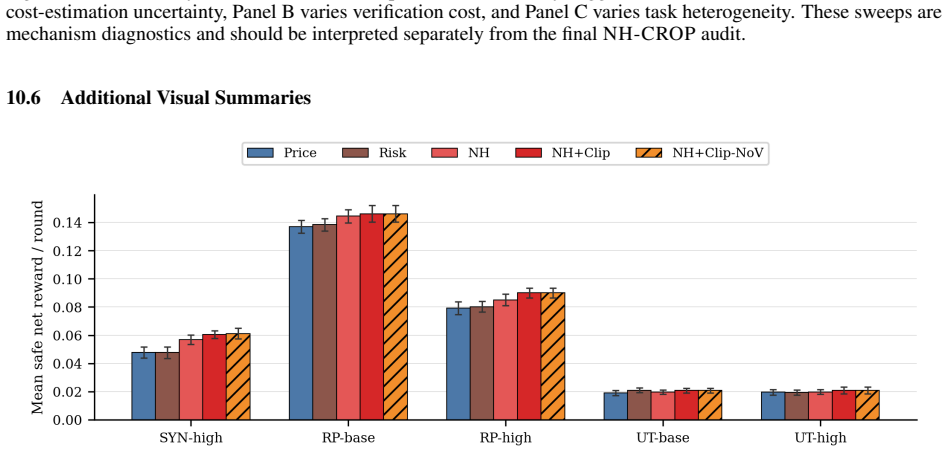
10.1 Full Non-Oracle Results Table 8 reports cumulative safe net revenue for the main non-oracle methods. The clipped NH-CROP variants improve over Price-Only UCB in all five settings and are strongest or competitive among learned non-oracle methods. In UT-BASE, Risk-Averse UCB is slightly stronger than NH+CLIP, so we interpret the result as evidence for ...
-
[13]
NoV” disables verification while preserving the pricing structure, and “Clip-NoV
10.7 Summary of Appendix C The supplementary results support three conclusions. First, clipped NH-CROP variants improve over Price-Only UCB across all main settings and are strongest or competitive among learned non-oracle methods. Second, fair clipping does not simply help every method; it helps the NH-CROP family more than Price-Only or Risk-Averse base...
discussion (0)
Sign in with ORCID, Apple, or X to comment. Anyone can read and Pith papers without signing in.