Recognition: unknown
Awareness in collective decision-making: Modeling and control in a game-theoretic framework
Pith reviewed 2026-05-08 17:39 UTC · model grok-4.3
The pith
Game theory and network systems theory model how awareness influences collective decisions toward societal benefits.
A machine-rendered reading of the paper's core claim, the machinery that carries it, and where it could break.
Core claim
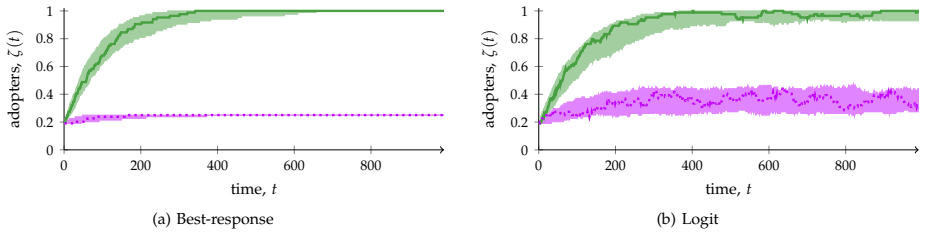
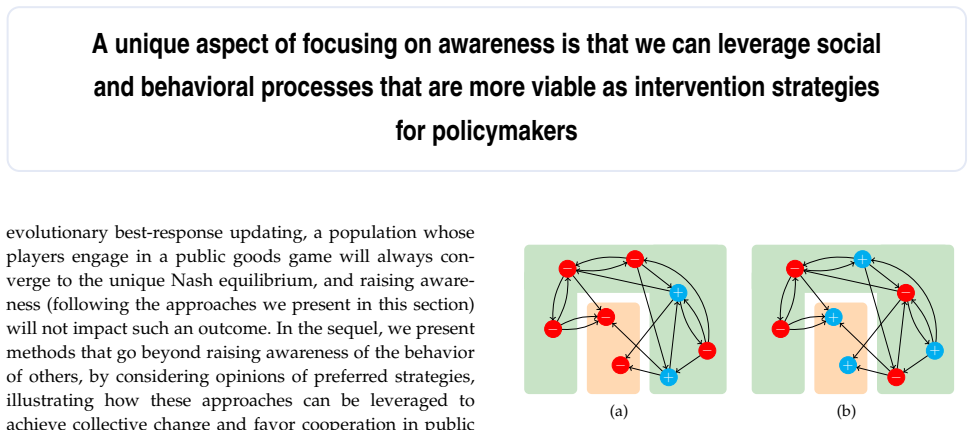
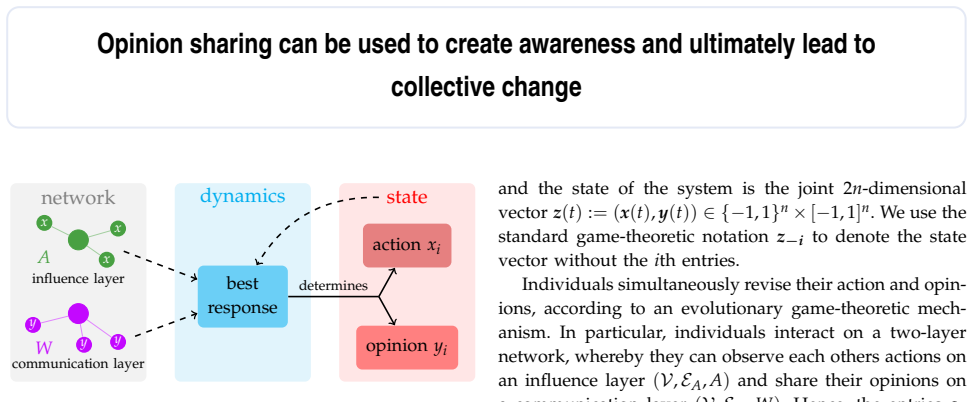
In this tutorial, we illustrate how game theory and network systems theory can be powerful tools to model and study this collective decision-making problem. We provide examples of how awareness of this tradeoff can impact collective change toward the societal good, exploring different problem contexts such as sustainable behavior and collective action. Finally, we review recent developments using systems and control-theoretic approaches to generate awareness and guide the emergent population dynamics towards a desired outcome, and conclude by highlighting new research and application frontiers.
What carries the argument
Game-theoretic models of networked populations where awareness adjusts the balance between personal and collective payoffs in decision-making.
If this is right
- Awareness can be quantified within game payoffs to predict when populations converge to socially optimal equilibria.
- Control inputs from systems theory can be designed to raise awareness and stabilize desired population states.
- The same modeling approach applies to both environmental sustainability and social equity mobilization.
- Future extensions include hybrid models that combine awareness dynamics with real-time network data.
Where Pith is reading between the lines
- Simulations from these models could let policymakers test awareness campaigns in advance of real deployment.
- Calibrating the models against survey or social media data on actual awareness levels would strengthen predictive use.
- The framework points to cooperation mechanisms that rely on information rather than direct regulation.
Load-bearing premise
The premise that awareness of individual-societal tradeoffs will lead real people to change their collective decisions in the direction of societal benefit.
What would settle it
A field experiment in which an awareness intervention designed using the game-theoretic control approach is applied but produces no predicted increase in the adoption rate of sustainable behaviors.
Figures






read the original abstract
For a society to remain healthy and prosperous, people must collectively behave and act to contribute to the common good, even if there is often a tradeoff against their individual benefit. Paradigmatic examples include the adoption of sustainable behaviors and technologies to combat the climate crisis, and the mobilization for collective action to promote the rights and freedoms of repressed minorities. In this tutorial, we illustrate how game theory and network systems theory can be powerful tools to model and study this collective decision-making problem. We provide examples of how awareness of this tradeoff can impact collective change toward the societal good, exploring different problem contexts such as sustainable behavior and collective action. Finally, we review recent developments using systems and control-theoretic approaches to generate awareness and guide the emergent population dynamics towards a desired outcome, and conclude by highlighting new research and application frontiers.
Editorial analysis
A structured set of objections, weighed in public.
Referee Report
Summary. This tutorial illustrates how game theory and network systems theory can model collective decision-making problems involving tradeoffs between individual and societal benefits. It supplies stylized examples of awareness effects on population dynamics in domains such as sustainable behavior and collective action, reviews existing systems and control-theoretic methods for steering those dynamics toward desired outcomes, and identifies open research frontiers.
Significance. The manuscript provides a clear, integrative synthesis of established game-theoretic and control tools for social dynamics, aimed at a systems audience. Its primary value is educational and bridging: it demonstrates modeling approaches and control design without advancing new empirical predictions or proofs. Strengths include the tutorial framing, concrete examples of awareness interventions, and explicit discussion of future directions, which may help researchers apply these frameworks to collective-action problems.
minor comments (3)
- [Abstract] Abstract: the phrasing 'game theory and network systems theory can be powerful tools' is appropriate for a tutorial but could be sharpened to explicitly note that the paper reviews and illustrates existing methods rather than deriving new ones.
- [Examples section] The stylized examples are useful for intuition, but the manuscript would benefit from a short discussion of how the models scale or remain robust when parameters (e.g., network topology or payoff matrices) vary, even if only qualitatively.
- [Conclusion] Conclusion: the 'new research and application frontiers' are listed but not elaborated; a one-paragraph expansion with 2-3 concrete open questions would better guide readers.
Simulated Author's Rebuttal
We thank the referee for the positive assessment of our tutorial manuscript and the recommendation for minor revision. The review accurately captures the paper's aim as an integrative synthesis of game-theoretic and control-theoretic tools for modeling awareness-driven collective decision-making, with emphasis on its educational value for systems audiences.
Circularity Check
Tutorial/review with no new derivations or predictions
full rationale
The paper is a tutorial that illustrates existing game-theoretic and network systems models of collective decision-making, supplies stylized examples of awareness effects, and reviews prior control-theoretic methods. It advances no new empirical claims, no parameter-fitted predictions, and no original derivation chain. All content is either expository or referential to external literature, so no load-bearing step reduces to its own inputs by construction, self-citation, or renaming.
Axiom & Free-Parameter Ledger
Reference graph
Works this paper leans on
-
[1]
Origins and evolution of antibiotic resistance,
J. Davies and D. Davies, “Origins and evolution of antibiotic resistance,” Microbiol. Mol. Biol. Rev., vol. 74, no. 3, p. 417–433, Sep. 2010
2010
-
[2]
Why do fish stocks collapse? the example of cod in Atlantic Canada,
R. A. Myers, J. A. Hutchings, and N. J. Barrowman, “Why do fish stocks collapse? the example of cod in Atlantic Canada,”Ecol. Appl., vol. 7, no. 1, p. 91–106, Feb. 1997
1997
-
[3]
Quids without quos — a praxeological approach,
T. Culyer, “Quids without quos — a praxeological approach,” inThe Economics of Charity, A. A. Alchian, Ed. London, UK: Institute of Economic Affairs, 1973, pp. 35–61
1973
-
[4]
Using social and behavioural science to support COVID-19 pandemic response,
J. J. V . Bavel, K. Baicker, P . S. Boggio, V . Capraro, A. Cichocka, M. Cikara, M. J. Crockett, A. J. Crum, K. M. Douglas, J. N. Druckman, J. Drury, O. Dube, N. Ellemers, E. J. Finkel, J. H. Fowler, M. Gelfand, S. Han, S. A. Haslam, J. Jetten, S. Kitayama, D. Mobbs, L. E. Napper, D. J. Packer, G. Pennycook, E. Peters, R. E. Petty, D. G. Rand, S. D. Reich...
2020
-
[5]
The practices of collective action: Practice theory, sustainability transitions and social change,
D. Welch and L. Yates, “The practices of collective action: Practice theory, sustainability transitions and social change,”J. Theory Soc. Behav., vol. 48, no. 3, p. 288–305, 2018
2018
-
[6]
Implementing the “sustainable development goals
K. J. Bowen, N. A. Cradock-Henry, F. Koch, J. Patterson, T. Häyhä, J. Vogt, and F. Barbi, “Implementing the “sustainable development goals”: towards addressing three key governance challenges—collective action, trade-offs, and accountability,”Curr. Opin. Environ. Sustain., vol. 26–27, p. 90–96, 2017
2017
-
[7]
Control for societal-scale challenges: Road map 2030,
A. M. Annaswamy, K. H. Johansson, and G. Pappas, “Control for societal-scale challenges: Road map 2030,”IEEE Control Syst., vol. 44, no. 3, pp. 30–32, 2024
2030
-
[8]
W. H. Sandholm,Population Games and Evolutionary Dynamics. Cam- bridge, UK: Cambridge University Press, 2010
2010
-
[9]
A survey on the analysis and control of evolutionary matrix games,
J. Riehl, P . Ramazi, and M. Cao, “A survey on the analysis and control of evolutionary matrix games,”Annu. Rev. Contr., vol. 45, pp. 87–106, 2018
2018
-
[10]
Games on networks,
M. O. Jackson and Y. Zenou, “Games on networks,” inHandbook of Game Theory with Economic Applications. Amsterdam, Netherlands: Elsevier, 2015, vol. 4, ch. 3, pp. 95–163
2015
-
[11]
The evolution of social norms,
H. Peyton Young, “The evolution of social norms,”Annu. Rev. Econ., vol. 7, no. 1, pp. 359–387, 2015
2015
-
[12]
Data-informed modeling of the formation, per- sistence, and evolution of social norms and conventions,
M. Ye and L. Zino, “Data-informed modeling of the formation, per- sistence, and evolution of social norms and conventions,” inHandbook of Visual, Experimental and Computational Mathematics : Bridges through Data, B. Sriraman, Ed. Cham: Springer, 2025, pp. 1–36
2025
-
[13]
The dynamics of social innovation,
H. P . Young, “The dynamics of social innovation,”Proc. Natl. Acad. Sci. USA, vol. 108, no. 4, pp. 21 285–21 291, 2011
2011
-
[14]
Collective patterns of social diffusion are shaped by individ- ual inertia and trend-seeking,
M. Ye, L. Zino, Z. Mlakar, J. W. Bolderdijk, H. Risselada, B. M. Fennis, and M. Cao, “Collective patterns of social diffusion are shaped by individ- ual inertia and trend-seeking,”Nat. Comm., vol. 12, p. 5698, 2021
2021
-
[15]
Contagion,
S. Morris, “Contagion,”Rev. Econ. Stud., vol. 67, no. 1, pp. 57–78, 2000
2000
-
[16]
Equilibria and learning dynamics in mixed network coordination/anti-coordination games,
L. Arditti, G. Como, F. Fagnani, and M. Vanelli, “Equilibria and learning dynamics in mixed network coordination/anti-coordination games,” in Proc. 60th IEEE Conf. Decis. Control., 2021, pp. 4982–4987
2021
-
[17]
Public goods in networks,
Y. Bramoullé and R. Kranton, “Public goods in networks,”J. Econ. Theory, vol. 135, no. 1, p. 478–494, 2007
2007
-
[18]
Olson Jr.,The Logic of Collective Action: Public Goods and the Theory of Groups
M. Olson Jr.,The Logic of Collective Action: Public Goods and the Theory of Groups. Cambridge MA, USA: Harvard University Press, 1965
1965
-
[19]
Rationality, imitation, and rational imitation in spatial public goods games,
A. Govaert, P . Ramazi, and M. Cao, “Rationality, imitation, and rational imitation in spatial public goods games,”IEEE T rans. Control Netw. Syst., vol. 8, no. 3, pp. 1324–1335, 2021
2021
-
[20]
Overcoming inaction: An agent-based modelling study of social inter- ventions that promote systematic pro-environmental change,
T. Hoffmann, M. Ye, L. Zino, M. Cao, W. Rauws, and J. W. Bolderdijk, “Overcoming inaction: An agent-based modelling study of social inter- ventions that promote systematic pro-environmental change,”J. Environ, Psychol., vol. 94, p. 102221, 2024
2024
-
[21]
MOBILISE: A higher-order integration of collective action research to address global challenges,
E. F. Thomas, L. Duncan, C. McGarty, W. R. Louis, and L. G. Smith, “MOBILISE: A higher-order integration of collective action research to address global challenges,”Political Psychol., vol. 43, pp. 107–164, 2022
2022
-
[22]
Unwelcome change: Coming to terms with democratic backsliding,
D. Waldner and E. Lust, “Unwelcome change: Coming to terms with democratic backsliding,”Annu. Rev. Political Sci., vol. 21, no. 1, pp. 93–113, 2018
2018
-
[23]
Using wearable proximity sensors to characterize social contact patterns in a village of rural Malawi,
L. Ozella, D. Paolotti, G. Lichand, J. P . Rodríguez, S. Haenni, J. Phuka, O. B. Leal-Neto, and C. Cattuto, “Using wearable proximity sensors to characterize social contact patterns in a village of rural Malawi,”EPJ Data Sci., vol. 10, no. 1, 2021
2021
-
[24]
The spread of innovations in social networks,
A. Montanari and A. Saberi, “The spread of innovations in social networks,”Proc. Natl. Acad. Sci. USA, vol. 107, no. 47, pp. 20 196–20 201, 2010
2010
-
[25]
Rapid innovation diffusion in social networks,
G. E. Kreindler and H. P . Young, “Rapid innovation diffusion in social networks,”Proc. Natl. Acad. Sci. USA, vol. 111, no. 3, pp. 10 881–10 888, 2014
2014
-
[26]
Experimental evidence for tipping points in social convention,
D. Centola, J. Becker, D. Brackbill, and A. Baronchelli, “Experimental evidence for tipping points in social convention,”Science, vol. 360, no. 6393, pp. 1116–1119, 2018
2018
-
[27]
Maximizing the Spread of Influence through a Social Network,
D. Kempe, J. Kleinberg, and E. Tardos, “Maximizing the Spread of Influence through a Social Network,” in9th ACM SIGKDD Int. Conf. Knowl. Discov. Data Min., 2003, pp. 137–146
2003
-
[28]
Diffusion of innovations in social networks,
D. Acemoglu, A. Ozdaglar, and E. Yildiz, “Diffusion of innovations in social networks,” inProc. 50th IEEE Conf. Decis. Control. andEur. Control Conf., 2011, p. 2329–2334
2011
-
[29]
Optimal targeting in super- modular games,
G. Como, S. Durand, and F. Fagnani, “Optimal targeting in super- modular games,”IEEE T rans. Autom. Control., vol. 67, no. 12, pp. 6366–6380, 2022
2022
-
[30]
Towards optimal control of evolutionary games on networks,
J. R. Riehl and M. Cao, “Towards optimal control of evolutionary games on networks,”IEEE T rans. Autom. Control, vol. 62, pp. 458–462, 2017
2017
-
[31]
Incentive-based control of asyn- chronous best-response dynamics on binary decision networks,
J. Riehl, P . Ramazi, and M. Cao, “Incentive-based control of asyn- chronous best-response dynamics on binary decision networks,”IEEE T rans. Control Netw. Syst., vol. 6, no. 2, pp. 727–736, 2018
2018
-
[32]
Incentive-based control of networked evolutionary coordination games under asynchronous best- response dynamics,
A. Liu, H. Li, L. Wang, and G. Chen, “Incentive-based control of networked evolutionary coordination games under asynchronous best- response dynamics,”Appl. Math. Comput., vol. 509, p. 129684, 2026
2026
-
[33]
A payoff dynamics model for generalized nash equilibrium seeking in population games,
J. Martinez-Piazuelo, N. Quijano, and C. Ocampo-Martinez, “A payoff dynamics model for generalized nash equilibrium seeking in population games,”Automatica, vol. 140, p. 110227, 2022
2022
-
[34]
Equilibrium selection in replicator equations using adaptive-gain control,
L. Zino, M. Ye, G. C. Calafiore, and A. Rizzo, “Equilibrium selection in replicator equations using adaptive-gain control,”IEEE T rans. Autom. Control, vol. 70, no. 10, p. 6799–6814, 2025
2025
-
[35]
Effect of Network Topology and Committed Minority in Promoting Social Diffusion,
T. Gao, L. Zino, and M. Ye, “Effect of Network Topology and Committed Minority in Promoting Social Diffusion,”IEEE T rans. Comput. Soc. Syst., 19 vol. 11, no. 2, pp. 2326–2339, 2024
2024
-
[36]
Altruistic punishment in humans,
E. Fehr and S. Gächter, “Altruistic punishment in humans,”Nature, vol. 415, no. 6868, p. 137–140, 2002
2002
-
[37]
The long-run benefits of punish- ment,
S. Gächter, E. Renner, and M. Sefton, “The long-run benefits of punish- ment,”Science, vol. 322, no. 5907, p. 1510–1510, 2008
2008
-
[38]
Positive interactions promote public cooperation,
D. G. Rand, A. Dreber, T. Ellingsen, D. Fudenberg, and M. A. Nowak, “Positive interactions promote public cooperation,”Science, vol. 325, no. 5945, p. 1272–1275, Sep. 2009
2009
-
[39]
The role of punishment in the spatial public goods game,
P . Zhu, H. Guo, H. Zhang, Y. Han, Z. Wang, and C. Chu, “The role of punishment in the spatial public goods game,”Nonlinear Dyn., vol. 102, no. 4, p. 2959–2968, 2020
2020
-
[40]
State-dependent optimal incentive allocation protocols for cooperation in public goods games on regular networks,
Z. Sun, X. Chen, and A. Szolnoki, “State-dependent optimal incentive allocation protocols for cooperation in public goods games on regular networks,”IEEE T rans. Netw. Sci. Eng., vol. 10, no. 6, pp. 3975 – 3988, 2023
2023
-
[41]
Reputation helps solve the ‘tragedy of the commons’,
M. Milinski, D. Semmann, and H.-J. Krambeck, “Reputation helps solve the ‘tragedy of the commons’,”Nature, vol. 415, no. 6870, p. 424–426, 2002
2002
-
[42]
A self-contained karma economy for the dynamic allocation of common resources,
E. Elokda, S. Bolognani, A. Censi, F. Dörfler, and E. Frazzoli, “A self-contained karma economy for the dynamic allocation of common resources,”Dyn. Games Appl., vol. 14, no. 3, p. 578–610, 2023
2023
-
[43]
Impact of committed minorities: Unveiling critical mass of cooperation in the iterated prisoner’s dilemma game,
Z. He, C. Shen, L. Shi, and J. Tanimoto, “Impact of committed minorities: Unveiling critical mass of cooperation in the iterated prisoner’s dilemma game,”Phys. Rev. Research, vol. 6, no. 1, 2024
2024
-
[44]
Promoting cooperation in the public goods game using artificial intelligent agents,
A. Hintze and C. Adami, “Promoting cooperation in the public goods game using artificial intelligent agents,”npj Complexity, vol. 3, no. 1, 2026
2026
-
[45]
Bicchieri,The Grammar of Society: The Nature and Dynamics of Social Norms
C. Bicchieri,The Grammar of Society: The Nature and Dynamics of Social Norms. Cambridge University Press, Cambridge, UK, 2006
2006
-
[46]
Join us: Dynamic norms encourage women to pursue STEM,
L. Cheng, M. Hao, L. Xiao, and F. Wang, “Join us: Dynamic norms encourage women to pursue STEM,”Curr. Psychol., vol. 41, p. 5967–5977, 2022
2022
-
[47]
Dynamic norms promote sustainable behavior, even if it is counternormative,
G. Sparkman and G. M. Walton, “Dynamic norms promote sustainable behavior, even if it is counternormative,”Psychol Sci., vol. 28, no. 11, pp. 1663–1674, 2017
2017
-
[48]
A novel momentum-based intervention sustains real-life participation in a social movement,
N. Cohen-Eick, E. Shuman, Y. Hasson, M. van Zomeren, and E. Halperin, “A novel momentum-based intervention sustains real-life participation in a social movement,”Sci. Rep., 2026
2026
-
[49]
Noelle-Neumann,The Spiral of Silence: Public Opinion, Our Social Skin
E. Noelle-Neumann,The Spiral of Silence: Public Opinion, Our Social Skin. Chicago IL, USA: University of Chicago Press, 1993
1993
-
[50]
A theory of fads, fashion, custom, and cultural change as informational cascades,
S. Bikhchandani, D. Hirshleifer, and I. Welch, “A theory of fads, fashion, custom, and cultural change as informational cascades,”J. Pol. Econ., vol. 100, no. 5, pp. 992–1026, 1992
1992
-
[51]
On modeling social diffusion under the impact of dynamic norms,
L. Zino, M. Ye, and M. Cao, “On modeling social diffusion under the impact of dynamic norms,” inProc. 60th IEEE Conf. Decis. Control., 2021
2021
-
[52]
Facilitating innovation diffusion in social networks using dynamic norms,
L. Zino, M. Ye, and M. Cao, “Facilitating innovation diffusion in social networks using dynamic norms,”PNAS Nexus, 10 2022, pgac229
2022
-
[53]
Neocortex size as a constraint on group size in primates,
R. Dunbar, “Neocortex size as a constraint on group size in primates,” J. Hum. Evol., vol. 22, no. 6, p. 469–493, 1992
1992
-
[54]
Activity driven modeling of time varying networks
N. Perra, B. Gonçalves, R. Pastor-Satorras, and A. Vespignani, “Activity driven modeling of time varying networks.”Sci. Rep., vol. 2, p. 469, 2012
2012
-
[55]
Probability inequalities for sums of bounded random variables,
W. Hoeffding, “Probability inequalities for sums of bounded random variables,”J. Am. Stat. Assoc., vol. 58, no. 301, pp. 13–30, 1963
1963
-
[56]
Affixing the theory of normative conduct (to your mailbox): Injunctive and descrip- tive norms as predictors of anti-ads sticker use,
K. R. Hamann, G. Reese, D. Seewald, and D. C. Loeschinger, “Affixing the theory of normative conduct (to your mailbox): Injunctive and descrip- tive norms as predictors of anti-ads sticker use,”J. Environ. Psychol., vol. 44, pp. 1–9, 2015
2015
-
[57]
Sticker in the box! object-person distance and descriptive norms as means to reduce waste,
G. Reese, D. C. Loeschinger, K. Hamann, and S. Neubert, “Sticker in the box! object-person distance and descriptive norms as means to reduce waste,”Ecopsychology, vol. 5, no. 2, pp. 146–148, 2013
2013
-
[58]
Committing to keep clean: Nudging complements standard policy measures to reduce illegal urban garbage disposal in a neighborhood with high levels of social cohesion,
I. Merkelbach, M. Dewies, and S. Denktas, “Committing to keep clean: Nudging complements standard policy measures to reduce illegal urban garbage disposal in a neighborhood with high levels of social cohesion,” Front. Psychol., vol. 12, p. 660410, 2021
2021
-
[59]
Random walks on activity-driven networks with attractiveness,
L. Alessandretti, K. Sun, A. Baronchelli, and N. Perra, “Random walks on activity-driven networks with attractiveness,”Phys. Rev. E, vol. 95, 2017
2017
-
[60]
On incentivizing innovation diffusion in a network of coordinating agents,
L. Zino and M. Ye, “On incentivizing innovation diffusion in a network of coordinating agents,” inProc. 22nd IF AC World Congr., vol. 56, no. 2, 2023, p. 4186–4191
2023
-
[61]
Dynamic norms drive sustainable consumption: Norm-based nudging helps café customers to avoid disposable to-go-cups,
D. D. Loschelder, H. Siepelmeyer, D. Fischer, and J. A. Rubel, “Dynamic norms drive sustainable consumption: Norm-based nudging helps café customers to avoid disposable to-go-cups,”J. Econ. Psychol., vol. 75, p. 102146, 2019
2019
-
[62]
The theory of planned behavior,
I. Ajzen, “The theory of planned behavior,”Organ. Behav. Hum. Decis. Process., vol. 50, no. 2, pp. 179–211, 1991
1991
-
[63]
The false enforcement of unpopular norms,
R. Willer, K. Kuwabara, and M. W. Macy, “The false enforcement of unpopular norms,”Am. J. Sociol., vol. 115, pp. 451–490, 2009
2009
-
[64]
’everybody’s doing it’: on the persistence of bad social norms,
D. Smerdon, T. Offerman, and U. Gneezy, “’everybody’s doing it’: on the persistence of bad social norms,”Exp. Econ., vol. 20, p. 392–420, 2020
2020
-
[65]
Climate of silence: Pluralistic ignorance as a barrier to climate change discussion,
N. Geiger and J. K. Swim, “Climate of silence: Pluralistic ignorance as a barrier to climate change discussion,”J. Environ, Psychol., vol. 47, p. 79–90, 2016
2016
-
[66]
Pluralistic ignorance and alcohol use on campus: some consequences of misperceiving the social norm
D. A. Prentice and D. T. Miller, “Pluralistic ignorance and alcohol use on campus: some consequences of misperceiving the social norm.”J. Pers. Soc. Psychol., vol. 64, no. 2, p. 243, 1993
1993
-
[67]
Pluralistic ignorance and white estimates of white support for racial segregation,
H. J. O’Gorman, “Pluralistic ignorance and white estimates of white support for racial segregation,”Public Opin. Q., vol. 39, no. 3, pp. 313–330, 1975
1975
-
[68]
Climate Change — Evidence,
NASA Science, “Climate Change — Evidence,” https://science.nasa.gov/climate-change/evidence/, accessed: May 5, 2026
2026
-
[69]
Environmental decision- making in times of polarization,
M. Judge, Y. Kashima, L. Steg, and T. Dietz, “Environmental decision- making in times of polarization,”Annu. Rev. Environ. Resour., vol. 48, no. 1, p. 477–503, 2023
2023
-
[70]
Continuous opinions and discrete actions in opinion dynamics problems,
A. C. R. Martins, “Continuous opinions and discrete actions in opinion dynamics problems,”Int. J. Mod. Phys. C, vol. 19, pp. 617–624, 2008
2008
-
[71]
Continu- ous opinions and discrete actions in social networks: A multi-agent system approach,
N. R. Chowdhury, I.-C. Mor˘ arescu, S. Martin, and S. Srikant, “Continu- ous opinions and discrete actions in social networks: A multi-agent system approach,” inProc. 55th IEEE Conf. Decis. Control., 2016, pp. 1739–1744
2016
-
[72]
Consensus and disagreement: The role of quantized behaviors in opinion dynamics,
F. Ceragioli and P . Frasca, “Consensus and disagreement: The role of quantized behaviors in opinion dynamics,”SIAM J. Control Optim., vol. 56, no. 2, pp. 1058–1080, 2018
2018
-
[73]
Synchronous coda opinion dynamics over social networks,
K. Tang, Y. Zhao, J. Zhang, and J. Hu, “Synchronous coda opinion dynamics over social networks,” inProc. 40th Chinese Control Conf., 2021, pp. 5448–5453
2021
-
[74]
An opinion dynamics model for the diffusion of innovations,
A. C. Martins, C. de B. Pereira, and R. Vicente, “An opinion dynamics model for the diffusion of innovations,”Physica A, vol. 388, no. 15, pp. 3225–3232, 2009
2009
-
[75]
Opinion dynamics aware marketing strategies in duopolies,
V . S. Varma, I.-C. Morarescu, S. Lasaulce, and S. Martin, “Opinion dynamics aware marketing strategies in duopolies,” inProc. 56th IEEE Conf. Decis. Control., 2017, pp. 3859–3864
2017
-
[76]
Optimal policy design for repeated decision-making under social influence,
C. Ravazzi, V . Breschi, P . Frasca, F. Dabbene, and M. Tanelli, “Optimal policy design for repeated decision-making under social influence,”IEEE T rans. Autom. Control, pp. 1–15, 2026
2026
-
[77]
A psychologically-motivated model of opinion change with applications to american politics
P . Duggins, “A psychologically-motivated model of opinion change with applications to american politics.”J. Artif. Soc. Soc. Simul., vol. 20, no. 1, 2017
2017
-
[78]
An influence network model to study discrepancies in expressed and private opinions,
M. Ye, Y. Qin, A. Govaert, B. D. Anderson, and M. Cao, “An influence network model to study discrepancies in expressed and private opinions,” Automatica, vol. 107, pp. 371–381, 2019
2019
-
[79]
Social conformity creates consensus and strong diversity of Hegselmann-Krause opinion dynamics,
C. Cheng and C. Yu, “Social conformity creates consensus and strong diversity of Hegselmann-Krause opinion dynamics,”Sci. China Inf. Sci., vol. 65, no. 2, p. 129202, 2022
2022
-
[80]
Resilient consensus for expressed and private opinions,
Y. Shang, “Resilient consensus for expressed and private opinions,” IEEE T rans. Cybern., vol. 51, no. 1, pp. 318–331, 2021
2021
discussion (0)
Sign in with ORCID, Apple, or X to comment. Anyone can read and Pith papers without signing in.