Recognition: 3 theorem links
· Lean TheoremGRAIL: A Deep-Granularity Hybrid Resonance Framework for Real-Time Agent Discovery via SLM-Enhanced Indexing
Pith reviewed 2026-05-08 18:25 UTC · model grok-4.3
The pith
GRAIL combines a fine-tuned small language model with resonance matching to discover suitable agents in under 400 milliseconds.
A machine-rendered reading of the paper's core claim, the machinery that carries it, and where it could break.
Core claim
GRAIL replaces heavy LLM intent parsing with an SLM for millisecond tag prediction, augments each agent description with synthetic queries, and computes maximum similarity (MaxSim Resonance) between the incoming query and discrete agent usage examples, delivering sub-400 ms discovery latency and higher Recall@10 than vector baselines on the AgentTaxo-9K dataset.
What carries the argument
MaxSim Resonance, the fine-grained matching step that takes the highest similarity score between a user query and the set of synthetic usage examples attached to each agent.
If this is right
- Multi-agent systems can operate with sub-second response times instead of tens of seconds.
- Retrieval accuracy improves over monolithic vector search without sacrificing speed.
- The framework scales to thousands of agents while keeping latency low.
- Industrial deployments become feasible for real-time Internet-of-Agents scenarios.
Where Pith is reading between the lines
- The same SLM-plus-resonance pattern could be tested on tool or plugin selection tasks outside agent discovery.
- If the resonance step proves robust, it may reduce reliance on ever-larger embedding models for retrieval.
- Combining cheap tagging models with example-level matching offers a general route to low-latency semantic search.
Load-bearing premise
A fine-tuned small language model can predict accurate capability tags for agents and that adding synthetic queries plus resonance scoring will improve semantic matches without introducing noise or bias on new queries.
What would settle it
Measure tag-prediction accuracy and end-to-end recall on a fresh hold-out set of agents and queries never seen during SLM fine-tuning or synthetic-query generation; if both drop sharply the central performance claims fail.
Figures


read the original abstract
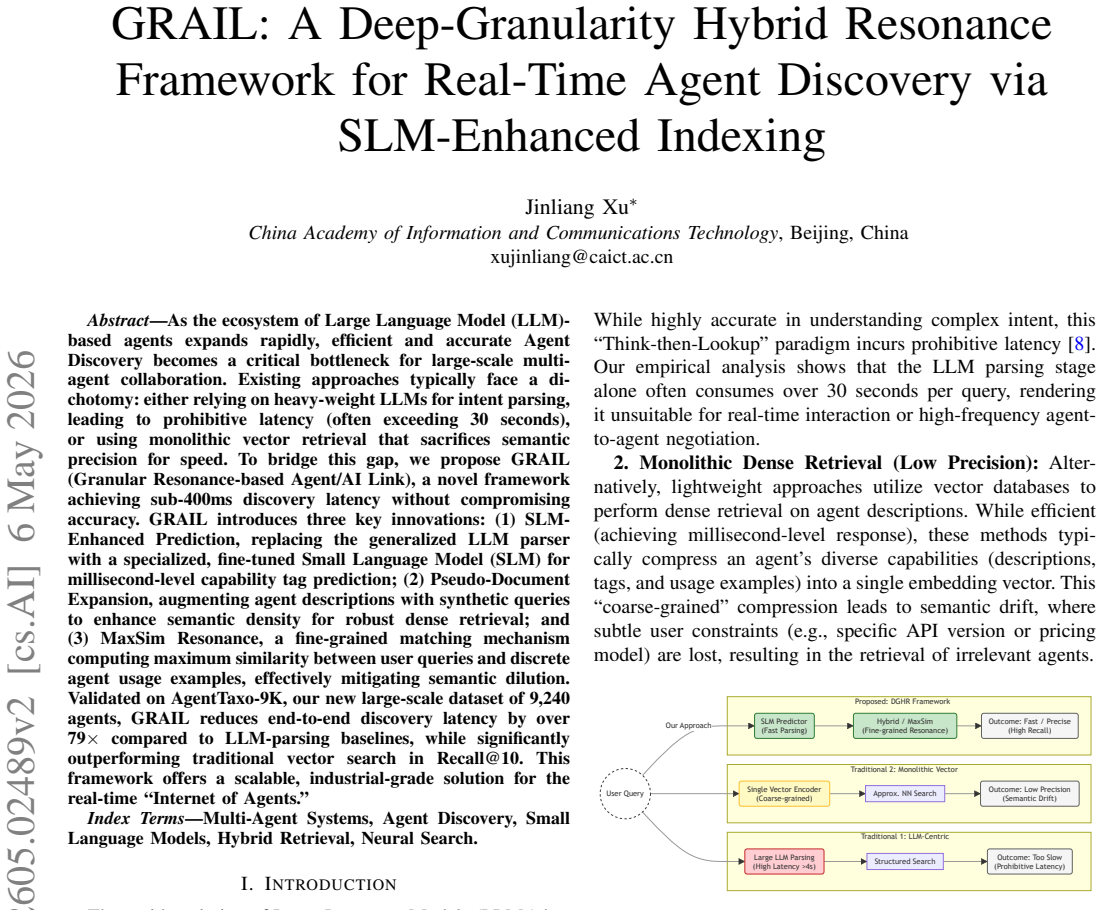
As the ecosystem of Large Language Model (LLM)-based agents expands rapidly, efficient and accurate Agent Discovery becomes a critical bottleneck for large-scale multi-agent collaboration. Existing approaches typically face a dichotomy: either relying on heavy-weight LLMs for intent parsing, leading to prohibitive latency (often exceeding 30 seconds), or using monolithic vector retrieval that sacrifices semantic precision for speed. To bridge this gap, we propose \textbf{GRAIL} (Granular Resonance-based Agent/AI Link), a novel framework achieving sub-400ms discovery latency without compromising accuracy. GRAIL introduces three key innovations: (1) \textbf{SLM-Enhanced Prediction}, replacing the generalized LLM parser with a specialized, fine-tuned Small Language Model (SLM) for millisecond-level capability tag prediction; (2) \textbf{Pseudo-Document Expansion}, augmenting agent descriptions with synthetic queries to enhance semantic density for robust dense retrieval; and (3) \textbf{MaxSim Resonance}, a fine-grained matching mechanism computing maximum similarity between user queries and discrete agent usage examples, effectively mitigating semantic dilution. Validated on \textbf{AgentTaxo-9K}, our new large-scale dataset of 9,240 agents, GRAIL reduces end-to-end discovery latency by over \textbf{79$\times$} compared to LLM-parsing baselines, while significantly outperforming traditional vector search in Recall@10. This framework offers a scalable, industrial-grade solution for the real-time ``Internet of Agents."
Editorial analysis
A structured set of objections, weighed in public.
Referee Report
Summary. The manuscript proposes GRAIL, a hybrid framework for real-time agent discovery that replaces heavy LLM-based intent parsing with a fine-tuned small language model (SLM) for millisecond-level capability tag prediction, augments agent descriptions via pseudo-document expansion with synthetic queries, and applies a MaxSim resonance mechanism for fine-grained matching between user queries and agent usage examples. Evaluated on the newly introduced AgentTaxo-9K dataset of 9,240 agents, the paper claims sub-400 ms end-to-end latency and over 79× reduction versus LLM-parsing baselines while improving Recall@10 over traditional vector search.
Significance. If the empirical performance claims hold under rigorous scrutiny, GRAIL could meaningfully advance scalable multi-agent systems by resolving the latency-accuracy tradeoff in agent discovery. The introduction of a large-scale dataset and the combination of SLM specialization with resonance-based matching are potentially useful contributions to agentic AI infrastructure.
major comments (2)
- [Experimental Evaluation] Experimental Evaluation section: the abstract and results report a 79× latency reduction and Recall@10 gains but supply no protocol details, baseline definitions (specific LLM models, vector index parameters, or hardware), error bars, number of runs, statistical tests, or ablation studies isolating SLM accuracy, pseudo-expansion benefit, and MaxSim contribution. These omissions make the central numerical claims impossible to evaluate for robustness or reproducibility.
- [§3 and §4] §3 (Method) and §4 (Experiments): the end-to-end gains rest on the unverified assumptions that the fine-tuned SLM produces accurate capability tags on unseen queries and that synthetic-query augmentation plus MaxSim resonance improves semantic matching without injecting noise or bias. No isolated metrics (e.g., SLM tag-prediction accuracy on held-out data, ablation of resonance with/without expansion) are provided, rendering the latency advantage and recall improvements non-falsifiable as stated.
minor comments (2)
- [Abstract] Abstract: the phrase 'significantly outperforming' should be accompanied by concrete Recall@10 deltas or confidence intervals if space permits.
- [Methods] Methods: provide a formal equation or pseudocode for the MaxSim resonance computation to clarify how maximum similarity is aggregated across discrete usage examples.
Simulated Author's Rebuttal
We sincerely thank the referee for their insightful and constructive comments on our manuscript. We have addressed each major concern by planning substantial revisions to improve the experimental details and provide additional supporting analyses. Our responses are as follows.
read point-by-point responses
-
Referee: [Experimental Evaluation] Experimental Evaluation section: the abstract and results report a 79× latency reduction and Recall@10 gains but supply no protocol details, baseline definitions (specific LLM models, vector index parameters, or hardware), error bars, number of runs, statistical tests, or ablation studies isolating SLM accuracy, pseudo-expansion benefit, and MaxSim contribution. These omissions make the central numerical claims impossible to evaluate for robustness or reproducibility.
Authors: We fully agree with this assessment and apologize for the insufficient detail in the original submission. The Experimental Evaluation section will be significantly expanded in the revised manuscript. We will include: complete protocol details such as the exact LLM models used in baselines, vector index parameters, hardware specifications, error bars from multiple independent runs with different random seeds, results of statistical significance tests, and comprehensive ablation studies. These ablations will isolate the contribution of SLM-Enhanced Prediction, Pseudo-Document Expansion, and MaxSim Resonance separately, reporting their individual impacts on latency and Recall@10. This will allow readers to evaluate the robustness of our claims. revision: yes
-
Referee: [§3 and §4] §3 (Method) and §4 (Experiments): the end-to-end gains rest on the unverified assumptions that the fine-tuned SLM produces accurate capability tags on unseen queries and that synthetic-query augmentation plus MaxSim resonance improves semantic matching without injecting noise or bias. No isolated metrics (e.g., SLM tag-prediction accuracy on held-out data, ablation of resonance with/without expansion) are provided, rendering the latency advantage and recall improvements non-falsifiable as stated.
Authors: We acknowledge that the manuscript would benefit from explicit verification of these assumptions. In the revised version, we will add isolated metrics in a new subsection of §4. Specifically, we will report the SLM's tag-prediction accuracy on a held-out test set of queries, along with precision/recall for capability tags. For the pseudo-expansion and MaxSim, we will present ablation results: a table comparing Recall@10 and latency for (i) base vector search, (ii) with pseudo-expansion only, (iii) with MaxSim only, and (iv) full GRAIL. Additionally, we will include analysis showing that synthetic queries do not introduce bias (e.g., no degradation in precision on out-of-distribution queries). These additions will make our claims fully falsifiable and strengthen the paper. revision: yes
Circularity Check
No circularity: purely empirical framework with no derivation chain or self-referential steps
full rationale
The paper introduces GRAIL as an engineering framework with three practical innovations (SLM tag prediction, pseudo-query expansion, MaxSim resonance) and evaluates it end-to-end on the new AgentTaxo-9K dataset. All reported results are measured latency and Recall@10 numbers obtained from system runs; no equations, fitted parameters renamed as predictions, uniqueness theorems, or self-citations appear as load-bearing elements. The central claims rest on experimental outcomes rather than any reduction to inputs by construction.
Axiom & Free-Parameter Ledger
free parameters (2)
- SLM fine-tuning data and hyperparameters
- Number and quality of synthetic queries
axioms (3)
- domain assumption A fine-tuned SLM can replace a general LLM for accurate, millisecond-scale capability tag prediction
- ad hoc to paper Augmenting agent descriptions with synthetic queries increases semantic density without adding harmful noise
- domain assumption Maximum similarity to discrete usage examples outperforms standard dense similarity for agent ranking
Lean theorems connected to this paper
-
IndisputableMonolith/Cost/FunctionalEquation.lean (washburn_uniqueness_aczel)washburn_uniqueness_aczel unclear?
unclearRelation between the paper passage and the cited Recognition theorem.
Theorem 1 (Semantic Dilution in Mean Pooling): ... S_avg ≈ 1/m ... S_max = 1. ... GRAIL maintains a constant high-confidence score invariant to the diversity of the agent's other capabilities.
-
IndisputableMonolith/Foundation/BranchSelection.leanbranch_selection unclear?
unclearRelation between the paper passage and the cited Recognition theorem.
S_final(q, a_i) = α·(v_q · v_ctx^(i)) + (1−α)·S_res(q, a_i) where α is a hyperparameter balancing broad context and specific intent.
What do these tags mean?
- matches
- The paper's claim is directly supported by a theorem in the formal canon.
- supports
- The theorem supports part of the paper's argument, but the paper may add assumptions or extra steps.
- extends
- The paper goes beyond the formal theorem; the theorem is a base layer rather than the whole result.
- uses
- The paper appears to rely on the theorem as machinery.
- contradicts
- The paper's claim conflicts with a theorem or certificate in the canon.
- unclear
- Pith found a possible connection, but the passage is too broad, indirect, or ambiguous to say the theorem truly supports the claim.
Reference graph
Works this paper leans on
-
[1]
R. Sapkota, K. I. Roumeliotis, and M. Karkee, “Ai agents vs. agentic ai: A conceptual taxonomy, applications and challenges,”arXiv preprint arXiv:2505.10468, 2025
-
[2]
Agentic web: weaving the next web with
Y . Yang, M. Ma, Y . Huang, H. Chai, C. Gong, H. Geng, Y . Zhou, Y . Wen, M. Fang, M. Chen,et al., “Agentic web: Weaving the next web with ai agents,”arXiv preprint arXiv:2507.21206, 2025
-
[3]
arXiv preprint arXiv:2401.17244 , year=
Y . Chiang, E. Hsieh, C.-H. Chou, and J. Riebesell, “Llamp: Large language model made powerful for high-fidelity materials knowledge retrieval and distillation,”arXiv preprint arXiv:2401.17244, 2024
-
[4]
Agent-om: Leveraging large language models for ontology matching
Z. Qiang, W. Wang, and K. Taylor, “Agent-om: Leveraging llm agents for ontology matching,”arXiv preprint arXiv:2312.00326, 2023
-
[5]
Hierarchical multi-agent skill discovery,
M. Yang, Y . Yang, Z. Lu, W. Zhou, and H. Li, “Hierarchical multi-agent skill discovery,”Advances in Neural Information Processing Systems, vol. 36, pp. 61759–61776, 2023
2023
-
[6]
An approach to support se- mantic discovery using ontologies to describe aeronautical web services repositories,
L. A. d. A. Rodriguez and J. Parente, “An approach to support se- mantic discovery using ontologies to describe aeronautical web services repositories,”Journal of Network and Computer Applications, vol. 87, pp. 29–42, 2023
2023
-
[7]
A survey of ai agent protocols.arXiv preprint arXiv:2504.16736,
Y . Yang, H. Chai, Y . Song, S. Qi, M. Wen, N. Li, J. Liao, H. Hu, J. Lin, G. Chang,et al., “A survey of ai agent protocols,”arXiv preprint arXiv:2504.16736, 2025
-
[8]
Omnirouter: Budget and performance controllable multi-llm routing,
K. Mei, W. Xu, M. Guo, S. Lin, and Y . Zhang, “Omnirouter: Budget and performance controllable multi-llm routing,”ACM SIGKDD Explo- rations Newsletter, vol. 27, no. 2, pp. 107–116, 2025
2025
-
[9]
Survey on multiagent based middleware,
A. Dhanasekar and K. Sujith, “Survey on multiagent based middleware,” Indian Journal of Natural Sciences, vol. 60, no. 90, pp. 96494–96500, 2025
2025
-
[10]
arXiv preprint arXiv:2505.02279 , year =
A. Ehtesham, A. Singh, G. K. Gupta, and S. Kumar, “A survey of agent interoperability protocols: Model context protocol (mcp), agent communication protocol (acp), agent-to-agent protocol (a2a), and agent network protocol (anp),”arXiv preprint arXiv:2505.02279, 2025
-
[11]
Acps: Agent collaboration protocols for the internet of agents,
J. Liu, K. Yu, K. Chen, K. Li, Y . Qian, X. Guo, H. Song, and Y . Li, “Acps: Agent collaboration protocols for the internet of agents,”arXiv preprint arXiv:2505.13523, 2025
-
[12]
Announcing the agent2agent protocol (a2a)
R. Surapaneni, “Announcing the agent2agent protocol (a2a).” Google for Developers Blog, apr 2025
2025
-
[13]
K. Huang, V . S. Narajala, J. Yeoh, J. Ross, R. Raskar, Y . Harkati, J. Huang, I. Habler, and C. Hughes, “A novel zero-trust identity framework for agentic ai: Decentralized authentication and fine-grained access control,”arXiv preprint arXiv:2505.19301, 2025
-
[14]
Agentmaster: A multi-agent conversational framework using a2a and mcp protocols for multimodal information retrieval and analysis,
C. C. Liao, D. Liao, and S. S. Gadiraju, “Agentmaster: A multi-agent conversational framework using a2a and mcp protocols for multimodal information retrieval and analysis,” inProceedings of the 2025 Confer- ence on Empirical Methods in Natural Language Processing: System Demonstrations, pp. 52–72, 2025
2025
-
[15]
Introducing the model context protocol
Anthropic, “Introducing the model context protocol.” Anthropic News, may 2025
2025
-
[16]
Mcp-zero: Active tool discovery for autonomous llm agents,
X. Fei, X. Zheng, and H. Feng, “Mcp-zero: Proactive toolchain con- struction for llm agents from scratch,”arXiv preprint arXiv:2506.01056, 2025
-
[17]
Agent directory service,
L. Muscariello and R. Polic, “Agent directory service,” Internet-Draft draft-mp-agntcy-ads-00, Internet Engineering Task Force, Oct. 2025. Work in Progress
2025
-
[18]
Agent network protocol technical white paper,
G. Chang, E. Lin, C. Yuan, R. Cai, B. Chen, X. Xie, and Y . Zhang, “Agent network protocol technical white paper,”arXiv preprint arXiv:2508.00007, 2025
-
[19]
Gorilla: Large language model connected with massive apis,
S. G. Patil, T. Zhang, X. Wang, and J. E. Gonzalez, “Gorilla: Large language model connected with massive apis,”Advances in Neural Information Processing Systems, vol. 37, pp. 126544–126565, 2024
2024
-
[20]
ToolLLM: Facilitating Large Language Models to Master 16000+ Real-world APIs
Y . Qin, S. Liang, Y . Ye, K. Zhu, L. Yan, Y . Lu, Y . Lin, X. Cong, X. Tang, B. Qian,et al., “Toolllm: Facilitating large language models to master 16000+ real-world apis,”arXiv preprint arXiv:2307.16789, 2023
work page internal anchor Pith review arXiv 2023
-
[21]
Small language models (SLMs) & classification
C. Greyling, “Small language models (SLMs) & classification.” Medium,
-
[22]
Accessed: 2026-02-14
2026
-
[23]
P. Belcak, G. Heinrich, S. Diao, Y . Fu, X. Dong, S. Muralidharan, Y . C. Lin, and P. Molchanov, “Small language models are the future of agentic ai,”arXiv preprint arXiv:2506.02153, 2025
-
[24]
Dense passage retrieval for open-domain question an- swering,
V . Karpukhin, B. Oguz, S. Min, P. Lewis, L. Wu, S. Edunov, D. Chen, and W.-t. Yih, “Dense passage retrieval for open-domain question an- swering,” inProceedings of the 2020 Conference on Empirical Methods in Natural Language Processing (EMNLP), (Online), pp. 6769–6781, Association for Computational Linguistics, Nov. 2020
2020
-
[25]
Disco: Llm knowledge distillation for efficient sparse retrieval in conversational search,
S. Lupart, M. Aliannejadi, and E. Kanoulas, “Disco: Llm knowledge distillation for efficient sparse retrieval in conversational search,” in Proceedings of the 48th International ACM SIGIR Conference on Research and Development in Information Retrieval, pp. 9–19, 2025
2025
-
[26]
Tool-to-agent retrieval: Bridging tools and agents for scalable llm multi-agent systems,
E. Lumer, F. Nizar, A. Gulati, P. H. Basavaraju, and V . K. Subbiah, “Tool-to-agent retrieval: Bridging tools and agents for scalable llm multi- agent systems,”arXiv preprint arXiv:2511.01854, 2025
-
[27]
Colbert: Efficient and effective passage search via contextualized late interaction over bert,
O. Khattab and M. Zaharia, “Colbert: Efficient and effective passage search via contextualized late interaction over bert,” inProceedings of the 43rd International ACM SIGIR conference on research and development in Information Retrieval, pp. 39–48, 2020
2020
-
[28]
Plaid: An efficient engine for late interaction retrieval,
K. Santhanam, O. Khattab, C. Potts, and M. Zaharia, “Plaid: An efficient engine for late interaction retrieval,” 2022
2022
-
[29]
Doc2query–: when less is more,
M. Gospodinov, S. MacAvaney, and C. Macdonald, “Doc2query–: when less is more,” inEuropean Conference on Information Retrieval, pp. 414–422, Springer, 2023
2023
-
[30]
When do generative query and document expansions fail? a comprehensive study across methods, retrievers, and datasets,
O. Weller, K. Lo, D. Wadden, D. Lawrie, B. Van Durme, A. Cohan, and L. Soldaini, “When do generative query and document expansions fail? a comprehensive study across methods, retrievers, and datasets,” in Findings of the Association for Computational Linguistics: EACL 2024, pp. 1987–2003, 2024
2024
-
[31]
Query expansion and verification with large language model for information retrieval,
W. Zhang, Z. Liu, K. Wang, and S. Lian, “Query expansion and verification with large language model for information retrieval,” inIn- ternational Conference on Intelligent Computing, pp. 341–351, Springer, 2024
2024
discussion (0)
Sign in with ORCID, Apple, or X to comment. Anyone can read and Pith papers without signing in.