Recognition: 3 theorem links
· Lean TheoremGraphons, Geometry, and Dynamics: Forward and Inverse Perspectives
Pith reviewed 2026-05-08 18:09 UTC · model grok-4.3
The pith
Graphons from different geometries can be isospectral without being combinatorially equivalent.
A machine-rendered reading of the paper's core claim, the machinery that carries it, and where it could break.
Core claim
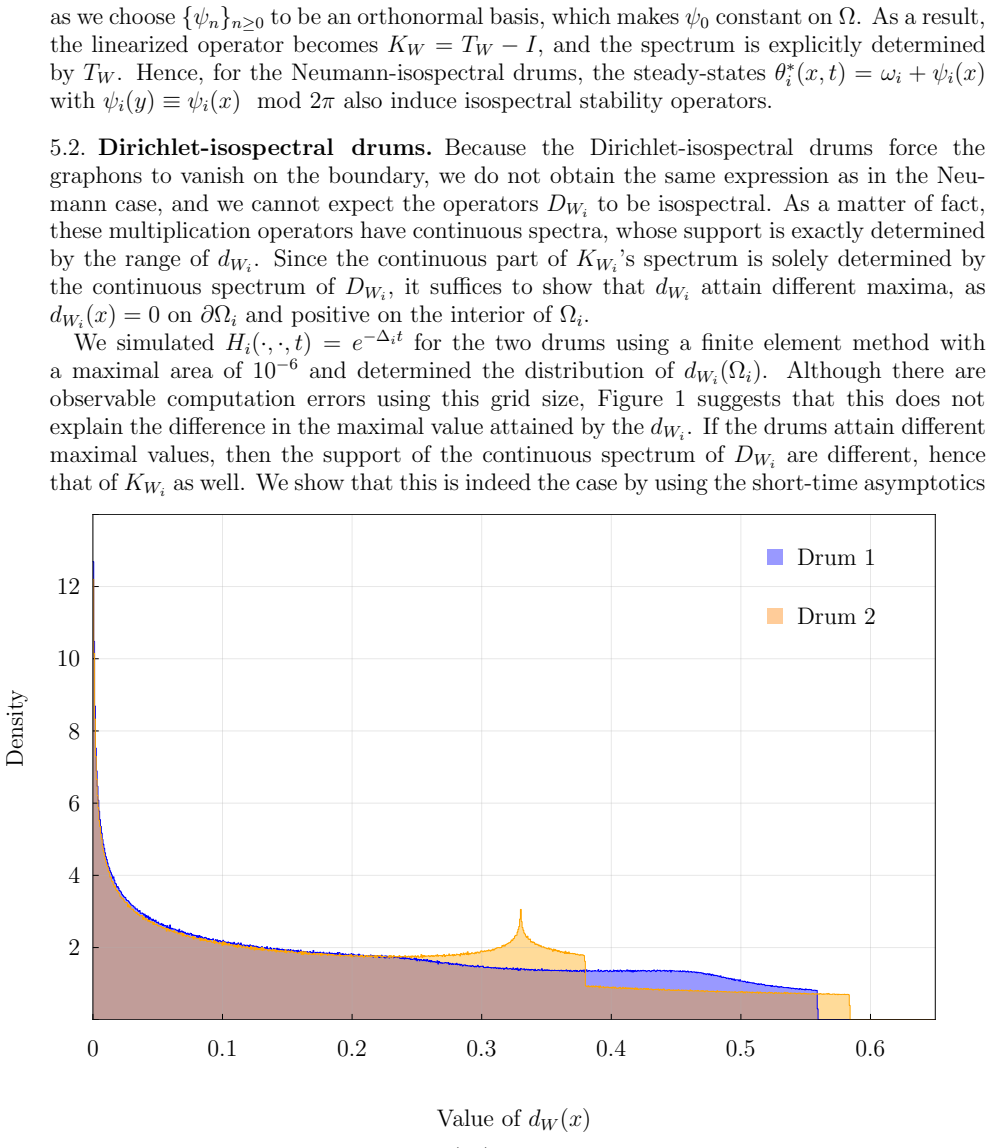
We construct explicit examples of isospectral graphons -- graphons whose integral operators share the same spectrum -- that differ in their underlying geometry. By utilizing the heat kernels of Neumann- and Dirichlet-isospectral drums, we demonstrate that these graphons are not combinatorially equivalent. In the continuum Kuramoto model with graphon-defined interactions, isospectrality implies identical stability properties in certain cases, but this correspondence breaks down when the differing boundary conditions of the Neumann and Dirichlet constructions are considered.
What carries the argument
The heat kernels of Neumann- and Dirichlet-isospectral drums that define the graphon kernels and produce identical spectra for the associated integral operators despite distinct boundary conditions.
If this is right
- Spectral data of the graphon operator does not determine the combinatorial equivalence class of the graphon.
- Geometric structure of the underlying space is not fully recoverable from the spectrum alone.
- Stability thresholds in the continuum Kuramoto model on graphons can depend on boundary conditions even when the spectra coincide.
- Pure graphons simultaneously encode both combinatorial equivalence and geometric information.
Where Pith is reading between the lines
- Inverse problems that aim to recover a graphon from spectral measurements may require additional geometric or combinatorial data to be well-posed.
- The same heat-kernel technique could be applied to other network dynamical systems to test whether spectral equivalence controls long-term behavior beyond the Kuramoto case.
- The separation between spectrum and geometry suggests that graphon-based models of real networks may need auxiliary spatial information to predict collective dynamics reliably.
Load-bearing premise
The heat-kernel constructions from the two families of isospectral drums produce graphons whose integral operators truly share the same spectrum while remaining non-equivalent combinatorially, with the boundary-condition difference alone accounting for any divergence in Kuramoto stability.
What would settle it
A direct computation of the eigenvalues of the integral operators defined by the two heat kernels that reveals any mismatch in the spectrum would falsify the isospectrality claim.
Figures
read the original abstract
In this work, we explore the interplay between graph limit theory, the geometry of underlying probability spaces, spectral theory, and network dynamical systems. We investigate two primary questions concerning forward and inverse perspectives: first, whether a graphon retains information about the geometry of the space on which it is defined, and second, whether spectral properties can distinguish graphons that originate from different geometric spaces. To address these questions, we differentiate between combinatorial equivalence and geometric structure, highlighting how these concepts are captured simultaneously by the class of pure graphons. Furthermore, we construct explicit examples of isospectral graphons -- graphons whose integral operators share the same spectrum -- that differ in their underlying geometry. By utilizing the heat kernels of Neumann- and Dirichlet-isospectral drums, we demonstrate that these graphons are not combinatorially equivalent. Finally, we establish new connections between the geometric aspects of graph limit theory and dynamical systems by analyzing a continuum Kuramoto model with graphon-defined interactions. We demonstrate that while isospectrality implies identical stability properties in certain cases, this correspondence breaks down when the differing boundary conditions of our specific Neumann and Dirichlet constructions are considered.
Editorial analysis
A structured set of objections, weighed in public.
Referee Report
Summary. The manuscript explores forward and inverse perspectives in graphon theory, asking whether graphons retain geometric information from their underlying probability spaces and whether spectral properties can distinguish graphons arising from different geometries. It distinguishes combinatorial equivalence from geometric structure (captured by pure graphons), constructs explicit isospectral graphons via heat kernels of Neumann- and Dirichlet-isospectral drums that are not combinatorially equivalent, and analyzes a continuum Kuramoto model with graphon coupling, claiming that isospectrality implies identical stability in certain cases but that this fails for the Neumann/Dirichlet constructions specifically because of differing boundary conditions.
Significance. If the constructions are rigorously verified and the claimed breakdown in the isospectral-stability link is substantiated, the work would supply concrete counterexamples linking spectral geometry (isospectral drums) to graph limit theory and network dynamics. The explicit use of heat kernels to produce isospectral yet geometrically distinct graphons, together with the Kuramoto analysis, offers a falsifiable bridge between operator spectra and dynamical thresholds that could be useful for researchers studying when spectral data fully determines stability in continuum network models.
major comments (1)
- [Kuramoto model analysis] In the section analyzing the continuum Kuramoto model (the final technical section), the assertion that 'this correspondence breaks down when the differing boundary conditions of our specific Neumann and Dirichlet constructions are considered' is load-bearing for the inverse-perspective claim yet lacks a concrete mechanism. The linearization around the synchronized state is stated to be given by an operator whose eigenvalues are precisely those of the graphon integral operator; since the constructed graphons are isospectral by design, the stability thresholds should coincide. The manuscript does not identify an additional geometric term, modified coupling, or boundary-induced correction in the dynamical equations that would allow the original drum boundary conditions to affect stability without altering the shared spectrum.
minor comments (1)
- [Abstract and §1] The abstract and introduction would benefit from a brief statement of the precise stability threshold (e.g., the critical coupling value or the sign of the largest non-zero eigenvalue) that is claimed to differ between the two constructions.
Simulated Author's Rebuttal
We thank the referee for the careful reading of our manuscript and for identifying the need for greater clarity in the Kuramoto analysis. We address the major comment below and will revise the manuscript accordingly.
read point-by-point responses
-
Referee: In the section analyzing the continuum Kuramoto model (the final technical section), the assertion that 'this correspondence breaks down when the differing boundary conditions of our specific Neumann and Dirichlet constructions are considered' is load-bearing for the inverse-perspective claim yet lacks a concrete mechanism. The linearization around the synchronized state is stated to be given by an operator whose eigenvalues are precisely those of the graphon integral operator; since the constructed graphons are isospectral by design, the stability thresholds should coincide. The manuscript does not identify an additional geometric term, modified coupling, or boundary-induced correction in the dynamical equations that would allow the original drum boundary conditions to affect stability without altering the shared spectrum.
Authors: We agree that the current text does not sufficiently spell out the mechanism, and we will revise the final section to supply it. The graphons are realized as (normalized) heat kernels on the underlying manifolds with boundary. When the continuum Kuramoto equation is written with respect to the Riemannian probability measure on each drum, the linearization around the synchronized state takes the form of the graphon integral operator acting on functions that are required to satisfy the same boundary conditions as the original drum. Although the spectra of the two graphon operators coincide, the domains of these operators (and therefore the admissible perturbations) differ: Neumann functions admit a nonzero normal derivative on the boundary while Dirichlet functions vanish there. This produces a boundary-induced correction in the effective linearized operator that is invisible to the spectrum alone but shifts the stability threshold. In the revision we will insert an explicit derivation of this correction term, together with a short numerical check confirming that the thresholds differ for the concrete Neumann/Dirichlet pair. revision: yes
Circularity Check
No significant circularity detected; derivation relies on external isospectral drum constructions
full rationale
The paper's core construction draws on established Neumann- and Dirichlet-isospectral drums from the literature to define graphons via their heat kernels, then verifies isospectrality of the resulting integral operators and combinatorial inequivalence directly from the boundary condition differences. No step reduces by definition to its own output, no parameters are fitted and relabeled as predictions, and no load-bearing premise depends on a self-citation chain or uniqueness theorem imported from the authors' prior work. The Kuramoto stability analysis follows from the standard linearization around the synchronized state using the graphon operator spectrum, with the claimed breakdown presented as a consequence of the specific geometric constructions rather than an internal redefinition. The overall chain is self-contained against external benchmarks.
Axiom & Free-Parameter Ledger
Lean theorems connected to this paper
-
Foundation.AlexanderDuality (spectral/topological geometry)alexander_duality_circle_linking unclearWe construct explicit examples of isospectral graphons—graphons whose integral operators share the same spectrum—that differ in their underlying geometry. By utilizing the heat kernels of Neumann- and Dirichlet-isospectral drums, we demonstrate that these graphons are not combinatorially equivalent.
-
Cost.FunctionalEquation (J-cost / cosh structure)washburn_uniqueness_aczel unclearthe graphon W_{S^1}(x,y) = 1/2 + 1/8 cos(d_{S^1}(x,y)) + 1/8 cos(2 d_{S^1}(x,y)) ... has nonzero spectrum {1/2, 1/16}
Reference graph
Works this paper leans on
- [1]
-
[2]
Battiston, G
F. Battiston, G. Cencetti, I. Iacopini, V. Latora, M. Lucas, A. Patania, J.-G. Young, and G. Petri, Networks beyond pairwise interactions: Structure and dynamics, Physics Reports874(2020), 1–92
2020
-
[3]
Berner, T
R. Berner, T. Gross, C. Kuehn, J. Kurths, and S. Yanchuk,Adaptive dynamical networks, Physics Reports1031(2023), 1–59
2023
-
[4]
Bick and D
C. Bick and D. Sclosa,Dynamical systems on graph limits and their symmetries, Journal of Dynamics and Differential Equations37(2025), no. 2, 1171–1206
2025
-
[5]
Borgs, J
C. Borgs, J. Chayes, and L. Lov´ asz,Moments of two-variable functions and the uniqueness of graph limits, Geometric and Functional Analysis19(2010), no. 6, 1597–1619
2010
-
[6]
Borgs, J
C. Borgs, J. T. Chayes, L. Lov´ asz, V. T. S´ os, and K. Vesztergombi,Convergent sequences of dense graphs I: Subgraph frequencies, metric properties and testing, Advances in Mathematics219(2008), no. 6, 1801–1851
2008
-
[7]
Bramburger and M
J. Bramburger and M. Holzer,Pattern formation in random networks using graphons, SIAM Journal on Mathematical Analysis55(2023), no. 3, 2150–2185
2023
-
[8]
Chiba and G
H. Chiba and G. Medvedev,The mean field analysis for the Kuramoto model on graphs I. the mean field equation and transition point formulas, Discrete and Continuous Dynamical Systems - Series A39 (2019), no. 1, 131–155
2019
-
[9]
Chiba, G
H. Chiba, G. Medvedev, and M. S. Mizuhara,Bifurcations in the Kuramoto model on graphs, Chaos: An Interdisciplinary Journal of Nonlinear Science28(2018), no. 7, 073109
2018
-
[10]
E. Cho, S. A. Myers, and J. Leskovec,Friendship and mobility: User movement in location-based social networks, Proc. 17th ACM SIGKDD Int. Conf. on Knowledge Discovery and Data Mining (2011), 1082–1090
2011
-
[11]
Courant and D
R. Courant and D. Hilbert,Methods of mathematical physics, vol. 2, John Wiley & Sons, 1989. 13
1989
-
[12]
Cucker and S
F. Cucker and S. Smale,Emergent behavior in flocks, IEEE Transactions on Automatic Control52 (2007), no. 5, 852–862
2007
-
[13]
D¨ uring, J
B. D¨ uring, J. Franceschi, M. T. Wolfram, and M. Zanella,Breaking consensus in kinetic opinion for- mation models on graphons, Journal of Nonlinear Science34(2024), no. 4, 79
2024
- [14]
-
[15]
M. A. Gkogkas, B. J¨ uttner, C. Kuehn, and E. A. Martens,Graphop mean-field limits and synchronization for the stochastic Kuramoto model, Chaos: An Interdisciplinary Journal of Nonlinear Science32(2022), no. 1, 113120
2022
-
[16]
M. A. Gkogkas, C. Kuehn, and C. Xu,Continuum limits for adaptive network dynamics, Communica- tions in Mathematical Sciences21(2023), no. 1, 83–106
2023
-
[17]
,Mean field limits of co-evolutionary signed heterogeneous networks, European Journal of Applied Mathematics (2025), 1–44, (Accepted / To appear)
2025
-
[18]
Gordon, D
C. Gordon, D. L. Webb, and S. Wolpert,One cannot hear the shape of a drum, Bulletin of the American Mathematical Society27(1992), no. 1, 134–138
1992
-
[19]
E. P. Hsu,Stochastic analysis on manifolds, vol. 38, American Mathematical Society, 2002
2002
-
[20]
S. Janson,Graphons, cut norm and distance, couplings and rearrangements, 2010, arXiv preprint arXiv: 1009.2376
-
[21]
Kac,Can one hear the shape of a drum?, The American Mathematical Monthly73(1966), no
M. Kac,Can one hear the shape of a drum?, The American Mathematical Monthly73(1966), no. 4P2, 1–23
1966
-
[22]
Kaliuzhnyi-Verbovetskyi and G
D. Kaliuzhnyi-Verbovetskyi and G. S. Medvedev,The mean field equation for the Kuramoto model on graph sequences with non-Lipschitz limit, SIAM Journal on Mathematical Analysis50(2018), no. 3, 2441–2465
2018
-
[23]
Kuehn,Network dynamics on graphops, New Journal of Physics22(2020), no
C. Kuehn,Network dynamics on graphops, New Journal of Physics22(2020), no. 5, 053030
2020
-
[24]
Kuehn and C
C. Kuehn and C. Pulido,Mean-field limits for stochastic interacting particles via digraph measures, Journal of Differential Equations456(2026), 114054
2026
-
[25]
Kuehn and S
C. Kuehn and S. Throm,Power network dynamics on graphons, SIAM Journal on Applied Mathematics 79(2019), no. 4, 1271–1292
2019
-
[26]
Kuehn and C
C. Kuehn and C. Xu,Vlasov equations on directed hypergraph measures, Partial Differential Equations and Applications6(2025), no. 9, 1–49
2025
-
[27]
Lacker, K
D. Lacker, K. Ramanan, and R. Wu,Local weak convergence for sparse networks of interacting processes, The Annals of Probability33(2023), no. 2, 843–888
2023
-
[28]
Lov´ asz,Large networks and graph limits, vol
L. Lov´ asz,Large networks and graph limits, vol. 60, American Mathematical Society, 2012
2012
-
[29]
Lov´ asz and B
L. Lov´ asz and B. Szegedy,Limits of dense graph sequences, Journal of Combinatorial Theory, Series B 96(2006), no. 6, 933–957
2006
-
[30]
,Regularity partitions and the topology of graphons, An Irregular Mind: Szemer´ edi is 70, Springer, Berlin, Heidelberg, 2010, pp. 415–446
2010
-
[31]
G. S. Medvedev,The nonlinear heat equation on W-random graphs, Archive for Rational Mechanics and Analysis212(2014), no. 3, 781–803
2014
-
[32]
4, 883–898
,The continuum limit of the Kuramoto model on sparse random graphs, Communications in Mathematical Sciences17(2019), no. 4, 883–898
2019
-
[33]
B. Mityagin,The zero set of a real analytic function, 2015, arXiv preprint arXiv:1512.07276
-
[34]
M. E. J. Newman,The structure and function of complex networks, SIAM Review45(2003), 167–256
2003
-
[35]
Qu,Cooperative control of dynamical systems: Applications to autonomous vehicles, Springer, 2009
Z. Qu,Cooperative control of dynamical systems: Applications to autonomous vehicles, Springer, 2009
2009
-
[36]
Romanczuk, M
P. Romanczuk, M. B¨ ar, W. Ebeling, B. Lindner, and L. Schimansky-Geier,Active Brownian particles, The European Physical Journal Special Topics202(2012), no. 1, 1–162
2012
-
[37]
Szegedy,Limits of kernel operators and the spectral regularity lemma, European Journal of Combi- natorics32(2011), no
B. Szegedy,Limits of kernel operators and the spectral regularity lemma, European Journal of Combi- natorics32(2011), no. 7, 1156–1167, Homomorphisms and Limits
2011
-
[38]
S. Throm,Continuum limit for interacting systems on adaptive networks, 2023, arXiv preprint arXiv: 2308.15433
-
[39]
S. R. S. Varadhan,On the behavior of the fundamental solution of the heat equation with variable coefficients, Communications on Pure and Applied Mathematics20(1967), no. 2, 431–455
1967
-
[40]
Vicsek and A
T. Vicsek and A. Zafiris,Collective motion, Physics Reports517(2012), no. 3, 71–140. 14 1ELTE E ¨otv¨os Lor ´and University, Faculty of Science, Institute of Mathematics, Bu- dapest, Hungary 2HUN-REN Alfr´ed R´enyi Institute of Mathematics, Budapest, Hungary 3Munich Data Science Institute, Garching b. M ¨unchen, Germany 4Technical University of Munich, Sc...
2012
discussion (0)
Sign in with ORCID, Apple, or X to comment. Anyone can read and Pith papers without signing in.