Recognition: 3 theorem links
· Lean TheoremHyp2Former: Hierarchy-Aware Hyperbolic Embeddings for Open-Set Panoptic Segmentation
Pith reviewed 2026-05-08 18:44 UTC · model grok-4.3
The pith
Hyperbolic embeddings of known category hierarchies place unknown objects near parent concepts for reliable open-set detection.
A machine-rendered reading of the paper's core claim, the machinery that carries it, and where it could break.
Core claim
Hyp2Former learns an end-to-end hyperbolic embedding space in which known categories are positioned so that semantic parent-child relations are preserved at multiple levels of abstraction. Unknown objects, never seen in training, nevertheless lie closer to the appropriate higher-level concepts than to unrelated ones, allowing them to be segmented as separate instances without any auxiliary unknown modeling.
What carries the argument
Hierarchy-aware hyperbolic embeddings that encode multi-level semantic similarities among known categories so that proximity to parent concepts serves as the detection signal for unknowns.
If this is right
- Unknown objects can be segmented as distinct instances solely from their distance to higher-level concepts without retraining or outlier modeling.
- The same embedding space supports both closed-set accuracy on known classes and open-set discovery on novel ones.
- Hierarchical structure reduces confusion between semantically distant categories when unknowns appear.
Where Pith is reading between the lines
- The method could be tested on datasets with explicit multi-level taxonomies to measure how depth of hierarchy affects unknown placement.
- If hyperbolic geometry is replaced by Euclidean space while keeping the hierarchy loss, performance would likely degrade because flat distances do not naturally respect parent-child nesting.
- The approach suggests that any open-set task with implicit category structure might benefit from embedding unknowns relative to learned abstractions rather than treating them as pure outliers.
Load-bearing premise
The hierarchy learned only from known classes will automatically locate unseen objects near their correct higher-level parents in the embedding space.
What would settle it
Measure embedding distances: if a large fraction of held-out unknown objects lie farther from their semantic parents than from unrelated known classes, the detection mechanism fails.
Figures




read the original abstract
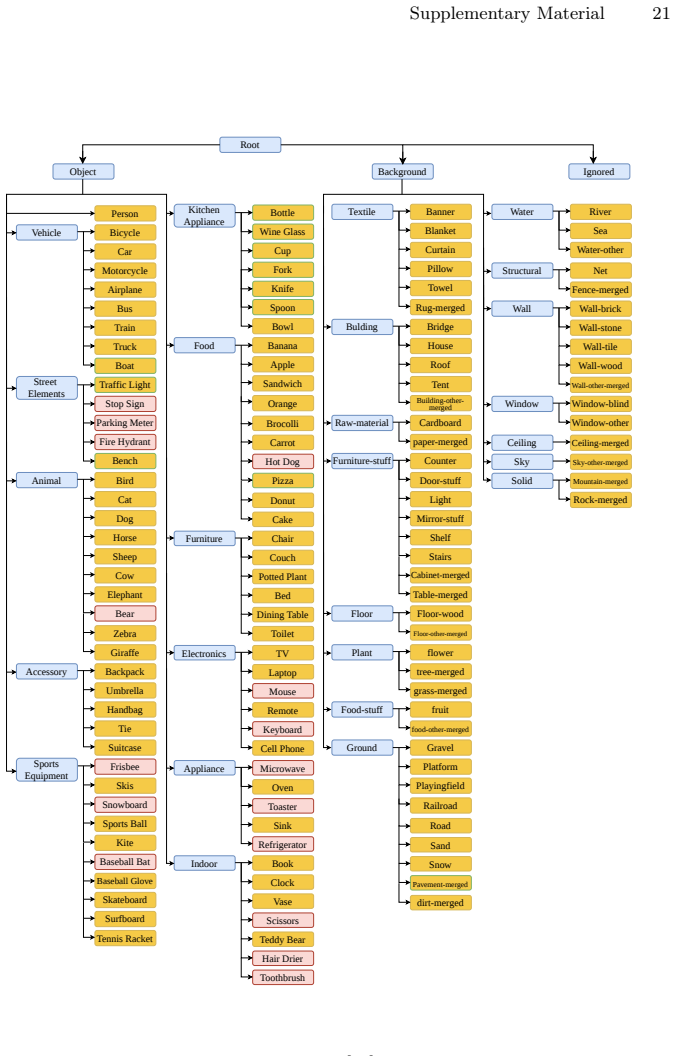
Recognizing unknown objects is crucial for safety-critical applications such as autonomous driving and robotics. Open-Set Panoptic Segmentation (OPS) aims to segment known thing and stuff classes while identifying valid unknown objects as separate instances. Prior OPS approaches largely treat known categories as a flat label set, ignoring the semantic hierarchy that provides valuable structural priors for distinguishing unknown objects from in-distribution classes. In this work, we propose Hyp2Former, an end-to-end framework for OPS that does not require explicit modeling of unknowns during training, and instead learns hierarchical semantic similarities continuously in hyperbolic space. By explicitly encoding hierarchical relationships among known categories, the model learns a structured embedding space that captures multiple levels of semantic abstraction. As a result, unknown objects that cannot be confidently classified as known categories still remain in close proximity to higher-level concepts (e.g., an unknown animal remains closer to "animal" or "object" than to unrelated concepts such as "electronics" or "stuff") and can therefore be reliably detected, even if their fine-grained category was not represented during training. Empirical evaluations across multiple public datasets such as MS COCO, Cityscapes, and Lost&Found demonstrate that Hyp2Former outperforms existing methods on OPS, achieving the best balance between unknown object discovery and in-distribution robustness.
Editorial analysis
A structured set of objections, weighed in public.
Referee Report
Summary. The paper proposes Hyp2Former, an end-to-end framework for open-set panoptic segmentation (OPS) that embeds known thing/stuff categories into hyperbolic space to explicitly encode their semantic hierarchy. Training uses only known-category supervision with hierarchy-aware losses; at inference, unknowns are detected as instances whose embeddings lie closer to higher-level parent concepts than to unrelated known leaves. The authors claim this yields the best trade-off between unknown discovery and in-distribution robustness on MS COCO, Cityscapes, and Lost&Found.
Significance. If the central generalization claim holds, the work offers a principled alternative to outlier-exposure or generative open-set methods by exploiting the tree structure already present in semantic taxonomies. Hyperbolic geometry is a natural fit for hierarchies, and an end-to-end panoptic architecture that avoids explicit unknown modeling during training would be a useful contribution to safety-critical segmentation.
major comments (3)
- [§3.2] §3.2 (Hyperbolic Hierarchy Loss): The loss is defined exclusively over pairs of known categories and their ancestors; no term, regularizer, or architectural constraint pulls embeddings of out-of-distribution visual features toward the appropriate higher-level nodes. Consequently the detection rule (proximity to parents) rests on an unverified inductive bias rather than an enforced property.
- [§4] §4 (Experiments): No ablation isolates the contribution of the hyperbolic hierarchy loss versus a Euclidean baseline with the same hierarchy loss; no embedding-distance statistics or t-SNE-style visualizations are provided to confirm that unknown instances land nearer to their putative parents than to unrelated concepts. Without these, the central claim cannot be verified from the reported numbers alone.
- [§4.3] §4.3 (Lost&Found results): The reported gains in unknown recall are presented without error bars across multiple random seeds or statistical significance tests against the strongest baseline, making it impossible to judge whether the improvement is robust or within the variance of the training protocol.
minor comments (2)
- The notation for the hyperbolic operations (exp, log, Möbius addition) is introduced without a short self-contained recap or reference to a standard reference such as Nickel & Kiela (2017), which would aid readers unfamiliar with the manifold.
- Figure 3 caption should explicitly state the distance metric used to color the unknown points (e.g., hyperbolic distance to the nearest ancestor).
Simulated Author's Rebuttal
Thank you for your detailed review and valuable suggestions. We appreciate the opportunity to clarify the design choices and strengthen the experimental validation of Hyp2Former. Below we respond to each major comment.
read point-by-point responses
-
Referee: [§3.2] §3.2 (Hyperbolic Hierarchy Loss): The loss is defined exclusively over pairs of known categories and their ancestors; no term, regularizer, or architectural constraint pulls embeddings of out-of-distribution visual features toward the appropriate higher-level nodes. Consequently the detection rule (proximity to parents) rests on an unverified inductive bias rather than an enforced property.
Authors: We acknowledge that the hierarchy loss is applied only to known categories during training. The design relies on the properties of hyperbolic space, where the learned hierarchical structure among known classes creates an embedding geometry in which out-of-distribution features, not matching any specific leaf, are positioned closer to higher-level parent nodes. This follows from the tree-like embedding properties of hyperbolic geometry. We will revise §3.2 to provide a more detailed explanation of this inductive bias and its role in OOD detection. revision: partial
-
Referee: [§4] §4 (Experiments): No ablation isolates the contribution of the hyperbolic hierarchy loss versus a Euclidean baseline with the same hierarchy loss; no embedding-distance statistics or t-SNE-style visualizations are provided to confirm that unknown instances land nearer to their putative parents than to unrelated concepts. Without these, the central claim cannot be verified from the reported numbers alone.
Authors: We agree that these additional analyses would help verify the central claim. In the revised manuscript, we will add an ablation study comparing Hyp2Former with a Euclidean variant using the same hierarchy loss. We will also include visualizations of the embeddings (such as projections in the Poincaré disk) and quantitative distance statistics demonstrating that unknown instances are closer to their semantic parents than to unrelated known categories. revision: yes
-
Referee: [§4.3] §4.3 (Lost&Found results): The reported gains in unknown recall are presented without error bars across multiple random seeds or statistical significance tests against the strongest baseline, making it impossible to judge whether the improvement is robust or within the variance of the training protocol.
Authors: To address this, we will perform additional experiments with multiple random seeds and report the mean and standard deviation for the metrics on the Lost&Found dataset. We will also include statistical significance testing against the baselines to confirm the robustness of the observed improvements. revision: yes
Circularity Check
No significant circularity; claims rest on generalization in hyperbolic space
full rationale
The paper's core argument is that encoding known-category hierarchies in hyperbolic embeddings causes unknown objects to land near higher-level concepts for detection. This is presented as a consequence of the learned structured space rather than any definitional equivalence or fitted parameter renamed as prediction. No equations, self-citations, or ansatzes are quoted that reduce the unknown-proximity claim to the training inputs by construction. The approach relies on inductive biases of hyperbolic geometry and out-of-distribution generalization, which are external to the derivation and not tautological.
Axiom & Free-Parameter Ledger
axioms (1)
- domain assumption Hyperbolic space can represent hierarchical semantic relationships among object categories more effectively than Euclidean space.
Lean theorems connected to this paper
-
IndisputableMonolith/Cost (CostAlphaLog, cosh-based cost); Foundation/AlphaCoordinateFixationcostAlphaLog_fourth_deriv_at_zero echoes?
echoesECHOES: this paper passage has the same mathematical shape or conceptual pattern as the Recognition theorem, but is not a direct formal dependency.
we adopt the Lorentz model... defined through the Lorentzian inner product ⟨x,y⟩_L = −x_time y_time + ⟨x_space, y_space⟩_E... d_L(x,y) = (1/√c) cosh⁻¹(−c⟨x,y⟩_L)
-
Foundation (parameter-free forcing chain)reality_from_one_distinction contradicts?
contradictsCONTRADICTS: the theorem conflicts with this paper passage, or marks a claim that would need revision before publication.
we use the hyperbolic curvature c=0.1... α_leaf=5, α_anc=2.5 and δ=0.5 for margin. The loss weight is set to λ=0.5
What do these tags mean?
- matches
- The paper's claim is directly supported by a theorem in the formal canon.
- supports
- The theorem supports part of the paper's argument, but the paper may add assumptions or extra steps.
- extends
- The paper goes beyond the formal theorem; the theorem is a base layer rather than the whole result.
- uses
- The paper appears to rely on the theorem as machinery.
- contradicts
- The paper's claim conflicts with a theorem or certificate in the canon.
- unclear
- Pith found a possible connection, but the passage is too broad, indirect, or ambiguous to say the theorem truly supports the claim.
Reference graph
Works this paper leans on
-
[1]
In: Proceedings of the IEEE/CVF conference on computer vision and pattern recognition
Atigh, M.G., Schoep, J., Acar, E., Van Noord, N., Mettes, P.: Hyperbolic image segmentation. In: Proceedings of the IEEE/CVF conference on computer vision and pattern recognition. pp. 4453–4462 (2022)
2022
-
[2]
In: Proceedings of the IEEE conference on computer vision and pattern recognition
Bendale, A., Boult, T.E.: Towards open set deep networks. In: Proceedings of the IEEE conference on computer vision and pattern recognition. pp. 1563–1572 (2016)
2016
-
[3]
Flavors of geometry31(59-115), 2 (1997)
Cannon, J.W., Floyd, W.J., Kenyon, R., Parry, W.R., et al.: Hyperbolic geometry. Flavors of geometry31(59-115), 2 (1997)
1997
-
[4]
SAM 3: Segment Anything with Concepts
Carion, N., Gustafson, L., Hu, Y.T., Debnath, S., Hu, R., Suris, D., Ryali, C., Alwala,K.V.,Khedr,H.,Huang,A.,etal.:Sam3:Segmentanythingwithconcepts. arXiv preprint arXiv:2511.16719 (2025)
work page Pith review arXiv 2025
-
[5]
In: Proceedings of the IEEE/CVF conference on computer vision and pattern recognition
Cheng, B., Collins, M.D., Zhu, Y., Liu, T., Huang, T.S., Adam, H., Chen, L.C.: Panoptic-deeplab: A simple, strong, and fast baseline for bottom-up panoptic seg- mentation. In: Proceedings of the IEEE/CVF conference on computer vision and pattern recognition. pp. 12475–12485 (2020)
2020
-
[6]
In: Proceedings of the IEEE/CVF conference on computer vision and pattern recognition
Cheng, B., Misra, I., Schwing, A.G., Kirillov, A., Girdhar, R.: Masked-attention mask transformer for universal image segmentation. In: Proceedings of the IEEE/CVF conference on computer vision and pattern recognition. pp. 1290–1299 (2022)
2022
-
[7]
Advances in neural information processing systems34, 17864–17875 (2021)
Cheng, B., Schwing, A., Kirillov, A.: Per-pixel classification is not all you need for semantic segmentation. Advances in neural information processing systems34, 17864–17875 (2021)
2021
-
[8]
IEEE Transactions on Pattern Analysis and Machine Intelligence (2026)
Conti, A., Fini, E., Mancini, M., Rota, P., Wang, Y., Ricci, E.: Vocabulary-free image classification and semantic segmentation. IEEE Transactions on Pattern Analysis and Machine Intelligence (2026)
2026
-
[9]
In: Proceedings of the IEEE conference on computer vision and pattern recognition
Cordts, M., Omran, M., Ramos, S., Rehfeld, T., Enzweiler, M., Benenson, R., Franke, U., Roth, S., Schiele, B.: The cityscapes dataset for semantic urban scene understanding. In: Proceedings of the IEEE conference on computer vision and pattern recognition. pp. 3213–3223 (2016)
2016
-
[10]
In: International Conference on Machine Learning
Desai, K., Nickel, M., Rajpurohit, T., Johnson, J., Vedantam, S.R.: Hyperbolic image-text representations. In: International Conference on Machine Learning. pp. 7694–7731 (2023)
2023
-
[11]
In: Proceedings of the AAAI Conference on Artificial Intelligence
Doan, T., Li, X., Behpour, S., He, W., Gou, L., Ren, L.: Hyp-ow: Exploiting hierar- chical structure learning with hyperbolic distance enhances open world object de- tection. In: Proceedings of the AAAI Conference on Artificial Intelligence. vol. 38, pp. 1555–1563 (2024)
2024
-
[12]
In: Proceed- ings of the IEEE/CVF Conference on Computer Vision and Pattern Recognition (CVPR)
Ermolov, A., Mirvakhabova, L., Khrulkov, V., Sebe, N., Oseledets, I.: Hyperbolic vision transformers: Combining improvements in metric learning. In: Proceed- ings of the IEEE/CVF Conference on Computer Vision and Pattern Recognition (CVPR). pp. 7409–7419 (2022)
2022
-
[13]
Ester, M., Kriegel, H.P., Sander, J., Xu, X., et al.: A density-based algorithm for discovering clusters in large spatial databases with noise. In: kdd. vol. 96, pp. 226–231 (1996) 16 Y. Lu et al
1996
-
[14]
Advances in neural information processing systems31(2018)
Ganea, O., Bécigneul, G., Hofmann, T.: Hyperbolic neural networks. Advances in neural information processing systems31(2018)
2018
-
[15]
In: Proceedings of the IEEE/CVF international conference on computer vision
Gasperini, S., Marcos-Ramiro, A., Schmidt, M., Navab, N., Busam, B., Tombari, F.: Segmenting known objects and unseen unknowns without prior knowledge. In: Proceedings of the IEEE/CVF international conference on computer vision. pp. 19321–19332 (2023)
2023
-
[16]
In: Proceedings of the IEEE/CVF conference on computer vision and pattern recognition
Ge, S., Mishra, S., Kornblith, S., Li, C.L., Jacobs, D.: Hyperbolic contrastive learn- ing for visual representations beyond objects. In: Proceedings of the IEEE/CVF conference on computer vision and pattern recognition. pp. 6840–6849 (2023)
2023
-
[17]
In: Proceedings of the IEEE/CVF Conference on Computer Vision and Pattern Recognition
Grcić, M., Šarić, J., Šegvić, S.: On advantages of mask-level recognition for outlier- aware segmentation. In: Proceedings of the IEEE/CVF Conference on Computer Vision and Pattern Recognition. pp. 2937–2947 (2023)
2023
-
[18]
He,K.,Zhang,X.,Ren,S.,Sun,J.:Deepresiduallearningforimagerecognition.In: Proceedings of the IEEE conference on computer vision and pattern recognition. pp. 770–778 (2016)
2016
-
[19]
IEEE Robotics and Automation Letters10(2), 1904–1911 (2024)
Hindel, J., Cattaneo, D., Valada, A.: Taxonomy-aware continual semantic seg- mentation in hyperbolic spaces for open-world perception. IEEE Robotics and Automation Letters10(2), 1904–1911 (2024)
1904
-
[20]
In: International Workshop on Applications of Medical AI
Hindel, J., Mekic, E., Enamundram, N.K., Mohan, R., Cattaneo, D., Kalweit, M., Valada, A.: Dynamic robot-assisted surgery with hierarchical class-incremental semantic segmentation. In: International Workshop on Applications of Medical AI. pp. 246–257 (2025)
2025
-
[21]
In: 2025 IEEE/RSJ International Conference on Intelligent Robots and Systems (IROS)
Hindel, J., Mohan, R., Bratulić, J., Cattaneo, D., Brox, T., Valada, A.: Label- efficient lidar semantic segmentation with 2d-3d vision transformer adapters. In: 2025 IEEE/RSJ International Conference on Intelligent Robots and Systems (IROS). pp. 4115–4122. IEEE (2025)
2025
-
[22]
IEEE Robotics and Automation Letters (2026)
Hurtado, J.V., Mohan, R., Valada, A.: Hyperspectral adapter for semantic seg- mentation with vision foundation models. IEEE Robotics and Automation Letters (2026)
2026
-
[23]
In: Proceedings of the IEEE/CVF Conference on Computer Vision and Pattern Recognition
Hwang, J., Oh, S.W., Lee, J.Y., Han, B.: Exemplar-based open-set panoptic seg- mentation network. In: Proceedings of the IEEE/CVF Conference on Computer Vision and Pattern Recognition. pp. 1175–1184 (2021)
2021
-
[24]
In: IEEE International conference on robotics and automation (ICRA)
Käppeler, M., Petek, K., Vödisch, N., Burgard, W., Valada, A.: Few-shot panop- tic segmentation with foundation models. In: IEEE International conference on robotics and automation (ICRA). pp. 7718–7724 (2024)
2024
-
[25]
Khrulkov, V., Mirvakhabova, L., Ustinova, E., Oseledets, I., Lempitsky, V.: Hyper- bolicimageembeddings.In:ProceedingsoftheIEEE/CVFconferenceoncomputer vision and pattern recognition. pp. 6418–6428 (2020)
2020
-
[26]
In: Proceedings of the IEEE/CVF conference on computer vision and pattern recognition
Kim, S., Jeong, B., Kwak, S.: Hier: Metric learning beyond class labels via hier- archical regularization. In: Proceedings of the IEEE/CVF conference on computer vision and pattern recognition. pp. 19903–19912 (2023)
2023
-
[27]
In: Proceedings of the IEEE/CVF Conference on Computer Vision and Pattern Recognition (CVPR)
Kim, S., Kim, D., Cho, M., Kwak, S.: Proxy anchor loss for deep metric learning. In: Proceedings of the IEEE/CVF Conference on Computer Vision and Pattern Recognition (CVPR). pp. 3238–3247 (2020)
2020
-
[28]
In: Proceedings of the IEEE/CVF conference on computer vision and pattern recog- nition
Kirillov,A., Girshick,R., He,K.,Dollár,P.:Panopticfeaturepyramid networks. In: Proceedings of the IEEE/CVF conference on computer vision and pattern recog- nition. pp. 6399–6408 (2019)
2019
-
[29]
In: Proceedings of the IEEE/CVF conference on computer vision and pattern recog- nition
Kirillov, A., He, K., Girshick, R., Rother, C., Dollár, P.: Panoptic segmentation. In: Proceedings of the IEEE/CVF conference on computer vision and pattern recog- nition. pp. 9404–9413 (2019) Hyp2Former 17
2019
-
[30]
In: DAGM German Conference on Pattern Recognition
Lang, C., Braun, A., Schillingmann, L., Valada, A.: On hyperbolic embeddings in object detection. In: DAGM German Conference on Pattern Recognition. pp. 462–476 (2022)
2022
-
[31]
In: International conference on machine learning
Law, M., Liao, R., Snell, J., Zemel, R.: Lorentzian distance learning for hyperbolic representations. In: International conference on machine learning. pp. 3672–3681 (2019)
2019
-
[32]
In: European conference on computer vision
Lin, T.Y., Maire, M., Belongie, S., Hays, J., Perona, P., Ramanan, D., Dollár, P., Zitnick, C.L.: Microsoft coco: Common objects in context. In: European conference on computer vision. pp. 740–755 (2014)
2014
-
[33]
In: International Conference on Learning Representations (2017)
Loshchilov, I., Hutter, F.: Decoupled weight decay regularization. In: International Conference on Learning Representations (2017)
2017
-
[34]
arXiv preprint arXiv:2602.23172 (2026)
Luz, M., Mohan, R., Nürnberg, T., Miron, Y., Cattaneo, D., Valada, A.: La- tent gaussian splatting for 4d panoptic occupancy tracking. arXiv preprint arXiv:2602.23172 (2026)
-
[35]
In: 2024 IEEE International Conference on Robotics and Automation (ICRA)
Luz, M., Mohan, R., Sekkat, A.R., Sawade, O., Matthes, E., Brox, T., Valada, A.: Amodal optical flow. In: 2024 IEEE International Conference on Robotics and Automation (ICRA). pp. 14677–14684. IEEE (2024)
2024
-
[36]
International Journal of Computer Vision132(9), 3484–3508 (2024)
Mettes, P., Ghadimi Atigh, M., Keller-Ressel, M., Gu, J., Yeung, S.: Hyperbolic deep learning in computer vision: A survey. International Journal of Computer Vision132(9), 3484–3508 (2024)
2024
-
[37]
arXiv preprint arXiv:2602.08006 (2026)
Mohan, R., Hurtado, J.V., Mohan, R., Valada, A.: Forecastocc: Vision-based se- mantic occupancy forecasting. arXiv preprint arXiv:2602.08006 (2026)
-
[38]
IEEE Robotics and Automation Letters9(8), 7094–7101 (2024)
Mohan,R.,Arce,J.,Mokhtar,S.,Cattaneo,D.,Valada,A.:Syn-mediverse:amulti- modal synthetic dataset for intelligent scene understanding of healthcare facilities. IEEE Robotics and Automation Letters9(8), 7094–7101 (2024)
2024
-
[39]
arXiv preprint arXiv:2602.19349 (2026)
Mohan, R., Drews, F., Miron, Y., Cattaneo, D., Valada, A.: Up-fuse: Uncertainty- guided lidar-camera fusion for 3d panoptic segmentation. arXiv preprint arXiv:2602.19349 (2026)
-
[40]
In: IEEE/RSJ International Conference on Intelligent Robots and Systems (IROS)
Mohan, R., Hindel, J., Drews, F., Gläser, C., Cattaneo, D., Valada, A.: Open-set lidar panoptic segmentation guided by uncertainty-aware learning. In: IEEE/RSJ International Conference on Intelligent Robots and Systems (IROS). pp. 2224–2231 (2025)
2025
-
[41]
IEEE Robotics and Automation Letters9(5), 4075–4082 (2024)
Mohan, R., Kumaraswamy, K., Hurtado, J.V., Petek, K., Valada, A.: Panoptic out-of-distribution segmentation. IEEE Robotics and Automation Letters9(5), 4075–4082 (2024)
2024
-
[42]
IEEE Robotics and Automation Letters7(4), 9302–9309 (2022)
Mohan, R., Valada, A.: Perceiving the invisible: Proposal-free amodal panoptic segmentation. IEEE Robotics and Automation Letters7(4), 9302–9309 (2022)
2022
-
[43]
In: Proceedings of the IEEE/CVF International Conference on Computer Vision
Nayal, N., Yavuz, M., Henriques, J.F., Güney, F.: Rba: Segmenting unknown re- gions rejected by all. In: Proceedings of the IEEE/CVF International Conference on Computer Vision. pp. 711–722 (2023)
2023
-
[44]
Advances in neural information processing systems30(2017)
Nickel, M., Kiela, D.: Poincaré embeddings for learning hierarchical representa- tions. Advances in neural information processing systems30(2017)
2017
-
[45]
In: IEEE/RSJ In- ternational Conference on Intelligent Robots and Systems (IROS)
Pinggera, P., Ramos, S., Gehrig, S., Franke, U., Rother, C., Mester, R.: Lost and found: detecting small road hazards for self-driving vehicles. In: IEEE/RSJ In- ternational Conference on Intelligent Robots and Systems (IROS). pp. 1099–1106 (2016)
2016
-
[46]
In: International conference on machine learning
Radford, A., Kim, J.W., Hallacy, C., Ramesh, A., Goh, G., Agarwal, S., Sastry, G., Askell, A., Mishkin, P., Clark, J., et al.: Learning transferable visual models from natural language supervision. In: International conference on machine learning. pp. 8748–8763 (2021) 18 Y. Lu et al
2021
-
[47]
IEEE Transactions on Pattern Analysis and Machine Intelligence46(12), 9286–9302 (2024)
Rai, S.N., Cermelli, F., Caputo, B., Masone, C.: Mask2anomaly: Mask transformer for universal open-set segmentation. IEEE Transactions on Pattern Analysis and Machine Intelligence46(12), 9286–9302 (2024)
2024
-
[48]
Pattern Recognition Letters (2025)
Reichard, K., Rizzoli, G., Gasperini, S., Hoyer, L., Zanuttigh, P., Navab, N., Tombari, F.: From open-vocabulary to vocabulary-free semantic segmentation. Pattern Recognition Letters (2025)
2025
-
[49]
In: International conference on machine learning
Sala, F., De Sa, C., Gu, A., Ré, C.: Representation tradeoffs for hyperbolic em- beddings. In: International conference on machine learning. pp. 4460–4469 (2018)
2018
-
[50]
In: International symposium on graph drawing
Sarkar, R.: Low distortion delaunay embedding of trees in hyperbolic plane. In: International symposium on graph drawing. pp. 355–366 (2011)
2011
-
[51]
arXiv preprint arXiv:2504.04841 (2025)
Schmidt, S., Körner, J., Fuchsgruber, D., Gasperini, S., Tombari, F., Günnemann, S.: Prior2former–evidential modeling of mask transformers for assumption-free open-world panoptic segmentation. arXiv preprint arXiv:2504.04841 (2025)
-
[52]
Advances in Neural Information Processing Systems 37, 91220–91259 (2024)
Sinha, A., Zeng, S., Yamada, M., Zhao, H.: Learning structured representations with hyperbolic embeddings. Advances in Neural Information Processing Systems 37, 91220–91259 (2024)
2024
-
[53]
Applied Sciences15(16), 9087 (2025)
Ungur, V., Popa, C.A.: Openmamba: Introducing state space models to open- vocabulary semantic segmentation. Applied Sciences15(16), 9087 (2025)
2025
-
[54]
arXiv preprint arXiv:2303.10147 (2023)
Vödisch, N., Petek, K., Burgard, W., Valada, A.: Codeps: Online continual learning for depth estimation and panoptic segmentation. arXiv preprint arXiv:2303.10147 (2023)
-
[55]
IEEE Robotics and Automation Letters10(1), 216–223 (2024)
Vödisch, N., Petek, K., Käppeler, M., Valada, A., Burgard, W.: A good foundation is worth many labels: Label-efficient panoptic segmentation. IEEE Robotics and Automation Letters10(1), 216–223 (2024)
2024
-
[56]
In: Conference on Robot Learning
Wong, K., Wang, S., Ren, M., Liang, M., Urtasun, R.: Identifying unknown in- stances for autonomous driving. In: Conference on Robot Learning. pp. 384–393 (2020)
2020
-
[57]
In: British Machine Vision Conference (2022)
Xu, H., Chen, H., Liu, L., Yin, Y.: Dual decision improves open-set panoptic seg- mentation. In: British Machine Vision Conference (2022)
2022
-
[58]
In: Proceedings of the AAAI Conference on Artificial Intelligence
Yin, Y., Chen, H., Zhou, W., Deng, J., Xu, H., Li, H.: Revisiting open-set panoptic segmentation. In: Proceedings of the AAAI Conference on Artificial Intelligence. vol. 38, pp. 6747–6754 (2024) Supplementary Material Hyp2Former: Hierarchy-Aware Hyperbolic Embeddings for Open-Set Panoptic Segmentation Yao Lu1, Rohit Mohan1, Florian Drews2, Yakov Miron2, a...
2024
discussion (0)
Sign in with ORCID, Apple, or X to comment. Anyone can read and Pith papers without signing in.