Recognition: 4 theorem links
· Lean TheoremAxial tidal Love numbers of black holes in matter environments
Pith reviewed 2026-05-08 18:19 UTC · model grok-4.3
The pith
Black holes in matter environments have axial tidal Love numbers modified by the surrounding density profile, with non-compact matter producing logarithmic terms that obstruct standard tidal matching.
A machine-rendered reading of the paper's core claim, the machinery that carries it, and where it could break.
Core claim
When a Schwarzschild black hole is surrounded by a spherically symmetric matter distribution, its axial tidal Love numbers are obtained by solving the coupled perturbation equations for gravity and the anisotropic fluid. For density profiles without compact support the perturbation variable develops logarithmic terms at large distances, which obstruct the standard tidal matching procedure because the exterior region is never strictly vacuum.
What carries the argument
The coupled axial gravitational perturbation equations together with the perturbations of the anisotropic fluid, whose asymptotic analysis reveals logarithmic terms whenever the matter distribution lacks compact support.
If this is right
- The resulting Love numbers depend on the specific functional form of the matter density profile.
- Closed-form analytic expressions for the Love numbers are available in the small-compactness limit.
- Numerical integration supplies concrete values for profiles of astrophysical interest.
- The same framework applies to other spherically symmetric environments around black holes.
Where Pith is reading between the lines
- In realistic settings with diffuse matter halos the standard definition of tidal Love numbers may require modification to handle the logarithmic behavior.
- Gravitational-wave signals from black holes embedded in galactic centers or dark-matter distributions could carry signatures of these asymptotic effects.
- Similar obstructions might arise when extending the analysis to polar perturbations or to rotating black holes in matter.
Load-bearing premise
The matter distribution remains spherically symmetric and is adequately modeled as an anisotropic fluid whose perturbations can be consistently coupled to the axial gravitational perturbations without introducing instabilities or invalidating the asymptotic matching procedure.
What would settle it
A numerical or analytic computation of the far-field asymptotic expansion of the perturbation variable for a concrete non-compact density profile, such as a power-law tail, that either confirms or rules out the presence of logarithmic terms.
Figures

read the original abstract
We study the axial (magnetic) tidal Love numbers of a Schwarzschild black hole surrounded by a spherically symmetric matter distribution. While the formalism developed here is general, we specialize to the case of anisotropic fluids as a proxy for dark matter distributions, computing the Love numbers for different density profiles of astrophysical interest. We employ two complementary methods: a small-compactness expansion, yielding closed-form analytic expressions, and direct numerical integration of the perturbation equations. We discuss the connection between different formulations of the fluid perturbations and the resulting Love numbers. We further show that density profiles lacking compact support generically produce logarithmic terms in the asymptotic expansion of the perturbation variable, which obstruct the standard tidal matching procedure and whose origin we trace to the absence of a strictly vacuum exterior. Our findings highlight the importance of controlling the asymptotic structure of the matter distribution when defining tidal observables for black holes dressed by matter, and provide a general framework that can be applied to other spherically symmetric environments.
Editorial analysis
A structured set of objections, weighed in public.
Referee Report
Summary. The manuscript develops a general formalism for axial (magnetic) tidal Love numbers of a Schwarzschild black hole immersed in a spherically symmetric matter distribution, specializing to anisotropic-fluid models as proxies for dark-matter halos. It computes the Love numbers via two complementary approaches—an analytic small-compactness expansion that yields closed-form expressions and direct numerical integration of the linearized perturbation equations—and shows that density profiles lacking compact support generically produce logarithmic terms in the asymptotic expansion of the axial perturbation variable. These logs obstruct the standard tidal matching procedure and are traced to the absence of a strictly vacuum exterior region.
Significance. If the central results hold, the work is significant because it supplies a concrete, general framework for tidal observables in non-vacuum environments that are astrophysically relevant (e.g., black holes with extended dark-matter distributions). The explicit demonstration that non-compact-support matter produces logarithmic obstructions, together with the dual analytic/numeric methods that allow cross-checks, provides a reusable template for other spherically symmetric backgrounds. The paper also clarifies the relation between alternative fluid-perturbation formulations and the extracted Love numbers.
major comments (2)
- [§3.2] §3.2 (small-compactness expansion): the closed-form Love-number expressions are derived under the assumption that the exterior is asymptotically vacuum; when the density profile has power-law tails, the same expansion produces an explicit logarithmic term in the solution for the perturbation variable (see Eq. (27) and the subsequent matching). It is not immediately clear whether the authors propose a modified matching procedure or simply conclude that the standard Love number is ill-defined; a concrete prescription for the non-compact case would strengthen the central claim.
- [§4] §4 (numerical integration): the boundary conditions imposed at large but finite radius for the numerical solutions are stated to reproduce the analytic small-compactness results, yet the paper does not quantify the truncation error introduced by cutting off the density tail at a finite radius. A convergence test with increasing cutoff radius would directly test whether the logarithmic obstruction persists in the numerical data.
minor comments (3)
- [Introduction / §2] The abstract and introduction refer to “different density profiles of astrophysical interest” without listing them explicitly; a short table or enumerated list in §2 would improve readability.
- [§3] Notation for the axial perturbation variable (often denoted H or Z) is introduced in §3 but used inconsistently with the fluid-perturbation variables in §3.1; a single glossary or consistent symbol table would help.
- [References] Several references to prior work on tidal Love numbers in vacuum (e.g., the original Regge-Wheeler and Zerilli papers) are cited only by author name; full bibliographic details should be supplied.
Simulated Author's Rebuttal
We thank the referee for the positive assessment and constructive comments. We address each major point below and outline the revisions we will make.
read point-by-point responses
-
Referee: [§3.2] §3.2 (small-compactness expansion): the closed-form Love-number expressions are derived under the assumption that the exterior is asymptotically vacuum; when the density profile has power-law tails, the same expansion produces an explicit logarithmic term in the solution for the perturbation variable (see Eq. (27) and the subsequent matching). It is not immediately clear whether the authors propose a modified matching procedure or simply conclude that the standard Love number is ill-defined; a concrete prescription for the non-compact case would strengthen the central claim.
Authors: We thank the referee for this observation. In §3.2 the small-compactness expansion is performed on the background metric that approaches Schwarzschild only when the density has compact support; for power-law tails the perturbation equation yields an explicit logarithmic term at large r. We conclude that the standard vacuum tidal matching (and thus the conventional Love number) is ill-defined in such cases, precisely because there is no strictly vacuum exterior. The manuscript does not introduce a modified matching scheme, as its central claim is the identification and origin of this obstruction. We will revise the text to state this conclusion more explicitly and add a short paragraph noting possible directions for future work (e.g., regularization or finite-radius matching), without claiming to provide a complete prescription. revision: partial
-
Referee: [§4] §4 (numerical integration): the boundary conditions imposed at large but finite radius for the numerical solutions are stated to reproduce the analytic small-compactness results, yet the paper does not quantify the truncation error introduced by cutting off the density tail at a finite radius. A convergence test with increasing cutoff radius would directly test whether the logarithmic obstruction persists in the numerical data.
Authors: We agree that a quantitative convergence test would strengthen the numerical section. The cutoff radius used in the present calculations is chosen sufficiently large that the solutions reproduce the analytic small-compactness results wherever the latter are valid. In the revised manuscript we will include an explicit convergence study in which the cutoff radius is systematically increased, demonstrating that the logarithmic terms remain and that the extracted quantities stabilize, thereby confirming that the obstruction is not an artifact of the finite cutoff. revision: yes
Circularity Check
No significant circularity; derivation follows directly from perturbation equations
full rationale
The paper computes axial tidal Love numbers by integrating the linearized Einstein equations with anisotropic fluid perturbations on a spherically symmetric background, using both small-compactness analytic expansions and numerical solutions. The key result—that non-compact-support density profiles produce logarithmic terms obstructing standard tidal matching—is obtained by direct inspection of the asymptotic form of the perturbation variable, which follows from the modified background metric and potential at large r. No fitted parameters are renamed as predictions, no self-definitional loops appear in the Love-number extraction, and the formalism does not rely on load-bearing self-citations or imported uniqueness theorems. The derivation is self-contained against the Einstein-fluid system and standard asymptotic matching.
Axiom & Free-Parameter Ledger
axioms (2)
- domain assumption The background spacetime is a Schwarzschild black hole plus a static, spherically symmetric anisotropic fluid distribution.
- standard math Axial perturbations can be consistently decoupled and solved independently of polar modes.
Lean theorems connected to this paper
-
Foundation/AlphaCoordinateFixation.lean, Cost/FunctionalEquation.leanNo parallel: paper uses perturbative expansion in M/a₀ rather than RS's ratio-symmetric J-cost or φ-ladder. unclearWe employ two complementary methods: a small-compactness expansion, yielding closed-form analytic expressions, and direct numerical integration of the perturbation equations.
-
N/ANo RS theorem speaks to ACMC matching of axial perturbations on non-vacuum exteriors. uncleardensity profiles lacking compact support generically produce logarithmic terms in the asymptotic expansion of the perturbation variable, which obstruct the standard tidal matching procedure
-
Foundation/AlphaDerivationExplicit.leanPaper has free astrophysical parameters; RS chain is parameter-free. No conflict, just different scope. unclear˜k^B_2 = 4(ℓ+2)(2ℓ−1)!!/(ℓ−1) · σ_ℓ / L_scale^{2ℓ+1} ... varying M ∈ [1,10^4] M_BH ... a_0 = 10^6 M_BH
Reference graph
Works this paper leans on
-
[1]
(50) can be solved using a Green’s function approach
Hernquist profile The mass function of the Hernquist profile takes a par- ticularly simple analytic form: m(r) =M BH +M r−2M BH r+a 0 2 .(49) The first-order axial perturbation obeys the inhomoge- neous equation h(1) 0 ′′ − 1 r2 6 + 8MBH r−2M BH h(1) 0 =S,(50) where the source term is S=− H20 3 a0r(4r2 −6M BHr+ 5a 0r−8a 0MBH) (r+a 0)3 .(51) Eq. (50) can b...
-
[2]
Imposing m(rc) =M+M BH, the mass function can be obtained analytically from the background field Eq
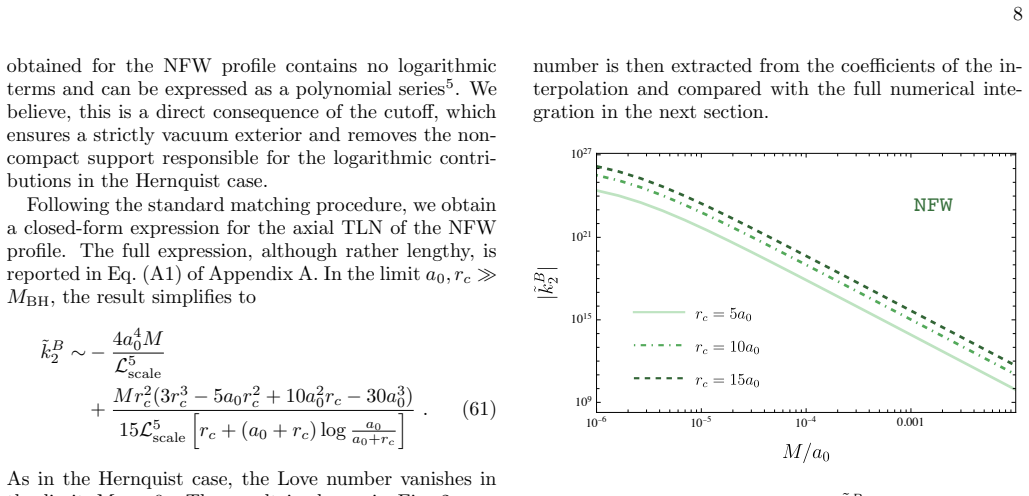
NFW profile The mass function of the NFW distribution diverges logarithmically at infinity, requiring the introduction of a cutoff radiusr c to render the total mass finite. Imposing m(rc) =M+M BH, the mass function can be obtained analytically from the background field Eq. (16): m(r) = M+M BH + M r+a 0 (r+a 0)(a0 +r c) log r+a0 a0+rc −(a ...
-
[3]
The source term of Eq
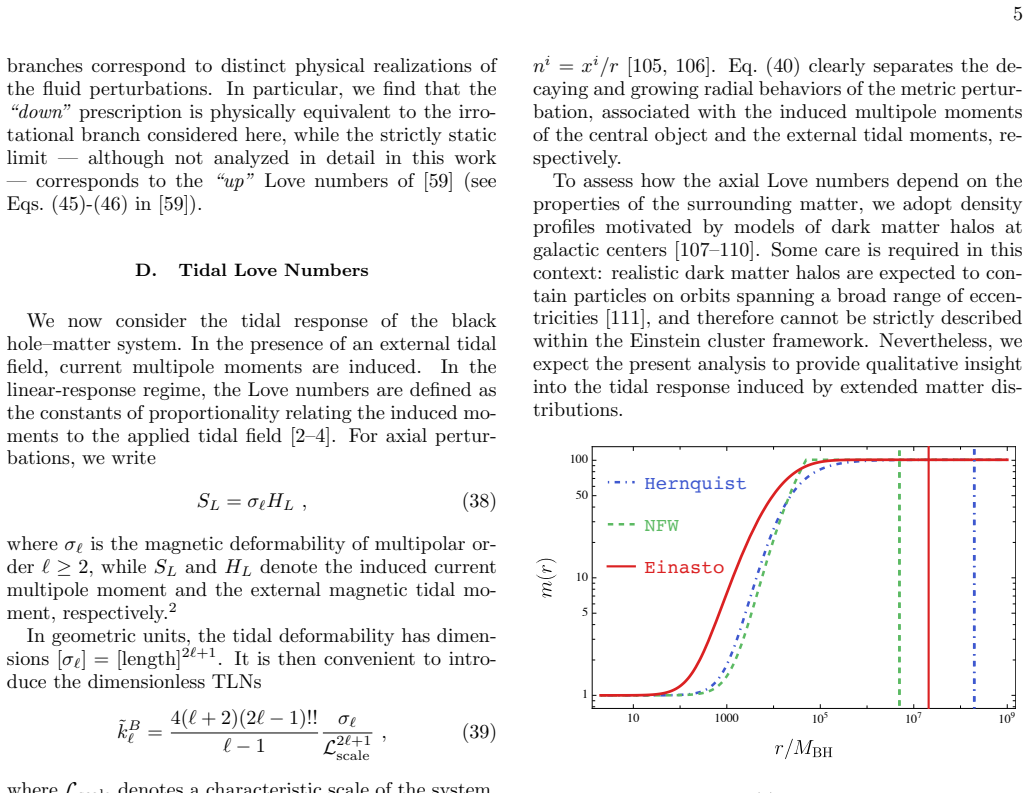
Einasto profile For the Einasto profile, the mass function takes the analytic form m(r) =M+M BH + M r2 8M3 BH × 2MBHE1−2n d( r a0 ) 1 n −rE1−3n d( r a0 ) 1 n E1−3n d 2MBH a0 1 n −E1−2n d 2MBH a0 1 n , (62) whereE n(x) denotes the exponential integral function. The source term of Eq. (50) for the Einasto profile is considerably more involved than i...
-
[4]
The large magnitude reflects the extended and weakly bound nature of the matter dis- tribution
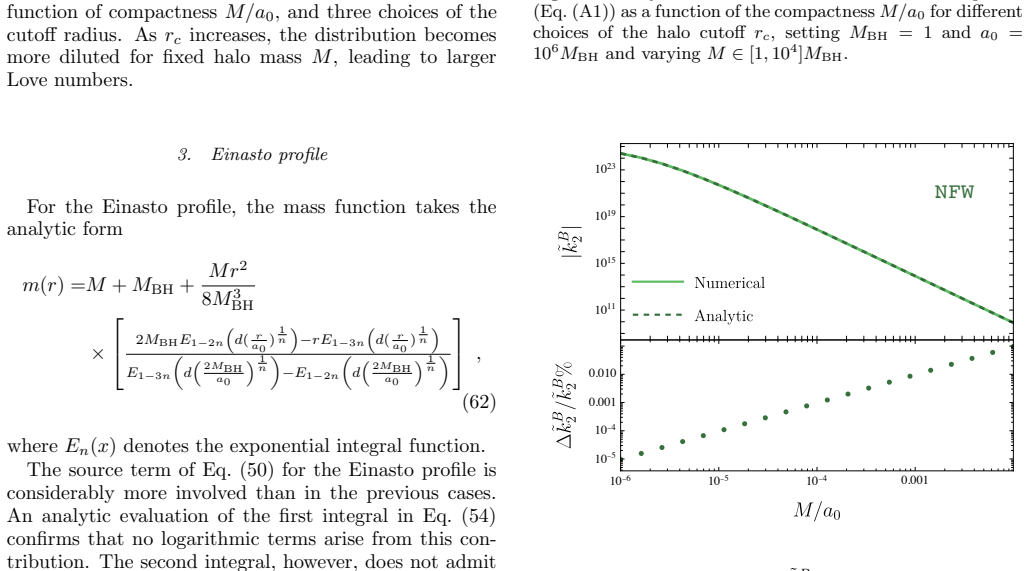
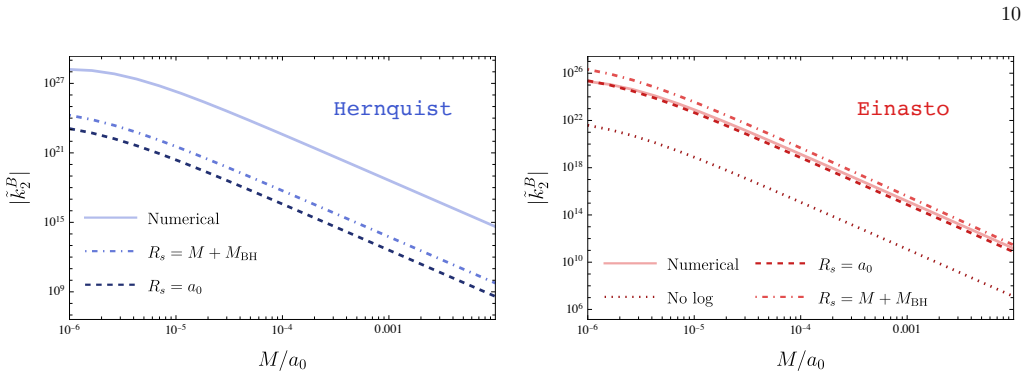
and for exotic compact objects [42, 45], though the un- derlying mechanisms differ. The large magnitude reflects the extended and weakly bound nature of the matter dis- tribution. We first discuss the NFW profile. Figure 3 shows the configuration withr c = 5a0. The analytical and numeri- cal results are in excellent agreement, with discrepancies increasin...
-
[5]
Small compactness expansion: cutoff prescription The disagreement between the results of the small- compactness expansion and the numerical integration for the Hernquist and Einasto profiles points to an intrinsic difference between models with a sharp cutoff, beyond which the spacetime is strictly vacuum, and models with non-compact asymptotic tails. Thi...
-
[6]
E. E. Flanagan and T. Hinderer, Phys. Rev. D77, 021502 (2008), arXiv:0709.1915 [astro-ph]
work page Pith review arXiv 2008
-
[7]
T. Damour and A. Nagar, Phys. Rev. D80, 084035 (2009), arXiv:0906.0096 [gr-qc]
-
[8]
T. Binnington and E. Poisson, Phys. Rev. D80, 084018 (2009), arXiv:0906.1366 [gr-qc]
-
[9]
Tidal Love numbers of neutron stars
T. Hinderer, Astrophys. J.677, 1216 (2008), [Erratum: Astrophys.J. 697, 964 (2009)], arXiv:0711.2420 [astro- ph]
work page Pith review arXiv 2008
-
[10]
T. Hinderer, B. D. Lackey, R. N. Lang, and J. S. Read, Phys. Rev. D81, 123016 (2010), arXiv:0911.3535 [astro- ph.HE]
- [11]
- [12]
-
[13]
P. Landry and E. Poisson, Phys. Rev. D91, 104026 (2015), arXiv:1504.06606 [gr-qc]
- [14]
-
[15]
J. Gagnon-Bischoff, S. R. Green, P. Landry, and N. Or- tiz, Phys. Rev. D97, 064042 (2018), arXiv:1711.05694 [gr-qc]
-
[16]
B. P. Abbott et al. (LIGO Scientific, Virgo), Phys. Rev. Lett.119, 161101 (2017), arXiv:1710.05832 [gr-qc]
work page internal anchor Pith review arXiv 2017
- [17]
- [18]
-
[19]
K. Yagi, Phys. Rev. D89, 043011 (2014), [Erratum: Phys.Rev.D 96, 129904 (2017), Erratum: Phys.Rev.D 97, 129901 (2018)], arXiv:1311.0872 [gr-qc]
- [20]
-
[21]
Nonlinearities in the tidal Love numbers of black holes,
V. De Luca, J. Khoury, and S. S. C. Wong, Phys. Rev. D108, 024048 (2023), arXiv:2305.14444 [gr-qc]
- [22]
-
[23]
Deruelle and T
N. Deruelle and T. Piran, eds., Gravitational Radiation (1983)
1983
-
[24]
On the gravitational polarizability of black holes,
T. Damour and O. M. Lecian, Phys. Rev. D80, 044017 (2009), arXiv:0906.3003 [gr-qc]
-
[25]
No-hair theorem for Black Holes in Astrophysical Environments,
N. G¨ urlebeck, Phys. Rev. Lett.114, 151102 (2015), arXiv:1503.03240 [gr-qc]
- [26]
-
[27]
Spinning Black Holes Fall in Love,
A. Le Tiec and M. Casals, Phys. Rev. Lett.126, 131102 (2021), arXiv:2007.00214 [gr-qc]
- [28]
-
[29]
Tidal love num- bers of kerr black holes,
A. Le Tiec, M. Casals, and E. Franzin, Phys. Rev. D 103, 084021 (2021), arXiv:2010.15795 [gr-qc]
-
[30]
On the vanishing of love numbers for kerr black holes,
P. Charalambous, S. Dubovsky, and M. M. Ivanov, JHEP05, 038, arXiv:2102.08917 [hep-th]
-
[31]
Tidal re- sponse from scattering and the role of analytic con- tinuation,
G. Creci, T. Hinderer, and J. Steinhoff, Phys. Rev. D 104, 124061 (2021), [Erratum: Phys.Rev.D 105, 109902 (2022)], arXiv:2108.03385 [gr-qc]
-
[32]
G. Bonelli, C. Iossa, D. P. Lichtig, and A. Tanzini, Phys. Rev. D105, 044047 (2022), arXiv:2105.04483 [hep-th]
- [33]
-
[34]
T. Katagiri, M. Kimura, H. Nakano, and K. Omukai, Phys. Rev. D107, 124030 (2023), arXiv:2209.10469 [gr- qc]
- [35]
- [36]
- [37]
-
[38]
Exploring lad- der symmetry and Love numbers for static and rotating black holes,
C. Sharma, R. Ghosh, and S. Sarkar, Phys. Rev. D109, L041505 (2024), arXiv:2401.00703 [gr-qc]
- [39]
- [40]
-
[41]
Hidden Symmetry of Vanishing Love Numbers,
P. Charalambous, S. Dubovsky, and M. M. Ivanov, Phys. Rev. Lett.127, 101101 (2021), arXiv:2103.01234 [hep-th]
-
[42]
P. Charalambous, S. Dubovsky, and M. M. Ivanov, JHEP10, 175, arXiv:2209.02091 [hep-th]
- [43]
-
[44]
Ladder symmetries and Love numbers of Reissner-Nordstr¨ om black holes,
M. Rai and L. Santoni, JHEP07, 098, arXiv:2404.06544 [gr-qc]
-
[45]
V. De Luca, B. Khek, J. Khoury, and M. Trodden, Phys. Rev. D113, 044006 (2026), arXiv:2512.06082 [gr-qc]
-
[46]
Universal Ladder Structure Across Scales: From Quantum to Black Hole Physics
R. Ghosh, R. P. Bhatt, S. Chakraborty, and S. Bose, Universal Ladder Structure Across Scales: From Quan- tum to Black Hole Physics (2026), arXiv:2604.06249 [gr- qc]
work page internal anchor Pith review Pith/arXiv arXiv 2026
-
[47]
Tidal Response of Compact Objects
S. Chakraborty and P. Pani, Tidal Response of Compact Objects (2026), arXiv:2604.08679 [gr-qc]
work page internal anchor Pith review Pith/arXiv arXiv 2026
-
[48]
M. J. Rodr´ ıguez, L. Santoni, and A. R. Solomon, Love numbers of black holes and compact objects (2026), arXiv:2604.08653 [gr-qc]
work page internal anchor Pith review Pith/arXiv arXiv 2026
-
[49]
Tidal deformability and I-Love-Q relations for gravastars with polytropic thin shells,
N. Uchikata, S. Yoshida, and P. Pani, Phys. Rev. D94, 064015 (2016), arXiv:1607.03593 [gr-qc]
-
[50]
Testing strong-field gravity with tidal Love numbers,
V. Cardoso, E. Franzin, A. Maselli, P. Pani, and G. Ra- poso, Phys. Rev. D95, 084014 (2017), [Addendum: Phys.Rev.D 95, 089901 (2017)], arXiv:1701.01116 [gr- qc]
-
[51]
A. Maselli, P. Pnigouras, N. G. Nielsen, C. Kouvaris, and K. D. Kokkotas, Phys. Rev. D96, 023005 (2017), arXiv:1704.07286 [astro-ph.HE]
-
[52]
Probing Planckian corrections at the horizon scale with LISA binaries,
A. Maselli, P. Pani, V. Cardoso, T. Abdelsalhin, L. Gualtieri, and V. Ferrari, Phys. Rev. Lett.120, 081101 (2018), arXiv:1703.10612 [gr-qc]
-
[53]
Testing the nature of dark compact objects: a status report
V. Cardoso and P. Pani, Living Rev. Rel.22, 4 (2019), arXiv:1904.05363 [gr-qc]
work page internal anchor Pith review arXiv 2019
-
[54]
T. Katagiri, V. Cardoso, T. Ikeda, and K. Yagi, Phys. Rev. D111, 084081 (2025), arXiv:2410.02531 [gr-qc]
- [55]
-
[56]
A. Saffer and K. Yagi, Phys. Rev. D104, 124052 (2021), arXiv:2110.02997 [gr-qc]
-
[57]
T. Katagiri, T. Ikeda, and V. Cardoso, Phys. Rev. D 109, 044067 (2024), arXiv:2310.19705 [gr-qc]
-
[58]
S. Garcia-Saenz and H. Lin, On the logarithmic Love number of black holes beyond general relativity (2025), arXiv:2512.19111 [gr-qc]
-
[59]
Tidal deformation of black holes in Lovelock gravity,
C. Singha and S. Chakraborty, Phys. Rev. D113, 024005 (2026), arXiv:2508.14944 [gr-qc]
- [60]
-
[61]
V. Cardoso and F. Duque, Phys. Rev. D101, 064028 (2020), arXiv:1912.07616 [gr-qc]
-
[62]
V. Cardoso, K. Destounis, F. Duque, R. P. Macedo, and A. Maselli, Phys. Rev. D105, L061501 (2022), arXiv:2109.00005 [gr-qc]
-
[63]
T. Katagiri, H. Nakano, and K. Omukai, Phys. Rev. D 108, 084049 (2023), arXiv:2304.04551 [gr-qc]
-
[64]
S. Chakraborty, G. Comp` ere, and L. Machet, Phys. Rev. D112, 024015 (2025), arXiv:2412.14831 [gr-qc]
-
[65]
Tidal de- formability of black holes surrounded by thin accre- tion disks,
E. Cannizzaro, V. De Luca, and P. Pani, Phys. Rev. D 110, 123004 (2024), arXiv:2408.14208 [astro-ph.HE]
-
[66]
V. De Luca, A. Maselli, and P. Pani, Phys. Rev. D107, 044058 (2023), arXiv:2212.03343 [gr-qc]
-
[67]
K. Chakravarti and C. Singha, Tidal Love numbers and quasi-normal modes of the ECO in a Dark Matter halo (2025), arXiv:2509.03556 [gr-qc]
-
[68]
Laser Interferometer Space Antenna
P. Amaro-Seoane, H. Audley, S. Babak, J. Baker, E. Ba- rausse, P. Bender, E. Berti, P. Binetruy, M. Born, D. Bortoluzzi, J. Camp, C. Caprini, V. Cardoso, M. Colpi, J. Conklin, N. Cornish, C. Cutler, K. Danz- mann, R. Dolesi, L. Ferraioli, V. Ferroni, E. Fitzsimons, J. Gair, L. Gesa Bote, D. Giardini, F. Gibert, C. Gri- mani, H. Halloin, G. Heinzel, T. Her...
work page internal anchor Pith review arXiv 2017
-
[69]
TianQin: a space-borne gravitational wave detector
J. Luo et al. (TianQin), Class. Quant. Grav.33, 035010 (2016), arXiv:1512.02076 [astro-ph.IM]
work page Pith review arXiv 2016
- [70]
-
[71]
The Science of the Einstein Telescope
A. Abac et al. (ET), The Science of the Einstein Tele- scope (2025), arXiv:2503.12263 [gr-qc]
work page internal anchor Pith review Pith/arXiv arXiv 2025
-
[72]
V. Cardoso and A. Maselli, Astron. Astrophys.644, A147 (2020), arXiv:1909.05870 [astro-ph.HE]
-
[73]
G. Caneva Santoro, S. Roy, R. Vicente, M. Haney, O. J. Piccinni, W. Del Pozzo, and M. Martinez, Phys. Rev. Lett.132, 251401 (2024), arXiv:2309.05061 [gr-qc]
-
[74]
M. Andr´ es-Carcasona and G. Caneva Santoro, No Love for black holes: tightest constraints on tidal Love numbers of black holes from GW250114 (2025), arXiv:2512.01918 [gr-qc]
-
[75]
V. De Luca, L. Del Grosso, F. Iacovelli, A. Maselli, and E. Berti, Phys. Rev. D111, 124046 (2025), arXiv:2503.10746 [gr-qc]
- [76]
-
[77]
Axial Tidal Anisotropic repo, (github.com/zmonneee/Axial-Tidal-Anisotropic)
-
[78]
BH-with-matter, (github.com/gogol91/BH-with- matter)
-
[79]
sgrep repo, (github.com/masellia/SGREP/)
-
[80]
Einstein, Annals of Mathematics40, 922 (1939)
A. Einstein, Annals of Mathematics40, 922 (1939). 15
1939
discussion (0)
Sign in with ORCID, Apple, or X to comment. Anyone can read and Pith papers without signing in.