EstemPMM: Polynomial Maximization Method for Non-Gaussian Regression and Time Series in R
Pith reviewed 2026-05-08 18:27 UTC · model grok-4.3
The pith
The Polynomial Maximization Method yields more efficient estimators than ordinary least squares by using the skewness and kurtosis of non-Gaussian errors.
A machine-rendered reading of the paper's core claim, the machinery that carries it, and where it could break.
Core claim
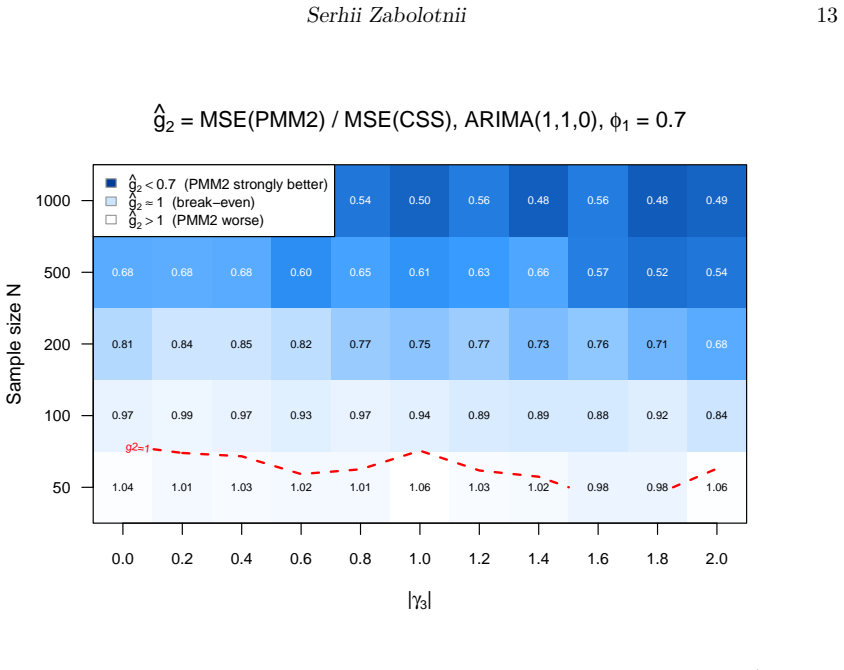
PMM exploits higher-order cumulants of the error distribution -- specifically the third standardized moment gamma_3 and fourth standardized moment gamma_4 -- to construct estimators that outperform ordinary least squares (OLS) whenever the errors are asymmetric or leptokurtic. Asymptotic efficiency is characterised by Kunchenko-style coefficients g_2, g_3 in [0,1], defined as the ratios of the asymptotic variance of the PMM2 and PMM3 estimators to that of OLS. Monte Carlo experiments confirm the theoretical values.
What carries the argument
The Polynomial Maximization Method (PMM) that constructs estimators by maximizing a polynomial function of the residuals involving estimates of gamma_3 and gamma_4.
If this is right
- PMM2 and PMM3 achieve asymptotic variances that are fractions g2 and g3 of the OLS variance.
- The pmm_dispatch function selects the method to use based on empirical skewness and kurtosis.
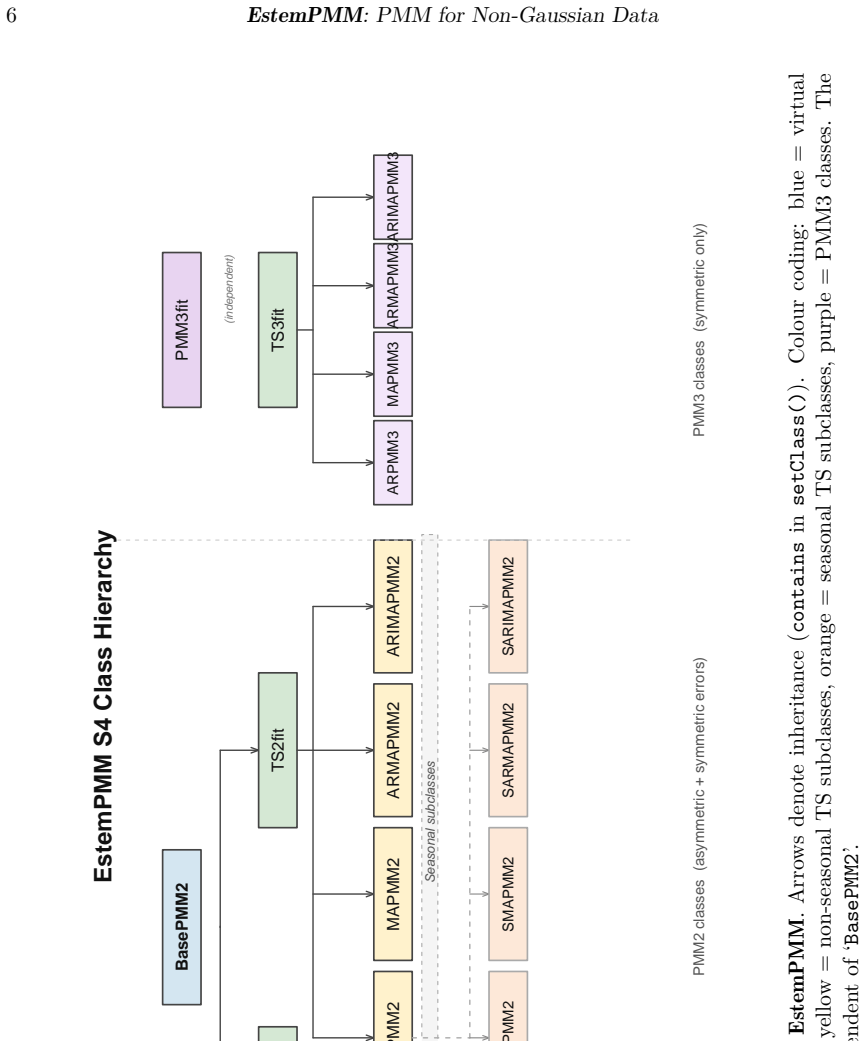
- The package supports AR, MA, ARMA, and ARIMA models in addition to linear regression.
- A case study on crude oil prices demonstrates practical gains in parameter precision.
Where Pith is reading between the lines
- The dispatch approach may generalize to other moment-based selection criteria in statistical modeling.
- In time series with non-Gaussian innovations, PMM could improve forecasting accuracy beyond what is shown in the regression case.
Load-bearing premise
That the sample skewness and excess kurtosis provide a reliable basis for dispatching to PMM2 or PMM3 without degrading finite-sample performance or introducing selection bias.
What would settle it
Running Monte Carlo simulations where the true error distribution has known non-zero gamma_3 or gamma_4 but the PMM estimators do not show reduced variance compared to OLS, or where the dispatcher selects PMM3 but performance is inferior.
Figures



read the original abstract
We describe the R package EstemPMM, which implements the Polynomial Maximization Method (PMM) for parameter estimation under non-Gaussian errors. PMM exploits higher-order cumulants of the error distribution -- specifically the third standardized moment gamma_3 and fourth standardized moment gamma_4 -- to construct estimators that outperform ordinary least squares (OLS) whenever the errors are asymmetric or leptokurtic. The package provides a unified interface for linear regression (lm_pmm2, lm_pmm3), autoregressive and moving-average time-series models (ar_pmm2, ma_pmm2, arma_pmm2, arima_pmm2, and seasonal variants), a data-driven dispatch function (pmm_dispatch) that automatically selects OLS, PMM2, or PMM3 based on the sample skewness and excess kurtosis, and Monte Carlo comparison utilities. The implementation uses R's S4 class system and follows standard generic interfaces (coef, fitted, residuals, predict, summary, AIC, logLik, vcov, confint). Asymptotic efficiency is characterised by Kunchenko-style coefficients g_2, g_3 in [0,1], defined as the ratios of the asymptotic variance of the PMM2 and PMM3 estimators to that of OLS. Monte Carlo experiments confirm the theoretical values and a WTI crude-oil case study illustrates the dispatcher and parameter-precision benefits of PMM2 on real heavy-tailed data. EstemPMM version 0.3.2 is available from CRAN at https://CRAN.R-project.org/package=EstemPMM under the GPL-3 licence.
Editorial analysis
A structured set of objections, weighed in public.
Referee Report
Summary. The manuscript describes the EstemPMM R package (v0.3.2 on CRAN), which implements the Polynomial Maximization Method (PMM) for linear regression and ARMA time-series models under non-Gaussian errors. PMM2 and PMM3 estimators exploit the third and fourth standardized moments (gamma_3, gamma_4) of the errors to achieve asymptotic efficiency gains over OLS, quantified by Kunchenko-style coefficients g_2 and g_3 in [0,1]. The package supplies a data-driven pmm_dispatch function that selects among OLS, PMM2 and PMM3 using sample skewness and excess kurtosis, plus Monte Carlo comparison utilities and a WTI crude-oil case study.
Significance. If the finite-sample behavior of the dispatcher is validated, the package supplies a readily usable implementation of a higher-moment estimator with clear asymptotic advantages for asymmetric or leptokurtic errors, together with standard S4 generics and reproducible Monte Carlo tools. This could be of practical value to applied researchers working with heavy-tailed regression or time-series data.
major comments (1)
- [Monte Carlo experiments] Monte Carlo experiments section: the reported simulations confirm the asymptotic g_2 and g_3 coefficients but do not report the pmm_dispatch selection-error rate or the unconditional finite-sample MSE (or risk) under the data-driven rule for moderate n. Without these quantities it is not possible to verify that the dispatcher delivers the claimed outperformance without occasional degradation relative to OLS.
minor comments (2)
- [Abstract] Abstract and §1: the phrase 'Kunchenko-style coefficients' is used without a brief definition or citation to the original reference; adding one sentence would improve accessibility.
- The package description states that it follows standard generic interfaces (coef, summary, etc.); a short table listing which generics are implemented for each model class would help users.
Simulated Author's Rebuttal
We thank the referee for the constructive assessment of our manuscript on the EstemPMM package. We address the single major comment below and will revise the manuscript to incorporate the requested finite-sample evaluation.
read point-by-point responses
-
Referee: Monte Carlo experiments section: the reported simulations confirm the asymptotic g_2 and g_3 coefficients but do not report the pmm_dispatch selection-error rate or the unconditional finite-sample MSE (or risk) under the data-driven rule for moderate n. Without these quantities it is not possible to verify that the dispatcher delivers the claimed outperformance without occasional degradation relative to OLS.
Authors: We agree that the existing Monte Carlo experiments focus on confirming the asymptotic efficiency gains (g_2 and g_3) of the PMM2 and PMM3 estimators but do not evaluate the finite-sample behavior of the data-driven pmm_dispatch selector. This is a valid point, as users need assurance that the automatic choice among OLS, PMM2, and PMM3 does not produce net degradation for moderate n. In the revised manuscript we will augment the Monte Carlo section with new experiments that report (i) the selection-error rates of pmm_dispatch (probability of choosing the suboptimal estimator) and (ii) the unconditional finite-sample MSE of the dispatched estimator, for sample sizes n=50, 100, 200, 500. These will be run under the same error distributions (varying skewness and excess kurtosis) already used in the paper, with direct comparison to OLS. The new results will be generated with the package's own Monte Carlo utilities to guarantee reproducibility. revision: yes
Circularity Check
No significant circularity; derivation self-contained
full rationale
The paper defines the PMM2/PMM3 estimators directly from the third and fourth standardized moments of the error distribution, defines the efficiency coefficients g2 and g3 explicitly as ratios of asymptotic variances to OLS, and implements a dispatch rule that thresholds on the observable sample skewness and excess kurtosis. None of these steps reduces a claimed prediction or uniqueness result to a fitted quantity by construction, nor does any load-bearing premise collapse to a self-citation or ansatz imported from the authors' prior work. Monte Carlo confirmation of the theoretical g coefficients is an external verification step rather than a tautology. The central claim of outperformance under asymmetric or leptokurtic errors therefore rests on the explicit dependence of the asymptotic variances on gamma3 and gamma4, which is not circular.
Axiom & Free-Parameter Ledger
free parameters (2)
- gamma_3
- gamma_4
axioms (2)
- domain assumption The error distribution has finite moments up to order four.
- standard math The sample skewness and kurtosis are consistent estimators of the population values for large samples.
Lean theorems connected to this paper
-
IndisputableMonolith.Cost (J(x) = ½(x+x⁻¹) − 1)washburn_uniqueness_aczel unclear?
unclearRelation between the paper passage and the cited Recognition theorem.
PMM exploits higher-order cumulants of the error distribution -- specifically the third standardized moment gamma_3 and fourth standardized moment gamma_4 -- to construct estimators that outperform ordinary least squares (OLS)
What do these tags mean?
- matches
- The paper's claim is directly supported by a theorem in the formal canon.
- supports
- The theorem supports part of the paper's argument, but the paper may add assumptions or extra steps.
- extends
- The paper goes beyond the formal theorem; the theorem is a base layer rather than the whole result.
- uses
- The paper appears to rely on the theorem as machinery.
- contradicts
- The paper's claim conflicts with a theorem or certificate in the canon.
- unclear
- Pith found a possible connection, but the passage is too broad, indirect, or ambiguous to say the theorem truly supports the claim.
Forward citations
Cited by 1 Pith paper
-
Variance-Reduced Manifold Sampling via Polynomial-Maximization Density Estimation
PMM-MASEM introduces a gated PMM2/PMM3 density estimator on kNN shell spacings for MASEM, reducing MSE by 22-36% on asymmetric regimes while falling back to MLE on flat Exp(1) spacings and showing mixed results overall.
Reference graph
Works this paper leans on
-
[1]
, title =
Chambers, John M. , title =. 2008 , doi =
2008
-
[2]
Venables, W. N. and Ripley, B. D. , title =. 2002 , doi =
2002
-
[3]
Maechler, Martin and Rousseeuw, Peter and Croux, Christophe and Todorov, Valentin and Ruckstuhl, Andreas and Salibian-Barrera, Matias and Verbeke, Tobias and Koller, Manuel and Conceicao, Eduardo L. T. and di Palma, Maria Anna , title =. R package version 0.99-1 , year =
-
[4]
2005 , address =
Koenker, Roger , title =. 2005 , address =
2005
-
[5]
and Athanasopoulos, George , title =
Hyndman, Rob J. and Athanasopoulos, George , title =. 2021 , url =
2021
-
[6]
and Ulrich, Joshua M
Ryan, Jeffrey A. and Ulrich, Joshua M. , title =. 2023 , note =
2023
-
[7]
, title =
Kunchenko, Yuriy P. , title =
-
[8]
, title =
Zabolotnii, Serhii W. , title =. 2025 , doi =
2025
-
[9]
and Warsza, Zygmunt L
Zabolotnii, Serhii W. and Warsza, Zygmunt L. and Tkachenko, Oleksandr , title =. Automation 2018: Advances in Intelligent Systems and Computing , editor =. 2018 , publisher =
2018
-
[10]
, title =
Zabolotnii, Serhii and Tkachenko, Oleksandr and Warsza, Zygmunt L. , title =. Automation 2022: New Solutions and Technologies for Automation, Robotics and Measurement Techniques , pages =. 2022 , publisher =
2022
-
[11]
, title =
Zabolotnii, Serhii and Tkachenko, Oleksandr and Warsza, Zygmunt L. , title =. Automation 2023: Key Challenges in Automation, Robotics and Measurement Techniques , pages =. 2023 , publisher =
2023
-
[12]
Eastern-European Journal of Enterprise Technologies , volume =
Zabolotnii, Serhii and Khotunov, Volodymyr and Chepynoha, Andrii and Tkachenko, Oleksandr , title =. Eastern-European Journal of Enterprise Technologies , volume =. 2021 , doi =
2021
-
[13]
Joint Signal Parameter Estimation in Non-
Palahin, Volodymyr and Juh\'. Joint Signal Parameter Estimation in Non-. Journal of Electrical Engineering , volume =. 2016 , doi =
2016
-
[14]
and Zabolotnii, Serhii W
Warsza, Zygmunt L. and Zabolotnii, Serhii W. , title =. Automation 2017: Advances in Intelligent Systems and Computing , editor =. 2017 , publisher =
2017
-
[15]
and Warsza, Zygmunt L
Zabolotnii, Serhii W. and Warsza, Zygmunt L. and Tkachenko, Oleksandr , title =. Automation 2019: Advances in Intelligent Systems and Computing , editor =. 2020 , publisher =
2019
-
[16]
, title =
Huber, Peter J. , title =. The Annals of Mathematical Statistics , volume =. 1964 , doi =
1964
-
[17]
and Ronchetti, Elvezio M
Hampel, Frank R. and Ronchetti, Elvezio M. and Rousseeuw, Peter J. and Stahel, Werner A. , title =. 1986 , address =
1986
-
[18]
Box, George E. P. and Jenkins, Gwilym M. and Reinsel, Gregory C. and Ljung, Greta M. , title =
-
[19]
Robust Estimation for
Muler, Nora and Pe\. Robust Estimation for. The Annals of Statistics , volume =. 2009 , doi =
2009
-
[20]
and Kim, Young Shin and Fabozzi, Frank J
Scherer, Matthias and Rachev, Svetlozar T. and Kim, Young Shin and Fabozzi, Frank J. , title =. Applied Financial Economics , volume =. 2012 , doi =
2012
-
[21]
Physica A: Statistical Mechanics and Its Applications , volume =
Eom, Cheoljun and Kaizoji, Taisei and Scalas, Enrico , title =. Physica A: Statistical Mechanics and Its Applications , volume =. 2019 , doi =
2019
-
[22]
, title =
Efron, Bradley and Tibshirani, Robert J. , title =. 1993 , doi =
1993
-
[23]
and Efron, Bradley , title =
DiCiccio, Thomas J. and Efron, Bradley , title =. Statistical Science , volume =. 1996 , doi =
1996
-
[24]
Quinlan, J. R. , title =. Proceedings of the Tenth International Conference on Machine Learning , pages =. 1993 , publisher =
1993
-
[25]
2017 , institution =
2017
-
[26]
2022 , note =
James, Gareth and Witten, Daniela and Hastie, Trevor and Tibshirani, Robert , title =. 2022 , note =
2022
discussion (0)
Sign in with ORCID, Apple, or X to comment. Anyone can read and Pith papers without signing in.