Variance-Reduced Manifold Sampling via Polynomial-Maximization Density Estimation
Pith reviewed 2026-05-20 04:01 UTC · model grok-4.3
The pith
A gated polynomial-maximization estimator replaces plug-in density rules in MASEM to reduce error on asymmetric manifold spacings.
A machine-rendered reading of the paper's core claim, the machinery that carries it, and where it could break.
Core claim
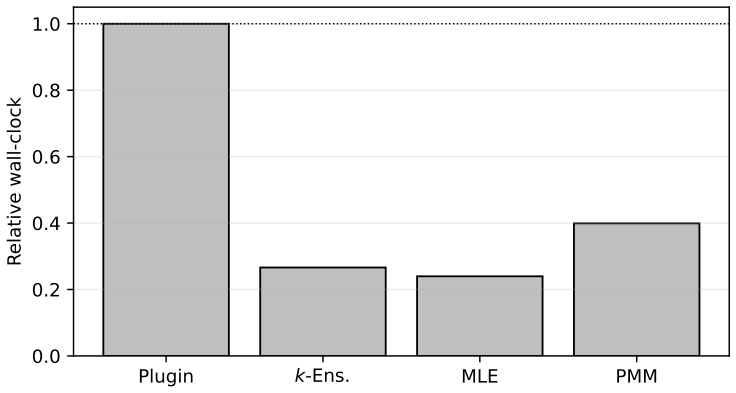
The PMM-MASEM module computes shell spacings from nested k-nearest-neighbour radii, estimates their standardized cumulants, and applies a gated PMM2 or PMM3 estimator only on departure from the flat Exp(1) regime, reverting to the plug-in MLE rule otherwise, which is optimal on flat homogeneous manifolds.
What carries the argument
The gated selector that switches between polynomial-maximization moment estimation and maximum-likelihood density estimation based on cumulant tests for spacing distribution shape.
If this is right
- On flat homogeneous manifolds the method correctly reverts to the standard MLE without performance loss.
- Density estimation mean squared error drops 22-36% in asymmetric gamma and boundary-spacing regimes.
- PMM3 increases error under platykurtic uniform spacing laws.
- Resampling proxy experiments show better seven-lobes coverage but worse sine and swiss-roll performance.
Where Pith is reading between the lines
- The gating logic may generalize to other local density estimators in sampling algorithms.
- Testing on additional manifold types could map the precise boundary where PMM becomes beneficial.
- Integrating higher-order cumulants might refine the detection of beneficial regimes.
Load-bearing premise
Standardized cumulants estimated from nested k-nearest-neighbour radii can reliably detect when spacing distributions depart from the flat exponential law.
What would settle it
An experiment showing that the cumulant-based gate fails to switch on clearly asymmetric spacings or incorrectly activates on flat ones, leading to higher overall error.
Figures


read the original abstract
Uniform sampling on implicitly defined manifolds is a core primitive in motion planning, constrained simulation, and probabilistic machine learning. MASEM addresses this problem by entropy-maximizing resampling, but its resampling weights depend on a local k-nearest-neighbour density estimate whose errors can be amplified by aggressive resampling temperatures. We ask whether a polynomial-maximization moment estimator can replace the plug-in density rule without changing the surrounding MASEM architecture. The proposed PMM-MASEM module computes shell spacings from nested k-nearest-neighbour radii, estimates their standardized cumulants, and uses a gated PMM2/PMM3 estimator only when the spacing distribution departs from the flat Exp(1) regime; otherwise it falls back to the plug-in/MLE rule. This fallback is essential: on a flat homogeneous manifold the plug-in estimator is already the MLE, so PMM should not outperform it. A local Known-DGP Monte Carlo experiment confirms this gate: the selector returns MLE on flat Exp(1) spacings and reduces density MSE by 22--36% on asymmetric gamma and boundary-spacing regimes. The evidence is not uniformly positive: PMM3 worsens a platykurtic uniform spacing law, and a lightweight resampling-proxy experiment improves seven-lobes coverage but degrades the sine and swiss-roll proxies. The current evidence therefore supports an applicability-boundary result rather than a general MASEM improvement claim.
Editorial analysis
A structured set of objections, weighed in public.
Referee Report
Summary. The manuscript proposes replacing the plug-in kNN density estimator inside MASEM with a gated polynomial-maximization moment (PMM) estimator for variance-reduced uniform sampling on implicitly defined manifolds. The gate computes standardized cumulants from shell spacings of nested k-nearest-neighbor radii and applies PMM2/PMM3 only when the local spacing law departs from the flat Exp(1) regime; otherwise it reverts to the MLE/plug-in rule. Known-DGP Monte Carlo experiments are reported to confirm that the selector returns MLE on homogeneous flat spacings and yields 22–36 % density MSE reduction on asymmetric gamma and boundary-spacing regimes, while the abstract explicitly notes counter-examples in which PMM3 degrades platykurtic uniform spacing and certain resampling proxies degrade on sine and swiss-roll manifolds. The contribution is framed as an applicability-boundary result rather than a uniform improvement.
Significance. If the finite-sample gating rule proves reliable, the targeted use of PMM could deliver practically useful variance reduction for density estimation in manifold sampling tasks. A clear strength is the paper’s explicit reporting of counter-examples and its use of Known-DGP validation to support the applicability-boundary framing rather than over-claiming generality.
major comments (1)
- [Abstract / Gating Mechanism] Abstract and gating description: the central applicability-boundary claim rests on the selector correctly identifying beneficial regimes from estimated standardized cumulants (skewness and kurtosis) of nested-kNN shell spacings. The reported Known-DGP Monte Carlo uses oracle regime labels, yet real deployment must estimate those cumulants from finite local samples; higher-order sample cumulants are known to have high variance and boundary bias, raising the risk of false triggers on detrimental regimes such as the platykurtic uniform spacing already shown to worsen under PMM3.
minor comments (2)
- [Experiments] The resampling-proxy experiment would benefit from explicit tabulation of the coverage metric, temperature schedule, and number of Monte Carlo repetitions so that the mixed results (seven-lobes improvement versus sine/swiss-roll degradation) can be reproduced.
- [Method] Provide a short pseudocode block or explicit equations for the PMM2 and PMM3 maximizers, including the precise polynomial basis and the objective being maximized.
Simulated Author's Rebuttal
We thank the referee for the constructive review and for acknowledging the applicability-boundary framing of the work. We address the single major comment below and will revise the manuscript to strengthen the validation of the gating mechanism.
read point-by-point responses
-
Referee: [Abstract / Gating Mechanism] Abstract and gating description: the central applicability-boundary claim rests on the selector correctly identifying beneficial regimes from estimated standardized cumulants (skewness and kurtosis) of nested-kNN shell spacings. The reported Known-DGP Monte Carlo uses oracle regime labels, yet real deployment must estimate those cumulants from finite local samples; higher-order sample cumulants are known to have high variance and boundary bias, raising the risk of false triggers on detrimental regimes such as the platykurtic uniform spacing already shown to worsen under PMM3.
Authors: We agree that the Known-DGP Monte Carlo isolates estimator performance under oracle regime labels and does not yet demonstrate the full end-to-end gating procedure with estimated cumulants. Sample skewness and kurtosis are indeed high-variance estimators, and this introduces a legitimate risk of misclassification on regimes such as platykurtic uniform spacing. In the revised manuscript we will add a dedicated finite-sample gating study that (i) draws local shell spacings from each tested distribution, (ii) computes the sample cumulants exactly as the gate would in deployment, (iii) records the trigger decisions, and (iv) reports the resulting density MSE together with the empirical false-positive rate on the detrimental platykurtic case. These results will be summarized in a new table and discussed in the text to quantify the practical reliability of the selector. revision: yes
Circularity Check
No circularity: gating rule and performance claims rest on external Monte Carlo validation
full rationale
The paper's central mechanism is a data-driven gate that estimates standardized cumulants from nested kNN shell spacings and switches between PMM2/PMM3 and the plug-in MLE only when departure from Exp(1) is detected. This rule is justified by a separate Known-DGP Monte Carlo experiment that labels regimes oracle-style and measures MSE reduction; the experiment is external to the estimator itself and does not reduce any claimed prediction to a fitted parameter by construction. No self-citation chain, uniqueness theorem, or ansatz smuggling appears in the provided derivation steps. The fallback to MLE on flat regimes is presented as a logical consequence of the known MLE property rather than a fitted result, keeping the overall argument self-contained against external benchmarks.
Axiom & Free-Parameter Ledger
axioms (1)
- domain assumption Shell spacings derived from nested k-nearest-neighbour radii carry sufficient information to estimate standardized cumulants and detect departure from Exp(1).
Reference graph
Works this paper leans on
-
[1]
Tyrus Berry and Timothy Sauer. Density estimation on manifolds with boundary.Computa- tional Statistics & Data Analysis, 107:1–17, 2017. doi: 10.1016/j.csda.2016.09.011
-
[2]
C. V. Braun, T. Burghoff, and M. Toussaint. Manifold sampling via entropy maximization. arXiv preprint arXiv:2605.12338, 2026
work page internal anchor Pith review Pith/arXiv arXiv 2026
-
[3]
Guillermo Henry, Andr´ es Mu˜ noz, and Daniela Rodriguez.k-nearest neighbor density estima- tion on riemannian manifolds.arXiv preprint arXiv:1106.4763, 2011
work page internal anchor Pith review Pith/arXiv arXiv 2011
-
[4]
J. F. C. Kingman.Poisson Processes. Oxford University Press, 1993. 14
work page 1993
-
[5]
L. F. Kozachenko and N. N. Leonenko. Sample estimate of the entropy of a random vector. Problems of Information Transmission, 23(2):95–101, 1987
work page 1987
-
[6]
Yu. P. Kunchenko.Stochastic Polynomials. Naukova Dumka, Kyiv, 2006
work page 2006
-
[7]
Don O. Loftsgaarden and Charles P. Quesenberry. A nonparametric estimate of a multivariate density function.The Annals of Mathematical Statistics, 36(3):1049–1051, 1965. doi: 10.1214/ aoms/1177700079
-
[8]
Y. P. Mack and M. Rosenblatt. Multivariatek-nearest neighbor density estimates.Journal of Multivariate Analysis, 9(1):1–15, 1979. doi: 10.1016/0047-259X(79)90065-4
-
[9]
Bruno Pelletier. Kernel density estimation on riemannian manifolds.Statistics & Probability Letters, 73(3):297–304, 2005. doi: 10.1016/j.spl.2005.04.004
-
[10]
Mathew Penrose.Random Geometric Graphs. Oxford University Press, 2003
work page 2003
-
[11]
Spacings.Journal of the Royal Statistical Society
Ronald Pyke. Spacings.Journal of the Royal Statistical Society. Series B (Methodological), 27 (3):395–436, 1965. doi: 10.1111/j.2517-6161.1965.tb00602.x
-
[12]
Zygmunt Lech Warsza and Serhii V. Zabolotnii. Estimation of measurand parameters for data from asymmetric distributions by polynomial maximization method. InAutomation 2018, volume 743 ofAdvances in Intelligent Systems and Computing, pages 746–757. Springer, Cham, 2018. doi: 10.1007/978-3-319-77179-3 74
-
[13]
Serhii Zabolotnii. Applying the polynomial maximization method to estimate ARIMA models with asymmetric non-Gaussian innovations.arXiv preprint arXiv:2511.07059, 2025. doi: 10. 48550/arXiv.2511.07059. URLhttps://arxiv.org/abs/2511.07059
work page internal anchor Pith review Pith/arXiv arXiv 2025
-
[14]
EstemPMM: Polynomial Maximization Method for Non-Gaussian Regression and Time Series in R
Serhii Zabolotnii. EstemPMM: Polynomial maximization method for non-gaussian regression and time series in R.arXiv preprint arXiv:2605.02673, 2026. doi: 10.48550/arXiv.2605.02673. URLhttps://arxiv.org/abs/2605.02673
work page internal anchor Pith review Pith/arXiv arXiv doi:10.48550/arxiv.2605.02673 2026
-
[15]
Analysis of KNN density estimation.arXiv preprint arXiv:2010.00438, 2020
Puning Zhao and Lifeng Lai. Analysis of KNN density estimation.arXiv preprint arXiv:2010.00438, 2020. 15
discussion (0)
Sign in with ORCID, Apple, or X to comment. Anyone can read and Pith papers without signing in.