Recognition: 2 theorem links
· Lean TheoremEnvironmental Quenching of High-Redshift Galaxies: Interpreting JWST Observations with Simulations
Pith reviewed 2026-05-08 17:51 UTC · model grok-4.3
The pith
Simulations indicate that JWST-observed low-mass quenched galaxies at high redshift are environmentally quenched satellites.
A machine-rendered reading of the paper's core claim, the machinery that carries it, and where it could break.
Core claim
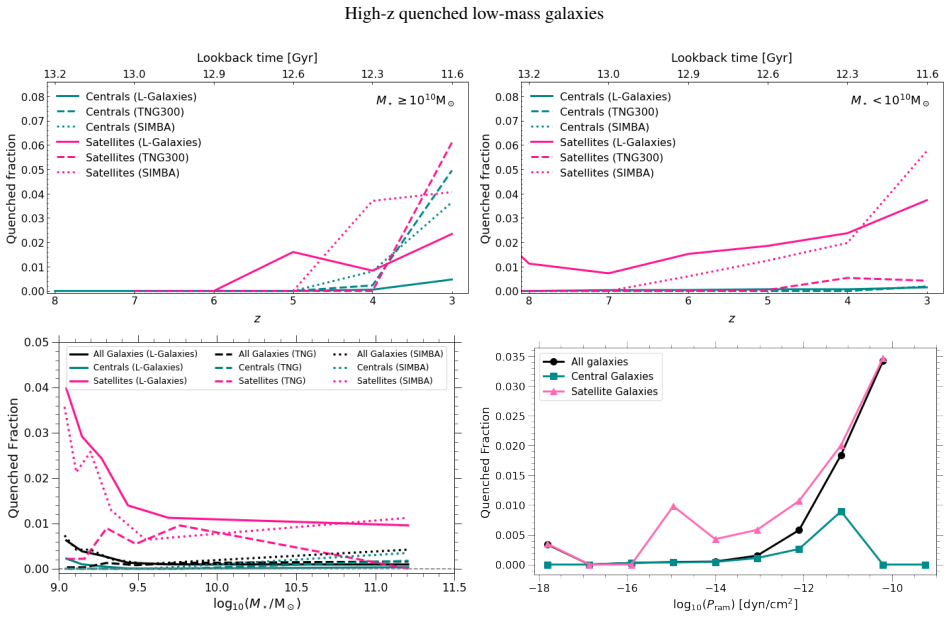
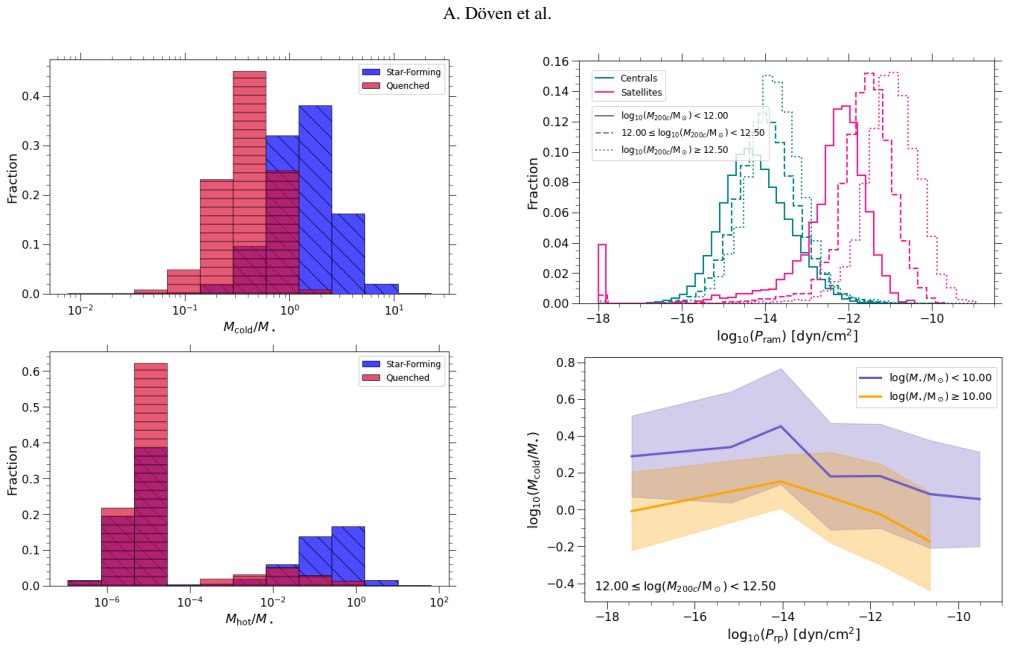
Across all simulations, quenched low-mass galaxies at z greater than 3 are overwhelmingly satellites despite representing less than 10 percent of the total galaxy population. Satellite quenching strengthens with increasing host halo mass and weakens with rising stellar mass or greater halocentric distance, correlating with higher ram-pressure exposure and gas depletion. The simulations, particularly L-GALAXIES, produce low-mass quenched galaxies whose abundance and properties align with JWST observations, suggesting these systems are environmentally quenched objects near massive halos that are frequently temporary, with nearly 90 percent merging within a few hundred megayears.
What carries the argument
Satellite environmental quenching driven by ram-pressure stripping and gas depletion within host halos.
If this is right
- The fraction of quenched satellites rises with host halo mass and falls with stellar mass and distance from the halo center.
- Nearly 90 percent of the quenched low-mass satellites merge into larger systems within a few hundred megayears.
- A small fraction of these galaxies can rejuvenate and resume star formation after quenching.
- Larger future samples of high-redshift galaxies can test whether environmental effects dominate quenching at early times.
Where Pith is reading between the lines
- Galaxy formation models may require stronger or more detailed environmental modules to reproduce the growing high-redshift quenched population.
- Direct measurements of the spatial clustering of quenched low-mass galaxies relative to massive halos at z greater than 3 would provide an independent test.
- Episodic star-formation histories driven by temporary environmental effects could appear in detailed stellar-population studies of these objects.
Load-bearing premise
The simulations accurately capture the environmental processes that remove gas and quench star formation in low-mass galaxies orbiting near massive halos at redshifts above 3.
What would settle it
A large observational sample showing that most low-mass quenched galaxies at z greater than 3 are central galaxies rather than satellites would contradict the simulations' prediction.
Figures





read the original abstract
Recent observations of the high-redshift Universe, particularly with JWST, have revealed a population of quenched galaxies that challenges current galaxy formation models, which systematically underpredict their abundance. This discrepancy has been extensively studied for massive systems, motivating revisions to internal quenching mechanisms such as AGN feedback. However, the origin of quenching in lower-mass galaxies at high-z has received far less attention, largely due to previous observational limitations. JWST has now identified low-mass quenched galaxies (${M_{\star}}<10^{10}{\rm M_{\odot}}$). Given this emerging observational evidence, we investigate the viability of environmental quenching as the primary mechanism suppressing star formation in low-mass galaxies at $z>3$. We analyze several simulations, including L-GALAXIES, IllustrisTNG, SIMBA, and TNG-Cluster, jointly comprising more than half a million galaxies at z=5. Across all simulations, quenched systems are overwhelmingly satellites, despite representing less than 10\% of the total galaxy population. Satellite quenching increases with host halo mass and decreases with both stellar mass and halocentric distance, showing strong correlations with enhanced ram-pressure exposure and gas depletion. The simulations, particularly L-GALAXIES, produce low-mass quenched galaxies broadly consistent with those observed by JWST. Our results suggest that the recently discovered high-redshift quenched low-mass galaxies are possibly environmentally quenched systems residing in the vicinity of massive halos. According to the simulations, these galaxies are often only temporarily quenched: nearly 90\% of them merge within a few hundred megayears, and a small fraction rejuvenate and resume star formation. Extended samples from future observations will enable robust tests of the environmental origin of galaxy quenching in the early Universe.
Editorial analysis
A structured set of objections, weighed in public.
Referee Report
Summary. The paper claims that the low-mass quenched galaxies (M_star < 10^10 M_sun) recently identified by JWST at z > 3 are primarily environmentally quenched satellites. This is supported by analysis of >500,000 galaxies at z=5 across four simulations (L-GALAXIES, IllustrisTNG, SIMBA, TNG-Cluster), where quenched systems are overwhelmingly satellites (<10% of the total population), with quenching efficiency increasing with host halo mass and decreasing with stellar mass and halocentric radius, correlated with ram-pressure and gas depletion. L-GALAXIES in particular yields quenched populations broadly consistent with JWST observations, and the quenched satellites are predicted to be mostly temporary, with ~90% merging within a few hundred Myr.
Significance. If the central claim holds, the work provides a timely environmental explanation for an unexpected JWST population without requiring revisions to internal feedback prescriptions, and the multi-simulation approach with a large sample size is a clear strength. The finding that environmental processes can dominate at high-z for low-mass systems would have broad implications for galaxy formation models and future observational tests.
major comments (3)
- [Abstract and §4] Abstract and §4 (comparison with JWST): the statement that L-GALAXIES produces low-mass quenched galaxies 'broadly consistent' with observations supplies no quantitative metrics (e.g., quenched fractions vs. stellar mass or halo mass, number densities with Poisson or cosmic-variance errors, or Kolmogorov-Smirnov statistics), selection-function matching, or robustness tests against observational cuts; this absence is load-bearing for the viability claim.
- [§3.2] §3.2 (environmental processes): the correlations between quenching, ram-pressure exposure, and gas depletion rest entirely on subgrid prescriptions that are calibrated against z<2 data; no sensitivity tests to variations in stripping thresholds, depletion timescales, or UV-background strength at z=5 for M_star<10^10 M_sun are presented, leaving open a systematic bias that would directly alter the predicted satellite quenched fraction.
- [§5] §5 (merger and rejuvenation statistics): the claim that 'nearly 90% of them merge within a few hundred megayears' and that a small fraction rejuvenate is presented without specifying the simulation(s) used, the exact merger timescale definition, or the fraction of the quenched population that is tracked forward in time; this is central to the 'temporary quenching' interpretation.
minor comments (2)
- [Figures] Figure 2 (or equivalent): the halocentric-distance and halo-mass trends would be clearer with explicit error bars or shaded regions indicating the number of galaxies per bin.
- [Methods] Notation: the definition of 'quenched' (specific star-formation rate threshold) is used consistently but should be restated explicitly in the methods section for readers unfamiliar with the simulation conventions.
Simulated Author's Rebuttal
We thank the referee for the constructive and detailed report, which highlights both the strengths of our multi-simulation approach and areas where greater quantitative rigor and specificity are needed. We address each major comment below and will revise the manuscript accordingly.
read point-by-point responses
-
Referee: [Abstract and §4] Abstract and §4 (comparison with JWST): the statement that L-GALAXIES produces low-mass quenched galaxies 'broadly consistent' with observations supplies no quantitative metrics (e.g., quenched fractions vs. stellar mass or halo mass, number densities with Poisson or cosmic-variance errors, or Kolmogorov-Smirnov statistics), selection-function matching, or robustness tests against observational cuts; this absence is load-bearing for the viability claim.
Authors: We agree that the current phrasing is qualitative and that quantitative support is required to substantiate the consistency claim. In the revised manuscript we will add (i) quenched fractions versus stellar mass and host halo mass for L-GALAXIES and the JWST sample, (ii) number densities with Poisson errors plus an estimate of cosmic variance from the simulation volume, and (iii) a Kolmogorov-Smirnov test on the stellar-mass distributions. We will also describe how we approximate the observational selection function by applying comparable mass and redshift cuts and will report the resulting robustness checks. revision: yes
-
Referee: [§3.2] §3.2 (environmental processes): the correlations between quenching, ram-pressure exposure, and gas depletion rest entirely on subgrid prescriptions that are calibrated against z<2 data; no sensitivity tests to variations in stripping thresholds, depletion timescales, or UV-background strength at z=5 for M_star<10^10 M_sun are presented, leaving open a systematic bias that would directly alter the predicted satellite quenched fraction.
Authors: The referee correctly identifies that the sub-grid implementations were calibrated primarily at lower redshift. While the physical basis of ram-pressure stripping and gas depletion is expected to remain valid at z=5, we will expand §3.2 to discuss this calibration limitation explicitly and to note that the same qualitative trends appear across four independent codes with differing sub-grid treatments. Full sensitivity experiments would require new simulation runs that are outside the present scope; we therefore treat this as a partial revision by adding the caveats and robustness discussion rather than performing new runs. revision: partial
-
Referee: [§5] §5 (merger and rejuvenation statistics): the claim that 'nearly 90% of them merge within a few hundred megayears' and that a small fraction rejuvenate is presented without specifying the simulation(s) used, the exact merger timescale definition, or the fraction of the quenched population that is tracked forward in time; this is central to the 'temporary quenching' interpretation.
Authors: We will revise §5 to state that the statistics are obtained from the L-GALAXIES merger trees. The merger timescale is defined as the time from z=5 until the satellite merges with the central galaxy or another satellite according to the simulation’s merger-tree algorithm. We track the full population of quenched satellites identified at z=5 and will report that approximately 90 % merge within 300 Myr while ~8 % rejuvenate before merging. These details will be added to the text and to the caption of the relevant figure. revision: yes
Circularity Check
No significant circularity in simulation-based interpretation
full rationale
The paper's central analysis consists of post-processing outputs from established, publicly available simulations (L-GALAXIES, IllustrisTNG, SIMBA, TNG-Cluster) to compare quenched galaxy populations against JWST observations at z>3. No new parameters are fitted to the target data, no equations reduce predictions to inputs by construction, and the load-bearing statements (satellite dominance of quenched systems, consistency with observations) rest on the pre-existing subgrid implementations rather than any self-referential loop or self-citation chain. The work is therefore a standard interpretive comparison whose validity hinges on simulation fidelity, not on internal definitional or fitting circularity.
Axiom & Free-Parameter Ledger
axioms (1)
- domain assumption Standard Lambda-CDM cosmology and the subgrid galaxy formation physics implemented in L-GALAXIES, IllustrisTNG, SIMBA, and TNG-Cluster
Lean theorems connected to this paper
-
Cost / Foundation.LogicAsFunctionalEquation (Jcost uniqueness)washburn_uniqueness_aczel — no parallel: the sSFR threshold is a heuristic from the literature, not derived from a ratio-symmetric cost. unclear?
unclearRelation between the paper passage and the cited Recognition theorem.
We classify a galaxy as quenched based on a sSFR threshold of 0.2/t_H(z), below which the galaxy is considered as quenched.
What do these tags mean?
- matches
- The paper's claim is directly supported by a theorem in the formal canon.
- supports
- The theorem supports part of the paper's argument, but the paper may add assumptions or extra steps.
- extends
- The paper goes beyond the formal theorem; the theorem is a base layer rather than the whole result.
- uses
- The paper appears to rely on the theorem as machinery.
- contradicts
- The paper's claim conflicts with a theorem or certificate in the canon.
- unclear
- Pith found a possible connection, but the passage is too broad, indirect, or ambiguous to say the theorem truly supports the claim.
Reference graph
Works this paper leans on
-
[1]
Unifying X-ray scaling relations from galaxies to clusters. , archivePrefix = "arXiv", eprint =. doi:10.1093/mnras/stv437 , adsurl =
-
[2]
arXiv e-prints , archivePrefix = "arXiv", eprint =
Galaxy Quenching from Cosmic Web Detachment. arXiv e-prints , archivePrefix = "arXiv", eprint =
-
[3]
, archivePrefix = "arXiv", eprint =
The origin of the enhanced metallicity of satellite galaxies. , archivePrefix = "arXiv", eprint =. doi:10.1093/mnras/stw2329 , adsurl =
-
[4]
Monthly Notices of the Royal Astronomical Society , author =
Photometric redshifts for the SDSS Data Release 12. , keywords =. doi:10.1093/mnras/stw1009 , archivePrefix =. 1603.09708 , primaryClass =
-
[5]
2009, MNRAS, 396, 1383, doi:10.1111/j.1365-2966.2009.14843.x
Ram-pressure stripping of halo gas in disc galaxies: implications for galactic star formation in different environments. , archivePrefix = "arXiv", eprint =. doi:10.1111/j.1365-2966.2009.15431.x , adsurl =
-
[6]
Environmental Effects on Late-Type Galaxies in Nearby Clusters. , eprint =. doi:10.1086/500691 , adsurl =
-
[7]
A Virgo Environmental Survey Tracing Ionised Gas Emission (VESTIGE). I. Introduction to the survey. , archivePrefix = "arXiv", eprint =. doi:10.1051/0004-6361/201732407 , adsurl =
-
[8]
, archivePrefix = "arXiv", eprint =
Modelling galactic conformity with the colour-halo age relation in the Illustris simulation. , archivePrefix = "arXiv", eprint =. doi:10.1093/mnras/stv2316 , adsurl =
-
[9]
2003, MNRAS, 340, 1214, doi: 10.1046/j.1365-8711.2003.06380.x
Stellar population synthesis at the resolution of 2003. , keywords =. doi:10.1046/j.1365-8711.2003.06897.x , archivePrefix =. astro-ph/0309134 , primaryClass =
-
[10]
ENZO: An Adaptive Mesh Refinement Code for Astrophysics. , keywords =. doi:10.1088/0067-0049/211/2/19 , archivePrefix =. 1307.2265 , primaryClass =
-
[11]
Galactic Stellar and Substellar Initial Mass Function. , keywords =. doi:10.1086/376392 , archivePrefix =. astro-ph/0304382 , primaryClass =
-
[12]
MUFASA: Galaxy star formation, gas, and metal properties across cosmic time. , keywords =. doi:10.1093/mnras/stx108 , archivePrefix =. 1610.01626 , primaryClass =
-
[13]
The quenching and morphological evolution of central galaxies is facilitated by the feedback-driven expulsion of circumgalactic gas. , keywords =. doi:10.1093/mnras/stz3201 , archivePrefix =. 1908.11380 , primaryClass =
-
[14]
The Open Journal of Astrophysics , keywords =
Witnessing downsizing in the making: quiescent and breathing galaxies at the dawn of the Universe. The Open Journal of Astrophysics , keywords =. doi:10.33232/001c.147267 , archivePrefix =. 2509.09764 , primaryClass =
-
[15]
Searching for Quiescent Galaxies over 3 < z < 6 in JWST Surveys Using Manifold Learning. arXiv e-prints , keywords =. doi:10.48550/arXiv.2501.09066 , archivePrefix =. 2501.09066 , primaryClass =
-
[16]
Overview of the DESI Legacy Imaging Surveys. , keywords =. doi:10.3847/1538-3881/ab089d , archivePrefix =. 1804.08657 , primaryClass =
-
[17]
Atomic and molecular gas in IllustrisTNG galaxies at low redshift. , keywords =. doi:10.1093/mnras/stz1323 , archivePrefix =. 1902.10714 , primaryClass =
-
[18]
2019, MNRAS, 485, 4817, doi: 10.1093/mnras/stz712
The star formation activity of IllustrisTNG galaxies: main sequence, UVJ diagram, quenched fractions, and systematics. , keywords =. doi:10.1093/mnras/stz712 , archivePrefix =. 1812.07584 , primaryClass =
-
[19]
Dancing in the dark: galactic properties trace spin swings along the cosmic web
Dancing in the dark: galactic properties trace spin swings along the cosmic web. , archivePrefix = "arXiv", eprint =. doi:10.1093/mnras/stu1227 , adsurl =
-
[20]
2013, Monthly Notices of the Royal Astronomical Society, 434, 1531, doi:10.1093/mnras/stt1117
Star formation and metallicity gradients in semi-analytic models of disc galaxy formation. , keywords =. doi:10.1093/mnras/stt1117 , archivePrefix =. 1303.5586 , primaryClass =
-
[21]
Shape, Spin, and Baryon Fraction of Clusters in the MareNostrum Universe. , keywords =. doi:10.1086/517907 , archivePrefix =. astro-ph/0703164 , primaryClass =
-
[22]
Mass and environmental quenching, conformity and clustering
Galaxy formation in the Planck cosmology - IV. Mass and environmental quenching, conformity and clustering. , archivePrefix = "arXiv", eprint =. doi:10.1093/mnras/stx1010 , adsurl =
-
[23]
TREESPH: A Unification of SPH with the Hierarchical Tree Method. , keywords =. doi:10.1086/191344 , adsurl =
-
[24]
A new class of accurate, mesh-free hydrodynamic simulation methods. , keywords =. doi:10.1093/mnras/stv195 , archivePrefix =. 1409.7395 , primaryClass =
-
[25]
doi:10.1088/0067-0049/214/2/15 , arxivId =
A Highly Consistent Framework for the Evolution of the Star-Forming ``Main Sequence'' from z -0.5ex 0-6. , keywords =. doi:10.1088/0067-0049/214/2/15 , archivePrefix =. 1405.2041 , primaryClass =
-
[26]
Star formation and mass assembly in high redshift galaxies. , keywords =. doi:10.1051/0004-6361/200811434 , archivePrefix =. 0905.0683 , primaryClass =
-
[27]
FIRE-2 Simulations: Physics versus Numerics in Galaxy Formation
FIRE-2 simulations: physics versus numerics in galaxy formation. , keywords =. doi:10.1093/mnras/sty1690 , archivePrefix =. 1702.06148 , primaryClass =
-
[28]
2009, ApJ, 690, 1236, doi: 10.1088/0004-637X/690/2/1236 Ivezi´ c,ˇZ., Kahn, S
Cosmos Photometric Redshifts with 30-Bands for 2-deg ^ 2. , keywords =. doi:10.1088/0004-637X/690/2/1236 , archivePrefix =. 0809.2101 , primaryClass =
-
[29]
, archivePrefix = "arXiv", eprint =
BUDHIES II: a phase-space view of H I gas stripping and star formation quenching in cluster galaxies. , archivePrefix = "arXiv", eprint =. doi:10.1093/mnras/stv100 , adsurl =
-
[30]
Galaxy evolution in the metric of the cosmic web. , keywords =. 2018. doi:10.1093/mnras/stx2638 , archivePrefix =. 1710.02676 , primaryClass =
-
[31]
On the variation of the initial mass function. , keywords =. doi:10.1046/j.1365-8711.2001.04022.x , archivePrefix =. astro-ph/0009005 , primaryClass =
-
[32]
The evolution of disk galaxies and the origin of S0 galaxies. , keywords =. doi:10.1086/157917 , adsurl =
-
[33]
, archivePrefix = "arXiv", eprint =
Gas Contents of Galaxy Groups from Thermal Sunyaev-Zel dovich Effects. , archivePrefix = "arXiv", eprint =. doi:10.3847/1538-4357/aaaa21 , adsurl =
-
[34]
The Evolution of the Fractions of Quiescent and Star-forming Galaxies as a Function of Stellar Mass Since z = 3: Increasing Importance of Massive, Dusty Star-forming Galaxies in the Early Universe. , keywords =. doi:10.3847/2041-8205/827/2/L25 , archivePrefix =. 1606.04090 , primaryClass =
-
[35]
Astronomy and Computing , volume=
The illustris simulation: Public data release , author=. Astronomy and Computing , volume=. 2015 , publisher=
2015
-
[36]
Zooming in on accretion - I. The structure of halo gas. , archivePrefix = "arXiv", eprint =. doi:10.1093/mnras/stw1191 , adsurl =
-
[37]
First results from the IllustrisTNG simulations: the galaxy color bimodality
First results from the IllustrisTNG simulations: the galaxy colour bimodality. , archivePrefix = "arXiv", eprint =. doi:10.1093/mnras/stx3040 , adsurl =
work page internal anchor Pith review doi:10.1093/mnras/stx3040
-
[38]
The FABLE simulations: A feedback model for galaxies, groups and clusters
The FABLE simulations: a feedback model for galaxies, groups, and clusters. , keywords =. doi:10.1093/mnras/sty1780 , archivePrefix =. 1804.05064 , primaryClass =
-
[39]
doi:10.1093/mnras/staa2235 , archiveprefix =
The baryon content of groups and clusters of galaxies in the FABLE simulations. , keywords =. doi:10.1093/mnras/staa2235 , archivePrefix =. 1911.12367 , primaryClass =
-
[40]
2018, Monthly Notices of the Royal Astronomical Society, 477, 450–479, doi: 10.1093/mnras/sty656
The abundance, distribution, and physical nature of highly ionized oxygen O VI, O VII, and O VIII in IllustrisTNG. , keywords =. doi:10.1093/mnras/sty656 , archivePrefix =. 1712.00016 , primaryClass =
-
[41]
2019, Computational Astrophysics and Cosmology, 6, 2, doi: 10.1186/s40668-019-0028-x
The IllustrisTNG simulations: public data release. Computational Astrophysics and Cosmology , keywords =. doi:10.1186/s40668-019-0028-x , archivePrefix =. 1812.05609 , primaryClass =
-
[42]
Star Formation in AEGIS Field Galaxies since z=1.1: The Dominance of Gradually Declining Star Formation, and the Main Sequence of Star-forming Galaxies. , eprint =. doi:10.1086/517926 , adsurl =
-
[43]
Mass and Environment as Drivers of Galaxy Evolution in SDSS and zCOSMOS and the Origin of the Schechter Function. , archivePrefix = "arXiv", eprint =. doi:10.1088/0004-637X/721/1/193 , adsurl =
-
[44]
Formation of Galaxies and Clusters of Galaxies by Self-Similar Gravitational Condensation. , year = 1974, month = feb, volume =. doi:10.1086/152650 , adsurl =
-
[45]
2018b, MNRAS, 473, 4077, doi: 10.1093/mnras/stx2656
Simulating galaxy formation with the IllustrisTNG model. , keywords =. doi:10.1093/mnras/stx2656 , archivePrefix =. 1703.02970 , primaryClass =
-
[46]
2018a, MNRAS, 475, 648, doi: 10.1093/mnras/stx3112
First results from the IllustrisTNG simulations: the stellar mass content of groups and clusters of galaxies. , keywords =. doi:10.1093/mnras/stx3112 , archivePrefix =. 1707.03406 , primaryClass =
-
[47]
Monthly Notices of the Royal Astronomical Society , volume=
First results from the TNG50 simulation: the evolution of stellar and gaseous discs across cosmic time , author=. Monthly Notices of the Royal Astronomical Society , volume=. 2019 , publisher=
2019
-
[48]
GASP. I. Gas Stripping Phenomena in Galaxies with MUSE. , archivePrefix = "arXiv", eprint =. doi:10.3847/1538-4357/aa78ed , adsurl =
-
[49]
arXiv e-prints , keywords =
Quenching low-mass satellite galaxies: evidence for a threshold ICM density. arXiv e-prints , keywords =. 2019
2019
-
[50]
Ram pressure stripping of disc galaxies orbiting in clusters - I. Mass and radius of the remaining gas disc. , archivePrefix = "arXiv", eprint =. doi:10.1111/j.1365-2966.2007.12241.x , adsurl =
-
[51]
, archivePrefix = "arXiv", eprint =
The colours of satellite galaxies in the Illustris simulation. , archivePrefix = "arXiv", eprint =. doi:10.1093/mnrasl/slu173 , adsurl =
-
[52]
2009, MNRAS, 396, 1383, doi:10.1111/j.1365-2966.2009.14843.x
The physics driving the cosmic star formation history. , archivePrefix = "arXiv", eprint =. doi:10.1111/j.1365-2966.2009.16029.x , adsurl =
-
[53]
, archivePrefix = "arXiv", eprint =
X-ray and SZ constraints on the properties of hot CGM. , archivePrefix = "arXiv", eprint =. doi:10.1093/mnras/sty1276 , adsurl =
-
[54]
, archivePrefix = "arXiv", eprint =
Physical Models of Galaxy Formation in a Cosmological Framework. , archivePrefix = "arXiv", eprint =. doi:10.1146/annurev-astro-082812-140951 , adsurl =
work page Pith review doi:10.1146/annurev-astro-082812-140951
-
[55]
arXiv e-prints , keywords =
A homogeneous measurement of the delay between the onsets of gas stripping and star formation quenching in satellite galaxies of groups and clusters. arXiv e-prints , keywords =
-
[56]
Atomic hydrogen in IllustrisTNG galaxies: the impact of environment parallelled with local 21-cm surveys. , archivePrefix = "arXiv", eprint =. doi:10.1093/mnras/sty3451 , adsurl =
-
[57]
Molecular hydrogen in IllustrisTNG galaxies: carefully comparing signatures of environment with local CO and SFR data. , keywords =. doi:10.1093/mnras/staa3662 , archivePrefix =. 2011.03226 , primaryClass =
-
[58]
Building disc structure and galaxy properties through angular momentum: the DARK SAGE semi-analytic model. , keywords =. doi:10.1093/mnras/stw1332 , archivePrefix =. 1605.00647 , primaryClass =
-
[59]
The relationship between black hole mass and galaxy properties: examining the black hole feedback model in IllustrisTNG. , keywords =. doi:10.1093/mnras/staa374 , archivePrefix =. 1906.02747 , primaryClass =
-
[60]
Cosmological hydrodynamics with adaptive mesh refinement. A new high resolution code called RAMSES. , keywords =. doi:10.1051/0004-6361:20011817 , archivePrefix =. astro-ph/0111367 , primaryClass =
-
[61]
, archivePrefix = "arXiv", eprint =
Gas Stripping in Simulated Galaxies with a Multiphase Interstellar Medium. , archivePrefix = "arXiv", eprint =. doi:10.1088/0004-637X/694/2/789 , adsurl =
-
[62]
Monthly Notices of the Royal Astronomical Society , volume=
A model for cosmological simulations of galaxy formation physics: multi-epoch validation , author=. Monthly Notices of the Royal Astronomical Society , volume=. 2014 , publisher=
2014
-
[63]
It is not easy being green: the evolution of galaxy colour in the EAGLE simulation. , keywords =. 2016. doi:10.1093/mnras/stw1230 , archivePrefix =. 1601.07907 , primaryClass =
-
[64]
2020, MNRAS, 494, 549, doi: 10.1093/mnras/staa685
X-ray signatures of black hole feedback: Hot galactic atmospheres in illustristng and X-ray observations. , keywords =. doi:10.1093/mnras/staa685 , archivePrefix =. 1911.11165 , primaryClass =
-
[65]
2013, MNRAS, 436, 3031, doi: 10.1093/mnras/stt1789
A model for cosmological simulations of galaxy formation physics. , keywords =. doi:10.1093/mnras/stt1789 , archivePrefix =. 1305.2913 , primaryClass =
-
[66]
, archivePrefix = "arXiv", eprint =
The Co-evolution of a Magnetized Intracluster Medium and Hot Galactic Coronae: Magnetic Field Amplification and Turbulence Generation. , archivePrefix = "arXiv", eprint =. doi:10.3847/1538-4357/aa6eac , adsurl =
-
[67]
Gasoline2: a modern smoothed particle hydrodynamics code. , keywords =. doi:10.1093/mnras/stx1643 , archivePrefix =. 1707.03824 , primaryClass =
-
[68]
Radial distribution and environmental effects
Satellite abundances around bright isolated galaxies - II. Radial distribution and environmental effects. , archivePrefix = "arXiv", eprint =. doi:10.1093/mnras/stu988 , adsurl =
-
[69]
The Three Hundred Project: The Influence of Environment on Simulated Galaxy Properties. , keywords =. 2018. doi:10.3847/1538-4357/aae52e , archivePrefix =. 1809.05244 , primaryClass =
-
[70]
2017, MNRAS, 465, 3291, doi: 10.1093/mnras/stw2944
Simulating galaxy formation with black hole driven thermal and kinetic feedback. , keywords =. doi:10.1093/mnras/stw2944 , archivePrefix =. 1607.03486 , primaryClass =
-
[71]
Supermassive black holes and their feedback effects in the IllustrisTNG simulation. , keywords =. doi:10.1093/mnras/sty1733 , archivePrefix =. 1710.04659 , primaryClass =
-
[72]
Gas-stripping phenomena in the full cosmological context
Jellyfish galaxies with the IllustrisTNG simulations - I. Gas-stripping phenomena in the full cosmological context. , archivePrefix = "arXiv", eprint =. doi:10.1093/mnras/sty3156 , adsurl =
-
[73]
arXiv e-prints , keywords =
Dual Effects of Ram Pressure on Star Formation in Multi-phase Disk Galaxies with Strong Stellar Feedback. arXiv e-prints , keywords =
-
[74]
R., Cole S., Efstathiou G., Kaiser N., 1991, @doi [ApJ] 10.1086/170520 , 379, 440
Excursion Set Mass Functions for Hierarchical Gaussian Fluctuations. , keywords =. doi:10.1086/170520 , adsurl =
-
[75]
Ellipsoidal collapse and an improved model for the number and spatial distribution of dark matter haloes. , keywords =. doi:10.1046/j.1365-8711.2001.04006.x , archivePrefix =. astro-ph/9907024 , primaryClass =
-
[76]
, year = 1972, month = aug, volume =
On the Infall of Matter Into Clusters of Galaxies and Some Effects on Their Evolution. , year = 1972, month = aug, volume =. doi:10.1086/151605 , adsurl =
-
[77]
Simulations of the formation, evolution and clustering of galaxies and quasars. , keywords =. doi:10.1038/nature03597 , archivePrefix =. astro-ph/0504097 , primaryClass =
-
[78]
From dwarf spheroidals to cD galaxies: simulating the galaxy population in a CDM cosmology. , keywords =. doi:10.1111/j.1365-2966.2010.18114.x , archivePrefix =. 1006.0106 , primaryClass =
-
[79]
Matching the observed evolution of star formation rates, colours and stellar masses
Galaxy formation in the Planck cosmology - I. Matching the observed evolution of star formation rates, colours and stellar masses. , keywords =. doi:10.1093/mnras/stv705 , archivePrefix =. 1410.0365 , primaryClass =
-
[80]
2009, MNRAS, 396, 1383, doi:10.1111/j.1365-2966.2009.14843.x
Monte Carlo Markov Chain parameter estimation in semi-analytic models of galaxy formation. , keywords =. doi:10.1111/j.1365-2966.2009.14730.x , archivePrefix =. 0810.2548 , primaryClass =
discussion (0)
Sign in with ORCID, Apple, or X to comment. Anyone can read and Pith papers without signing in.