Recognition: 3 theorem links
· Lean TheoremLinearly distributive coherence in the absence of units
Pith reviewed 2026-05-08 17:45 UTC · model grok-4.3
The pith
Linearly distributive categories without units are coherent.
A machine-rendered reading of the paper's core claim, the machinery that carries it, and where it could break.
Core claim
Coherence in a monoidal category asserts that all morphisms built from structural isomorphisms with a fixed source and target coincide. Linearly distributive categories carry two tensor products, with structural morphisms given by associators and distributors relating the two tensor products. In several examples, including Grothendieck--Verdier categories, also known as *-autonomous categories, these distributors need not be invertible. We give a self-contained proof that linearly distributive categories without units are coherent, while units may obstruct coherence. With the same techniques, we also establish an analogous coherence result for Frobenius linearly distributive functors without
What carries the argument
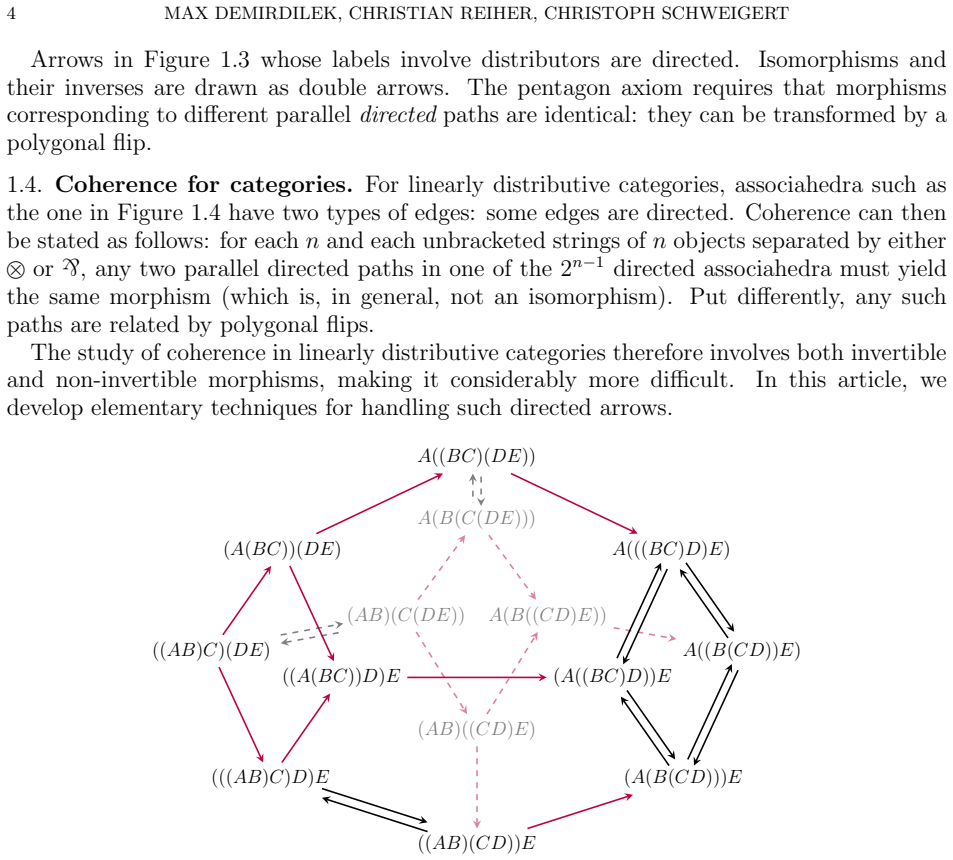
Reformulation of coherence as equality of all directed paths between given vertices in associahedra and multiplihedra.
If this is right
- All diagrams composed solely of associators and distributors commute in linearly distributive categories without units.
- The identical coherence statement holds for Frobenius linearly distributive functors that lack units.
- Coherence reduces to showing that every pair of directed paths in the associahedron or multiplihedron between matching vertices are equal.
- The combinatorial path description supplies an explicit criterion that can be checked without enumerating all possible composites.
Where Pith is reading between the lines
- The specific obstructions that units introduce could be isolated and classified in a follow-up analysis.
- The path reformulation may transfer to coherence questions for other two-tensor structures whose diagrams admit polyhedral models.
- Categories arising in linear logic without unit objects would inherit automatic commutation of all structural diagrams.
Load-bearing premise
The categories and functors are strictly without units, because the paper notes that units can create obstructions to coherence.
What would settle it
A linearly distributive category without units in which two distinct morphisms built only from associators and distributors share the same source and target.
Figures




read the original abstract
Coherence in a monoidal category asserts that all morphisms built from structural isomorphisms with a fixed source and target coincide. These structural isomorphisms include, in particular, the associators. Linearly distributive categories carry two tensor products, with structural morphisms given by associators and distributors relating the two tensor products. In several examples, including Grothendieck--Verdier categories, also known as $\ast$-autonomous categories, these distributors need not be invertible. We give a self-contained proof that linearly distributive categories without units are coherent, while units may obstruct coherence. With the same techniques, we also establish an analogous coherence result for Frobenius linearly distributive functors without units. These results admit a reformulation in terms of directed paths in associahedra and multiplihedra.
Editorial analysis
A structured set of objections, weighed in public.
Referee Report
Summary. The paper claims to provide a self-contained proof that linearly distributive categories without units are coherent, meaning all structural morphisms built from associators and distributors with fixed source and target coincide. It states that units may obstruct coherence. Using the same techniques, it establishes an analogous coherence result for Frobenius linearly distributive functors without units and reformulates both results in terms of directed paths in associahedra and multiplihedra.
Significance. If the central claims hold, the work is significant for coherence theory in monoidal and linearly distributive structures, particularly in non-unital settings relevant to *-autonomous categories and models of linear logic. The self-contained combinatorial proof avoids circularity with prior results, and the reformulation via directed paths in associahedra and multiplihedra provides a concrete geometric tool that strengthens the argument and may enable extensions.
minor comments (3)
- [Introduction] Introduction: the discussion of how units obstruct coherence would benefit from a brief concrete counterexample (even if sketched) to illustrate the distinction from the non-unital case.
- [Reformulation] The reformulation section: an explicit small example showing two distinct directed paths in an associahedron that are proven equal via the coherence argument would improve readability of the combinatorial equivalence.
- [Preliminaries] Notation: ensure consistent use of symbols for the two tensor products and the distributors throughout; a small table summarizing the structural morphisms would aid clarity.
Simulated Author's Rebuttal
We thank the referee for their positive and accurate summary of our manuscript, including the self-contained coherence proof for non-unital linearly distributive categories, the analogous result for Frobenius functors, and the reformulation via directed paths in associahedra and multiplihedra. We appreciate the recognition of the work's significance for coherence theory in non-unital settings and its potential extensions. No specific major comments were raised in the report.
Circularity Check
No significant circularity; self-contained combinatorial proof
full rationale
The paper provides a direct, self-contained proof that all structural morphisms (associators and distributors) between fixed objects coincide in linearly distributive categories without units, with the same techniques yielding an analogous result for Frobenius linearly distributive functors without units. This is reformulated equivalently as directed paths in associahedra and multiplihedra, but the reformulation follows from the proof techniques rather than presupposing the result. The explicit statement that units may obstruct coherence treats their absence as a hypothesis that avoids known obstructions, not as a derived or fitted quantity. No load-bearing self-citations, self-definitional steps, or reductions of predictions to inputs appear in the argument structure; the central claim rests on combinatorial verification from the category axioms.
Axiom & Free-Parameter Ledger
axioms (1)
- standard math Standard axioms of category theory, including associativity of composition and the definition of monoidal and linearly distributive structures.
Lean theorems connected to this paper
-
Foundation/ArithmeticOf.lean (PeanoObject.IsInitial, logicNat_initial)logicNat_initial unclearCategorical Coherence Theorem (Theorem 5.7): The free unitless linearly distributive category on a set is thin. Equivalently, every formal diagram in a unitless linearly distributive category commutes.
Reference graph
Works this paper leans on
-
[1]
and Chapman, J
Altenkirch, T. and Chapman, J. and Uustalu, T. , TITLE =. Log. Methods Comput. Sci. , FJOURNAL =. 2015 , NUMBER =
2015
-
[2]
Allen, R. , year=. Hopf algebroids and
-
[3]
and Lentner, S
Allen, R. and Lentner, S. and Schweigert, C. and Wood, S. , title =. Sel. Math., New Ser. , issn =
-
[4]
Blute, R. F. and Cockett, J. R. B. and Seely, R. A. G. and Trimble, T. H. , title =. J. Pure Appl. Algebra , issn =
-
[5]
and Drinfeld, V
Boyarchenko, M. and Drinfeld, V. , TITLE =. Quantum Topol. , FJOURNAL =. 2013 , NUMBER =
2013
-
[6]
and Garner, R
Buckley, M. and Garner, R. and Lack, S. and Street, R. , TITLE =. Math. Proc. Cambridge Philos. Soc. , FJOURNAL =. 2015 , NUMBER =
2015
-
[7]
, title =
Blanco, N. , title =. 2023 , school =
2023
-
[8]
, title =
Blute, R. , title =. Theor. Comput. Sci. , issn =
-
[9]
and Zeilberger, N
Blanco, N. and Zeilberger, N. , title =. Proceedings of the 36th conference on mathematical foundations of programming semantics, MFPS XXXVI, virtual conference, June 2--6, 2020 , pages =. 2020 , publisher =
2020
-
[10]
and Laplante-Anfossi, G
Curien, P.-L. and Laplante-Anfossi, G. , TITLE =. Cah. Topol. G\'eom. Diff\'er. Cat\'eg. , FJOURNAL =
-
[11]
Cockett, J. R. B. and Seely, R. A. G. , TITLE =. J. Pure Appl. Algebra , FJOURNAL =. 1997 , NUMBER =
1997
-
[12]
Cockett, J. R. B. and Seely, R. A. G. , title =. J. Pure Appl. Algebra , issn =
-
[13]
and Kesten, J
Czenky, A. and Kesten, J. and Quinonez, A. and Walton, C. , title =. Theory Appl. Categ. , issn =
-
[14]
, TITLE =
Dehornoy, P. , TITLE =. J. Pure Appl. Algebra , FJOURNAL =. 2005 , NUMBER =
2005
- [15]
-
[16]
Demirdilek and C
M. Demirdilek and C. Schweigert , year=
-
[17]
Proof-net categories , isbn =
Do. Proof-net categories , isbn =. 2007 , publisher =
2007
-
[18]
Proof-theoretical coherence , fseries =
Do. Proof-theoretical coherence , fseries =. 2004 , publisher =
2004
-
[19]
and Vicary, J
Dunn, L. and Vicary, J. , title =. Log. Methods Comput. Sci. , issn =
-
[20]
Epstein, D. B. A. , TITLE =. 1966 , PAGES =
1966
-
[21]
and Gubkin, S
Fiedorowicz, Z. and Gubkin, S. and Vogt, R. M. , title =. Algebr. Geom. Topol. , issn =
-
[22]
and Laugwitz, R
Flake, J. and Laugwitz, R. and Posur, S. , title =. Adv. Math. , issn =
-
[23]
, title =
Forcey, S. , title =. Topology Appl. , issn =
-
[24]
and Schaumann, G
Fuchs, J. and Schaumann, G. and Schweigert, C. and Wood, S. , title =. Quantum symmetries tensor categories, TQFTs, and vertex algebras. 2025 , publisher =
2025
-
[25]
and Schaumann, G
Fuchs, J. and Schaumann, G. and Schweigert, C. and Wood, S. , title =. Adv. Math. , issn =. 2025 , language =
2025
-
[26]
and Schweigert, C
Fuchs, J. and Schweigert, C. and Yang, Y. , title =. Theory Appl. Categ. , issn =
-
[27]
, TITLE =
Girard, J.-Y. , TITLE =. Theoret. Comput. Sci. , FJOURNAL =. 1987 , NUMBER =
1987
-
[28]
and Johnson, N
Gurski, N. and Johnson, N. , TITLE =. Compositionality , FJOURNAL =. 2025 , NUMBER =
2025
-
[29]
, title =
Haiman, M. , title =. 1984 , note =
1984
-
[30]
and Vicary, J
Heunen, C. and Vicary, J. , title =. 2019 , publisher =
2019
-
[31]
, title =
Houston, R. , title =. 2007 , school =
2007
-
[32]
Hughes, D. J. D. , title =. J. Pure Appl. Algebra , issn =
-
[33]
and Yadav, H
Jaklitsch, D. and Yadav, H. , title =. Int. Math. Res. Not. , issn =
-
[34]
, TITLE =
Kapranov, M. , TITLE =. J. Pure Appl. Algebra , FJOURNAL =. 1993 , NUMBER =
1993
-
[35]
Kelly, G. M. and MacLane, S. , title =. J. Pure Appl. Algebra , issn =
-
[36]
Laplaza, M. L. , title =. J. Pure Appl. Algebra , issn =. 1972 , language =
1972
-
[37]
and Strassburger, L
Lamarche, F. and Strassburger, L. , title =. Log. Methods Comput. Sci. , issn =
-
[38]
, title =
Lewis, G. , title =. 1972 , language =
1972
-
[39]
and Street, R
Lack, S. and Street, R. , TITLE =. Theory Appl. Categ. , FJOURNAL =. 2012 , PAGES =
2012
-
[40]
and Street, R
Lack, S. and Street, R. , TITLE =. Adv. Math. , FJOURNAL =. 2014 , PAGES =
2014
-
[41]
and Winkler, T
Lincoln, P. and Winkler, T. , title =. Theor. Comput. Sci. , issn =
-
[42]
and Ponto, K
Malkiewich, C. and Ponto, K. , TITLE =. Theory Appl. Categ. , FJOURNAL =. 2022 , PAGES =
2022
-
[43]
and Rietsch, K
Majid, S. and Rietsch, K. , title =. 2021 , eprint =
2021
-
[44]
and Woodward, C
Ma'u, S. and Woodward, C. , title =. Compos. Math. , issn =
-
[45]
and Pourcelot, H
Melani, V. and Pourcelot, H. , title =. 2026 , note =
2026
-
[46]
and Poliakova, D
Pilaud, V. and Poliakova, D. , title =. Math. Ann. , issn =
-
[47]
Power, A. J. , TITLE =. J. Pure Appl. Algebra , FJOURNAL =. 1989 , NUMBER =
1989
-
[48]
Monoidal
Rom. Monoidal. 2024 , school =
2024
-
[49]
and Umble, R
Saneblidze, S. and Umble, R. , title =. Homology Homotopy Appl. , issn =
-
[50]
, title =
Simpson, C. , title =. 1998 , eprint =
1998
-
[51]
, title =
Stasheff, J. , title =. Trans. Am. Math. Soc. , issn =. 1963 , language =
1963
-
[52]
, title =
Stasheff, J. , title =. 1970 , publisher =
1970
-
[53]
and Street, R
Joyal, A. and Street, R. , title =. Adv. Math. , issn =
-
[54]
, TITLE =
Szlach\'anyi, K. , TITLE =. Adv. Math. , FJOURNAL =. 2012 , NUMBER =
2012
-
[55]
, title =
Tamari, D. , title =. 1951 , school =
1951
-
[56]
, title =
Trimble, T. , title =. 1994 , school =
1994
-
[57]
, title =
Yadav, H. , title =. Proc. Am. Math. Soc. , issn =
discussion (0)
Sign in with ORCID, Apple, or X to comment. Anyone can read and Pith papers without signing in.