Recognition: unknown
Human-Provenance Verification should be Treated as Labor Infrastructure in AI-Saturated Markets
Pith reviewed 2026-05-08 17:01 UTC · model grok-4.3
The pith
In AI-saturated markets, verified human presence will command premiums that require treating provenance verification as core labor infrastructure.
A machine-rendered reading of the paper's core claim, the machinery that carries it, and where it could break.
Core claim
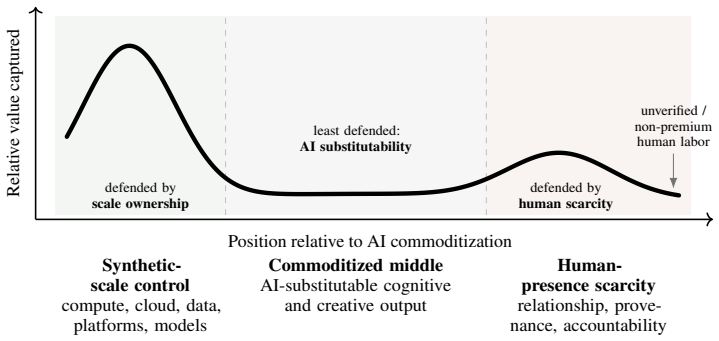
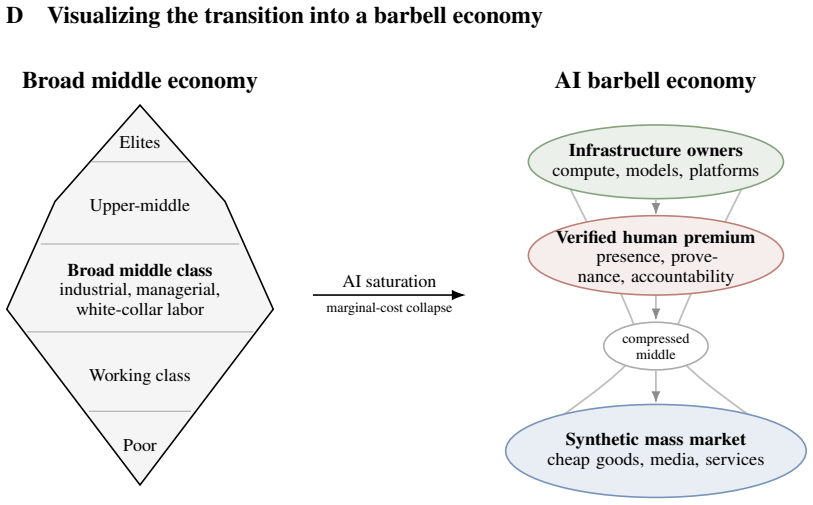
AI compresses the value of standardized middle-tier labor by making good-enough synthetic substitutes scalable at low marginal cost, hollowing out the middle of the skill distribution. This compression reallocates demand toward work valued for its visible human character, which the authors term performative humanity and divide into relational presence, aesthetic provenance, and accountability. As these premiums depend on credible verification, AI governance should treat human-provenance systems as labor infrastructure rather than luxury authenticity labels. Hybrid human-AI work retains human value when human judgment, attention, accountability, authorship, or relational participation is not
What carries the argument
Human-provenance premiums, which arise when verified human presence adds value to outputs in markets where AI supplies scalable substitutes for standardized tasks.
If this is right
- Standardized middle-tier cognitive and creative work will lose scarcity value as AI substitutes become widely available.
- Labor demand will shift toward roles where visible human character is central, including relational presence, aesthetic provenance, and accountability.
- Hybrid human-AI outputs will be valued for human elements only when those elements are constitutive of what is purchased.
- Governance should prioritize scalable verification systems as essential labor infrastructure to enable capture of human-provenance premiums.
Where Pith is reading between the lines
- Private control of verification tools could allow AI owners to gate access to human-premium markets and concentrate economic power.
- Training and education systems might need to emphasize skills in relational and accountability work over routine expertise.
- The same logic could apply to domains such as healthcare or legal services where buyer willingness to pay for verified human accountability emerges.
- Without public investment in verification, the barbell structure may reduce the overall share of income going to labor.
Load-bearing premise
AI will reliably produce scalable, good-enough substitutes for middle-tier standardized cognitive and creative tasks, driving an asymmetric reallocation of demand toward performative human labor.
What would settle it
Empirical observation that middle-tier knowledge-work wages and employment remain stable or rise as AI adoption scales, or that markets show no sustained price differential between verified human and synthetic outputs in creative and professional services.
Figures

read the original abstract
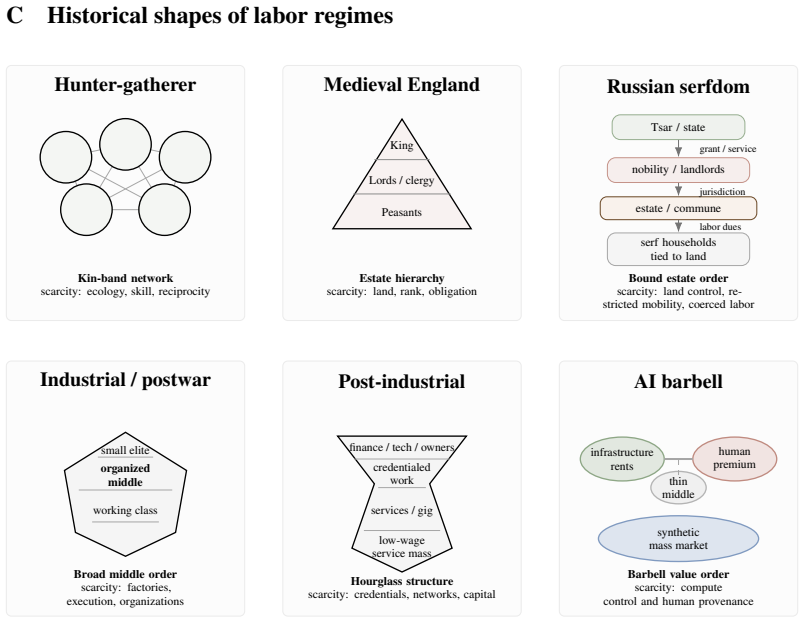
We argue that AI-saturated markets are likely to create Veblen-good premiums, which we term human-provenance premiums, for verified human presence, and hence AI governance should treat human-provenance verification as labor infrastructure. Generative and agentic AI systems lower the cost of many standardized cognitive, creative, and coordination tasks, weakening the scarcity premiums that have supported much middle-tier knowledge work. We argue that this pressure may produce an asymmetric barbell-shaped structure of value capture in advanced economies: high-volume synthetic production controlled by owners of AI infrastructure at one pole, and scarce, high-status human labor valued for verified human presence at the other. We advance three claims. First, AI compresses the value of standardized middle-tier labor by making good-enough synthetic substitutes scalable at low marginal cost, hollowing out the middle of the skill distribution currently categorized by knowledge work. Second, this compression reallocates demand for human labor toward work valued for its visible human character. We term this performative humanity and distinguish three forms of labor: relational presence, aesthetic provenance, and accountability. Third, as these premiums depend on credible verification, AI governance should treat human-provenance systems as labor infrastructure rather than as luxury authenticity labels. To evaluate hybrid human-AI work, we propose constitutive human presence as the relevant standard: human labor retains premium value when human judgment, attention, accountability, authorship, or relational participation is not incidental to the output but constitutive of what is being purchased.
Editorial analysis
A structured set of objections, weighed in public.
Referee Report
Summary. The paper claims that generative and agentic AI will compress the value of standardized middle-tier cognitive and creative labor through scalable low-cost substitutes, producing an asymmetric barbell labor market: high-volume synthetic output controlled by AI infrastructure owners at one pole, and scarce high-status human labor valued for verified presence (termed performative humanity in relational presence, aesthetic provenance, and accountability forms) at the other. It introduces human-provenance premiums and constitutive human presence as the relevant standard for hybrid work, and concludes that AI governance must treat credible human-provenance verification systems as labor infrastructure rather than luxury authenticity labels.
Significance. If the barbell structure and associated premiums materialize, the reframing would shift AI governance from regulating synthetic content to building verification infrastructure that sustains new forms of human labor value capture. The distinction between incidental and constitutive human elements provides a policy-relevant lens for evaluating hybrid systems, though the manuscript offers no empirical data, equilibrium model, or falsifiable predictions to ground the claims.
major comments (3)
- [Abstract, paragraph advancing the three claims] The second claim (reallocation toward performative humanity) and the resulting recommendation rest on the premise that AI cannot credibly scale substitutes for relational presence, aesthetic provenance, or accountability tasks; no equilibrium model, elasticity estimates, or counter-scenario analysis is supplied to derive the barbell outcome or rule out future model advances that close this gap.
- [Abstract, definition of constitutive human presence] Human-provenance premiums and constitutive human presence are defined in terms of the premium value they are intended to explain (e.g., human elements are constitutive when they retain premium value), rendering the central argument self-referential rather than independently grounded.
- [Abstract, first claim] The first claim (compression of middle-tier labor) is logically consistent with cost-reduction premises but provides no quantitative bounds, historical analogies, or falsifiable predictions to support the specific asymmetric reallocation to the three forms of performative humanity.
minor comments (2)
- [Terminology throughout] The manuscript introduces several novel terms without explicit mapping to or differentiation from existing concepts in labor economics (e.g., Veblen goods) or AI ethics (e.g., authenticity and provenance frameworks).
- [References section] No references are provided to empirical studies on AI substitution effects in knowledge work or to governance proposals for verification systems.
Simulated Author's Rebuttal
Thank you for the referee's thoughtful review. We respond to each major comment below, clarifying the conceptual nature of the paper and indicating revisions where appropriate to strengthen the argument.
read point-by-point responses
-
Referee: The second claim (reallocation toward performative humanity) and the resulting recommendation rest on the premise that AI cannot credibly scale substitutes for relational presence, aesthetic provenance, or accountability tasks; no equilibrium model, elasticity estimates, or counter-scenario analysis is supplied to derive the barbell outcome or rule out future model advances that close this gap.
Authors: We acknowledge that the manuscript does not include a formal equilibrium model or quantitative elasticity estimates, as it is a conceptual paper proposing a reframing of AI governance rather than an empirical or modeling study. The premise is based on current limitations in AI for tasks requiring genuine relational presence and accountability, supported by references in the full text to AI capability assessments. To address the concern about future advances, we will add a dedicated subsection in the revision discussing potential counter-scenarios where AI might close these gaps and the implications for the barbell structure. revision: partial
-
Referee: Human-provenance premiums and constitutive human presence are defined in terms of the premium value they are intended to explain (e.g., human elements are constitutive when they retain premium value), rendering the central argument self-referential rather than independently grounded.
Authors: This is a valid point regarding the definitional structure. We will revise the abstract and the relevant sections to first ground the concepts in observable market phenomena—such as existing premiums for human-verified services in fields like law, medicine, and creative arts—before linking them to the proposed premiums. This will make the definitions more independent and less circular. revision: yes
-
Referee: The first claim (compression of middle-tier labor) is logically consistent with cost-reduction premises but provides no quantitative bounds, historical analogies, or falsifiable predictions to support the specific asymmetric reallocation to the three forms of performative humanity.
Authors: The full manuscript does reference historical analogies from the automation of routine tasks and cites literature on labor market polarization. However, we agree that more explicit quantitative bounds and falsifiable predictions are not provided, as the paper focuses on qualitative implications for governance. In the revision, we will expand the discussion of historical analogies and clarify that the asymmetric reallocation is presented as a plausible outcome under current trends rather than a definitive prediction. revision: partial
Circularity Check
No significant circularity; conceptual argument is self-contained
full rationale
The paper advances three sequential claims about AI-driven labor compression, reallocation toward performative human labor, and the resulting policy implication for treating verification as infrastructure. These rest on posited economic premises about AI scalability and the non-mimickable character of certain human attributes rather than on any internal definitions, fitted parameters, or self-citations that reduce the conclusions to the inputs by construction. New terms such as 'human-provenance premiums' and 'constitutive human presence' are introduced to label the posited phenomena and the proposed evaluative standard, but the text does not define the premiums in terms of the infrastructure recommendation or vice versa; the 'hence' linkage follows from the stated dependence of premiums on credible verification. No equations, self-referential loops, or load-bearing citations to prior author work appear in the derivation chain. The argument is therefore a forward-looking policy analysis whose validity hinges on external empirical assumptions about AI capabilities, not on circular reduction.
Axiom & Free-Parameter Ledger
axioms (2)
- domain assumption Generative and agentic AI systems lower the cost of many standardized cognitive, creative, and coordination tasks at low marginal cost.
- domain assumption Demand for human labor will reallocate toward work valued specifically for its visible human character when synthetic substitutes are available.
invented entities (3)
-
human-provenance premiums
no independent evidence
-
performative humanity
no independent evidence
-
constitutive human presence
no independent evidence
Reference graph
Works this paper leans on
-
[1]
Macmillan, 1899
Thorstein Veblen.The Theory of the Leisure Class. Macmillan, 1899
-
[2]
Harvey Leibenstein. Bandwagon, snob, and veblen effects in the theory of consumers’ demand. The Quarterly Journal of Economics, 64(2):183–207, 1950. doi: 10.2307/1882692
-
[4]
Felten, Manav Raj, and Robert Seamans
Edward W. Felten, Manav Raj, and Robert Seamans. Occupational heterogeneity in exposure to automation: Evidence from task-based measures.Strategic Management Journal, 42(10): 1855–1870, 2021. doi: 10.1002/smj.3287
-
[5]
Generative AI and jobs: A global analysis of potential effects on job quantity and quality
Pawel Gmyrek, Janine Berg, and David Bescond. Generative AI and jobs: A global analysis of potential effects on job quantity and quality. International Labour Organization Working Paper No. 96, 2023
2023
-
[6]
AI will transform the global economy
Kristalina Georgieva. AI will transform the global economy. let’s make sure it benefits humanity. IMF Blog, 2024
2024
-
[7]
URLhttps://www.aeaweb.org/articles?id=10.1257/aer
David H. Autor and David Dorn. The growth of low-skill service jobs and the polarization of the US labor market.American Economic Review, 103(5):1553–1597, 2013. doi: 10.1257/aer. 103.5.1553
work page doi:10.1257/aer 2013
-
[8]
Maarten Goos, Alan Manning, and Anna Salomons. Explaining job polarization: Routine-biased technological change and offshoring.American Economic Review, 104(8):2509–2526, 2014. doi: 10.1257/aer.104.8.2509
-
[9]
Varian.Information Rules: A Strategic Guide to the Network Economy
Carl Shapiro and Hal R. Varian.Information Rules: A Strategic Guide to the Network Economy. Harvard Business School Press, 1999
1999
-
[10]
Polity, 2017
Nick Srnicek.Platform Capitalism. Polity, 2017
2017
-
[11]
PublicAffairs, 2019
Shoshana Zuboff.The Age of Surveillance Capitalism: The Fight for a Human Future at the New Frontier of Power. PublicAffairs, 2019
2019
-
[12]
Melville House, 2024
Yanis Varoufakis.Technofeudalism: What Killed Capitalism. Melville House, 2024
2024
-
[13]
Techno-feudalism or platform capitalism? conceptualising the digital society
Jeremy Gilbert. Techno-feudalism or platform capitalism? conceptualising the digital society. European Journal of Social Theory, 27(4):561–578, 2024. doi: 10.1177/13684310241276474
-
[14]
Douglas Bernheim
Laurie Simon Bagwell and B. Douglas Bernheim. Veblen effects in a theory of conspicuous consumption.American Economic Review, 86(3):349–373, 1996
1996
-
[15]
Christoph Fuchs, Martin Schreier, and Stijn M. J. Van Osselaer. The handmade effect: What’s love got to do with it?Journal of Marketing, 79(2):98–110, 2015. doi: 10.1509/jm.14.0018
-
[17]
Michael R. Darby and Edi Karni. Free competition and the optimal amount of fraud.Journal of Law and Economics, 16(1):67–88, 1973. doi: 10.1086/466756
-
[18]
Robert C Allen. Technical change, globalization, and the labour market: British and american experience since 1620.Oxford Open Economics, 3(Supplement 1):i178–i211, 07 2024. ISSN 2752-5074. doi: 10.1093/ooec/odad033. URL https://doi.org/10.1093/ooec/odad033
-
[19]
The trademark function of authorship.Boston University Law Review, 85(4):1171–1242, 2005
Greg Lastowka. The trademark function of authorship.Boston University Law Review, 85(4):1171–1242, 2005. URL https://www.bu.edu/law/journals-archive/bulr/ volume85n4/LASTOWKA.pdf. 10
2005
-
[20]
Economic arguments in favour of reducing copyright protection for generative ai inputs and outputs
Bertin Martens. Economic arguments in favour of reducing copyright protection for generative ai inputs and outputs. Working Paper 09/2024, Bruegel, April 2024. URL https://www. econstor.eu/bitstream/10419/297853/1/188870473X.pdf
2024
-
[21]
M.et al.Identification of short-range ordering motifs in semiconductors.Science389, 1342–1346 (2025)
Shakked Noy and Whitney Zhang. Experimental evidence on the productivity effects of generative artificial intelligence.Science, 381(6654):187–192, 2023. doi: 10.1126/science. adh2586
-
[22]
The Quarterly Journal of Economics , author =
Erik Brynjolfsson, Danielle Li, and Lindsey Raymond. Generative AI at work.The Quarterly Journal of Economics, 140(2):889–942, 2025. doi: 10.1093/qje/qjae044
-
[23]
Generative AI and jobs: A refined global index of occupational exposure
Pawel Gmyrek, Janine Berg, Karol Kami´nski, Filip Konopczy´nski, Agnieszka Ładna, Balint Nafradi, Konrad Rosłaniec, and Marek Troszy´nski. Generative AI and jobs: A refined global index of occupational exposure. ILO Working Paper 140, International Labour Organization, 2025
2025
-
[24]
Kim A. Weeden. Why do some occupations pay more than others? social closure and earnings inequality in the united states.American Journal of Sociology, 108(1):55–101, 2002. doi: 10.1086/344121
-
[25]
Stephen Lippmann and Jeffrey E. Rosenthal. Do displaced workers lose occupational prestige? Social Science Research, 37(2):642–656, 2008. doi: 10.1016/j.ssresearch.2007.08.006
-
[26]
What can machine learning do? workforce implications
Erik Brynjolfsson and Tom Mitchell. What can machine learning do? workforce implications. Science, 358(6370):1530–1534, 2017. doi: 10.1126/science.aap8062. URL https://www. science.org/doi/10.1126/science.aap8062
-
[27]
Autor, Frank Levy, and Richard J
David H. Autor, Frank Levy, and Richard J. Murnane. The skill content of recent techno- logical change: An empirical exploration.The Quarterly Journal of Economics, 118(4): 1279–1333, 2003. doi: 10.1162/003355303322552801. URL https://doi.org/10.1162/ 003355303322552801
-
[28]
Lucas Bellaiche, Rohin Shahi, Martin Harry Turpin, Anya Ragnhildstveit, Shawn Sprockett, Nathaniel Barr, Alexander Christensen, and Paul Seli. Humans versus ai: Whether and why we prefer human-created compared to ai-created artwork.Cognitive Research: Principles and Implications, 8(1):42, 2023. doi: 10.1186/s41235-023-00499-6. URL https://doi.org/10. 1186...
-
[29]
Univer- sity of California Press, 1983
Arlie Russell Hochschild.The Managed Heart: Commercialization of Human Feeling. Univer- sity of California Press, 1983
1983
-
[30]
Zelizer.The Social Meaning of Money
Viviana A. Zelizer.The Social Meaning of Money. Basic Books, New York, 1994
1994
-
[31]
Linnea Laestadius, Andrea Bishop, Michael Gonzalez, Diana Illen ˇcík, and Celeste Campos- Castillo. Too human and not human enough: A grounded theory analysis of mental health harms from emotional dependence on the social chatbot Replika.New Media & Society, 26: 5923–5941, 2024. doi: 10.1177/14614448221142007
-
[32]
Kathleen Kara Fitzpatrick, Alison Darcy, and Molly Vierhile. Delivering cognitive behavior therapy to young adults with symptoms of depression and anxiety using a fully automated conversational agent (Woebot): A randomized controlled trial.JMIR Mental Health, 4(2):e19,
-
[33]
doi: 10.2196/mental.7785
-
[34]
The New Press, New York, 2001
Nancy Folbre.The Invisible Heart: Economics and Family Values. The New Press, New York, 2001
2001
-
[35]
Contradictions of capital and care.New Left Review, 100:99–117, 2016
Nancy Fraser. Contradictions of capital and care.New Left Review, 100:99–117, 2016
2016
-
[36]
Art and the machine: Why people devalue AI-generated creative work
Graelin Mandel and Alex Imas. Art and the machine: Why people devalue AI-generated creative work. SSRN Working Paper No. 6302659, March 2026. URL https://papers.ssrn.com/ sol3/papers.cfm?abstract_id=6302659
2026
-
[37]
Morris M. Kleiner. Occupational licensing.Journal of Economic Perspectives, 14(4):189–202,
-
[38]
URLhttps://doi.org/10.1257/jep.14.4.189
doi: 10.1257/jep.14.4.189. URLhttps://doi.org/10.1257/jep.14.4.189. 11
-
[39]
The Review of Economic Studies , author =
Carl Shapiro. Investment, moral hazard, and occupational licensing.The Review of Economic Studies, 53(5):843–862, 1986. doi: 10.2307/2297722. URL https://doi.org/10.2307/ 2297722
-
[40]
Regulation (EU) 2024/1689 of the european parliament and of the council of 13 june 2024 laying down harmonised rules on artificial intelligence (Artificial Intelligence Act)
European Union. Regulation (EU) 2024/1689 of the european parliament and of the council of 13 june 2024 laying down harmonised rules on artificial intelligence (Artificial Intelligence Act). Official Journal of the European Union, 2024
2024
-
[41]
David H. Autor. The task approach to labor markets: An overview.Journal for Labour Market Research, 46(3):185–199, 2013. doi: 10.1007/s12651-013-0128-z. URL https: //doi.org/10.1007/s12651-013-0128-z
-
[42]
George E. Newman and Paul Bloom. Art and authenticity: The importance of originals in judgments of value.Journal of Experimental Psychology: General, 141(3):558–569, 2012. doi: 10.1037/a0026035. URLhttps://doi.org/10.1037/a0026035
-
[43]
University of Chicago Press, Chicago, 2001
Eliot Freidson.Professionalism: The Third Logic: On the Practice of Knowledge. University of Chicago Press, Chicago, 2001. ISBN 9780226262031
2001
-
[44]
Celeste M. Brotheridge and Alicia A. Grandey. Emotional labor and burnout: Comparing two perspectives of people work.Journal of Vocational Behavior, 60(1):17–39, 2002. doi: 10.1006/jvbe.2001.1815. URLhttps://doi.org/10.1006/jvbe.2001.1815
-
[45]
Ute R. Hülsheger and Anna F. Schewe. On the costs and benefits of emotional labor: A meta-analysis of three decades of research.Journal of Occupational Health Psychology, 16(3): 361–389, 2011. doi: 10.1037/a0022876. URLhttps://doi.org/10.1037/a0022876
-
[46]
Zelizer.The Purchase of Intimacy
Viviana A. Zelizer.The Purchase of Intimacy. Princeton University Press, Princeton, NJ, 2005. ISBN 9780691124085
2005
-
[47]
Stanford University Press, Stanford, CA, 2010
Eileen Boris and Rhacel Salazar Parreñas, editors.Intimate Labors: Cultures, Technologies, and the Politics of Care. Stanford University Press, Stanford, CA, 2010. ISBN 9780804761932
2010
-
[48]
About cara, 2022
Cara Project. About cara, 2022. URLhttps://blog.cara.app/about
2022
-
[49]
Artificial intelligence, 2025
Writers Guild of America West. Artificial intelligence, 2025. URL https://www.wga.org/ contracts/know-your-rights/artificial-intelligence
2025
-
[50]
Harvard University Press, Cambridge, MA, 1976
Fred Hirsch.Social Limits to Growth. Harvard University Press, Cambridge, MA, 1976
1976
-
[51]
Journal of Political Economy , author =
Daron Acemoglu and Pascual Restrepo. Robots and jobs: Evidence from US labor markets. Journal of Political Economy, 128(6):2188–2244, 2020. doi: 10.1086/705716
-
[52]
Recommendation on the ethics of artificial intelligence
UNESCO. Recommendation on the ethics of artificial intelligence. Technical report, United Nations Educational, Scientific and Cultural Organization, Paris, November 2021. URL https: //unesdoc.unesco.org/ark:/48223/pf0000381137. Adopted by UNESCO’s General Conference at its 41st session on 23 November 2021
2021
-
[53]
Daron Acemoglu and Pascual Restrepo. Automation and new tasks: How technology displaces and reinstates labor.Journal of Economic Perspectives, 33(2):3–30, 2019. doi: 10.1257/jep.33. 2.3. URLhttps://doi.org/10.1257/jep.33.2.3
-
[54]
Automation, bargaining power, and labor market fluctuations
Sylvain Leduc and Zheng Liu. Automation, bargaining power, and labor market fluctuations. American Economic Journal: Macroeconomics, 16(4):311–349, 2024. doi: 10.1257/mac. 20220181. URLhttps://doi.org/10.1257/mac.20220181
work page doi:10.1257/mac 2024
-
[55]
Colleen P. Kirk and Julian Givi. The ai-authorship effect: Understanding authenticity, moral disgust, and consumer responses to ai-generated marketing communications.Journal of Business Research, 186:114984, 2025. doi: 10.1016/j.jbusres.2024.114984. URL https://doi.org/ 10.1016/j.jbusres.2024.114984
-
[56]
Artificial intelligence risk management framework (AI RMF 1.0)
Elham Tabassi. Artificial intelligence risk management framework (AI RMF 1.0). National Institute of Standards and Technology, 2023. 12
2023
-
[57]
C2PA and content credentials ex- plainer
Coalition for Content Provenance and Authenticity. C2PA and content credentials ex- plainer. C2PA Technical Specification Explainer, 2024. URL https://spec.c2pa.org/ specifications/specifications/2.4/explainer/Explainer.html
2024
-
[58]
S., Kumar, A., Balasubramanian, S., Wang, W., and Feizi, S
Vinu Sankar Sadasivan, Aounon Kumar, Sriram Balasubramanian, Wenxiao Wang, and Soheil Feizi. Can ai-generated text be reliably detected?, 2023. URL https://arxiv.org/abs/ 2303.11156
-
[59]
Watermarking needs input repetition masking, 2025
David Khachaturov, Robert Mullins, Ilia Shumailov, and Sumanth Dathathri. Watermarking needs input repetition masking, 2025. URLhttps://arxiv.org/abs/2504.12229
-
[60]
Chandra et al
B. Chandra et al. Reducing risks posed by synthetic content: An overview of technical approaches to digital content transparency. Technical Report NIST AI 100-4, National Institute of Standards and Technology, 2024. URLhttps://www.nist.gov/publications/ reducing-risks-posed-synthetic-content-overview-technical-approaches-digital-content
2024
-
[61]
Can companies arbitrarily reduce pay and terminate contracts amid the ai wave? a hangzhou intermediate people’s court press conference gives the final word, 2026
Jiawei Xu, Lan Wei, and Jialing Song. Can companies arbitrarily reduce pay and terminate contracts amid the ai wave? a hangzhou intermediate people’s court press conference gives the final word, 2026. URL https://ori.hangzhou.com.cn/ornews/content/2026-04/29/ content_9214417.htm
2026
-
[62]
Generative AI and the SME workforce: New survey evidence
OECD. Generative AI and the SME workforce: New survey evidence. OECD Publishing, 2025
2025
-
[63]
Michael Spence
A. Michael Spence. Job market signaling.The Quarterly Journal of Economics, 87(3):355–374,
-
[64]
13 A Summary of paper’s core claims Table 2: Evidentiary status of the paper’s core claims
doi: 10.2307/1882010. 13 A Summary of paper’s core claims Table 2: Evidentiary status of the paper’s core claims. Claim Evidence currently available Status AI reduces the cost of standard- ized cognitive work Task-level productivity studies and information-goods cost theory [ 21, 22, 9] Supported as mechanism Middle-tier labor loses scarcity premium Occup...
discussion (0)
Sign in with ORCID, Apple, or X to comment. Anyone can read and Pith papers without signing in.