Recognition: unknown
Partial Effective Information Decomposition for Synergistic Causality
Pith reviewed 2026-05-07 13:33 UTC · model grok-4.3
The pith
A decomposition framework separates unique and synergistic causal influences using maximum-entropy interventions on source variables.
A machine-rendered reading of the paper's core claim, the machinery that carries it, and where it could break.
Core claim
The authors claim that Partial Effective Information Decomposition (PEID) provides a computable, interventionist way to quantify synergistic causal relations by decomposing the influence of multiple source variables on a target under maximum-entropy interventions into unique and synergistic information. In the three-variable case, this decomposition is compatible with the major axioms of Partial Information Decomposition. Under the interventions, correlations among inputs are removed so that redundancy vanishes, enabling the isolation of synergy. The framework also allows causal graphs to incorporate hyperedges and downward causation, supplying a unified approach for multivariate and cross-
What carries the argument
Partial Effective Information Decomposition (PEID), a measure that splits effective information from sources to a target into unique and synergistic terms based on maximum-entropy interventions that eliminate correlations among the sources.
If this is right
- PEID is compatible with major PID axioms in the three-variable case.
- Redundancy vanishes under maximum-entropy interventions because correlations among sources are removed.
- Causal graphs can be defined that include hyperedges as well as downward causation.
- The framework offers a unified toolkit for analyzing cross-scale and multivariate causal mechanisms.
- PEID can extract interpretable inter-station causal structures from learned dynamical models in forecasting tasks.
Where Pith is reading between the lines
- The method could be tested in domains beyond air quality, such as neural networks or biological networks, to see if synergistic relations match known mechanisms.
- Extending the compatibility check to more than three variables might reveal whether the framework generalizes while preserving the interventionist interpretation.
- Integrating PEID with existing causal discovery algorithms could provide a way to both detect and quantify synergistic links in data.
Load-bearing premise
That maximum-entropy interventions on the source variables remove all correlations among them and isolate synergistic causal relations without introducing new artifacts or losing the original causal structure.
What would settle it
Observe a three-variable system known to have synergistic causality where, after applying maximum-entropy interventions to the sources, the resulting PEID values violate one of the standard PID axioms such as non-negativity of the synergistic term.
Figures


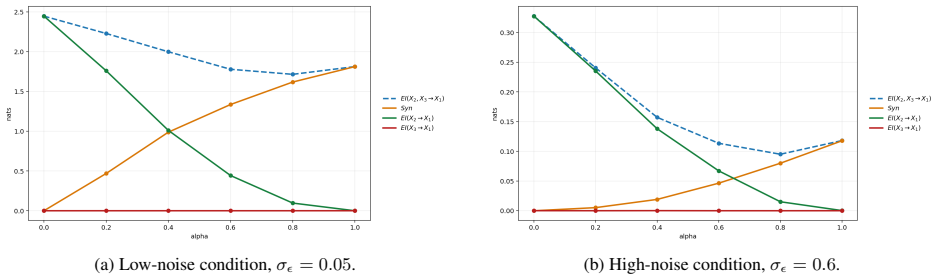


read the original abstract
Causality is a central topic in scientific inquiry, yet for complex systems, the identification and analysis of synergistic causation remain a challenging and fundamental problem. In the context of causal relations among multivariate variables, a decomposition framework grounded in interventionist causation is still lacking. To address this gap, this paper proposes Partial Effective Information Decomposition (PEID), a framework that decomposes the influence of multiple source variables on a target variable under maximum-entropy interventions into unique and synergistic information, thereby providing a unified and computable characterization of synergistic causal relations. Theoretically, in the three-variable case, the proposed framework is compatible with the major axioms of Partial Information Decomposition (PID). Empirically, under maximum-entropy interventions, correlations among input variables are removed, causing redundancy to vanish and thereby enabling PEID to compute synergistic relations. Furthermore, based on this framework, it is possible to define causal graphs containing hyperedges as well as downward causation, thus offering a unified toolkit for analyzing cross-scale and multivariate causal mechanisms in complex systems. Finally, applying the framework to a machine-learning-based air quality forecasting task on KnowAir-V2, we demonstrate that PEID can extract interpretable inter-station causal structures from a learned dynamical model. These results suggest that PEID provides a general interventionist information-theoretic tool for analyzing multivariate and synergistic causal mechanisms in complex systems.
Editorial analysis
A structured set of objections, weighed in public.
Referee Report
Summary. The manuscript proposes Partial Effective Information Decomposition (PEID) to decompose the influence of multiple source variables on a target under maximum-entropy interventions into unique and synergistic components. It asserts compatibility with the major axioms of Partial Information Decomposition (PID) in the three-variable case, claims that max-entropy interventions remove correlations among sources so that redundancy vanishes, and extends the framework to define causal graphs containing hyperedges and downward causation. The approach is demonstrated by extracting interpretable inter-station causal structures from a learned dynamical model on the KnowAir-V2 air-quality forecasting dataset.
Significance. If the central claims hold after clarification of the intervention step, PEID would supply a computable interventionist information-theoretic tool for synergistic causality in multivariate settings. The empirical application to interpreting a machine-learned dynamical model is a concrete strength that could be extended to other domains requiring cross-scale causal analysis.
major comments (2)
- [§3] §3 (Theoretical Framework): The assertion that PEID is compatible with the major PID axioms in the three-variable case is stated without an explicit derivation or proof. The manuscript must supply the step-by-step argument showing how the decomposed terms satisfy the PID axioms (non-negativity, monotonicity, etc.) under the chosen intervention, rather than relying on the abstract claim alone.
- [§3.2] §3.2 (Maximum-Entropy Intervention): The central claim that max-entropy interventions on the sources isolate synergistic causal relations rests on the unexamined equivalence between the original joint P(X,Y,Z) and the intervened measure P'(X,Y,Z). The manuscript does not show that the conditional P'(Z|X,Y) preserves the original synergistic influence rather than replacing it with an artifact induced by forcing uniform source marginals; this substitution is load-bearing for both the vanishing-redundancy argument and the subsequent extension to hyperedges and downward causation.
minor comments (2)
- [§3] Notation for effective information and the decomposed terms should be introduced with explicit definitions before first use in §3 to avoid ambiguity with standard PID notation.
- [§5] The empirical section would benefit from a quantitative comparison of PEID values against at least one existing PID estimator on the same KnowAir-V2 model to demonstrate added value beyond the qualitative graph extraction.
Simulated Author's Rebuttal
We thank the referee for the constructive comments, which highlight areas where the theoretical foundations of PEID require further elaboration. We agree that explicit derivations and justifications are needed and will revise the manuscript accordingly to strengthen these sections.
read point-by-point responses
-
Referee: [§3] §3 (Theoretical Framework): The assertion that PEID is compatible with the major PID axioms in the three-variable case is stated without an explicit derivation or proof. The manuscript must supply the step-by-step argument showing how the decomposed terms satisfy the PID axioms (non-negativity, monotonicity, etc.) under the chosen intervention, rather than relying on the abstract claim alone.
Authors: We agree that the compatibility claim requires an explicit step-by-step derivation rather than an abstract assertion. In the revised manuscript we will add a dedicated subsection (or appendix) that starts from the definitions of effective information under the maximum-entropy intervention, derives the unique and synergistic components, and verifies each major PID axiom in turn: non-negativity of all terms, monotonicity with respect to source sets, and consistency with the mutual information I(Z;X,Y) under the intervened measure. The argument will proceed by direct substitution of the intervened joint into the standard PID lattice and showing that the resulting quantities inherit the required inequalities. revision: yes
-
Referee: [§3.2] §3.2 (Maximum-Entropy Intervention): The central claim that max-entropy interventions on the sources isolate synergistic causal relations rests on the unexamined equivalence between the original joint P(X,Y,Z) and the intervened measure P'(X,Y,Z). The manuscript does not show that the conditional P'(Z|X,Y) preserves the original synergistic influence rather than replacing it with an artifact induced by forcing uniform source marginals; this substitution is load-bearing for both the vanishing-redundancy argument and the subsequent extension to hyperedges and downward causation.
Authors: We acknowledge that the intervention step must be justified more rigorously. In the revision we will expand §3.2 with an explicit argument showing that the maximum-entropy intervention replaces only the source marginals with uniform distributions while leaving the conditional P(Z|X,Y) unchanged. Because the synergistic component is defined as the excess information in P(Z|X,Y) that cannot be attributed to either source individually, this excess remains invariant under the marginal change; the intervention merely eliminates the redundant information that arose from source correlations in the observational measure. We will provide the corresponding algebraic identity relating the original and intervened synergistic terms and show that the vanishing-redundancy property follows directly, thereby supporting the subsequent definitions of hyperedges and downward causation. revision: yes
Circularity Check
No circularity; PEID is an explicit modeling choice on intervened distributions
full rationale
The paper defines PEID as a decomposition of effective information under deliberately chosen maximum-entropy interventions that remove source correlations by construction. This is presented as a deliberate framework choice rather than a result derived from the target quantities. Compatibility with PID axioms is asserted as a theoretical property in the three-variable case, and the air-quality forecasting application supplies an external check on the learned model. No load-bearing self-citation, ansatz smuggling, or reduction of a claimed prediction to a fitted input is exhibited. The derivation remains self-contained against the stated interventionist assumptions.
Axiom & Free-Parameter Ledger
Reference graph
Works this paper leans on
-
[1]
C. W. J. Granger. Investigating causal relations by econometric models and cross-spectral methods.Econometrica, 37(3):424–438, 1969. 16
1969
-
[2]
Ali Shojaie and Emily B. Fox. Granger causality: A review and recent advances.Annual Review of Statistics and Its Application, 9(1):289–319, 2022
2022
-
[3]
Causal inference in statistics: An overview.Statistics Surveys, 3:96–146, 2009
Judea Pearl. Causal inference in statistics: An overview.Statistics Surveys, 3:96–146, 2009
2009
-
[4]
Decomposing causality into its synergis- tic, unique, and redundant components.Nature Communications, 15, 2024
Álvaro Martínez-Sánchez, Gonzalo Arranz, and Adri’an Lozano-Dur’an. Decomposing causality into its synergis- tic, unique, and redundant components.Nature Communications, 15, 2024
2024
-
[5]
Emergence and causality in complex systems: A survey of causal emergence and related quantitative studies.Entropy, 26, 2024
Bing Yuan, Jiang Zhang, Aobo Lyu, Jiayun Wu, Zhipeng Wang, Mingzhe Yang, Kaiwei Liu, Muyun Mou, and Peng Cui. Emergence and causality in complex systems: A survey of causal emergence and related quantitative studies.Entropy, 26, 2024
2024
-
[6]
Nonnegative Decomposition of Multivariate Information
Paul L. Williams and Randall D. Beer. Nonnegative decomposition of multivariate information.ArXiv, abs/1004.2515, 2010
work page Pith review arXiv 2010
-
[7]
Pedro A. M. Mediano, Fernando E. Rosas, Andrea I. Luppi, Robin L. Carhart-Harris, Daniel Bor, Anil K. Seth, and Adam B Barrett. Toward a unified taxonomy of information dynamics via integrated information decomposition. Proceedings of the National Academy of Sciences of the United States of America, 122, 2025
2025
-
[8]
Shared information—new insights and problems in decomposing information in complex systems
Nils Bertschinger, Johannes Rauh, Eckehard Olbrich, and Jürgen Jost. Shared information—new insights and problems in decomposing information in complex systems. InProceedings of the European Conference on Complex Systems 2012, Springer Proceedings in Complexity, pages 251–269. Springer, Dordrecht, 2013
2012
-
[9]
Bivariate measure of redundant information.Physical Review E, 87(1):012130, 2013
Malte Harder, Christoph Salge, and Daniel Polani. Bivariate measure of redundant information.Physical Review E, 87(1):012130, 2013
2013
-
[10]
Conor Finn and Joseph T. Lizier. Pointwise partial information decomposition using the specificity and ambiguity lattices.Entropy, 20(4):297, 2018
2018
-
[11]
Michael Eichler. Causal inference with multiple time series: principles and problems.Philosophical Transactions of the Royal Society A: Mathematical, Physical and Engineering Sciences, 371(1997):20110613, 2013
1997
-
[12]
Stokes and Patrick L
Patrick A. Stokes and Patrick L. Purdon. A study of problems encountered in granger causality analysis from a neuroscience perspective.Proceedings of the National Academy of Sciences, 114(34):E7063–E7072, 2017
2017
-
[13]
Hoel, Larissa Albantakis, and Giulio Tononi
Erik P. Hoel, Larissa Albantakis, and Giulio Tononi. Quantifying causal emergence shows that macro can beat micro.Proceedings of the National Academy of Sciences, 110:19790 – 19795, 2013
2013
-
[14]
Rosas, Pedro A
Fernando E. Rosas, Pedro A. M. Mediano, Henrik Jeldtoft Jensen, Anil. K. Seth, Adam B. Barrett, Robin L. Carhart-Harris, and Daniel Bor. Reconciling emergences: An information-theoretic approach to identify causal emergence in multivariate data.PLoS Computational Biology, 16, 2020
2020
-
[15]
Types and forms of emergence.arXiv: Adaptation and Self-Organizing Systems, 2005
Jochen Fromm. Types and forms of emergence.arXiv: Adaptation and Self-Organizing Systems, 2005
2005
-
[16]
Erik P. Hoel. When the map is better than the territory.Entropy, 19(5):188, 2017
2017
-
[17]
Dynamical reversibility and a new theory of causal emergence based on svd.npj Complexity, 2, 2024
Jiang Zhang, Ruyi Tao, Keng Hou Leong, Mingzhe Yang, and Bing Yuan. Dynamical reversibility and a new theory of causal emergence based on svd.npj Complexity, 2, 2024
2024
-
[18]
Rubenstein, Sebastian Weichwald, Stephan Bongers, Joris M
Paul K. Rubenstein, Sebastian Weichwald, Stephan Bongers, Joris M. Mooij, Dominik Janzing, Moritz Grosse- Wentrup, and Bernhard Schölkopf. Causal consistency of structural equation models.ArXiv, abs/1707.00819, 2017
-
[19]
Fabio Massimo Zennaro, Paolo Turrini, and Theodoros Damoulas. Quantifying consistency and information loss for causal abstraction learning.ArXiv, abs/2305.04357, 2023
-
[20]
Toward causal representation learning.Proceedings of the IEEE, 109(5):612–634, 2021
Bernhard Sch"olkopf, Francesco Locatello, Stefan Bauer, Nan Rosemary Ke, Nal Kalchbrenner, Anirudh Goyal, and Yoshua Bengio. Toward causal representation learning.Proceedings of the IEEE, 109(5):612–634, 2021
2021
-
[21]
Measuring information integration.BMC Neuroscience, 4:31 – 31, 2003
Giulio Tononi and Olaf Sporns. Measuring information integration.BMC Neuroscience, 4:31 – 31, 2003
2003
-
[22]
An information integration theory of consciousness.BMC Neuroscience, 5:42 – 42, 2004
Giulio Tononi. An information integration theory of consciousness.BMC Neuroscience, 5:42 – 42, 2004
2004
-
[23]
Integrated information in discrete dynamical systems: Motivation and theoretical framework.PLoS Computational Biology, 4, 2008
David Balduzzi and Giulio Tononi. Integrated information in discrete dynamical systems: Motivation and theoretical framework.PLoS Computational Biology, 4, 2008
2008
-
[24]
What caused what? a quantitative account of actual causation using dynamical causal networks.Entropy, 21(5):459, 2019
Larissa Albantakis, William Marshall, Erik Hoel, and Giulio Tononi. What caused what? a quantitative account of actual causation using dynamical causal networks.Entropy, 21(5):459, 2019
2019
-
[25]
Higher order definition of causality by optimally conditioned transfer entropy.Physical Review E, 111(4):L042302, 2025
Jakub Ko ˇrenek, Pavel Sanda, and Jaroslav Hlinka. Higher order definition of causality by optimally conditioned transfer entropy.Physical Review E, 111(4):L042302, 2025
2025
-
[26]
Cyclic and multilevel causation in evolutionary processes.Biology & Philosophy, 35(5):50, 2020
Jonathan Warrell and Mark Gerstein. Cyclic and multilevel causation in evolutionary processes.Biology & Philosophy, 35(5):50, 2020. 17
2020
-
[27]
Luppi, Pedro A
Andrea I. Luppi, Pedro A. M. Mediano, Fernando E. Rosas, David J. Harrison, Robin L. Carhart-Harris, Daniel Bor, and Emmanuel A. Stamatakis. What it is like to be a bit: an integrated information decomposition account of emergent mental phenomena.Neuroscience of Consciousness, 2021(2):niab027, 2021
2021
-
[28]
Varley and Erik Hoel
Thomas F. Varley and Erik Hoel. Emergence as the conversion of information: a unifying theory.Philosophical Transactions of the Royal Society A: Mathematical, Physical and Engineering Sciences, 380:20210150, 2022
2022
-
[29]
Thomas F. Varley. A synergistic perspective on multivariate computation and causality in complex systems. Entropy, 26(10):883, 2024
2024
-
[30]
Luca Faes, Gorana Mijatovic, Riccardo Pernice, Daniele Marinazzo, Sebastiano Stramaglia, and Yuri Antonacci. Dissecting spectral granger causality through partial information decomposition.arXiv preprint arXiv:2603.07634, 2026
-
[31]
Synergy and redundancy in the granger causal analysis of dynamical networks.New Journal of Physics, 16(10):105003, 2014
Sebastiano Stramaglia, Jesus M Cortes, and Daniele Marinazzo. Synergy and redundancy in the granger causal analysis of dynamical networks.New Journal of Physics, 16(10):105003, 2014
2014
-
[32]
Pedro AM Mediano, Fernando E Rosas, Andrea I Luppi, Henrik J Jensen, Anil K Seth, Adam B Barrett, Robin L Carhart-Harris, and Daniel Bor. Greater than the parts: a review of the information decomposition approach to causal emergence.Philosophical Transactions of the Royal Society A: Mathematical, Physical and Engineering Sciences, 380(2227), 2022
2022
-
[33]
Measuring integrated information from the decoding perspective.PLOS Computational Biology, 12(1):e1004654, 2016
Masafumi Oizumi, Shun-ichi Amari, Toru Yanagawa, Naotaka Fujii, and Naotsugu Tsuchiya. Measuring integrated information from the decoding perspective.PLOS Computational Biology, 12(1):e1004654, 2016
2016
-
[34]
Foundation models for time series analysis: A tutorial and survey
Yuxuan Liang, Haomin Wen, Yuqi Nie, Yushan Jiang, Ming Jin, Dongjin Song, Shirui Pan, and Qingsong Wen. Foundation models for time series analysis: A tutorial and survey. InProceedings of the 30th ACM SIGKDD conference on knowledge discovery and data mining, pages 6555–6565, 2024
2024
-
[35]
Deep Time Series Models: A Comprehensive Survey and Benchmark
Yuxuan Wang, Haixu Wu, Jiaxiang Dong, Yong Liu, Chen Wang, Mingsheng Long, and Jianmin Wang. Deep time series models: A comprehensive survey and benchmark.arXiv preprint arXiv:2407.13278, 2024
work page internal anchor Pith review Pith/arXiv arXiv 2024
-
[36]
Estimating the mean and variance of the target probability distribution
David A Nix and Andreas S Weigend. Estimating the mean and variance of the target probability distribution. In Proceedings of 1994 ieee international conference on neural networks (ICNN’94), volume 1, pages 55–60. IEEE, 1994
1994
-
[37]
Optimal training of mean variance estimation neural networks
Laurens Sluijterman, Eric Cator, and Tom Heskes. Optimal training of mean variance estimation neural networks. Neurocomputing, 597:127929, 2024
2024
-
[38]
Neural information squeezer for causal emergence.Entropy, 25, 2022
Jiang Zhang. Neural information squeezer for causal emergence.Entropy, 25, 2022
2022
-
[39]
Finding emergence in data by maximizing effective information.National Science Review, 12(1):nwae279, 2025
Mingzhe Yang, Zhipeng Wang, Kaiwei Liu, Yingqi Rong, Bing Yuan, and Jiang Zhang. Finding emergence in data by maximizing effective information.National Science Review, 12(1):nwae279, 2025
2025
-
[40]
Quantifying system-environment synergistic information by effective information decomposition.Digital Technologies Research and Applications, 4(3):22–34, 2025
Mingzhe Yang, Linli Pan, and Jiang Zhang. Quantifying system-environment synergistic information by effective information decomposition.Digital Technologies Research and Applications, 4(3):22–34, 2025
2025
-
[41]
Multivariate partial information decomposition: Constructions, inconsistencies, and alternative measures.Physical Review E, 113(3), 2026
Aobo Lyu, Andrew Clark, and Netanel Raviv. Multivariate partial information decomposition: Constructions, inconsistencies, and alternative measures.Physical Review E, 113(3), 2026
2026
-
[42]
Pedro A. M. Mediano, Anil K. Seth, and Adam B. Barrett. Measuring integrated information: Comparison of candidate measures in theory and simulation.Entropy, 21(1):17, 2019
2019
-
[43]
On the representation and learning of monotone triangular transport maps.Foundations of Computational Mathematics, 24(6):2063–2108, 2024
Ricardo Baptista, Youssef Marzouk, and Olivier Zahm. On the representation and learning of monotone triangular transport maps.Foundations of Computational Mathematics, 24(6):2063–2108, 2024
2063
-
[44]
Knowair-v2: A benchmark dataset for air quality forecasting with pcdcnet, jun 2025
Shuo Wang, Yun Cheng, Qingye Meng, Olga Saukh, Jiang Zhang, Jingfang Fan, Yuanting Zhang, Xingyuan Yuan, and Lothar Thiele. Knowair-v2: A benchmark dataset for air quality forecasting with pcdcnet, jun 2025
2025
-
[45]
Spatial and temporal characteristics of ozone pollution and sensitivity analysis of its influencing factors in hangzhou
Huansang Chen, Kexin Yan, Jingyi Qiu, Mengjing Zhu, Yuting He, Ru Yi, Mingjuan Shi, and Tao Ding. Spatial and temporal characteristics of ozone pollution and sensitivity analysis of its influencing factors in hangzhou. Polish Journal of Environmental Studies, 2026. Online publication date: 2026-03-04
2026
-
[46]
Z. S. Han, H. N. Liu, B. Yu, and X. Y . Wang. The effects of coastal local circulations and their interactions on ozone pollution in the hangzhou metropolitan area.Urban Climate, 48:101417, mar 2023
2023
-
[47]
Air pollution characteristics and meteorologi- cal correlates in lin’an, hangzhou, china.Aerosol and Air Quality Research, 19:2770–2780, 2019
Xintao Lin, Jian Chen, Ting Lu, Dongming Huang, and Jing Zhang. Air pollution characteristics and meteorologi- cal correlates in lin’an, hangzhou, china.Aerosol and Air Quality Research, 19:2770–2780, 2019
2019
-
[48]
Xin Wang, Yu Han, Xiang Tu, Jiandong Shen, Baojun Zhang, and Hongbo Fu. Distribution of volatile organic compounds (vocs) in the urban atmosphere of hangzhou, east china: Temporal variation, source attribution, and impact on the secondary formations of ozone and aerosol.Frontiers in Environmental Science, 12:1418948, 2024. 18
2024
-
[49]
Pm2.5 pollution modulates the response of ozone formation to voc emitted from various sources: Insights from machine learning.Science of the Total Environment, 916:170009, 2024
Chenliang Tao, Qingzhu Zhang, Sisi Huo, Yuchao Ren, Shuyan Han, Qiao Wang, and Wenxing Wang. Pm2.5 pollution modulates the response of ozone formation to voc emitted from various sources: Insights from machine learning.Science of the Total Environment, 916:170009, 2024
2024
-
[50]
Tropospheric ozone and its natural precursors impacted by climatic changes in emission and dynamics.Frontiers in Environmental Science, 10:1007942, 2022
Surat Dewan and Anita Lakhani. Tropospheric ozone and its natural precursors impacted by climatic changes in emission and dynamics.Frontiers in Environmental Science, 10:1007942, 2022
2022
-
[51]
representative non-optimal coarse-graining
Shuo Wang, Yun Cheng, Qingye Meng, Olga Saukh, Jiang Zhang, Jingfang Fan, Yuanting Zhang, Xingyuan Yuan, and Lothar Thiele. Pcdcnet: A surrogate model for air quality forecasting with physical-chemical dynamics and constraints.arXiv preprint arXiv:2505.19842, 2025. A PID axiomatic background This appendix briefly reviews the axiomatic language of partial ...
discussion (0)
Sign in with ORCID, Apple, or X to comment. Anyone can read and Pith papers without signing in.