Recognition: unknown
Asymptotic properties of random monomial ideals
Pith reviewed 2026-05-07 04:14 UTC · model grok-4.3
The pith
The LCM-lattice density of random monomial ideals exhibits sharp threshold behavior that separates three distinct regimes rather than changing smoothly.
A machine-rendered reading of the paper's core claim, the machinery that carries it, and where it could break.
Core claim
In random families of monomial ideals the poset density of the LCM-lattice undergoes sharp threshold behavior that abruptly separates a low-density Taylor-like regime, a high-density redundant regime, and a narrow transition window; the transition point moves to lower probabilities when generator degree increases. For equigenerated squarefree monomial ideals the density is conjectured to exhibit a phase transition of the same kind that governs the emergence of giant components in random hypergraphs.
What carries the argument
The poset density of the LCM-lattice, defined as the proportion of comparable pairs among the least common multiples of the generators, which serves as a combinatorial measure of redundancy and resolution complexity.
If this is right
- Redundancy and resolution-complexity indicators concentrate into distinct typical regimes inside natural random families of monomial ideals.
- The LCM-lattice functions as a statistical invariant whose value can be predicted from the number and degree of generators once the regime is known.
- For equigenerated squarefree ideals the transition in density is expected to be as sharp as the percolation threshold in random hypergraphs.
- Increasing generator degree shifts the entire threshold curve to lower probabilities, tightening the window of typical behavior.
- Classical ideal-by-ideal invariants therefore admit an asymptotic counterpart that concentrates on a small number of typical values.
Where Pith is reading between the lines
- The observed regimes may guide probabilistic algorithms that simplify random ideals by first detecting which density phase they occupy.
- Similar threshold phenomena are likely to appear in other algebraic invariants such as Betti tables or syzygy modules when the same random models are applied.
- The hypergraph analogy suggests that tools from random combinatorial structures could be imported to prove the conjectured phase transition for squarefree ideals.
- Systematic sampling at larger scales could test whether the three-regime picture persists when the number of variables grows with the number of generators.
Load-bearing premise
The chosen random algebraic models and network constructions produce LCM-lattice densities that are representative of the asymptotic behavior of monomial ideals in general.
What would settle it
A smooth, gradual change in LCM-lattice density with increasing number of generators, instead of abrupt jumps that create three separated regimes, would falsify the sharp-threshold claim.
Figures


read the original abstract
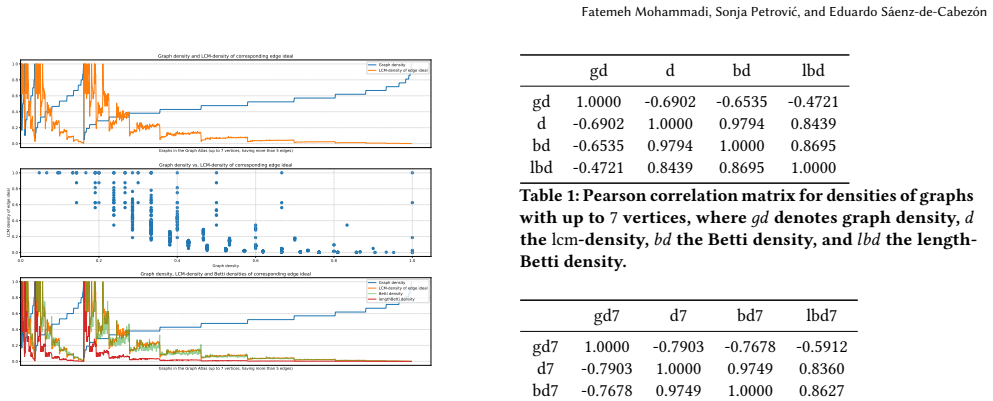
This paper focuses on asymptotic properties of random monomial ideals through a statistical viewpoint. It extends the study of redundancy in monomial ideals by analyzing the poset density of the LCM-lattice. We explore how this density behaves across random algebraic models and structured networks. Experimental data reveal that the LCM-lattice exhibits sharp threshold behavior rather than changing smoothly. We observe a strong negative correlation between the number of generators and LCM-lattice density, abruptly separating three distinct regimes: a low-density Taylor-like regime, a high-density redundant regime, and a narrow transition window. We show that increasing the generator degree causes this density drop to occur at lower probability thresholds. We conclude by conjecturing that for equigenerated squarefree ideals, the LCM-lattice density undergoes a sharp phase transition, analogous to the emergence of giant components in hypergraphs. This suggests that the classical, ideal-by-ideal role of the LCM-lattice as a combinatorial invariant also admits a statistical/asymptotic counterpart: in natural random families, redundancy and resolution-complexity indicators concentrate into distinct typical regimes separated by a narrow transition window.
Editorial analysis
A structured set of objections, weighed in public.
Referee Report
Summary. The manuscript examines asymptotic properties of random monomial ideals by studying the poset density of the LCM-lattice across random algebraic models and structured networks. Experimental observations indicate that this density exhibits sharp threshold behavior, with a strong negative correlation to the number of generators that separates three regimes (low-density Taylor-like, high-density redundant, and narrow transition). Increasing generator degree shifts the density drop to lower probability thresholds. The paper concludes with a conjecture that equigenerated squarefree ideals undergo a sharp phase transition in LCM-lattice density, analogous to the emergence of giant components in hypergraphs, implying that redundancy and resolution complexity concentrate into distinct typical regimes.
Significance. If the reported thresholds and regime separations are asymptotically robust, the work would establish a statistical counterpart to the classical combinatorial role of the LCM-lattice, linking monomial ideal theory to random hypergraph phenomena and offering predictions for typical resolution complexity in random families. The conjecture supplies a concrete, falsifiable statement that could guide further analytic or computational study. The experimental exploration of multiple models is a positive step toward identifying universal behavior, though the absence of scaling analysis limits the strength of the asymptotic claims.
major comments (2)
- [Experimental results and conjecture] Experimental section (results on threshold behavior): The claim that the LCM-lattice 'exhibits sharp threshold behavior rather than changing smoothly' and that the density drop 'abruptly separates three distinct regimes' is load-bearing for the central statistical claim, yet the manuscript provides no finite-size scaling analysis. No plots or tables show how the transition window width varies with the number of variables n or generator degree, nor any quantitative measure (e.g., window width scaling as O(1/n) or faster) to distinguish asymptotic phase transitions from finite-size sigmoidal effects. Without this, the observed negative correlation and regime separation could be artifacts of the sampled scales, weakening support for the conjecture on equigenerated squarefree ideals.
- [Abstract and Section 4 (experimental setup)] Abstract and experimental description: The abstract states that 'experimental data reveal sharp thresholds and a strong negative correlation' but supplies no sample sizes, number of trials per parameter point, error bars, statistical tests for threshold detection, or explicit definitions of the random models (e.g., probability distributions over generators). These omissions make it impossible to evaluate reproducibility or the robustness of the reported regime separation, which is central to the paper's contribution.
minor comments (2)
- [Introduction] Notation for LCM-lattice density is introduced without a clear equation reference in the early sections; adding an explicit definition (e.g., as the normalized height or width of the poset) would improve readability.
- [Concluding conjecture] The analogy to giant components in hypergraphs is stated in the conjecture but lacks a brief reference to the relevant hypergraph literature (e.g., on threshold phenomena for k-uniform hypergraphs) to help readers connect the algebraic and combinatorial settings.
Simulated Author's Rebuttal
We thank the referee for the careful reading and constructive comments, which identify key areas where the experimental support for our claims can be strengthened. We address each major comment below and will incorporate revisions to improve the rigor and reproducibility of the manuscript.
read point-by-point responses
-
Referee: [Experimental results and conjecture] Experimental section (results on threshold behavior): The claim that the LCM-lattice 'exhibits sharp threshold behavior rather than changing smoothly' and that the density drop 'abruptly separates three distinct regimes' is load-bearing for the central statistical claim, yet the manuscript provides no finite-size scaling analysis. No plots or tables show how the transition window width varies with the number of variables n or generator degree, nor any quantitative measure (e.g., window width scaling as O(1/n) or faster) to distinguish asymptotic phase transitions from finite-size sigmoidal effects. Without this, the observed negative correlation and regime separation could be artifacts of the sampled scales, weakening support for the conjecture on equigenerated squarefree ideals.
Authors: We acknowledge that a quantitative finite-size scaling analysis is necessary to rigorously establish the asymptotic nature of the observed thresholds and to distinguish them from finite-size smoothing effects. Although our experiments were performed across a range of n and generator degrees, with the density drop visibly sharpening for larger n, the submitted manuscript does not include explicit scaling plots or fitted exponents for the transition window width. In the revised version we will add a new subsection to the experimental results that reports the window width (defined via the p-interval over which density falls from 0.8 to 0.2) as a function of n for several fixed degrees, together with a scaling fit. This additional analysis will provide direct quantitative support for the conjecture by showing that the transition sharpens in the large-n limit, consistent with the hypergraph giant-component analogy. revision: yes
-
Referee: [Abstract and Section 4 (experimental setup)] Abstract and experimental description: The abstract states that 'experimental data reveal sharp thresholds and a strong negative correlation' but supplies no sample sizes, number of trials per parameter point, error bars, statistical tests for threshold detection, or explicit definitions of the random models (e.g., probability distributions over generators). These omissions make it impossible to evaluate reproducibility or the robustness of the reported regime separation, which is central to the paper's contribution.
Authors: We agree that the experimental methodology must be documented with sufficient detail for reproducibility. While the random models are defined in Section 3, the abstract and experimental section do not explicitly list sample sizes, trial counts, error bars, or the precise statistical procedures used to locate thresholds. In the revision we will expand the abstract to note the experimental scale and will augment Section 4 with explicit statements of the probability distributions defining each random model, the number of independent trials performed per parameter point, error bars on all plots, and the method employed to detect thresholds (e.g., inflection-point fitting). These changes will enable readers to assess the robustness of the reported regime separations and correlations. revision: yes
Circularity Check
No significant circularity; results are direct experimental observations and an explicit open conjecture
full rationale
The paper reports experimental sampling of random monomial ideals and structured networks, documenting a negative correlation between number of generators and LCM-lattice density that separates low-density, high-density, and transition regimes. These observations are presented as direct outputs of the chosen random models rather than any algebraic derivation or fitted parameter that is then relabeled as a prediction. The final statement is explicitly labeled a conjecture about phase-transition behavior in equigenerated squarefree ideals, kept separate from the data. No self-citations are invoked as load-bearing uniqueness theorems, no ansatz is smuggled in, and no step reduces the target density or threshold by construction to the input sampling procedure. The derivation chain is therefore self-contained as statistical exploration of specific families.
Axiom & Free-Parameter Ledger
axioms (2)
- standard math Monomial ideals and their LCM-lattices obey the standard definitions and properties of commutative algebra.
- domain assumption The random algebraic models and structured networks produce samples whose statistical properties reflect the typical asymptotic behavior of monomial ideals.
Reference graph
Works this paper leans on
-
[1]
2007.Experimental mathematics in action
David Bailey, Jonathan Borwein, Neil Calkin, Russell Luke, Roland Girgensohn, and Victor Moll. 2007.Experimental mathematics in action. AK Peters/CRC Press
2007
-
[2]
2016.Network Science
Albert-László Barabási. 2016.Network Science. Cambridge University Press
2016
-
[3]
2001.Random Graphs(2 ed.)
Béla Bollobás. 2001.Random Graphs(2 ed.). Cambridge University Press
2001
-
[4]
João Camarneiro, Ben Drabkin, Duarte Fragoso, William Frendreiss, Daniel Hoffman, Alexandra Seceleanu, Tingting Tang, and Sewon Yang. 2022. Convex bodies and asymptotic invariants for powers of monomial ideals.Journal of Pure and Applied Algebra226, 10 (2022), 107089
2022
-
[5]
Ri-Xiang Chen. 2022. Lcm-lattice, Taylor bases and minimal free resolutions of a monomial ideal.Journal of Algebra and Its Applications21, 11 (2022), 2250216
2022
-
[6]
De Loera, Serkan Hoşten, Robert Krone, and Lily Silverstein
Jesús A. De Loera, Serkan Hoşten, Robert Krone, and Lily Silverstein. 2019. Average behavior of minimal free resolutions of monomial ideals.Proc. Amer. Math. Soc.147, 8 (2019), 3239–3257. doi:10.1090/proc/14403
-
[7]
De Loera, Sonja Petrović, Lily Silverstein, Despina Stasi, and Dane Wilburne
Jesús A. De Loera, Sonja Petrović, Lily Silverstein, Despina Stasi, and Dane Wilburne. 2019. Random monomial ideals.Journal of Algebra519 (2019), 440– 473
2019
-
[8]
J. A. De Loera, S. Petrović, L. Silverstein, D. Stasi, and D. Wilburne. 2019. Random monomial ideals.J. Algebra519 (2019), 440–473. doi:10.1016/j.jalgebra.2018.05. 041
-
[9]
Paul Erdős and Alfréd Rényi. 1959. On Random Graphs. I.Publicationes Mathe- maticae6, 3-4 (1959), 290–297
1959
-
[10]
Paul Erdős and Alfréd Rényi. 1960. On the evolution of random graphs.Publ. Math. Inst. Hung. Acad. Sci5, 1 (1960), 17–61
1960
-
[11]
Gasharov, I
V. Gasharov, I. Peeva, and V. Welker. 1999. The lcm-lattice in monomial resolu- tions.Mathematical Research Letters6 (1999), 521–532
1999
-
[12]
E. N. Gilbert. 1959. Random graphs.Annals of Mathematical Statistics30 (1959), 1141–1144
1959
-
[13]
Hagberg, Daniel A
Aric A. Hagberg, Daniel A. Schult, and Pieter J. Swart. 2008. Exploring Network Structure, Dynamics, and Function using NetworkX. InProceedings of the 7th Python in Science Conference, Gaël Varoquaux, Travis Vaught, and Jarrod Millman (Eds.). Pasadena, CA USA, 11 – 15
2008
-
[14]
S. Mapes. 2013. Finite atomic lattices and resolutions of monomial ideals.Journal of Algebra379 (2013), 259–276
2013
-
[15]
Miller and B
E. Miller and B. Sturmfels. 2005.Combinatorial commutative algebra. Springer. Asymptotic properties of random monomial ideals
2005
-
[16]
Fatemeh Mohammadi, Eduardo Sáenz-de-Cabezón, and Henry Wynn. 2025. Re- dundancy analysis using lcm-filtrations: networks, system signature and sensi- tivity evaluation. InProceedings of the 2025 International Symposium on Symbolic and Algebraic Computation. 293–301
2025
-
[17]
2018.Networks(2 ed.)
Mark Newman. 2018.Networks(2 ed.). Oxford University Press
2018
-
[18]
J. Phan. 2006.Order properties of monomial ideals and their free resolutions. Ph. D. Dissertation. Columbia University
2006
-
[19]
1998.An atlas of graphs
Ronald C Read and Robin J Wilson. 1998.An atlas of graphs. Oxford University Press
1998
-
[20]
Lily Silverstein, Dane Wilburne, and Jay Yang. 2023. Asymptotic degree of random monomial ideals.Commut. Algebra15, 1 (2023), 99 – 114
2023
discussion (0)
Sign in with ORCID, Apple, or X to comment. Anyone can read and Pith papers without signing in.