Recognition: 2 theorem links
· Lean TheoremBayesian hypergraph inference from scarce and noisy dynamical observations
Pith reviewed 2026-05-08 17:41 UTC · model grok-4.3
The pith
Bayesian sparse regression reconstructs hypergraph interaction structure from scarce noisy time-series data while exposing a built-in non-identifiability limit.
A machine-rendered reading of the paper's core claim, the machinery that carries it, and where it could break.
Core claim
Bayes-THIS applies sparse Bayesian regression with automatic relevance determination to the Taylor coefficients of observed trajectories, yielding a full posterior over hyperedge strengths that supports posterior predictive checks for model order and credible-interval pruning of edges; the same framework reveals that when higher-order interactions concentrate exclusively on nodes without lower-order connections, the expansion necessarily inflates lower-order coefficients, rendering genuine and spurious terms statistically indistinguishable.
What carries the argument
Automatic relevance determination prior inside sparse Bayesian regression applied to Taylor expansion coefficients of the dynamics, which performs term-wise adaptive shrinkage while estimating residual variance.
If this is right
- The method remains usable in data-limited and high-noise regimes where fixed-threshold regression fails to separate signal from noise.
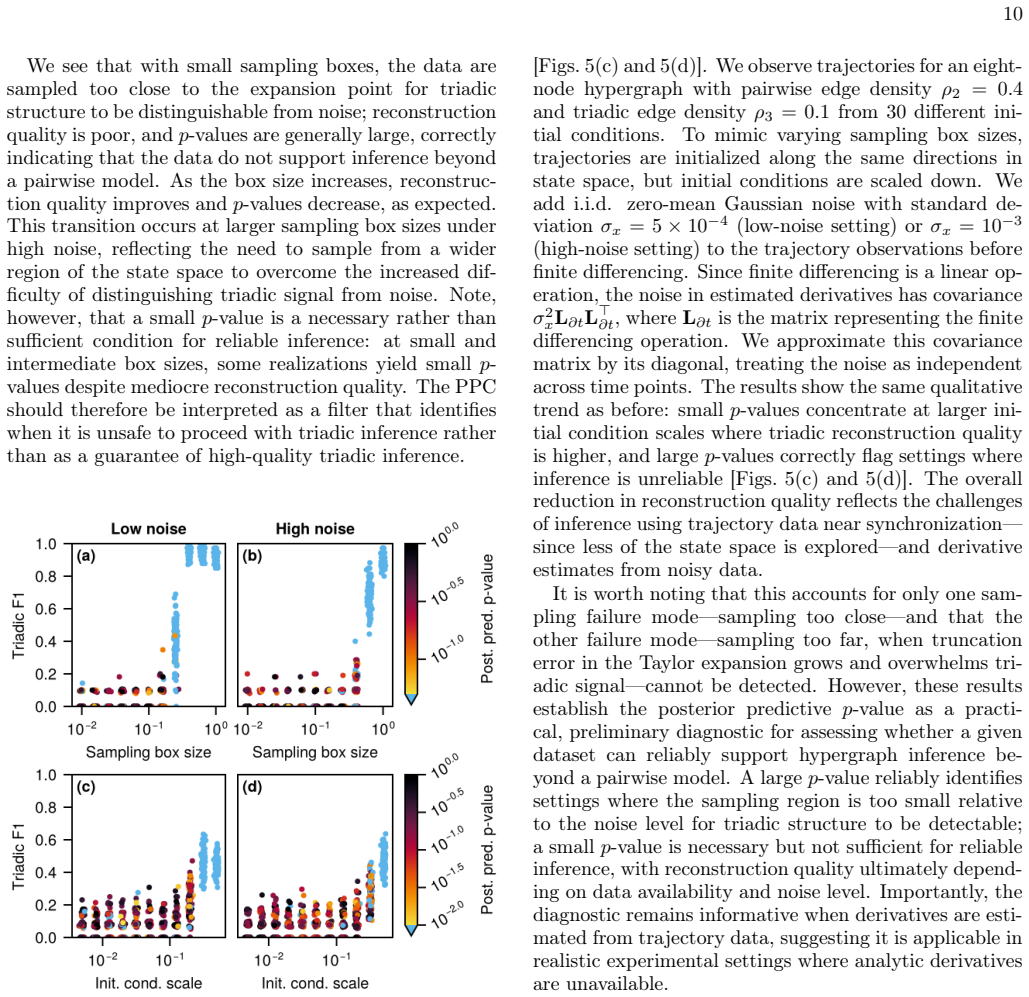
- Posterior predictive checks give a concrete criterion for whether a pairwise model is sufficient or higher-order terms are required.
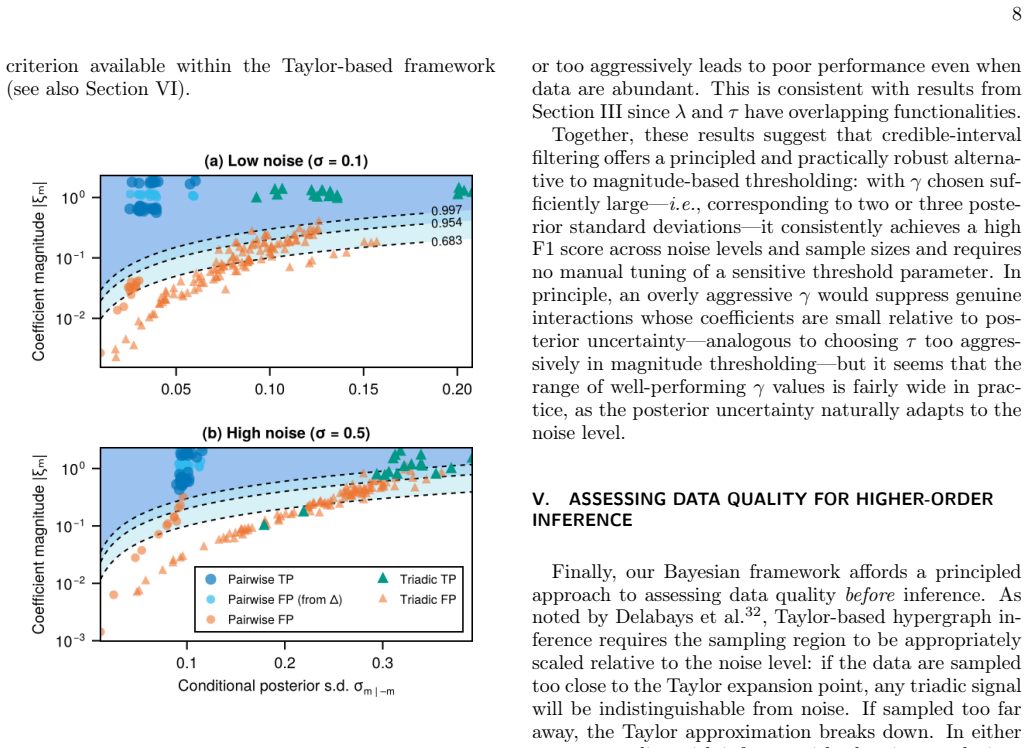
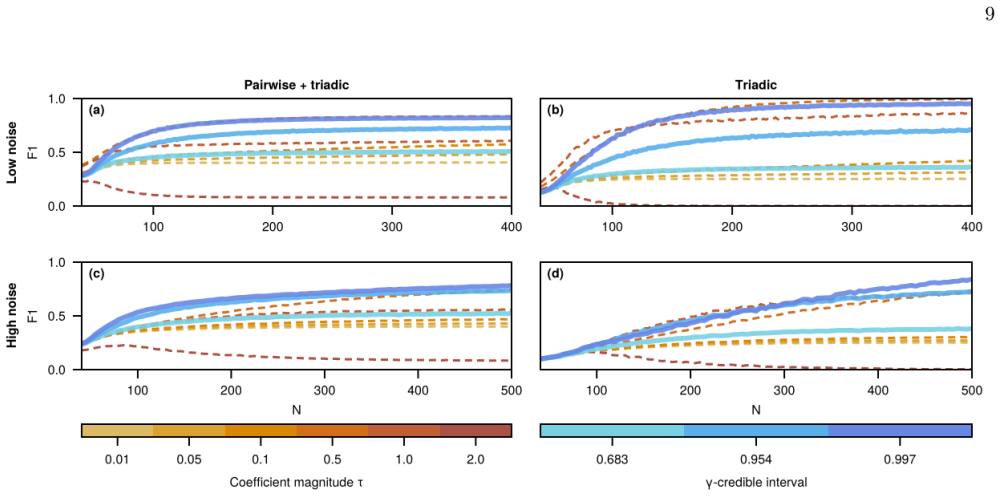
- Credible-interval pruning supplies a statistically grounded rule for retaining or discarding candidate hyperedges.
- The identified non-identifiability warns practitioners that certain inferred lower-order edges may be artifacts rather than true interactions.
Where Pith is reading between the lines
- Alternative bases or auxiliary measurements that break the Taylor-expansion symmetry could resolve the non-identifiability in future extensions.
- The uncertainty workflow could be combined with multi-experiment designs to test whether apparent lower-order terms persist across different initial conditions.
- In applied domains such as epidemic or opinion dynamics, the method suggests prioritizing data collection on nodes that already participate in lower-order links.
Load-bearing premise
The true hypergraph does not place all its higher-order interactions exclusively on nodes that have no lower-order connections to other nodes.
What would settle it
Generate synthetic dynamics from a hypergraph whose triple or higher interactions involve only nodes with zero true pairwise edges, then verify whether the inferred pairwise coefficients remain distinguishable from zero under credible-interval pruning.
Figures



read the original abstract
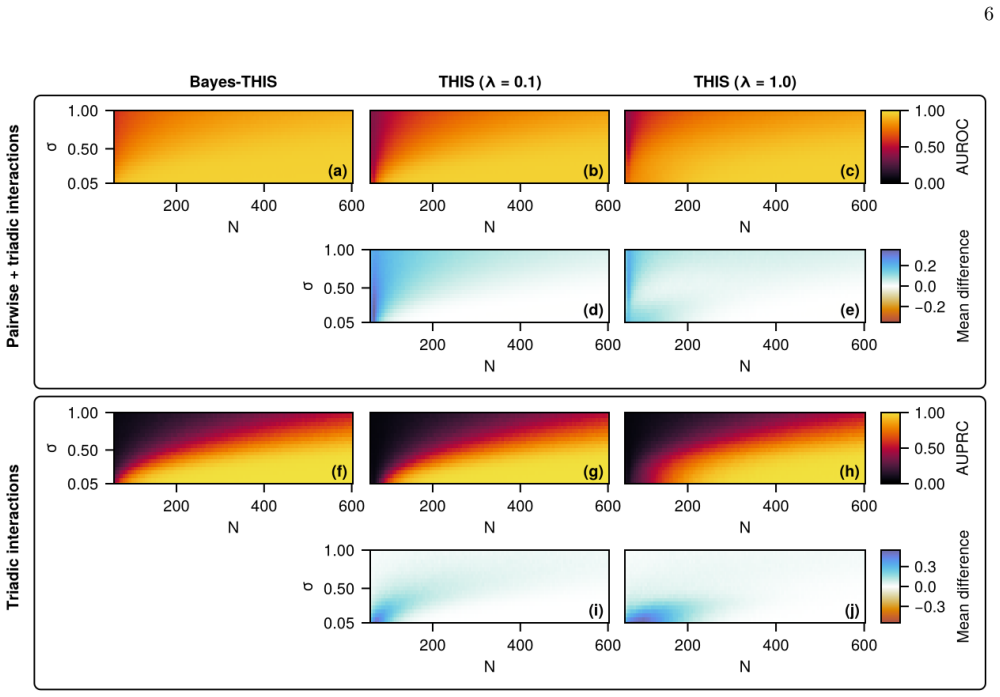
Inferring higher-order interaction structure from observations of dynamics is a central challenge in complex systems, particularly when data are scarce, noisy, or concentrated in lower-dimensional regions of state space. We develop Bayes-THIS, a Bayesian extension of Taylor-based Hypergraph Inference using SINDy (THIS), which reconstructs hypergraph structure from time-series data by identifying sparse Taylor coefficients associated with pairwise and higher-order interactions. By replacing fixed-threshold sparse regression with sparse Bayesian regression using automatic relevance determination, Bayes-THIS explicitly models residual variance and applies adaptive, term-wise coefficient shrinkage, improving robustness in data-limited, high-noise, and ill-conditioned regimes. The resulting Gaussian posterior also enables an uncertainty-aware inference workflow: a posterior predictive check assesses whether the data contain sufficient higher-order signal to reliably support inference beyond a pairwise model, and credible-interval pruning selects hyperedges whose inferred coefficients are statistically distinguishable from zero. Finally, we characterize a fundamental limitation of the Taylor-based inference framework: when higher-order interactions concentrate on nodes that lack lower-order connections, the Taylor expansion systematically inflates lower-order coefficient estimates, producing spurious edges indistinguishable from genuine lower-order interactions. This structural non-identifiability cannot be resolved by either THIS or Bayes-THIS.
Editorial analysis
A structured set of objections, weighed in public.
Referee Report
Summary. The manuscript introduces Bayes-THIS, a Bayesian extension of Taylor-based Hypergraph Inference using SINDy (THIS). It replaces fixed-threshold sparse regression with sparse Bayesian regression employing automatic relevance determination (ARD) to explicitly model residual variance and apply adaptive, term-wise coefficient shrinkage. The method is claimed to improve robustness for reconstructing hypergraph structure from scarce, noisy, or ill-conditioned dynamical time-series data. It further provides an uncertainty-aware workflow via posterior predictive checks (to assess sufficiency of higher-order signal) and credible-interval pruning (to select statistically significant hyperedges). The paper also characterizes a structural non-identifiability inherent to the Taylor expansion: when higher-order interactions concentrate exclusively on nodes lacking lower-order connections, the expansion systematically inflates lower-order coefficient estimates, producing spurious edges indistinguishable from genuine pairwise interactions; this limitation cannot be resolved by Bayes-THIS.
Significance. If the derivations and empirical claims hold, the work is significant for complex-systems inference because it supplies a Bayesian framework with built-in uncertainty quantification for hypergraph reconstruction under data constraints, while explicitly documenting a fundamental limitation of Taylor-based methods. The adaptive shrinkage via ARD and the posterior-predictive/credible-interval workflow constitute concrete advances over non-Bayesian sparse regression. The honest characterization of the non-identifiability regime is a strength that can guide future methodological development.
major comments (2)
- [Abstract / structural non-identifiability discussion] Abstract and final section on structural non-identifiability: the claim that the Taylor expansion 'systematically inflates lower-order coefficient estimates' when higher-order interactions occur only on nodes without lower-order connections is load-bearing for the limitation result. A concrete low-dimensional example or explicit expansion (showing the inflation mechanism) should be supplied to substantiate why ARD shrinkage and credible-interval pruning cannot separate the artifact from genuine lower-order terms.
- [Results section] Results / validation experiments: the central robustness claim (improved performance of Bayes-THIS over THIS in scarce/noisy/ill-conditioned regimes) requires quantitative support, e.g., recovery rates, coefficient error, or false-positive rates across controlled noise levels and data lengths. Without such metrics or ablation tables, the improvement remains unsubstantiated.
minor comments (2)
- Define all acronyms (ARD, SINDy, THIS) at first use in the main text and ensure consistent notation for Taylor coefficients versus hyperedge indicators.
- Clarify the precise form of the posterior predictive check and the threshold used for credible-interval pruning; a short algorithmic box would improve reproducibility.
Simulated Author's Rebuttal
We thank the referee for their constructive and positive assessment of our manuscript. We address each major comment in turn below, indicating the revisions we will incorporate.
read point-by-point responses
-
Referee: [Abstract / structural non-identifiability discussion] Abstract and final section on structural non-identifiability: the claim that the Taylor expansion 'systematically inflates lower-order coefficient estimates' when higher-order interactions occur only on nodes without lower-order connections is load-bearing for the limitation result. A concrete low-dimensional example or explicit expansion (showing the inflation mechanism) should be supplied to substantiate why ARD shrinkage and credible-interval pruning cannot separate the artifact from genuine lower-order terms.
Authors: We agree that an explicit low-dimensional example would strengthen the presentation of this structural limitation. The manuscript derives the general non-identifiability mechanism, but we will add a concrete two-node example with an exclusive third-order interaction (no pairwise or lower-order terms present) in the revised version. This will include the explicit Taylor expansion demonstrating the induced spurious pairwise coefficients and explain why neither fixed-threshold nor ARD-based shrinkage can distinguish the artifact, as it arises deterministically from the expansion itself rather than from noise or estimation error. revision: yes
-
Referee: [Results section] Results / validation experiments: the central robustness claim (improved performance of Bayes-THIS over THIS in scarce/noisy/ill-conditioned regimes) requires quantitative support, e.g., recovery rates, coefficient error, or false-positive rates across controlled noise levels and data lengths. Without such metrics or ablation tables, the improvement remains unsubstantiated.
Authors: The results section already compares Bayes-THIS and THIS through figures that display reconstruction performance under controlled variations in noise level, data length, and conditioning. To make these comparisons more quantitative and directly address the request, we will add a summary table in the revised manuscript reporting explicit metrics including hyperedge recovery rates, coefficient RMSE, and false-positive rates across the tested regimes. This will complement the existing figures without altering the reported findings. revision: yes
Circularity Check
Minor self-citation for base THIS method; Bayes-THIS derivation and non-identifiability result remain independent
full rationale
The paper extends the existing THIS framework (Taylor-based Hypergraph Inference using SINDy) with standard sparse Bayesian regression via automatic relevance determination (ARD), which explicitly models residual variance and applies term-wise shrinkage using established priors. This is not self-definitional or fitted by construction. The structural non-identifiability result is derived directly from the mathematical properties of the Taylor expansion when higher-order interactions are isolated on nodes lacking lower-order connections, as stated in the abstract; it is not obtained by fitting parameters or renaming inputs. No load-bearing step reduces to a self-citation chain or ansatz smuggled from prior work by the same authors. The central robustness and uncertainty-aware workflow claims rest on standard Bayesian machinery applied to the Taylor coefficients, which is externally verifiable and not circular. This warrants a low score of 2 for the minor self-citation of the base method.
Axiom & Free-Parameter Ledger
free parameters (1)
- ARD prior hyperparameters
axioms (2)
- domain assumption The observed time series are generated by a dynamical system whose vector field admits a sparse Taylor expansion containing pairwise and higher-order interaction terms
- domain assumption Residual noise is Gaussian and independent of the signal
Lean theorems connected to this paper
-
Foundation.ArithmeticFromLogic / Cost.FunctionalEquationwashburn_uniqueness_aczel (no contact: paper's identifiability obstruction is purely linear-algebraic on monomial libraries) unclearwhen higher-order interactions concentrate on nodes that lack lower-order connections, the Taylor expansion systematically inflates lower-order coefficient estimates, producing spurious edges
Reference graph
Works this paper leans on
-
[1]
Karlebach \ and\ author R
author author G. Karlebach \ and\ author R. Shamir ,\ title title Modelling and analysis of gene regulatory networks , \ @noop journal journal Nature Reviews Molecular Cell Biology \ volume 9 ,\ pages 770--780 ( year 2008 ) NoStop
2008
-
[2]
Breakspear ,\ title title Dynamic models of large-scale brain activity , \ @noop journal journal Nature Neuroscience \ volume 20 ,\ pages 340--352 ( year 2017 ) NoStop
author author M. Breakspear ,\ title title Dynamic models of large-scale brain activity , \ @noop journal journal Nature Neuroscience \ volume 20 ,\ pages 340--352 ( year 2017 ) NoStop
2017
-
[3]
author author M. J. \ Keeling \ and\ author P. Rohani ,\ title title Estimating spatial coupling in epidemiological systems: a mechanistic approach , \ @noop journal journal Ecology Letters \ volume 5 ,\ pages 20--29 ( year 2002 ) NoStop
2002
-
[4]
author author N. W. \ Landry , author W. Thompson , author L. Hébert-Dufresne , \ and\ author J.-G. \ Young ,\ title title Reconstructing networks from simple and complex contagions , \ 10.1103/PhysRevE.110.L042301 journal journal Physical Review E \ volume 110 ,\ pages L042301 ( year 2024 ) ,\ note arXiv:2405.00129 [cs] NoStop
-
[5]
Timme \ and\ author J
author author M. Timme \ and\ author J. Casadiego ,\ title title Revealing networks from dynamics: an introduction , \ @noop journal journal Journal of Physics A: Mathematical and Theoretical \ volume 47 ,\ pages 343001 ( year 2014 ) NoStop
2014
-
[6]
author author N. M. \ Mangan , author S. L. \ Brunton , author J. L. \ Proctor , \ and\ author J. N. \ Kutz ,\ title title Inferring biological networks by sparse identification of nonlinear dynamics , \ @noop journal journal IEEE Transactions on Molecular, Biological, and Multi-Scale Communications \ volume 2 ,\ pages 52--63 ( year 2017 a ) NoStop
2017
-
[7]
Han , author Z
author author X. Han , author Z. Shen , author W.-X. \ Wang , \ and\ author Z. Di ,\ title title Robust reconstruction of complex networks from sparse data , \ @noop journal journal Physical Review Letters \ volume 114 ,\ pages 028701 ( year 2015 ) NoStop
2015
-
[8]
Ma , author H.-S
author author C. Ma , author H.-S. \ Chen , author Y.-C. \ Lai , \ and\ author H.-F. \ Zhang ,\ title title Statistical inference approach to structural reconstruction of complex networks from binary time series , \ @noop journal journal Physical Review E \ volume 97 ,\ pages 022301 ( year 2018 ) NoStop
2018
-
[9]
author author T. P. \ Peixoto ,\ title title Network reconstruction and community detection from dynamics , \ 10.1103/PhysRevLett.123.128301 journal journal Physical Review Letters \ volume 123 ,\ pages 128301 ( year 2019 ) NoStop
-
[10]
author author M. A. \ Kramer , author U. T. \ Eden , author S. S. \ Cash , \ and\ author E. D. \ Kolaczyk ,\ title title Network inference with confidence from multivariate time series , \ @noop journal journal Physical Review E—Statistical, Nonlinear, and Soft Matter Physics \ volume 79 ,\ pages 061916 ( year 2009 ) NoStop
2009
-
[11]
Tirabassi , author R
author author G. Tirabassi , author R. Sevilla-Escoboza , author J. M. \ Buld \'u , \ and\ author C. Masoller ,\ title title Inferring the connectivity of coupled oscillators from time-series statistical similarity analysis , \ @noop journal journal Scientific Reports \ volume 5 ,\ pages 10829 ( year 2015 ) NoStop
2015
-
[12]
Ladroue , author S
author author C. Ladroue , author S. Guo , author K. Kendrick , \ and\ author J. Feng ,\ title title Beyond element-wise interactions: identifying complex interactions in biological processes , \ @noop journal journal PloS ONE \ volume 4 ,\ pages e6899 ( year 2009 ) NoStop
2009
-
[13]
Wu , author W
author author X. Wu , author W. Wang , \ and\ author W. X. \ Zheng ,\ title title Inferring topologies of complex networks with hidden variables , \ @noop journal journal Physical Review E—Statistical, Nonlinear, and Soft Matter Physics \ volume 86 ,\ pages 046106 ( year 2012 ) NoStop
2012
-
[14]
author author F. Battiston , author G. Cencetti , author I. Iacopini , author V. Latora , author M. Lucas , author A. Patania , author J.-G. \ Young , \ and\ author G. Petri ,\ title title Networks beyond pairwise interactions: Structure and dynamics , \ 10.1016/j.physrep.2020.05.004 journal journal Physics Reports \ volume 874 ,\ pages 1--92 ( year 2020 ) NoStop
-
[15]
Battiston , author E
author author F. Battiston , author E. Amico , author A. Barrat , author G. Bianconi , author G. Ferraz de Arruda , author B. Franceschiello , author I. Iacopini , author S. K \'e fi , author V. Latora , author Y. Moreno , et al. ,\ title title The physics of higher-order interactions in complex systems , \ @noop journal journal Nature Physics \ volume 17...
2021
-
[16]
author author C. Bick , author E. Gross , author H. A. \ Harrington , \ and\ author M. T. \ Schaub ,\ title title What are higher-order networks? \ 10.1137/21M1414024 journal journal SIAM Review \ volume 65 ,\ pages 686--731 ( year 2023 ) NoStop
-
[17]
Iacopini , author G
author author I. Iacopini , author G. Petri , author A. Barrat , \ and\ author V. Latora ,\ title title Simplicial models of social contagion , \ @noop journal journal Nature Communications \ volume 10 ,\ pages 2485 ( year 2019 ) NoStop
2019
-
[18]
Patania , author G
author author A. Patania , author G. Petri , \ and\ author F. Vaccarino ,\ title title The shape of collaborations , \ @noop journal journal EPJ Data Science \ volume 6 ,\ pages 18 ( year 2017 ) NoStop
2017
-
[19]
author author A. R. \ Benson , author R. Abebe , author M. T. \ Schaub , author A. Jadbabaie , \ and\ author J. Kleinberg ,\ title title Simplicial closure and higher-order link prediction , \ @noop journal journal Proceedings of the National Academy of Sciences \ volume 115 ,\ pages E11221--E11230 ( year 2018 ) NoStop
2018
-
[20]
Grilli , author G
author author J. Grilli , author G. Barab \'a s , author M. J. \ Michalska-Smith , \ and\ author S. Allesina ,\ title title Higher-order interactions stabilize dynamics in competitive network models , \ @noop journal journal Nature \ volume 548 ,\ pages 210--213 ( year 2017 ) NoStop
2017
-
[21]
Arya , author A
author author S. Arya , author A. B. \ George , \ and\ author J. P. \ O’Dwyer ,\ title title Sparsity of higher-order landscape interactions enables learning and prediction for microbiomes , \ @noop journal journal Proceedings of the National Academy of Sciences \ volume 120 ,\ pages e2307313120 ( year 2023 ) NoStop
2023
-
[22]
Yu , author H
author author S. Yu , author H. Yang , author H. Nakahara , author G. S. \ Santos , author D. Nikoli \'c , \ and\ author D. Plenz ,\ title title Higher-order interactions characterized in cortical activity , \ @noop journal journal Journal of Neuroscience \ volume 31 ,\ pages 17514--17526 ( year 2011 ) NoStop
2011
-
[23]
Petri , author P
author author G. Petri , author P. Expert , author F. Turkheimer , author R. Carhart-Harris , author D. Nutt , author P. J. \ Hellyer , \ and\ author F. Vaccarino ,\ title title Homological scaffolds of brain functional networks , \ @noop journal journal Journal of The Royal Society Interface \ volume 11 ,\ pages 20140873 ( year 2014 ) NoStop
2014
-
[24]
Carletti , author F
author author T. Carletti , author F. Battiston , author G. Cencetti , \ and\ author D. Fanelli ,\ title title Random walks on hypergraphs , \ @noop journal journal Physical Review E \ volume 101 ,\ pages 022308 ( year 2020 ) NoStop
2020
-
[25]
author author P. S. \ Skardal \ and\ author A. Arenas ,\ title title Abrupt desynchronization and extensive multistability in globally coupled oscillator simplexes , \ @noop journal journal Physical Review Letters \ volume 122 ,\ pages 248301 ( year 2019 ) NoStop
2019
-
[26]
author author P. S. \ Skardal \ and\ author A. Arenas ,\ title title Higher order interactions in complex networks of phase oscillators promote abrupt synchronization switching , \ 10.1038/s42005-020-00485-0 journal journal Communications Physics \ volume 3 ,\ pages 218 ( year 2020 ) NoStop
-
[27]
author author J.-G. \ Young , author G. Petri , \ and\ author T. P. \ Peixoto ,\ title title Hypergraph reconstruction from network data , \ 10.1038/s42005-021-00637-w journal journal Communications Physics \ volume 4 ,\ pages 135 ( year 2021 ) NoStop
-
[28]
author author S. Lizotte , author J.-G. \ Young , \ and\ author A. Allard ,\ title title Hypergraph reconstruction from uncertain pairwise observations , \ 10.1038/s41598-023-48081-w journal journal Scientific Reports \ volume 13 ( year 2023 ),\ 10.1038/s41598-023-48081-w NoStop
-
[29]
author author H. Wang , author C. Ma , author H.-S. \ Chen , author Y.-C. \ Lai , \ and\ author H.-F. \ Zhang ,\ title title Full reconstruction of simplicial complexes from binary contagion and Ising data , \ 10.1038/s41467-022-30706-9 journal journal Nature Communications \ volume 13 ,\ pages 3043 ( year 2022 ) NoStop
-
[30]
author author F. Malizia , author A. Corso , author L. V. \ Gambuzza , author G. Russo , author V. Latora , \ and\ author M. Frasca ,\ title title Reconstructing higher-order interactions in coupled dynamical systems , \ 10.1038/s41467-024-49278-x journal journal Nature Communications \ volume 15 ,\ pages 5184 ( year 2024 ) NoStop
-
[31]
author author J. Casadiego , author M. Nitzan , author S. Hallerberg , \ and\ author M. Timme ,\ title title Model-free inference of direct network interactions from nonlinear collective dynamics , \ 10.1038/s41467-017-02288-4 journal journal Nature Communications \ volume 8 ,\ pages 2192 ( year 2017 ) NoStop
-
[32]
author author R. Delabays , author G. De Pasquale , author F. Dörfler , \ and\ author Y. Zhang ,\ title title Hypergraph reconstruction from dynamics , \ 10.1038/s41467-025-57664-2 journal journal Nature Communications \ volume 16 ,\ pages 2691 ( year 2025 ) NoStop
-
[33]
author author S. L. \ Brunton , author J. L. \ Proctor , \ and\ author J. N. \ Kutz ,\ title title Discovering governing equations from data by sparse identification of nonlinear dynamical systems , \ 10.1073/pnas.1517384113 journal journal Proceedings of the National Academy of Sciences \ volume 113 ,\ pages 3932--3937 ( year 2016 ) NoStop
-
[34]
author author U. Fasel , author J. N. \ Kutz , author B. W. \ Brunton , \ and\ author S. L. \ Brunton ,\ title title Ensemble- SINDy : Robust sparse model discovery in the low-data, high-noise limit, with active learning and control , \ 10.1098/rspa.2021.0904 journal journal Proceedings of the Royal Society A: Mathematical, Physical and Engineering Scienc...
-
[35]
author author S. M. \ Hirsh , author D. A. \ Barajas-Solano , \ and\ author J. N. \ Kutz ,\ title title Sparsifying priors for Bayesian uncertainty quantification in model discovery , \ 10.1098/rsos.211823 journal journal Royal Society Open Science \ volume 9 ,\ pages 211823 ( year 2022 ) NoStop
-
[36]
author author L. Fung , author U. Fasel , \ and\ author M. Juniper ,\ title title Rapid Bayesian identification of sparse nonlinear dynamics from scarce and noisy data , \ 10.1098/rspa.2024.0200 journal journal Proceedings of the Royal Society A: Mathematical, Physical and Engineering Sciences \ volume 481 ,\ pages 20240200 ( year 2025 ) NoStop
-
[37]
author author M. E. \ Tipping ,\ title title Sparse Bayesian Learning and the Relevance Vector Machine , \ 10.1162/15324430152748236 journal journal Journal of Machine Learning Research \ volume 1 ,\ pages 211--244 ( year 2001 ) NoStop
-
[38]
author author R. K. \ Niven , author L. Cordier , author A. Mohammad-Djafari , author M. Abel , \ and\ author M. Quade ,\ title title Dynamical system identification, model selection, and model uncertainty quantification by Bayesian inference , \ 10.1063/5.0200684 journal journal Chaos \ volume 34 ( year 2024 ),\ 10.1063/5.0200684 NoStop
-
[39]
author author S. Zhang \ and\ author G. Lin ,\ title title Robust data-driven discovery of governing physical laws with error bars , \ 10.1098/rspa.2018.0305 journal journal Proceedings of the Royal Society A: Mathematical, Physical and Engineering Sciences \ volume 474 ,\ pages 20180305 ( year 2018 ) NoStop
-
[40]
author author R. Tibshirani ,\ title title Regression shrinkage and selection via the lasso , \ http://www.jstor.org/stable/2346178 journal journal Journal of the Royal Statistical Society. Series B (Methodological) \ volume 58 ,\ pages 267--288 ( year 1996 ) NoStop
-
[41]
author author N. M. \ Mangan , author J. N. \ Kutz , author S. L. \ Brunton , \ and\ author J. L. \ Proctor ,\ title title Model selection for dynamical systems via sparse regression and information criteria , \ 10.1098/rspa.2017.0009 journal journal Proceedings of the Royal Society A: Mathematical, Physical and Engineering Sciences \ volume 473 ,\ pages ...
-
[42]
author author D. A. \ Messenger \ and\ author D. M. \ Bortz ,\ title title Weak SINDy : Galerkin -based data-driven model selection , \ 10.1137/20M1343166 journal journal Multiscale Modeling & Simulation \ volume 19 ,\ pages 1474--1497 ( year 2021 ) ,\ http://arxiv.org/abs/https://doi.org/10.1137/20M1343166 https://doi.org/10.1137/20M1343166 NoStop
-
[43]
author author R. Fuentes , author R. Nayek , author P. Gardner , author N. Dervilis , author T. Rogers , author K. Worden , \ and\ author E. Cross ,\ title title Equation discovery for nonlinear dynamical systems: A Bayesian viewpoint , \ 10.1016/j.ymssp.2020.107528 journal journal Mechanical Systems and Signal Processing \ volume 154 ,\ pages 107528 ( ye...
-
[44]
author author M. E. \ Tipping \ and\ author A. C. \ Faul ,\ title title Fast marginal likelihood maximisation for sparse Bayesian models , \ in\ @noop booktitle Proceedings of the Ninth International Workshop on Artificial Intelligence and Statistics \ ( year 2003 )\ pp.\ pages 276--283 NoStop
2003
-
[45]
author author J. O. \ Berger ,\ 10.1007/978-1-4757-4286-2 title Statistical Decision Theory and Bayesian Analysis ,\ Springer Series in Statistics \ ( publisher Springer New York ,\ address New York, NY ,\ year 1985 )\ note ISSN : 0172-7397 NoStop
-
[46]
author author D. J. C. \ MacKay ,\ title title Comparison of approximate methods for handling hyperparameters , \ 10.1162/089976699300016331 journal journal Neural Computation \ volume 11 ,\ pages 1035--1068 ( year 1999 ) NoStop
-
[47]
Gelman , author X.-L
author author A. Gelman , author X.-L. \ Meng , \ and\ author H. Stern ,\ title title Posterior predictive assessment of model fitness via realized discrepancies , \ @noop journal journal Statistica Sinica \ ,\ pages 733--760 ( year 1996 ) NoStop
1996
-
[48]
Zhang , author M
author author Y. Zhang , author M. Lucas , \ and\ author F. Battiston ,\ title title Higher-order interactions shape collective dynamics differently in hypergraphs and simplicial complexes , \ @noop journal journal Nature Communications \ volume 14 ,\ pages 1605 ( year 2023 ) NoStop
2023
-
[49]
Lucas , author G
author author M. Lucas , author G. Cencetti , \ and\ author F. Battiston ,\ title title Multiorder L aplacian for synchronization in higher-order networks , \ @noop journal journal Physical Review Research \ volume 2 ,\ pages 033410 ( year 2020 ) NoStop
2020
-
[50]
Lucas , author L
author author M. Lucas , author L. Gallo , author A. Ghavasieh , author F. Battiston , \ and\ author M. De Domenico ,\ title title Reducibility of higher-order networks from dynamics , \ @noop journal journal Nature Communications \ ( year 2026 ) NoStop
2026
-
[51]
Kessy , author A
author author A. Kessy , author A. Lewin , \ and\ author K. Strimmer ,\ title title Optimal whitening and decorrelation , \ @noop journal journal The American Statistician \ volume 72 ,\ pages 309--314 ( year 2018 ) NoStop
2018
discussion (0)
Sign in with ORCID, Apple, or X to comment. Anyone can read and Pith papers without signing in.