Recognition: unknown
From Video-to-PDE: Data-Driven Discovery of Nonlinear Dye Plume Dynamics
Pith reviewed 2026-05-08 16:55 UTC · model grok-4.3
The pith
Uncalibrated video of an ink plume yields a compact nonlinear PDE that predicts its evolution and reduces to a linear advection-diffusion equation via Cole-Hopf transformation.
A machine-rendered reading of the paper's core claim, the machinery that carries it, and where it could break.
Core claim
The selected reduced model u_t + v(t)·∇u = 9.005 |∇u|^2 + 0.666 Δu is recovered from the video data; it outperforms advection-diffusion baselines on held-out frames, retains a positive Laplacian coefficient, and admits a Cole-Hopf reduction to a linear advection-diffusion equation.
What carries the argument
The video-to-PDE pipeline that converts grayscale frames to a normalized scalar field, isolates bulk drift via intensity-weighted centroid, performs weak-form sparse regression on compact gradient libraries, and refines coefficients with an inverse physics-informed network followed by forward-rollout recalibration.
If this is right
- The identified nonlinear term allows the plume model to be transformed into a linear advection-diffusion equation, simplifying analytic or numerical treatment.
- Positive Laplacian coefficient indicates that the effective diffusion remains physically consistent even after data-driven selection.
- The separation of discovery, calibration, and uncertainty stages produces models that remain predictive on unseen frames without overfitting to noise in differentiation.
- Compact gradient-based libraries suffice once collinearity diagnostics eliminate overcomplete candidates.
Where Pith is reading between the lines
- The same staged pipeline could be applied to other scalar visual fields such as temperature or concentration maps from environmental imagery.
- The Cole-Hopf reduction raises the possibility that the discovered nonlinearity corresponds to a known transformation in the underlying physics rather than an artifact of the imaging process.
- Chronological block bootstrap uncertainty estimates could be used to decide when additional video data would meaningfully tighten coefficient bounds.
- If the intensity-to-concentration mapping is monotonic but nonlinear, the recovered coefficients would require rescaling before quantitative physical interpretation.
Load-bearing premise
The normalized grayscale image intensity can be treated as a faithful scalar concentration field whose evolution is governed by a compact gradient-based transport law that is discoverable from the video without missing essential physical terms.
What would settle it
A direct comparison of the model's forward predictions against additional held-out video frames from the same plume, or an independent laboratory experiment with known dye concentration under controlled advection, that shows systematic deviation beyond the reported bootstrap uncertainty bands.
Figures




read the original abstract
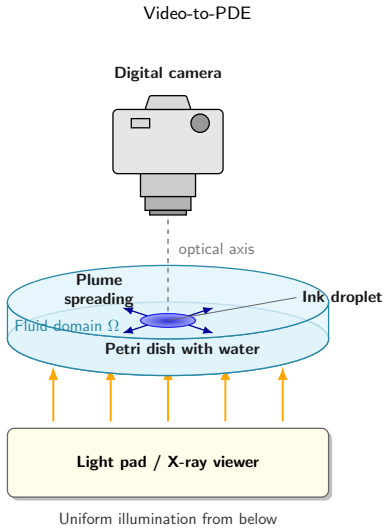
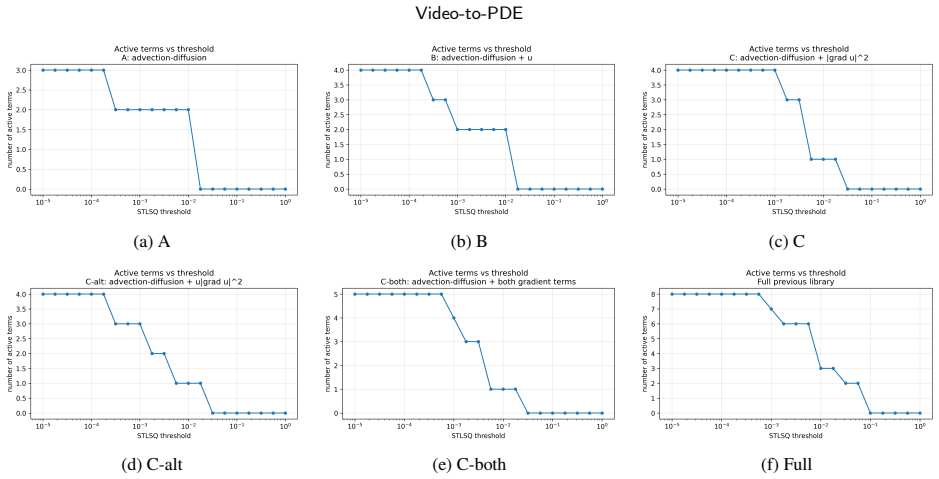
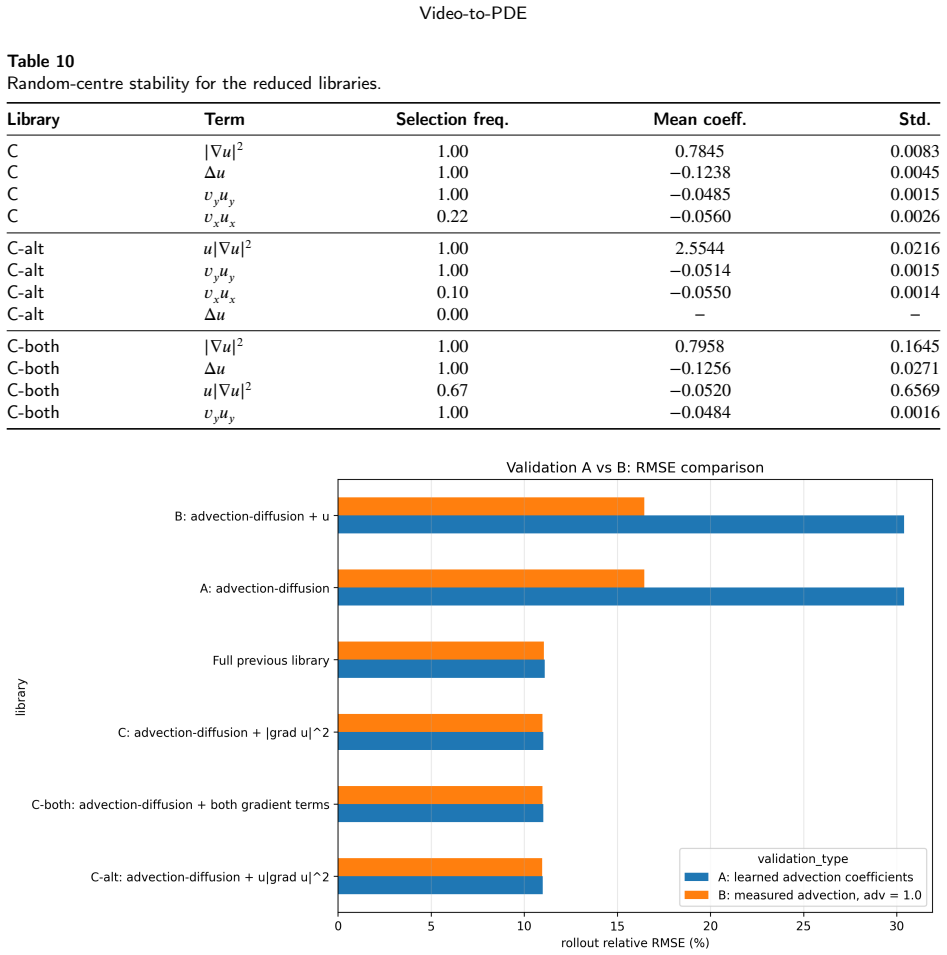
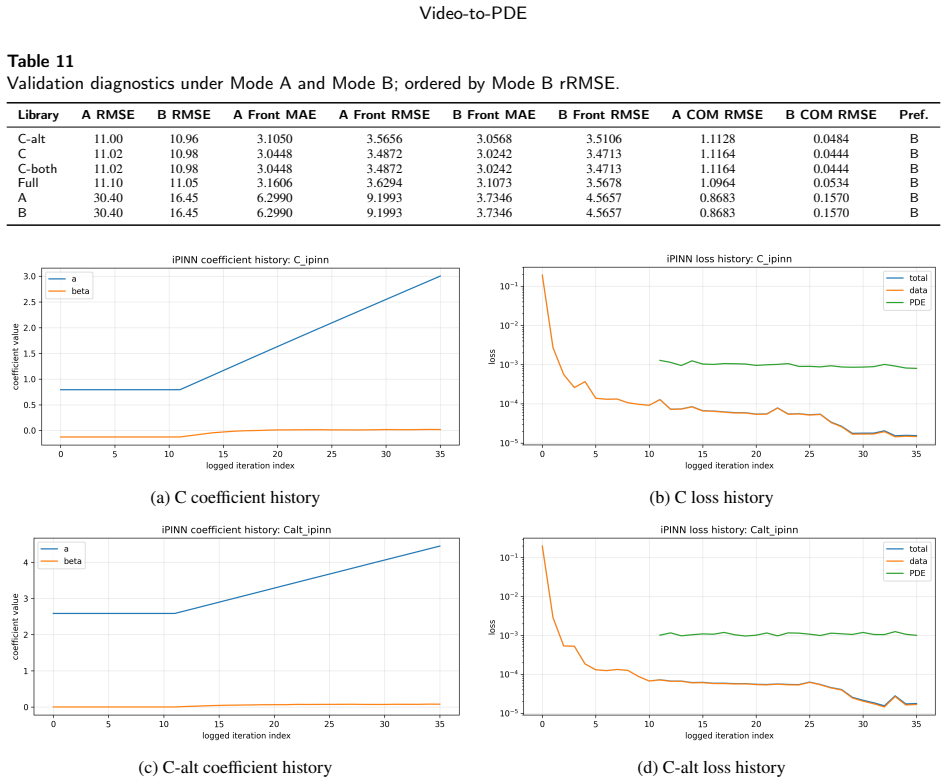
Inferring continuum models directly from video is hampered by two facts: the recorded field is uncalibrated image intensity rather than a physical state, and direct numerical differentiation of noisy frames is unstable. We develop a video-to-PDE pipeline that converts grayscale recordings of an ink plume into a normalised scalar field $u(x,y,t)$, isolates a bulk drift $\mathbf{v}(t)$ from intrinsic spreading via the intensity-weighted centroid, and identifies an effective transport law by weak-form sparse regression. Conditioning, threshold-sweep and random-centre diagnostics show that overcomplete libraries are strongly collinear; the search is therefore restricted to compact gradient-based libraries. Coefficients are refined by an inverse physics-informed network and recalibrated against forward rollouts, with a chronological block bootstrap quantifying uncertainty. The selected reduced model $u_t+\mathbf v(t)\!\cdot\!\nabla u = 9.005\,|\nabla u|^{2}+0.666\,\Delta u$ outperforms advection--diffusion baselines on held-out frames, retains a positive Laplacian coefficient, and admits a Cole--Hopf reduction to a linear advection--diffusion equation. The framework demonstrates that uncalibrated visual data can yield compact, predictive and structurally interpretable continuum models when discovery, calibration and uncertainty are treated as distinct stages.
Editorial analysis
A structured set of objections, weighed in public.
Referee Report
Summary. The paper proposes a video-to-PDE pipeline that converts grayscale recordings of an ink plume into a normalized scalar field u(x,y,t), extracts a bulk drift v(t) via the intensity-weighted centroid, identifies an effective transport law through weak-form sparse regression on a restricted compact gradient-based library (after collinearity diagnostics), refines coefficients with an inverse physics-informed neural network and forward-rollout recalibration, and quantifies uncertainty via chronological block bootstrap. The selected model u_t + v(t)·∇u = 9.005 |∇u|^2 + 0.666 Δu is reported to outperform advection-diffusion baselines on held-out frames, retain a positive Laplacian coefficient, and admit a Cole-Hopf reduction to a linear advection-diffusion equation.
Significance. If the mapping from image intensity to the state variable holds, the work demonstrates a practical, multi-stage framework for extracting compact, predictive, and structurally interpretable continuum models from uncalibrated visual data. Strengths include explicit separation of discovery, calibration, and uncertainty stages; diagnostics for library collinearity (threshold sweeps, random-centre tests); bootstrap uncertainty; and the Cole-Hopf interpretability that links the nonlinear term to a possible logarithmic transformation. This approach addresses noisy differentiation and overcomplete libraries in a reproducible manner and could advance data-driven modeling in fluid dynamics and scientific machine learning.
major comments (2)
- [Abstract and §2] Abstract and §2 (field normalization and library selection): The central claim that the pipeline yields models of 'nonlinear dye plume dynamics' rests on treating normalized grayscale intensity as a faithful scalar concentration field u(x,y,t) governed by the discovered gradient-based law. The large nonlinear coefficient (9.005) is consistent with u ∝ log(physical concentration), yet no calibration experiment, independent intensity-to-concentration mapping, or test against known linear advection-diffusion behavior in physical concentration is provided. This assumption is load-bearing for the asserted physical interpretability and structural reduction.
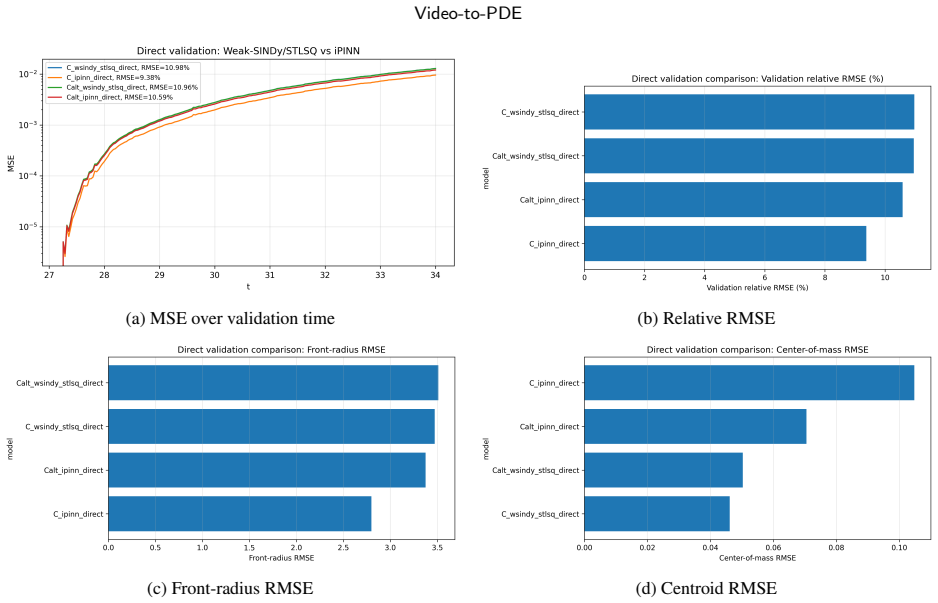
- [§4] §4 (held-out validation and performance): The claim that the reduced model outperforms advection-diffusion baselines on chronologically held-out frames is central to the predictive utility, but the manuscript provides no quantitative metrics (e.g., L2 prediction errors, relative norms, or R² values) comparing the discovered PDE against the baselines. Without these numbers, the magnitude and robustness of the reported outperformance cannot be assessed.
minor comments (2)
- [Notation] Notation for the time-dependent velocity should be uniformly boldface (v(t)) in all equations and text for consistency.
- [Figures] Figure captions for validation plots should explicitly indicate the frame ranges or time blocks used for training versus held-out testing.
Simulated Author's Rebuttal
We thank the referee for the constructive comments on the scope of our video-to-PDE pipeline and the need for clearer validation metrics. We address each major comment below, indicating where revisions will be made to improve clarity without overstating the results.
read point-by-point responses
-
Referee: [Abstract and §2] Abstract and §2 (field normalization and library selection): The central claim that the pipeline yields models of 'nonlinear dye plume dynamics' rests on treating normalized grayscale intensity as a faithful scalar concentration field u(x,y,t) governed by the discovered gradient-based law. The large nonlinear coefficient (9.005) is consistent with u ∝ log(physical concentration), yet no calibration experiment, independent intensity-to-concentration mapping, or test against known linear advection-diffusion behavior in physical concentration is provided. This assumption is load-bearing for the asserted physical interpretability and structural reduction.
Authors: We agree that the mapping from normalized grayscale intensity to physical dye concentration is not calibrated experimentally in this work. The pipeline is designed to operate directly on the extracted scalar field u(x,y,t) derived from video intensity, and the resulting PDE is therefore an effective model for the observed intensity dynamics rather than a direct description of physical concentration. The Cole-Hopf reduction is presented as a mathematical property of the discovered equation that offers structural insight and is consistent with a possible logarithmic relation to concentration, but we do not claim a calibrated physical mapping. In the revision we will update the abstract and Section 2 to state explicitly that the model governs normalized intensity and to qualify the physical interpretation as suggestive, thereby scoping the load-bearing assumption appropriately. revision: partial
-
Referee: [§4] §4 (held-out validation and performance): The claim that the reduced model outperforms advection-diffusion baselines on chronologically held-out frames is central to the predictive utility, but the manuscript provides no quantitative metrics (e.g., L2 prediction errors, relative norms, or R² values) comparing the discovered PDE against the baselines. Without these numbers, the magnitude and robustness of the reported outperformance cannot be assessed.
Authors: We accept that the outperformance statement in Section 4 is currently qualitative. Although the manuscript reports that the discovered model performs better than advection-diffusion baselines on held-out frames, explicit numerical comparisons are not tabulated. We will add quantitative metrics—L2 prediction errors, relative norms, and R² values—for the discovered PDE and the baselines on the chronologically held-out data. These will appear in a revised table or figure panel in Section 4 of the resubmission. revision: yes
Circularity Check
No significant circularity; model discovery and validation are data-driven with held-out evaluation
full rationale
The paper's core pipeline—normalizing video intensity to u(x,y,t), extracting v(t) via centroids, applying weak-form sparse regression on a restricted gradient-based library, refining coefficients via inverse PINN and forward rollouts, and evaluating predictive performance on chronologically held-out frames with bootstrap—operates directly on observed data without presupposing the final PDE form or coefficients. The selected equation is not equivalent to its inputs by construction; outperformance on unseen frames and the positive Laplacian term are empirical outcomes. The Cole-Hopf reduction is a mathematical property noted after discovery, not a load-bearing assumption or self-referential step. No self-citations, fitted-input-as-prediction, or ansatz smuggling are evident in the derivation chain.
Axiom & Free-Parameter Ledger
free parameters (2)
- nonlinear coefficient =
9.005
- diffusion coefficient =
0.666
axioms (2)
- domain assumption Normalized grayscale intensity represents the physical scalar concentration field u(x,y,t)
- ad hoc to paper The true dynamics lie within a compact gradient-based library
Reference graph
Works this paper leans on
-
[1]
Antonelli,G.,Chiaverini,S.,Lillo,P.D.,2022. Ondata-drivenidentification:Isautomaticallydiscoveringequationsofmotionfromdataachimera? Nonlinear Dynamics 111, 6487–6498. doi:10.1007/s11071-022-08192-x. Banerjee, C., Nguyen, K., Fookes, C., Karniadakis, G.,
-
[2]
Both, G.J., Choudhury, S., Sens, P., Kusters, R.,
doi:10.1145/3689037. Both, G.J., Choudhury, S., Sens, P., Kusters, R.,
-
[3]
Journal of Computational Physics 428, 109985
Deepmod: Deep learning for model discovery in noisy data. Journal of Computational Physics 428, 109985. doi:10.1016/j.jcp.2020.109985. Brunton, S.L., Proctor, J.L., Kutz, J.N.,
-
[4]
Abhimanyu Das, Weihao Kong, Rajat Sen, and Yichen Zhou
Discovering governing equations from data by sparse identification of nonlinear dynamical systems. Proceedings of the National Academy of Sciences 113, 3932–3937. doi:10.1073/pnas.1517384113. Chu, M., Liu, L., Zheng, Q., Franz, A., Seidel, H.P., Theobalt, C., Zayer, R.,
- [5]
-
[6]
doi:10.1007/s10915-022-01939-z. Dreisbach, M., Kiyani, E., Kriegseis, J., Karniadakis, G., Stroh, A.,
-
[7]
Language Model Cascades: Token-Level Uncertainty and Beyond
Pinns4drops: Video-conditioned physics-informed neural networks for two-phase flow reconstruction. arXiv preprint arXiv:2411.15949 URL:https://arxiv.org/abs/2411.15949, doi:10.48550/arXiv. 2411.15949. Efron, B.,
work page internal anchor Pith review doi:10.48550/arxiv
-
[8]
Bootstrap methods: Another look at the jackknife. The Annals of Statistics 7, 1–26. doi:https://doi.org/10.1214/aos/ 1176344552. Fasel, U., Kutz, J.N., Brunton, B.W., Brunton, S.L.,
-
[9]
Ensemble-sindy: Robust sparse model discovery in the low-data, high-noise limit, with active learning and control. Proceedings of the Royal Society A 478, 20210904. doi:10.1098/rspa.2021.0904. Fukami,K.,Murata,T.,Zhang,K.,Fukagata,K.,2021. Sparseidentificationofnonlineardynamicswithlow-dimensionalizedflowrepresentations. Journal of Fluid Mechanics 926, A1...
-
[10]
Communications on Pure and Applied Mathematics 3, 201–230
The partial differential equation𝑢 𝑡 +𝑢𝑢 𝑥 =𝜇𝑢 𝑥𝑥. Communications on Pure and Applied Mathematics 3, 201–230. doi:10.1002/cpa.3160030302. Horn, B.K.P., Schunck, B.G.,
-
[11]
Determining optical flow. Artificial Intelligence 17, 185–203. doi:10.1016/0004-3702(81)90024-2. Hu,M.K.,1962. Visualpatternrecognitionbymomentinvariants. IRETransactionsonInformationTheory8,179–187. doi:10.1109/TIT.1962. 1057692. Jaques,M.,Burke,M.,Hospedales,T.M.,2019. Physics-as-inverse-graphics:Jointunsupervisedlearningofobjectsandphysicsfromvideo. Co...
-
[12]
Physical Review Letters 129, 258001
Data-driven discovery of active nematic hydrodynamics. Physical Review Letters 129, 258001. doi:10.1103/PhysRevLett.129.258001. Minoli, Sarkar:Preprint submitted to ElsevierPage 20 of 22 Video-to-PDE Kaheman, K., Kutz, J.N., Brunton, S.L.,
-
[13]
Proceedings of the Royal Society A 476, 20200279
Sindy-pi: A robust algorithm for parallel implicit sparse identification of nonlinear dynamics. Proceedings of the Royal Society A 476, 20200279. doi:10.1098/rspa.2020.0279. Kaptanoglu, A.A., de Silva, B.M., Fasel, U., Kaheman, K., Goldschmidt, A.J., Callaham, J.L., Delahunt, C.B., Nicolaou, Z.G., Champion, K., Loiseau, J.C., Kutz, J.N., Brunton, S.L.,
-
[14]
Pysindy: A comprehensive python package for robust sparse system identification,
doi:10.21105/joss.03994. Kardar, M., Parisi, G., Zhang, Y.C.,
-
[15]
Kevrekidis, Lu Lu, Paris Perdikaris, Sifan Wang, and Liu Yang
Physics-informed machine learning. Nature Reviews Physics 3, 422–440. doi:https://doi.org/10.1038/s42254-021-00314-5. Krishnapriyan, A.S., Gholami, A., Zhe, S., Kirby, R.M., Mahoney, M.W.,
-
[16]
26548–26560
Characterizing possible failure modes in physics-informed neural networks, in: Advances in Neural Information Processing Systems 34 (NeurIPS 2021), pp. 26548–26560. URL:https://proceedings. neurips.cc/paper/2021/file/df438e5206f31600e6ae4af72f2725f1-Paper.pdf. Künsch, H.R.,
2021
-
[17]
The jackknife and the bootstrap for general stationary observations. The Annals of Statistics 17, 1217–1241. doi:https: //doi.org/10.1214/aos/1176347265. Larson, J., Menickelly, M., Wild, S.M.,
-
[18]
Measurement Science and Technology 33, 075406
Image convolution-based experimental technique for flame front detection and dimension estimation: a case study on laminar-to-transition jet diffusion flame height measurement. Measurement Science and Technology 33, 075406. doi:10.1088/1361-6501/ac65db. Liu,R.Y.,Singh,K.,1992. Movingblocksjackknifeandbootstrapcaptureweakdependence,in:LePage,R.,Billard,L.(...
-
[19]
Journal of Fluid Mechanics 844, 459–490
Sparse reduced-order modelling: sensor-based dynamics to full-state estimation. Journal of Fluid Mechanics 844, 459–490. doi:10.1017/jfm.2018.147. Long,Z.,Lu,Y.,Dong,B.,2019. PDE-Net2.0:LearningPDEsfromdatawithanumeric–symbolichybriddeepnetwork. JournalofComputational Physics 399, 108925. doi:10.1016/j.jcp.2019.108925. Mangan,N.M.,Kutz,J.N.,Brunton,S.L.,P...
-
[20]
Hidden physics models: Machine learning of nonlinear partial differential equations,
Automatic block-length selection for the dependent bootstrap. Econometric Reviews 23, 53–70. doi:10.1081/ ETC-120028836. Raissi,M.,Karniadakis,G.E.,2018. Hiddenphysicsmodels:Machinelearningofnonlinearpartialdifferentialequations. JournalofComputational Physics 357, 125–141. doi:10.1016/j.jcp.2017.11.039. Raissi, M., Perdikaris, P., Karniadakis, G.,
-
[21]
Physics-informed neural networks: A deep learning framework for solving forward and inverse problems involving nonlinear partial differential equations. Journal of Computational Physics 378, 686–707. URL:https://www. sciencedirect.com/science/article/pii/S0021999118307125, doi:https://doi.org/10.1016/j.jcp.2018.10.045. Raissi, M., Yazdani, A., Karniadakis, G.E.,
-
[22]
Science367(6481), 1026– 1030 (2020) https://doi.org/10.1126/science.aaw4741
Hidden fluid mechanics: Learning velocity and pressure fields from flow visualizations. Science 367, 1026–1030. doi:10.1126/science.aaw4741. Reinbold,P.A.K., Gurevich,D.R., Grigoriev,R.O.,2020. Usingnoisy orincomplete datatodiscover modelsofspatiotemporal dynamics. Physical Review E 101, 010203. doi:10.1103/PhysRevE.101.010203. Rudy,S.,Alla,A.,Brunton,S.L...
-
[23]
Science Advances3(4), 1602614 (2017) https://doi
Data-driven discovery of partial differential equations. Science Advances 3, e1602614. doi:10.1126/sciadv.1602614. Savitzky,A.,Golay,M.J.E.,1964.Smoothinganddifferentiationofdatabysimplifiedleastsquaresprocedures.AnalyticalChemistry36,1627–1639. doi:10.1021/ac60214a047. Schaeffer, H., McCalla, S.G.,
-
[24]
Sparse model selection via integral terms. Physical Review E 96, 023302. doi:10.1103/PhysRevE.96. 023302. Sharma, P., Chung, W.T., Akoush, B., Ihme, M.,
-
[25]
doi:10.3390/en16052343. Shea,D.E.,Brunton,S.L.,Kutz,J.N.,2021. Sindy-bvp:Sparseidentificationofnonlineardynamicsforboundaryvalueproblems. PhysicalReview Research 3, 023255. doi:10.1103/PhysRevResearch.3.023255. Vinuesa, R., Brunton, S.L., McKeon, B.J.,
-
[26]
Nature Reviews Physics 5, 536–545
The transformative potential of machine learning for experiments in fluid mechanics. Nature Reviews Physics 5, 536–545. doi:10.1038/s42254-023-00622-y. Wentz, J., Doostan, A.,
-
[27]
Computer Methods in Applied Mechanics and Engineering 413, 116096
Derivative-based sindy (dsindy): Addressing the challenge of discovering governing equations from noisy data. Computer Methods in Applied Mechanics and Engineering 413, 116096. doi:10.1016/j.cma.2023.116096. Minoli, Sarkar:Preprint submitted to ElsevierPage 21 of 22 Video-to-PDE Westerweel, J., Elsinga, G.E., Adrian, R.J.,
-
[28]
Annual Review of Fluid Mechanics 45, 409–436
Particle image velocimetry for complex and turbulent flows. Annual Review of Fluid Mechanics 45, 409–436. doi:10.1146/annurev-fluid-120710-101204. Yu, C., Bi, X., Fan, Y., 2023a. Deep learning for fluid velocity field estimation: A review. Ocean Engineering 271, 113693. doi:10.1016/j. oceaneng.2023.113693. Yu, H.X., Zheng, Y., Gao, Y., Deng, Y., Zhu, B., ...
-
[29]
A unified framework for sparse relaxed regularized regression sr3. IEEE Access 7, 1404–1423. doi:10.1109/ACCESS.2018.2886528. Minoli, Sarkar:Preprint submitted to ElsevierPage 22 of 22
discussion (0)
Sign in with ORCID, Apple, or X to comment. Anyone can read and Pith papers without signing in.