Recognition: unknown
Sequential topology optimization: SIMP initialization for level-set boundary refinement
Pith reviewed 2026-05-08 16:12 UTC · model grok-4.3
The pith
Initializing level-set topology optimization from a SIMP density field produces sharp manufacturable boundaries while reducing sensitivity to the starting design.
A machine-rendered reading of the paper's core claim, the machinery that carries it, and where it could break.
Core claim
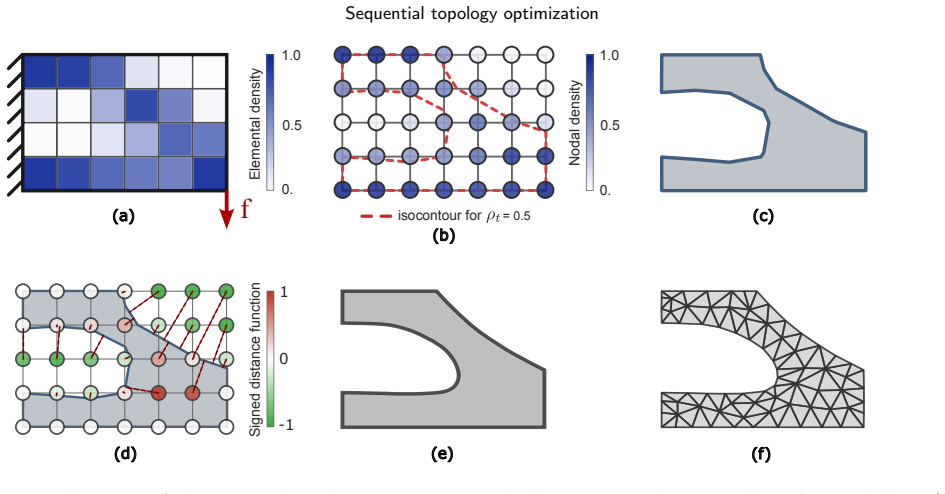
The SIMP-derived initialization mitigates sensitivity to the initial design in level-set optimization, and the level-set stage acts as optimization-driven post-processing that produces manufacturing-ready boundaries. The key step is an SDF-based geometry transfer formulated for three-dimensional meshes that converts the SIMP density distribution into an initial signed distance function for the subsequent level-set evolution.
What carries the argument
SDF-based geometry transfer that converts a SIMP density distribution into a signed distance function to initialize level-set boundary refinement.
If this is right
- Level-set optimization can start from a topologically rich density field rather than an arbitrary initial guess, reducing the number of failed runs.
- The final designs emerge with sharp material interfaces that require no additional thresholding or smoothing for manufacturing.
- The overall procedure achieves compliance comparable to pure level-set optimization while delivering reported speedups of up to 4.6 times on the cantilever benchmark.
- The same transfer step can be applied to other density-based methods that produce gray-scale fields, extending the post-processing benefit beyond SIMP.
Where Pith is reading between the lines
- The approach may generalize to other physics problems where an initial diffuse solution can be sharpened into a crisp interface, such as certain fluid or thermal topology problems.
- Because the level-set stage is treated as refinement rather than primary topology discovery, the method could be paired with faster but coarser density solvers to further reduce total compute time.
- Open release of the code allows direct testing on user-defined three-dimensional geometries to measure whether the speedup and boundary sharpness hold outside the published cantilever and MBB cases.
Load-bearing premise
Converting the SIMP density distribution to a signed distance function preserves the essential topological features without introducing artifacts that the subsequent level-set optimization cannot correct.
What would settle it
Running the sequential method on the same three-dimensional cantilever and MBB benchmarks and obtaining either substantially higher final compliance than pure level-set optimization or visibly non-sharp boundaries after the level-set stage.
Figures




read the original abstract
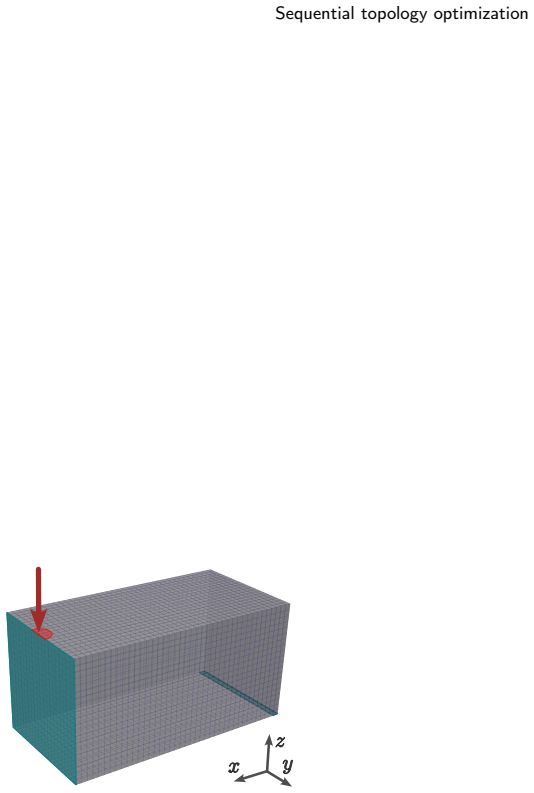
Density-based topology optimization methods such as SIMP enable efficient topological exploration but produce diffuse material boundaries that require interpretation before manufacturing. Level-set methods maintain sharp interfaces but are sensitive to the initial design. This paper presents a sequential framework that addresses these complementary limitations through a signed distance function (SDF)-based geometry transfer, formulated for three-dimensional meshes. The SIMP density distribution is converted into an SDF that initializes subsequent level-set boundary refinement. From the level-set perspective, the SIMP-derived initialization mitigates sensitivity to the initial design. From the SIMP perspective, the level-set stage acts as optimization-driven post-processing that produces manufacturing-ready boundaries. Validation on three-dimensional cantilever and MBB benchmarks demonstrates compliance comparable to standalone level-set optimization, with up to 4.6x wall-clock speedup on the cantilever case. The full implementation is released under an open-source license to support reproducibility.
Editorial analysis
A structured set of objections, weighed in public.
Referee Report
Summary. The paper proposes a sequential topology optimization framework that first performs SIMP density-based optimization, converts the resulting density field to a signed distance function (SDF) to initialize level-set optimization, and then refines the boundaries. This hybrid approach is claimed to combine SIMP's topological exploration with level-set's sharp interfaces, mitigating level-set sensitivity to initial designs while producing manufacturing-ready boundaries. Validation on 3D cantilever and MBB beam benchmarks reports compliance comparable to standalone level-set optimization, with up to 4.6x wall-clock speedup on the cantilever case, and the implementation is released open-source.
Significance. If the sensitivity-mitigation benefit is demonstrated, the method offers a practical route to robust 3D topology optimization with sharp boundaries and reduced overall cost. The open-source release is a clear strength that enables reproducibility and community extension of the SDF conversion step. However, the current evidence establishes only performance parity on standard benchmarks rather than the claimed robustness advantage.
major comments (2)
- [Validation section] Validation section (cantilever and MBB benchmarks): the central claim that 'the SIMP-derived initialization mitigates sensitivity to the initial design' lacks supporting experiments. The reported results show only that compliance is comparable to standalone level-set optimization (presumably from favorable initials), with no ablation studies using varied or poor initial designs to demonstrate degradation in the pure level-set case that the sequential method avoids. This directly undermines the stated benefit from the level-set perspective.
- [Method section] Method section (SDF conversion step): the assumption that converting the SIMP density distribution to an SDF 'preserves the essential topological features without introducing artifacts' is stated but not tested. No quantitative metrics or failure-case examples are provided to confirm that any conversion-induced issues are reliably corrected by the subsequent level-set evolution, which is load-bearing for the sequential framework's reliability.
minor comments (2)
- [Abstract] Abstract: the speedup factor (4.6x) and compliance comparisons are stated without error bars, convergence histories, or mesh-resolution sensitivity analysis, making it difficult to assess robustness of the performance claims.
- [Introduction] The manuscript would benefit from explicit comparison to other hybrid SIMP/level-set approaches in the literature to clarify the novelty of the SDF-based transfer.
Simulated Author's Rebuttal
We thank the referee for the constructive comments. We address each major comment below, agreeing that additional evidence would strengthen the claims on sensitivity mitigation and SDF conversion reliability. We will make the indicated revisions to the manuscript.
read point-by-point responses
-
Referee: [Validation section] Validation section (cantilever and MBB benchmarks): the central claim that 'the SIMP-derived initialization mitigates sensitivity to the initial design' lacks supporting experiments. The reported results show only that compliance is comparable to standalone level-set optimization (presumably from favorable initials), with no ablation studies using varied or poor initial designs to demonstrate degradation in the pure level-set case that the sequential method avoids. This directly undermines the stated benefit from the level-set perspective.
Authors: We agree that the manuscript would benefit from explicit ablation studies to directly demonstrate the sensitivity-mitigation benefit. The current results show performance parity and up to 4.6x speedup relative to standalone level-set optimization on standard benchmarks, which is consistent with the SIMP initialization providing a robust starting point that avoids poor local optima. To address the referee's point, we will add new experiments in the revised validation section using deliberately suboptimal initial designs for pure level-set optimization and compare outcomes with the sequential method. These will appear as additional figures and quantitative discussion. revision: yes
-
Referee: [Method section] Method section (SDF conversion step): the assumption that converting the SIMP density distribution to an SDF 'preserves the essential topological features without introducing artifacts' is stated but not tested. No quantitative metrics or failure-case examples are provided to confirm that any conversion-induced issues are reliably corrected by the subsequent level-set evolution, which is load-bearing for the sequential framework's reliability.
Authors: We acknowledge that the SDF conversion step is presented without quantitative validation of feature preservation or artifact analysis. In the revised manuscript we will add metrics such as the change in number of connected components and Euler characteristic before versus after conversion, together with boundary discrepancy measured by Hausdorff distance between the SIMP isosurface and the SDF zero level set. We will also discuss any observed artifacts in the cantilever and MBB cases and how level-set evolution corrects them, supported by the existing benchmark data. revision: yes
Circularity Check
No circularity in the algorithmic sequential framework
full rationale
The paper presents a procedural method: run SIMP, convert density field to SDF for level-set initialization, then refine boundaries. No equations, parameters, or results are defined in terms of themselves or prior outputs by construction. Claims about sensitivity mitigation and manufacturing-ready boundaries are supported by benchmark comparisons rather than self-referential definitions or fitted-input predictions. No load-bearing self-citations or imported uniqueness theorems appear in the provided text. The derivation chain is self-contained and non-circular.
Axiom & Free-Parameter Ledger
axioms (2)
- domain assumption Finite-element discretization of the compliance minimization problem under volume constraint is a valid model of structural behavior.
- ad hoc to paper Signed distance function conversion from a density field yields a geometrically faithful initial interface for level-set evolution.
Reference graph
Works this paper leans on
-
[1]
Ahrens, J., Geveci, B., Law, C., 2005. ParaView: An end-user tool forlarge-datavisualization,in:TheVisualizationHandbook.Elsevier, pp. 717–731. doi:10.1016/B978-012387582-2/50038-1
-
[2]
doi:10.1016/bs.hna.2020.10.004 , author =
Allaire, G., Dapogny, C., Jouve, F.o., 2021. Shape and topology optimization, in: Geometric Partial Differential Equations, Part II. Elsevier. volume 22 ofHandbook of Numerical Analysis, pp. 1–132. doi:10.1016/bs.hna.2020.10.004
-
[3]
Structural optimization using topological and shape sensitivity via a level set method
Allaire,G.,deGournay,F.,Jouve,F.,Toader,A.M.,2005. Structural optimization using topological and shape sensitivity via a level set method. Control and Cybernetics 34, 59–80. URL:http://eudml. org/doc/209353
2005
-
[4]
Allaire, G., Jouve, F., Toader, A.M., 2004. Structural optimization using sensitivity analysis and a level-set method. Journal of Compu- tational Physics 194, 363–393. doi:10.1016/j.jcp.2003.09.032
-
[5]
Altair OptiStruct 2026 User Guide
Altair Engineering Inc., 2026. Altair OptiStruct 2026 User Guide. Troy, MI. URL:https://2026.help.altair.com/2026/hwsolvers/os/ index.htm. accessed: 2026-01-09
2026
-
[6]
Efficient topology optimization in MATLAB using 88 lines of code
Andreassen,E.,Clausen,A.,Schevenels,M.,Lazarov,B.S.,Sigmund, O., 2011. Efficient topology optimization in MATLAB using 88 lines of code. Structural and Multidisciplinary Optimization 43, 1–
2011
-
[7]
URL:https://doi.org/10.1007/s00158-010-0594-7, doi:10.1007/ s00158-010-0594-7
-
[8]
Ansys Mechanical 2025 R2: Topology Opti- mization
ANSYS, Inc., 2025. Ansys Mechanical 2025 R2: Topology Opti- mization. Canonsburg, PA. URL:https://www.ansys.com/products/ structures/topology-optimization. accessed: 2026-01-09
2025
-
[9]
Badia, S., Verdugo, F., 2020. Gridap: An extensible finite element toolbox in julia. Journal of Open Source Software 5, 2520. URL: https://doi.org/10.21105/joss.02520, doi:10.21105/joss.02520
-
[10]
Hole seeding in level set topology optimization via density fields
Barrera, J.L., Geiss, M.J., Maute, K., 2020. Hole seeding in level set topology optimization via density fields. Structural and Multidisciplinary Optimization 61, 1319–1343. doi:10.1007/ s00158-019-02480-8
2020
-
[11]
Optimalshapedesignasamaterialdistribution problem
Bendsøe,M.P.,1989. Optimalshapedesignasamaterialdistribution problem. Structural Optimization 1, 193–202. URL:https://doi. org/10.1007/BF01650949, doi:10.1007/BF01650949
-
[12]
Material interpolation schemes in topology optimization
Bendsøe, M.P., Sigmund, O., 1999. Material interpolation schemes in topology optimization. Archive of Applied Mechanics 69, 635–
1999
-
[13]
URL:https://doi.org/10.1007/s004190050248, doi:10.1007/ s004190050248
-
[14]
(2003).Topology Optimization: Theory, Methods, and Applications
Bendsøe, M.P., Sigmund, O., 2004. Topology Optimization: The- ory, Methods, and Applications. 2 ed., Springer, Berlin, Heidel- berg. URL:https://doi.org/10.1007/978-3-662-05086-6, doi:10. 1007/978-3-662-05086-6
-
[15]
Multidimensional binary search trees used for associative searching
Bentley, J.L., 1975. Multidimensional binary search trees used for associative searching. Communications of the ACM 18, 509–517. doi:10.1145/361002.361007
-
[16]
Bezanson, J., Edelman, A., Karpinski, S., Shah, V.B., 2017. Julia: A fresh approach to numerical computing. SIAM review 59, 65–98. URL:https://doi.org/10.1137/141000671
-
[17]
International Journal for Numerical Methods in Engineering , volume =
Bourdin, B., 2001. Filters in topology optimization. International Journal for Numerical Methods in Engineering 50, 2143 – 2158. doi:10.1002/nme.116
-
[18]
Bruns, T.E., Tortorelli, D.A., 2001. Topology optimization of non-linear elastic structures and compliant mechanisms. Com- puter Methods in Applied Mechanics and Engineering 190, 3443–3459. URL:https://www.sciencedirect.com/science/article/ pii/S0045782500002784, doi:https://doi.org/10.1016/S0045-7825(00) 00278-4
-
[19]
Incorporating topolog- ical derivatives into level set methods
Burger, M., Hackl, B., Ring, W., 2004. Incorporating topolog- ical derivatives into level set methods. Journal of Computa- tional Physics 194, 344–362. URL:https://www.sciencedirect. com/science/article/pii/S0021999103004868,doi:https://doi.org/10. 1016/j.jcp.2003.09.033
2004
-
[20]
NearestNeighbors.jl: High performance nearest neighbor data structures and algorithms for Julia
Carlsson, K., 2024. NearestNeighbors.jl: High performance nearest neighbor data structures and algorithms for Julia. URL:https:// github.com/KristofferC/NearestNeighbors.jl
2024
-
[21]
SIMULIA Tosca Structure 2025 User Guide
Dassault Systèmes, 2025. SIMULIA Tosca Structure 2025 User Guide. Vélizy-Villacoublay, France. URL:https://www.3ds.com/ products/simulia/tosca. accessed: 2026-01-09
2025
-
[22]
A survey of structural and multidisciplinarycontinuumtopologyoptimization:post2000.Struc- tural and Multidisciplinary Optimization 49, 1–38
Deaton, J.D., Grandhi, R.V., 2014. A survey of structural and multidisciplinarycontinuumtopologyoptimization:post2000.Struc- tural and Multidisciplinary Optimization 49, 1–38. doi:10.1007/ s00158-013-0956-z
2014
-
[23]
Level- setmethodsforstructuraltopologyoptimization:areview
vanDijk,N.P.,Maute,K.,Langelaar,M.,vanKeulen,F.,2013. Level- setmethodsforstructuraltopologyoptimization:areview. Structural andMultidisciplinaryOptimization48,437–472. URL:https://doi. org/10.1007/s00158-013-0912-y, doi:10.1007/s00158-013-0912-y
-
[24]
An efficient method of triangulating equi- valued surfaces by using tetrahedral cells
Doi, A., Koide, A., 1991. An efficient method of triangulating equi- valued surfaces by using tetrahedral cells. IEICE TRANSACTIONS on Information E74-D, 214–224
1991
-
[25]
Real-Time Collision Detection
Ericson, C., 2004. Real-Time Collision Detection. Morgan Kauf- mann, San Francisco
2004
-
[26]
Velocityextensionforthelevel-setmethodand multipleeigenvaluesinshapeoptimization
deGournay,F.,2006. Velocityextensionforthelevel-setmethodand multipleeigenvaluesinshapeoptimization. SIAMJournalonControl and Optimization 45, 343–367. doi:10.1137/050624108
-
[27]
Achieving minimum lengthscaleintopologyoptimizationusingnodaldesignvariablesand projectionfunctions
Guest, J.K., Prévost, J.H., Belytschko, T., 2004. Achieving minimum lengthscaleintopologyoptimizationusingnodaldesignvariablesand projectionfunctions. InternationalJournalforNumericalMethodsin Engineering 61, 238–254. URL:https://onlinelibrary.wiley.com/ doi/abs/10.1002/nme.1064, doi:https://doi.org/10.1002/nme.1064
-
[28]
Density- based hole seeding in xfem level-set topology optimization of fluid problems
Høghøj, L.C., Andreasen, C.S., Maute, K., 2025. Density- based hole seeding in xfem level-set topology optimization of fluid problems. Structural and Multidisciplinary Optimization 68,
2025
-
[29]
URL:https://doi.org/10.1007/s00158-024-03956-y,doi:10.1007/ s00158-024-03956-y
-
[30]
On smooth or 0/1 designs of the fixed- mesh element-based topology optimization
Huang, X., 2021. On smooth or 0/1 designs of the fixed- mesh element-based topology optimization. Advances in Engi- neering Software 151, 102942. URL:https://www.sciencedirect. com/science/article/pii/S0965997820309881,doi:https://doi.org/10. 1016/j.advengsoft.2020.102942
-
[31]
Sequential topology optimization: SIMP initialization for level-set boundaryrefinement
Ježek, O., Kopačka, J., Isoz, M., Gabriel, D., 2026a. Data for: “Sequential topology optimization: SIMP initialization for level-set boundaryrefinement”.Zenodo.doi:10.5281/zenodo.20024424.dataset, v1.0.0
-
[32]
Sequential topology optimization: SIMP initialization for level-set boundary re- finement.https://github.com/jezekon/2026-Jezek-SeqTopOpt
Ježek, O., Kopačka, J., Isoz, M., Gabriel, D., 2026b. Sequential topology optimization: SIMP initialization for level-set boundary re- finement.https://github.com/jezekon/2026-Jezek-SeqTopOpt. Source O. Jezek et al.:Preprint submitted to ElsevierPage 14 of 15 Sequential topology optimization code repository, version 1.0.0
2026
-
[33]
Ježek, O., Kopačka, J., Isoz, M., Gabriel, D., Maršálek, P., Šo- tola, M., Halama, R., 2026. Smooth geometry extraction from simp topology optimization: Signed distance function approach with volume preservation. Advances in Engineering Software 212, 104071. URL:https://www.sciencedirect.com/science/article/pii/ S0965997825002091, doi:https://doi.org/10.1...
-
[34]
Isosurfacestuffing:Fasttetrahedral meshes with good dihedral angles
Labelle,F.,Shewchuk,J.R.,2007. Isosurfacestuffing:Fasttetrahedral meshes with good dihedral angles. ACM Transactions on Graphics 26, 57. doi:10.1145/1276377.1276448
-
[35]
Smoothing topology optimization results using pre-built lookup tables
Li, Z., Lee, T.U., Yao, Y., Xie, Y.M., 2022. Smoothing topology optimization results using pre-built lookup tables. Advances in Engineering Software 173, 103204. URL:https: //www.sciencedirect.com/science/article/pii/S0965997822001090, doi:10.1016/j.advengsoft.2022.103204
-
[36]
Design of the multi-material structure using an MMC-SIMP sequential topology optimization method
Li, Z., Xu, H., Zhang, S., Cui, J., Liu, X., 2025. Design of the multi-material structure using an MMC-SIMP sequential topology optimization method. PLOS ONE 20, e0321100. doi:10.1371/ journal.pone.0321100
2025
-
[37]
Liu, J., Gaynor, A.T., Chen, S., Kang, Z., Suresh, K., Takezawa, A., Li,L.,Kato,J.,Tang,J.,Wang,C.C.L.,Cheng,L.,Liang,X.,To,A.C.,
-
[38]
Structural and Multidisciplinary Optimization 57, 2457–2483
Currentandfuturetrendsintopologyoptimizationforadditive manufacturing. Structural and Multidisciplinary Optimization 57, 2457–2483. doi:10.1007/s00158-018-1994-3
-
[39]
Lorensen,W.E.,Cline,H.E.,1987.Marchingcubes:Ahighresolution 3D surface construction algorithm, in: Proceedings of the 14th An- nual Conference on Computer Graphics and Interactive Techniques (SIGGRAPH ’87), ACM. pp. 163–169. doi:10.1145/37401.37422
-
[40]
From topology optimization design to additive manufacturing: Today’s success and tomorrow’s roadmap
Meng,L.,Zhang,W.,Quan,D.,Shi,G.,Tang,L.,Hou,Y.,Breitkopf, P., Zhu, J., Gao, T., 2020. From topology optimization design to additive manufacturing: Today’s success and tomorrow’s roadmap. Archives of Computational Methods in Engineering 27, 805–830. doi:10.1007/s11831-019-09331-1
-
[41]
Nocedal, J., Wright, S.J., 2006. Numerical Optimization. Springer Series in Operations Research and Financial Engineering. 2nd ed., Springer, New York. doi:10.1007/978-0-387-40065-5
-
[42]
Osher, S., Fedkiw, R., 2004. The Level Set Methods and Dynamic Implicit Surfaces. volume 57. doi:10.1115/1.1760520
-
[43]
Fronts propagating with curvature- dependent speed: Algorithms based on Hamilton-Jacobi formula- tions
Osher, S., Sethian, J.A., 1988. Fronts propagating with curvature- dependent speed: Algorithms based on Hamilton-Jacobi formula- tions. Journal of Computational Physics 79, 12–49. doi:10.1016/ 0021-9991(88)90002-2
1988
-
[44]
APDE- based fast local level set method
Peng,D.,Merriman,B.,Osher,S.,Zhao,H.,Kang,M.,1999. APDE- based fast local level set method. Journal of Computational Physics 155, 410–438. doi:10.1006/jcph.1999.6345
-
[45]
Level-set topology optimization with PDE generated conformalmeshes
Schmidt, M.R., Barrera, J.L., Mittal, K., Swartz, K.E., Tortorelli, D.A., 2024. Level-set topology optimization with PDE generated conformalmeshes. StructuralandMultidisciplinaryOptimization67,
2024
-
[46]
doi:10.1007/s00158-024-03870-3
-
[47]
Level Set Methods and Fast Marching Methods: Evolving Interfaces in Computational Geometry, Fluid Mechanics, Computer Vision, and Materials Science
Sethian, J.A., 1999. Level Set Methods and Fast Marching Methods: Evolving Interfaces in Computational Geometry, Fluid Mechanics, Computer Vision, and Materials Science. 2nd ed., Cambridge Uni- versity Press, Cambridge
1999
-
[48]
Tetgen, a delaunay-based quality tetrahedral mesh generator,
Si, H., 2015. TetGen, a Delaunay-based quality tetrahedral mesh generator. ACM Transactions on Mathematical Software 41, 11:1– 11:36. doi:10.1145/2629697
-
[49]
On the design of compliant mechanisms using topology optimization
Sigmund, O., 1997. On the design of compliant mechanisms using topology optimization. Mechanics of Structures and Machines 25, 493–524. URL:https://doi.org/10.1080/08905459708945415, doi:10. 1080/08905459708945415
-
[50]
A 99 line topology optimization code written in matlab
Sigmund, O., 2001. A 99 line topology optimization code written in matlab. Structural and Multidisciplinary Optimization 21, 120–
2001
-
[51]
URL:https://doi.org/10.1007/s001580050176, doi:10.1007/ s001580050176
-
[52]
Morphology-based black and white filters for topologyoptimization
Sigmund, O., 2007. Morphology-based black and white filters for topologyoptimization. StructuralandMultidisciplinaryOptimization 33, 401–424. URL:https://doi.org/10.1007/s00158-006-0087-x, doi:10.1007/s00158-006-0087-x
-
[53]
Topology optimization approaches: A comparative review,
Sigmund, O., Maute, K., 2013. Topology optimization approaches: Acomparativereview. StructuralandMultidisciplinaryOptimization 48, 1031–1055. doi:10.1007/s00158-013-0978-6
-
[54]
Sigmund, O., Petersson, J., 1998. Numerical instabilities in topology optimization: A survey on procedures dealing with checkerboards, mesh-dependencies and local minima. Structural Optimization 16, 68–75. doi:10.1007/BF01214002
-
[55]
Areviewofmethodsfor thegeometricpost-processingoftopologyoptimizedmodels
Subedi,S.C.,Verma,C.S.,Suresh,K.,2020. Areviewofmethodsfor thegeometricpost-processingoftopologyoptimizedmodels. Journal of Computing and Information Science in Engineering 20, 060801. doi:10.1115/1.4047429
-
[56]
Svanberg, K., 1987. The method of moving asymptotes—a new method for structural optimization. International Journal for Nu- merical Methods in Engineering 24, 359–373. doi:10.1002/nme. 1620240207
work page doi:10.1002/nme 1987
-
[57]
Post-Processing of Topology Optimized Results:Amethodforretrievingsmoothandcrispgeometries
Swierstra, M.K., 2017. Post-Processing of Topology Optimized Results:Amethodforretrievingsmoothandcrispgeometries. Master thesis. Delft University of Technology. URL:https://resolver. tudelft.nl/uuid:0db4da1e-07e5-433f-a261-3dc0cd6abfc0
2017
-
[58]
Swierstra, M.K., Gupta, D.K., Langelaar, M., 2020. Automated and accurate geometry extraction and shape optimization of 3d topology optimization results. ArXiv abs/2004.05448. URL:https://api. semanticscholar.org/CorpusID:215745139
-
[59]
Tang,Y.,Li,Y.,Xiang,X.,Luo,J.,Zhou,W.,Yao,W.,2026. Explicit reconstruction and shape optimization of topology optimization re- sultswithmechanicalperformancepreservation. ComputerModeling in Engineering & Sciences URL:http://www.techscience.com/CMES/ online/detail/26583, doi:10.32604/cmes.2026.079578
-
[60]
Verdugo, F., Badia, S., 2022. The software design of gridap: A finite element package based on the julia JIT compiler. Computer Physics Communications 276, 108341. URL:https://doi.org/10.1016/j. cpc.2022.108341, doi:10.1016/j.cpc.2022.108341
work page doi:10.1016/j 2022
-
[61]
A level set method for structuraltopologyoptimization
Wang, M.Y., Wang, X., Guo, D., 2003. A level set method for structuraltopologyoptimization. ComputerMethodsinAppliedMe- chanics and Engineering 192, 227–246. doi:10.1016/S0045-7825(02) 00559-5
-
[62]
Radial basis functions and level set method for structural topology optimization
Wang, S., Wang, M., 2006. Radial basis functions and level set method for structural topology optimization. International Journal forNumericalMethodsinEngineering65,2060–2090. doi:10.1002/ nme.1536
2006
-
[63]
GridapTopOpt.jl:ascalableJuliatoolboxforlevelset-basedtopology optimisation
Wegert,Z.J.,Manyer,J.,Mallon,C.N.,Badia,S.,Challis,V.J.,2025a. GridapTopOpt.jl:ascalableJuliatoolboxforlevelset-basedtopology optimisation. Structural and Multidisciplinary Optimization 68,
-
[64]
URL:https://doi.org/10.1007/s00158-024-03927-3,doi:10.1007/ s00158-024-03927-3
-
[65]
Level-set topology optimisation with unfitted finite elements and automatic shape differentiation
Wegert, Z.J., Manyer, J., Mallon, C.N., Badia, S., Challis, V.J., 2025b. Level-set topology optimisation with unfitted finite elements and automatic shape differentiation. Computer Methods in Applied MechanicsandEngineering445,118203. URL:https://doi.org/10. 1016/j.cma.2025.118203, doi:10.1016/j.cma.2025.118203
-
[66]
A Hilbertian pro- jectionmethodforconstrainedlevelset-basedtopologyoptimisation
Wegert, Z.J., Roberts, A.P., Challis, V.J., 2023. A Hilbertian pro- jectionmethodforconstrainedlevelset-basedtopologyoptimisation. Structural and Multidisciplinary Optimization 66, 204. doi:10.1007/ s00158-023-03663-0
2023
-
[67]
A topology optimization method based on the level set method incorporating a fictitious interface energy
Yamada, T., Izui, K., Nishiwaki, S., Takezawa, A., 2010. A topology optimization method based on the level set method incorporating a fictitious interface energy. Computer Methods in Applied Mechanics and Engineering 199, 2876–2891. URL:https://www.sciencedirect. com/science/article/pii/S0045782510001623,doi:https://doi.org/10. 1016/j.cma.2010.05.013
2010
-
[68]
Thecocalgorithm,partii:Topological, geometrical and generalized shape optimization
Zhou,M.,Rozvany,G.,1991. Thecocalgorithm,partii:Topological, geometrical and generalized shape optimization. Computer Methods in Applied Mechanics and Engineering 89, 309–336. URL:https: //www.sciencedirect.com/science/article/pii/0045782591900469, doi:https://doi.org/10.1016/0045-7825(91)90046-9. second World Congress on Computational Mechanics. O. Jezek...
discussion (0)
Sign in with ORCID, Apple, or X to comment. Anyone can read and Pith papers without signing in.