Recognition: unknown
Turbulent damping of fast tidal oscillations by three-dimensional Rayleigh-B\'enard convection with a radiating free surface
Pith reviewed 2026-05-08 15:46 UTC · model grok-4.3
The pith
Fast tidal oscillations transfer kinetic energy to convective mean flows at a rate scaling as the square of the fluctuation velocity over the convective timescale.
A machine-rendered reading of the paper's core claim, the machinery that carries it, and where it could break.
Core claim
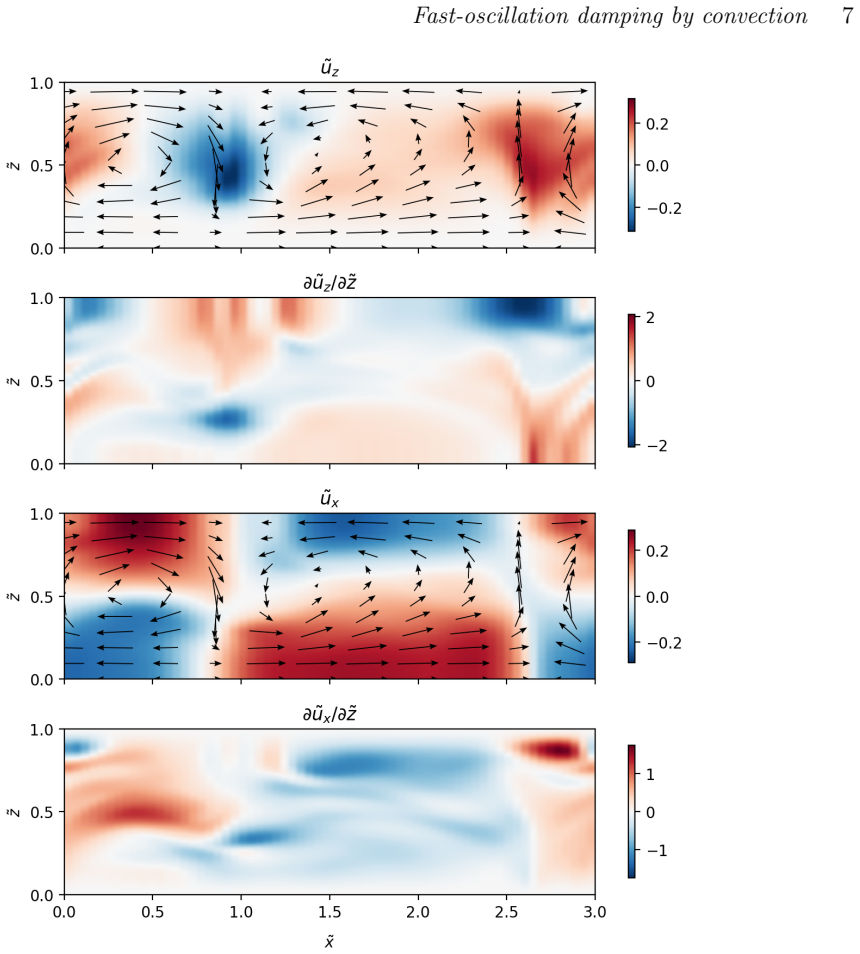
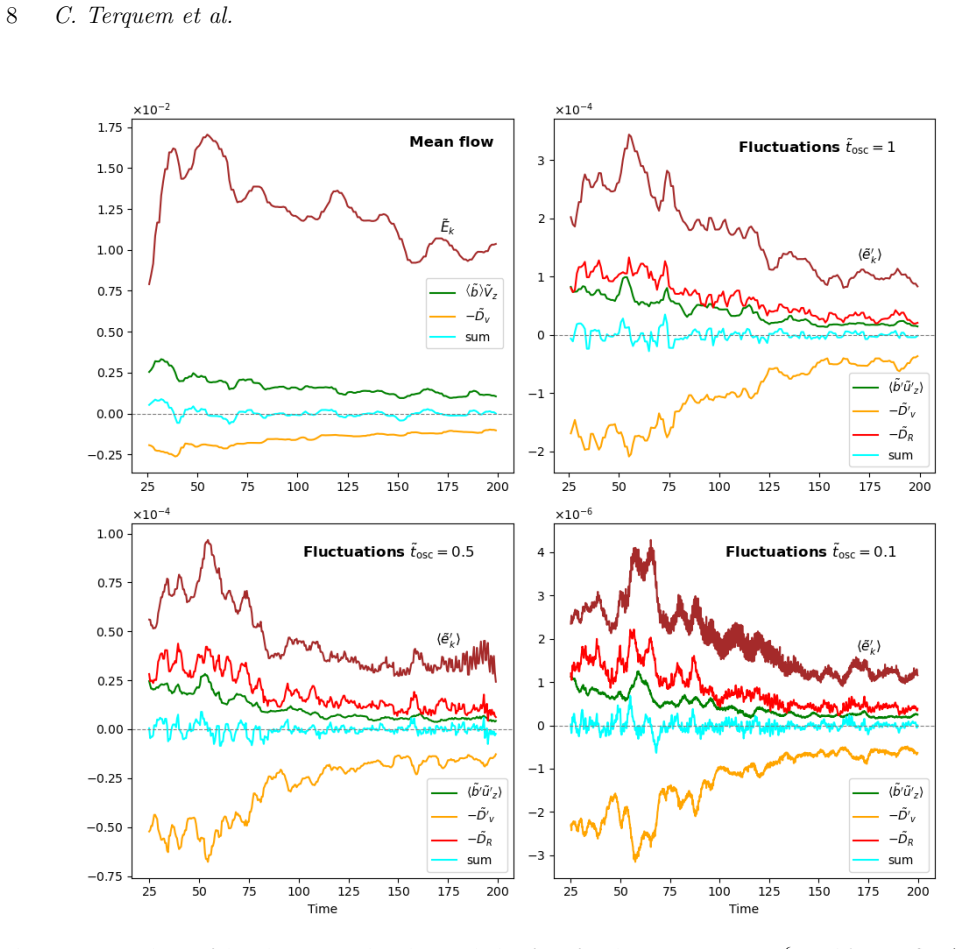
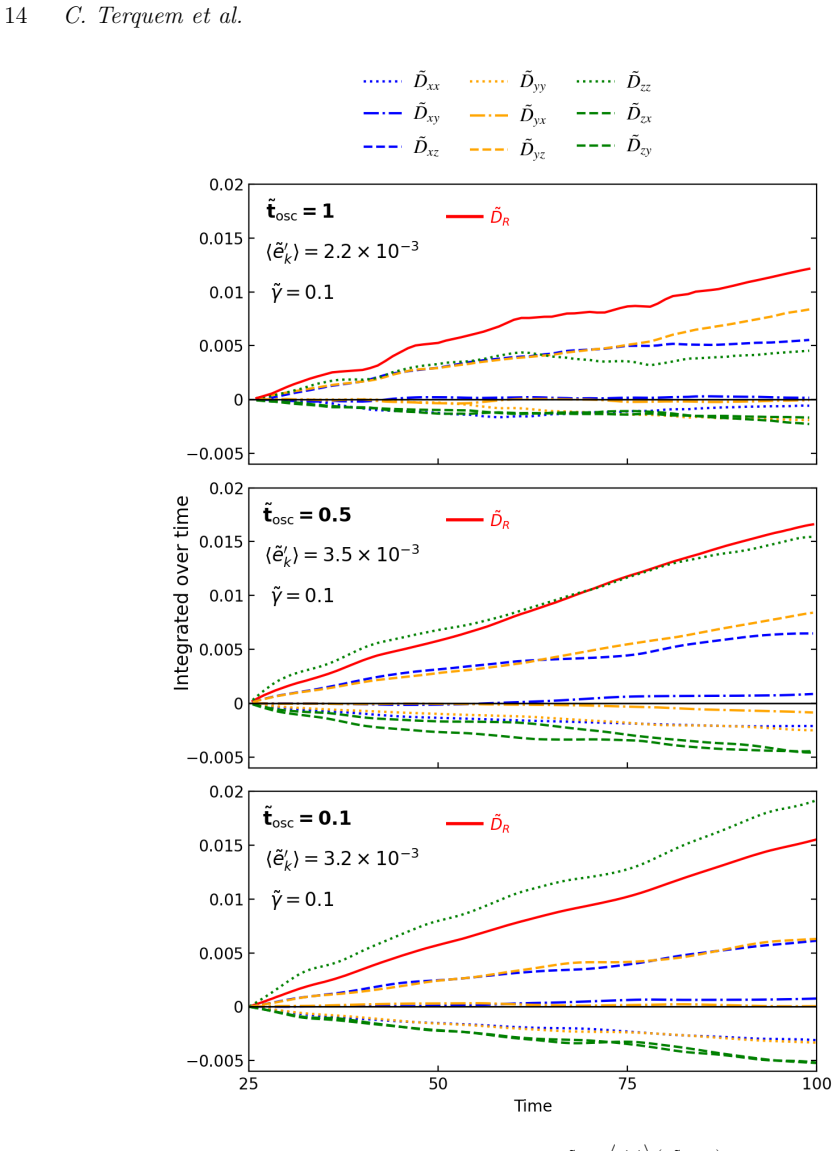
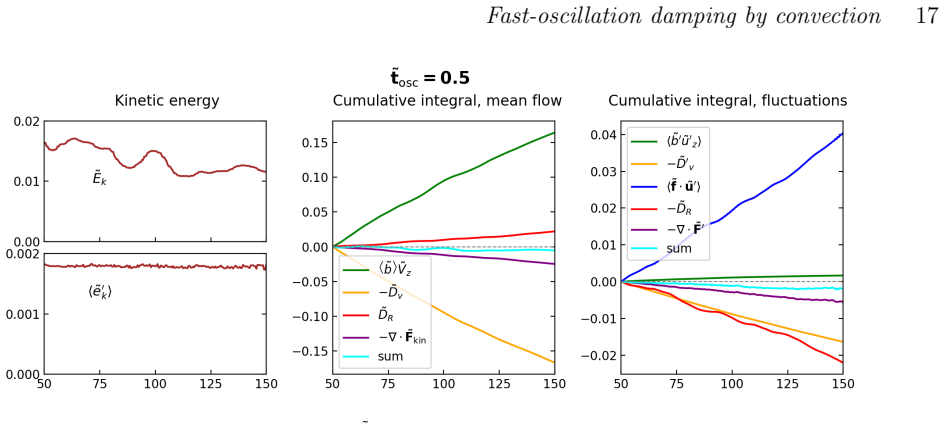
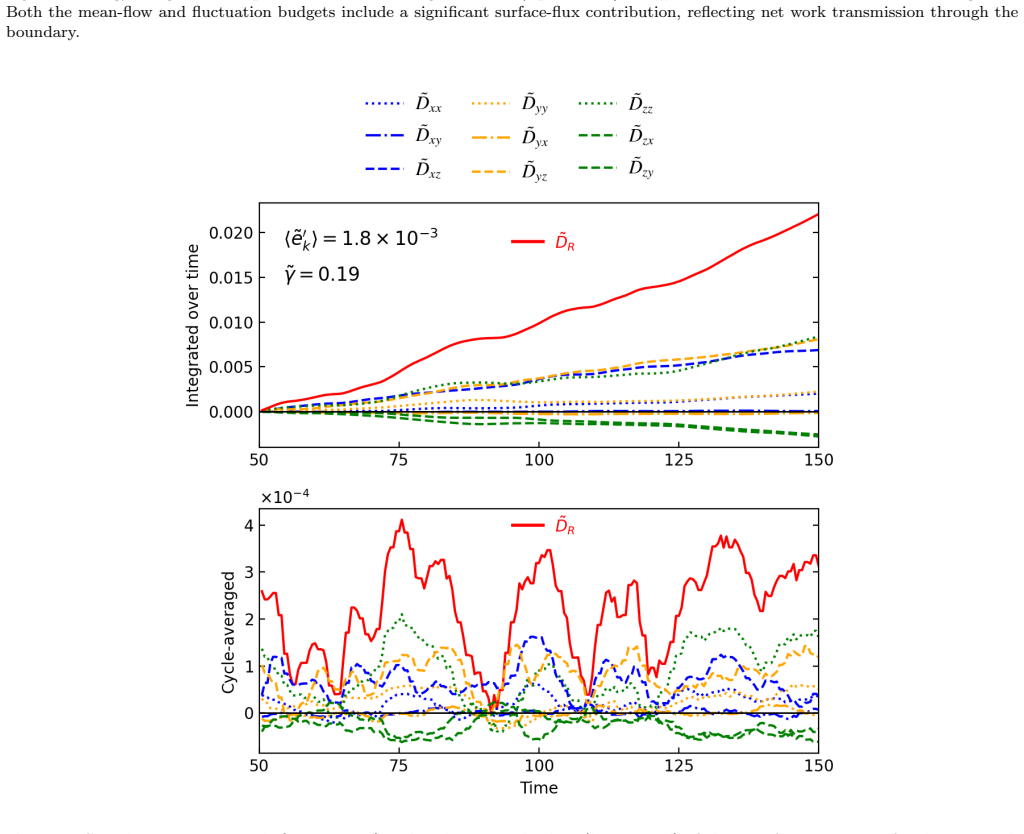
In these simulations the tidal oscillations systematically transfer kinetic energy to the mean convective flow at a volume-averaged rate D_R similar to u' squared over t_conv, where u' is the rms fluctuation velocity. This occurs because of strong correlations between the fluctuation velocities and the mean flow, which arise as the oscillatory forcing displaces fluid elements that buoyancy and incompressibility redirect in the same manner as the mean flow. The transfer is dominated by correlations involving vertical velocity fluctuations and vertical gradients of the mean flow. Replacing the free surface with a rigid upper boundary significantly modifies these correlations.
What carries the argument
The Reynolds decomposition averaging the velocity field over one oscillation period to separate the tidal oscillations as fluctuations from the convective mean flow, revealing their energy exchange through velocity correlations.
Load-bearing premise
The low-amplitude oscillatory forcing with periods 10-100 times shorter than the convective timescale accurately represents real tidal perturbations in stellar and planetary convective envelopes without significant back-reaction on the mean convective state.
What would settle it
A simulation or observation showing no systematic kinetic energy transfer from the oscillations to the mean flow at the predicted rate when the oscillatory Reynolds number is high would falsify the central claim.
Figures



read the original abstract
We present three-dimensional Dedalus simulations of Rayleigh-B\'enard convection with a blackbody-radiating free upper surface, subject to a low-amplitude oscillatory forcing that mimics tidal perturbations in convective envelopes of stars and planets. The forcing period is 10-100 times shorter than the convective timescale, $t_{\rm conv}$. Using a Reynolds decomposition of the velocity field averaged over one oscillation period, in which the tidal oscillations naturally constitute the fluctuating field and convection the mean flow, we elucidate the kinetic energy exchange between the two. Provided the oscillatory Reynolds number exceeds a modest threshold, we find that the oscillations systematically transfer kinetic energy to the mean flow at a volume-averaged rate $D_R \sim u'^2 t_{\rm conv}^{-1}$, where $u'$ is the rms fluctuation velocity. This reflects strong, order-unity correlations between the fluctuation velocities and the mean flow. These arise because the oscillatory forcing displaces fluid elements that are then redirected by buoyancy and incompressibility in the same manner as the mean flow. The transfer is dominated by correlations involving vertical velocity fluctuations and vertical gradients of the mean flow. The resulting energy transfer rate is consistent, within the equilibrium-tide framework, with the observed tidal circularisation of solar-type binaries and with the orbital evolution of moons of Jupiter and Saturn. This validates the formalism proposed by Terquem (2021) for the dissipation of fast tides, a longstanding problem. Replacing the free surface with a rigid upper boundary significantly and artificially modifies the correlations.
Editorial analysis
A structured set of objections, weighed in public.
Referee Report
Summary. The manuscript reports three-dimensional Dedalus simulations of Rayleigh-Bénard convection with a blackbody-radiating free upper surface, subject to low-amplitude oscillatory forcing with periods 10-100 times shorter than the convective turnover time t_conv. Using Reynolds decomposition (period-averaged mean flow for convection, fluctuations for tides), the authors find that above a modest oscillatory Reynolds number threshold the fluctuations transfer kinetic energy to the mean flow at volume-averaged rate D_R ∼ u'^2 t_conv^{-1} due to order-unity correlations (dominated by vertical velocity fluctuations and vertical mean-flow gradients). This rate is stated to be consistent with observed tidal circularization in solar-type binaries and orbital evolution of Jupiter/Saturn moons, thereby validating the equilibrium-tide formalism of Terquem (2021). A rigid upper boundary is shown to alter the correlations significantly.
Significance. If the reported scaling and correlations prove robust, the work supplies numerical support for a mechanism of fast-tide dissipation in convective envelopes, with direct relevance to binary circularization timescales and satellite orbital evolution. The three-dimensional geometry, radiating free surface, and emergence of a parameter-free scaling from the simulations are strengths; the result is not an algebraic reduction but an emergent numerical finding.
major comments (3)
- [Abstract and Results] The central interpretation of D_R as a physical tidal-convective energy transfer requires that the low-amplitude forcing leaves the mean convective state (velocity profiles, rms u, heat flux) statistically invariant. No explicit test or comparison of these mean-flow diagnostics with versus without the oscillatory forcing is reported, leaving open the possibility that the extracted correlations are contaminated by back-reaction on the mean state.
- [Numerical Methods] The scaling D_R ∼ u'^2 t_conv^{-1} is presented as an emergent result, yet the manuscript provides no resolution studies, grid-convergence tests, or error bars on the measured D_R. Without these, it is impossible to judge whether the order-unity correlations and the reported rate are insensitive to numerical choices or post-processing details such as the exact averaging window.
- [Discussion] The claim that the result 'validates the formalism proposed by Terquem (2021)' is load-bearing for the paper's astrophysical conclusion. The quantitative match between the simulated D_R and the analytical prediction (including the precise dependence on tidal amplitude and frequency) should be shown explicitly rather than asserted at the level of consistency with observations.
minor comments (2)
- [Abstract] The abstract refers to a 'volume-averaged rate' but does not define the precise expression for D_R or the correlation terms from which it is computed.
- [Results] Figure captions and text should clarify how the oscillatory Reynolds number threshold is determined and whether it depends on the specific forcing amplitude used.
Simulated Author's Rebuttal
We thank the referee for their careful reading of our manuscript and for providing detailed comments that have improved the clarity and robustness of our work. Below we address each major comment point by point.
read point-by-point responses
-
Referee: [Abstract and Results] The central interpretation of D_R as a physical tidal-convective energy transfer requires that the low-amplitude forcing leaves the mean convective state (velocity profiles, rms u, heat flux) statistically invariant. No explicit test or comparison of these mean-flow diagnostics with versus without the oscillatory forcing is reported, leaving open the possibility that the extracted correlations are contaminated by back-reaction on the mean state.
Authors: We concur that it is essential to verify that the low-amplitude oscillatory forcing does not alter the mean convective state. Although not explicitly shown in the original submission, we have conducted additional simulations without the forcing and compared the mean velocity profiles, rms velocities, and heat transport. The differences are statistically insignificant, confirming the invariance. In the revised manuscript, we will include these comparisons in a new figure and accompanying text in the Results section. revision: yes
-
Referee: [Numerical Methods] The scaling D_R ∼ u'^2 t_conv^{-1} is presented as an emergent result, yet the manuscript provides no resolution studies, grid-convergence tests, or error bars on the measured D_R. Without these, it is impossible to judge whether the order-unity correlations and the reported rate are insensitive to numerical choices or post-processing details such as the exact averaging window.
Authors: We acknowledge that the absence of resolution studies and error bars limits the assessment of numerical robustness. We will perform and report grid-convergence tests by running simulations at increased resolutions and demonstrate that the scaling and correlations are insensitive to resolution within the reported precision. Error bars on D_R, based on temporal variations and multiple runs, will also be added to the relevant figures and tables. Additionally, we will discuss the sensitivity to the averaging window. revision: yes
-
Referee: [Discussion] The claim that the result 'validates the formalism proposed by Terquem (2021)' is load-bearing for the paper's astrophysical conclusion. The quantitative match between the simulated D_R and the analytical prediction (including the precise dependence on tidal amplitude and frequency) should be shown explicitly rather than asserted at the level of consistency with observations.
Authors: We appreciate this point, as the validation of Terquem (2021) is indeed central to our conclusions. While we stated consistency with observations, we agree that an explicit quantitative comparison to the analytical prediction is warranted. In the revised manuscript, we will add a dedicated paragraph and figure in the Discussion section that directly compares the simulated D_R values to the Terquem (2021) formula across the simulated amplitudes and frequencies, showing the agreement and any deviations. revision: yes
Circularity Check
Numerical simulation result stands independently of self-citation
full rationale
The paper's central finding—an emergent volume-averaged energy transfer rate D_R ∼ u'^2 t_conv^{-1}—is obtained directly from 3D Dedalus simulations of Rayleigh-Bénard convection subject to low-amplitude oscillatory forcing. The Reynolds decomposition is applied by definition to separate period-averaged mean flow (convection) from fluctuations (tides), after which correlations are measured as simulation outputs. No algebraic step reduces this measured rate to a fitted parameter, prior ansatz, or self-citation by construction. The closing statement that the result 'validates the formalism proposed by Terquem (2021)' is a contextual consistency remark, not a load-bearing premise; the derivation chain relies on numerical solution of the fluid equations and is externally falsifiable by re-running the simulations.
Axiom & Free-Parameter Ledger
axioms (2)
- domain assumption Incompressible Boussinesq fluid with constant thermal expansion coefficient and kinematic viscosity
- domain assumption Blackbody radiation boundary condition at the free upper surface
Reference graph
Works this paper leans on
-
[1]
R., 1987, J
Auton T. R., 1987, J. Fluid Mech., 183, 199
1987
-
[2]
J., Astoul A
Barker A. J., Astoul A. A. V., 2021, , 506, L69
2021
-
[3]
J., Vasil G
Burns K. J., Vasil G. M., Oishi J. S., Lecoanet D., Brown B. P., 2020, ApJS, 251, 17
2020
-
[4]
A., Tavener S
Cliffe K. A., Tavener S. J., 1998, Journal of Computational Physics, 145, 193
1998
-
[5]
Dang C., Peybernes M., Le Tellier R., Saas L., 2021, Annals of Nuclear Energy, 150, 107848
2021
-
[6]
D., Barker A
Duguid C. D., Barker A. J., Jones C. A., 2020, MNRAS, 497, 3400
2020
-
[7]
D., 1977, Icar, 30, 301
Goldreich P., Nicholson P. D., 1977, Icar, 30, 301
1977
-
[8]
I., 2014, ARA&A, 52, 171
Ogilvie G. I., 2014, ARA&A, 52, 171
2014
-
[9]
I., Lesur G., 2012, MNRAS, 422, 1975
Ogilvie G. I., Lesur G., 2012, MNRAS, 422, 1975
2012
-
[10]
Penev K., Sasselov D., Robinson F., Demarque P., 2009, ApJ, 704, 930
2009
-
[11]
R., 2020, Reviews of Modern Physics, 92, 041001
Schumacher J., Sreenivasan K. R., 2020, Reviews of Modern Physics, 92, 041001
2020
-
[12]
Terquem C., 2021, , 503, 5789
2021
-
[13]
Terquem C., 2023, , 525, 508
2023
-
[14]
Terquem C., Martin S., 2021, , 507, 4165
2021
-
[15]
Terquem C., Papaloizou J. C. B., Nelson R. P., Lin D. N. C., 1998, ApJ, 502, 788
1998
-
[16]
J., 2020a, MNRAS, 497, 4472
Vidal J., Barker A. J., 2020a, MNRAS, 497, 4472
-
[17]
J., 2020b, ApJ, 888, L31
Vidal J., Barker A. J., 2020b, ApJ, 888, L31
-
[18]
P., 1966, AnAp, 29, 489
Zahn J. P., 1966, AnAp, 29, 489
1966
discussion (0)
Sign in with ORCID, Apple, or X to comment. Anyone can read and Pith papers without signing in.