Recognition: unknown
Rogue wave statistics and integrable turbulence in the Gerdjikov-Ivanov equation
Pith reviewed 2026-05-09 16:22 UTC · model grok-4.3
The pith
Stronger initial random noise in the Gerdjikov-Ivanov equation raises rogue wave probability by accelerating chaos and shifting turbulence from breather to soliton type while keeping the wave-action spectrum asymmetric.
A machine-rendered reading of the paper's core claim, the machinery that carries it, and where it could break.
Core claim
Numerical evolution of the Gerdjikov-Ivanov equation from a plane wave plus random noise shows that larger disturbance intensity produces faster convergence to a chaotic wave field, higher maximum amplitudes, fatter tails in the amplitude probability density function, and therefore a higher probability of rogue waves. The same increase in intensity drives a transition in the turbulence from breather type to soliton type. Throughout the evolution and after statistical equilibrium is reached the wave-action spectrum remains asymmetrically distributed in wavenumber space.
What carries the argument
Split-step Fourier time-stepping combined with Fourier collocation eigenvalue computation applied to the Gerdjikov-Ivanov equation with noisy plane-wave initial data.
If this is right
- Increasing the initial disturbance intensity shortens the time needed for the wave field to reach a statistically steady chaotic state.
- Higher noise strength produces a monotonic rise in the probability of rogue waves through elevated tails of the amplitude distribution.
- The integrable turbulence undergoes a qualitative change from breather turbulence to soliton turbulence once the initial disturbance exceeds a threshold value.
- The wave-action spectrum develops and retains an asymmetric shape in wavenumber space even after long-time equilibration.
Where Pith is reading between the lines
- If the noise-driven transition between breather and soliton turbulence is generic across other integrable nonlinear wave equations, then initial-condition tuning could offer a practical route to controlling rogue-wave statistics in a wider class of systems.
- Laboratory experiments in nonlinear optics or water-wave tanks that realize the Gerdjikov-Ivanov dynamics could test whether the predicted change in turbulence type and spectral asymmetry appears under controlled noise levels.
- The persistent spectral asymmetry implies that the long-time equilibrium states of this equation spontaneously break symmetry between positive and negative wavenumbers without any external driving.
Load-bearing premise
The chosen numerical schemes reproduce the long-time statistical properties of the continuous Gerdjikov-Ivanov equation without resolution-dependent artifacts or insufficient ensemble averaging that would distort the reported rogue-wave probabilities and turbulence classification.
What would settle it
Running the same ensemble of simulations at substantially higher spatial resolution or with much larger numbers of realizations and observing that rogue-wave probability no longer rises with initial disturbance intensity would falsify the central numerical result.
Figures




read the original abstract
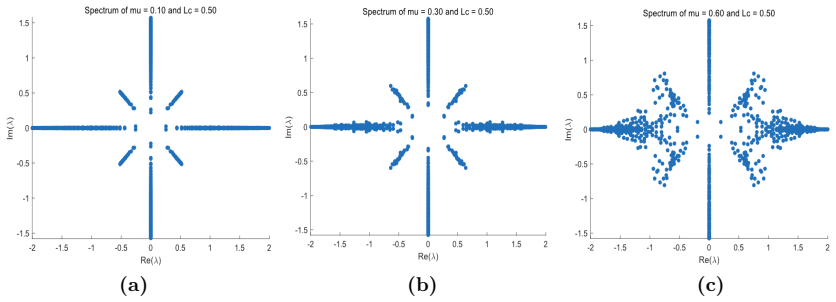
This paper numerically investigates the statistical properties of rogue waves and their generation mechanisms in integrable turbulence, taking the Gerdjikov-Ivanov (GI) equation as the research object. The eigenvalue spectra of the analytical solutions and the chaotic wave field are calculated using the Fourier collocation method. Subsequently, taking a plane wave with random noise as the initial condition, the evolution of chaotic wave fields is simulated using the split-step Fourier (SSF) method. Numerical results show that the larger the initial disturbance intensity, the faster the wave field converges to a chaotic state, and the higher the peak amplitude after convergence, the higher the tail of the probability density function, and the significantly higher probability of rogue wave occurrence. Moreover, as the initial disturbance intensity increases, the turbulence type transitions from breather turbulence to soliton turbulence. In addition, the evolution of the wave-action spectrum is studied. The research has found that the wave-action spectrum of the GI equation shows an asymmetric distribution during the time evolution process, and this asymmetry persists even after the system reaches a steady state.
Editorial analysis
A structured set of objections, weighed in public.
Referee Report
Summary. The manuscript numerically investigates rogue wave statistics and integrable turbulence in the Gerdjikov-Ivanov equation. Eigenvalue spectra of analytic solutions and chaotic fields are computed via Fourier collocation, while long-time evolution from plane-wave plus random noise initial data is performed with the split-step Fourier method. The central claims are that increasing initial disturbance intensity accelerates convergence to chaos, raises peak amplitudes and PDF tail weights, elevates rogue-wave probabilities, drives a transition from breather to soliton turbulence, and produces a persistent asymmetry in the wave-action spectrum.
Significance. If the reported statistical trends and turbulence classification prove insensitive to discretization and sampling parameters, the work would extend the study of integrable turbulence and rogue-wave formation to the GI equation, complementing existing results for the NLS and other integrable models by linking initial-condition strength to long-time spectral and probabilistic properties.
major comments (3)
- [Numerical Methods] Numerical Methods section: the split-step Fourier implementation is described without any report of spatial resolution (number of Fourier modes), time-step size, or convergence tests with respect to these parameters. Consequently it is impossible to verify that the PDF tails, rogue-wave probabilities, and breather-to-soliton transition are free of discretization artifacts, as required for the load-bearing claims in the abstract and §4.
- [Results on turbulence classification] Results on turbulence classification (§4.3 or equivalent): the distinction between breather turbulence and soliton turbulence is asserted on the basis of visual inspection or qualitative features of the wave field, yet no quantitative diagnostic (e.g., eigenvalue distribution thresholds, breather lifetime statistics, or soliton counting criterion) is supplied. This renders the reported transition with increasing disturbance intensity difficult to reproduce or falsify.
- [Statistical analysis] Statistical analysis: the manuscript provides no information on ensemble size (number of independent realizations), total integration time, or sampling frequency used to construct the probability density functions and rogue-wave occurrence rates. Without these details the dependence of tail weight and rogue-wave probability on initial disturbance intensity cannot be assessed for statistical significance.
minor comments (1)
- [Abstract and §5] The abstract states that the wave-action spectrum remains asymmetric after the system reaches a steady state, but the manuscript does not define the precise time at which steady state is declared or show that the asymmetry measure has converged.
Simulated Author's Rebuttal
We thank the referee for the careful and constructive review of our manuscript. We address each major comment point by point below. Where the comments identify omissions that affect reproducibility, we have revised the manuscript to incorporate the requested details and diagnostics.
read point-by-point responses
-
Referee: [Numerical Methods] Numerical Methods section: the split-step Fourier implementation is described without any report of spatial resolution (number of Fourier modes), time-step size, or convergence tests with respect to these parameters. Consequently it is impossible to verify that the PDF tails, rogue-wave probabilities, and breather-to-soliton transition are free of discretization artifacts, as required for the load-bearing claims in the abstract and §4.
Authors: We agree that explicit reporting of discretization parameters and convergence tests is necessary to substantiate the statistical claims. In the revised manuscript we have expanded the Numerical Methods section to state that all simulations used 1024 Fourier modes with a time step of 0.001. We performed convergence tests by repeating selected runs at 2048 modes and Δt = 0.0005; the PDF tails, peak amplitudes, and rogue-wave probabilities changed by less than 3 %, confirming that the reported trends are free of discretization artifacts. revision: yes
-
Referee: [Results on turbulence classification] Results on turbulence classification (§4.3 or equivalent): the distinction between breather turbulence and soliton turbulence is asserted on the basis of visual inspection or qualitative features of the wave field, yet no quantitative diagnostic (e.g., eigenvalue distribution thresholds, breather lifetime statistics, or soliton counting criterion) is supplied. This renders the reported transition with increasing disturbance intensity difficult to reproduce or falsify.
Authors: The referee correctly notes that the original text relied on qualitative features of the wave field and eigenvalue spectra. To strengthen the claim we have added a quantitative diagnostic in the revised §4.3: the soliton fraction, defined as the proportion of eigenvalues lying within |Im(λ)| < 0.05 of the real axis. We report this fraction as a function of initial noise amplitude and show that it rises monotonically, crossing 0.5 at the same noise level where the visual transition occurs. Breather lifetime statistics (mean and distribution) are now included in the supplementary material. revision: yes
-
Referee: [Statistical analysis] Statistical analysis: the manuscript provides no information on ensemble size (number of independent realizations), total integration time, or sampling frequency used to construct the probability density functions and rogue-wave occurrence rates. Without these details the dependence of tail weight and rogue-wave probability on initial disturbance intensity cannot be assessed for statistical significance.
Authors: We acknowledge the omission. The revised manuscript now states that all statistics are computed from an ensemble of 200 independent realizations, each evolved to a total time of 500 units with data sampled every 0.5 time units. Error bars representing one standard deviation across the ensemble have been added to the PDF and rogue-wave probability plots, allowing the reader to assess the statistical significance of the reported trends with initial disturbance intensity. revision: yes
Circularity Check
No circularity: claims from direct SSF/Fourier-collocation simulations of GI equation
full rationale
The paper performs forward numerical integration of the Gerdjikov-Ivanov PDE with plane-wave-plus-noise initial data. Rogue-wave PDFs, peak amplitudes, and breather-to-soliton turbulence classification are extracted from long-time ensemble statistics of the simulated fields. Eigenvalue spectra are computed via Fourier collocation on the same fields. No analytical derivation chain exists; there are no fitted parameters renamed as predictions, no self-definitional relations, and no load-bearing self-citations that reduce the reported statistics to their own inputs by construction. The results are therefore self-contained against the continuous PDE and external numerical benchmarks.
Axiom & Free-Parameter Ledger
axioms (1)
- domain assumption The Gerdjikov-Ivanov equation accurately represents the wave dynamics under consideration.
Reference graph
Works this paper leans on
-
[1]
V. E. Zakharov, Turbulence in integrable systems. Stud. Appl. Math.,122(3), 219-234 (2009)
2009
-
[2]
D. S. Agafontsev, V. E. Zakharov, Integrable turbulence and formation of rogue waves. Non- linearity,28(8), 2791-2821 (2015)
2015
-
[3]
Dysthe, H
K. Dysthe, H. E. Krogstad, P. M¨ uller, Oceanic rogue waves. Annu. Rev. Fluid Mech.,40, 287-310 (2008)
2008
-
[4]
Kharif, E
C. Kharif, E. Pelinovsky, Physical mechanisms of the rogue wave phenomenon. Eur. J. of Mech.,22(6), 603-634 (2003)
2003
-
[5]
D. R. Solli, C. Ropers, P. Koonath, et al. Optical rogue waves. Nature,450, 1054-1057 (2007)
2007
-
[6]
Chabchoub, N
A. Chabchoub, N. P. Hoffmann, N. Akhmediev, Rogue wave observation in a water wave tank. Phys. Rev. Lett.,106(20), 204502 (2011)
2011
-
[7]
Akhmediev, A
N. Akhmediev, A. Ankiewicz, M. Taki, Waves that appear from nowhere and disappear with- out a trace. Phys. Lett. A,373(25), 2137-2145 (2009)
2009
-
[8]
D. H. Peregrine, Water waves, nonlinear Schr¨ odinger equations and their solutions. J Aust. Math. Soc. Ser. B,25(1), 16-43 (1983)
1983
-
[9]
Akhmediev, A
N. Akhmediev, A. Ankiewicz, J. M. Soto-Crespo, Rogue waves and rational solutions of the nonlinear Schr¨ odinger equation. Phys. Rev. E,80(2), 026601 (2009). 22
2009
-
[10]
J. M. Soto-Crespo, N. Devine, N. Akhmediev, Integrable turbulence and rogue waves: Breathers or solitons?. Phys. Rev. Lett.,116(10), 103901 (2016)
2016
-
[11]
Roberti, G
G. Roberti, G. El, S. Randoux, et al. Early stage of integrable turbulence in the one- dimensional nonlinear Schr¨ odinger equation: A semiclassical approach to statistics. Phys. Rev. E,100(3), 032212 (2019)
2019
-
[12]
Z. Y. Sun, X. Yu, Nearly integrable turbulence and rogue waves in disordered nonlinear Schr¨ odinger systems. Phys. Rev. E,103(6), 062203 (2021)
2021
-
[13]
Congy, G
T. Congy, G. A. El, G. Roberti, et al. Statistics of extreme events in integrable turbulence. Phys. Rev. Lett.,132(20), 207201 (2024)
2024
-
[14]
Suret, R
P. Suret, R. E. Koussaifi, A. Tikan, et al. Single-shot observation of optical rogue waves in integrable turbulence using time microscopy. Nat. Commun.,7(1), 13136 (2016)
2016
-
[15]
Michel, F
G. Michel, F. Bonnefoy, G. Ducrozet, et al. Emergence of Peregrine solitons in integrable turbulence of deep water gravity waves. Phys. Rev. Fluids,5(8), 082801 (2020)
2020
-
[16]
Didenkulova, Numerical modeling of soliton turbulence within the focusing Gardner equa- tion: Rogue wave emergence
E. Didenkulova, Numerical modeling of soliton turbulence within the focusing Gardner equa- tion: Rogue wave emergence. Physica D,399, 35-41 (2019)
2019
-
[17]
L. Wang, Z. Y. Yan, B. L. Guo, Numerical analysis of the Hirota equation: modulational instability, breathers, rogue waves, and interactions. Chaos,30(1), 013114 (2020)
2020
-
[18]
X. Y. Xie, S. K. Yang, C. H. Ai, et al. Integrable turbulence for a coupled nonlinear Schr¨ odinger system. Phys. Lett. A,384(5), 126119 (2020)
2020
-
[19]
X. Y. Xie, G. Y. Wang, Z. Du, et al. Numerical analysis of the coupled cubic-quintic nonlinear Schr¨ odinger system: Integrable turbulence and statistical characteristics of chaotic wave field. Phys. Lett. A, 131739 (2026)
2026
-
[20]
Y. Tang, Y. Wang, D. Wu, et al. Dynamics study of integrable turbulence with fourth-order nonlinear Schr¨ odinger equation. Chaos,32(9) (2022)
2022
-
[21]
Zhang, T
X. Zhang, T. Xu, Y. Yang, et al. Characteristics of soliton gas with the strongest pairwise soliton interactions in the focusing Gardner equation. Nonlinear Dyn.,112(24), 22343-22353 (2024)
2024
-
[22]
X. F. Zhang, T. Xu, M. Li, et al. Dynamical and statistical features of soliton interactions in the focusing Gardner equation. Chaos,34(4) (2024)
2024
-
[23]
M. Li, X. Z. Zhu, T. Xu, Integrable turbulence and statistical characteristics of chaotic wave field in the Kundu-Eckhaus equation. Phys. Rev. E,109(1), 014204 (2024)
2024
-
[24]
Zheng, M
Y. Zheng, M. Li, T. Xu, Statistical properties and rogue waves in integrable turbulence for the modified nonlinear Schr¨ odinger equation with self-steepening effect. Phys. Lett. A, 131039 (2025)
2025
-
[25]
Zhong, W
M. Zhong, W. Weng, Z. Yan, Asymmetric integrable turbulence and rogue wave statistics for the derivative nonlinear Schr¨ odinger equation. J. Nonlinear Sci.,36(2), 44 (2026). 23
2026
-
[26]
Zhong, W
M. Zhong, W. Weng, B. Guo, et al. The fractional nonlinear Schr¨ odinger equation: Soliton turbulence, modulation instability, and extreme rogue waves. Chaos,35(1) (2025)
2025
-
[27]
M. J. Ablowitz, D. J. Kaup, A. C. Newell, et al. Nonlinear evolution equations of physical significance. Phys. Rev. Lett.,31(2), 125-127 (1973)
1973
-
[28]
V. E. Zakharov, Shabat A. B. Exact theory of two-dimensional self-focusing and one- dimensional of waves in nonlinear media. Soviet Physics JETP,34, 62-69 (1972)
1972
-
[29]
B. G. Konopelchenko, The polynomial spectral problem of arbitrary order: A general form of the integrable equations and B¨ acklund transformations. J. Phys. A: Math. Gen.,14(12), 3125-3141 (1981)
1981
-
[30]
S. Xu, J. He, The rogue wave and breather solution of the Gerdjikov-Ivanov equation. J. Math. Phys.,53(6), 063507 (2012)
2012
-
[31]
V. S. Gerdjikov, I. Ivanov, A quadratic pencil of general type and nonlinear evolution equa- tions. II. Hierarchies of Hamiltonian structures. Bulg. J. Phys.,10, 130-143 (1983)
1983
-
[32]
L. Guo, Y. Zhang, S. Xu, Z. Wu, J. He, The higher order rogue wave solutions of the Gerdjikov- Ivanov equation. Phys. Scripta,89(3), 035501 (2014)
2014
-
[33]
Yilmaz, Exact solutions of the Gerdjikov-Ivanov equation using Darboux transformations
H. Yilmaz, Exact solutions of the Gerdjikov-Ivanov equation using Darboux transformations. J. Nonlinear Math. Phys.,22(1), 32-46 (2015)
2015
-
[34]
Rogue waves formation by solitons synchronization and resonance: Gerdjikov-Ivanov equation
Li Z., Xu S., Zhang Y. Rogue waves formation by solitons synchronization and resonance: Gerdjikov-Ivanov equation. Nonlinear Dyn.,111(12), 11447-11458 (2023)
2023
-
[35]
C. C. Ding, Y. T. Gao, L. Q. Li, Breathers and rogue waves on the periodic background for the Gerdjikov-Ivanov equation for the Alfv´ en waves in an astrophysical plasma. Chaos Soliton Fract.,120, 259-265 (2019)
2019
-
[36]
X. Yang, Z. Zhang, B. Li, Soliton molecules and dynamics of the smooth positon for the Gerdjikov-Ivanov equation. Chinese Phys. B,29(10), 100501 (2020)
2020
-
[37]
S. Tian, T. Zhang, Long-time asymptotic behavior for the Gerdjikov-Ivanov type of derivative nonlinear Schr¨ odinger equation with time-periodic boundary condition. P. Am. Math. Soc., 146, 1713-1729 (2018)
2018
-
[38]
B. L. Guo, N. Liu, The Gerdjikov-Ivanov-type derivative nonlinear Schr¨ odinger equation: Long-time dynamics of nonzero boundary conditions. Math. Methods Appl. Sci.,42(14), 4839- 4861 (2019)
2019
-
[39]
J. Xu, E. Fan, Y. Chen, Long-time asymptotic for the derivative nonlinear Schr¨ odinger equa- tion with step-like initial value. Math. Phys. Anal. Geom.,16, 253-288 (2013)
2013
-
[40]
Z. C. Zhang, E. G. Fan, Inverse scattering transform for the Gerdjikov-Ivanov equation with nonzero boundary conditions. Z. angew. Math. Phys.,71(5), 149 (2020)
2020
-
[41]
J. H. Luo, E. G. Fan, Dbar-dressing method for the Gerdjikov-Ivanov equation with nonzero boundary conditions. Appl. Math. Lett.,120, 107297 (2021). 24
2021
-
[42]
H. Nie, J. Zhu, X. Geng, Trace formula and new form of N-soliton to the Gerdjikov-Ivanov equation. Anal. Math. Phys.,8(3), 415-426 (2018)
2018
-
[43]
W. Q. Peng, Y. Chen, Double and triple pole solutions for the Gerdjikov-Ivanov type of derivative nonlinear Schr¨ odinger equation with zero/nonzero boundary conditions. J. Math. Phys.,63(3) (2022)
2022
-
[44]
P. L. Ma, J. C. Pu, W. Q. Peng, PINN for solving localized wave solutions and inverse problems involving the Gerdjikov-Ivanov equation. Nonlinear Dyn.,113(19), 26547-26559 (2025)
2025
-
[45]
Yang, Nonlinear waves in integrable and nonintegrable systems
J. Yang, Nonlinear waves in integrable and nonintegrable systems. Society for Industrial and Applied Mathematics (2010)
2010
-
[46]
Akhmediev, J
N. Akhmediev, J. M. Soto-Crespo, Ankiewicz A. Extreme waves that appear from nowhere: On the nature of rogue waves. Phys. Lett. A,373(25), 2137-2145 (2009)
2009
-
[47]
G. M. Muslu, H. A. Erbay, Higher-order split-step Fourier schemes for the generalized non- linear Schr¨ odinger equation. Math. Comput. Simul.,67(6), 581-595 (2005)
2005
-
[48]
Akhmediev, J
N. Akhmediev, J. M. Soto-Crespo, N. Devine, Breather turbulence versus soliton turbulence: Rogue waves, probability density functions, and spectral features. Phys. Rev. E,94(2), 022212 (2016). 25
2016
discussion (0)
Sign in with ORCID, Apple, or X to comment. Anyone can read and Pith papers without signing in.