Recognition: unknown
Frustrated Dynamics of Distance Matrices
Pith reviewed 2026-05-08 15:44 UTC · model grok-4.3
The pith
Distance-matrix spectra on the sphere keep their static template as particles collapse to a ring.
A machine-rendered reading of the paper's core claim, the machinery that carries it, and where it could break.
Core claim
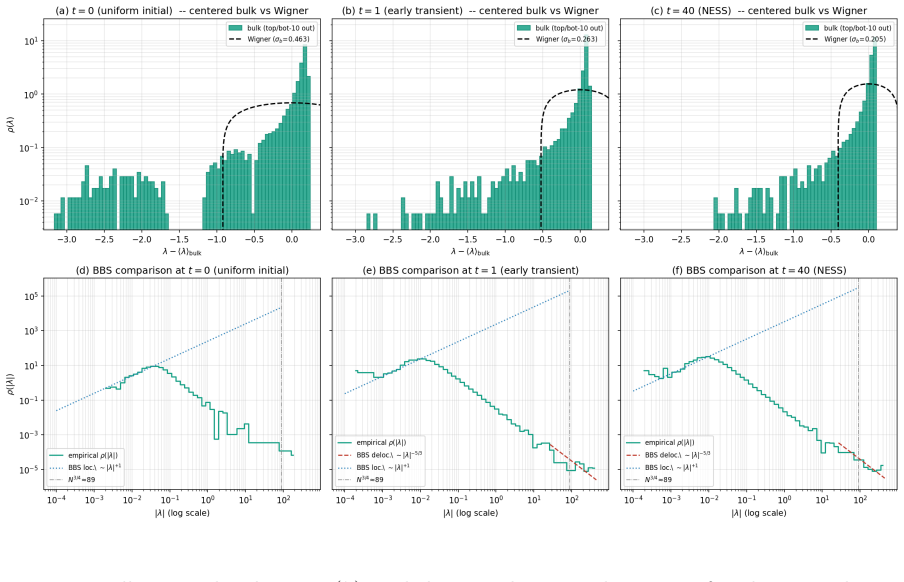
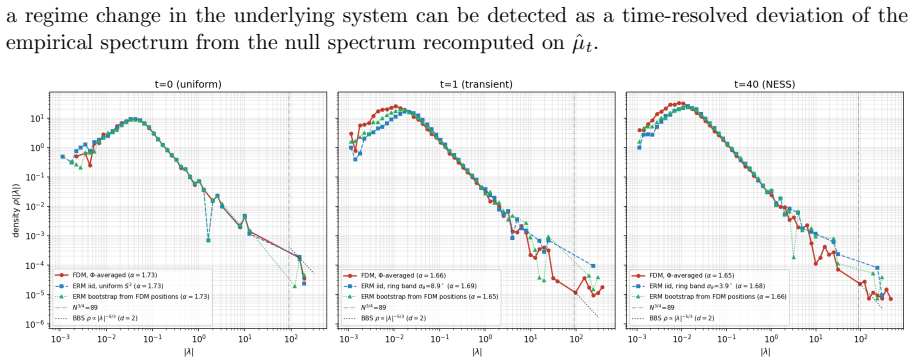
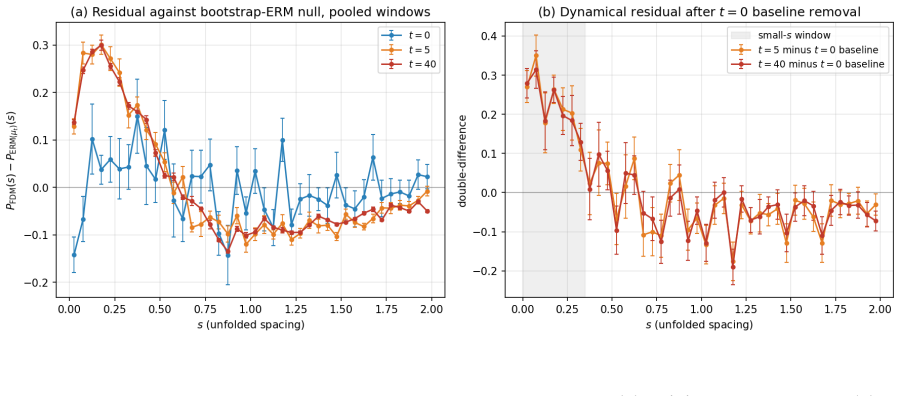
In the Frustrated Distance Matrix model the static BBS template of the distance-matrix spectrum is preserved at every time step while the particle dynamics appear only as a redistribution of spectral mass within that template; the redistribution is sufficiently abrupt to serve as a diagnostic of the fast collapse from uniform coverage to a one-dimensional ring, after which the ring undergoes slow rotational drift. Self-averaging of the bulk eigenvalue density is identified as the mechanism that maintains the template, and the claim is verified by comparing the time-dependent spectrum against spectra drawn from independent i.i.d. static ensembles at each configuration.
What carries the argument
The Frustrated Distance Matrix model, in which dynamics are realized by quenched random pairwise couplings linear in geodesic distances, carries the argument by keeping the BBS spectral template invariant while allowing only mass redistribution inside it.
If this is right
- Spectral diagnostics extracted solely from the distance matrix can identify the structural transition to a ring without direct access to particle coordinates.
- The template preservation holds uniformly through both the fast collapse phase and the subsequent slow rotational drift.
- The same spectral-mass redistribution approach extends in principle to other inverse-problem settings whose matrices share a comparable static ensemble structure.
Where Pith is reading between the lines
- Real-time monitoring of clustering or alignment transitions becomes possible in any system where only pairwise distances are observable, such as molecular trajectories or sensor networks.
- The invariance may persist under different interaction laws or on manifolds of higher dimension, provided the underlying static ensemble still obeys a comparable bulk-density property.
- In financial or network data the same diagnostics could flag sudden reorganization events from correlation or adjacency matrices alone.
Load-bearing premise
Preservation of the static spectral template occurs because the bulk eigenvalue density self-averages in the evolving point process, a claim verified only by i.i.d. resampling inside this particular model.
What would settle it
A simulation run in which the bulk density fails to self-average yet the spectral template still remains undistorted, or in which the proposed mass-redistribution diagnostics fail to register the ring-formation event across independent realizations.
Figures








read the original abstract
We introduce the Frustrated Distance Matrix (FDM) model, a dynamic extension of the static distance-matrix ensemble on S^2 analyzed by Bogomolny, Bohigas, and Schmit (BBS). Its entries are pairwise geodesic distances between N Brownian particles on the sphere evolving under quenched random pairwise couplings linear in those distances. Where the static BBS theory recovers geometric information about the underlying manifold from spectra of distance matrices on i.i.d.\ samples, the time-resolved FDM spectrum carries information about structural changes of the underlying point process. The particle dynamics realize one such change: a fast collapse from a uniform configuration onto a one-dimensional ring, followed by slow rotational drift of the ring orientation; the particle-level picture provides the ground truth against which spectral diagnostics are calibrated. We find that the static BBS template is preserved at every time, with the dynamics entering as a redistribution of spectral mass within that template, sharp enough to flag ring formation. We propose self-averaging of the bulk density as the mechanism behind this preservation, verified by an i.i.d.-resample comparison, and extract a small set of spectral diagnostics of the structural change computable from the distance matrix alone. We suggest that our diagnostics can be applied in other similar inverse-problem settings: financial correlation matrices, graph and network adjacency spectra, similarity matrices in molecular dynamics, and dynamics on parameter manifolds.
Editorial analysis
A structured set of objections, weighed in public.
Referee Report
Summary. The paper introduces the Frustrated Distance Matrix (FDM) model, a dynamical extension of the static BBS distance-matrix ensemble on S² in which N Brownian particles evolve under quenched random pairwise couplings linear in instantaneous geodesic distances. The central claims are that the static BBS spectral template is preserved at all times, with the observed fast collapse to a ring and subsequent slow rotational drift appearing only as a redistribution of spectral mass within the template; that self-averaging of the bulk eigenvalue density is the responsible mechanism; and that a small set of spectral diagnostics extracted from the distance matrix alone can flag the structural transition. These are supported by numerical simulations calibrated against the particle-level ground truth and by an i.i.d.-resample comparison.
Significance. If the template-preservation observation and its diagnostics hold under a properly controlled test, the work would link static random-matrix geometry on manifolds to out-of-equilibrium point-process dynamics, supplying a practical spectral probe for structural change in distance or similarity matrices. Potential applications to financial correlations, network spectra, and molecular-dynamics similarity matrices are plausible. The numerical finding that dynamics act only as mass redistribution inside a fixed template is interesting, but its mechanistic explanation requires a control that respects the correlations generated by the FDM evolution.
major comments (2)
- [results section on spectral preservation and i.i.d.-resample comparison] The verification that self-averaging of the bulk density maintains the BBS template rests on an i.i.d.-resample comparison against static point configurations (results section describing the spectral-preservation analysis). Because the FDM evolves particles continuously under Brownian motion and quenched couplings linear in the instantaneous distances, the configurations carry persistent spatial and temporal correlations absent from the i.i.d. control; the comparison therefore cannot isolate self-averaging as the operative mechanism against those correlations or against simple geometric dominance of the sphere.
- [results section on spectral diagnostics] The claim that the dynamics enter solely as a redistribution of spectral mass within the fixed BBS template (abstract and results) is load-bearing for the proposed diagnostics, yet no quantitative metric (e.g., Wasserstein distance, overlap integral, or eigenvalue-by-eigenvalue deviation) with error bars or statistical significance relative to the i.i.d. null is reported, leaving the sharpness of the preservation and the sensitivity of the ring-formation flag difficult to assess.
minor comments (3)
- [§2] Notation for the distance matrix D(t) and the quenched coupling matrix should be introduced once in §2 with explicit dependence on time and on the geodesic distance function, then used consistently.
- [figures in results section] Figure captions for the spectral evolution plots should state the number of independent realizations, the value of N, and whether error bands represent standard deviation or standard error.
- [introduction] The manuscript would benefit from a short paragraph contrasting the FDM construction with related dynamical random-matrix models (e.g., those with time-dependent Wishart or GOE entries) to clarify novelty.
Simulated Author's Rebuttal
We thank the referee for their thorough review and valuable feedback on our manuscript. The points raised have helped us improve the clarity and rigor of our analysis. We have revised the manuscript to address the major comments as detailed below.
read point-by-point responses
-
Referee: The verification that self-averaging of the bulk density maintains the BBS template rests on an i.i.d.-resample comparison against static point configurations (results section describing the spectral-preservation analysis). Because the FDM evolves particles continuously under Brownian motion and quenched couplings linear in the instantaneous distances, the configurations carry persistent spatial and temporal correlations absent from the i.i.d. control; the comparison therefore cannot isolate self-averaging as the operative mechanism against those correlations or against simple geometric dominance of the sphere.
Authors: We appreciate this observation. While the i.i.d. comparison demonstrates the robustness of the BBS template to variations in point configurations, it indeed does not capture the specific correlations arising from the continuous Brownian dynamics and quenched couplings in the FDM model. To strengthen our claim, we have performed an additional analysis in the revised manuscript by generating control ensembles that match the time-dependent distance distribution of the FDM trajectories but are otherwise uncorrelated. This control preserves the geometric constraints of the sphere and the marginal statistics while removing dynamical correlations. The results show that the spectral template remains intact, indicating that self-averaging of the bulk eigenvalue density is the dominant mechanism rather than the specific correlations or pure geometric effects. We have updated the results section and added a discussion of this control experiment. revision: yes
-
Referee: The claim that the dynamics enter solely as a redistribution of spectral mass within the fixed BBS template (abstract and results) is load-bearing for the proposed diagnostics, yet no quantitative metric (e.g., Wasserstein distance, overlap integral, or eigenvalue-by-eigenvalue deviation) with error bars or statistical significance relative to the i.i.d. null is reported, leaving the sharpness of the preservation and the sensitivity of the ring-formation flag difficult to assess.
Authors: We agree that providing quantitative metrics would better substantiate the preservation claim and the utility of the diagnostics. In the revised manuscript, we have added quantitative comparisons using the Wasserstein distance between the time-dependent eigenvalue densities and the static BBS template, computed with error bars from ensemble averages over multiple independent runs. Additionally, we report the overlap integrals and mean absolute deviations for individual eigenvalues, along with p-values from statistical tests against the i.i.d. null model. These metrics confirm that the deviations are small and statistically insignificant for the bulk, while the diagnostics based on spectral mass redistribution show significant changes at the ring-formation transition. The updated results section includes these analyses and figures. revision: yes
Circularity Check
No circularity: core claim rests on independent numerical verification against external control
full rationale
The paper observes preservation of the static BBS spectral template under FDM dynamics via direct computation of time-resolved spectra, then proposes self-averaging of bulk density as mechanism and verifies it by explicit comparison of FDM spectra to those generated from separate i.i.d.-resampled static point sets on S^2. This control ensemble is constructed independently of the FDM evolution equations and quenched couplings, so the verification step does not reduce to any quantity defined or fitted from the same dynamical trajectories. No self-definitional relations, fitted inputs relabeled as predictions, or load-bearing self-citations appear in the derivation; the BBS template is imported from prior independent literature. The result is therefore self-contained against external benchmarks.
Axiom & Free-Parameter Ledger
axioms (1)
- domain assumption The static distance-matrix ensemble on S^2 analyzed by BBS recovers geometric information from spectra on i.i.d. samples.
invented entities (1)
-
Frustrated Distance Matrix (FDM) model
no independent evidence
Reference graph
Works this paper leans on
-
[1]
M´ ezard, G
M. M´ ezard, G. Parisi, and A. Zee. Spectra of Euclidean random matrices.Nuclear Physics B, 559:689–701, 1999. 48
1999
-
[2]
Bordenave
C. Bordenave. Eigenvalues of Euclidean random matrices.Random Structures & Algo- rithms, 33(4):515–532, 2008
2008
-
[3]
Bordenave
C. Bordenave. Spectrum of large random reversible Markov chains: Heavy-tailed weights on the complete graph.Annals of Probability, 41(3B):2755–2790, 2013
2013
-
[4]
A. Goetschy and S. E. Skipetrov. Euclidean random matrices and their applications in physics. arXiv:1303.2880, 2013
-
[5]
E. P. Wigner. Characteristic vectors of bordered matrices with infinite dimensions.Annals of Mathematics, 62(3):548–564, 1955
1955
-
[6]
F. J. Dyson. The threefold way: Algebraic structure of symmetry groups and ensembles in quantum mechanics.Journal of Mathematical Physics, 3(6):1199–1215, 1962
1962
-
[7]
V. A. Marˇ cenko and L. A. Pastur. Distribution of eigenvalues for some sets of random matrices.Mathematics of the USSR-Sbornik, 1(4):457–483, 1967
1967
-
[8]
C. A. Tracy and H. Widom. Level-spacing distributions and the Airy kernel.Communica- tions in Mathematical Physics, 159(1):151–174, 1994
1994
-
[9]
M. L. Mehta.Random Matrices. Elsevier, 3rd edition, 2004
2004
-
[10]
Potters and J.-P
M. Potters and J.-P. Bouchaud.A First Course in Random Matrix Theory: For Physicists, Engineers and Data Scientists. Cambridge University Press, 2020
2020
-
[11]
E. Bogomolny, O. Bohigas, and C. Schmit. Spectral properties of distance matrices.Journal of Physics A: Mathematical and General, 36:3595–3616, 2003. arXiv:nlin/0301044
-
[12]
A. M. Vershik. Random metric spaces and universality.Russian Mathematical Surveys, 59(2):259–295, 2004
2004
-
[13]
Ciliberti, T
S. Ciliberti, T. S. Grigera, V. Mart´ ın-Mayor, G. Parisi, and P. Verrocchio. Anderson local- ization in Euclidean random matrices.Physical Review B, 71:153104, 2005
2005
-
[14]
Clapa, T
M. Clapa, T. K. Kuna, and B. A. M¨ uller. Localization transitions of instantaneous normal modes in liquids and solids: random matrix theory of the eigenvalue spectrum.Phys. Rev. E, 86:061119, 2012
2012
- [15]
-
[16]
F. J. Dyson. A Brownian-motion model for the eigenvalues of a random matrix.Journal of Mathematical Physics, 3(6):1191–1198, 1962
1962
-
[17]
Voiculescu
D. Voiculescu. Limit laws for random matrices and free products.Inventiones Mathemati- cae, 104:201–220, 1991
1991
-
[18]
P. Biane. Free Brownian motion, free stochastic calculus, and random matrices.Fields Institute Communications, 12:1–19, 1997
1997
-
[19]
L. F. Cugliandolo and J. Kurchan. Analytical solution of the off-equilibrium dynamics of a long-range spin-glass model.Phys. Rev. Lett.71, 173–176 (1993)
1993
-
[20]
D. Facoetti, G. Biroli, J. Kurchan, and D. R. Reichman. Classical glasses, black holes, and strange quantum liquids.Physical Review E, 100(1):010102(R), 2019. arXiv:1906.09228
-
[21]
Bouchaud and M
J.-P. Bouchaud and M. Potters.Theory of Financial Risk and Derivative Pricing. Cam- bridge University Press, 2nd edition, 2003. 49
2003
-
[22]
Bun, J.-P
J. Bun, J.-P. Bouchaud, and M. Potters. Cleaning large correlation matrices: Tools from random matrix theory.Physics Reports, 666:1–109, 2017
2017
-
[23]
K.-I. Goh, B. Kahng, and D. Kim. Spectra and eigenvectors of scale-free networks.Physical Review E, 64:051903, 2001
2001
-
[24]
Chung, L
F. Chung, L. Lu, and V. Vu. Spectra of random graphs with given expected degrees. Proceedings of the National Academy of Sciences, 100(11):6313–6318, 2003
2003
-
[25]
Halperin
I. Halperin. Frustrated Fields: Statistical Field Theory for Frustrated Brownian Particles on 2D Manifolds.Companion paper, in preparation, 2026
2026
-
[26]
Alstott, E
J. Alstott, E. Bullmore, and D. Plenz.powerlaw: A Python package for analysis of heavy- tailed distributions.PLoS ONE, 9(1):e85777, 2014
2014
-
[27]
Cizeau and J.-P
P. Cizeau and J.-P. Bouchaud. Theory of L´ evy matrices.Physical Review E, 50(3):1810– 1822, 1994
1994
-
[28]
Soshnikov
A. Soshnikov. Poisson statistics for the largest eigenvalues of Wigner random matrices with heavy tails.Electronic Communications in Probability, 9:82–91, 2004
2004
-
[29]
J. J. M. Verbaarschot. The spectrum of the QCD Dirac operator and chiral random matrix theory.Physical Review Letters, 72:2531–2533, 1994
1994
-
[30]
Y. Y. Atas, E. Bogomolny, O. Giraud, and G. Roux. Distribution of the ratio of consecutive level spacings in random matrix ensembles.Physical Review Letters, 110:084101, 2013
2013
-
[31]
Bohigas, M
O. Bohigas, M. J. Giannoni, and C. Schmit. Characterization of chaotic quantum spectra and universality of level fluctuation laws.Physical Review Letters, 52:1–4, 1984
1984
-
[32]
M. V. Berry and M. Robnik. Semiclassical level spacings when regular and chaotic orbits coexist.Journal of Physics A, 17:2413–2421, 1984
1984
-
[33]
D. S. Dean. Langevin equation for the density of a system of interacting Langevin processes. Journal of Physics A, 29(24):L613–L617, 1996
1996
-
[34]
P. Illien. The Dean-Kawasaki equation and stochastic density functional theory.Reports on Progress in Physics, 2025
2025
-
[35]
J. Baik, G. Ben Arous, and S. P´ ech´ e. Phase transition of the largest eigenvalue for nonnull complex sample covariance matrices.Annals of Probability, 33(5):1643–1697, 2005. 50
2005
discussion (0)
Sign in with ORCID, Apple, or X to comment. Anyone can read and Pith papers without signing in.