Recognition: unknown
Welcome to the Statverse: A Metaverse for Data Science
Pith reviewed 2026-05-08 03:09 UTC · model grok-4.3
The pith
A metaverse called Statverse is proposed to blend physical and digital worlds for teaching complex statistical concepts immersively.
A machine-rendered reading of the paper's core claim, the machinery that carries it, and where it could break.
Core claim
Statverse is introduced as a metaverse framework that integrates the physical and digital realms to create an immersive environment for representing and interacting with complex statistical concepts, with the explicit aim of advancing statistical education through this new digital strategy.
What carries the argument
The Statverse metaverse framework, which merges physical and virtual spaces to enable immersive representation of statistical concepts.
If this is right
- Statistical concepts could be explored through direct virtual manipulation rather than abstract descriptions alone.
- Educational programs might adopt shared virtual spaces for collaborative data analysis across institutions.
- Teaching methods could shift toward experiential learning where students navigate data visualizations in three dimensions.
- Partnership models between universities could expand to co-develop virtual statistical tools and curricula.
Where Pith is reading between the lines
- The framework may require integration with existing statistical software to become practical for daily classroom use.
- Similar metaverse approaches could be tested in related fields like machine learning or experimental design.
- Long-term adoption would depend on accessibility of the required hardware and software for students.
- Without defined metrics for immersion or learning gains, progress reports risk remaining conceptual rather than operational.
Load-bearing premise
That building a metaverse integration will produce a transformative improvement in how statistics is taught and learned.
What would settle it
A randomized trial measuring student understanding and retention of statistical concepts in Statverse sessions versus standard lectures that finds no measurable difference in outcomes.
Figures
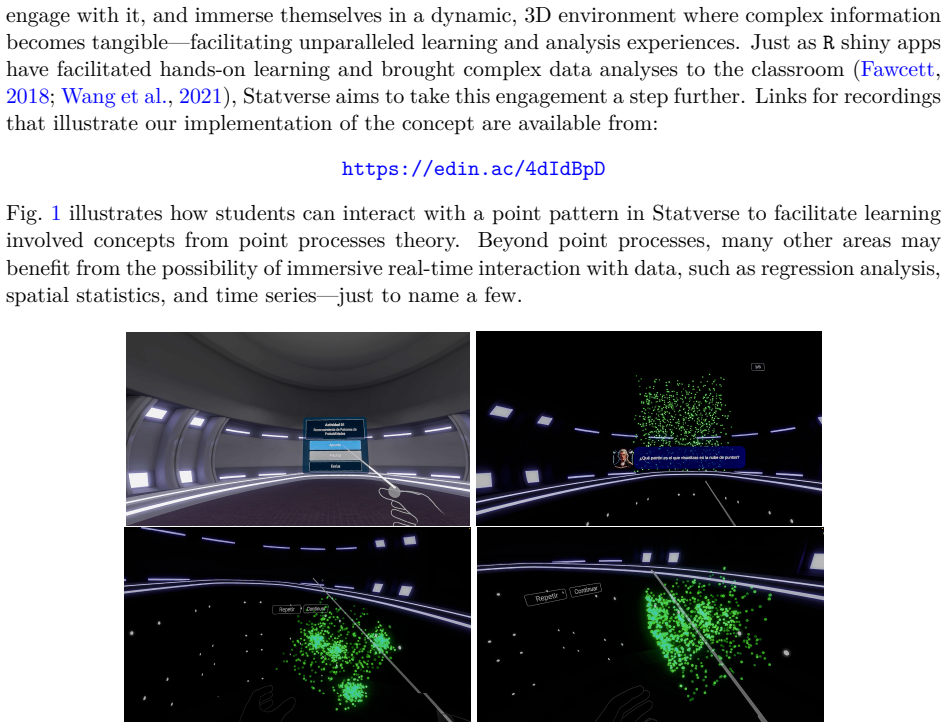


read the original abstract
This paper introduces the Statverse, a Metaverse framework designed to revolutionize statistical education in the digital age. Our key goal is to report our progress and encourage others to integrate similar strategies into their programs. The proposed framework seamlessly integrates the physical and digital realms to provide an immersive environment for the nuanced representation of complex statistical concepts. Finally, we discuss the potential impact of Statverse on advancing Statistical Education, offering a transformative approach to teaching and learning in the digital age. Statverse is the outcome of an academic partnership between Universidad T\'ecnica Federico Santa Mar\'ia (UTFSM) and the University of Edinburgh (UoE).
Editorial analysis
A structured set of objections, weighed in public.
Referee Report
Summary. The paper introduces the Statverse, a Metaverse framework for statistical education developed via an academic partnership between Universidad Técnica Federico Santa María (UTFSM) and the University of Edinburgh (UoE). It claims the framework seamlessly integrates physical and digital realms to create an immersive environment for nuanced representation of complex statistical concepts, aims to report progress and encourage adoption by others, and discusses the potential transformative impact on statistical education.
Significance. If the framework were implemented with concrete architecture, visualizations, and evaluations demonstrating improved learning outcomes, it could represent an innovative application of immersive technologies to statistics pedagogy. As presented, however, the absence of any technical details, examples, or evidence means the work offers only a high-level conceptual idea whose significance cannot be evaluated.
major comments (2)
- [Abstract] Abstract: The central claim that the framework 'seamlessly integrates the physical and digital realms to provide an immersive environment for the nuanced representation of complex statistical concepts' is presented without any description of integration mechanisms, data structures, visualization techniques, or how specific statistical concepts (e.g., distributions, inference) would be rendered.
- [Abstract] Abstract: The stated goal 'to report our progress' on the Statverse is not met, as the manuscript supplies no details on accomplishments from the UTFSM-UoE partnership, such as prototypes, pilot implementations, accessibility considerations, or outcome metrics.
minor comments (1)
- The manuscript contains no references, figures, tables, or examples to ground the claims or allow readers to assess feasibility.
Simulated Author's Rebuttal
We thank the referee for their careful reading and constructive feedback on our manuscript. We address each major comment below, indicating where we agree and have revised the text accordingly.
read point-by-point responses
-
Referee: [Abstract] Abstract: The central claim that the framework 'seamlessly integrates the physical and digital realms to provide an immersive environment for the nuanced representation of complex statistical concepts' is presented without any description of integration mechanisms, data structures, visualization techniques, or how specific statistical concepts (e.g., distributions, inference) would be rendered.
Authors: We agree that the abstract presents the integration at a conceptual level without technical specifics. The manuscript is intended as a vision paper describing the Statverse framework and the UTFSM-UoE partnership rather than a technical implementation report. In the revised version we have updated the abstract to state that the framework 'seeks to integrate' the realms and have added a dedicated paragraph in the main text outlining high-level approaches to integration, including the use of existing metaverse platforms for rendering statistical distributions via interactive 3D visualizations and inference concepts through simulated scenarios. Specific data structures and full rendering pipelines remain future work. revision: yes
-
Referee: [Abstract] Abstract: The stated goal 'to report our progress' on the Statverse is not met, as the manuscript supplies no details on accomplishments from the UTFSM-UoE partnership, such as prototypes, pilot implementations, accessibility considerations, or outcome metrics.
Authors: We acknowledge that the current text does not detail concrete prototypes or metrics. The reported progress consists of the formation of the partnership and the initial conceptual design of the framework. We have revised the abstract to read 'reports on the initial progress' and have expanded the main body with a new subsection describing the partnership activities to date, including joint conceptual workshops and shared design principles. Accessibility considerations and outcome metrics are part of planned future evaluation and are not yet available. revision: partial
Circularity Check
No circularity: conceptual proposal contains no derivations, equations, or fitted predictions
full rationale
The manuscript introduces the Statverse as a high-level conceptual framework for statistical education via metaverse integration. It contains no equations, no quantitative derivations, no parameter fitting, and no predictions that could reduce to inputs by construction. The text consists of descriptive goals, a partnership statement, and an intent to report progress, with no self-citation chains or ansatzes that bear load on any claimed result. As there are no load-bearing mathematical or predictive steps, the paper is self-contained at the level of an aspirational outline and exhibits no circularity.
Axiom & Free-Parameter Ledger
invented entities (1)
-
Statverse
no independent evidence
Reference graph
Works this paper leans on
-
[1]
Statistical
Schabenberger, Oliver and Gotway, Carol A , year=. Statistical
-
[2]
Edman, Polly , year=. Tactile
-
[3]
Godfrey, AJ , journal=. The
-
[4]
Teaching
Gelman, Andrew and Nolan, Deborah , year=. Teaching
-
[5]
Probability,
Speegle, Darrin and Clair, Bryan , year=. Probability,
-
[6]
Introduction to
Blitzstein, Joseph K and Hwang, Jessica , year=. Introduction to
-
[7]
Devore, Jay L and Berk, Kenneth N and Carlton, Matthew A , year=. Modern
-
[8]
Dick, Walter and Carey, Lou and Carey, James O , year=. The
-
[9]
Allen, Michael and Sites, Richard , year=. Leaving
-
[10]
Journal of Computational and Graphical Statistics , volume=
Immersive projection technology for visual data mining , author=. Journal of Computational and Graphical Statistics , volume=. 2002 , publisher=
2002
-
[11]
Chance , year =
Virtual Reality: Real Ponderings , author=. Chance , year =
-
[12]
Interdisciplinary Literary Studies , volume=
Information bodies: computational anxiety in neal stephenson's snow crash , author=. Interdisciplinary Literary Studies , volume=. 2017 , publisher=
2017
-
[13]
Healy, Kieran , year=. Data
-
[14]
Visual Informatics , volume=
Metaverse: Perspectives from graphics, interactions and visualization , author=. Visual Informatics , volume=. 2022 , publisher=
2022
-
[15]
Fundamentals of
Wilke, Claus O , year=. Fundamentals of
-
[16]
Grant, Robert , year=. Data
-
[17]
Student-developed shiny applications for teaching
Wang, Sabrina Luxin and Zhang, Anna Yinqi and Messer, Samuel and Wiesner, Andrew and Pearl, Dennis K , journal=. Student-developed shiny applications for teaching. 2021 , publisher=
2021
-
[18]
Journal of Statistics Education , volume=
Using interactive shiny applications to facilitate research-informed learning and teaching , author=. Journal of Statistics Education , volume=. 2018 , publisher=
2018
-
[19]
Daley, Daryl J and Vere-Jones, David and others , year=. An
-
[20]
A guide to teaching
Hicks, Stephanie C and Irizarry, Rafael A , journal=. A guide to teaching. 2018 , publisher=
2018
-
[21]
Consultancy Style Dissertations in
Sharifi Far, Serveh and In. Consultancy Style Dissertations in. The American Statistician , volume=. 2023 , publisher=
2023
-
[22]
What should data science education do with large language models , author=. arXiv:2307.02792 , year=
-
[23]
Journal of the Royal Statistical Society Series A: Statistics in Society , volume=
Visualizing spatiotemporal models with virtual reality: from fully immersive environments to applications in stereoscopic view , author=. Journal of the Royal Statistical Society Series A: Statistics in Society , volume=. 2019 , publisher=
2019
-
[24]
Science , volume=
Immersive interfaces for engagement and learning , author=. Science , volume=. 2009 , publisher=
2009
-
[25]
Bates, T. (2019). Teaching in a Digital Age: Guidelines for Designing Teaching and Learning, 2nd Edition. Vancouver: Tony Bates Ltd
2019
-
[26]
Morrison, G. R. (2010). Designing Effective Instruction, 6th Edition. New York: John Wiley & Sons
2010
discussion (0)
Sign in with ORCID, Apple, or X to comment. Anyone can read and Pith papers without signing in.