Recognition: unknown
Helium emission from Balmer-dominated shocks in Type Ia supernova remnants provides constraints to their progenitor systems
Pith reviewed 2026-05-08 05:33 UTC · model grok-4.3
The pith
Helium emission lines detected in Balmer-dominated shocks of Type Ia supernova remnants indicate varying helium abundances that can constrain progenitor systems.
A machine-rendered reading of the paper's core claim, the machinery that carries it, and where it could break.
Core claim
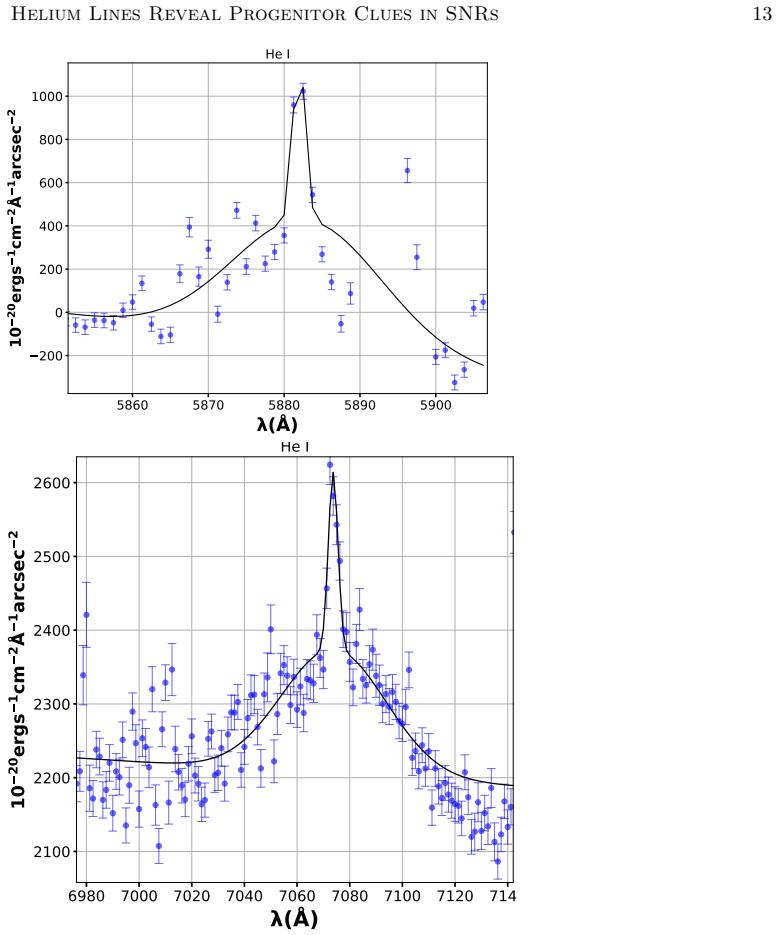
Broad and narrow helium lines appear alongside the usual hydrogen Balmer lines in the shocks. Narrow He II emission is detected where standard models predict none, suggesting either incomplete ion equilibration or precursor contributions. Neutral He/H intensity ratios point to helium enhancement in SNR 0509-67.5 and N103B but match the expected primordial value in SNR 0519-69.0. The authors therefore treat helium emission as a diagnostic capable of returning the total helium-to-hydrogen abundance ratio once initial ionization fractions are known.
What carries the argument
Neutral helium-to-hydrogen line intensity ratios extracted from the narrow and broad components of the observed emission lines.
If this is right
- Narrow helium lines become usable probes of circumstellar conditions once reliable preshock neutral H/He ratios are available.
- Helium abundance differences between remnants can be read as signatures of different progenitor evolutionary channels.
- The presence of narrow He II requires updates to existing models of ion-ion equilibration or shock-precursor physics.
- The modeling approach serves as a proof of concept that total He-to-H ratios can be extracted despite current uncertainties.
Where Pith is reading between the lines
- If the abundance variations hold, they could help discriminate between single-degenerate and double-degenerate channels for Type Ia events by revealing the presence or absence of helium-rich material near the explosion.
- The same helium-line technique might be extended to other classes of collisionless shocks where optical diagnostics are accessible.
- Improved atomic models that track helium ionization through the shock transition would tighten the abundance constraints without new observations.
Load-bearing premise
The initial ionization fractions of helium and hydrogen in the preshock gas are known well enough that observed line ratios can be converted into total elemental abundances.
What would settle it
A high-resolution spectrum of an additional Balmer-dominated shock that shows no narrow He II emission under standard ion-equilibration assumptions, or an independent measurement of the preshock neutral helium fraction that contradicts the abundance inferred from the lines.
Figures




read the original abstract
Balmer-dominated shocks in Type Ia supernova remnants offer powerful probes into collisionless shock physics and hints towards supernova progenitor environments. Prior studies focused on the hydrogen Balmer lines, which manifest as a superposition of broad and narrow emission lines. Using integral-field spectroscopy with MUSE, we discovered broad and narrow helium emission lines from Balmer-dominated filaments of three Type Ia supernovae remnants in the Large Magellanic Cloud: SNR 0509-67.5, SNR 0519-69.0 and N103B. We detect broad and narrow He~\textsc{i} 5876~\AA~,7065~\AA\ emission in SNR 0519 and N103B and He \textsc{ii} 8236~\AA\ in SNR 0519. In SNR 0509 we detect narrow He~\textsc{i} 5015~\AA, 6678~\AA, 7065~\AA\ and 7281~\AA, with only 7065~\AA~ exhibiting a broad component. The detection of narrow He\,\textsc{ii} challenges existing shock models, where such emission is not expected, and may indicate either incomplete ion-ion equilibration behind the shock or an origin in shock precursors. For SNR 0509 and N103B, the neutral He/H line ratios indicate enhanced helium abundances, whereas SNR 0519 is consistent with the primordial He/H value. We therefore propose helium emission in Balmer-dominated shocks as a new diagnostic of shock physics and Type Ia supernova circumstellar environments. Although our modeling is primarily a proof of concept, it demonstrates the possibility to infer the total He-to-H abundance ratio, with dominant uncertainties arising from the assumed initial ionization fractions. Despite the uncertainties, we demonstrate that narrow helium lines can serve as effective probes of circumstellar conditions and progenitor evolution when analysed alongside reliable constraints on the preshock neutral H/He abundance ratio.
Editorial analysis
A structured set of objections, weighed in public.
Referee Report
Summary. The manuscript reports MUSE integral-field spectroscopy detections of broad and narrow He I (5876, 7065 Å and others) and He II 8236 Å emission lines from Balmer-dominated filaments in three LMC Type Ia SNRs (0509-67.5, 0519-69.0, N103B). Line ratios are compared to primordial values to infer enhanced neutral He/H abundances in two remnants and primordial values in the third; narrow He II is noted as challenging existing shock models. The authors present a proof-of-concept model showing that total He/H can be inferred from narrow He lines once preshock neutral H/He constraints are available, while acknowledging dominant uncertainties from assumed initial ionization fractions. They propose He emission as a new diagnostic for shock physics and progenitor circumstellar environments.
Significance. The observational detections of He lines in Balmer-dominated shocks are novel and, if robust, could open a new window on circumstellar composition and collisionless shock microphysics in Type Ia remnants. The proof-of-concept modeling demonstrates the diagnostic potential but does not yet deliver quantitative, falsifiable abundance constraints; strengthening the ionization modeling would elevate the work from exploratory to a usable tool for distinguishing single- versus double-degenerate channels.
major comments (2)
- [Modeling and abundance analysis (proof-of-concept section)] The central inference that neutral He/H line ratios indicate enhanced helium abundances (for SNR 0509 and N103B) or primordial values (SNR 0519) is load-bearing for the diagnostic claim, yet the manuscript states that initial ionization fractions dominate the uncertainty budget and are treated as free inputs. Different combinations of ionization fraction and He/H can reproduce the same observed ratios, rendering the abundance values non-unique without independent preshock neutral H/He constraints.
- [Discussion of He II detection] The detection of narrow He II 8236 Å is presented as challenging existing shock models, with possible origins in incomplete ion-ion equilibration or shock precursors. No quantitative calculation or model grid is shown demonstrating that either mechanism reproduces the observed line strength and width; this attribution remains qualitative and does not yet constrain the proposed diagnostic.
minor comments (2)
- [Results section] The abstract and text refer to 'neutral He/H line ratios' without specifying which exact line pairs are used for each remnant or providing the measured flux ratios and their uncertainties.
- [Modeling section] No error bars, full line-flux tables, or sensitivity plots versus ionization fraction are included, which would clarify the robustness of the claimed abundance differences.
Simulated Author's Rebuttal
We thank the referee for their constructive and insightful comments, which have helped us better articulate the scope and limitations of our proof-of-concept analysis. We address each major comment below and outline the revisions we will make.
read point-by-point responses
-
Referee: The central inference that neutral He/H line ratios indicate enhanced helium abundances (for SNR 0509 and N103B) or primordial values (SNR 0519) is load-bearing for the diagnostic claim, yet the manuscript states that initial ionization fractions dominate the uncertainty budget and are treated as free inputs. Different combinations of ionization fraction and He/H can reproduce the same observed ratios, rendering the abundance values non-unique without independent preshock neutral H/He constraints.
Authors: We agree that the inferred neutral He/H ratios do not yield unique total abundances without independent constraints on the preshock ionization fractions, and that different combinations can reproduce the observed line ratios. Our manuscript already frames the analysis explicitly as a proof-of-concept and states that the diagnostic becomes useful only when paired with reliable preshock neutral H/He constraints. In the revised version we will strengthen this language by (i) adding a dedicated paragraph in the modeling section that quantifies the degeneracy with example ionization-fraction grids and (ii) outlining observational paths (e.g., UV absorption or multi-epoch spectroscopy) that could supply the missing preshock constraints. This will make the conditional nature of the abundance claims unambiguous while preserving the demonstration that narrow He lines can serve as a new diagnostic once those constraints are available. revision: partial
-
Referee: The detection of narrow He II 8236 Å is presented as challenging existing shock models, with possible origins in incomplete ion-ion equilibration or shock precursors. No quantitative calculation or model grid is shown demonstrating that either mechanism reproduces the observed line strength and width; this attribution remains qualitative and does not yet constrain the proposed diagnostic.
Authors: We acknowledge that the discussion of the narrow He II 8236 Å detection is currently qualitative. The primary challenge arises from the fact that standard Balmer-dominated shock models (e.g., those assuming full ion-electron equilibration and no precursor) predict negligible narrow He II emission; the mere detection therefore already conflicts with those assumptions. In the revision we will (i) cite the specific model predictions that lack this line, (ii) add a short paragraph comparing the observed width and strength to the limited existing calculations of ion-ion equilibration timescales and precursor ionization, and (iii) explicitly state that a full quantitative grid exploring these mechanisms lies beyond the present proof-of-concept scope and is left for future theoretical work. This will clarify that the detection motivates, rather than fully constrains, revisions to shock microphysics. revision: partial
Circularity Check
No significant circularity in the derivation chain
full rationale
The paper reports observational detections of broad and narrow helium emission lines in Balmer-dominated shocks of Type Ia supernova remnants using MUSE integral-field spectroscopy. It compares the observed neutral He/H line ratios to primordial values for some remnants and proposes helium emission as a new diagnostic for shock physics and circumstellar environments. The modeling is explicitly a proof of concept demonstrating the possibility of inferring the total He-to-H abundance ratio, with the dominant uncertainties explicitly attributed to assumed initial ionization fractions treated as inputs. No load-bearing steps reduce the abundance inferences to parameters defined or fitted from the same line ratio data by construction, nor do self-citations or uniqueness theorems from prior author work underpin the central claims. Prior shock models are invoked as external benchmarks rather than self-referential. The chain is therefore self-contained as an empirical observation with acknowledged external assumptions.
Axiom & Free-Parameter Ledger
free parameters (1)
- initial ionization fractions
axioms (1)
- domain assumption Existing shock models do not predict narrow He II emission behind Balmer-dominated shocks
Reference graph
Works this paper leans on
-
[1]
2013, Science, 339, 807, doi: 10.1126/science.1231160
Detection of the Characteristic Pion-Decay Signature in Supernova Remnants. Science , keywords =. doi:10.1126/science.1231160 , archivePrefix =. 1302.3307 , primaryClass =
-
[2]
, keywords =
On the origin of high-velocity gas H alpha-emission from the Cygnus Loop and IC 443. , keywords =
-
[3]
Astronomical Data Analysis Software and Systems XVIII , year = 2009, editor =
AWAIC: A WISE Astronomical Image Co-adder. Astronomical Data Analysis Software and Systems XVIII , year = 2009, editor =
2009
-
[4]
Azimuthal Density Variations around the Rim of Tycho's Supernova Remnant. , keywords =. doi:10.1088/0004-637X/770/2/129 , archivePrefix =. 1305.0567 , primaryClass =
-
[5]
Forbidden Line Emission from Type Ia Supernova Remnants Containing Balmer-dominated Shells. , keywords =. doi:10.3847/1538-4357/ac2c04 , archivePrefix =. 2110.09250 , primaryClass =
-
[6]
A Deep Search for Prompt Radio Emission from Thermonuclear Supernovae with the Very Large Array. , keywords =. doi:10.3847/0004-637X/821/2/119 , archivePrefix =. 1510.07662 , primaryClass =
-
[7]
Type Ia Supernovae Strongly Interacting with Their Circumstellar Medium. , keywords =. doi:10.1088/0067-0049/207/1/3 , archivePrefix =. 1304.0763 , primaryClass =
-
[8]
Late-onset Circumstellar Medium Interactions are Rare: An Unbiased GALEX View of Type Ia Supernovae. , keywords =. doi:10.3847/1538-4357/ac3bb4 , archivePrefix =. 2104.02086 , primaryClass =
-
[9]
Thirty Years of Radio Observations of Type Ia SN 1972E and SN 1895B: Constraints on Circumstellar Shells. , keywords =. doi:10.3847/1538-4357/ab6b2a , archivePrefix =. 2001.03558 , primaryClass =
-
[10]
Delayed Circumstellar Interaction for Type Ia SN 2015cp Revealed by an HST Ultraviolet Imaging Survey. , keywords =. doi:10.3847/1538-4357/aaf41e , archivePrefix =. 1812.02757 , primaryClass =
-
[11]
doi:10.1071/AS09057 , shorttitle =
Balmer-Dominated Shocks: A Concise Review. , keywords =. doi:10.1071/AS09057 , archivePrefix =. 0908.4080 , primaryClass =
-
[12]
, keywords =
Limits on diffusive shock acceleration in dense and incompletely ionised media. , keywords =
-
[13]
Theory of interstellar shocks. , keywords =. doi:10.1146/annurev.aa.31.090193.002105 , adsurl =
-
[14]
A High-resolution X-Ray and Optical Study of SN 1006: Asymmetric Expansion and Small-scale Structure in a Type Ia Supernova Remnant. , keywords =. doi:10.1088/0004-637X/781/2/65 , archivePrefix =. 1312.3367 , primaryClass =
-
[15]
Dust Destruction in Type Ia Supernova Remnants in the Large Magellanic Cloud. , keywords =. doi:10.1086/504472 , archivePrefix =. astro-ph/0602313 , primaryClass =
-
[16]
An X-Ray and Radio Study of the Varying Expansion Velocities in Tycho s Supernova Remnant. , keywords =. doi:10.3847/2041-8205/823/2/L32 , archivePrefix =. 1604.01779 , primaryClass =
-
[17]
arXiv e-prints , keywords =
A Third Epoch Proper Motion Study of The Forward Shock in Kepler's Supernova Remnant. arXiv e-prints , keywords =
-
[18]
Wait for It: Post-supernova Winds Driven by Delayed Radioactive Decays. , keywords =. doi:10.3847/1538-4357/834/2/180 , archivePrefix =. 1610.06573 , primaryClass =
-
[19]
2012, MNRAS, 420, 1825, doi: 10.1111/j.1365-2966.2011.19805.x
A circumbinary disc in the final stages of common envelope and the core-degenerate scenario for Type Ia supernovae. , keywords =. doi:10.1111/j.1365-2966.2011.19361.x , archivePrefix =. 1105.5698 , primaryClass =
-
[20]
2012, MNRAS, 420, 1825, doi: 10.1111/j.1365-2966.2011.19805.x
Type Ia supernovae from very long delayed explosion of core-white dwarf merger. , keywords =. doi:10.1111/j.1365-2966.2011.19833.x , archivePrefix =. 1106.2027 , primaryClass =
-
[21]
Have the Elusive Progenitors of Type Ia Supernovae Been Discovered?. , keywords =. doi:10.1086/378765 , archivePrefix =. astro-ph/0308018 , primaryClass =
-
[22]
The core-degenerate scenario for the progenitors of Type Ia supernovae. , keywords =. doi:10.1093/mnras/stw2646 , archivePrefix =. 1610.03662 , primaryClass =
-
[23]
2012, NewAR, 56, 122, doi: 10.1016/j.newar.2012.04.001
Progenitors of type Ia supernovae. , keywords =. doi:10.1016/j.newar.2012.04.001 , archivePrefix =. 1204.1155 , primaryClass =
-
[24]
, keywords =
Constraints on cosmic silicates. , keywords =
-
[25]
Infrared Emission Lines of [Fe II] as Diagnostics of Shocked Gas in Stellar Jets. , keywords =. doi:10.1086/425322 , adsurl =
-
[26]
Astronomical Data Analysis Software and Systems XII , Date-Added =
-
[27]
The DrizzlePack Handbook , Year =
-
[28]
doi:10.1051/0004-6361/201322068 , Eid =. arXiv , Author =:1307.6212 , Journal =
-
[29]
Hunter, J. D. , Date-Added =. Matplotlib: A 2D graphics environment , Volume =. doi:10.1109/MCSE.2007.55 , Journal =
-
[30]
2010, ARA&A, 48, 21, doi: 10.1146/annurev-astro-081309-130815 47
Cosmic Silicates. , year = 2010, month = sep, volume =. doi:10.1146/annurev-astro-081309-130815 , adsurl =
-
[31]
A Comprehensive Progenitor Model for SNe Ia. , keywords =. doi:10.1088/0004-637X/710/2/1310 , archivePrefix =. 0910.4992 , primaryClass =
-
[32]
Binary evolution and birth rate
A common-envelope wind model for Type Ia supernovae - I. Binary evolution and birth rate. , keywords =. doi:10.1093/mnras/stx1137 , archivePrefix =. 1705.04465 , primaryClass =
-
[33]
A single-degenerate model for the progenitor of the Type Ia supernova 2002ic. , keywords =. doi:10.1111/j.1365-2966.2006.10185.x , archivePrefix =. astro-ph/0602229 , primaryClass =
-
[34]
No Surviving Companion in Kepler's Supernova. , keywords =. doi:10.3847/1538-4357/aac9c4 , archivePrefix =. 1711.00876 , primaryClass =
-
[35]
A Reconnaissance of the Possible Donor Stars to the Kepler Supernova. , keywords =. doi:10.1088/0004-637X/782/1/27 , archivePrefix =. 1309.5964 , primaryClass =
-
[36]
, keywords =
The Galactic metallicity gradient. , keywords =
-
[37]
Abundance Gradients in the Galaxy. , keywords =. doi:10.1086/498869 , adsurl =
-
[38]
The Relationship between Infrared, Optical, and Ultraviolet Extinction. , keywords =. doi:10.1086/167900 , adsurl =
-
[39]
QFitsView: FITS file viewer
-
[40]
X-Ray Emission from Strongly Asymmetric Circumstellar Material in the Remnant of Kepler's Supernova. , keywords =. doi:10.1088/0004-637X/764/1/63 , archivePrefix =. 1212.4534 , primaryClass =
-
[41]
An Ejecta Kinematics Study of Kepler's Supernova Remnant with High-resolution Chandra HETG Spectroscopy. , keywords =. doi:10.3847/1538-4357/ab7db1 , archivePrefix =. 1905.04475 , primaryClass =
-
[42]
Updated stellar yields from asymptotic giant branch models. , keywords =. doi:10.1111/j.1365-2966.2009.16198.x , archivePrefix =. 0912.2142 , primaryClass =
-
[43]
On the progenitors of Type Ia supernovae. , keywords =. doi:10.1016/j.physrep.2018.02.002 , archivePrefix =. 1802.03125 , primaryClass =
-
[44]
Optical Tomography of Chemical Elements Synthesized in Type Ia Supernovae. , keywords =. doi:10.1103/PhysRevLett.123.041101 , archivePrefix =. 1906.05972 , primaryClass =
-
[45]
The imprint of a symbiotic binary progenitor on the properties of Kepler's supernova remnant. , keywords =. doi:10.1051/0004-6361/201014754 , archivePrefix =. 1103.5487 , primaryClass =
-
[46]
Type IA Supernova Explosions in Binary Systems: The Impact on the Secondary Star and Its Consequences. , keywords =. doi:10.1086/313392 , archivePrefix =. astro-ph/9908116 , primaryClass =
-
[47]
Subdwarf B stars as possible surviving companions in Type Ia supernova remnants. , keywords =. doi:10.1093/mnras/sty3092 , archivePrefix =. 1811.11351 , primaryClass =
-
[48]
1996, ApJL, 470, L97, https://doi.org/10.1086/310303
A New Model for Progenitor Systems of Type IA Supernovae. , keywords =. doi:10.1086/310303 , adsurl =
-
[49]
Are the Models for Type Ia Supernova Progenitors Consistent with the Properties of Supernova Remnants?. , keywords =. doi:10.1086/518022 , archivePrefix =. astro-ph/0703321 , primaryClass =
-
[50]
Search for Surviving Companions in Type Ia Supernova Remnants. , keywords =. doi:10.1088/0004-637X/792/1/71 , archivePrefix =. 1407.6829 , primaryClass =
-
[51]
Molecular Clouds Associated with the Type Ia SNR N103B in the Large Magellanic Cloud. , keywords =. doi:10.3847/1538-4357/aae07c , archivePrefix =. 1806.10299 , primaryClass =
-
[52]
Vortices in the Wakes of Asymptotic Giant Branch Stars. , keywords =. doi:10.1086/518308 , archivePrefix =. astro-ph/0703732 , primaryClass =
-
[53]
2007, MNRAS, 378, 910, doi: 10.1111/j.1365-2966.2007.11817.x
The interaction of planetary nebulae and their asymptotic giant branch progenitors with the interstellar medium. , keywords =. doi:10.1111/j.1365-2966.2007.12459.x , archivePrefix =. 0709.2848 , primaryClass =
-
[54]
CHIANTI - an atomic database for emission lines. , keywords =. doi:10.1051/aas:1997368 , adsurl =
-
[55]
Shocked Interstellar Clouds and Dust Grain Destruction in the LMC Supernova Remnant N132D. , keywords =. doi:10.3847/1538-4365/aac837 , archivePrefix =. 1806.04276 , primaryClass =
-
[56]
Cooling Functions for Low-Density Astrophysical Plasmas. , keywords =. doi:10.1086/191823 , adsurl =
-
[57]
, keywords =
Dynamics and spectra of magnetically cushioned radiative shocks. , keywords =
-
[58]
Forbidden Iron Lines and Dust Destruction in Supernova Remnant Shocks: The Case of N49 in the Large Magellanic Cloud. , keywords =. doi:10.3847/0004-637X/826/2/150 , archivePrefix =. 1605.02385 , primaryClass =
-
[59]
Turbulence and Energetic Particles in Radiative Shock Waves in the Cygnus Loop. I. Shock Properties. , keywords =. doi:10.3847/1538-4357/ab886d , archivePrefix =. 2004.09567 , primaryClass =
-
[60]
Carbon, Helium, and Proton Kinetic Temperatures in a Cygnus Loop Shock Wave. , keywords =. doi:10.1088/0004-637X/805/2/152 , archivePrefix =. 1504.01423 , primaryClass =
-
[61]
Ion-Ion Equilibration and Particle Distributions in a 3000 km s ^ -1 Shock in SN 1006. , keywords =. doi:10.3847/1538-4357/aa998f , adsurl =
-
[62]
Search for Surviving Companions of Progenitors of Young LMC SN Ia Remnants. , keywords =. doi:10.3847/1538-4357/ab4a03 , archivePrefix =. 1910.01093 , primaryClass =
-
[63]
Surviving companions of Type Ia supernovae: theory and observations. , keywords =. doi:10.1016/j.newar.2019.101523 , archivePrefix =. 1812.04977 , primaryClass =
-
[64]
arXiv e-prints , keywords =
The Interaction of Type Ia Supernovae with Planetary Nebulae: the Case of Kepler's Supernova Remnant. arXiv e-prints , keywords =
-
[65]
Attenuation Caused by a Distant Isothermal Turbulent Screen. , keywords =. doi:10.1086/426185 , archivePrefix =. astro-ph/0412567 , primaryClass =
-
[66]
Effects of Preionization in Radiative Shocks. I. Self-consistent Models. , keywords =. doi:10.3847/1538-4365/aa6541 , archivePrefix =. 1702.07453 , primaryClass =
-
[67]
On the probability distribution function of the mass surface density of molecular clouds. I. , keywords =. doi:10.1051/0004-6361/201321417 , archivePrefix =. 1403.0454 , primaryClass =
-
[68]
On the probability distribution function of the mass surface density of molecular clouds. II. , keywords =. doi:10.1051/0004-6361/201423647 , archivePrefix =. 1409.5708 , primaryClass =
-
[69]
The Expansion of the Young Supernova Remnant 0509-68.7 (N103B). , keywords =. doi:10.3847/2041-8213/aae08d , archivePrefix =. 1809.06391 , primaryClass =
-
[70]
A diagnostic tool for the identification of supernova remnants. , keywords =. doi:10.1093/mnras/stz2594 , archivePrefix =. 1909.05879 , primaryClass =
-
[71]
, year = 2017, month = jun, volume =
Erratum: Optical Spectroscopy of Supernova Remnants in M81 AND M82 (<A href=``https://doi.org/10.1088/0004-637x/804/1/63''>2015, ApJ, 804, 63</A>). , year = 2017, month = jun, volume =. doi:10.3847/1538-4357/aa74e6 , adsurl =
-
[72]
A middle-class Type Ia supernova by all spectroscopic metrics
SN 2014J at M82 - I. A middle-class Type Ia supernova by all spectroscopic metrics. , keywords =. doi:10.1093/mnras/stw026 , archivePrefix =. 1510.06596 , primaryClass =
-
[73]
Variations of the dust properties of M82 with galactocentric distance. , keywords =. doi:10.1093/mnras/stv1335 , archivePrefix =. 1506.03821 , primaryClass =
-
[74]
Extensive HST ultraviolet spectra and multiwavelength observations of SN 2014J in M82 indicate reddening and circumstellar scattering by typical dust. , keywords =. doi:10.1093/mnras/stu1378 , archivePrefix =. 1405.3677 , primaryClass =
-
[75]
Distance to the Large Magellanic Cloud: The RR Lyrae Stars. , keywords =. doi:10.1086/367773 , adsurl =
-
[76]
Optical identification of Balmer-dominated supernova remnants in the Large Magellanic Cloud. , keywords =. doi:10.1086/160358 , adsurl =
-
[77]
Delay Time Distributions of Type Ia Supernovae from Galaxy and Cosmic Star Formation Histories. , keywords =. doi:10.3847/1538-4357/ab6a97 , archivePrefix =. 2001.05967 , primaryClass =
-
[78]
Constraining the double-degenerate scenario for Type Ia supernovae from merger ejected matter. , keywords =. doi:10.1093/mnras/stu2580 , archivePrefix =. 1408.1375 , primaryClass =
-
[79]
Explaining the Early Excess Emission of the Type Ia Supernova 2018oh by the Interaction of the Ejecta with Disk-originated Matter. , keywords =. doi:10.3847/2041-8213/ab0285 , archivePrefix =. 1812.05054 , primaryClass =
-
[80]
The double-degenerate model for the progenitors of Type Ia supernovae. , keywords =. doi:10.1093/mnras/stx2756 , archivePrefix =. 1710.03961 , primaryClass =
discussion (0)
Sign in with ORCID, Apple, or X to comment. Anyone can read and Pith papers without signing in.