Recognition: unknown
Closing the Loop: Unified 3D Scene Generation and Immersive Interaction via LLM-RL Coupling
Pith reviewed 2026-05-08 14:48 UTC · model grok-4.3
The pith
Tightly coupling language model scene generation with reinforcement learning and virtual reality user feedback produces more adaptive and realistic 3D environments.
A machine-rendered reading of the paper's core claim, the machinery that carries it, and where it could break.
Core claim
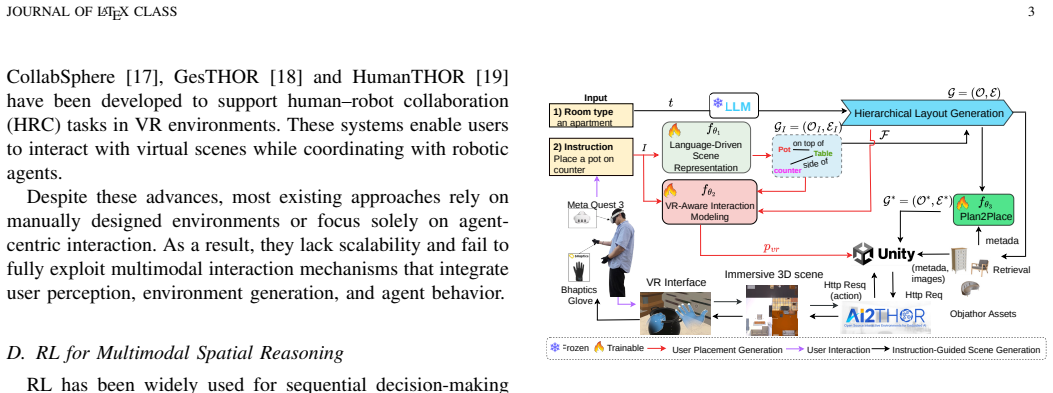
Given natural language instructions, the system constructs structured scene representations using LLMs and optimizes spatial layouts via reinforcement learning under geometric and semantic constraints. The generated environments are deployed in a virtual reality setting to facilitate continuous user interactions that provide feedback to align generated content with human perception and usability. Experiments on the ALFRED benchmark show state-of-the-art performance in task-based scene generation, with qualitative results and user studies indicating consistent improvements in immersion, interaction quality, and task efficiency.
What carries the argument
The closed-loop coupling of LLM-based scene construction, reinforcement learning layout optimization under constraints, and continuous virtual reality user feedback for refinement.
If this is right
- Task-based 3D scene generation reaches state-of-the-art performance on the ALFRED benchmark.
- User studies report gains in immersion, interaction quality, and task efficiency.
- Scenes adapt during use instead of remaining fixed after initial creation.
- The integration supports multimedia experiences that better match human perception through ongoing feedback.
Where Pith is reading between the lines
- The method could be extended beyond virtual reality by substituting other forms of live sensor data for user feedback in robotic or simulation settings.
- Repeated sessions with the same users might allow the system to encode personal preferences into future scene adjustments.
- This style of interactive refinement may reduce the size of datasets needed for training complex scene generators.
Load-bearing premise
Feedback from virtual reality users can steadily improve the generated scenes to match human views without adding errors or making the adjustment process unstable.
What would settle it
Disabling the continuous virtual reality feedback and finding no drop in task success rates on the ALFRED benchmark or in user-rated immersion would show the loop adds no benefit.
Figures



read the original abstract
Recent advances in large language models (LLMs) have significantly improved language-driven 3D content generation, but most existing approaches still treat scene generation and user interaction as separate processes, limiting the adaptability and immersive potential of interactive multimedia systems. This paper presents a unified framework that closes the loop between language-driven 3D scene generation and immersive user interaction. Given natural language instructions, the system first constructs structured scene representations using LLMs, and then optimizes spatial layouts via reinforcement learning under geometric and semantic constraints. The generated environments are deployed in a virtual reality setting to facilitate HRI-in-the-loop, where user interactions provide continuous feedback to align generated content with human perception and usability. By tightly coupling generation and interaction, the proposed framework enables more responsive, adaptive, and realistic multimedia experiences. Experiments on the ALFRED benchmark demonstrate state-of-the-art performance in task-based scene generation. Furthermore, qualitative results and user studies show consistent improvements in immersion, interaction quality, and task efficiency, highlighting the importance of closed-loop integration of generation and interaction for next-generation multimedia systems. Our project page can be found at https://proj-showcase.github.io/h3ds/.
Editorial analysis
A structured set of objections, weighed in public.
Referee Report
Summary. The manuscript proposes a unified framework that couples LLMs for language-driven 3D scene generation with reinforcement learning to optimize spatial layouts under geometric and semantic constraints, then deploys the scenes in VR for continuous HRI-in-the-loop user feedback to improve alignment with human perception. It asserts state-of-the-art performance on the ALFRED benchmark for task-based scene generation and reports qualitative/user-study gains in immersion, interaction quality, and task efficiency.
Significance. If the experimental claims hold with proper validation, the work would be significant as one of the first demonstrations of a closed-loop LLM-RL-VR system for adaptive 3D scene generation, addressing the separation of generation and interaction that limits current multimedia systems. This could influence next-generation immersive interfaces in VR and HRI.
major comments (3)
- [Experiments section] Experiments section: the central claim of state-of-the-art performance on ALFRED is presented without any quantitative metrics, baseline comparisons, error bars, or statistical tests, rendering it impossible to evaluate whether the LLM-RL coupling actually outperforms prior methods.
- [Method section] Method section: the RL optimization step is described only at a high level with no explicit reward function, state/action formulation, or integration details between LLM scene representations and geometric constraints, which is load-bearing for assessing the novelty and correctness of the proposed coupling.
- [User studies subsection] User studies subsection: improvements in immersion and task efficiency are asserted from qualitative results and user studies, but no participant count, study protocol, control conditions, or statistical analysis is provided, undermining support for the HRI-in-the-loop feedback mechanism.
minor comments (2)
- The project page URL is given but no accompanying code, models, or data release is mentioned, which would strengthen reproducibility claims.
- [Method section] Notation for scene representations and constraints could be formalized with equations or pseudocode to clarify the LLM-to-RL pipeline.
Simulated Author's Rebuttal
We thank the referee for the constructive and detailed feedback. We have reviewed each major comment carefully and will revise the manuscript to provide the missing quantitative details, methodological specifications, and user-study reporting. These changes will strengthen the paper without altering its core contributions.
read point-by-point responses
-
Referee: [Experiments section] Experiments section: the central claim of state-of-the-art performance on ALFRED is presented without any quantitative metrics, baseline comparisons, error bars, or statistical tests, rendering it impossible to evaluate whether the LLM-RL coupling actually outperforms prior methods.
Authors: We agree that the Experiments section currently lacks the necessary quantitative support for the SOTA claim on ALFRED. In the revised manuscript we will add comprehensive tables reporting task success rates, efficiency metrics, and other standard ALFRED measures, together with direct comparisons to relevant baselines, error bars or confidence intervals, and appropriate statistical tests. revision: yes
-
Referee: [Method section] Method section: the RL optimization step is described only at a high level with no explicit reward function, state/action formulation, or integration details between LLM scene representations and geometric constraints, which is load-bearing for assessing the novelty and correctness of the proposed coupling.
Authors: We acknowledge that the RL component is presented at too high a level. The revised Method section will explicitly define the reward function (including geometric and semantic terms), the state and action spaces, the policy architecture, and the precise interface between LLM-generated scene graphs and the constraint enforcement module. revision: yes
-
Referee: [User studies subsection] User studies subsection: improvements in immersion and task efficiency are asserted from qualitative results and user studies, but no participant count, study protocol, control conditions, or statistical analysis is provided, undermining support for the HRI-in-the-loop feedback mechanism.
Authors: We agree that the user-study reporting is incomplete. The revised manuscript will specify the number of participants, the full experimental protocol, the control conditions employed, the questionnaires or metrics used, and the statistical analyses (including p-values and effect sizes) that support the reported gains in immersion and task efficiency. revision: yes
Circularity Check
No significant circularity detected
full rationale
The paper presents a high-level framework description coupling LLMs for scene construction with RL optimization under constraints, followed by VR-based HRI feedback and empirical evaluation on the ALFRED benchmark. No mathematical derivations, equations, fitted parameters presented as predictions, or self-citation chains appear in the abstract or described structure. The central claims rest on experimental SOTA results and qualitative user studies rather than any reduction of outputs to inputs by definition or construction. The derivation chain is therefore self-contained against external benchmarks with no load-bearing steps that collapse to tautology.
Axiom & Free-Parameter Ledger
Reference graph
Works this paper leans on
-
[1]
Vla-rl: Towards masterful and general robotic manipulation with scalable reinforcement learning,
G. Lu, W. Guo, C. Zhang, Y . Zhou, H. Jiang, Z. Gao, Y . Tang, and Z. Wang, “Vla-rl: Towards masterful and general robotic manipulation with scalable reinforcement learning,”arXiv preprint arXiv:2505.18719, 2025
-
[2]
Y . Liu, H. Li, S. Tian, Y . Qin, Y . Chen, Y . Zheng, Y . Huang, and D. Zhao, “Towards long-lived robots: Continual learning vla models via reinforcement fine-tuning,”arXiv preprint arXiv:2602.10503, 2026
-
[3]
Deepseekmath-v2: Towards self-verifiable mathematical reasoning,
Z. Shao, Y .-W. Luo, C. Lu, Z. Ren, J. Hu, T. Ye, Z. Gou, S. Ma, and X. Zhang, “Deepseekmath-v2: Towards self-verifiable mathematical reasoning,”ArXiv, vol. abs/2511.22570, 2025
-
[4]
Instruction- driven 3d facial expression generation and transition,
A. H. V o, T.-S. Kim, H. Jin, S.-M. Choi, and Y .-G. Kim, “Instruction- driven 3d facial expression generation and transition,”IEEE Transac- tions on Multimedia, vol. 27, pp. 6140–6153, 2025
2025
-
[5]
More is not always better: Toward general cross-modal saliency prediction for immersive commu- nications,
H. Liu, Y . Gao, S. Zhou, and L. Zhou, “More is not always better: Toward general cross-modal saliency prediction for immersive commu- nications,”IEEE Transactions on Multimedia, pp. 1–11, 2026
2026
-
[6]
Llm integration in extended reality: A comprehensive review of current trends, challenges, and future perspectives,
Y . Tang, J. Situ, A. Y . Cui, M. Wu, and Y . Huang, “Llm integration in extended reality: A comprehensive review of current trends, challenges, and future perspectives,” inProceedings of the 2025 CHI Conference on Human Factors in Computing Systems. Association for Computing Machinery, 2025
2025
-
[7]
Exploring large language model-driven agents for environment-aware spatial interactions and conversations in virtual reality role-play scenarios,
Z. Li, H. Zhang, C. Peng, and R. Peiris, “Exploring large language model-driven agents for environment-aware spatial interactions and conversations in virtual reality role-play scenarios,” in2025 IEEE Conference Virtual Reality and 3D User Interfaces (VR), 2025, pp. 1–11
2025
-
[8]
Lmr: Real-time prompting of interactive worlds using large language models,
F. D. L. Torre, C. M. Fang, H. Huang, A. Banburski-Fahey, J. A. Fer- nandez, and J. Lanier, “Lmr: Real-time prompting of interactive worlds using large language models,” inProceedings of the CHI Conference on Human Factors in Computing Systems, 2024
2024
-
[9]
Exploring context- aware and llm-driven locomotion for immersive virtual reality,
S. ¨Ozdel, K. B. Buldu, E. Kasneci, and E. Bozkir, “Exploring context- aware and llm-driven locomotion for immersive virtual reality,”ArXiv, vol. abs/2504.17331, 2025
-
[10]
RAG-VR: Leveraging retrieval-augmented gen- eration for 3D question answering in VR environments,
S. Ding and Y . Chen, “RAG-VR: Leveraging retrieval-augmented gen- eration for 3D question answering in VR environments,” inProceedings of IEEE VR GenAI-XR, 2025
2025
-
[11]
Instructscene: Instruction-driven 3d indoor scene synthesis with semantic graph prior,
C. Lin and Y . Mu, “Instructscene: Instruction-driven 3d indoor scene synthesis with semantic graph prior,” inInternational Conference on Learning Representations (ICLR), 2024
2024
-
[12]
Layoutgpt: Compositional visual planning and generation with large language models,
W. Feng, W. Zhu, T.-j. Fu, V . Jampani, A. Akula, X. He, S. Basu, X. E. Wang, and W. Y . Wang, “Layoutgpt: Compositional visual planning and generation with large language models,”Advances in Neural Information Processing Systems, vol. 36, 2024
2024
-
[13]
Anyhome: Open-vocabulary gen- eration of structured and textured 3d homes,
R. Fu, Z. Wen, Z. Liu, and S. Sridhar, “Anyhome: Open-vocabulary gen- eration of structured and textured 3d homes,” inEuropean Conference on Computer Vision. Springer, 2024, pp. 52–70
2024
-
[14]
Holodeck: Language guided generation of 3d embodied ai environments,
Y . Yang, F.-Y . Sun, L. Weihs, E. VanderBilt, A. Herrasti, W. Han, J. Wu, N. Haber, R. Krishna, L. Liu, C. Callison-Burch, M. Yatskar, A. Kembhavi, and C. Clark, “Holodeck: Language guided generation of 3d embodied ai environments,” inProceedings of the IEEE/CVF Conference on Computer Vision and Pattern Recognition (CVPR), 2024, pp. 16 227–16 237
2024
-
[15]
Logi- cenvgen: Task-logic driven generation of diverse simulated environments for embodied ai,
J. Wang, S. Zhang, B. Li, J. Chen, J. Qi, Z. Zhang, and C. Qian, “Logi- cenvgen: Task-logic driven generation of diverse simulated environments for embodied ai,”ArXiv, vol. abs/2601.13556, 2026
-
[16]
Demonstrating rfuniverse: A multiphysics simulation platform for embodied ai,
H. Fu, W. Xu, R. Ye, H. Xue, Z. Yu, T. Tang, Y . Li, W. Du, J. Zhang, and C. Lu, “Demonstrating rfuniverse: A multiphysics simulation platform for embodied ai,” inRSS Robotics: Science and Systems, 2023
2023
-
[17]
Collabsphere: A virtual simulation system for human-robot collaboration and evaluation,
Y . Liu, J. Ren, Y . Li, and Y . Dong, “Collabsphere: A virtual simulation system for human-robot collaboration and evaluation,” in2024 9th International Conference on Intelligent Informatics and Biomedical Sciences (ICIIBMS), vol. 9, 2024, pp. 630–634
2024
-
[18]
Communicative learning with natural gestures for embodied navigation agents with human-in-the- scene,
Q. Wu, C.-J. Wu, Y . Zhu, and J. Joo, “Communicative learning with natural gestures for embodied navigation agents with human-in-the- scene,” inInternational Conference on Intelligent Robotics and Systems (IROS), 2021
2021
-
[19]
Demonstrating HumanTHOR: A simulation platform and benchmark for human-robot collaboration in a shared workspace,
C. Wang, B. Du, J. Xu, P. Li, D. Guo, and H. Liu, “Demonstrating HumanTHOR: A simulation platform and benchmark for human-robot collaboration in a shared workspace,” inProc. of Robotics: Science and Systems(RSS), 2024
2024
-
[20]
ALFRED: A Benchmark for Interpreting Grounded Instructions for Everyday Tasks,
M. Shridhar, J. Thomason, D. Gordon, Y . Bisk, W. Han, R. Mottaghi, L. Zettlemoyer, and D. Fox, “ALFRED: A Benchmark for Interpreting Grounded Instructions for Everyday Tasks,” inThe IEEE Conference on Computer Vision and Pattern Recognition (CVPR), 2020
2020
-
[21]
Generating role- playing game quests with gpt language models,
S. V ¨artinen, P. H ¨am¨al¨ainen, and C. Guckelsberger, “Generating role- playing game quests with gpt language models,”IEEE Transactions on Games, vol. 16, no. 1, pp. 127–139, 2024
2024
-
[22]
Infiniteworld: A unified scalable simulation framework for general visual-language robot interaction,
P. Ren, M. Li, Z. Luo, X. Song, Z. Chen, W. Liufu, Y . Yang, H. Zheng, R. Xu, Z. Huang, T. Ding, L. Xie, K. Zhang, C. Fu, Y . Liu, L. Lin, F. Zheng, and X. Liang, “Infiniteworld: A unified scalable simulation framework for general visual-language robot interaction,” 2024
2024
-
[23]
Divscene: Benchmarking lvlms for object navigation with diverse scenes and objects,
Z. Wang, H. Zhang, T. Fang, Y . Tian, Y . Yang, K. Ma, X. Pan, Y . Song, and D. Yu, “Divscene: Benchmarking lvlms for object navigation with diverse scenes and objects,” 2024
2024
-
[24]
Architect: Generating vivid and interactive 3d scenes with hierarchical 2d inpainting,
Y . Wang, X. Qiu, J. Liu, Z. Chen, J. Cai, Y . Wang, T.-H. Wang, Z. Xian, and C. Gan, “Architect: Generating vivid and interactive 3d scenes with hierarchical 2d inpainting,” inThe Thirty-eighth Annual Conference on Neural Information Processing Systems, 2024
2024
-
[25]
Reward-driven u-net training for obstacle avoidance drone,
S.-Y . Shin, Y .-W. Kang, and Y .-G. Kim, “Reward-driven u-net training for obstacle avoidance drone,”Expert Systems with Applications, vol. 143, p. 113064, 2020
2020
-
[26]
A hybrid framework using diffusion policy and residual rl for force-sensitive robotic manip- ulation,
Y . Li, Q. Lyu, J. Yang, Y . Salam, and W. Wang, “A hybrid framework using diffusion policy and residual rl for force-sensitive robotic manip- ulation,”IEEE Robotics and Automation Letters, 2025
2025
-
[27]
Coarse-to- fine fusion for language grounding in 3d navigation,
T. T. Nguyen, A. H. V o, S.-M. Choi, and Y .-G. Kim, “Coarse-to- fine fusion for language grounding in 3d navigation,”Knowledge-Based Systems, vol. 277, p. 110785, 2023
2023
-
[28]
Reinforcement learning for large model: A survey,
W. Wu, C. Gao, J. Chen, K. Q. Lin, Q. Meng, Y . Zhang, Y . Qiu, H. Zhou, and M. Z. Shou, “Reinforcement learning for large model: A survey,” arXiv preprint arXiv:2508.08189, 2025
-
[29]
Training language models to follow instructions with human feedback,
L. Ouyang, J. Wu, X. Jiang, D. Almeida, C. L. Wainwright, P. Mishkin, C. Zhang, S. Agarwal, K. Slama, A. Ray, J. Schulman, J. Hilton, F. Kel- ton, L. Miller, M. Simens, A. Askell, P. Welinder, P. Christiano, J. Leike, and R. Lowe, “Training language models to follow instructions with human feedback,” inProceedings of the 36th International Conference on N...
2022
-
[30]
Z. Liu, J. Kim, X. Luo, D. Li, and Y . Yang, “Exploratory memory- augmented llm agent via hybrid on-and off-policy optimization,”arXiv preprint arXiv:2602.23008, 2026
-
[31]
Hierarchical reinforcement learning for furniture layout in virtual indoor scenes,
X. Di and P. Yu, “Hierarchical reinforcement learning for furniture layout in virtual indoor scenes,”Reinforcement Learning for Real Life (RL4RealLife) Workshop, NeurIPS, 2022. JOURNAL OF LATEX CLASS 13
2022
-
[32]
Direct numerical layout generation for 3d indoor scene synthesis via spatial reasoning
X. Ran, Y . Li, L. Xu, M. Yu, and B. Dai, “Direct numerical layout generation for 3d indoor scene synthesis via spatial reasoning,”ArXiv, vol. abs/2506.05341, 2025
-
[33]
Optiscene: Llm-driven indoor scene layout generation via scaled human-aligned data synthesis and multi-stage preference optimization,
Y . Yang, Z. Luo, T. Ding, J. Lu, M. Gao, J. Yang, V . Sanchez, and F. Zheng, “Optiscene: Llm-driven indoor scene layout generation via scaled human-aligned data synthesis and multi-stage preference optimization,” inThe Thirty-ninth Annual Conference on NIPS
-
[34]
LoRA: Low-rank adaptation of large language models,
E. J. Hu, Y . Shen, P. Wallis, Z. Allen-Zhu, Y . Li, S. Wang, L. Wang, and W. Chen, “LoRA: Low-rank adaptation of large language models,” inInternational Conference on Learning Representations, 2021
2021
-
[35]
Learning transferable visual models from natural language supervi- sion,
A. Radford, J. W. Kim, C. Hallacy, A. Ramesh, G. Goh, S. Agarwal, G. Sastry, A. Askell, P. Mishkin, J. Clark, G. Krueger, and I. Sutskever, “Learning transferable visual models from natural language supervi- sion,” inProceedings of the 38th International Conference on Machine Learning, vol. 139, 18–24 Jul 2021, pp. 8748–8763
2021
-
[36]
Sentence-bert: Sentence embeddings using siamese bert-networks,
N. Reimers and I. Gurevych, “Sentence-bert: Sentence embeddings using siamese bert-networks,” inConference on Empirical Methods in Natural Language Processing, 2019
2019
-
[37]
Bert: Pre-training of deep bidirectional transformers for language understanding,
J. Devlin, M.-W. Chang, K. Lee, and K. Toutanova, “Bert: Pre-training of deep bidirectional transformers for language understanding,” inNorth American Chapter of the Association for Computational Linguistics, 2019
2019
-
[38]
3d-front: 3d furnished rooms with layouts and semantics,
H. Fu, B. Cai, L. Gao, L.-X. Zhang, J. Wang, C. Li, Q. Zeng, C. Sun, R. Jia, B. Zhaoet al., “3d-front: 3d furnished rooms with layouts and semantics,” inProceedings of the IEEE/CVF International Conference on Computer Vision, 2021, pp. 10 933–10 942
2021
-
[39]
Proc- THOR: Large-Scale Embodied AI Using Procedural Generation,
M. Deitke, E. VanderBilt, A. Herrasti, L. Weihs, J. Salvador, K. Ehsani, W. Han, E. Kolve, A. Farhadi, A. Kembhavi, and R. Mottaghi, “Proc- THOR: Large-Scale Embodied AI Using Procedural Generation,” in NeurIPS, 2022
2022
-
[40]
LLaMA: Open and Efficient Foundation Language Models
H. Touvron, T. Lavril, G. Izacard, X. Martinet, M.-A. Lachaux, T. Lacroix, B. Rozi `ere, N. Goyal, E. Hambro, F. Azhar, A. Rodriguez, A. Joulin, E. Grave, and G. Lample, “Llama: Open and efficient foundation language models,”ArXiv, vol. abs/2302.13971, 2023
work page internal anchor Pith review arXiv 2023
-
[41]
A. Q. Jiang, A. Sablayrolles, A. Mensch, C. Bamford, D. S. Chaplot, D. de Las Casas, F. Bressand, G. Lengyel, G. Lample, L. Saulnier, L. R. Lavaud, M.-A. Lachaux, P. Stock, T. L. Scao, T. Lavril, T. Wang, T. Lacroix, and W. E. Sayed, “Mistral 7b,”ArXiv, vol. abs/2310.06825, 2023
work page internal anchor Pith review arXiv 2023
-
[42]
The falcon series of open language models,
E. Almazrouei, H. Alobeidli, A. Alshamsi, A. Cappelli, R.-A. Cojocaru, D. Hesslow, J. Launay, Q. Malartic, D. Mazzotta, B. Noune, B. Pannier, and G. Penedo, “The falcon series of open language models,”ArXiv, vol. abs/2311.16867, 2023
-
[43]
Stanford alpaca: An instruction-following llama model,
R. Taori, I. Gulrajani, T. Zhang, Y . Dubois, X. Li, C. Guestrin, P. Liang, and T. B. Hashimoto, “Stanford alpaca: An instruction-following llama model,” https://github.com/tatsu-lab/stanford alpaca, 2023
2023
-
[44]
Exploring the limits of transfer learning with a unified text-to-text transformer,
C. Raffel, N. Shazeer, A. Roberts, K. Lee, S. Narang, M. Matena, Y . Zhou, W. Li, and P. J. Liu, “Exploring the limits of transfer learning with a unified text-to-text transformer,”Journal of Machine Learning Research, vol. 21, no. 140, pp. 1–67, 2020
2020
-
[45]
Scaling Instruction-Finetuned Language Models
H. W. Chung, L. Hou, S. Longpre, B. Zoph, Y . Tay, W. Fedus, E. Li, X. Wang, M. Dehghani, S. Brahma, A. Webson, S. S. Gu, Z. Dai, M. Suzgun, X. Chen, A. Chowdhery, D. Valter, S. Narang, G. Mishra, A. W. Yu, V . Zhao, Y . Huang, A. M. Dai, H. Yu, S. Petrov, E. H. Chi, J. Dean, J. Devlin, A. Roberts, D. Zhou, Q. V . Le, and J. Wei, “Scaling instruction-fine...
work page internal anchor Pith review arXiv 2022
-
[46]
Combinatorial learning of graph edit distance via dynamic embedding,
R. Wang, T. Zhang, P. Ding, J. Fan, and X. Jin, “Combinatorial learning of graph edit distance via dynamic embedding,” inProceedings of the IEEE/CVF Conference on Computer Vision and Pattern Recognition (CVPR), 2021, pp. 1273–1282
2021
-
[47]
An efficient algorithm for graph edit distance computation,
X. Chen, H. Huo, J. Huan, and J. S. Vitte, “An efficient algorithm for graph edit distance computation,”Knowledge-Based Systems, vol. 163, p. 762–775, 2019
2019
-
[48]
Instruct and extract: Instruction tuning for on-demand information extraction,
Y . Jiao, M. Zhong, S. Li, R. Zhao, S. Ouyang, H. Ji, and J. Han, “Instruct and extract: Instruction tuning for on-demand information extraction,” arXiv preprint arXiv:2310.16040, 2023
-
[49]
HSM: Hierarchical Scene Motifs for Multi-Scale Indoor Scene Generation,
H. I. D. Pun, H. I. I. Tam, A. T. Wang, X. Huo, A. X. Chang, and M. Savva, “HSM: Hierarchical Scene Motifs for Multi-Scale Indoor Scene Generation,” inProceedings of the IEEE Conference on 3D Vision (3DV), 2026
2026
-
[50]
SceneEval: Evaluating semantic coherence in text-conditioned 3D indoor scene synthesis,
H. I. I. Tam, H. I. D. Pun, A. T. Wang, A. X. Chang, and M. Savva, “SceneEval: Evaluating semantic coherence in text-conditioned 3D indoor scene synthesis,” inProceedings of the IEEE Winter Conference on Applications of Computer Vision (WACV), 2026
2026
-
[51]
Direct numerical layout generation for 3d indoor scene synthesis via spatial reasoning,
X. Ran, Y . Li, L. Xu, M. Yu, and B. Dai, “Direct numerical layout generation for 3d indoor scene synthesis via spatial reasoning,” 2025. APPENDIXA SUPPLEMENTARY
2025
-
[52]
Reward Energy Function:To provide informative feed- back to the agent, we formulate the reward function as an energy minimization objective instead of relying on sparse or rule-based signals. The energy function measures the degree of constraint violation in the generated layout, including rela- tional consistency, interaction affordances, navigation feas...
-
[53]
i)Fidelity Metrics: •Object Count (CNT)check if the number of objects in the generated scene matches the quantities specified in the list of input objects
Details of the quantitative metrics:We utilize fidelity and plausibility metrics for the quantitative evaluation. i)Fidelity Metrics: •Object Count (CNT)check if the number of objects in the generated scene matches the quantities specified in the list of input objects. •Success Rate (SR)whether the quantities of anchor and inference objects match those sp...
-
[54]
•Diversityevaluates the different and varied generated scenes across different generated scenes of the same method
Details of Semantic Quality:We provided clear instruc- tions for each metric to guide participants in evaluating the different methods, as follows: •Realismevaluates the realistic and plausibility of the generated scene. •Diversityevaluates the different and varied generated scenes across different generated scenes of the same method. •Object Accessibilit...
-
[55]
Experiment Setting for Language-Driven Scene Repre- sentation:During training, we use a learning rate of 2e-5 for 50 epochs, with the Adam optimizer
-
[56]
The Adam optimizer is used for training
Experiment Setting for Position Prediction:We use a batch size of 16, train for 50 epochs, and set the learning rate to3e −4. The Adam optimizer is used for training
-
[57]
The discount factorγis set to 0.99, and optimization is performed using the Adam optimizer
Experiment Setting for Plan2Place:The model is trained for 50 epochs with a batch size of 1 and a learning rate of 1×10 −4. The discount factorγis set to 0.99, and optimization is performed using the Adam optimizer. Baselines -DFS and MILP solver. These methods are employed similarly to those in [14]. -Z3 solver 1. The 3D positions and orientations of ob-...
-
[58]
10 further shows a comparison between our model, LLM-E2E, and LLM+FH
Evaluation across Standard Metrics:Fig. 10 further shows a comparison between our model, LLM-E2E, and LLM+FH. The results indicate that our model consistently outperforms both baselines across all evaluation sets in terms of F1-score, precision, and recall. Key Anchor Infer 0 50 100 80.98 37.57 49.2744.82 70.86 25.62 99.91 98.35 99.83 Recall (%) (a) Key A...
-
[59]
Experiments are conducted on three evaluation sets, including ID, TS, and OS
Effect of Hidden Dimensionality on Position Prediction of VR Devices Performance:Table X presents a compara- tive analysis of VR position prediction performance across different hidden dimensions for both token embedding and MLP layer. Experiments are conducted on three evaluation sets, including ID, TS, and OS. The results consistently demonstrate that a...
-
[60]
across most datasets. E. More Results for Object Placement Optimization
-
[61]
Effect of Hidden dimension for Plan2Place:We analyze the impact of hidden dimensionality on Plan2Place’s perfor- mance under multiple evaluation metrics. As shown in Table XI, no single configuration consistently outperforms others across all metrics, revealing a trade-off between layout quality, navigability, and object placement capacity. JOURNAL OF LAT...
-
[62]
Effect of the Global State Context:Fig 11 illustrates the impact of the global state context on constraint-aware reward learning. By utilizing the global state as the query and the local state as the keys and values within the cross-attention mechanism, the model conditions local object features on the overall scene structure. This design effectively capt...
2000
-
[63]
fridge,” which is required to perform the “chill
More Generated Results: - Additional Qualitative Comparison with Baseline Meth- odsFig 12 illustrates a qualitative comparison of different object placement methods, including Z3, MILP, DFS, and Plan2Place (ours). The first two columns present 3D scenes generated for a bedroom and a bathroom, both of which are included in our dataset. For the bedroom, Z3 ...
discussion (0)
Sign in with ORCID, Apple, or X to comment. Anyone can read and Pith papers without signing in.