Recognition: unknown
Exponential mixing for the stochastic Allen--Cahn equation with localized white noise
Pith reviewed 2026-05-08 06:15 UTC · model grok-4.3
The pith
The 1D stochastic Allen-Cahn equation with localized white noise has a unique invariant measure and mixes exponentially.
A machine-rendered reading of the paper's core claim, the machinery that carries it, and where it could break.
Core claim
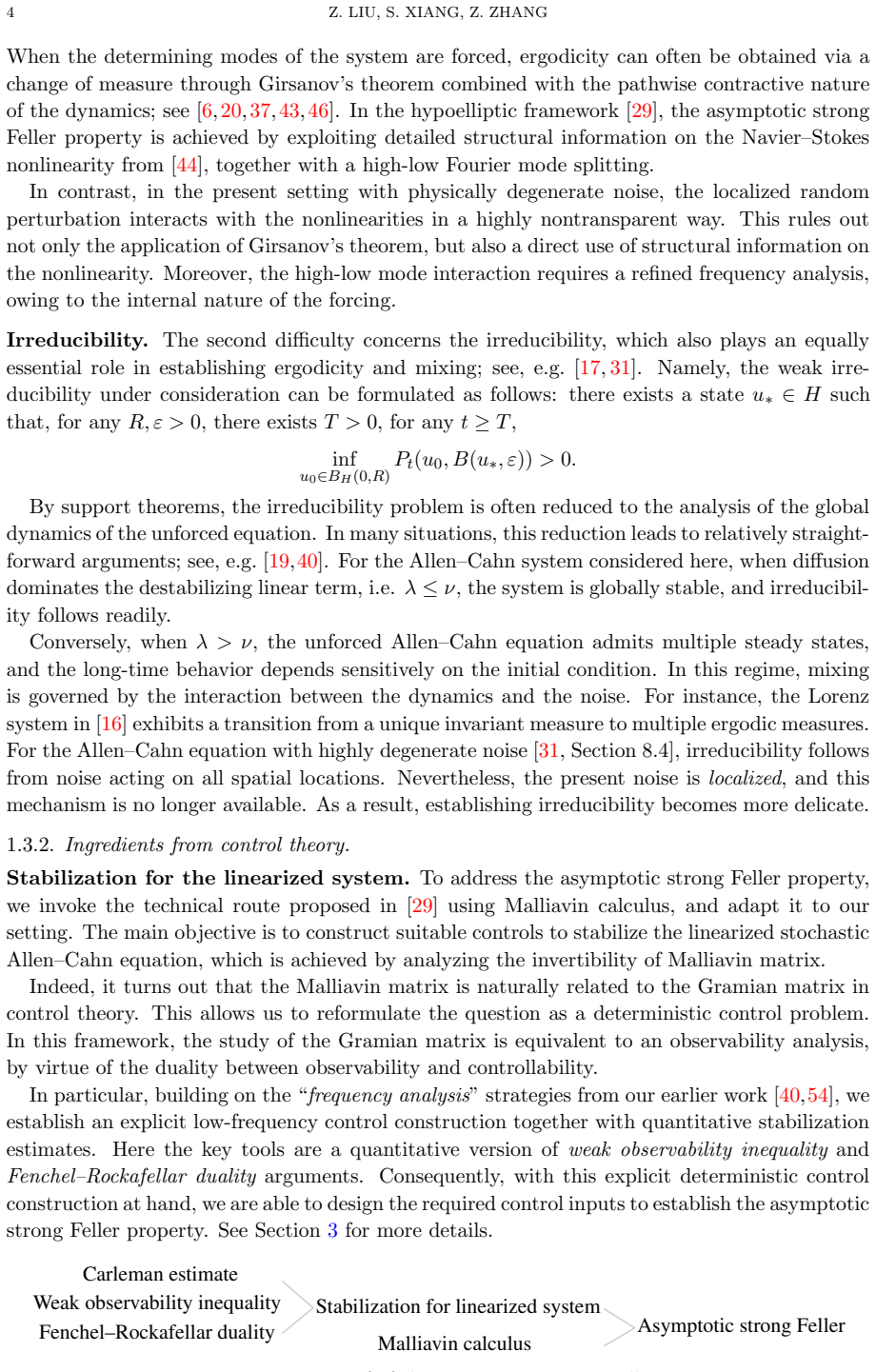
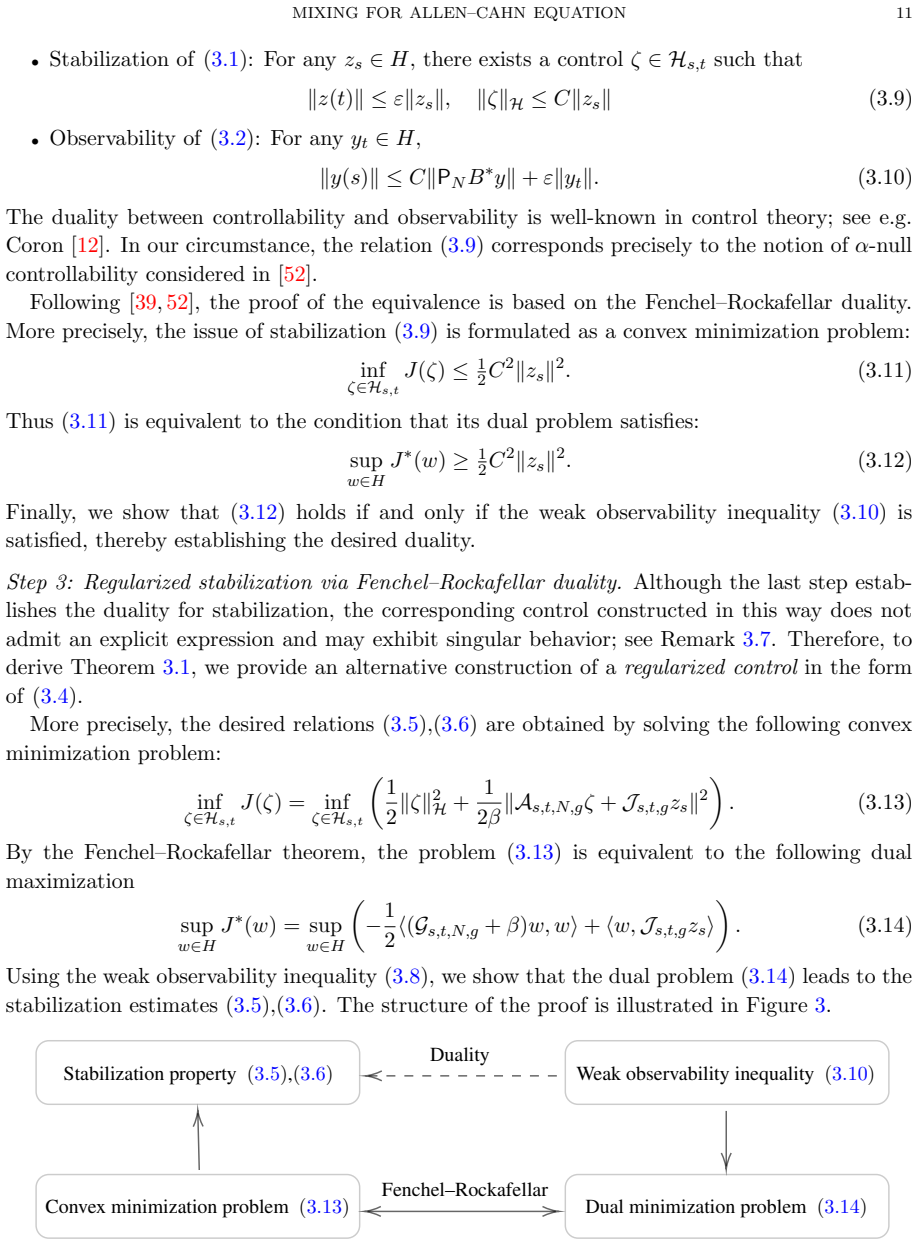
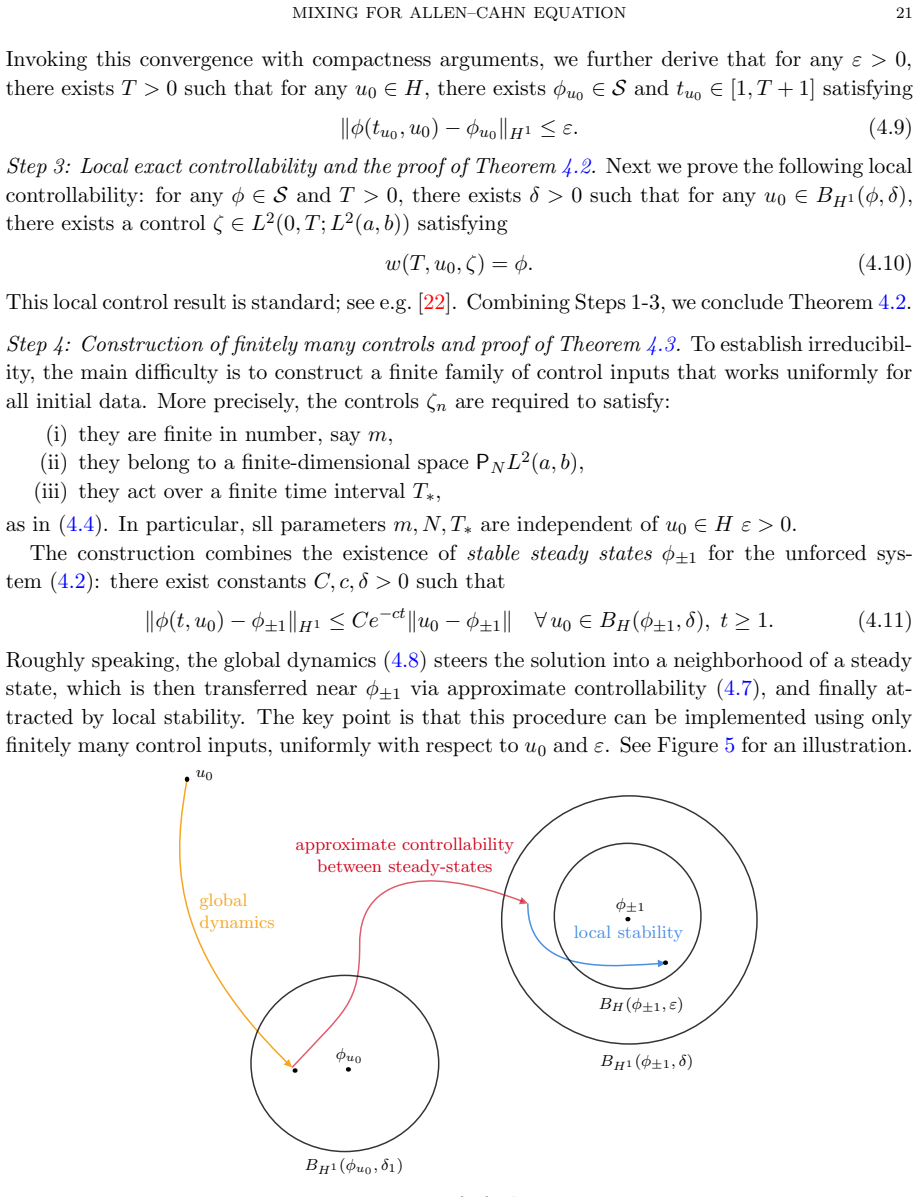
We prove that the associated Markov process admits a unique invariant measure and is exponential mixing. The main challenge lies in the interaction between the localized nature of the noise and the non-trivial global dynamics of the system. To overcome this, our approach relies on two ingredients from PDE control theory: stabilization for the linearized system and global steady-state controllability for the nonlinear equation. The stabilization result is derived using the weak observability and Fenchel-Rockafellar duality, while the global controllability relies on quasi-static deformations combined with global dynamics.
What carries the argument
Stabilization of the linearized equation via weak observability and Fenchel-Rockafellar duality, paired with global steady-state controllability of the nonlinear equation via quasi-static deformations.
Load-bearing premise
The localized noise must still allow stabilization of the linearized system and global steady-state controllability of the nonlinear system on the bounded domain.
What would settle it
Numerical or analytic evidence of two distinct invariant measures, or of the total-variation distance between laws from different initial data failing to decay exponentially, would refute the claim.
Figures


read the original abstract
This paper studies the 1D stochastic Allen--Cahn equation on a bounded domain driven by localized white noise. We prove that the associated Markov process admits a unique invariant measure and is exponential mixing. The main challenge lies in the interaction between localized nature of the noise and non-trivial global dynamics of the system. To overcome this, our approach relies on two ingredients from PDE control theory: stabilization for the linearized system and global steady-state controllability for the nonlinear equation. The stabilization result is derived using the weak observability and Fenchel--Rockafellar duality, while the global controllability relies on quasi-static deformations combined with global dynamics.
Editorial analysis
A structured set of objections, weighed in public.
Referee Report
Summary. The manuscript claims to prove that the Markov process for the one-dimensional stochastic Allen-Cahn equation driven by localized white noise on a bounded domain admits a unique invariant measure and exhibits exponential mixing. The proof strategy combines linear stabilization results obtained from weak observability and Fenchel-Rockafellar duality with nonlinear global steady-state controllability achieved through quasi-static deformations.
Significance. Should the result be correct, it would be a notable advancement in the ergodic theory of SPDEs, particularly for systems where the noise is localized and the underlying deterministic dynamics are non-trivial. By leveraging tools from PDE control theory, the paper addresses a setting where standard methods like hypoellipticity may not directly apply due to the localization of the noise.
major comments (1)
- The quasi-static deformation technique for global steady-state controllability (described in the abstract as relying on slow variation to stay close to the manifold of steady states) risks producing steering times T that are not uniformly bounded independent of the initial datum or the distance between equilibria. Exponential mixing of the Markov semigroup requires a uniform positive lower bound (independent of the starting point) on the probability of entering a contracting neighborhood within a fixed time window; asymptotic controllability alone would at best yield sub-exponential rates. An explicit estimate bounding the admissible deformation speed and total time T uniformly must be supplied.
minor comments (2)
- The abstract refers to 'global dynamics' of the Allen-Cahn equation; the introduction should explicitly state how these are combined with the quasi-static deformations to obtain the controllability result.
- All invocations of external PDE control results (weak observability, Fenchel-Rockafellar duality, etc.) should include precise theorem citations and a brief verification that the hypotheses hold for the localized noise support on the bounded interval.
Simulated Author's Rebuttal
We thank the referee for the careful reading of our manuscript and for the positive evaluation of its significance in the ergodic theory of SPDEs. We address the major comment below and will incorporate the requested clarifications in the revised version.
read point-by-point responses
-
Referee: The quasi-static deformation technique for global steady-state controllability (described in the abstract as relying on slow variation to stay close to the manifold of steady states) risks producing steering times T that are not uniformly bounded independent of the initial datum or the distance between equilibria. Exponential mixing of the Markov semigroup requires a uniform positive lower bound (independent of the starting point) on the probability of entering a contracting neighborhood within a fixed time window; asymptotic controllability alone would at best yield sub-exponential rates. An explicit estimate bounding the admissible deformation speed and total time T uniformly must be supplied.
Authors: We appreciate the referee's observation on the necessity of uniform bounds for the steering times to secure exponential mixing. In Section 4 of the manuscript, the quasi-static deformation is constructed by following a path in the manifold of steady states at a rate controlled by the spectral gap of the linearized operator around each steady state. Because the domain is bounded and the Allen-Cahn nonlinearity satisfies standard growth conditions, the admissible deformation speed can be chosen uniformly with respect to both the initial datum and the distance between equilibria; the total time T is then bounded by a constant depending only on the geometry of the manifold and the uniform observability constant from the linear stabilization result. We will add an explicit lemma (new Lemma 4.8) providing these uniform estimates, together with the resulting lower bound on the transition probability into the contracting neighborhood. This closes the argument for exponential mixing with a rate independent of the starting point. revision: yes
Circularity Check
No circularity; proof relies on external PDE control results
full rationale
The derivation chain invokes stabilization of the linearized system (via weak observability and Fenchel-Rockafellar duality) and global steady-state controllability (via quasi-static deformations) as ingredients from PDE control theory. These steps are not shown to reduce by construction to the paper's own inputs, fitted parameters, or self-citations; the abstract explicitly frames them as external tools applied to the stochastic Allen-Cahn setting. No self-definitional equivalences, renamed known results, or load-bearing self-citation chains appear. The central claim of unique invariant measure and exponential mixing therefore rests on independent external benchmarks rather than tautological reduction.
Axiom & Free-Parameter Ledger
axioms (2)
- domain assumption The stochastic Allen-Cahn equation with localized noise generates a well-posed Markov process on a suitable function space.
- domain assumption The linearized system around steady states is stabilizable and the nonlinear system is globally controllable using the localized noise.
Reference graph
Works this paper leans on
-
[1]
Alphonse and J
P. Alphonse and J. Martin. Stabilization and approximate null-controllability for a large class of diffusive equations from thick control supports.ESAIM Control Optim. Calc. Var., 28(16):30 pp, 2022
2022
-
[2]
Barbu and R
V. Barbu and R. Triggiani. Internal stabilization of Navier-Stokes equations with finite-dimensional con- trollers.Indiana Univ. Math. J., 53(5):1443–1494, 2004
2004
-
[3]
Bedrossian, A
J. Bedrossian, A. Blumenthal, and S. Punshon-Smith. Almost-sure exponential mixing of passive scalars by the stochastic Navier-Stokes equations.Ann. Probab., 50(1):241–303, 2022
2022
-
[4]
Bedrossian, A
J. Bedrossian, A. Blumenthal, and S. Punshon-Smith. Lagrangian chaos and scalar advection in stochastic fluid mechanics.J. Eur. Math. Soc. (JEMS), 24(6):1893–1990, 2022
1990
-
[5]
V. I. Bogachev.Gaussian measures. American Mathematical Society, Providence, RI, 1998
1998
-
[6]
Bricmont, A
J. Bricmont, A. Kupiainen, and R. Lefevere. Exponential mixing of the 2D stochastic Navier-Stokes dynamics. Comm. Math. Phys., 230(1):87–132, 2002
2002
- [7]
-
[8]
Chen and S
Y. Chen and S. Xiang. Donsker-Varadhan large deviation principle for locally damped and randomly forced NLS equations.Ann. Henri Poincar´ e, 2026, early access
2026
- [9]
-
[10]
Cooperman and K
W. Cooperman and K. Rowan. Exponential scalar mixing for the 2D Navier–Stokes equations with degenerate stochastic forcing.Invent. math., To appear
-
[11]
J.-M. Coron. Local controllability of a 1-d tank containing a fluid modeled by the shallow water equations. ESAIM Control Optim. Calc. Var., 8:513–554, 2002. MIXING FOR ALLEN–CAHN EQUATION 45
2002
-
[12]
Coron.Control and nonlinearity
J.-M. Coron.Control and nonlinearity. American Mathematical Society, Providence, RI, 2007
2007
- [13]
-
[14]
Coron and E
J.-M. Coron and E. Tr´ elat. Global steady-state controllability of one-dimensional semilinear heat equations. SIAM J. Control Optim., 43(2):549–569, 2004
2004
-
[15]
Coron and S
J.-M. Coron and S. Xiang. Global controllability to harmonic maps of the heat flow from a circle to a sphere. J. Math. Pures Appl. (9), 204:Paper No. 103761, 47 pp, 2025
2025
-
[16]
Coti Zelati and M
M. Coti Zelati and M. Hairer. A noise-induced transition in the Lorenz system.Commun. Math. Phys., 383:2243–2274, 2021
2021
-
[17]
Da Prato and J
G. Da Prato and J. Zabczyk.Ergodicity for infinite dimensional systems. Cambridge University Press, Cam- bridge, 1996
1996
-
[18]
Duyckaerts, X
T. Duyckaerts, X. Zhang, and E. Zuazua. On the optimality of the observability inequalities for parabolic and hyperbolic systems with potentials.Ann. Inst. H. Poincar´ e C Anal. Non Lin´ eaire, 25(1):1–41, 2008
2008
-
[19]
W. E and J. C. Mattingly. Ergodicity for the Navier-Stokes equation with degenerate random forcing: finite- dimensional approximation.Comm. Pure Appl. Math., 54(11):1386–1402, 2001
2001
-
[20]
W. E, J. C. Mattingly, and Y. Sinai. Gibbsian dynamics and ergodicity for the stochastically forced Navier- Stokes equation.Comm. Math. Phys., 224(1):83–106, 2001
2001
-
[21]
Ekeland and R
I. Ekeland and R. T´ emam.Convex analysis and variational problems. Society for Industrial and Applied Mathematics (SIAM), Philadelphia, PA, 1999
1999
-
[22]
O. Yu. `Emanuilov. Controllability of parabolic equations.Mat. Sb., 186(6):879–900, 1995
1995
-
[23]
Fern´ andez-Cara and E
E. Fern´ andez-Cara and E. Zuazua. The cost of approximate controllability for heat equations: the linear case.Adv. Differential Equations, 5(4-6):465–514, 2000
2000
-
[24]
Flandoli and B
F. Flandoli and B. Maslowski. Ergodicity of the 2-D Navier-Stokes equation under random perturbations. Comm. Math. Phys., 172(1):119–141, 1995
1995
-
[25]
F¨ oldes, N
J. F¨ oldes, N. E. Glatt-Holtz, G. Richards, and E. Thomann. Ergodic and mixing properties of the Boussinesq equations with a degenerate random forcing.J. Funct. Anal., 269(8):2427–2504, 2015
2015
-
[26]
X. Fu, Q. L¨ u, and X. Zhang.Carleman estimates for second order partial differential operators and applica- tions: a unified approach. Springer, Cham, 2019
2019
-
[27]
F. Gong, Y. Liu, Y. Liu, and Z. Liu. Asymptotic stability for non-equicontinuous Markov semigroups.Com- mun. Math. Stat., 2025, early access
2025
-
[28]
F. Gong, Y. Liu, Y. Liu, and Z. Liu. Ergodicity for eventually continuous Markov–Feller semigroups on Polish spaces.Sci. China Math., 2026, early access
2026
-
[29]
Hairer and J
M. Hairer and J. C. Mattingly. Ergodicity of the 2D Navier-Stokes equations with degenerate stochastic forcing.Ann. of Math. (2), 164(3):993–1032, 2006
2006
-
[30]
Hairer and J
M. Hairer and J. C. Mattingly. Spectral gaps in Wasserstein distances and the 2D stochastic Navier-Stokes equations.Ann. Probab., 36(6):2050–2091, 2008
2050
-
[31]
Hairer and J
M. Hairer and J. C. Mattingly. A theory of hypoellipticity and unique ergodicity for semilinear stochastic PDEs.Electron. J. Probab., 16:658–738, 2011
2011
-
[32]
Hairer and W
M. Hairer and W. Zhao. Ergodicity of 2D singular stochastic Navier–Stokes equations.Probab. Math. Phys., 6(3):777–818, 2025
2025
-
[33]
J. K. Hale.Asymptotic behavior of dissipative systems. American Mathematical Society, Providence, RI, 1988
1988
-
[34]
Henry.Geometric theory of semilinear parabolic equations
D. Henry.Geometric theory of semilinear parabolic equations. Springer-Verlag, Berlin-New York, 1981
1981
-
[35]
H. K. Khalil.Nonlinear systems. Macmillan Publishing Company, New York, 1992
1992
-
[36]
Kuksin, V
S. Kuksin, V. Nersesyan, and A. Shirikyan. Exponential mixing for a class of dissipative PDEs with bounded degenerate noise.Geom. Funct. Anal., 30(1):126–187, 2020
2020
-
[37]
Kuksin and A
S. Kuksin and A. Shirikyan. Coupling approach to white-forced nonlinear PDEs.J. Math. Pures Appl. (9), 81(6):567–602, 2002
2002
-
[38]
Lions.Contrˆ olabilit´ e exacte, perturbations et stabilisation de syst` emes distribu´ es
J.-L. Lions.Contrˆ olabilit´ e exacte, perturbations et stabilisation de syst` emes distribu´ es. Tome 1. Masson, Paris, 1988
1988
-
[39]
J.-L. Lions. Remarks on approximate controllability.J. Anal. Math., 59:103–116, 1992
1992
- [40]
-
[41]
Masmoudi and L.-S
N. Masmoudi and L.-S. Young. Ergodic theory of infinite dimensional systems with applications to dissipative parabolic PDEs.Comm. Math. Phys., 227(3):461–481, 2002
2002
-
[42]
J. C. Mattingly. The dissipative scale of the stochastics Navier-Stokes equation: regularization and analyticity. J. Statist. Phys., 108(5-6):1157–1179, 2002
2002
-
[43]
J. C. Mattingly. Exponential convergence for the stochastically forced Navier-Stokes equations and other partially dissipative dynamics.Comm. Math. Phys., 230(3):421–462, 2002
2002
-
[44]
J. C. Mattingly and ´E. Pardoux. Malliavin calculus for the stochastic 2D Navier-Stokes equation.Comm. Pure Appl. Math., 59(12):1742–1790, 2006. 46 Z. LIU, S. XIANG, Z. ZHANG
2006
-
[45]
V. Nersesyan, D. Zhang, and C. Zhou. On the chaotic behavior of the Lagrangian flow of the 2D Navier-Stokes system with bounded degenerate noise.arXiv:2406.17612, 2024
-
[46]
V. Nersesyan and M. Zhao. Polynomial mixing for the white-forced Navier-Stokes system in the whole space. arXiv:2410.15727, 2024
-
[47]
Nualart.The Malliavin calculus and related topics
D. Nualart.The Malliavin calculus and related topics. Springer-Verlag, Berlin, second edition, 2006
2006
- [48]
-
[49]
R. T. Rockafellar. Duality and stability in extremum problems involving convex functions.Pacific J. Math., 21:167–187, 1967
1967
-
[50]
Shirikyan
A. Shirikyan. Control and mixing for 2D Navier-Stokes equations with space-time localised noise.Ann. Sci. ´Ec. Norm. Sup´ er, 48(2):253–280, 2015
2015
-
[51]
Shirikyan
A. Shirikyan. Controllability implies mixing II. Convergence in the dual-Lipschitz metric.J. Eur. Math. Soc. (JEMS), 23(4):1381–1422, 2021
2021
-
[52]
Tr´ elat, G
E. Tr´ elat, G. Wang, and Y. Xu. Characterization by observability inequalities of controllability and stabi- lization properties.Pure Appl. Anal., 59(1):93–122, 2020
2020
-
[53]
S. Xiang. Small-time local stabilization of the two-dimensional incompressible Navier-Stokes equations.Ann. Inst. H. Poincar´ e C Anal. Non Lin´ eaire, 40(6):1487–1511, 2023
2023
-
[54]
S. Xiang. Quantitative rapid and finite time stabilization of the heat equation.ESAIM Control Optim. Calc. Var., 30:Paper No. 40, 25 pp, 2024. (Ziyu Liu)School of Mathematics and Physics, University of Science and Technology Beijing, 100083, Beijing, China. Email address:ziyu@ustb.edu.cn (Shengquan Xiang)School of Mathematical Sciences, Peking University,...
2024
discussion (0)
Sign in with ORCID, Apple, or X to comment. Anyone can read and Pith papers without signing in.