Recognition: unknown
Early interaction signatures and an extended plateau phase in Type II SN 2020aze
Pith reviewed 2026-05-08 06:06 UTC · model grok-4.3
The pith
Type II SN 2020aze displays early He II 4686 lines from ejecta interacting with dense circumstellar material and an extended plateau consistent with a 14 solar mass red supergiant.
A machine-rendered reading of the paper's core claim, the machinery that carries it, and where it could break.
Core claim
SN 2020aze exhibits transient narrow and broad blue-shifted He II 4686 features in spectra younger than 6 days, taken as direct evidence of ejecta interaction with dense circumstellar material, while semi-analytical modeling of its light curve gives an initial radius of 1100 solar radii, ejecta mass 12 solar masses, explosion energy 1.5e51 erg, and a red supergiant progenitor mass of 14 solar masses with a weak wind of 10^{-3} solar masses per year; the combination of early interaction signatures, steep decline, and extended photospheric phase demonstrates the influence of pre-supernova mass loss on Type II supernova diversity.
What carries the argument
Transient narrow 4687 Angstrom emission and 4400-4800 Angstrom broad feature interpreted as narrow and blue-shifted broad He II 4686 from ejecta-dense CSM interaction, together with semi-analytical light-curve models used to extract progenitor radius, mass, and energy.
If this is right
- The 2.04 mag per 100 days decline and 120-day recombination phase arise because circumstellar interaction modifies the standard recombination-driven plateau.
- A mass-loss rate near 10^{-3} solar masses per year is required to produce the observed early interaction signatures in a red supergiant wind.
- Fast-declining Type II events can still host extended plateaus when pre-explosion mass loss creates sufficient circumstellar density.
- Early-time spectroscopy within the first few days is necessary to catch transient He II features before they fade.
Where Pith is reading between the lines
- Many fast-declining Type II supernovae may harbor undetected early interaction phases if they lack spectra before day 6.
- The extended plateau implies that circumstellar material can lengthen the photospheric phase even in events that initially appear to decline steeply.
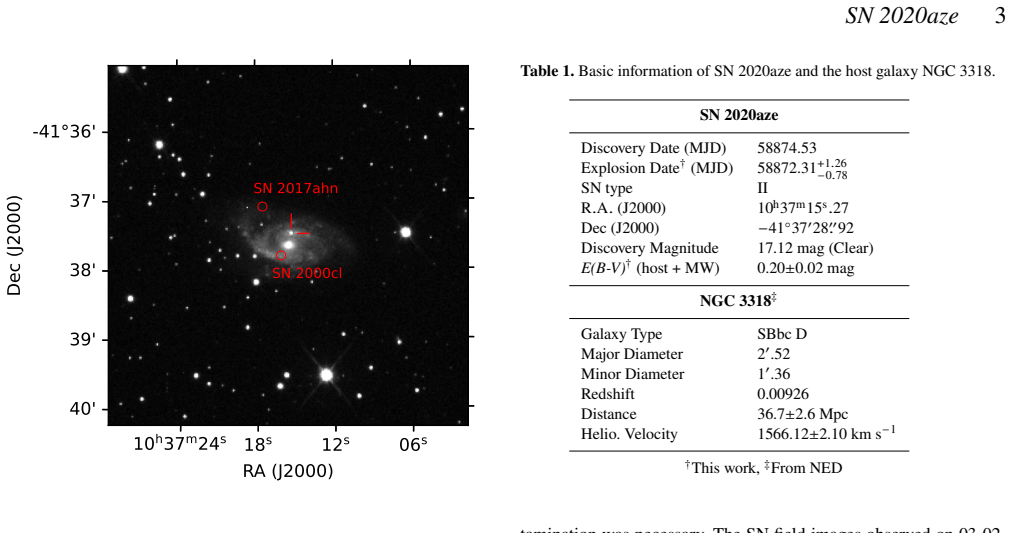
- Similar transient He II detections in future rapid-follow-up observations would allow systematic mapping of circumstellar densities around Type II progenitors.
Load-bearing premise
The spectral features at 4687 Angstroms and across 4400-4800 Angstroms must be produced by He II 4686 from ejecta hitting circumstellar material rather than by other ions or non-interaction processes.
What would settle it
High-resolution spectra or detailed non-LTE modeling that identifies the 4687 Angstrom line as a different species or shows that standard non-interacting Type II models fit the early spectra without requiring circumstellar material.
Figures





read the original abstract
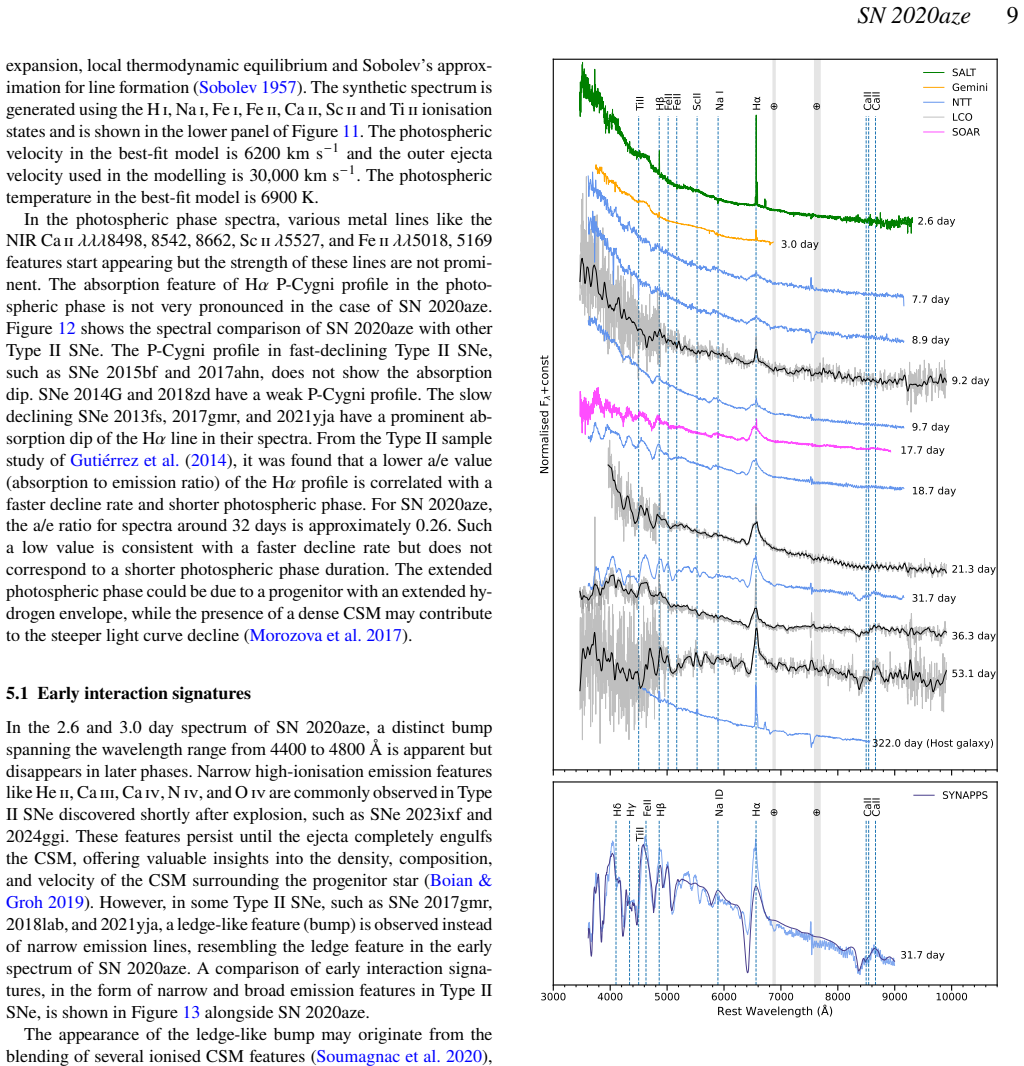
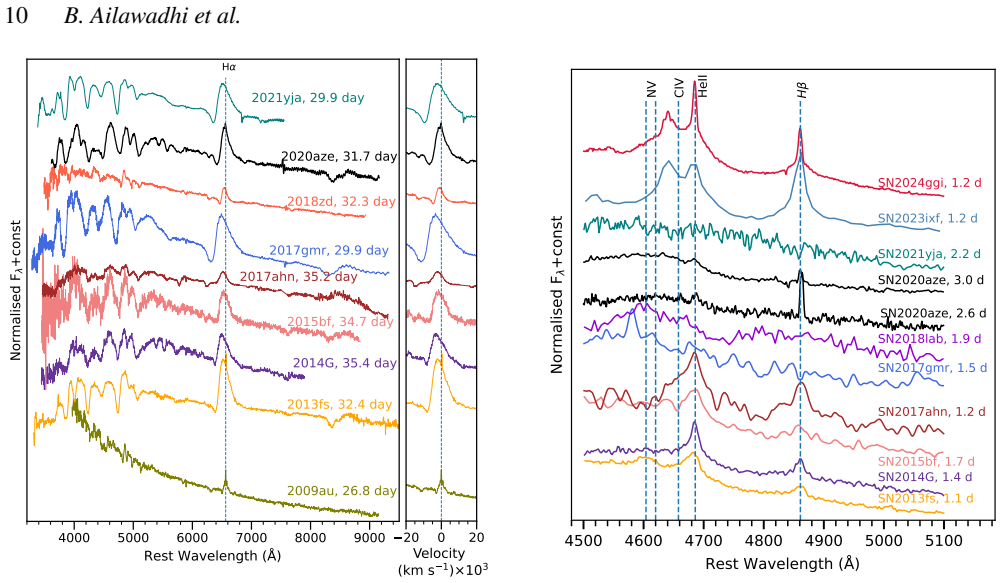
We present a photometric and spectroscopic analysis of the fast-declining Type II SN 2020aze, observed in optical bands from 2.2 to 137.4 days after explosion. The V-band light curve reaches a peak absolute magnitude of about minus 16.97$\pm$0.20 mag by 15 days, followed by a recombination phase with a decline rate of 2.04$\pm$0.13 mag per 100 days, lasting about 120 days. Early spectra (younger than 6 days) show a transient weak narrow emission line at 4687 Angstroms and a feature spanning 4400-4800 Angstroms, attributed to narrow and broad blue-shifted He II 4686, indicating interaction between the ejecta and dense circumstellar material. Comparison with spectral models suggests a red supergiant progenitor with a weak wind and a mass-loss rate of about 1e-3 solar masses per year. Semi-analytical light-curve modeling gives an initial radius of about 1100 solar radii, an ejecta mass of about 12 solar masses, an explosion energy of about 1.5e51 erg, and a progenitor mass of about 14 solar masses. These early interaction signatures, the steep decline, and the extended photospheric phase highlight the role of pre-supernova mass loss and circumstellar interaction in shaping the diversity of Type II supernovae.
Editorial analysis
A structured set of objections, weighed in public.
Referee Report
Summary. The manuscript presents photometric and spectroscopic observations of the fast-declining Type II supernova SN 2020aze from 2.2 to 137.4 days post-explosion. It identifies transient narrow emission at 4687 Å and a 4400-4800 Å feature in spectra younger than 6 days as narrow and broad blue-shifted He II 4686, interpreted as evidence of early ejecta-CSM interaction. Semi-analytical light-curve modeling is used to derive an initial radius of ~1100 R_⊙, ejecta mass ~12 M_⊙, explosion energy ~1.5×10^51 erg, and progenitor mass ~14 M_⊙, with a mass-loss rate ~10^{-3} M_⊙ yr^{-1} from spectral comparisons; the work emphasizes the role of pre-supernova mass loss in shaping Type II diversity.
Significance. If the He II identification holds and the light-curve parameters can be shown to be robust despite the claimed interaction, the result would add a well-observed case of early CSM interaction in a Type II event with an extended plateau, helping quantify how mass-loss episodes affect light-curve morphology. The combination of early spectra and long-term photometry is a strength.
major comments (3)
- [light-curve modeling results] The semi-analytical light-curve modeling (described in the results section following the spectral analysis) employs standard diffusion-based codes that assume a homologously expanding sphere with no additional energy input from shock-CSM interaction. This assumption is violated by the early spectra claiming ejecta-CSM interaction that would contribute extra luminosity to the first ~15 days of photometry used in the fit, rendering the reported R_init, M_ej, and E unreliable without re-fitting using an interacting-SN module.
- [early spectra analysis] The attribution of the 4687 Å line and 4400-4800 Å feature specifically to He II 4686 (narrow and broad components) lacks quantitative support such as velocity measurements, line-profile decomposition, or direct comparison to synthetic spectra with goodness-of-fit metrics; the transient and weak nature of the features makes the identification load-bearing for the interaction claim but currently under-constrained.
- [abstract and results] No uncertainties, error budgets, data-exclusion criteria, or quantitative fit statistics (e.g., reduced χ²) are reported for the derived parameters or the semi-analytical fits, so the central numerical claims (R_init ≈ 1100 R_⊙, M_ej ≈ 12 M_⊙, etc.) cannot be assessed for robustness.
minor comments (2)
- [photometric analysis] The V-band decline rate is stated as 2.04±0.13 mag per 100 days; clarify whether this is measured over the full 120-day plateau or a specific interval and how the uncertainty was derived.
- [throughout] Notation for solar units (R_⊙, M_⊙) and scientific notation for energy should be standardized throughout the text and figures.
Simulated Author's Rebuttal
We thank the referee for the careful and constructive review of our manuscript on SN 2020aze. We address each major comment in turn below, indicating where revisions will be made to strengthen the presentation and analysis.
read point-by-point responses
-
Referee: [light-curve modeling results] The semi-analytical light-curve modeling (described in the results section following the spectral analysis) employs standard diffusion-based codes that assume a homologously expanding sphere with no additional energy input from shock-CSM interaction. This assumption is violated by the early spectra claiming ejecta-CSM interaction that would contribute extra luminosity to the first ~15 days of photometry used in the fit, rendering the reported R_init, M_ej, and E unreliable without re-fitting using an interacting-SN module.
Authors: We agree that the semi-analytical models employed do not incorporate explicit energy input from ejecta-CSM interaction. The early interaction signatures are indeed present and could contribute additional luminosity during the rise. To address this, we will re-perform the light-curve modeling by excluding the first 15 days of photometry (where interaction effects are strongest) and compare the resulting parameters to the original fit. If an interacting SN module is accessible, we will also test it; otherwise, we will explicitly discuss the limitation and the robustness of the plateau-phase constraints on M_ej and E. These changes will be incorporated in the revised manuscript. revision: yes
-
Referee: [early spectra analysis] The attribution of the 4687 Å line and 4400-4800 Å feature specifically to He II 4686 (narrow and broad components) lacks quantitative support such as velocity measurements, line-profile decomposition, or direct comparison to synthetic spectra with goodness-of-fit metrics; the transient and weak nature of the features makes the identification load-bearing for the interaction claim but currently under-constrained.
Authors: The line identification rests on the precise wavelength coincidence with He II 4686, the transient appearance only in spectra younger than 6 days, and analogy to other early-interacting Type II events. We will expand the spectral analysis section to include measured velocities (narrow component near rest, broad component blueshifted), a description of the line profile, and direct overlays of the observed features against published synthetic spectra or model predictions used for the mass-loss rate estimate. While a full chi-squared minimization against synthetic spectra is not feasible given the low signal-to-noise of the weak features, the added quantitative details and literature comparisons will better substantiate the claim. revision: partial
-
Referee: [abstract and results] No uncertainties, error budgets, data-exclusion criteria, or quantitative fit statistics (e.g., reduced χ²) are reported for the derived parameters or the semi-analytical fits, so the central numerical claims (R_init ≈ 1100 R_⊙, M_ej ≈ 12 M_⊙, etc.) cannot be assessed for robustness.
Authors: We acknowledge that uncertainties, fit statistics, and data-handling details were omitted. In the revised manuscript we will report formal uncertainties on all derived quantities (R_init, M_ej, E, progenitor mass), include the reduced χ² values for the semi-analytical fits, specify any photometric points excluded from the modeling, and add a brief error-budget discussion. These additions will allow readers to evaluate the robustness of the reported parameters. revision: yes
Circularity Check
No significant circularity; parameters are standard model fits to photometry
full rationale
The paper's derivation chain separates spectral identification of possible He II features (attributed to early ejecta-CSM interaction) from semi-analytical light-curve modeling that yields R_init, M_ej, E, and progenitor mass. These quantities are presented as direct outputs of fitting the observed photometry under standard diffusion assumptions, with no claim that they are independent first-principles predictions or that the spectral data are used to derive the same parameters by construction. No self-citations, uniqueness theorems, or ansatzes are invoked as load-bearing steps that reduce the central results to tautologies. The chain remains self-contained against the two distinct observational inputs (spectra and light curve).
Axiom & Free-Parameter Ledger
free parameters (5)
- mass-loss rate =
10^{-3} M_sun yr^{-1}
- initial radius =
1100 R_sun
- ejecta mass =
12 M_sun
- explosion energy =
1.5e51 erg
- progenitor mass =
14 M_sun
axioms (2)
- domain assumption The 4687 Angstrom narrow line and 4400-4800 Angstrom feature arise from narrow and broad blue-shifted He II 4686 produced by ejecta-CSM interaction
- domain assumption Semi-analytical light-curve models for Type II supernovae with weak winds accurately recover physical parameters when fitted to the observed photometry
Reference graph
Works this paper leans on
-
[1]
Electron scattering wings on lines in interacting supernovae. , keywords =. doi:10.1093/mnras/stx3163 , archivePrefix =. 1712.01237 , primaryClass =
-
[2]
Evolved Massive Stars in the Local Group. I. Identification of Red Supergiants in NGC 6822, M31, and M33. , keywords =. doi:10.1086/305818 , adsurl =
-
[3]
The Evolution of Massive Stars. I. Red Supergiants in the Magellanic Clouds. , keywords =. doi:10.1086/379558 , archivePrefix =. astro-ph/0309272 , primaryClass =
-
[4]
The Red Supergiant Binary Fraction of the Large Magellanic Cloud. , keywords =. doi:10.3847/1538-4357/ababaa , archivePrefix =. 2007.15852 , primaryClass =
-
[5]
SN 1994W: an interacting supernova or two interacting shells?. , keywords =. doi:10.1111/j.1365-2966.2008.14042.x , archivePrefix =. 0804.0428 , primaryClass =
-
[6]
Broad emission lines from the opaque electron-scattering environment of SN 1998S. , keywords =. doi:10.1111/j.1365-2966.2001.04717.x , archivePrefix =. astro-ph/0106234 , primaryClass =
-
[7]
Nuovo Cimento C Geophysics Space Physics C , keywords =
PROMPT: Panchromatic Robotic Optical Monitoring and Polarimetry Telescopes. Nuovo Cimento C Geophysics Space Physics C , keywords =. doi:10.1393/ncc/i2005-10149-6 , archivePrefix =. astro-ph/0502429 , primaryClass =
-
[8]
The diversity of Type II supernova versus the similarity in their progenitors. , keywords =. doi:10.1093/mnras/stw870 , archivePrefix =. 1603.08953 , primaryClass =
-
[9]
2014, MNRAS, 438, L101, doi: 10.1093/mnrasl/slt171
The first month of evolution of the slow-rising Type IIP SN 2013ej in M74 ^ ★. , keywords =. doi:10.1093/mnrasl/slt171 , archivePrefix =. 1309.4269 , primaryClass =
-
[10]
CHARACTERIZING THE<i>V</i>-BAND LIGHT-CURVES OF HYDROGEN-RICH TYPE II SUPERNOVAE
Characterizing the V-band Light-curves of Hydrogen-rich Type II Supernovae. , keywords =. doi:10.1088/0004-637X/786/1/67 , archivePrefix =. 1403.7091 , primaryClass =
-
[11]
, keywords =
Photometric properties of type II supernovae. , keywords =
-
[12]
Photometric Behavior of Evolved Supernovae. , keywords =. doi:10.1086/115558 , adsurl =
-
[13]
A sample of Type II-L supernovae. , keywords =. doi:10.1093/mnras/stu1760 , archivePrefix =. 1409.1536 , primaryClass =
-
[14]
ASASSN-14dq: a fast-declining Type II-P supernova in a low-luminosity host galaxy. , keywords =. doi:10.1093/mnras/sty1957 , archivePrefix =. 1807.07251 , primaryClass =
-
[15]
Research Notes of the American Astronomical Society , year = 2018, month = dec, volume =
SuperBol: A User-friendly Python Routine for Bolometric Light Curves. Research Notes of the American Astronomical Society , year = 2018, month = dec, volume =. doi:10.3847/2515-5172/aaf799 , adsurl =
-
[16]
Supernova 2013by: a Type IIL supernova with a IIP-like light-curve drop ^ ★. , keywords =. doi:10.1093/mnras/stv208 , archivePrefix =. 1501.06491 , primaryClass =
-
[17]
The long-lived Type IIn SN 2015da: Infrared echoes and strong interaction within an extended massive shell. , keywords =. doi:10.1051/0004-6361/201936553 , archivePrefix =. 1908.08580 , primaryClass =
-
[18]
, year = 2000, month = may, volume =
Supernova 2000cl in NGC 3318. , year = 2000, month = may, volume =
2000
-
[19]
The Early Discovery of SN 2017ahn: Signatures of Persistent Interaction in a Fast-declining Type II Supernova. , keywords =. doi:10.3847/1538-4357/abca8a , archivePrefix =. 2008.06515 , primaryClass =
-
[20]
Weak Mass Loss from the Red Supergiant Progenitor of the Type II SN 2021yja. , keywords =. doi:10.3847/1538-4357/ac75f0 , archivePrefix =. 2203.08155 , primaryClass =
-
[21]
Shock Cooling and Possible Precursor Emission in the Early Light Curve of the Type II SN 2023ixf. , keywords =. doi:10.3847/2041-8213/ace4c4 , archivePrefix =. 2306.06097 , primaryClass =
-
[22]
arXiv e-prints , keywords =
Circumstellar Medium Interaction in SN 2018lab, A Low-Luminosity II-P Supernova observed with TESS. arXiv e-prints , keywords =
-
[23]
Flash Spectroscopy: Emission Lines from the Ionized Circumstellar Material around <10-day-old Type II Supernovae. , keywords =. doi:10.3847/0004-637X/818/1/3 , archivePrefix =. 1512.00846 , primaryClass =
-
[24]
SN 2015ba: a Type IIP supernova with a long plateau. , keywords =. doi:10.1093/mnras/sty1634 , archivePrefix =. 1806.05470 , primaryClass =
-
[25]
A Wolf-Rayet-like progenitor of SN 2013cu from spectral observations of a stellar wind. , keywords =. doi:10.1038/nature13304 , archivePrefix =. 1406.7640 , primaryClass =
-
[26]
Explosion of red-supergiant stars: Influence of the atmospheric structure on shock breakout and early-time supernova radiation. , keywords =. doi:10.1051/0004-6361/201730942 , archivePrefix =. 1704.01697 , primaryClass =
-
[27]
2012, MNRAS, 423, 600, doi: 10.1111/j.1365-2966.2012.20901.x
Progenitor mass constraints for core-collapse supernovae from correlations with host galaxy star formation. , keywords =. doi:10.1111/j.1365-2966.2012.21324.x , archivePrefix =. 1205.3802 , primaryClass =
-
[28]
Unifying Type II Supernova Light Curves with Dense Circumstellar Material. , keywords =. doi:10.3847/1538-4357/aa6251 , archivePrefix =. 1610.08054 , primaryClass =
-
[29]
VizieR Online Data Catalog , keywords =
VizieR Online Data Catalog: Type IIP supernovae from Pan-STARRS1 (Sanders+, 2015). VizieR Online Data Catalog , keywords =
2015
-
[30]
Final Moments. II. Observational Properties and Physical Modeling of Circumstellar-material-interacting Type II Supernovae. , keywords =. doi:10.3847/1538-4357/ad4a2a , archivePrefix =. 2403.02382 , primaryClass =
-
[31]
2012, MNRAS, 423, 600, doi: 10.1111/j.1365-2966.2012.20901.x
An empirical relation between sodium absorption and dust extinction. , keywords =. doi:10.1111/j.1365-2966.2012.21796.x , archivePrefix =. 1206.6107 , primaryClass =
-
[32]
Transient Name Server Classification Report , keywords =
ePESSTO+ Transient Classification Report for 2020-02-02. Transient Name Server Classification Report , keywords =
2020
-
[33]
Transient Name Server Discovery Report , keywords =
DLT40 Transient Discovery Report for 2020-01-26. Transient Name Server Discovery Report , keywords =
2020
-
[34]
Handbook of Supernovae , year = 2017, editor =
Shock Breakout Theory. Handbook of Supernovae , year = 2017, editor =. doi:10.1007/978-3-319-21846-5_33 , adsurl =
-
[35]
doi:10.5281/zenodo.4312178 , url =
Griffin Hosseinzadeh and Sebastian Gomez , title =. doi:10.5281/zenodo.4312178 , url =
-
[36]
, keywords =
UV/Optical Emission from the Expanding Envelopes of Type II Supernovae. , keywords =
-
[37]
Light curves and H luminosities as indicators of ^ 56 Ni mass in type IIP supernovae. , keywords =. doi:10.1051/0004-6361:20030522 , archivePrefix =. astro-ph/0304144 , primaryClass =
-
[38]
A meta-analysis of core-collapse supernova ^ 56 Ni masses. , keywords =. doi:10.1051/0004-6361/201935027 , archivePrefix =. 1906.00761 , primaryClass =
-
[39]
A two-component model for fitting light curves of core-collapse supernovae. , keywords =. doi:10.1051/0004-6361/201527931 , archivePrefix =. 1602.04001 , primaryClass =
-
[40]
A low-luminosity core-collapse supernova very similar to SN 2005cs. , keywords =. doi:10.1093/mnras/staa1743 , archivePrefix =. 2007.07650 , primaryClass =
-
[41]
, keywords =
Non-equilibrium radiative transfer in supernova theory : models of linear type II supernovae. , keywords =
-
[42]
, year = 2011, month = feb, volume =
SYNAPPS: Data-Driven Analysis for Supernova Spectroscopy. , year = 2011, month = feb, volume =. doi:10.1086/658673 , adsurl =
-
[43]
Direct Analysis of Spectra of Type Ib Supernovae. , keywords =. doi:10.1086/338127 , archivePrefix =. astro-ph/0106367 , primaryClass =
-
[44]
, year = 1957, month = oct, volume =
The Diffusion of L Radiation in Nebulae and Stellar Envelopes. , year = 1957, month = oct, volume =
1957
-
[45]
SN 2013ej: A Type IIL Supernova with Weak Signs of Interaction. , keywords =. doi:10.1088/0004-637X/806/2/160 , archivePrefix =. 1504.06207 , primaryClass =
-
[46]
H _ Spectral Diversity of Type II Supernovae: Correlations with Photometric Properties. , keywords =. doi:10.1088/2041-8205/786/2/L15 , archivePrefix =. 1403.7089 , primaryClass =
-
[47]
Supernova Explosions of Super-asymptotic Giant Branch Stars: Multicolor Light Curves of Electron-capture Supernovae. , keywords =. doi:10.1088/2041-8205/771/1/L12 , archivePrefix =. 1305.6813 , primaryClass =
-
[48]
ATLAS: A High-Cadence All-Sky Survey System
ATLAS: A High-cadence All-sky Survey System. , keywords =. doi:10.1088/1538-3873/aabadf , archivePrefix =. 1802.00879 , primaryClass =
-
[49]
SN 2016gsd: an unusually luminous and linear Type II supernova with high velocities. , keywords =. doi:10.1093/mnras/staa365 , archivePrefix =. 1909.13617 , primaryClass =
-
[50]
Photometric and polarimetric observations of fast declining Type II supernovae 2013hj and 2014G. , keywords =. doi:10.1093/mnras/stv2351 , archivePrefix =. 1510.01927 , primaryClass =
-
[51]
2012, MNRAS, 420, 1825, doi: 10.1111/j.1365-2966.2011.19805.x
The Type IIP SN 2007od in UGC 12846: from a bright maximum to dust formation in the nebular phase. , keywords =. doi:10.1111/j.1365-2966.2011.19128.x , archivePrefix =. 1102.5468 , primaryClass =
-
[52]
Diversity of supernovae and impostors shortly after explosion. , keywords =. doi:10.1051/0004-6361/201833779 , archivePrefix =. 1811.06505 , primaryClass =
-
[53]
The Distance to SN 1999em from the Expanding Photosphere Method. , keywords =. doi:10.1086/322450 , archivePrefix =. astro-ph/0105006 , primaryClass =
-
[54]
The Distance to SN 1999em in NGC 1637 from the Expanding Photosphere Method. , keywords =. doi:10.1086/324785 , archivePrefix =. astro-ph/0109535 , primaryClass =
-
[55]
The Cepheid Distance to NGC 1637: A Direct Test of the Expanding Photosphere Method Distance to SN 1999em. , keywords =. doi:10.1086/376831 , archivePrefix =. astro-ph/0305259 , primaryClass =
-
[56]
SN 2005cs in M51 - II. Complete evolution in the optical and the near-infrared. , keywords =. doi:10.1111/j.1365-2966.2009.14505.x , archivePrefix =. 0901.2075 , primaryClass =
-
[57]
SN 2005cs in M51 - I. The first month of evolution of a subluminous SN II plateau. , keywords =. doi:10.1111/j.1365-2966.2006.10587.x , archivePrefix =. astro-ph/0605700 , primaryClass =
-
[58]
Type II Plateau supernovae as metallicity probes of the Universe. , keywords =. doi:10.1093/mnras/stu417 , archivePrefix =. 1403.1167 , primaryClass =
-
[59]
Measuring Reddening with SDSS Stellar Spectra and Recalibrating SFD
Measuring Reddening with Sloan Digital Sky Survey Stellar Spectra and Recalibrating SFD. , keywords =. doi:10.1088/0004-637X/737/2/103 , archivePrefix =. 1012.4804 , primaryClass =
-
[60]
The Early Detection and Follow-up of the Highly Obscured Type II Supernova 2016ija/DLT16am. , keywords =. doi:10.3847/1538-4357/aaa014 , archivePrefix =. 1711.03940 , primaryClass =
-
[61]
Type II Supernova Spectral Diversity. I. Observations, Sample Characterization, and Spectral Line Evolution. , keywords =. doi:10.3847/1538-4357/aa8f52 , archivePrefix =. 1709.02487 , primaryClass =
-
[62]
Progenitors of Core-Collapse Supernovae. , keywords =. doi:10.1146/annurev-astro-082708-101737 , archivePrefix =. 0908.0700 , primaryClass =
-
[63]
Observational Constraints on the Progenitors of Core-Collapse Supernovae: The Case for Missing High-Mass Stars. , keywords =. doi:10.1017/pasa.2015.17 , archivePrefix =. 1504.02635 , primaryClass =
-
[64]
The Berkeley sample of Type II supernovae: BVRI light curves and spectroscopy of 55 SNe II. , keywords =. doi:10.1093/mnras/stz2714 , archivePrefix =. 1909.13813 , primaryClass =
-
[65]
SN 2009ib: a Type II-P supernova with an unusually long plateau. , keywords =. doi:10.1093/mnras/stv857 , archivePrefix =. 1504.02404 , primaryClass =
-
[66]
SN 2015an: a normal luminosity type II supernova with low expansion velocity at early phases. , keywords =. doi:10.1093/mnras/stz2703 , archivePrefix =. 1909.10602 , primaryClass =
-
[67]
ASASSN-16ab: a transitional Type II supernova
SN 2016B a.k.a. ASASSN-16ab: a transitional Type II supernova. , keywords =. doi:10.1093/mnras/stz949 , archivePrefix =. 1904.01844 , primaryClass =
-
[68]
SN 2018hwm, a faint event with an unusually long plateau
Low-luminosity Type II supernovae - III. SN 2018hwm, a faint event with an unusually long plateau. , keywords =. doi:10.1093/mnras/staa3730 , archivePrefix =. 2011.11297 , primaryClass =
-
[69]
SN 2020cxd and SN 2021aai, at the edges of the sub-luminous supernovae class
Low luminosity Type II supernovae - IV. SN 2020cxd and SN 2021aai, at the edges of the sub-luminous supernovae class. , keywords =. doi:10.1093/mnras/stac1182 , archivePrefix =. 2203.03988 , primaryClass =
-
[70]
doi:10.5281/zenodo.6519623 , url =
Griffin Hosseinzadeh and Sebastian Gomez , title =. doi:10.5281/zenodo.6519623 , url =
-
[71]
SN 2017gmr: An Energetic Type II-P Supernova with Asymmetries. , keywords =. doi:10.3847/1538-4357/ab43e3 , archivePrefix =. 1907.01013 , primaryClass =
-
[72]
SN 2018zd: an unusual stellar explosion as part of the diverse Type II Supernova landscape. , keywords =. doi:10.1093/mnras/staa2273 , archivePrefix =. 2007.14348 , primaryClass =
-
[73]
Enormous explosion energy of Type IIP SN 2017gmr with bipolar ^ 56 Ni ejecta. , keywords =. doi:10.1093/mnras/stab1369 , archivePrefix =. 2105.04606 , primaryClass =
-
[74]
Environments of interacting transients: impostors and Type IIn supernovae. , keywords =. doi:10.1093/mnras/stu684 , archivePrefix =. 1404.2282 , primaryClass =
-
[75]
Confined dense circumstellar material surrounding a regular type II supernova. Nature Physics , keywords =. doi:10.1038/nphys4025 , archivePrefix =. 1701.02596 , primaryClass =
-
[76]
SN 2015bf: A fast declining type II supernova with flash-ionized signatures. , keywords =. doi:10.1093/mnras/stab1550 , adsurl =
-
[77]
The electron-capture origin of supernova 2018zd. Nature Astronomy , keywords =. doi:10.1038/s41550-021-01384-2 , archivePrefix =. 2011.02176 , primaryClass =
-
[78]
7737, Observatory Operations: Strategies, Processes, and Systems III, ed
PySALT: the SALT science pipeline. Observatory Operations: Strategies, Processes, and Systems III , year = 2010, editor =. doi:10.1117/12.857000 , adsurl =
-
[79]
Astronomical Data Analysis Software and Systems XXVII , year = 2019, editor =
DRAGONS - Data Reduction for Astronomy from Gemini Observatory North and South. Astronomical Data Analysis Software and Systems XXVII , year = 2019, editor =
2019
-
[80]
J., Valenti, S., Fraser, M., et al
PESSTO: survey description and products from the first data release by the Public ESO Spectroscopic Survey of Transient Objects. , keywords =. doi:10.1051/0004-6361/201425237 , archivePrefix =. 1411.0299 , primaryClass =
discussion (0)
Sign in with ORCID, Apple, or X to comment. Anyone can read and Pith papers without signing in.