Recognition: unknown
From Review to Design: Ethical Multimodal Driver Monitoring Systems for Risk Mitigation, Incident Response, and Accountability in Automated Vehicles
Pith reviewed 2026-05-08 04:47 UTC · model grok-4.3
The pith
The paper proposes a modular ethical design framework that converts broad regulatory principles into specific, actionable features for driver monitoring systems in automated vehicles.
A machine-rendered reading of the paper's core claim, the machinery that carries it, and where it could break.
Core claim
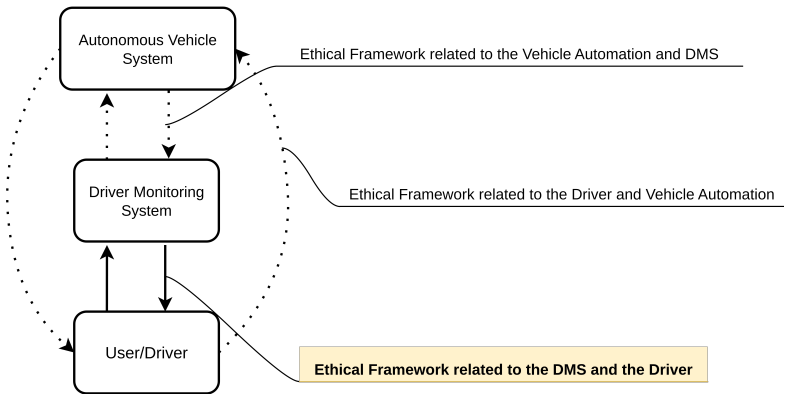
The paper's core contribution is a modular ethical design framework for multimodal Driver Monitoring Systems. This framework takes high-level principles from existing regulations and turns them into practical design elements, such as user-configurable consent mechanisms, fairness-aware model development, transparency and explainability tools, and safeguards for driver emotional well-being. It further provides a risk analysis and failure mitigation strategy focused on incident response and accountability in the DMS context.
What carries the argument
The modular ethical design framework, which structures ethical requirements into separate, implementable modules for consent management, model fairness, system transparency, emotional safeguards, and risk response in driver monitoring.
Load-bearing premise
That identified gaps in regulations can be addressed adequately by applying a modular design framework without the need for new legislation or conflicts with current rules.
What would settle it
Deploying a DMS prototype built according to the framework and submitting it for review under GDPR or the EU AI Act to see if it resolves the identified applicability gaps without additional regulatory changes.
Figures


read the original abstract
As vehicles transition toward higher levels of automation, Driver Monitoring Systems (DMS) have become essential for ensuring human oversight, safety, and regulatory compliance in a vehicle. These systems rely on multimodal sensing and AI-driven inference to assess driver attention, cognitive state, and readiness to take control. While technologically promising, their deployment introduces a complex set of ethical and legal challenges - ranging from privacy and consent to data ownership and algorithmic fairness. While overarching frameworks such as the GDPR, EU AI Act, and IEEE standards offer important guidance, they lack the specificity required for addressing the unique risks posed by in-cabin sensing technologies. This paper adopts a review-to-design perspective, critically examining existing regulatory instruments and ethical frameworks -- such as the GDPR, the EU AI Act, and IEEE guidelines -- and identifying gaps in their applicability to the distinctive risks posed by multimodal, AI-enabled in-cabin monitoring. Building on this review, we propose a modular ethical design framework tailored specifically to Driver Monitoring Systems. The framework translates high-level principles into actionable design and deployment guidance, including user-configurable consent mechanisms, fairness-aware model development, transparency and explainability tools, and safeguards for driver emotional well-being. Finally, the paper outlines a risk analysis and failure mitigation strategy, emphasizing proactive incident response and accountability mechanisms tailored to the DMS context. Together, these contributions aim to inform the development of transparent, trustworthy, and human-centered driver monitoring systems for next-generation autonomous vehicles.
Editorial analysis
A structured set of objections, weighed in public.
Referee Report
Summary. The paper reviews ethical and legal challenges in multimodal Driver Monitoring Systems (DMS) for automated vehicles, identifies gaps in the specificity of GDPR, EU AI Act, and IEEE guidelines for in-cabin sensing risks, and proposes a modular ethical design framework that translates high-level principles into components including user-configurable consent mechanisms, fairness-aware model development, transparency/explainability tools, and emotional well-being safeguards. It concludes with a risk analysis, failure mitigation strategy, and accountability mechanisms for incident response.
Significance. If the framework's components can be shown to resolve the identified regulatory gaps without introducing conflicts or safety trade-offs, the work would offer constructive, actionable guidance for ethical DMS design in autonomous vehicles, helping bridge abstract standards with practical deployment needs in AI ethics and transportation systems.
major comments (2)
- [Proposed modular ethical design framework] In the section proposing the modular ethical design framework (as summarized in the abstract), the claim that components such as user-configurable consent and fairness-aware models adequately address gaps in GDPR and the EU AI Act is not supported by concrete mappings or exception analyses. For instance, no discussion is provided on compatibility with GDPR Article 9 special-category data rules for biometric processing or EU AI Act high-risk obligations for in-cabin monitoring systems, nor on how consent withdrawal would be overridden in safety-critical scenarios without impairing vehicle control.
- [Risk analysis and failure mitigation strategy] The risk analysis and failure mitigation strategy (outlined in the final contribution) presents proactive incident response and accountability mechanisms at a high level but does not include case-specific mappings, compliance checklists, or evaluation criteria to verify that the safeguards prevent the very regulatory conflicts identified earlier in the review.
minor comments (2)
- [Abstract] The abstract would benefit from a brief outline of the paper's section structure to help readers navigate the transition from review to design proposal.
- [Introduction / Background] Terminology such as 'multimodal sensing' and 'in-cabin monitoring' could be defined more precisely on first use to ensure consistency for readers outside the immediate subfield.
Simulated Author's Rebuttal
We thank the referee for their constructive and detailed report. We address each major comment below and commit to revisions that will enhance the specificity and actionability of the proposed framework without altering the manuscript's core contributions.
read point-by-point responses
-
Referee: [Proposed modular ethical design framework] In the section proposing the modular ethical design framework (as summarized in the abstract), the claim that components such as user-configurable consent and fairness-aware models adequately address gaps in GDPR and the EU AI Act is not supported by concrete mappings or exception analyses. For instance, no discussion is provided on compatibility with GDPR Article 9 special-category data rules for biometric processing or EU AI Act high-risk obligations for in-cabin monitoring systems, nor on how consent withdrawal would be overridden in safety-critical scenarios without impairing vehicle control.
Authors: We agree that the current manuscript presents the framework at a conceptual level and lacks explicit mappings to specific regulatory provisions or exception analyses. The modular design is intended to support such adaptations, but the text does not currently demonstrate this through concrete examples. In the revised version, we will insert a dedicated subsection that provides explicit mappings: compatibility with GDPR Article 9 for biometric data processing, alignment with EU AI Act high-risk obligations for in-cabin monitoring, and mechanisms for consent override in safety-critical situations that respect legal exceptions (e.g., public interest and vital interests) while preserving vehicle control integrity. This addition will directly support the claim and address the identified gaps. revision: yes
-
Referee: [Risk analysis and failure mitigation strategy] The risk analysis and failure mitigation strategy (outlined in the final contribution) presents proactive incident response and accountability mechanisms at a high level but does not include case-specific mappings, compliance checklists, or evaluation criteria to verify that the safeguards prevent the very regulatory conflicts identified earlier in the review.
Authors: We acknowledge that the risk analysis and mitigation strategy is currently described at a high level without case-specific illustrations or verification tools. To strengthen this section, we will expand it to include concrete case mappings (e.g., biometric data breach or fairness violations in emotion detection), compliance checklists tied to each framework component, and proposed evaluation criteria such as transparency metrics and accountability audit protocols. These additions will demonstrate how the safeguards mitigate the regulatory conflicts noted in the review. revision: yes
Circularity Check
No circularity: framework is external synthesis with no self-referential reductions
full rationale
The paper performs a review of external instruments (GDPR, EU AI Act, IEEE guidelines) to identify gaps in applicability to multimodal in-cabin sensing, then presents a modular design framework as a direct translation of those high-level principles into components such as consent mechanisms and fairness-aware models. No equations, fitted parameters, self-citations, or uniqueness theorems appear in the provided text; the derivation chain consists of external review followed by independent synthesis rather than any step that reduces by construction to the paper's own inputs or prior outputs. The central proposal therefore remains self-contained against external benchmarks.
Axiom & Free-Parameter Ledger
axioms (1)
- domain assumption Overarching frameworks such as the GDPR, EU AI Act, and IEEE standards offer important guidance but lack the specificity required for addressing the unique risks posed by in-cabin sensing technologies.
invented entities (1)
-
Modular ethical design framework for DMS
no independent evidence
Reference graph
Works this paper leans on
-
[1]
Ac- cessed 10 April
Twitter says its image crops weren’t very biased, but is phasing them out anyhow.https://www.theverge.com/2021/5/19/ 22444372/twitter-image-crop-racial-gender-bias-research. Ac- cessed 10 April
2021
-
[2]
DATA, P.O.P.,
Autonomous vehicles: human factors issues and future research, in: Australasian Road Safety Conference, 1st, 2015, Gold Coast, Queensland, Australia. DATA, P.O.P.,
2015
-
[3]
European New Car Assessment Programme (Euro NCAP)
Euro ncap vision 2030: a safer future for mobility. European New Car Assessment Programme (Euro NCAP) . European Union Agency for Cybersecurity,
2030
-
[4]
Farooq, M.A., Kielty, P., Yao, W., Corcoran, P., 2025a
Advanced techniques and use cases. Farooq, M.A., Kielty, P., Yao, W., Corcoran, P., 2025a. Synadult: Multi- modal synthetic adult dataset generation via diffusion models and neuro- morphic event simulation for critical biometric applications. IEEE Access . Farooq, M.A., Shariff, W., Corcoran, P., 2025b. Thermvision: Exploring flux for synthesizing hyper-r...
-
[5]
IEEE Access 12, 145955– 145967
Joint speech- text embeddings for multitask speech processing. IEEE Access 12, 145955– 145967. doi:10.1109/ACCESS.2024.3473743. Goodfellow, I., Pouget-Abadie, J., Mirza, M., Xu, B., Warde-Farley, D., Ozair, S., Courville, A., Bengio, Y.,
-
[6]
arXiv preprint arXiv:2307.13008
Adap- tation of whisper models to child speech recognition. arXiv preprint arXiv:2307.13008 . Jain, R., Yiwere, M.Y., Bigioi, D., Corcoran, P., Cucu, H.,
-
[7]
A text- to-speech pipeline, evaluation methodology, and initial fine-tuning results for child speech synthesis. IEEE Access 10, 47628–47642. doi:10.1109/ ACCESS.2022.3170836. Jambholkar, M.,
-
[8]
arXiv preprint arXiv:2409.17380
Tesla’s autopilot: Ethics and tragedy. arXiv preprint arXiv:2409.17380 . Johnson, N., Li, Y., Tang, F., Sarker, S.,
-
[9]
Privacy and initial information in automated driving—evaluation of information demands and data sharing concerns, in: 2017 IEEE Intelligent Vehicles Symposium (IV), IEEE. pp. 541–546. Jung, J., Lim, S., Kim, B.K., Lee, S.,
2017
-
[10]
Neuromorphic driver monitoring systems: A proof-of-concept for yawn detection and seatbelt state detection using an event camera. IEEE Access 11, 96363–96373. doi:10.1109/ACCESS.2023.3312190. Koesdwiady, A., Soua, R., Karray, F., Kamel, M.S.,
-
[11]
arXiv preprint arXiv:2408.15388
Panoptic perception for autonomous driving: A survey. arXiv preprint arXiv:2408.15388 . Liu, Y.,
-
[12]
Would i consent if it monitors me better? a technology acceptance com- parison of bci-based and unobtrusive driver monitoring systems, in: 2022 IEEE International Conference on Metrology for Extended Reality, Ar- tificial Intelligence and Neural Engineering (MetroXRAINE), IEEE. pp. 545–550. Regulation, P.,
2022
-
[13]
Real-time multi-task facial analytics with event cameras. IEEE Access 11, 76964–76976. doi:10.1109/ACCESS.2023.3297500. Ryan, C., Murphy, F., Mullins, M.,
-
[14]
IEEE Open Journal of Vehicular Technology 4, 836–848
Neuromorphic driver monitoring systems: A compu- tationally efficient proof-of-concept for driver distraction detection. IEEE Open Journal of Vehicular Technology 4, 836–848. doi:10.1109/OJVT. 2023.3325656. Shariff, W., Dilmaghani, M.S., Kielty, P., Moustafa, M., Lemley, J., Cor- coran, P.,
-
[15]
Event cameras in automotive sensing: A review. IEEE Access 12, 51275–51306. doi:10.1109/ACCESS.2024.3386032. Shelby, R., Rismani, S., Henne, K., Moon, A., Rostamzadeh, N., Nicholas, P., Yilla-Akbari, N., Gallegos, J., Smart, A., Garcia, E., et al.,
-
[16]
Sociotechnicalharmsofalgorithmicsystems: Scopingataxonomyforharm reduction, in: Proceedings of the 2023 AAAI/ACM Conference on AI, Ethics, and Society, pp. 723–741. 45 Sherstinsky, A.,
2023
-
[17]
arXiv preprint arXiv:2103.02162
Predicting driver fatigue in auto- mated driving with explainability. arXiv preprint arXiv:2103.02162 . Zuboff, S.,
discussion (0)
Sign in with ORCID, Apple, or X to comment. Anyone can read and Pith papers without signing in.