Recognition: unknown
Optimizing Social Utility in Sequential Experiments
Pith reviewed 2026-05-08 04:08 UTC · model grok-4.3
The pith
A sequential trial protocol with targeted subsidies lets regulators increase social utility from risky product development by more than 35 percent.
A machine-rendered reading of the paper's core claim, the machinery that carries it, and where it could break.
Core claim
We introduce a statistical protocol for experimentation where the product developer (the agent) conducts a randomized controlled trial sequentially and the regulator (the principal) partially subsidizes its cost. By modeling the protocol using a belief Markov decision process, we show that the agent's optimal strategy can be found efficiently using dynamic programming. Further, we show that the social utility is a piecewise linear and convex function over the subsidy level the principal selects, and thus the socially optimal subsidy can also be found efficiently using divide-and-conquer. Simulation experiments using publicly available data on antibiotic development and approval demonstrate a
What carries the argument
A belief Markov decision process that represents the developer's sequential decisions on whether to continue or stop a trial, solved by dynamic programming for the agent's policy and by convexity analysis to optimize the regulator's subsidy level.
If this is right
- Regulators obtain an efficient algorithm to select the subsidy level that maximizes social utility for any given product profile.
- Developers become willing to pursue more high-uncertainty projects whose expected social value exceeds their private cost.
- Resources are shifted away from low-value products because sequential stopping rules avoid completing expensive trials when interim evidence is weak.
- The same modeling approach can be reused for other regulatory domains that require statistical evidence before approval.
Where Pith is reading between the lines
- If developers receive additional private signals not included in the public belief model, the realized utility gains may be smaller or larger than the simulations predict.
- Allowing the subsidy to depend on interim results rather than being fixed in advance could further increase social utility.
- The piecewise-linear convexity property implies that modest errors in estimating the optimal subsidy produce only small losses, which aids practical implementation.
Load-bearing premise
That real developers update their beliefs and make continuation decisions under uncertainty in the same way the belief Markov decision process assumes.
What would settle it
A direct comparison between the trial-stopping thresholds chosen by actual developers under offered subsidies and the thresholds computed by the dynamic programming solution on the same product parameters.
Figures






read the original abstract
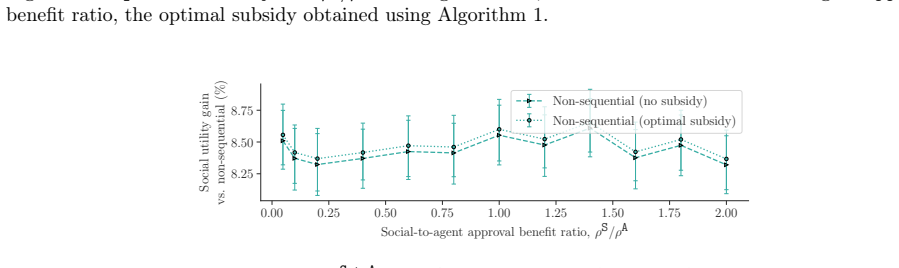
Regulatory approval of products in high-stakes domains such as drug development requires statistical evidence of safety and efficacy through large-scale randomized controlled trials. However, the high financial cost of these trials may deter developers who lack absolute certainty in their product's efficacy, ultimately stifling the development of `moonshot' products that could offer high social utility. To address this inefficiency, in this paper, we introduce a statistical protocol for experimentation where the product developer (the agent) conducts a randomized controlled trial sequentially and the regulator (the principal) partially subsidizes its cost. By modeling the protocol using a belief Markov decision process, we show that the agent's optimal strategy can be found efficiently using dynamic programming. Further, we show that the social utility is a piecewise linear and convex function over the subsidy level the principal selects, and thus the socially optimal subsidy can also be found efficiently using divide-and-conquer. Simulation experiments using publicly available data on antibiotic development and approval demonstrate that our statistical protocol can be used to increase social utility by more than $35$$\%$ relative to standard, non-sequential protocols.
Editorial analysis
A structured set of objections, weighed in public.
Referee Report
Summary. The paper proposes a sequential statistical protocol for high-stakes RCTs (e.g., drug development) in which the developer (agent) runs trials adaptively while the regulator (principal) offers a partial cost subsidy. The interaction is modeled as a belief MDP whose optimal policy is recovered by dynamic programming. The authors prove that social utility is piecewise-linear and convex in the subsidy level, permitting efficient computation of the socially optimal subsidy via divide-and-conquer search. Simulations on public antibiotic-development data are reported to yield more than 35% higher social utility than non-sequential baselines.
Significance. If the convexity result and the simulation protocol are robust, the work supplies a computationally tractable framework for subsidy design that can raise social welfare in regulated innovation settings. The dynamic-programming solution and the divide-and-conquer optimality search are concrete algorithmic contributions; the 35% empirical gain is a falsifiable, policy-relevant claim whose validity rests on the precise definition of social utility and the fidelity of the belief-MDP to developer incentives.
major comments (2)
- [§4] §4 (Simulation Experiments): the reported >35% social-utility gain is stated without an explicit equation or table showing how social utility is computed from the MDP value function, the precise baseline non-sequential protocol, or the antibiotic data parameters (e.g., prior beliefs, cost distributions). This gap prevents verification that the numerical improvement is load-bearing for the central claim.
- [§3.2] §3.2 (Convexity of Social Utility): the proof that social utility is piecewise linear and convex in the subsidy parameter relies on the specific form of the agent's value function and the belief-update rule; if the utility definition or the transition probabilities contain fitted parameters from the same data used in §4, the convexity claim risks circularity that is not addressed.
minor comments (2)
- [Abstract] Abstract: the expression “more than $35$$%” contains a duplicated dollar sign and should be rendered as “more than 35%.”
- Notation: the belief state and the subsidy parameter are introduced without a consolidated table of symbols; a short notation table would improve readability.
Simulated Author's Rebuttal
We thank the referee for their careful reading and constructive comments, which have helped us improve the clarity and verifiability of the manuscript. We address each major comment below and have revised the paper accordingly.
read point-by-point responses
-
Referee: [§4] §4 (Simulation Experiments): the reported >35% social-utility gain is stated without an explicit equation or table showing how social utility is computed from the MDP value function, the precise baseline non-sequential protocol, or the antibiotic data parameters (e.g., prior beliefs, cost distributions). This gap prevents verification that the numerical improvement is load-bearing for the central claim.
Authors: We agree that the simulation section requires additional explicit detail for reproducibility. In the revised manuscript we have inserted Equation (12) defining social utility precisely as the principal's expected value under the optimal policy minus the unsubsidized portion of the agent's cost, together with Table 3 that specifies the baseline non-sequential protocol (fixed-sample-size RCT sized by standard power analysis at α=0.05, β=0.2) and lists all antibiotic-data parameters used (prior Beta(2,5) on efficacy, log-normal cost distribution with parameters taken directly from the public dataset, etc.). These additions permit independent verification of the reported gains. revision: yes
-
Referee: [§3.2] §3.2 (Convexity of Social Utility): the proof that social utility is piecewise linear and convex in the subsidy parameter relies on the specific form of the agent's value function and the belief-update rule; if the utility definition or the transition probabilities contain fitted parameters from the same data used in §4, the convexity claim risks circularity that is not addressed.
Authors: The proof of piecewise linearity and convexity (Theorem 3.2) is structural: it follows from the linearity of the agent's payoff in the subsidy level and the fact that the value function of a finite-horizon belief MDP with finite actions is piecewise linear and convex in the belief state, independent of any particular parameter values. The antibiotic data appear only in §4 as an instantiation for numerical illustration; no parameters are estimated from that data in a manner that enters the transition kernel or utility definition used in the proof. We have added a short clarifying paragraph in §3.2 stating that the result holds for arbitrary valid priors and Bayesian updates. revision: yes
Circularity Check
No circularity: derivations follow from MDP structure and definitions without reduction to inputs
full rationale
The paper defines a belief MDP for the sequential trial protocol, computes the agent's optimal policy via standard dynamic programming, and proves piecewise linearity plus convexity of social utility as a function of the subsidy parameter directly from the value functions and Bellman equations of that MDP. These steps are mathematical consequences of the model construction rather than fitted quantities or self-referential definitions. The divide-and-conquer search for the optimal subsidy follows immediately from the proven convexity. The 35% gain is an out-of-sample simulation result on external public data and does not feed back into the theoretical claims. No self-citations, ansatzes, or uniqueness theorems imported from prior author work appear in the load-bearing chain. The entire derivation chain is therefore self-contained and non-circular.
Axiom & Free-Parameter Ledger
free parameters (1)
- subsidy level
axioms (1)
- domain assumption The decision process of the agent can be accurately modeled as a belief Markov decision process.
Reference graph
Works this paper leans on
-
[1]
The safety and efficacy of new drug approval.Cato J., 5:177, 1985
Dale H Gieringer. The safety and efficacy of new drug approval.Cato J., 5:177, 1985
1985
-
[2]
Food and Drug Administration
U.S. Food and Drug Administration. Demonstrating substantial evidence of effectiveness for human drug and biological products: Guidance for industry. Draft guidance, U.S. Department of Health and Human Services, Food and Drug Administration, Center for Drug Evaluation and Research (CDER), Center for Biologics Evaluation and Research (CBER), December 2019....
2019
-
[3]
Building comparative efficacy and tolerability into the fda approval process.Jama, 303(10):979– 980, 2010
Alec B O’Connor. Building comparative efficacy and tolerability into the fda approval process.Jama, 303(10):979– 980, 2010
2010
-
[4]
Perrine Janiaud, Telba Irony, Estelle Russek-Cohen, and Steven N Goodman. U.S. food and drug administration reasoning in approval decisions when efficacy evidence is borderline, 2013-2018.Ann. Intern. Med., 174(11):1603– 1611, November 2021
2013
-
[5]
Alberto Farina, Federico Moro, Frederick Fasslrinner, Annahita Sedghi, Miluska Bromley, and Timo Siepmann. Strength of clinical evidence leading to approval of novel cancer medicines in europe: A systematic review and data synthesis.Pharmacology Research & Perspectives, 9(4):e00816, 2021
2021
-
[6]
Are clinical trials a cost-effective investment?Jama, 262(13):1795–1800, 1989
Allan S Detsky. Are clinical trials a cost-effective investment?Jama, 262(13):1795–1800, 1989
1989
-
[7]
Why are clinical costs so high?Nature Reviews Drug Discovery, 2(11), 2003
Simon Frantz. Why are clinical costs so high?Nature Reviews Drug Discovery, 2(11), 2003
2003
-
[8]
How much do clinical trials cost?Nature Reviews Drug Discovery, 16(6):381–382, 2017
Linda Martin, Melissa Hutchens, Conrad Hawkins, and Alaina Radnov. How much do clinical trials cost?Nature Reviews Drug Discovery, 16(6):381–382, 2017
2017
-
[9]
Adaptive designs for randomized trials in public health.Annual review of public health, 30(1):1–25, 2009
C Hendricks Brown, Thomas R Ten Have, Booil Jo, Getachew Dagne, Peter A Wyman, Bengt Muthén, and Robert D Gibbons. Adaptive designs for randomized trials in public health.Annual review of public health, 30(1):1–25, 2009. 11
2009
-
[10]
Adaptive design clinical trials: Methodology, challenges and prospect.Indian journal of pharmacology, 42(4):201–207, 2010
Rajiv Mahajan and Kapil Gupta. Adaptive design clinical trials: Methodology, challenges and prospect.Indian journal of pharmacology, 42(4):201–207, 2010
2010
-
[11]
Food and Drug Administration
U.S. Food and Drug Administration. Use of bayesian methodology in clinical trials of drug and biological products. Draft guidance, Center for Biologics Evaluation and Research and Center for Drug Evaluation and Research, Food and Drug Administration, March 2026
2026
-
[12]
https://grants.nih.gov/policy-and-compliance/policy- topics/clinical-trials/specific-funding-opportunities
Clinical trial-specific funding opportunities. https://grants.nih.gov/policy-and-compliance/policy- topics/clinical-trials/specific-funding-opportunities. Accessed: 2026-03-31
2026
-
[13]
Accessed: 2026-03-31
Clinical trials grants program.https://www.fda.gov/industry/orphan-products-grants-program/clinical- trials-grants-program. Accessed: 2026-03-31
2026
-
[14]
Accessed: 2026-03-31
Clinical trials.https://www.dfg.de/en/research-funding/funding-opportunities/programmes/individual/ clinical-trials. Accessed: 2026-03-31
2026
-
[15]
Accessed: 2026-03- 31
The european and developing countries clinical trials partnership.https://www.edctp.org/. Accessed: 2026-03- 31
2026
-
[16]
Principal-agent hypothesis testing.arXiv preprint arXiv:2205.06812, 2022
Stephen Bates, Michael I Jordan, Michael Sklar, and Jake A Soloff. Principal-agent hypothesis testing.arXiv preprint arXiv:2205.06812, 2022
-
[17]
Flora C Shi, Stephen Bates, and Martin J Wainwright. Sharp results for hypothesis testing with risk-sensitive agents.arXiv preprint arXiv:2412.16452, 2024
-
[18]
Strategic hypothesis testing
Safwan Hossain, Yatong Chen, and Yiling Chen. Strategic hypothesis testing. InThe Thirty-Ninth Annual Conference on Neural Information Processing Systems (NeurIPS), 2025
2025
-
[19]
An analysis of the principal-agent problem
Sanford J Grossman and Oliver D Hart. An analysis of the principal-agent problem. InFoundations of insurance economics: Readings in economics and finance, pages 302–340. Springer, 1992
1992
-
[20]
Game-theoretic statistics and safe anytime-valid inference, 2023
Aaditya Ramdas, Peter Grünwald, Vladimir Vovk, and Glenn Shafer. Game-theoretic statistics and safe anytime-valid inference, 2023
2023
-
[21]
Planning and acting in partially observable stochastic domains.Artificial intelligence, 101(1-2):99–134, 1998
Leslie Pack Kaelbling, Michael L Littman, and Anthony R Cassandra. Planning and acting in partially observable stochastic domains.Artificial intelligence, 101(1-2):99–134, 1998
1998
-
[22]
An economic theory of statistical testing
Aleksey Tetenov. An economic theory of statistical testing. CeMMAP working papers 50/16, Institute for Fiscal Studies, Sep 2016
2016
-
[23]
Experimentation and approval mechanisms.Econometrica, 90(5):2215–2247, 2022
Andrew McClellan. Experimentation and approval mechanisms.Econometrica, 90(5):2215–2247, 2022
2022
-
[24]
Safe testing.Journal of the Royal Statistical Society Series B: Statistical Methodology, 86(5):1091–1128, 03 2024
Peter Grünwald, Rianne de Heide, and Wouter Koolen. Safe testing.Journal of the Royal Statistical Society Series B: Statistical Methodology, 86(5):1091–1128, 03 2024
2024
-
[25]
Hypothesis testing with e-values.Foundations and Trends in Statistics, 1(1-2):1–390, 07 2025
Aaditya Ramdas and Ruodu Wang. Hypothesis testing with e-values.Foundations and Trends in Statistics, 1(1-2):1–390, 07 2025
2025
-
[26]
Estimating means of bounded random variables by betting, 2022
Ian Waudby-Smith and Aaditya Ramdas. Estimating means of bounded random variables by betting, 2022
2022
-
[27]
Online multiple testing with e-values
Ziyu Xu and Aaditya Ramdas. Online multiple testing with e-values. In Sanjoy Dasgupta, Stephan Mandt, and Yingzhen Li, editors,Proceedings of The 27th International Conference on Artificial Intelligence and Statistics, volume 238 ofProceedings of Machine Learning Research, pages 3997–4005. PMLR, 02–04 May 2024
2024
-
[28]
E-detectors: A nonparametric framework for sequential change detection.The New England Journal of Statistics in Data Science, 2(2):229–260, 2024
Jaehyeok Shin, Aaditya Ramdas, and Alessandro Rinaldo. E-detectors: A nonparametric framework for sequential change detection.The New England Journal of Statistics in Data Science, 2(2):229–260, 2024
2024
-
[29]
Nonparametric two-sample testing by betting.IEEE Trans
Shubhanshu Shekhar and Aaditya Ramdas. Nonparametric two-sample testing by betting.IEEE Trans. Inf. Theor., 70(2):1178–1203, February 2024
2024
-
[30]
Ian Waudby-Smith, Ricardo Sandoval, and Michael I. Jordan. Universal log-optimality for general classes of e-processes and sequential hypothesis tests, 2025. 12
2025
-
[31]
Post-hoc large-sample statistical inference.arXiv preprint arXiv:2603.08002,
Ben Chugg, Etienne Gauthier, Michael I Jordan, Aaditya Ramdas, and Ian Waudby-Smith. Post-hoc large-sample statistical inference.arXiv preprint arXiv:2603.08002, 2026
-
[32]
Etienne Gauthier, Francis Bach, and Michael I. Jordan. Backward conformal prediction. InThe Thirty-ninth Annual Conference on Neural Information Processing Systems, 2025
2025
-
[33]
Towards anytime-valid statistical watermarking.arXiv preprint arXiv:2602.17608, 2026
Baihe Huang, Eric Xu, Kannan Ramchandran, Jiantao Jiao, and Michael I Jordan. Towards anytime-valid statistical watermarking.arXiv preprint arXiv:2602.17608, 2026
-
[34]
Auditing pay-per-token in large language models
Ander Artola Velasco, Stratis Tsirtsis, and Manuel Gomez Rodriguez. Auditing pay-per-token in large language models. InThe 29th International Conference on Artificial Intelligence and Statistics, 2026
2026
-
[35]
Dhillon, Javier Gonzalez, Teodora Pandeva, and Alicia Curth
Guneet S. Dhillon, Javier Gonzalez, Teodora Pandeva, and Alicia Curth. E-scores for (in)correctness assessment of generative model outputs. InThe 29th International Conference on Artificial Intelligence and Statistics, 2026
2026
-
[36]
Optimal stopping.The American Mathematical Monthly, 77(4):333–343, 1970
Herbert Robbins. Optimal stopping.The American Mathematical Monthly, 77(4):333–343, 1970
1970
-
[37]
Lectures in Mathematics
Goran Peskir and Albert N Shiryaev.Optimal stopping and free-boundary problems. Lectures in Mathematics. ETH Zürich. Birkhauser Verlag AG, Basel, Switzerland, 2006 edition, August 2006
2006
-
[38]
Wiley Series in Probability and Statistics
Warren B Powell and Ilya O Ryzhov.Optimal Learning. Wiley Series in Probability and Statistics. Wiley-Blackwell, Hoboken, NJ, March 2012
2012
-
[39]
Bayesian reinforcement learning: A survey.Foundations and Trends®in Machine Learning, 8(5–6):359–483, November 2015
Mohammad Ghavamzadeh, Shie Mannor, Joelle Pineau, and Aviv Tamar. Bayesian reinforcement learning: A survey.Foundations and Trends®in Machine Learning, 8(5–6):359–483, November 2015
2015
-
[40]
Bayesian learning approach to model predictive control.arXiv preprint arXiv:2203.02720, 2022
Namhoon Cho, Seokwon Lee, Hyo-Sang Shin, and Antonios Tsourdos. Bayesian learning approach to model predictive control.arXiv preprint arXiv:2203.02720, 2022
-
[41]
Minimax-bayes reinforcement learning, 2023
Thomas Kleine Buening, Christos Dimitrakakis, Hannes Eriksson, Divya Grover, and Emilio Jorge. Minimax-bayes reinforcement learning, 2023
2023
-
[42]
Wanggang Shen and Xun Huan. Bayesian sequential optimal experimental design for nonlinear models using policy gradient reinforcement learning.Computer Methods in Applied Mechanics and Engineering, 416:116304, 2023
2023
-
[43]
Optimal stopping for sequential bayesian experimental design.arXiv preprint arXiv:2509.21734, 2025
Chen Cheng and Xun Huan. Optimal stopping for sequential bayesian experimental design.arXiv preprint arXiv:2509.21734, 2025
-
[44]
Variational sequential optimal experimental design using reinforcement learning.Comput
Wanggang Shen, Jiayuan Dong, and Xun Huan. Variational sequential optimal experimental design using reinforcement learning.Comput. Methods Appl. Mech. Eng., 444(118068):118068, September 2025
2025
-
[45]
A. Wald. Sequential Tests of Statistical Hypotheses.The Annals of Mathematical Statistics, 16(2):117 – 186, 1945
1945
-
[46]
de la Peña
Victor H. de la Peña. A General Class of Exponential Inequalities for Martingales and Ratios.The Annals of Probability, 27(1):537 – 564, 1999
1999
-
[47]
Howard, Aaditya Ramdas, Jon McAuliffe, and Jasjeet Sekhon
Steven R. Howard, Aaditya Ramdas, Jon McAuliffe, and Jasjeet Sekhon. Time-uniform Chernoff bounds via nonnegative supermartingales.Probability Surveys, 17(none):257 – 317, 2020
2020
-
[48]
A systematic review and critical assessment of incentive strategies for discovery and development of novel antibiotics.J
Matthew J Renwick, David M Brogan, and Elias Mossialos. A systematic review and critical assessment of incentive strategies for discovery and development of novel antibiotics.J. Antibiot. (Tokyo), 69(2):73–88, February 2016
2016
-
[49]
Government r&d subsidies and enterprise r&d activities: theory and evidence
Wan-Shu Wu and Kai Zhao. Government r&d subsidies and enterprise r&d activities: theory and evidence. Economic Research-Ekonomska Istraživanja, 35(1):391–408, 2022
2022
-
[50]
Bayesian decision theory, rule utilitarianism, and arrow’s impossibility theorem.Theory and Decision, 11(3):289–317, 1979
John C Harsanyi. Bayesian decision theory, rule utilitarianism, and arrow’s impossibility theorem.Theory and Decision, 11(3):289–317, 1979. 13
1979
-
[51]
Sutton and Andrew G
Richard S. Sutton and Andrew G. Barto.Reinforcement Learning: An Introduction. The MIT Press, second edition, 2018
2018
-
[52]
A tutorial on thompson sampling, 2020
Daniel Russo, Benjamin Van Roy, Abbas Kazerouni, Ian Osband, and Zheng Wen. A tutorial on thompson sampling, 2020
2020
-
[53]
Springer, Berlin, Germany, 2011 edition, August 2010
Heinrich von Stackelberg.Market Structure and Equilibrium. Springer, Berlin, Germany, 2011 edition, August 2010
2011
-
[54]
Congress
U.S. Congress. 26 U.S.C. 45C — clinical testing expenses for certain drugs for rare diseases or conditions. Internal Revenue Code, 2024. Accessed: 2026-05-03
2024
-
[55]
Small business funding.https://seed.nih.gov/small-business-funding, 2026
National Institutes of Health. Small business funding.https://seed.nih.gov/small-business-funding, 2026. Accessed: 2026-05-03
2026
-
[56]
Springer New York, 1996
Onésimo Hernández-Lerma and Jean Bernard Lasserre.Discrete-Time Markov Control Processes. Springer New York, 1996
1996
-
[57]
Computing the optimal strategy to commit to
Vincent Conitzer and Tuomas Sandholm. Computing the optimal strategy to commit to. InProceedings of the 7th ACM Conference on Electronic Commerce, EC ’06, page 82–90, New York, NY, USA, 2006. Association for Computing Machinery
2006
-
[58]
Playing games for security: An efficient exact algorithm for solving bayesian stackelberg games
Praveen Paruchuri, Jonathan P Pearce, Janusz Marecki, Milind Tambe, Fernando Ordonez, and Sarit Kraus. Playing games for security: An efficient exact algorithm for solving bayesian stackelberg games. InProceedings of the 7th international joint conference on Autonomous agents and multiagent systems-Volume 2, pages 895–902, 2008
2008
-
[59]
Global burden of bacterial antimicrobial resistance 1990-2021: a systematic analysis with forecasts to 2050.Lancet, 404(10459):1199–1226, September 2024
GBD 2021 Antimicrobial Resistance Collaborators. Global burden of bacterial antimicrobial resistance 1990-2021: a systematic analysis with forecasts to 2050.Lancet, 404(10459):1199–1226, September 2024
2021
-
[60]
Tackling the threat of antimicrobial resistance: from policy to sustainable action.Philos
Laura J Shallcross, Simon J Howard, Tom Fowler, and Sally C Davies. Tackling the threat of antimicrobial resistance: from policy to sustainable action.Philos. Trans. R. Soc. Lond. B Biol. Sci., 370(1670):20140082, June 2015
2015
-
[61]
Approval and withdrawal of new antibiotics and other antiinfectives in the U.S., 1980-2009.J
Kevin Outterson, John H Powers, Enrique Seoane-Vazquez, Rosa Rodriguez-Monguio, and Aaron S Kesselheim. Approval and withdrawal of new antibiotics and other antiinfectives in the U.S., 1980-2009.J. Law Med. Ethics, 41(3):688–696, 2013
1980
-
[62]
The economic conundrum for antibacterial drugs.Antimicrob
David M Shlaes. The economic conundrum for antibacterial drugs.Antimicrob. Agents Chemother., 64(1), December 2019
2019
-
[63]
Current economic and regulatory challenges in developing antibiotics for gram-negative bacteria.NPJ Antimicrob
Nupur Gargate, Mark Laws, and Khondaker Miraz Rahman. Current economic and regulatory challenges in developing antibiotics for gram-negative bacteria.NPJ Antimicrob. Resist., 3(1):50, June 2025
2025
-
[64]
Why big pharma has abandoned antibiotics.Nature, 586(7830):S50–S52, October 2020
Benjamin Plackett. Why big pharma has abandoned antibiotics.Nature, 586(7830):S50–S52, October 2020
2020
-
[65]
Looking for solutions to the pitfalls of developing novel antibacterials in an economically challenging system.Microbiol
Gilles Courtemanche, Rohini Wadanamby, Amritanjali Kiran, Luisa Fernanda Toro-Alzate, Mathew Diggle, Dipanjan Chakraborty, Ariel Blocker, and Maarten van Dongen. Looking for solutions to the pitfalls of developing novel antibacterials in an economically challenging system.Microbiol. Res. (Pavia), 12(1):173–185, March 2021
2021
-
[66]
Advancing global antibiotic research, development and access.Nat
Laura J V Piddock, Yewande Alimi, James Anderson, Damiano de Felice, Catrin E Moore, John-Arne Røttingen, Henry Skinner, and Peter Beyer. Advancing global antibiotic research, development and access.Nat. Med., 30(9):2432–2443, September 2024
2024
-
[67]
Novel insights from financial analysis of the failure to commercialise plazomicin: Implications for the antibiotic investment ecosystem.Humanit
Nadya Wells, Vinh-Kim Nguyen, and Stephan Harbarth. Novel insights from financial analysis of the failure to commercialise plazomicin: Implications for the antibiotic investment ecosystem.Humanit. Soc. Sci. Commun., 11(1), July 2024
2024
-
[68]
Accelerating global innovation to address antibacterial resistance: introducing CARB-X.Nat
Kevin Outterson, John H Rex, Tim Jinks, Peter Jackson, John Hallinan, Steve Karp, Deborah T Hung, Francois Franceschi, Tyler Merkeley, Christopher Houchens, Dennis M Dixon, Michael G Kurilla, Rosemarie Aurigemma, and Joseph Larsen. Accelerating global innovation to address antibacterial resistance: introducing CARB-X.Nat. Rev. Drug Discov., 15(9):589–590,...
2016
-
[69]
Challenges and opportunities for incentivising antibiotic research and development in europe.Lancet Reg
Michael Anderson, Dimitra Panteli, Robin van Kessel, Gunnar Ljungqvist, Francesca Colombo, and Elias Mossialos. Challenges and opportunities for incentivising antibiotic research and development in europe.Lancet Reg. Health Eur., 33(100705):100705, October 2023
2023
-
[70]
United States Congress. H.R. 7352: PASTEUR Act of 2026, 2026. To amend the Public Health Service Act to establish a program to develop innovative antimicrobial drugs
2026
-
[71]
Market concentration of new antibiotic sales
Sakib Rahman, Olof Lindahl, Chantal M Morel, and Aidan Hollis. Market concentration of new antibiotic sales. J. Antibiot. (Tokyo), 74(6):421–423, June 2021
2021
-
[72]
Cost drivers of a hospital-acquired bacterial pneumonia and ventilator- associated bacterial pneumonia phase 3 clinical trial.Clin
Stella Stergiopoulos, Sara B Calvert, Carrie A Brown, Josephine Awatin, Pamela Tenaerts, Thomas L Holland, Joseph A DiMasi, and Kenneth A Getz. Cost drivers of a hospital-acquired bacterial pneumonia and ventilator- associated bacterial pneumonia phase 3 clinical trial.Clin. Infect. Dis., 66(1):72–80, January 2018
2018
-
[73]
Estimated costs of pivotal trials for novel therapeutic agents approved by the US food and drug administration, 2015-2016.JAMA Intern
Thomas J Moore, Hanzhe Zhang, Gerard Anderson, and G Caleb Alexander. Estimated costs of pivotal trials for novel therapeutic agents approved by the US food and drug administration, 2015-2016.JAMA Intern. Med., 178(11):1451–1457, November 2018
2015
-
[74]
Instance-adaptive hypothesis tests with heterogeneous agents.arXiv preprint arXiv:2510.21178, 2025
Flora C Shi, Martin J Wainwright, and Stephen Bates. Instance-adaptive hypothesis tests with heterogeneous agents.arXiv preprint arXiv:2510.21178, 2025
-
[75]
Campbell, N Balakrishnan, and Brani Vidakovic.Encyclopedia of statistical sciences
B. Campbell, N Balakrishnan, and Brani Vidakovic.Encyclopedia of statistical sciences. Methods and Applications of Statistics. John Wiley & Sons, Nashville, TN, 2 edition, December 2005
2005
-
[76]
False-positive psychology: undisclosed flexibility in data collection and analysis allows presenting anything as significant.Psychol
Joseph P Simmons, Leif D Nelson, and Uri Simonsohn. False-positive psychology: undisclosed flexibility in data collection and analysis allows presenting anything as significant.Psychol. Sci., 22(11):1359–1366, November 2011
2011
-
[77]
Etienne Gauthier, Francis Bach, and Michael I. Jordan. Betting on equilibrium: Monitoring strategic behavior in multi-agent systems, 2026
2026
-
[78]
Ville.Étude Critique de la Notion de Collectif
J. Ville.Étude Critique de la Notion de Collectif. Collection des monographies des probabilités. Gauthier-Villars, 1939
1939
-
[79]
RejectH0
R.T. Rockafellar.Convex Analysis. Princeton landmarks in mathematics and physics. Princeton University Press, 1970. 15 A Summary of Notation In Table 1 we summarize the key symbols used in the main body of the paper. Table 1:Summary of notation. Symbol Description κPrincipal’s false positive rate bound θ∗ True (unknown) product efficacy θb Baseline effica...
1970
-
[80]
IfA L =A R, then ¯U A(πε;ε) =V 0 L +ε·A L for allε∈[ε L, εR]
discussion (0)
Sign in with ORCID, Apple, or X to comment. Anyone can read and Pith papers without signing in.