Recognition: unknown
UniSD: Towards a Unified Self-Distillation Framework for Large Language Models
Pith reviewed 2026-05-08 09:52 UTC · model grok-4.3
The pith
A unified framework makes self-distillation a reliable way to adapt large language models without stronger teachers.
A machine-rendered reading of the paper's core claim, the machinery that carries it, and where it could break.
Core claim
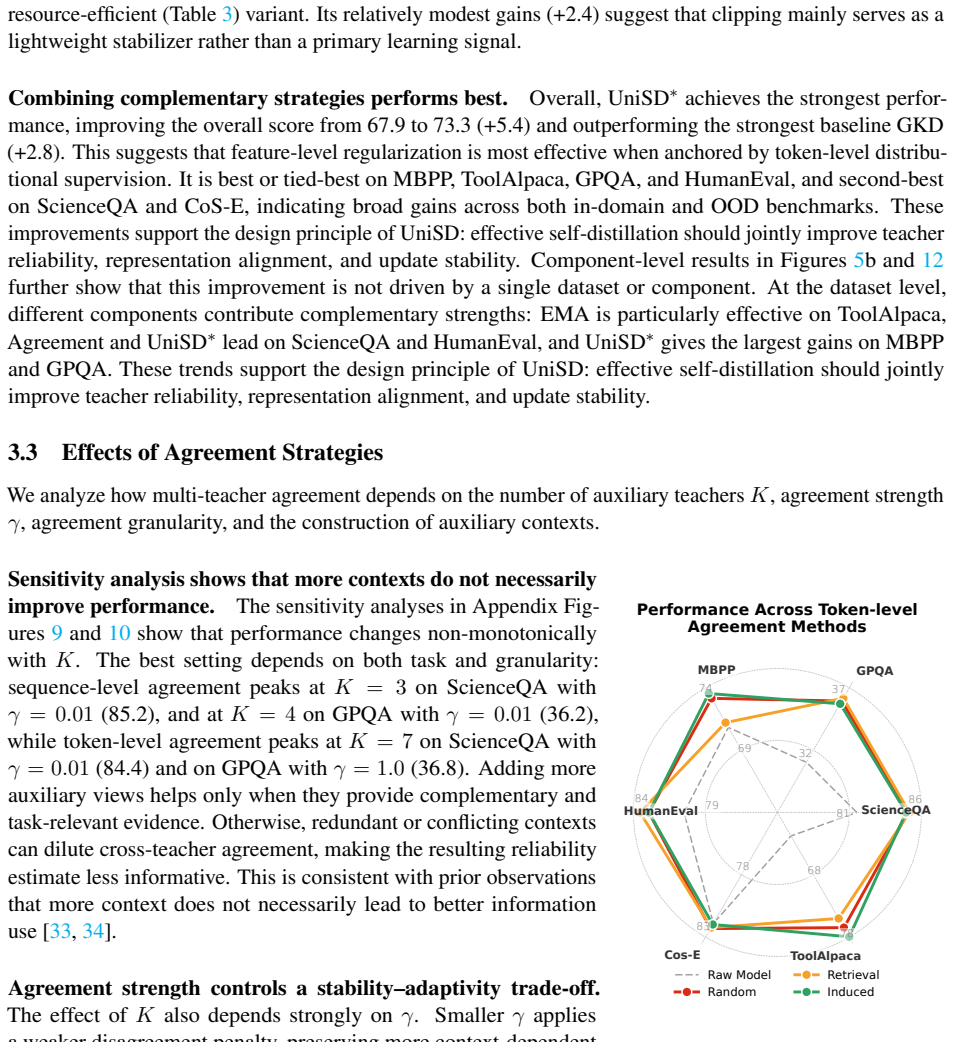
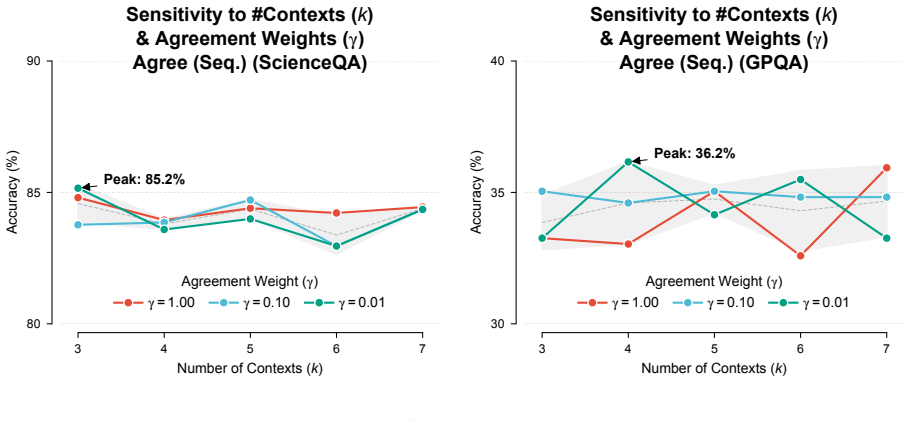
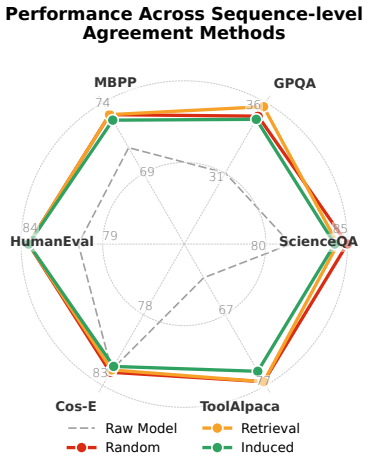
UniSD integrates multi-teacher agreement, EMA teacher stabilization, token-level contrastive learning, feature matching, and divergence clipping to address supervision reliability, representation alignment, and training stability in self-distillation for LLMs. Guided by analysis of component roles and interactions, the UniSDfull pipeline achieves the strongest results, with improvements of 5.4 points over the base model and 2.8 points over the strongest baseline across six benchmarks and six models from three families.
What carries the argument
The UniSD unified framework that combines complementary mechanisms for handling free-form self-generated trajectories in self-distillation.
If this is right
- Self-distillation can outperform static imitation when stabilization and alignment components are included.
- The choice of components determines gains on different tasks and model families.
- Combining the mechanisms yields the highest overall performance improvements.
- Analysis reveals the conditions under which self-distillation provides benefits.
Where Pith is reading between the lines
- Adopting this approach could allow smaller teams to adapt large models using only their own compute resources.
- Similar unification strategies might apply to other areas where self-supervised signals are noisy.
- Further work could test if these gains hold when scaling to models with billions more parameters.
- The insights on component interactions could guide design of future distillation methods.
Load-bearing premise
The individual mechanisms address instability in self-generated supervision and their benefits combine additively without hidden selection effects in the experiments.
What would settle it
Testing the UniSDfull pipeline on a new benchmark suite or model family where it fails to exceed the strongest baseline by a similar margin would indicate the gains are not general.
Figures






read the original abstract
Self-distillation (SD) offers a promising path for adapting large language models (LLMs) without relying on stronger external teachers. However, SD in autoregressive LLMs remains challenging because self-generated trajectories are free-form, correctness is task-dependent, and plausible rationales can still provide unstable or unreliable supervision. Existing methods mainly examine isolated design choices, leaving their effectiveness, roles, and interactions unclear. In this paper, we propose UniSD, a unified framework to systematically study self-distillation. UniSD integrates complementary mechanisms that address supervision reliability, representation alignment, and training stability, including multi-teacher agreement, EMA teacher stabilization, token-level contrastive learning, feature matching, and divergence clipping. Across six benchmarks and six models from three model families, UniSD reveals when self-distillation improves over static imitation, which components drive the gains, and how these components interact across tasks. Guided by these insights, we construct UniSDfull, an integrated pipeline that combines complementary components and achieves the strongest overall performance, improving over the base model by +5.4 points and the strongest baseline by +2.8 points. Extensive evaluation highlights self-distillation as a practical and steerable approach for efficient LLM adaptation without stronger external teachers.
Editorial analysis
A structured set of objections, weighed in public.
Referee Report
Summary. The paper proposes UniSD, a unified self-distillation framework for large language models that integrates mechanisms including multi-teacher agreement, EMA teacher stabilization, token-level contrastive learning, feature matching, and divergence clipping to improve supervision reliability, representation alignment, and training stability in autoregressive LLMs using self-generated trajectories. Through experiments across six benchmarks and six models from three families, it analyzes component effectiveness and interactions, and presents UniSDfull—an integrated pipeline—as achieving the strongest performance with +5.4 points over the base model and +2.8 over the strongest baseline.
Significance. If the gains hold after addressing assembly concerns, the work would be significant for demonstrating self-distillation as a practical, steerable method for efficient LLM adaptation without external teachers. Credit is due to the broad evaluation spanning multiple model families and tasks, which supports claims about generalizability and when self-distillation outperforms static imitation.
major comments (1)
- [Abstract] Abstract: The construction of UniSDfull 'guided by these insights' from component studies performed on the same six benchmarks risks post-hoc selection bias; without pre-specification of the exact combination of the five mechanisms or reporting of all enumerated subsets, the reported +5.4 and +2.8 point gains cannot be confidently attributed to reliable complementarity rather than selection on the evaluation data.
minor comments (2)
- The reported performance metrics lack error bars, standard deviations, or details on the number of runs, making it difficult to assess the statistical reliability of the improvements.
- Baseline definitions and implementation details (e.g., how static imitation and other self-distillation methods are instantiated) should be expanded for reproducibility.
Simulated Author's Rebuttal
We thank the referee for the detailed feedback and for highlighting the potential for post-hoc selection bias in the construction of UniSDfull. We address this concern directly below and commit to revisions that increase transparency around the component selection process.
read point-by-point responses
-
Referee: [Abstract] Abstract: The construction of UniSDfull 'guided by these insights' from component studies performed on the same six benchmarks risks post-hoc selection bias; without pre-specification of the exact combination of the five mechanisms or reporting of all enumerated subsets, the reported +5.4 and +2.8 point gains cannot be confidently attributed to reliable complementarity rather than selection on the evaluation data.
Authors: We agree that the current presentation leaves room for this interpretation. The component ablations were performed to identify which mechanisms provide complementary benefits across tasks and models, and UniSDfull was assembled from those showing consistent positive interactions rather than from exhaustive enumeration of all 2^5 subsets. To strengthen the claim, the revised manuscript will (1) explicitly state the selection criteria (average improvement across all six benchmarks and six models), (2) add a table reporting performance for the key partial combinations explored during development, and (3) include a brief discussion of the risk of evaluation-set overfitting with the mitigation steps taken (multi-model, multi-task evaluation). These additions will allow readers to judge the robustness of the reported gains independently. revision: yes
Circularity Check
No significant circularity in empirical framework
full rationale
The paper presents an empirical study proposing UniSD as a unified self-distillation framework for LLMs, integrating mechanisms like multi-teacher agreement and EMA stabilization, then evaluating performance across six benchmarks and six models. No mathematical derivation chain, equations, or predictions exist that reduce by construction to fitted inputs or self-definitions. The assembly of UniSDfull is described as guided by component insights from experiments, which is standard empirical practice rather than a self-referential loop. No load-bearing self-citations, uniqueness theorems, or ansatzes are invoked in a manner that creates circularity per the defined patterns. The work is self-contained against external benchmarks.
Axiom & Free-Parameter Ledger
Reference graph
Works this paper leans on
-
[1]
Visual instruction tuning.NeurIPS, 36:34892–34916, 2023
Haotian Liu, Chunyuan Li, Qingyang Wu, and Yong Jae Lee. Visual instruction tuning.NeurIPS, 36:34892–34916, 2023
2023
-
[2]
Alpaca: A strong, replicable instruction-following model.Stanford Center for Research on Foundation Models
Rohan Taori, Ishaan Gulrajani, Tianyi Zhang, Yann Dubois, Xuechen Li, Carlos Guestrin, Percy Liang, and Tatsunori B Hashimoto. Alpaca: A strong, replicable instruction-following model.Stanford Center for Research on Foundation Models. https://crfm. stanford. edu/2023/03/13/alpaca. html, 3(6):7, 2023
2023
-
[3]
Visual program distillation: Distilling tools and programmatic reasoning into vision-language models
Yushi Hu, Otilia Stretcu, Chun-Ta Lu, Krishnamurthy Viswanathan, Kenji Hata, Enming Luo, Ranjay Krishna, and Ariel Fuxman. Visual program distillation: Distilling tools and programmatic reasoning into vision-language models. InCVPR, pages 9590–9601, 2024
2024
-
[4]
DeepSeekMath: Pushing the Limits of Mathematical Reasoning in Open Language Models
Zhihong Shao, Peiyi Wang, Qihao Zhu, Runxin Xu, Junxiao Song, Xiao Bi, Haowei Zhang, Mingchuan Zhang, YK Li, Yang Wu, et al. Deepseekmath: Pushing the limits of mathematical reasoning in open language models.arXiv:2402.03300, 2024
work page internal anchor Pith review arXiv 2024
-
[5]
Simpo: Simple preference optimization with a reference-free reward.NeurIPS, 37:124198–124235, 2024
Yu Meng, Mengzhou Xia, and Danqi Chen. Simpo: Simple preference optimization with a reference-free reward.NeurIPS, 37:124198–124235, 2024
2024
-
[6]
An Yang, Anfeng Li, Baosong Yang, Beichen Zhang, Binyuan Hui, Bo Zheng, Bowen Yu, Chang Gao, Chengen Huang, Chenxu Lv, et al. Qwen3 technical report.arXiv:2505.09388, 2025
work page internal anchor Pith review arXiv 2025
-
[7]
Distilling the Knowledge in a Neural Network
Geoffrey Hinton, Oriol Vinyals, and Jeff Dean. Distilling the knowledge in a neural network. arXiv:1503.02531, 2015
work page internal anchor Pith review arXiv 2015
-
[8]
Gpt4all: An ecosystem of open source compressed language models
Yuvanesh Anand, Zach Nussbaum, Adam Treat, Aaron Miller, Richard Guo, Benjamin Schmidt, Brandon Duderstadt, and Andriy Mulyar. Gpt4all: An ecosystem of open source compressed language models. InNLP-OSS Workshop, pages 59–64, 2023
2023
-
[9]
Agentark: Distilling multi-agent intelligence into a single llm agent
Yinyi Luo, Yiqiao Jin, Weichen Yu, Mengqi Zhang, Srijan Kumar, Xiaoxiao Li, Weijie Xu, Xin Chen, and Jindong Wang. Agentark: Distilling multi-agent intelligence into a single llm agent. arXiv:2602.03955, 2026. 11
-
[10]
Self-Distillation Enables Continual Learning
Idan Shenfeld, Mehul Damani, Jonas Hübotter, and Pulkit Agrawal. Self-distillation enables continual learning.arXiv preprint arXiv:2601.19897, 2026
work page internal anchor Pith review arXiv 2026
-
[11]
Caixia Yan, Xiaojun Chang, Minnan Luo, Huan Liu, Xiaoqin Zhang, and Qinghua Zheng
Xiaohan Xu, Ming Li, Chongyang Tao, Tao Shen, Reynold Cheng, Jinyang Li, Can Xu, Dacheng Tao, and Tianyi Zhou. A survey on knowledge distillation of large language models.arXiv:2402.13116, 2024
-
[12]
Companioncast: A multi-agent conversational ai framework with spatial audio for social co-viewing experiences.ACM CHI 2026 Workshop on Human-Agent Collaboration, 2026
Yiyang Wang, Chen Chen, Tica Lin, Vishnu Raj, Josh Kimball, Alex Cabral, and Josiah Hester. Companioncast: A multi-agent conversational ai framework with spatial audio for social co-viewing experiences.ACM CHI 2026 Workshop on Human-Agent Collaboration, 2026
2026
-
[13]
Harnessing the wisdom of the inner crowd.Trends in cognitive sciences, 18(10):504–506, 2014
Stefan M Herzog and Ralph Hertwig. Harnessing the wisdom of the inner crowd.Trends in cognitive sciences, 18(10):504–506, 2014
2014
-
[14]
Instruction induction: From few examples to natural language task descriptions
Or Honovich, Uri Shaham, Samuel Bowman, and Omer Levy. Instruction induction: From few examples to natural language task descriptions. InACL, pages 1935–1952, 2023
1935
-
[15]
Wordnet: a lexical database for english.Communications of the ACM, 38(11):39–41, 1995
George A Miller. Wordnet: a lexical database for english.Communications of the ACM, 38(11):39–41, 1995
1995
-
[16]
Ppdb: The paraphrase database
Juri Ganitkevitch, Benjamin Van Durme, and Chris Callison-Burch. Ppdb: The paraphrase database. In NAACL, pages 758–764, 2013
2013
-
[17]
Textattack: A framework for adversarial attacks, data augmentation, and adversarial training in nlp
John Morris, Eli Lifland, Jin Yong Yoo, Jake Grigsby, Di Jin, and Yanjun Qi. Textattack: A framework for adversarial attacks, data augmentation, and adversarial training in nlp. InEMNLP, pages 119–126, 2020
2020
-
[18]
Less is more: Task-aware layer-wise distillation for language model compression
Chen Liang, Simiao Zuo, Qingru Zhang, Pengcheng He, Weizhu Chen, and Tuo Zhao. Less is more: Task-aware layer-wise distillation for language model compression. InICML, pages 20852–20867. PMLR, 2023
2023
-
[19]
Minilmv2: Multi-head self- attention relation distillation for compressing pretrained transformers
Wenhui Wang, Hangbo Bao, Shaohan Huang, Li Dong, and Furu Wei. Minilmv2: Multi-head self- attention relation distillation for compressing pretrained transformers. InACL, pages 2140–2151, 2021
2021
-
[20]
On-policy distillation of language models: Learning from self-generated mistakes
Rishabh Agarwal, Nino Vieillard, Yongchao Zhou, Piotr Stanczyk, Sabela Ramos Garea, Matthieu Geist, and Olivier Bachem. On-policy distillation of language models: Learning from self-generated mistakes. InICLR, 2024
2024
-
[21]
Ruixiang Zhang, Richard He Bai, Huangjie Zheng, Navdeep Jaitly, Ronan Collobert, and Yizhe Zhang. Embarrassingly simple self-distillation improves code generation.arXiv:2604.01193, 2026
-
[22]
Self-Distilled Reasoner: On-Policy Self-Distillation for Large Language Models
Siyan Zhao, Zhihui Xie, Mengchen Liu, Jing Huang, Guan Pang, Feiyu Chen, and Aditya Grover. Self-distilled reasoner: On-policy self-distillation for large language models.arXiv preprint arXiv:2601.18734, 2026
work page internal anchor Pith review arXiv 2026
-
[23]
Learn to explain: Multimodal reasoning via thought chains for science question answering
Pan Lu, Swaroop Mishra, Tony Xia, Liang Qiu, Kai-Wei Chang, Song-Chun Zhu, Oyvind Tafjord, Peter Clark, and Ashwin Kalyan. Learn to explain: Multimodal reasoning via thought chains for science question answering. InNeurIPS, 2022
2022
-
[24]
Gpqa: A graduate-level google-proof q&a benchmark
David Rein, Betty Li Hou, Asa Cooper Stickland, Jackson Petty, Richard Yuanzhe Pang, Julien Dirani, Julian Michael, and Samuel R Bowman. Gpqa: A graduate-level google-proof q&a benchmark. In COLM, 2024
2024
-
[25]
Explain yourself! leveraging language models for commonsense reasoning
Nazneen Fatema Rajani, Bryan McCann, Caiming Xiong, and Richard Socher. Explain yourself! leveraging language models for commonsense reasoning. InACL, pages 4932–4942, 2019. 12
2019
-
[26]
Commonsenseqa: A question answering challenge targeting commonsense knowledge
Alon Talmor, Jonathan Herzig, Nicholas Lourie, and Jonathan Berant. Commonsenseqa: A question answering challenge targeting commonsense knowledge. InNAACL, pages 4149–4158, 2019
2019
-
[27]
Program Synthesis with Large Language Models
Jacob Austin, Augustus Odena, Maxwell Nye, Maarten Bosma, Henryk Michalewski, David Dohan, Ellen Jiang, Carrie Cai, Michael Terry, Quoc Le, et al. Program synthesis with large language models. arXiv:2108.07732, 2021
work page internal anchor Pith review arXiv 2021
-
[28]
Evaluating Large Language Models Trained on Code
Mark Chen, Jerry Tworek, Heewoo Jun, Qiming Yuan, Henrique Ponde De Oliveira Pinto, Jared Kaplan, Harri Edwards, Yuri Burda, Nicholas Joseph, Greg Brockman, et al. Evaluating large language models trained on code.arXiv:2107.03374, 2021
work page internal anchor Pith review arXiv 2021
-
[29]
Toolalpaca: Generalized tool learning for language models with 3000 simulated cases
Qiaoyu Tang, Ziliang Deng, Hongyu Lin, Xianpei Han, Qiao Liang, Boxi Cao, and Le Sun. Toolalpaca: Generalized tool learning for language models with 3000 simulated cases.arXiv:2306.05301, 2023
-
[30]
Qwen2.5: A party of foundation models, September 2024
Qwen Team. Qwen2.5: A party of foundation models, September 2024
2024
-
[31]
Abhimanyu Dubey, Abhinav Jauhri, Abhinav Pandey, Abhishek Kadian, Ahmad Al-Dahle, Aiesha Letman, Akhil Mathur, Alan Schelten, Amy Yang, Angela Fan, et al. The llama 3 herd of models. arXiv:2407.21783, 2024
work page internal anchor Pith review arXiv 2024
-
[32]
Gemma Team, Aishwarya Kamath, Johan Ferret, Shreya Pathak, Nino Vieillard, Ramona Merhej, Sarah Perrin, Tatiana Matejovicova, Alexandre Ramé, Morgane Rivière, et al. Gemma 3 technical report. arXiv:2503.19786, 2025
work page internal anchor Pith review arXiv 2025
-
[33]
How context affects language models’ factual predictions
Fabio Petroni, Patrick Lewis, Aleksandra Piktus, Tim Rocktäschel, Yuxiang Wu, Alexander H Miller, and Sebastian Riedel. How context affects language models’ factual predictions. InAKBC, 2020
2020
-
[34]
Lost in the middle: How language models use long contexts.TACL, 12:157–173, 2024
Nelson F Liu, Kevin Lin, John Hewitt, Ashwin Paranjape, Michele Bevilacqua, Fabio Petroni, and Percy Liang. Lost in the middle: How language models use long contexts.TACL, 12:157–173, 2024
2024
-
[35]
Federated continual learning via knowledge fusion: A survey.TKDE, 36(8):3832–3850, 2024
Xin Yang, Hao Yu, Xin Gao, Hao Wang, Junbo Zhang, and Tianrui Li. Federated continual learning via knowledge fusion: A survey.TKDE, 36(8):3832–3850, 2024
2024
-
[36]
Catastrophic interference in connectionist networks: The sequential learning problem
Michael McCloskey and Neal J Cohen. Catastrophic interference in connectionist networks: The sequential learning problem. InPsychology of learning and motivation, volume 24, pages 109–165. Elsevier, 1989
1989
-
[37]
A comprehensive survey of continual learning: Theory, method and application.TPAMI, 46(8):5362–5383, 2024
Liyuan Wang, Xingxing Zhang, Hang Su, and Jun Zhu. A comprehensive survey of continual learning: Theory, method and application.TPAMI, 46(8):5362–5383, 2024
2024
-
[38]
Mascot: Towards multi-agent socio- collaborative companion systems.arXiv:2601.14230, 2026
Yiyang Wang, Yiqiao Jin, Alex Cabral, and Josiah Hester. Mascot: Towards multi-agent socio- collaborative companion systems.arXiv:2601.14230, 2026
-
[39]
A Survey of On-Policy Distillation for Large Language Models
Mingyang Song and Mao Zheng. A survey of on-policy distillation for large language models. arXiv:2604.00626, 2026
work page internal anchor Pith review arXiv 2026
-
[40]
Minillm: Knowledge distillation of large language models
Yuxian Gu, Li Dong, Furu Wei, and Minlie Huang. Minillm: Knowledge distillation of large language models. InICLR, 2024
2024
-
[41]
Distillm: Towards streamlined distillation for large language models
Jongwoo Ko, Sungnyun Kim, Tianyi Chen, and Se-Young Yun. Distillm: Towards streamlined distillation for large language models. InICML, 2024
2024
-
[42]
Entropy-aware on-policy distillation of language models
Woogyeol Jin, Taywon Min, Yongjin Yang, Swanand Ravindra Kadhe, Yi Zhou, Dennis Wei, Nathalie Baracaldo, and Kimin Lee. Entropy-aware on-policy distillation of language models.arXiv:2603.07079, 2026. 13
-
[43]
Zhide Zhong, Haodong Yan, Junfeng Li, Junjie He, Tianran Zhang, and Haoang Li. Vla-opd: Bridging offline sft and online rl for vision-language-action models via on-policy distillation.arXiv:2603.26666, 2026
-
[44]
SCOPE: Signal-Calibrated On-Policy Distillation Enhancement with Dual-Path Adaptive Weighting
Binbin Zheng, Xing Ma, Yiheng Liang, Jingqing Ruan, Xiaoliang Fu, Kepeng Lin, Benchang Zhu, Ke Zeng, and Xunliang Cai. Scope: Signal-calibrated on-policy distillation enhancement with dual-path adaptive weighting.arXiv:2604.10688, 2026
work page internal anchor Pith review Pith/arXiv arXiv 2026
-
[45]
Demystifying OPD: Length Inflation and Stabilization Strategies for Large Language Models
Feng Luo, Yu-Neng Chuang, Guanchu Wang, Zicheng Xu, Xiaotian Han, Tianyi Zhang, and Vladimir Braverman. Demystifying opd: Length inflation and stabilization strategies for large language models. arXiv:2604.08527, 2026
work page internal anchor Pith review Pith/arXiv arXiv 2026
-
[46]
Reinforcement Learning via Self-Distillation
Jonas Hübotter, Frederike Lübeck, Lejs Behric, Anton Baumann, Marco Bagatella, Daniel Marta, Ido Hakimi, Idan Shenfeld, Thomas Kleine Buening, Carlos Guestrin, et al. Reinforcement learning via self-distillation.arXiv:2601.20802, 2026
work page internal anchor Pith review arXiv 2026
-
[47]
Energy and policy considerations for deep learning in nlp
Emma Strubell, Ananya Ganesh, and Andrew McCallum. Energy and policy considerations for deep learning in nlp. InACL, pages 3645–3650, 2019
2019
-
[48]
Green ai.Communications of the ACM, 63(12):54–63, 2020
Roy Schwartz, Jesse Dodge, Noah A Smith, and Oren Etzioni. Green ai.Communications of the ACM, 63(12):54–63, 2020
2020
-
[49]
Carbon Emissions and Large Neural Network Training
David Patterson, Joseph Gonzalez, Quoc Le, Chen Liang, Lluis-Miquel Munguia, Daniel Rothchild, David So, Maud Texier, and Jeff Dean. Carbon emissions and large neural network training. arXiv:2104.10350, 2021
work page internal anchor Pith review arXiv 2021
-
[50]
CodeCarbon: mlco2/codecarbon v2.4.1, May 2024
Benoit Courty, Victor Schmidt, Sasha Luccioni, Goyal-Kamal, et al. CodeCarbon: mlco2/codecarbon v2.4.1, May 2024. Software
2024
-
[51]
Quantifying the Carbon Emissions of Machine Learning
Alexandre Lacoste, Alexandra Luccioni, Victor Schmidt, and Thomas Dandres. Quantifying the carbon emissions of machine learning.arXiv:1910.09700, 2019
work page internal anchor Pith review arXiv 1910
-
[52]
Pue: a comprehensive examination of the metric.White paper, 49:52, 2012
Victor Avelar, Dan Azevedo, Alan French, and Emerson Network Power. Pue: a comprehensive examination of the metric.White paper, 49:52, 2012
2012
-
[53]
Lora: Low-rank adaptation of large language models
Edward J Hu, Phillip Wallis, Zeyuan Allen-Zhu, Yuanzhi Li, Shean Wang, Lu Wang, Weizhu Chen, et al. Lora: Low-rank adaptation of large language models. InICLR, 2021
2021
-
[54]
Decoupled weight decay regularization
Ilya Loshchilov and Frank Hutter. Decoupled weight decay regularization. InICLR, 2019
2019
-
[55]
Efficient memory management for large language model serving with pagedattention
Woosuk Kwon, Zhuohan Li, Siyuan Zhuang, Ying Sheng, Lianmin Zheng, Cody Hao Yu, Joseph Gonzalez, Hao Zhang, and Ion Stoica. Efficient memory management for large language model serving with pagedattention. InSOSP, pages 611–626, 2023
2023
-
[56]
Beyond magic words: Sharpness-aware prompt evolving for robust large language models with tare
Guancheng Wan, Lucheng Fu, Haoxin Liu, Yiqiao Jin, Hui Yi Leong, Eric Hanchen Jiang, Hejia Geng, Jinhe Bi, Yunpu Ma, Xiangru Tang, et al. Beyond magic words: Sharpness-aware prompt evolving for robust large language models with tare. InICLR, 2026. 14 Table 2: Comparison of teacher-forced conditional perplexity on gold completions (§3.5). Lower values indi...
2026
discussion (0)
Sign in with ORCID, Apple, or X to comment. Anyone can read and Pith papers without signing in.