Recognition: unknown
Rational homology disk degenerations of elliptic surfaces
Pith reviewed 2026-05-08 06:00 UTC · model grok-4.3
The pith
All rational homology disk degenerations of nonsingular projective elliptic surfaces are classified.
A machine-rendered reading of the paper's core claim, the machinery that carries it, and where it could break.
Core claim
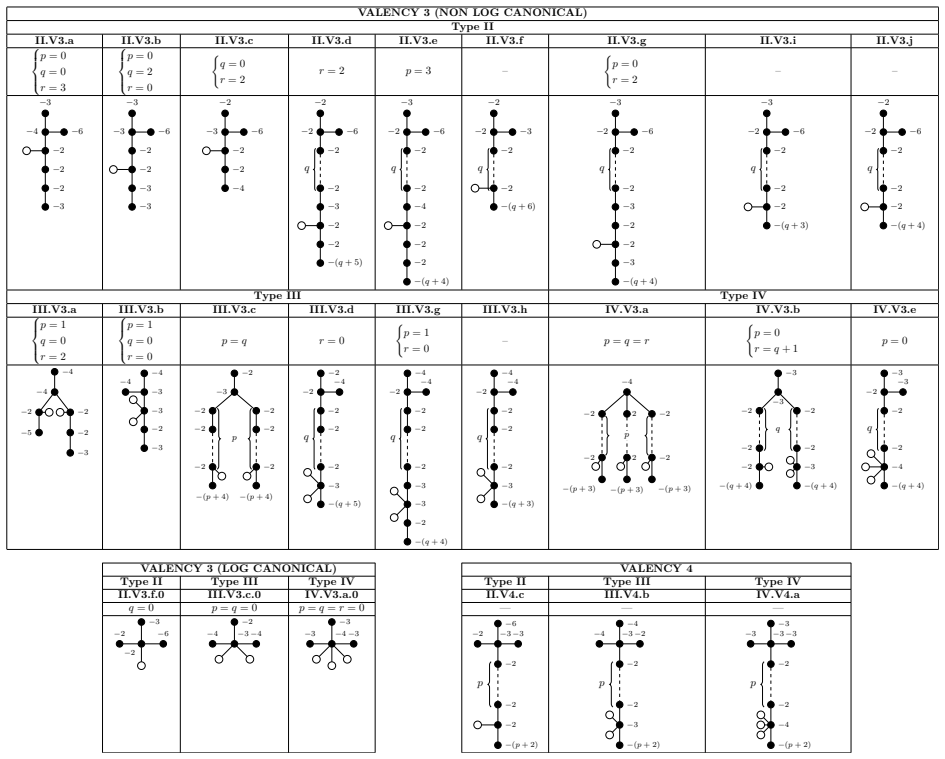
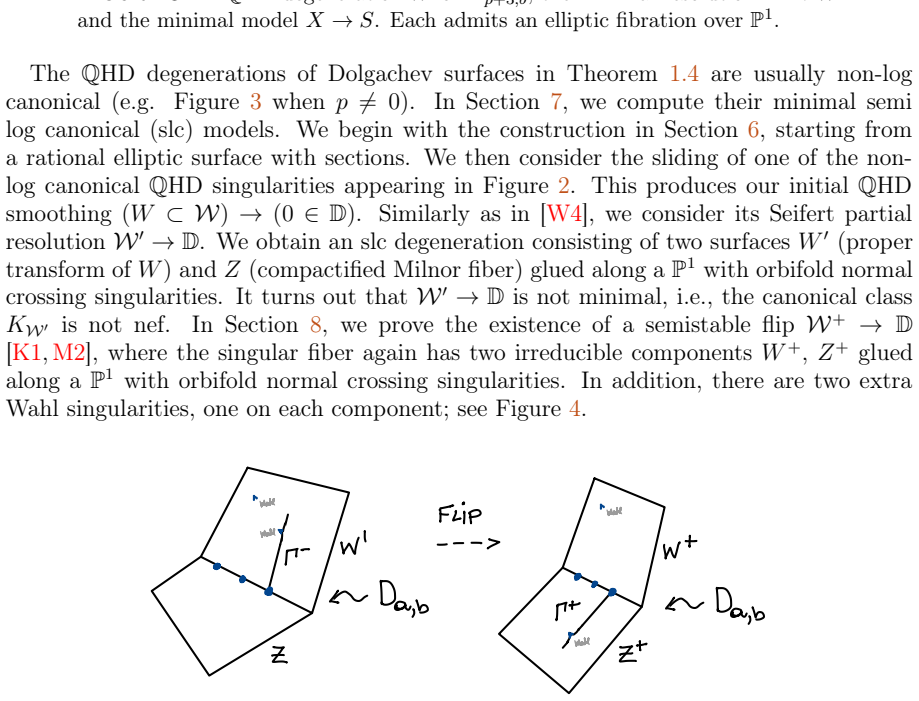
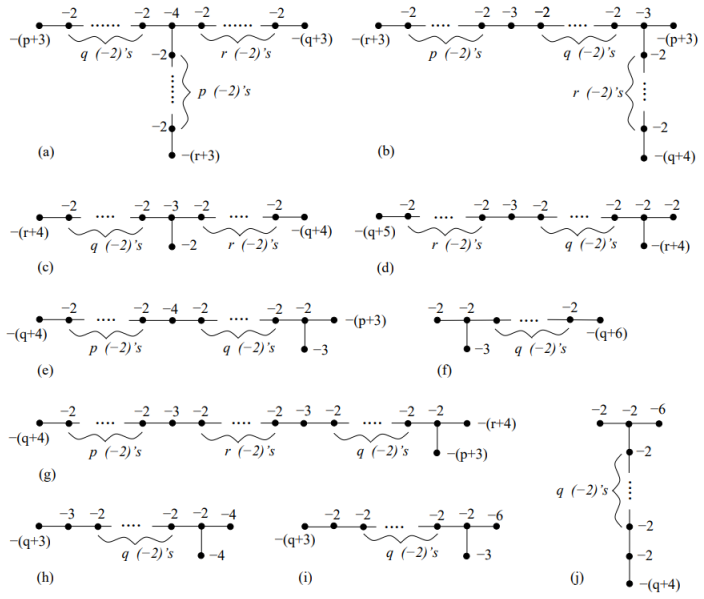
In this paper, a QHD singularity is defined as a weighted homogeneous normal surface singularity admitting a rational homology disk smoothing. We classify all QHD degenerations of nonsingular projective elliptic surfaces, extending Kawamata's classification restricted to Wahl singularities. We realize all QHD degenerations of Dolgachev surfaces D_{a,b} with exactly one QHD singularity for any integers a and b. For each degeneration we build a minimal semi-log canonical birational model by Seifert partial resolution followed by semistable flips. We prove these models are unobstructed and deform to the Dolgachev surface degenerations of D. Lee and Y. Lee.
What carries the argument
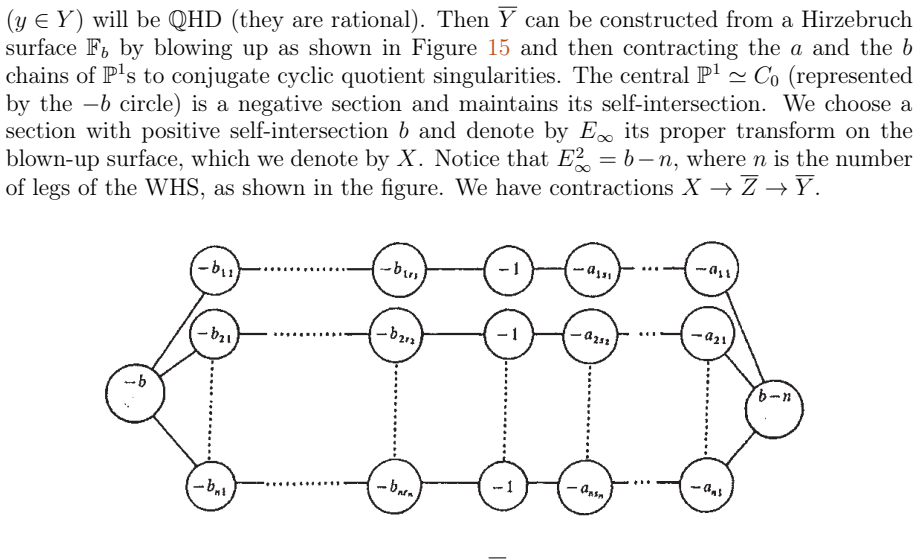
Seifert partial resolution followed by semistable flips to obtain minimal semi-log canonical birational models.
If this is right
- Realizations exist for all pairs a,b on D_{a,b} with one QHD singularity.
- Minimal slc models are constructed for every classified degeneration.
- The minimal slc models are unobstructed.
- These models deform to the degenerations constructed by Lee and Lee.
Where Pith is reading between the lines
- The list of possible QHD limits may describe components of the moduli space of elliptic surfaces.
- The resolution technique could classify analogous degenerations on other algebraic surfaces.
- Unobstructed models imply smooth local structure in the deformation space near these degenerations.
Load-bearing premise
Singularities are weighted homogeneous normal surface singularities admitting rational homology disk smoothings on nonsingular projective elliptic surfaces.
What would settle it
A QHD degeneration of a projective elliptic surface whose type or minimal model lies outside the classified families would contradict the completeness of the classification.
Figures





read the original abstract
In this paper, a $\mathbb{Q}$HD singularity is a weighted homogeneous normal surface singularity admitting a rational homology disk ($\mathbb{Q}$HD) smoothing. These singularities are rational but often not log canonical. We classify all $\mathbb{Q}$HD degenerations of nonsingular projective elliptic surfaces, extending Kawamata's classification of the case with only Wahl singularities (i.e., log terminal $\mathbb{Q}$HD singularities). We also realize all $\mathbb{Q}$HD degenerations of Dolgachev surfaces $D_{a,b}$ with one $\mathbb{Q}$HD singularity, for every pair of integers $a,b$. For each such degeneration, we construct a minimal semi log canonical (slc) birational model via a Seifert partial resolution in the sense of Wahl followed by semistable flips. Finally, we prove that these minimal slc models are unobstructed and deform to the recent degenerations of Dolgachev surfaces constructed by D. Lee and Y. Lee.
Editorial analysis
A structured set of objections, weighed in public.
Referee Report
Summary. The manuscript classifies all QHD degenerations of nonsingular projective elliptic surfaces, extending Kawamata's classification of the Wahl-singularity case. It realizes every such degeneration for Dolgachev surfaces D_{a,b} with exactly one QHD singularity, constructs the corresponding minimal slc birational models by Seifert partial resolution followed by semistable flips, and proves that these models are unobstructed while deforming to the Lee-Lee constructions.
Significance. If the classification and unobstructedness statements hold, the work supplies a complete, explicit picture of QHD degenerations for elliptic surfaces and supplies concrete birational models together with deformation-theoretic verification. These constructions extend standard techniques in a controlled way and could serve as a reference for moduli problems involving rational singularities on elliptic surfaces.
minor comments (3)
- [Introduction] The introduction should state the precise definition of a QHD singularity (weighted homogeneous normal surface singularity admitting a QHD smoothing) before the classification theorem is announced.
- [Construction of minimal slc models] In the section describing the Seifert partial resolution, the notation for the exceptional divisors and the weights should be made uniform with the notation used in the subsequent flip analysis.
- [Unobstructedness and deformation] The statement that the minimal slc models deform to the Lee-Lee examples would benefit from an explicit reference to the relevant deformation space dimension calculation.
Simulated Author's Rebuttal
We thank the referee for the positive summary of our manuscript, the assessment of its significance, and the recommendation for minor revision. The report accurately captures the main results: the classification of all QHD degenerations of nonsingular projective elliptic surfaces (extending Kawamata), the explicit realizations for Dolgachev surfaces D_{a,b}, the construction of minimal slc models via Seifert partial resolution and semistable flips, and the proof that these models are unobstructed and deform to the Lee-Lee constructions. Since the report lists no specific major comments, we have no point-by-point rebuttals to offer. We are prepared to incorporate any minor revisions the referee may suggest in a revised version.
Circularity Check
No circularity: classification extends prior work via independent birational constructions
full rationale
The paper defines QHD singularities explicitly as weighted homogeneous normal surface singularities admitting a QHD smoothing and classifies their degenerations on nonsingular projective elliptic surfaces by extending Kawamata's log-terminal case. It constructs minimal slc models using Seifert partial resolution followed by semistable flips, realizes cases for Dolgachev surfaces D_{a,b}, and verifies unobstructedness by deformation to Lee-Lee constructions. No load-bearing step reduces by definition or self-citation to its own inputs; all steps rely on standard birational geometry applied to the elliptic fibration data, with the scope (one QHD singularity, weighted homogeneity) stated upfront and verified independently.
Axiom & Free-Parameter Ledger
axioms (1)
- standard math Standard properties of elliptic surfaces, weighted homogeneous normal surface singularities, and birational geometry operations such as Seifert partial resolutions and semistable flips.
Reference graph
Works this paper leans on
-
[1]
Artin,Some numerical criteria for contractability of curves on algebraic surfaces, Amer
[A] M. Artin,Some numerical criteria for contractability of curves on algebraic surfaces, Amer. J. Math.84(1962), 485–496. [B] M. Beke,Minimal rational graphs admitting a QHD smoothing,
1962
-
[2]
Behnke and J
[BC] K. Behnke and J. A. Christophersen,M-resolutions and deformations of quotient singulari- ties, Amer. J. Math.116(1994), no. 4, 881–903. [BHPVdV] W. P. Barth, K. Hulek, C. A. M. Peters, and A. Van de Ven,Compact complex surfaces, Second, Ergebnisse der Mathematik und ihrer Grenzgebiete
1994
-
[3]
Bhupal and A
[BS] M. Bhupal and A. I. Stipsicz,Weighted homogeneous singularities and rational homology disk smoothings, Amer. J. Math.133(2011), no. 5, 1259–1297. [C] M. Canedo,Computation of discrepancies of QHD singularities,
2011
-
[4]
https://colab.research.google.com/drive/1BgJJCC0qD8eTAmpa3kdrB7CG2GsvNc6d?usp=sharing. [CDL] F. Cossec, I. Dolgachev, and C. Liedtke,Enriques surfaces. I, Second, Springer, Singapore, [2025]©2025. With an appendix by S. Kondo. [CU] M. Canedo and G. Urzúa,On QHD Horikawa surfaces, in progress
2025
-
[5]
Dolgachev,Algebraic surfaces withq=p g = 0, Algebraic surfaces, 2010, pp
[D] I. Dolgachev,Algebraic surfaces withq=p g = 0, Algebraic surfaces, 2010, pp. 97–215. [DK] I. Dolgachev and S. Kondo,Enriques surfaces II, Springer, Singapore, [2025]©2025. [F] J. R. Fowler,Rational homology disk smoothing components of weighted homogeneous surface singularities, ProQuest LLC, Ann Arbor, MI,
2010
-
[6]
[FS] R. Fintushel and R. J. Stern,Rational blowdowns of smooth4-manifolds, J. Differential Geom. 46(1997), no. 2, 181–235. [GS] G.-M. Greuel and J. Steenbrink,On the topology of smoothable singularities, Singularities, Part 1 (Arcata, Calif., 1981), 1983, pp. 535–545. 35 [H1] P. Hacking,A compactification of the space of plane curves, arXiv math/0104193,
-
[7]
J.124(2004), no
[H2] ,Compact moduli of plane curves, Duke Math. J.124(2004), no. 2, 213–257. [H3] ,Compact moduli spaces of surfaces of general type, Compact moduli spaces and vector bundles, 2012, pp. 1–18. [H4] ,Exceptional bundles associated to degenerations of surfaces, Duke Math. J.162 (2013), no. 6, 1171–1202. [H5] R. Hartshorne,Algebraic geometry, Graduate Texts ...
2004
-
[8]
Kawamata,Crepant blowing-up of3-dimensional canonical singularities and its application to degenerations of surfaces, Ann
[K1] Y. Kawamata,Crepant blowing-up of3-dimensional canonical singularities and its application to degenerations of surfaces, Ann. of Math. (2)127(1988), no. 1, 93–163. [K2] ,Moderate degenerations of algebraic surfaces, Complex algebraic varieties (Bayreuth, 1990), 1992, pp. 113–132. [K3] J. Kollár,Flips, flops, minimal models, etc., Surveys in different...
1988
-
[9]
With the collaboration of C. H. Clemens and A. Corti, Translated from the 1998 Japanese original. [KSB] J. Kollár and N. I. Shepherd-Barron,Threefolds and deformations of surface singularities, Invent. Math.91(1988), no. 2, 299–338. [L] H. B. Laufer,Taut two-dimensional singularities, Math. Ann.205(1973), 131–164. [LL] D. Lee and Y. Lee,Compact moduli of ...
-
[10]
Lee and J
[LP] Y. Lee and J. Park,A simply connected surface of general type withpg = 0andK 2 = 2, Invent. Math.170(2007), no. 3, 483–505. [LW] E. Looijenga and J. Wahl,Quadratic functions and smoothing surface singularities, Topology 25(1986), no. 3, 261–291. [M1] M. Manetti,Normal degenerations of the complex projective plane, J. Reine Angew. Math. 419(1991), 89–...
2007
-
[11]
Nakayama,The lower semicontinuity of the plurigenera of complex varieties, Algebraic geometry, Sendai, 1985, 1987, pp
[N] N. Nakayama,The lower semicontinuity of the plurigenera of complex varieties, Algebraic geometry, Sendai, 1985, 1987, pp. 551–590. [OW] P. Orlik and P. Wagreich,Singularities of algebraic surfaces withC∗ action, Math. Ann.193 (1971), 121–135. [P1] H. Pinkham,Deformations of normal surface singularities withC∗ action, Math. Ann.232 (1978), no. 1, 65–84...
1985
-
[12]
[PSU] H. Park, D. Shin, and G. Urzúa,A simply connected numerical Campedelli surface with an involution, Math. Ann.357(2013), no. 1, 31–49. [R] J. Reyes,Computer search of surfaces,
2013
-
[13]
https://github.com/jereyes4/Wahl_Chains/. [RU] J. Rana and G. Urzúa,Optimal bounds for T-singularities in stable surfaces, Adv. Math.345 (2019), 814–844. [SSW] A. I. Stipsicz, Z. Szabó, and J. Wahl,Rational blowdowns and smoothings of surface singu- larities, J. Topol.1(2008), no. 2, 477–517. [U1] G. Urzúa,Identifying neighbors of stable surfaces, Ann. Sc...
2019
-
[14]
[UZ] G. Urzúa and J. P. Zúñiga,Degenerations of del Pezzo surfaces with only Wahl singularities, arxiv.org/abs/2504.19929,
-
[15]
Wahl,Elliptic deformations of minimally elliptic singularities, Math
[W1] J. Wahl,Elliptic deformations of minimally elliptic singularities, Math. Ann.253(1980), no. 3, 241–262. [W2] ,Smoothings of normal surface singularities, Topology20(1981), no. 3, 219–246. [W3] ,On rational homology disk smoothings of valency 4 surface singularities,Geom.Topol. 15(2011), no. 2, 1125–1156. [W4] ,Log-terminal smoothings of graded normal...
1980
discussion (0)
Sign in with ORCID, Apple, or X to comment. Anyone can read and Pith papers without signing in.