Recognition: 2 theorem links
· Lean TheoremSTDA-Net: Spectrogram-Based Domain Adaptation for cross-dataset Sleep Stage Classification
Pith reviewed 2026-05-11 01:34 UTC · model grok-4.3
The pith
Spectrogram-based inputs with adversarial alignment let a model stage sleep accurately across different EEG datasets without target labels.
A machine-rendered reading of the paper's core claim, the machinery that carries it, and where it could break.
Core claim
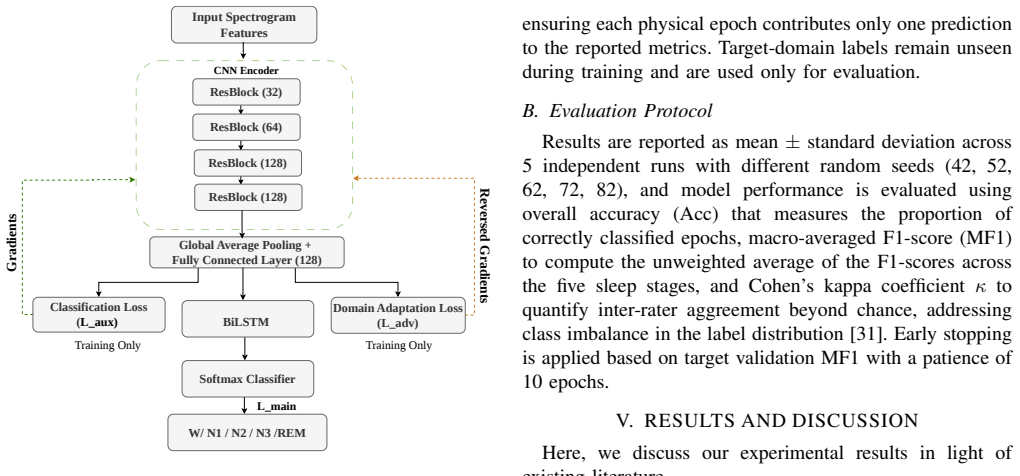
STDA-Net processes 2D spectrogram representations of EEG with a CNN-BiLSTM backbone and uses domain-adversarial training to align source and target feature distributions without any labeled target samples. In six cross-dataset transfer experiments the model delivers 89.03 percent average accuracy and 87.64 percent macro F1-score, outperforming existing 1D EEG baselines in balanced performance and showing markedly lower variance across five independent runs.
What carries the argument
STDA-Net, the CNN-BiLSTM architecture that ingests spectrograms and uses DANN adversarial loss to align source and target features for unsupervised domain adaptation.
If this is right
- 2D spectrogram inputs combined with temporal modeling yield more balanced classification than 1D signal baselines under domain shift.
- Adversarial alignment removes the need for any labeled target data while maintaining high accuracy across multiple public sleep datasets.
- Lower variance across repeated runs indicates the method produces more stable and reproducible results than prior 1D approaches.
- The same framework supports six different source-to-target transfer directions among Sleep-EDF, SHHS-1, and SHHS-2.
Where Pith is reading between the lines
- If spectrogram-based alignment continues to work on new hardware, clinics could deploy one trained model on varied EEG recorders without collecting fresh labels each time.
- The same 2D-plus-adversarial pattern may apply to other biosignal tasks that suffer from recording-site differences, such as seizure detection or ECG monitoring.
- Future tests on datasets with wider age or pathology gaps could show how far the current alignment generalizes before additional techniques become necessary.
Load-bearing premise
Spectrogram features plus adversarial alignment can reliably overcome EEG domain shifts caused by different montages, rates, environments, and populations without any target-domain labels.
What would settle it
A new cross-dataset transfer experiment in which STDA-Net accuracy falls below the best 1D baseline or its run-to-run variance exceeds the 1D variance would falsify the claimed advantage.
Figures

read the original abstract
Accurate sleep stage classification across datasets remains challenging due to variability in EEG channel montages, sampling rates, recording environments, and subject populations. Although deep learning has shown considerable promise for automated sleep staging, most existing cross-dataset methods rely on one-dimensional EEG signal representations, whereas the use of two-dimensional spectrogram-based inputs within an unsupervised domain adaptation framework has remained largely unexplored. Here, we propose STDA-Net (Spectrogram-based Temporal Domain Adaptation Network), a framework that combines a convolutional neural network (CNN) for spectrogram-based feature extraction, a bidirectional long short-term memory (BiLSTM) module for temporal modeling of sleep dynamics, and a domain-adversarial neural network (DANN) for source-to-target feature alignment without requiring any labeled target-domain data during training. Experiments are conducted on three publicly available datasets Sleep-EDF, SHHS-1, and SHHS-2 under six cross-dataset transfer settings. Results show that the proposed framework achieves an average accuracy of 89.03% and an average macro F1-score of 87.64%, consistently outperforming existing 1D baseline methods in terms of balanced classification performance, with substantially lower variance across five independent runs, indicating improved stability and reproducibility. Overall, these findings demonstrate that 2D spectrogram-based representations, combined with temporal modeling and adversarial domain adaptation, provide a robust and competitive alternative to conventional 1D EEG inputs for cross-dataset sleep staging.
Editorial analysis
A structured set of objections, weighed in public.
Referee Report
Summary. The manuscript proposes STDA-Net, which processes EEG signals as 2D spectrograms via CNN feature extraction, BiLSTM for temporal sleep dynamics modeling, and DANN for unsupervised source-to-target domain alignment. It evaluates the model under six cross-dataset transfer settings on Sleep-EDF, SHHS-1, and SHHS-2, reporting an average accuracy of 89.03% and macro F1-score of 87.64% while outperforming 1D baselines with lower variance across five independent runs.
Significance. If the results hold under rigorous controls, the work provides evidence that spectrogram-based 2D representations plus adversarial adaptation can yield more stable cross-dataset sleep staging performance than standard 1D EEG pipelines without target labels. The emphasis on repeated runs and reduced variance is a positive contribution to reproducibility in this domain.
major comments (2)
- [Experimental Setup and Results] Experimental Setup and Results sections: The manuscript reports outperformance over 1D baselines but provides no details on whether those baselines were reimplemented and trained using identical source-target splits, resampling, and preprocessing as STDA-Net. This information is load-bearing for attributing gains to the spectrogram + DANN design rather than implementation differences.
- [Results] Results section: Average accuracy and macro F1 are given, yet no per-run values, standard deviations, or statistical tests (e.g., paired t-test or Wilcoxon signed-rank) are reported to substantiate the claim of 'substantially lower variance' and consistent superiority across the five runs.
minor comments (2)
- [Abstract] Abstract: The numerical claims (89.03% accuracy, 87.64% F1) would be strengthened by briefly noting the number of cross-dataset pairs and the range of per-setting scores.
- [Methods] Methods: Explicit values for spectrogram parameters (FFT window length, hop size, frequency range) and DANN hyperparameters (adversarial loss weight, learning rates) should be tabulated for full reproducibility.
Simulated Author's Rebuttal
We thank the referee for the positive assessment and constructive suggestions regarding the experimental setup and results reporting. We address each major comment below and will incorporate the necessary revisions to enhance the clarity and rigor of the manuscript.
read point-by-point responses
-
Referee: [Experimental Setup and Results] Experimental Setup and Results sections: The manuscript reports outperformance over 1D baselines but provides no details on whether those baselines were reimplemented and trained using identical source-target splits, resampling, and preprocessing as STDA-Net. This information is load-bearing for attributing gains to the spectrogram + DANN design rather than implementation differences.
Authors: We agree that providing explicit details on the baseline implementations is crucial for fair comparison and to attribute performance gains correctly. In the revised version of the manuscript, we will expand the Experimental Setup section to include a detailed description of how the 1D baselines were reimplemented, confirming that they used the exact same source-target dataset splits, resampling procedures, and preprocessing steps as STDA-Net. This will ensure transparency and allow readers to replicate the comparisons accurately. revision: yes
-
Referee: [Results] Results section: Average accuracy and macro F1 are given, yet no per-run values, standard deviations, or statistical tests (e.g., paired t-test or Wilcoxon signed-rank) are reported to substantiate the claim of 'substantially lower variance' and consistent superiority across the five runs.
Authors: We acknowledge that reporting per-run values, standard deviations, and appropriate statistical tests would strengthen the claims regarding lower variance and consistent superiority. In the revision, we will add a supplementary table or section in the Results that presents the accuracy and macro F1 scores for each of the five independent runs for both STDA-Net and the baselines. We will also compute and report the mean and standard deviation, and include results from statistical significance tests such as the Wilcoxon signed-rank test to validate the observed differences. revision: yes
Circularity Check
No significant circularity; empirical evaluation is self-contained
full rationale
The paper proposes STDA-Net as a CNN-BiLSTM-DANN architecture for spectrogram-based unsupervised domain adaptation in sleep staging and reports empirical accuracies (89.03% average) and macro-F1 scores (87.64%) on six cross-dataset transfers using Sleep-EDF, SHHS-1, and SHHS-2. No equations, fitted parameters, or self-citations are used to derive the performance metrics; results are obtained via standard train-on-source/test-on-target protocols with five independent runs. The architecture description, preprocessing steps, and DANN alignment are presented as design choices rather than derived quantities, and no load-bearing claim reduces to a self-referential construction or renamed input. This is a standard empirical ML paper whose central claims rest on external dataset benchmarks rather than internal definitional equivalence.
Axiom & Free-Parameter Ledger
free parameters (1)
- CNN-BiLSTM-DANN hyperparameters and training settings
axioms (2)
- domain assumption Spectrogram representations preserve information that can be aligned across domains via adversarial training.
- domain assumption BiLSTM layers adequately capture sequential sleep-stage transitions.
Lean theorems connected to this paper
-
IndisputableMonolith/Cost/FunctionalEquation.leanwashburn_uniqueness_aczel unclear?
unclearRelation between the paper passage and the cited Recognition theorem.
STDA-Net ... CNN for spectrogram-based feature extraction, a bidirectional long short-term memory (BiLSTM) module for temporal modeling ... domain-adversarial neural network (DANN) ... Ltotal = Lmain + α Laux + λ Ladv
-
IndisputableMonolith/Foundation/ArithmeticFromLogic.leanLogicNat unclear?
unclearRelation between the paper passage and the cited Recognition theorem.
sliding window of L=10 epochs ... period-8 micro-structure absent; no φ-ladder or 8-tick periodicity invoked
What do these tags mean?
- matches
- The paper's claim is directly supported by a theorem in the formal canon.
- supports
- The theorem supports part of the paper's argument, but the paper may add assumptions or extra steps.
- extends
- The paper goes beyond the formal theorem; the theorem is a base layer rather than the whole result.
- uses
- The paper appears to rely on the theorem as machinery.
- contradicts
- The paper's claim conflicts with a theorem or certificate in the canon.
- unclear
- Pith found a possible connection, but the passage is too broad, indirect, or ambiguous to say the theorem truly supports the claim.
Reference graph
Works this paper leans on
-
[1]
A. Sankari and J. M. Slowik, “Sleep study,” inStatPearls. Treasure Island, FL, USA: StatPearls Publishing, 2026, updated 2026 Jan 10. [Online]. Available: https://www.ncbi.nlm.nih.gov/books/NBK563147/
work page 2026
-
[2]
T. U. Wara, A. H. Fahad, A. S. Das, and M. M. H. Shawon, “A systematic review on sleep stage classification and sleep disorder detection using artificial intelligence,”Heliyon, vol. 11, no. 12, 2025
work page 2025
-
[3]
Data augmentation in semi-supervised adversarial domain adaptation for eeg-based sleep staging,
E. R. Heremans, T. Osselaer, N. Seeuws, H. Phan, D. Testelmans, and M. De V os, “Data augmentation in semi-supervised adversarial domain adaptation for eeg-based sleep staging,” in2022 IEEE-EMBS Interna- tional Conference on Biomedical and Health Informatics (BHI)
-
[4]
Cross-scenario automatic sleep stage classification using transfer learning and single-channel eeg,
Z. He, M. Tang, P. Wang, L. Du, X. Chen, G. Cheng, and Z. Fang, “Cross-scenario automatic sleep stage classification using transfer learning and single-channel eeg,”Biomedical Signal Processing and Control, vol. 81, p. 104501, 2023
work page 2023
-
[5]
Singlechannelnet: A model for automatic sleep stage classification with raw single-channel eeg,
D. Zhou, J. Wang, G. Hu, J. Zhang, F. Li, R. Yan, L. Kettunen, Z. Chang, Q. Xu, and F. Cong, “Singlechannelnet: A model for automatic sleep stage classification with raw single-channel eeg,” Biomedical signal processing and control, vol. 75, p. 103592, 2022
work page 2022
-
[6]
U. Tallal, R. Agrawal, and S. Kshirsagar, “Modulation-based feature extraction for robust sleep stage classification across apnea-based cohorts,”Biosensors, vol. 16, no. 1, p. 56, 2026
work page 2026
-
[7]
Domain-adversarial training of neural networks,
Y . Ganin, E. Ustinova, H. Ajakan, P. Germain, H. Larochelle, F. Lavi- olette, M. Marchand, and V . Lempitsky, “Domain-adversarial training of neural networks,”Journal of Machine Learning Research, vol. 17, no. 59, pp. 1–35, 2016
work page 2016
-
[8]
E. R. Heremans, H. Phan, P. Borz ´ee, B. Buyse, D. Testelmans, and M. De V os, “From unsupervised to semi-supervised adversarial domain adaptation in electroencephalography-based sleep staging,”Journal of Neural Engineering, vol. 19, no. 3, p. 036044, 2022
work page 2022
-
[9]
A deep learning method approach for sleep stage classification with eeg spectrogram,
C. Li, Y . Qi, X. Ding, J. Zhao, T. Sang, and M. Lee, “A deep learning method approach for sleep stage classification with eeg spectrogram,” International journal of environmental research and public health, vol. 19, no. 10, p. 6322, 2022
work page 2022
-
[10]
P. Liu, W. Qian, H. Zhang, Y . Zhu, Q. Hong, Q. Li, and Y . Yao, “Automatic sleep stage classification using deep learning: signals, data representation, and neural networks,”Artificial Intelligence Review, vol. 57, no. 11, p. 301, 2024
work page 2024
-
[11]
Deepsleepnet: A model for automatic sleep stage scoring based on raw single-channel eeg,
A. Supratak, H. Dong, C. Wu, and Y . Guo, “Deepsleepnet: A model for automatic sleep stage scoring based on raw single-channel eeg,” IEEE transactions on neural systems and rehabilitation engineering, vol. 25, no. 11, pp. 1998–2008, 2017
work page 1998
-
[12]
S. Haghayegh, K. Hu, K. Stone, S. Redline, and E. Schernhammer, “Automated sleep stages classification using convolutional neural network from raw and time-frequency electroencephalogram signals: systematic evaluation study,”Journal of Medical Internet Research, vol. 25, p. e40211, 2023
work page 2023
-
[13]
Quality-aware bag of modulation spectrum features for robust speech emotion recognition,
S. R. Kshirsagar and T. H. Falk, “Quality-aware bag of modulation spectrum features for robust speech emotion recognition,”IEEE Trans- actions on Affective Computing, vol. 13, no. 4, pp. 1892–1905, 2022
work page 1905
-
[14]
A. R. Avila, S. R. Kshirsagar, A. Tiwari, D. Lafond, D. O’Shaughnessy, and T. H. Falk, “Speech-based stress classification based on modulation spectral features and convolutional neural networks,” in2019 27th European Signal Processing Conference (EUSIPCO). IEEE, 2019, pp. 1–5
work page 2019
-
[15]
S. Kshirsagar and T. H. Falk, “Cross-language speech emotion recog- nition using bag-of-word representations, domain adaptation, and data augmentation,”Sensors, vol. 22, no. 17, p. 6445, 2022
work page 2022
-
[16]
To- wards robust building damage detection: Leveraging augmentation and domain adaptation,
B. C. R. Parupati, S. Kshirsagar, R. Bagai, and A. Dutta, “To- wards robust building damage detection: Leveraging augmentation and domain adaptation,” in2025 IEEE Green Technologies Conference (GreenTech). IEEE, 2025, pp. 163–167
work page 2025
-
[17]
S. Kshirsagar, B. Chandra, U. Tallal, R. Bagai, and A. Dutta, “Geographic bias analysis and cross-domain generalization in deep learning-based building damage assessment,” 2026
work page 2026
-
[18]
Generalizable sleep staging via multi-level domain alignment,
J. Wang, S. Zhao, H. Jiang, S. Li, T. Li, and G. Pan, “Generalizable sleep staging via multi-level domain alignment,” inProceedings of the AAAI Conference on Artificial Intelligence, no. 1, 2024, pp. 265–273
work page 2024
-
[19]
Robust building damage detection in cross-disaster settings using domain adaptation,
A. Mouradi and S. Kshirsagar, “Robust building damage detection in cross-disaster settings using domain adaptation,”arXiv preprint arXiv:2603.14694, 2026
work page internal anchor Pith review arXiv 2026
-
[20]
Adast: Attentive cross-domain eeg-based sleep staging framework with iterative self-training,
E. Eldele, M. Ragab, Z. Chen, M. Wu, C.-K. Kwoh, X. Li, and C. Guan, “Adast: Attentive cross-domain eeg-based sleep staging framework with iterative self-training,”IEEE Transactions on Emerg- ing Topics in Computational Intelligence, 2022
work page 2022
-
[21]
Deep subdomain adaptation subject-specific sleep staging framework with iterative self-training,
J. Lyu, Z. Chen, W. Shi, and C.-H. Yeh, “Deep subdomain adaptation subject-specific sleep staging framework with iterative self-training,” Computer Methods and Programs in Biomedicine, p. 108996, 2025
work page 2025
-
[22]
Optimizing eeg-based sleep staging: adversarial deep learning joint domain adap- tation,
R. Ghasemigarjan, M. Mikaeili, and S. K. Setarehdan, “Optimizing eeg-based sleep staging: adversarial deep learning joint domain adap- tation,”IEEE Access, vol. 12, pp. 186 639–186 657, 2024
work page 2024
-
[23]
R. Ghasemigarjan, M. Mikaeili, S. Kamaledin Setarehdan, and A. Sa- boori, “Enhancing eeg-based sleep staging efficiency with minimal channels through adversarial domain adaptation and active deep learn- ing,”Journal of Neural Engineering, vol. 22, no. 4, p. 046043, 2025
work page 2025
-
[24]
Sleep stage classification with multi-modal fusion and denoising diffusion model,
X. Xu, F. Cong, Y . Chen, and J. Chen, “Sleep stage classification with multi-modal fusion and denoising diffusion model,”IEEE Journal of Biomedical and Health Informatics, 2024
work page 2024
-
[25]
I. Goodfellow, Y . Bengio, and A. Courville,Deep Learning. Cam- bridge, MA, USA: MIT Press, 2016
work page 2016
-
[26]
Domain-adversarial training of neural networks,
Y . Ganin, E. Ustinova, H. Ajakan, P. Germain, H. Larochelle, F. Lavi- olette, M. March, and V . Lempitsky, “Domain-adversarial training of neural networks,”Journal of machine learning research, vol. 17, no. 59, pp. 1–35, 2016
work page 2016
-
[27]
A. L. Goldberger, L. A. N. Amaral, L. Glass, J. M. Hausdorff, P. C. Ivanov, R. G. Mark, J. E. Mietus, G. B. Moody, C.-K. Peng, and H. E. Stanley, “Physiobank, physiotoolkit, and physionet: Components of a new research resource for complex physiologic signals,”Circulation, vol. 101, no. 23, pp. e215–e220, 2000
work page 2000
-
[28]
Analysis of a sleep-dependent neuronal feedback loop: The slow-wave microcontinuity of the eeg,
B. Kemp, A. H. Zwinderman, B. Tuk, H. A. C. Kamphuisen, and J. J. L. Obery ´e, “Analysis of a sleep-dependent neuronal feedback loop: The slow-wave microcontinuity of the eeg,”IEEE Transactions on Biomedical Engineering, vol. 47, no. 9, pp. 1185–1194, 2000
work page 2000
-
[29]
The national sleep research resource: Towards a sleep data commons,
G.-Q. Zhang, L. Cui, R. Mueller, S. Tao, M. Kim, M. Rueschman, S. Mariani, D. Mobley, and S. Redline, “The national sleep research resource: Towards a sleep data commons,”Journal of the American Medical Informatics Association, vol. 25, no. 10, pp. 1351–1358, 2018
work page 2018
-
[30]
The sleep heart health study: Design, rationale, and methods,
S. F. Quan, B. V . Howard, C. Iber, J. P. Kiley, F. J. Nieto, G. T. O’Connor, D. M. Rapoport, S. Redline, J. Robbins, J. M. Samet, and P. W. Wahl, “The sleep heart health study: Design, rationale, and methods,”Sleep, vol. 20, no. 12, pp. 1077–1085, 1997
work page 1997
-
[31]
Automatic sleep staging of eeg signals: recent development, challenges, and future directions,
H. Phan and K. Mikkelsen, “Automatic sleep staging of eeg signals: recent development, challenges, and future directions,”Physiological measurement, vol. 43, no. 4, p. 04TR01, 2022
work page 2022
-
[32]
Deep coral: Correlation alignment for deep domain adaptation,
B. Sun and K. Saenko, “Deep coral: Correlation alignment for deep domain adaptation,” inEuropean conference on computer vision. Springer, 2016, pp. 443–450
work page 2016
-
[33]
On minimum discrepancy estimation for deep domain adaptation,
M. M. Rahman, C. Fookes, M. Baktashmotlagh, and S. Sridharan, “On minimum discrepancy estimation for deep domain adaptation,” inDomain adaptation for visual understanding. Springer, 2020
work page 2020
-
[34]
Deep subdomain adaptation network for image classification,
Y . Zhu, F. Zhuang, J. Wang, G. Ke, J. Chen, J. Bian, H. Xiong, and Q. He, “Deep subdomain adaptation network for image classification,” IEEE transactions on neural networks and learning systems, vol. 32, no. 4, pp. 1713–1722, 2020
work page 2020
-
[35]
Adversarial discrim- inative domain adaptation,
E. Tzeng, J. Hoffman, K. Saenko, and T. Darrell, “Adversarial discrim- inative domain adaptation,” inProceedings of the IEEE conference on computer vision and pattern recognition, 2017, pp. 7167–7176
work page 2017
-
[36]
Conditional adver- sarial domain adaptation,
M. Long, Z. Cao, J. Wang, and M. I. Jordan, “Conditional adver- sarial domain adaptation,”Advances in neural information processing systems, vol. 31, 2018
work page 2018
-
[37]
R. Shu, H. H. Bui, H. Narui, and S. Ermon, “A dirt-t approach to unsupervised domain adaptation,”arXiv preprint arXiv:1802.08735
-
[38]
T. J. Boerner, S. Deems, T. R. Furlani, S. L. Knuth, and J. Towns, “Access: Advancing innovation: Nsf’s advanced cyberinfrastructure coordination ecosystem: Services & support,” inPractice and Experi- ence in Advanced Research Computing (PEARC ’23), 2023
work page 2023
discussion (0)
Sign in with ORCID, Apple, or X to comment. Anyone can read and Pith papers without signing in.