Recognition: 2 theorem links
· Lean TheoremRobust Building Damage Detection in Cross-Disaster Settings Using Domain Adaptation
Pith reviewed 2026-05-15 10:46 UTC · model grok-4.3
The pith
Supervised domain adaptation enables reliable four-class building damage detection on unseen disaster imagery.
A machine-rendered reading of the paper's core claim, the machinery that carries it, and where it could break.
Core claim
Supervised domain adaptation is indispensable for cross-disaster building damage classification. Adapting the xView2 first-place method to the Ida-BD target domain via SDA restores usable performance on four severity classes, while the identical pipeline without SDA fails entirely on the unseen test split; the best result (Macro-F1 0.5552) occurs when SDA is combined with unsharp-enhanced RGB imagery.
What carries the argument
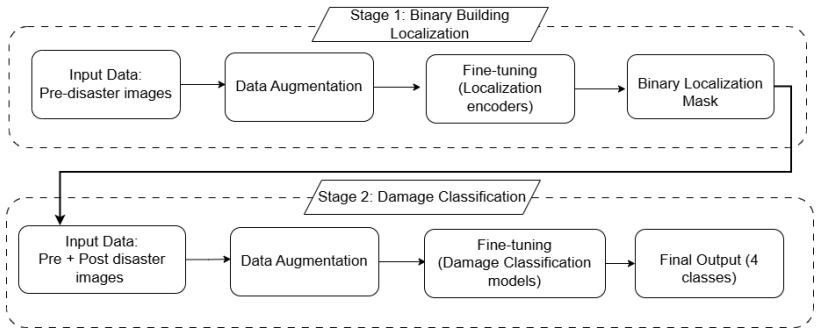
Supervised domain adaptation (SDA) inside a two-stage ensemble that transfers a damage classifier from the xView2 source domain to the Ida-BD target domain.
If this is right
- Damage detection modules can be deployed in new regions using only labeled source data plus a modest amount of target labels for adaptation.
- Human-machine disaster systems gain reliability because the adapted model no longer fails catastrophically on geographic shifts.
- Unsharp masking combined with SDA is shown to be the strongest single augmentation choice for this task.
- Four-class severity output becomes feasible without full retraining for each new disaster.
Where Pith is reading between the lines
- The same SDA wrapper could be tested on flood or wildfire mapping tasks that also suffer from cross-event domain shift.
- Pairing the adapted classifier with real-time satellite streams would let response teams receive updated damage maps within hours of a new event.
- Further gains might come from combining SDA with self-supervised pre-training on large unlabeled remote-sensing archives.
Load-bearing premise
The main performance gap between xView2 and Ida-BD arises from distributional mismatch that the chosen SDA procedure can correct without architectural changes or extra unlabeled target data.
What would settle it
A new unseen disaster dataset on which the non-adapted model still collapses but the SDA-adapted model also fails to reach usable Macro-F1 would falsify the claim that this SDA step is sufficient and indispensable.
Figures


read the original abstract
Rapid structural damage assessment from remote sensing imagery is essential for timely disaster response. Within human-machine systems (HMS) for disaster management, automated damage detection provides decision-makers with actionable situational awareness. However, models trained on multi-disaster benchmarks often underperform in unseen geographic regions due to domain shift - a distributional mismatch between training and deployment data that undermines human trust in automated assessments. We explore a two-stage ensemble approach using supervised domain adaptation (SDA) for building damage classification across four severity classes. The pipeline adapts the xView2 first-place method to the Ida-BD dataset using SDA and systematically investigates the effect of individual augmentation components on classification performance. Comprehensive ablation experiments on the unseen Ida-BD test split demonstrate that SDA is indispensable: removing it causes damage detection to fail entirely. Our pipeline achieves the most robust performance using SDA with unsharp-enhanced RGB input, attaining a Macro-F1 of 0.5552. These results underscore the critical role of domain adaptation in building trustworthy automated damage assessment modules for HMS-integrated disaster response.
Editorial analysis
A structured set of objections, weighed in public.
Referee Report
Summary. The manuscript proposes a two-stage ensemble pipeline applying supervised domain adaptation (SDA) to transfer the xView2 first-place building damage classifier to the unseen Ida-BD dataset for four-class damage severity prediction. It claims SDA is indispensable, as its removal causes complete failure on the held-out Ida-BD test split, and reports a peak Macro-F1 of 0.5552 using SDA with unsharp-enhanced RGB inputs after systematic ablation of augmentation components.
Significance. If the central claims hold after proper controls, the work would establish that supervised domain adaptation is required for reliable cross-disaster building damage detection, improving trustworthiness of automated modules within human-machine disaster response systems. The ablation of input augmentations supplies practical guidance for remote-sensing preprocessing.
major comments (1)
- [Ablation experiments and abstract] The claim that 'removing SDA causes damage detection to fail entirely' on the Ida-BD test split (abstract and ablation experiments) requires explicit definition of the non-SDA baseline. If this baseline is zero-shot application of the xView2 model with no Ida-BD exposure, collapse is expected from domain shift and does not demonstrate that the chosen SDA loss is required versus any use of target labels. A plain supervised fine-tuning baseline on Ida-BD training labels (standard cross-entropy, same backbone and data) must be reported to isolate the incremental contribution of SDA.
minor comments (1)
- [Abstract and experimental results] The abstract and results should report the size of the labeled target set used for SDA supervision, the exact form of the adaptation loss, and any error bars or statistical significance tests for the Macro-F1 values.
Simulated Author's Rebuttal
We thank the referee for the detailed and constructive comments. We agree that the ablation section requires clearer definition of baselines to properly isolate the contribution of supervised domain adaptation, and we will revise the manuscript accordingly.
read point-by-point responses
-
Referee: [Ablation experiments and abstract] The claim that 'removing SDA causes damage detection to fail entirely' on the Ida-BD test split (abstract and ablation experiments) requires explicit definition of the non-SDA baseline. If this baseline is zero-shot application of the xView2 model with no Ida-BD exposure, collapse is expected from domain shift and does not demonstrate that the chosen SDA loss is required versus any use of target labels. A plain supervised fine-tuning baseline on Ida-BD training labels (standard cross-entropy, same backbone and data) must be reported to isolate the incremental contribution of SDA.
Authors: We acknowledge the referee's point that the current phrasing of the 'no SDA' condition risks being interpreted as merely confirming the expected effects of domain shift. In the manuscript, the ablation labeled 'removing SDA' corresponds to zero-shot inference with the original xView2 model on Ida-BD data. To address the request, we will add a new baseline experiment consisting of standard supervised fine-tuning (cross-entropy loss only) on the Ida-BD training labels using the identical backbone, data splits, and augmentation pipeline. This will be reported alongside the existing SDA results in the revised ablation table and section. The abstract will also be updated to explicitly define all baselines and to qualify the claim of indispensability in light of the new comparison. We believe these additions will strengthen the manuscript by quantifying the incremental benefit of the SDA component. revision: yes
Circularity Check
No circularity: performance measured on held-out test split with no reduction to fitted inputs or self-citations
full rationale
The paper presents an empirical pipeline for domain adaptation on building damage classification, reporting Macro-F1 on an explicitly unseen Ida-BD test split after adaptation from xView2. No equations, derivations, or parameter fits are described that would make the reported score equivalent to its inputs by construction. The ablation claim that removing SDA causes failure is based on direct experimental comparison on held-out data rather than any self-definitional loop or renamed fit. External benchmarks (xView2 competition results) are independent of the present paper's fitted values, and no self-citation chain is invoked to justify uniqueness or force the result. The derivation chain is therefore self-contained against external data splits.
Axiom & Free-Parameter Ledger
axioms (1)
- domain assumption The primary cause of poor cross-disaster performance is distributional shift that supervised domain adaptation can correct
Lean theorems connected to this paper
-
IndisputableMonolith/Cost/FunctionalEquation.leanwashburn_uniqueness_aczel unclear?
unclearRelation between the paper passage and the cited Recognition theorem.
two-stage ensemble approach using supervised domain adaptation (SDA) for building damage classification across four severity classes... Macro-F1 of 0.5552
-
IndisputableMonolith/Foundation/RealityFromDistinction.leanreality_from_one_distinction unclear?
unclearRelation between the paper passage and the cited Recognition theorem.
Comprehensive ablation experiments... removing it causes damage detection to fail entirely
What do these tags mean?
- matches
- The paper's claim is directly supported by a theorem in the formal canon.
- supports
- The theorem supports part of the paper's argument, but the paper may add assumptions or extra steps.
- extends
- The paper goes beyond the formal theorem; the theorem is a base layer rather than the whole result.
- uses
- The paper appears to rely on the theorem as machinery.
- contradicts
- The paper's claim conflicts with a theorem or certificate in the canon.
- unclear
- Pith found a possible connection, but the passage is too broad, indirect, or ambiguous to say the theorem truly supports the claim.
Forward citations
Cited by 2 Pith papers
-
STDA-Net: Spectrogram-Based Domain Adaptation for cross-dataset Sleep Stage Classification
STDA-Net achieves 89.03% average accuracy and 87.64% macro F1 in cross-dataset sleep staging by processing 2D spectrograms with temporal modeling and unsupervised adversarial alignment, outperforming 1D baselines with...
-
Demographic-Aware Transfer Learning for Sleep Stage Classification in Clinical Polysomnography
Demographic-stratified fine-tuning of a convolutional recurrent sleep staging model improves Cohen's kappa by 0.9-12.9% over a single population-agnostic baseline on 100 clinical PSG recordings.
Reference graph
Works this paper leans on
-
[1]
Cambridge, UK and New York, NY , USA: Cambridge University Press, 2012
IPCC,Managing the Risks of Extreme Events and Disasters to Advance Climate Change Adaptation. Cambridge, UK and New York, NY , USA: Cambridge University Press, 2012
work page 2012
-
[2]
L. Dong and J. Shan, “A comprehensive review of earthquake-induced building damage detection with remote sensing techniques,”ISPRS Journal of Photogrammetry and Remote Sensing, vol. 84, pp. 85–99, 2013
work page 2013
-
[3]
F. Filipponi, “Exploitation of Sentinel-2 time series to map burned areas at the national level: A case study on the 2017 Italy wildfires,” Remote Sensing, vol. 11, no. 6, p. 622, 2019
work page 2017
-
[4]
G. M. Foody, “Remote sensing of tropical forest environments: Towards the monitoring of environmental resources for sustainable development,”International Journal of Remote Sensing, vol. 24, no. 20, pp. 4035–4046, 2003
work page 2003
-
[5]
Assisting flood disaster response with earth observation data and products: A critical assessment,
G. J. Schumann, G. R. Brakenridge, A. J. Kettner, R. Kashif, and E. Niebuhr, “Assisting flood disaster response with earth observation data and products: A critical assessment,”Remote Sensing, vol. 10, no. 8, p. 1230, 2018
work page 2018
-
[6]
U-Net: Convolutional networks for biomedical image segmentation,
O. Ronneberger, P. Fischer, and T. Brox, “U-Net: Convolutional networks for biomedical image segmentation,” inProc. Int. Conf. Med- ical Image Computing and Computer-Assisted Intervention (MICCAI). Springer, 2015, pp. 234–241
work page 2015
-
[7]
P. Li, H. Xu, S. Liu, and J. Guo, “Urban building damage detection from very high resolution imagery using one-class SVM and spatial relations,” inProc. IEEE Int. Geoscience and Remote Sensing Sym- posium (IGARSS), vol. 5. IEEE, 2009, pp. V–112
work page 2009
-
[8]
A. J. Cooner, Y . Shao, and J. B. Campbell, “Detection of urban damage using remote sensing and machine learning algorithms: Revisiting the 2010 Haiti earthquake,”Remote Sensing, vol. 8, no. 10, p. 868, 2016
work page 2010
-
[9]
An attention- based system for damage assessment using satellite imagery,
H. Hao, S. Baireddy, E. R. Bartusiak, L. Konz, K. LaTourette, M. Gribbons, M. Chan, E. J. Delp, and M. L. Comer, “An attention- based system for damage assessment using satellite imagery,” inProc. IEEE Int. Geoscience and Remote Sensing Symposium (IGARSS). IEEE, 2021, pp. 4396–4399
work page 2021
-
[10]
Y . Shen, S. Zhu, T. Yang, C. Chen, D. Pan, J. Chen, L. Xiao, and Q. Du, “BDANet: Multiscale convolutional neural network with cross- directional attention for building damage assessment from satellite images,”IEEE Trans. Geoscience and Remote Sensing, vol. 60, pp. 1–14, 2021
work page 2021
-
[11]
Fully convolutional Siamese neu- ral networks for buildings damage assessment from satellite images,
E. Khvedchenya and T. Gabruseva, “Fully convolutional Siamese neu- ral networks for buildings damage assessment from satellite images,” arXiv preprint arXiv:2111.00508, 2021
-
[12]
V . Hertel, C. Geiß, M. Wieland, and H. Taubenb ¨ock, “Rapid domain adaptation for disaster impact assessment: Remote sensing of building damage after the 2021 Germany floods,”Science of Remote Sensing, p. 100287, 2025
work page 2021
-
[13]
S. Hafner, Y . Ban, and A. Nascetti, “Unsupervised domain adaptation for global urban extraction using Sentinel-1 SAR and Sentinel-2 MSI data,”Remote Sensing of Environment, vol. 280, p. 113192, 2022
work page 2022
-
[14]
Domain adaptation for the classification of remote sensing data: An overview of recent advances,
D. Tuia, C. Persello, and L. Bruzzone, “Domain adaptation for the classification of remote sensing data: An overview of recent advances,” IEEE Geoscience and Remote Sensing Magazine, vol. 4, no. 2, pp. 41– 57, 2016
work page 2016
-
[15]
Selection of unlabeled source domains for domain adaptation in remote sensing,
C. Geiß, A. Rabuske, P. A. Pelizari, S. Bauer, and T. Taubenb ¨ock, “Selection of unlabeled source domains for domain adaptation in remote sensing,”Array, vol. 15, p. 100233, 2022
work page 2022
-
[16]
Towards ro- bust building damage detection: Leveraging augmentation and domain adaptation,
B. C. R. Parupati, S. Kshirsagar, R. Bagai, and A. Dutta, “Towards ro- bust building damage detection: Leveraging augmentation and domain adaptation,” inProc. IEEE Green Technologies Conf. (GreenTech). IEEE, 2025, pp. 163–167
work page 2025
-
[17]
A simple, strong baseline for building damage detection on the xBD dataset,
S. Gerard, P. Borne-Pons, and J. Sullivan, “A simple, strong baseline for building damage detection on the xBD dataset,”arXiv preprint arXiv:2401.17271, 2024
-
[18]
xBD: A dataset for as- sessing building damage from satellite imagery,
R. Gupta, R. Hosfelt, S. Sajeev, N. Patel, B. Goodman, J. Doshi, E. Heim, H. Choset, and M. Gaston, “xBD: A dataset for as- sessing building damage from satellite imagery,”arXiv preprint arXiv:1911.09296, 2019
-
[19]
xView2 first place: 1st place solution for xView2: As- sess building damage challenge,
V . Durnov, “xView2 first place: 1st place solution for xView2: As- sess building damage challenge,” GitHub repository, 2020, [Online]. Available: https://github.com/DIUx-xView/xView2 first place
work page 2020
-
[20]
xView2 solution: 2nd place solution for xView2 challenge,
S. Seferbekov, “xView2 solution: 2nd place solution for xView2 challenge,” GitHub repository, 2020, [Online]. Available: https://gi thub.com/selimsef/xview2 solution
work page 2020
-
[21]
xView2 third place: 3rd place solution for xView2 damage assessment challenge,
E. Khvedchenya, “xView2 third place: 3rd place solution for xView2 damage assessment challenge,” GitHub repository, 2020, [Online]. Available: https://github.com/DIUx-xView/xView2 third place
work page 2020
-
[22]
Quality-aware bag of modulation spectrum features for robust speech emotion recognition,
S. R. Kshirsagar and T. H. Falk, “Quality-aware bag of modulation spectrum features for robust speech emotion recognition,”IEEE Trans- actions on Affective Computing, no. 4, pp. 1892–1905, 2022
work page 1905
-
[23]
S. Kshirsagar, A. Pendyala, and T. H. Falk, “Task-specific speech enhancement and data augmentation for improved multimodal emotion recognition under noisy conditions.”
-
[24]
S. Kshirsagar and T. H. Falk, “Cross-language speech emotion recog- nition using bag-of-word representations, domain adaptation, and data augmentation,”Sensors, vol. 22, no. 17, p. 6445, 2022
work page 2022
-
[25]
C. Lee, N. Kaur, A. Mahdavi-Amiri, and A. Mostafavi, “Ida-BD: Pre- and post-disaster high-resolution satellite imagery for building damage assessment from Hurricane Ida,” DesignSafe-CI, 2022
work page 2022
-
[26]
Data augmentation approaches for satellite image super-resolution,
M. Ghaffar, A. McKinstry, T. Maul, and T. Vu, “Data augmentation approaches for satellite image super-resolution,”ISPRS Annals of the Photogrammetry, Remote Sensing and Spatial Information Sciences, vol. 4, pp. 47–54, 2019
work page 2019
discussion (0)
Sign in with ORCID, Apple, or X to comment. Anyone can read and Pith papers without signing in.