Recognition: 2 theorem links
· Lean TheoremRadial redistribution of stellar orbits in FIRE simulations of Milky-Way-mass galaxies
Pith reviewed 2026-05-11 00:45 UTC · model grok-4.3
The pith
The scatter in how far stars migrate radially from their birth orbits stops growing after about 3 billion years at roughly 2 kpc.
A machine-rendered reading of the paper's core claim, the machinery that carries it, and where it could break.
Core claim
Stars selected by birth orbital radius typically move inward over time. At a fixed radius today, stars younger than about 5 Gyr show net inward shifts while older stars show net outward shifts. The scatter in orbital-radius change grows with age only up to 3 Gyr and then saturates near 2 kpc for older stars, contradicting the common expectation of monotonic growth.
What carries the argument
The scatter sigma(Delta R_orbit) in the difference between a star's birth orbital radius and its present-day orbital radius, tracked as a function of stellar age.
If this is right
- At fixed present-day radius, young stars have typically moved inward since birth while older stars have moved outward.
- The amount of random radial redistribution does not keep growing for stars older than 3 Gyr.
- Timing of disk formation correlates with the average net shift but not with the scatter in shifts.
- Different consistent ways of measuring orbital radius produce the same overall trends.
Where Pith is reading between the lines
- Early galaxy events may establish a fixed level of mixing that later processes do not exceed.
- Older stellar populations could retain clearer chemical signatures of their birth sites than continuous-migration models predict.
- Similar saturation could be searched for in lower-mass galaxies to test whether the 3 Gyr limit is universal.
Load-bearing premise
The simulations correctly capture the dynamical processes that move stars radially without major numerical or missing physical effects that would alter the age trends.
What would settle it
A measurement showing that the scatter in radial orbit changes keeps increasing steadily with age for stars older than 3 Gyr, either in observations of the Milky Way or in independent simulations, would contradict the reported saturation.
Figures


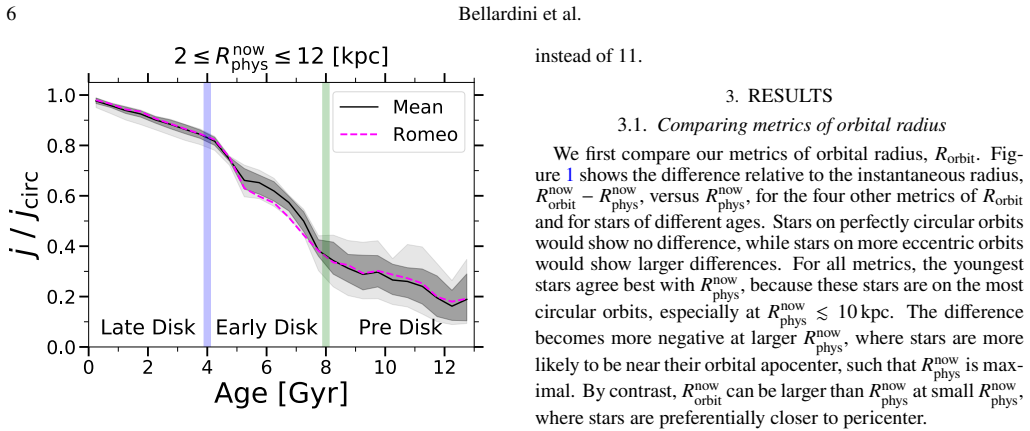


read the original abstract
A central question in galactic dynamics and galactic archeology is: how much do the orbits of stars redistribute (migrate) after birth? We use the FIRE-2 cosmological zoom-in simulations of 11 Milky Way-mass galaxies to quantify the change in the orbital specific angular momentum, j_phi, orbital radius, R_orbit, and azimuthal velocity, v_phi, of stars from birth to today. We examine the dependences on stellar age, present-day R_orbit, and birth R_orbit, characterizing both the median (net) change, Delta R_orbit, and its scatter, sigma(Delta R_orbit). We comprehensively compare five ways of measuring orbital radius; we find generally consistent trends, but only when measuring radius today and radial redistribution self-consistently. Stars selected by their birth R_orbit typically decreased in R_orbit, j_phi, and v_phi since birth. The trend for stars at a given R_orbit today depends on age: those younger than ~5 Gyr generally decreased in R_orbit, j_phi, and v_phi since birth, while those older generally increased in R_orbit, j_phi, and v_phi since birth. sigma(Delta R_orbit), a standard metric of radial redistribution, increases with stellar age only up to ~ 3 Gyr; it saturates at sigma(Delta R_orbit) ~2 kpc for older stars. This saturation contradicts a common expectation of a monotonic increase with age. Our results broadly agree with recent observational inferences of Delta R_orbit and sigma(Delta R_orbit) in the Milky Way. Across our FIRE-2 sample, the timing of disk formation does not correlate with sigma(Delta R_orbit), but it correlates with (net) Delta R_orbit.
Editorial analysis
A structured set of objections, weighed in public.
Referee Report
Summary. The manuscript uses particle tracking in 11 FIRE-2 cosmological zoom-in simulations of Milky Way-mass galaxies to measure changes in stellar orbital specific angular momentum j_phi, radius R_orbit, and azimuthal velocity v_phi from birth to z=0. It reports age-dependent net radial migration (younger stars at fixed present-day R_orbit tend to have decreased R_orbit since birth; older stars increased) and finds that the scatter sigma(Delta R_orbit) rises with age only until ~3 Gyr before saturating at ~2 kpc. Trends are stated to be consistent across five R_orbit definitions when measured self-consistently, and results are compared to Milky Way observations; disk formation time correlates with net Delta R_orbit but not with the scatter.
Significance. If the saturation result is physical rather than numerical, the work would be significant for galactic dynamics and archaeology: it directly challenges the expectation of monotonic growth in radial migration scatter with stellar age and supplies falsifiable, simulation-derived predictions that align with recent observational inferences. The analysis benefits from direct use of simulation particle data without fitted parameters or circular definitions, plus the multi-galaxy sample and cross-check of five radius definitions.
major comments (2)
- [Abstract and Results (age-dependence of sigma)] The central claim that sigma(Delta R_orbit) saturates at ~2 kpc after ~3 Gyr (abstract) rests on the assumption that FIRE-2 faithfully captures radial migration over >10 Gyr. No resolution-convergence tests or comparisons to higher-resolution runs are reported; older stars complete more orbital periods, so any resolution-dependent diffusion, softening-length heating, or incomplete capture of spiral/bar torques could produce an artificial plateau. This is load-bearing for the result that contradicts monotonic-increase expectations.
- [Abstract and Methods/Results comparison of definitions] The statement that trends are 'generally consistent' across five R_orbit definitions 'only when measuring radius today and radial redistribution self-consistently' (abstract) is presented without quantitative metrics (e.g., differences in median Delta R_orbit or sigma values, or statistical tests) that would demonstrate the degree of consistency or the impact of non-self-consistent choices.
minor comments (1)
- [Abstract] The abstract notes broad agreement with 'recent observational inferences' but does not cite the specific Milky Way studies being compared; these references should be added in the introduction or discussion.
Simulated Author's Rebuttal
We thank the referee for their insightful and constructive comments on our manuscript. We address each major comment point by point below, outlining our planned revisions where appropriate.
read point-by-point responses
-
Referee: The central claim that sigma(Delta R_orbit) saturates at ~2 kpc after ~3 Gyr (abstract) rests on the assumption that FIRE-2 faithfully captures radial migration over >10 Gyr. No resolution-convergence tests or comparisons to higher-resolution runs are reported; older stars complete more orbital periods, so any resolution-dependent diffusion, softening-length heating, or incomplete capture of spiral/bar torques could produce an artificial plateau. This is load-bearing for the result that contradicts monotonic-increase expectations.
Authors: We agree that the lack of explicit resolution-convergence tests specific to the radial migration scatter is a limitation of the current manuscript, and we appreciate the referee identifying this as load-bearing for the saturation result. The FIRE-2 simulations have been subject to extensive convergence studies in prior work for dynamical properties including disk structure and orbital evolution, and the saturation behavior is consistent across our full sample of 11 galaxies. In the revised manuscript, we will add a dedicated paragraph in the Discussion section that explicitly addresses potential numerical effects (gravitational softening, orbital period accumulation for older stars, and resolution of non-axisymmetric torques), explains why we consider the saturation physical rather than artificial, and notes the external consistency with Milky Way observational inferences. We cannot, however, run new higher-resolution simulations within the scope of this revision. revision: partial
-
Referee: The statement that trends are 'generally consistent' across five R_orbit definitions 'only when measuring radius today and radial redistribution self-consistently' (abstract) is presented without quantitative metrics (e.g., differences in median Delta R_orbit or sigma values, or statistical tests) that would demonstrate the degree of consistency or the impact of non-self-consistent choices.
Authors: We agree that the claim of general consistency would be strengthened by quantitative metrics. In the revised manuscript, we will expand the relevant results section to include a table (or supplementary figure) that reports the differences in median Delta R_orbit and sigma(Delta R_orbit) across the five definitions, quantifies the impact of non-self-consistent radius choices, and provides basic statistical comparisons (e.g., standard deviations of the medians and pairwise differences) to demonstrate the degree of agreement when measurements are performed self-consistently. revision: yes
- We cannot perform new higher-resolution simulations to directly test convergence of the sigma(Delta R_orbit) saturation result.
Circularity Check
No significant circularity in simulation-based orbital redistribution analysis
full rationale
The paper reports direct empirical measurements of Delta R_orbit, sigma(Delta R_orbit), and related quantities by tracking stellar particles from birth to z=0 in the FIRE-2 simulations. The reported saturation of sigma(Delta R_orbit) at ~2 kpc beyond ~3 Gyr is an observed trend in the simulation data, not a quantity derived from a model that assumes or fits it. The comparison of five orbital-radius definitions is a methodological consistency check rather than a self-referential definition. No parameters are fitted to subsets of the data and then presented as independent predictions, and no load-bearing claims reduce to self-citations or ansatzes imported from prior work by the same authors. The derivation chain consists of simulation outputs and straightforward statistical summaries of those outputs.
Axiom & Free-Parameter Ledger
Lean theorems connected to this paper
-
IndisputableMonolith/Foundation/AbsoluteFloorClosure.leanreality_from_one_distinction unclear?
unclearRelation between the paper passage and the cited Recognition theorem.
σ(ΔR_orbit) increases with stellar age only up to ~3 Gyr; it saturates at σ(ΔR_orbit) ~2 kpc for older stars
-
IndisputableMonolith/Foundation/ArithmeticFromLogic.leanLogicNat recovery unclear?
unclearRelation between the paper passage and the cited Recognition theorem.
We comprehensively compare five ways of measuring orbital radius
What do these tags mean?
- matches
- The paper's claim is directly supported by a theorem in the formal canon.
- supports
- The theorem supports part of the paper's argument, but the paper may add assumptions or extra steps.
- extends
- The paper goes beyond the formal theorem; the theorem is a base layer rather than the whole result.
- uses
- The paper appears to rely on the theorem as machinery.
- contradicts
- The paper's claim conflicts with a theorem or certificate in the canon.
- unclear
- Pith found a possible connection, but the passage is too broad, indirect, or ambiguous to say the theorem truly supports the claim.
Reference graph
Works this paper leans on
-
[1]
Abadi M. G., Navarro J. F., Steinmetz M., Eke V. R., 2003, @doi [ ] 10.1086/378316 , http://adsabs.harvard.edu/abs/2003ApJ...597...21A 597, 21
-
[2]
Alexander D. M., et al., 2025, @doi [ ] 10.1016/j.newar.2025.101733 , https://ui.adsabs.harvard.edu/abs/2025NewAR.10101733A 101, 101733
-
[3]
Anders F., et al., 2017, @doi [ ] 10.1051/0004-6361/201629363 , https://ui.adsabs.harvard.edu/abs/2017A&A...600A..70A 600, A70
-
[4]
Ansar S., Pearson S., Sanderson R. E., Arora A., Hopkins P. F., Wetzel A., Cunningham E. C., Quinn J., 2025, @doi [ ] 10.3847/1538-4357/ad8b45 , https://ui.adsabs.harvard.edu/abs/2025ApJ...978...37A 978, 37
-
[5]
Astropy Collaboration et al., 2013, @doi [ ] 10.1051/0004-6361/201322068 , http://adsabs.harvard.edu/abs/2013A26A...558A..33A 558, A33
-
[6]
Athanassoula E., 2003, @doi [ ] 10.1046/j.1365-8711.2003.06473.x , https://ui.adsabs.harvard.edu/abs/2003MNRAS.341.1179A 341, 1179
-
[7]
Baba J., 2025, @doi [ ] 10.1093/pasj/psaf062 , https://ui.adsabs.harvard.edu/abs/2025PASJ..tmp...67B
-
[8]
Barbanis B., Woltjer L., 1967, @doi [ ] 10.1086/149349 , https://ui.adsabs.harvard.edu/abs/1967ApJ...150..461B 150, 461
-
[9]
Bellardini M. A., Wetzel A., Loebman S. R., Faucher-Gigu \`e re C.-A., Ma X., Feldmann R., 2021, @doi [ ] 10.1093/mnras/stab1606 , https://ui.adsabs.harvard.edu/abs/2021MNRAS.505.4586B 505, 4586
-
[10]
Bellardini M. A., Wetzel A., Loebman S. R., Bailin J., 2022, @doi [ ] 10.1093/mnras/stac1637 , https://ui.adsabs.harvard.edu/abs/2022MNRAS.514.4270B 514, 4270
-
[11]
Belokurov V., Kravtsov A., 2022, @doi [ ] 10.1093/mnras/stac1267 , https://ui.adsabs.harvard.edu/abs/2022MNRAS.514..689B 514, 689
-
[12]
Benincasa S. M., et al., 2020, @doi [ ] 10.1093/mnras/staa2116 , https://ui.adsabs.harvard.edu/abs/2020MNRAS.497.3993B 497, 3993
-
[13]
Bhattarai B., Loebman S. R., Ness M. K., Wetzel A., Cunningham E. C., Parul H., Wiggins A. I., 2024, @doi [arXiv e-prints] 10.48550/arXiv.2408.02228 , https://ui.adsabs.harvard.edu/abs/2024arXiv240802228B p. arXiv:2408.02228
-
[14]
, archivePrefix = "arXiv", eprint =
Bird J. C., Kazantzidis S., Weinberg D. H., 2012, @doi [ ] 10.1111/j.1365-2966.2011.19728.x , https://ui.adsabs.harvard.edu/abs/2012MNRAS.420..913B 420, 913
-
[15]
Bird J. C., Loebman S. R., Weinberg D. H., Brooks A. M., Quinn T. R., Christensen C. R., 2021, @doi [ ] 10.1093/mnras/stab289 , https://ui.adsabs.harvard.edu/abs/2021MNRAS.503.1815B 503, 1815
-
[16]
Brunetti M., Chiappini C., Pfenniger D., 2011, @doi [ ] 10.1051/0004-6361/201117566 , https://ui.adsabs.harvard.edu/abs/2011A&A...534A..75B 534, A75
-
[17]
Buck T., Obreja A., Macci \`o A. V., Minchev I., Dutton A. A., Ostriker J. P., 2020, @doi [ ] 10.1093/mnras/stz3241 , https://ui.adsabs.harvard.edu/abs/2020MNRAS.491.3461B 491, 3461
-
[18]
Buder S., et al., 2018, @doi [ ] 10.1093/mnras/sty1281 , https://ui.adsabs.harvard.edu/abs/2018MNRAS.478.4513B 478, 4513
-
[19]
Carlberg R. G., Sellwood J. A., 1985, @doi [ ] 10.1086/163134 , https://ui.adsabs.harvard.edu/abs/1985ApJ...292...79C 292, 79
-
[20]
Carr C., Johnston K. V., Laporte C. F. P., Ness M. K., 2022, @doi [ ] 10.1093/mnras/stac2403 , https://ui.adsabs.harvard.edu/abs/2022MNRAS.516.5067C 516, 5067
-
[21]
Carrillo A., Ness M. K., Hawkins K., Sanderson R. E., Wang K., Wetzel A., Bellardini M. A., 2023, @doi [ ] 10.3847/1538-4357/aca1c7 , https://ui.adsabs.harvard.edu/abs/2023ApJ...942...35C 942, 35
-
[22]
Casagrande L., Sch \"o nrich R., Asplund M., Cassisi S., Ram \' rez I., Mel \'e ndez J., Bensby T., Feltzing S., 2011, @doi [ ] 10.1051/0004-6361/201016276 , https://ui.adsabs.harvard.edu/abs/2011A&A...530A.138C 530, A138
-
[23]
M., Grenon M., Barbuy B., McCarthy J
Castro S., Rich R. M., Grenon M., Barbuy B., McCarthy J. K., 1997, @doi [ ] 10.1086/118481 , https://ui.adsabs.harvard.edu/abs/1997AJ....114..376C 114, 376
-
[24]
doi:10.1093/mnras/stac2236 , eprint =
Chan T. K., Kere s D., Gurvich A. B., Hopkins P. F., Trapp C., Ji S., Faucher-Gigu \`e re C.-A., 2022, @doi [ ] 10.1093/mnras/stac2236 , https://ui.adsabs.harvard.edu/abs/2022MNRAS.517..597C 517, 597
-
[25]
Chiba R., Friske J. K. S., Sch \"o nrich R., 2021, @doi [ ] 10.1093/mnras/staa3585 , https://ui.adsabs.harvard.edu/abs/2021MNRAS.500.4710C 500, 4710
-
[26]
Christensen C., Quinn T., Governato F., Stilp A., Shen S., Wadsley J., 2012, @doi [ ] 10.1111/j.1365-2966.2012.21628.x , https://ui.adsabs.harvard.edu/abs/2012MNRAS.425.3058C 425, 3058
-
[27]
Conroy C., et al., 2022, arXiv e-prints, https://ui.adsabs.harvard.edu/abs/2022arXiv220402989C p. arXiv:2204.02989
-
[28]
Conselice C. J., 2014, @doi [ ] 10.1146/annurev-astro-081913-040037 , https://ui.adsabs.harvard.edu/abs/2014ARA&A..52..291C 52, 291
-
[29]
Croton D. J., et al., 2006, @doi [ ] 10.1111/j.1365-2966.2005.09675.x , https://ui.adsabs.harvard.edu/abs/2006MNRAS.365...11C 365, 11
-
[30]
Cui X.-Q., Zhao Y.-H., Chu Y.-Q., et al., 2012, @doi [Research in Astronomy and Astrophysics] 10.1088/1674-4527/12/9/003 , https://ui.adsabs.harvard.edu/abs/2012RAA....12.1197C 12, 1197
-
[31]
Danhaive A. L., et al., 2025, @doi [arXiv e-prints] 10.48550/arXiv.2503.21863 , https://ui.adsabs.harvard.edu/abs/2025arXiv250321863D p. arXiv:2503.21863
-
[32]
Daniel K. J., Wyse R. F. G., 2015, @doi [ ] 10.1093/mnras/stu2683 , https://ui.adsabs.harvard.edu/abs/2015MNRAS.447.3576D 447, 3576
-
[33]
Daniel K. J., Wyse R. F. G., 2018, @doi [ ] 10.1093/mnras/sty199 , https://ui.adsabs.harvard.edu/abs/2018MNRAS.476.1561D 476, 1561
-
[34]
Daniel K. J., Schaffner D. A., McCluskey F., Fiedler Kawaguchi C., Loebman S., 2019, @doi [ ] 10.3847/1538-4357/ab341a , https://ui.adsabs.harvard.edu/abs/2019ApJ...882..111D 882, 111
-
[35]
Simba: Cosmological Simulations with Black Hole Growth and Feedback
Dav \'e R., Angl \'e s-Alc \'a zar D., Narayanan D., Li Q., Rafieferantsoa M. H., Appleby S., 2019, @doi [ ] 10.1093/mnras/stz937 , https://ui.adsabs.harvard.edu/abs/2019MNRAS.486.2827D 486, 2827
-
[36]
De Silva G. M., et al., 2015, @doi [ ] 10.1093/mnras/stv327 , https://ui.adsabs.harvard.edu/abs/2015MNRAS.449.2604D 449, 2604
-
[37]
Deason A. J., Belokurov V., 2024, @doi [ ] 10.1016/j.newar.2024.101706 , https://ui.adsabs.harvard.edu/abs/2024NewAR..9901706D 99, 101706
-
[38]
Debattista V. P., Gonzalez O. A., Sanderson R. E., El-Badry K., Garrison-Kimmel S., Wetzel A., Faucher-Gigu \`e re C.-A., Hopkins P. F., 2019, @doi [ ] 10.1093/mnras/stz746 , https://ui.adsabs.harvard.edu/abs/2019MNRAS.485.5073D 485, 5073
-
[39]
Dubay L. O., Johnson J. A., Johnson J. W., 2024, @doi [ ] 10.3847/1538-4357/ad61df , https://ui.adsabs.harvard.edu/abs/2024ApJ...973...55D 973, 55
-
[40]
Dubois Y., Gavazzi R., Peirani S., Silk J., 2013, @doi [ ] 10.1093/mnras/stt997 , https://ui.adsabs.harvard.edu/abs/2013MNRAS.433.3297D 433, 3297
-
[41]
L., Nissen P
Edvardsson B., Andersen J., Gustafsson B., Lambert D. L., Nissen P. E., Tomkin J., 1993, , https://ui.adsabs.harvard.edu/abs/1993A&A...275..101E 275, 101
1993
-
[42]
El-Badry K., Wetzel A., Geha M., Hopkins P. F., Kere s D., Chan T. K., Faucher-Gigu \`e re C.-A., 2016, @doi [ ] 10.3847/0004-637X/820/2/131 , http://adsabs.harvard.edu/abs/2016ApJ...820..131E 820, 131
-
[43]
R., Geha M., Quataert E., Hopkins P
El-Badry K., Wetzel A. R., Geha M., Quataert E., Hopkins P. F., Kere s D., Chan T. K., Faucher-Gigu \`e re C.-A., 2017, @doi [ ] 10.3847/1538-4357/835/2/193 , http://adsabs.harvard.edu/abs/2017ApJ...835..193E 835, 193
-
[44]
El-Badry K., et al., 2018, @doi [ ] 10.1093/mnras/stx2482 , https://ui.adsabs.harvard.edu/#abs/2018MNRAS.473.1930E 473, 1930
-
[45]
Escala I., et al., 2018, @doi [ ] 10.1093/mnras/stx2858 , https://ui.adsabs.harvard.edu/#abs/2018MNRAS.474.2194E 474, 2194
-
[46]
Observational Evidence of AGN Feedback
Fabian A. C., 2012, @doi [ ] 10.1146/annurev-astro-081811-125521 , http://adsabs.harvard.edu/abs/2012ARA
work page internal anchor Pith review doi:10.1146/annurev-astro-081811-125521 2012
-
[47]
Faucher-Gigu \`e re C.-A., Lidz A., Zaldarriaga M., Hernquist L., 2009, @doi [ ] 10.1088/0004-637X/703/2/1416 , http://adsabs.harvard.edu/abs/2009ApJ...703.1416F 703, 1416
-
[48]
Feuillet D. K., et al., 2018, @doi [ ] 10.1093/mnras/sty779 , https://ui.adsabs.harvard.edu/abs/2018MNRAS.477.2326F 477, 2326
-
[49]
F \"o rster Schreiber N. M., Wuyts S., 2020, @doi [ ] 10.1146/annurev-astro-032620-021910 , https://ui.adsabs.harvard.edu/abs/2020ARA&A..58..661F 58, 661
-
[50]
Fragkoudi F., et al., 2020, @doi [ ] 10.1093/mnras/staa1104 , https://ui.adsabs.harvard.edu/abs/2020MNRAS.494.5936F 494, 5936
-
[51]
Fragkoudi F., Grand R. J. J., Pakmor R., G \'o mez F., Marinacci F., Springel V., 2025, @doi [ ] 10.1093/mnras/staf389 , https://ui.adsabs.harvard.edu/abs/2025MNRAS.538.1587F 538, 1587
-
[52]
Frankel N., Rix H.-W., Ting Y.-S., Ness M., Hogg D. W., 2018, @doi [ ] 10.3847/1538-4357/aadba5 , https://ui.adsabs.harvard.edu/#abs/2018ApJ...865...96F 865, 96
-
[53]
Frankel N., Sanders J., Ting Y.-S., Rix H.-W., 2020, @doi [ ] 10.3847/1538-4357/ab910c , https://ui.adsabs.harvard.edu/abs/2020ApJ...896...15F 896, 15
-
[54]
Frankel N., et al., 2022, @doi [ ] 10.3847/1538-4357/ac9972 , https://ui.adsabs.harvard.edu/abs/2022ApJ...940...61F 940, 61
-
[55]
Freeman K., Bland-Hawthorn J., 2002, @doi [ ] 10.1146/annurev.astro.40.060401.093840 , http://adsabs.harvard.edu/abs/2002ARA
-
[56]
Frosst M., Obreschkow D., Ludlow A., Fraser-McKelvie A., 2025, @doi [arXiv e-prints] 10.48550/arXiv.2508.14626 , https://ui.adsabs.harvard.edu/abs/2025arXiv250814626F p. arXiv:2508.14626
-
[57]
Gaia Collaboration Prusti T., de Bruijne J. H. J., Brown A. G. A., et al., 2016, @doi [ ] 10.1051/0004-6361/201629272 , https://ui.adsabs.harvard.edu/abs/2016A&A...595A...1G 595, A1
-
[58]
Gandhi P. J., Wetzel A., Hopkins P. F., Shappee B. J., Wheeler C., Faucher-Gigu \`e re C.-A., 2022, @doi [ ] 10.1093/mnras/stac2228 , https://ui.adsabs.harvard.edu/abs/2022MNRAS.516.1941G 516, 1941
-
[59]
Garrison-Kimmel S., et al., 2017, @doi [ ] 10.1093/mnras/stx1710 , http://adsabs.harvard.edu/abs/2017MNRAS.471.1709G 471, 1709
-
[60]
Garrison-Kimmel S., et al., 2018, @doi [ ] 10.1093/mnras/sty2513 , https://ui.adsabs.harvard.edu/abs/2018MNRAS.481.4133G 481, 4133
-
[61]
Garrison-Kimmel S., et al., 2019a, @doi [ ] 10.1093/mnras/stz1317 , https://ui.adsabs.harvard.edu/abs/2019MNRAS.487.1380G 487, 1380
-
[62]
Garrison-Kimmel S., et al., 2019b, @doi [ ] 10.1093/mnras/stz2507 , https://ui.adsabs.harvard.edu/abs/2019MNRAS.489.4574G 489, 4574
-
[63]
Glazebrook K., 2013, @doi [ ] 10.1017/pasa.2013.34 , https://ui.adsabs.harvard.edu/abs/2013PASA...30...56G 30, e056
-
[64]
Graf R. L., Wetzel A., Bellardini M. A., Bailin J., 2025a, @doi [ ] 10.3847/1538-4357/adacd7 , https://ui.adsabs.harvard.edu/abs/2025ApJ...981...47G 981, 47
-
[65]
L., Wetzel A., Bailin J., Orr M
Graf R. L., Wetzel A., Bailin J., Orr M. E., 2025b, @doi [ ] 10.3847/1538-4357/adfa07 , https://ui.adsabs.harvard.edu/abs/2025ApJ...991..139G 991, 139
-
[66]
Grand R. J. J., Springel V., G \'o mez F. A., Marinacci F., Pakmor R., Campbell D. J. R., Jenkins A., 2016, @doi [ ] 10.1093/mnras/stw601 , http://adsabs.harvard.edu/abs/2016MNRAS.459..199G 459, 199
-
[67]
Grand R. J. J., et al., 2017, @doi [ ] 10.1093/mnras/stx071 , https://ui.adsabs.harvard.edu/abs/2017MNRAS.467..179G 467, 179
-
[68]
Grenon M., 1989, @doi [ ] 10.1007/BF00646341 , https://ui.adsabs.harvard.edu/abs/1989Ap&SS.156...29G 156, 29
-
[69]
Grudi \'c M. Y., Hafen Z., Rodriguez C. L., Guszejnov D., Lamberts A., Wetzel A., Boylan-Kolchin M., Faucher-Gigu \`e re C.-A., 2023, @doi [ ] 10.1093/mnras/stac3573 , https://ui.adsabs.harvard.edu/abs/2023MNRAS.519.1366G 519, 1366
-
[70]
Gurvich A. B., et al., 2023, @doi [ ] 10.1093/mnras/stac3712 , https://ui.adsabs.harvard.edu/abs/2023MNRAS.519.2598G 519, 2598
-
[71]
Guszejnov D., Grudi \'c M. Y., Offner S. S. R., Boylan-Kolchin M., Faucher-Gigu \`e re C.-A., Wetzel A., Benincasa S. M., Loebman S., 2020, @doi [ ] 10.1093/mnras/stz3527 , https://ui.adsabs.harvard.edu/abs/2020MNRAS.492..488G 492, 488
-
[72]
Hahn O., Abel T., 2011, @doi [ ] 10.1111/j.1365-2966.2011.18820.x , http://adsabs.harvard.edu/abs/2011MNRAS.415.2101H 415, 2101
-
[73]
Halle A., Di Matteo P., Haywood M., Combes F., 2015, @doi [ ] 10.1051/0004-6361/201525612 , https://ui.adsabs.harvard.edu/abs/2015A&A...578A..58H 578, A58
-
[74]
Harris C. R., et al., 2020, @doi [ ] 10.1038/s41586-020-2649-2 , https://ui.adsabs.harvard.edu/abs/2020Natur.585..357H 585, 357
-
[75]
Hayden M. R., et al., 2015, @doi [ ] 10.1088/0004-637X/808/2/132 , http://adsabs.harvard.edu/abs/2015ApJ...808..132H 808, 132
-
[76]
Haywood M., 2008, @doi [MNRAS] 10.1111/j.1365-2966.2008.13395.x , http://adsabs.harvard.edu/abs/2008MNRAS.388.1175H 388, 1175
-
[77]
Haywood M., Snaith O., Lehnert M. D., Di Matteo P., Khoperskov S., 2019, @doi [ ] 10.1051/0004-6361/201834155 , https://ui.adsabs.harvard.edu/abs/2019A&A...625A.105H 625, A105
-
[78]
Haywood M., Khoperskov S., Cerqui V., Di Matteo P., Katz D., Snaith O., 2024, @doi [ ] 10.1051/0004-6361/202348767 , https://ui.adsabs.harvard.edu/abs/2024A&A...690A.147H 690, A147
-
[79]
Heckman T. M., Best P. N., 2014, @doi [ ] 10.1146/annurev-astro-081913-035722 , https://ui.adsabs.harvard.edu/abs/2014ARA&A..52..589H 52, 589
work page internal anchor Pith review doi:10.1146/annurev-astro-081913-035722 2014
-
[80]
Hopkins P. F., 2015, @doi [ ] 10.1093/mnras/stv195 , http://adsabs.harvard.edu/abs/2015MNRAS.450...53H 450, 53
discussion (0)
Sign in with ORCID, Apple, or X to comment. Anyone can read and Pith papers without signing in.