Recognition: no theorem link
The impact of envelope binding energies on the merger rate density of binary compact objects
Pith reviewed 2026-05-11 00:55 UTC · model grok-4.3
The pith
Envelope binding energies from detailed stellar models change predicted compact binary merger rates by more than an order of magnitude.
A machine-rendered reading of the paper's core claim, the machinery that carries it, and where it could break.
Core claim
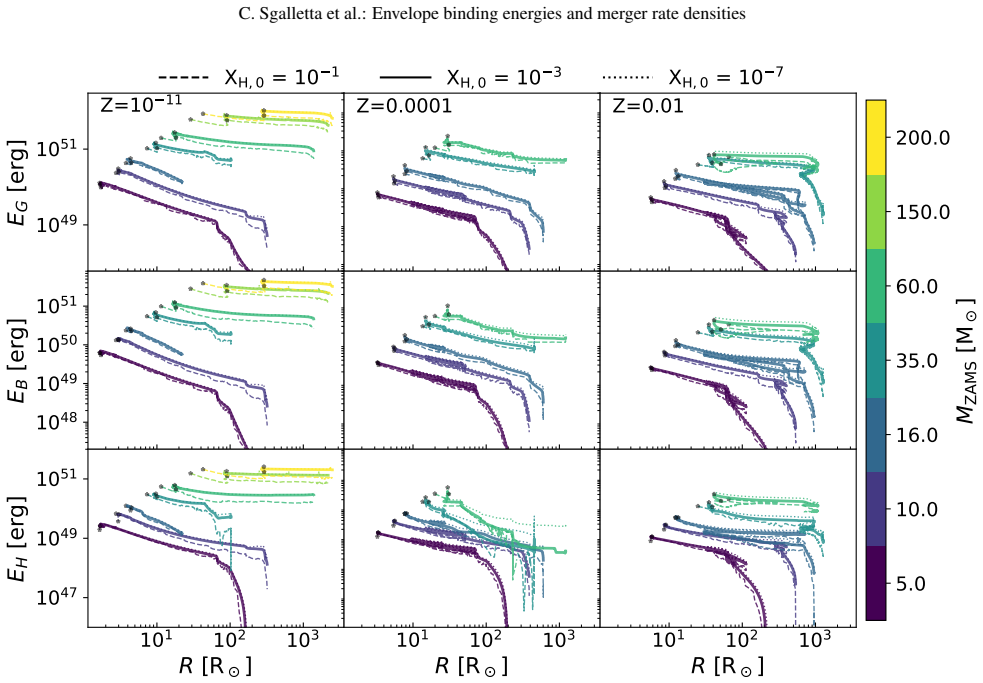
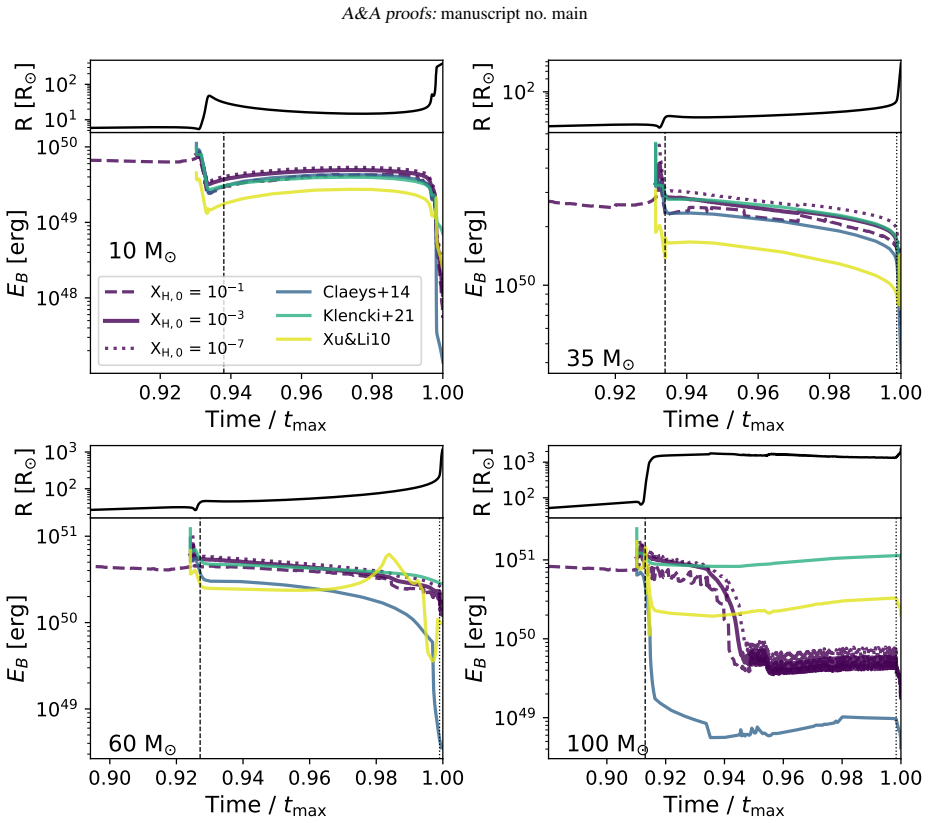
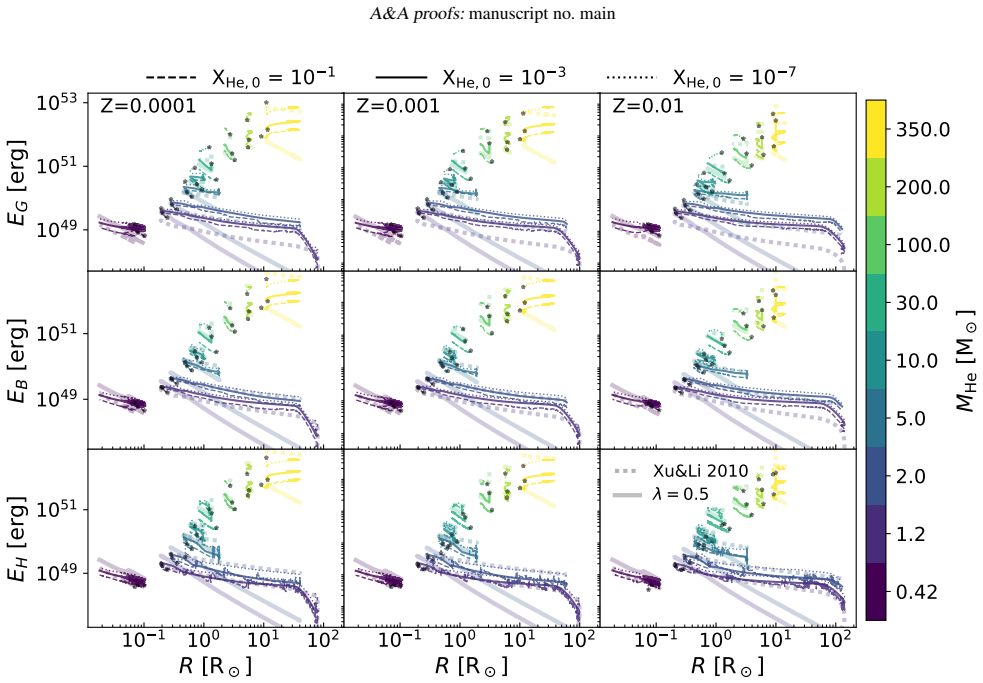
Envelope binding energies derived directly from PARSEC v2.0 tracks, when inserted into the SEVN population synthesis code, produce merger rate densities for compact binaries that differ by more than an order of magnitude from earlier models that used fitting formulas. Internal energy sources dominate the variation for hydrogen-rich stars while core-boundary choice dominates for pure-helium stars, with larger deviations appearing at higher masses and metallicities.
What carries the argument
Envelope binding energy prescriptions computed from PARSEC v2.0 stellar tracks, which set the energy cost of ejecting the common envelope in binary evolution.
If this is right
- For hydrogen-rich stars, different internal energy sources alter envelope binding energies by more than an order of magnitude.
- For pure-helium stars, the core-envelope boundary definition becomes the dominant source of variation in binding energy.
- Envelope binding energies from different stellar tracks deviate by several orders of magnitude, especially at high masses and metallicities.
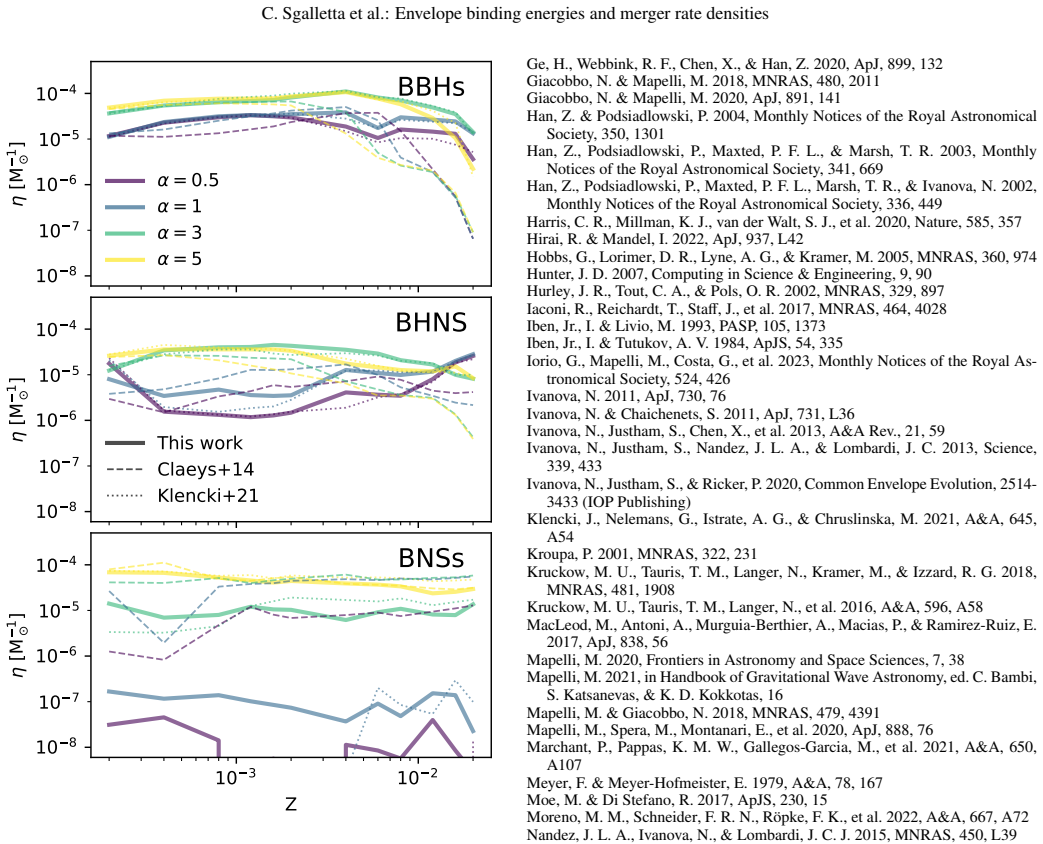
- Inserting the new binding energies into SEVN shifts predicted compact-object merger rate densities by more than an order of magnitude relative to prior fitting-formula models.
- Fitting formulas should not be extrapolated outside the stellar-parameter range where they were calibrated.
Where Pith is reading between the lines
- Revised merger rates would alter expected event counts for ground-based gravitational-wave detectors.
- Population synthesis codes should adopt self-consistent binding energies whenever the stellar model is updated.
- Extending the grid to include rotation or binary interaction effects during the pre-common-envelope phase could further modify the rates.
- Direct comparison across multiple stellar codes would quantify the systematic uncertainty still present in the binding energies.
Load-bearing premise
That the PARSEC v2.0 internal-energy contributions and core-boundary definitions accurately represent real stellar structure.
What would settle it
Recomputing envelope binding energies with an independent stellar evolution code such as MESA for the same initial masses and metallicities and checking whether the order-of-magnitude spread in merger rates remains.
Figures




read the original abstract
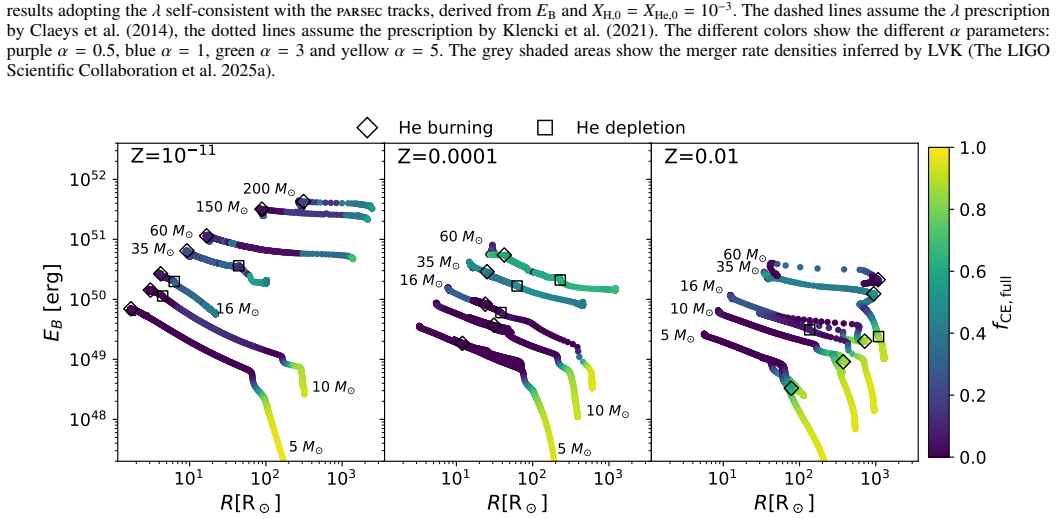
The common envelope (CE) phase plays a key role in the formation of binary compact object systems. Its final outcome strongly depends on the envelope binding energy, but this quantity is often estimated using fitting formulas that are not fully consistent with the underlying stellar evolution models adopted in population-synthesis codes. Here, we investigate envelope binding energies across the most extensive stellar grid considered to date. Our stellar tracks, evolved with PARSEC v2.0, include hydrogen (H) -rich stars with metallicities ranging from $Z = 10^{-11}$ (Population III stars) to $Z = 0.03$, and initial masses between 2 and 2000 M$_\odot$, as well as pure-helium stars with masses from 0.36 to 350 M$_\odot$. We examine the sensitivity of the envelope binding energies to the selected core-envelope boundary definition and to different internal energy source contributions. For H-rich stars, we find that internal energy sources can alter the envelope binding energy by more than an order of magnitude, whereas the core boundary criteria play a secondary role. In contrast, for pure helium stars, the core-boundary criterion becomes the dominant factor. The envelope binding energies derived from different stellar tracks can show deviations of several orders of magnitude, with larger differences for more massive stars and higher metallicities.Finally, by implementing our new envelope binding energy prescriptions into the binary population synthesis code SEVN, we show that the predicted merger rate densities of compact binaries can differ by more than an order of magnitude compared to previous models. Our results highlight the importance of using envelope binding energies that are consistent with the underlying stellar evolution models and caution against extrapolating empirical fits beyond the considered parameter space.
Editorial analysis
A structured set of objections, weighed in public.
Referee Report
Summary. The manuscript computes envelope binding energies E_bind from an extensive grid of PARSEC v2.0 stellar tracks (H-rich stars: 2–2000 M⊙, Z=10^{-11}–0.03; pure-He stars: 0.36–350 M⊙). It quantifies sensitivity to core-envelope boundary definitions and internal-energy contributions, finding >1 dex variations from internal energies in H-rich stars and dominant core-boundary effects in He stars. New prescriptions derived from these tracks are inserted into the SEVN binary population-synthesis code, yielding compact-object merger rate densities that differ by more than an order of magnitude from earlier models that used analytic fitting formulae.
Significance. If the PARSEC-derived binding energies prove representative, the work demonstrates that inconsistency between stellar-evolution models and population-synthesis codes can shift predicted merger rates by >1 dex, directly affecting gravitational-wave source forecasts. The broad parameter space, explicit sensitivity tests, and self-consistent (rather than extrapolated) prescriptions constitute a clear methodological advance over prior fitting-formula approaches.
major comments (2)
- [§4] §4 (SEVN implementation and rate-density results): The headline claim that merger rate densities shift by more than an order of magnitude rests on the assumption that PARSEC v2.0 binding energies are representative of modern stellar structure. The manuscript already shows that internal-energy terms alone move E_bind by >1 dex inside PARSEC; the same magnitude of variation is expected when swapping the entire stellar code (e.g., to MESA). No binding-energy tables or rate comparisons from a second code are provided, so it is impossible to determine whether the reported rate excursion is a general consequence of self-consistent energies or an artifact of PARSEC’s specific convection, overshooting, and thermal-energy treatment. A quantitative cross-code comparison is required to support the central claim.
- [§3] §3 (binding-energy results): While the paper reports deviations of several orders of magnitude in E_bind for massive stars at higher metallicities, the propagation of these variations through SEVN is presented only as a single-point comparison to “previous models.” No Monte-Carlo error budget or sensitivity run that varies the binding-energy prescription within the observed PARSEC scatter is shown, leaving the robustness of the >1 dex rate shift unquantified.
minor comments (3)
- [Figures] Figure captions and legends should explicitly state which internal-energy contributions (thermal, ionization, etc.) are included in each curve; current labels are ambiguous for readers unfamiliar with the exact PARSEC implementation.
- [§3] The fitting formulae for the new E_bind prescriptions are introduced without an explicit functional form or table of coefficients in the main text; these should be provided (or clearly referenced to an appendix) so that other codes can adopt them directly.
- [§2] A brief discussion of how the adopted core-boundary criteria compare with those used in the original SEVN stellar tracks would help readers assess internal consistency.
Simulated Author's Rebuttal
We thank the referee for the constructive and detailed report. The comments highlight important aspects of robustness and generality that we address below. We have revised the manuscript to incorporate clarifications and additional discussion where feasible.
read point-by-point responses
-
Referee: [§4] §4 (SEVN implementation and rate-density results): The headline claim that merger rate densities shift by more than an order of magnitude rests on the assumption that PARSEC v2.0 binding energies are representative of modern stellar structure. The manuscript already shows that internal-energy terms alone move E_bind by >1 dex inside PARSEC; the same magnitude of variation is expected when swapping the entire stellar code (e.g., to MESA). No binding-energy tables or rate comparisons from a second code are provided, so it is impossible to determine whether the reported rate excursion is a general consequence of self-consistent energies or an artifact of PARSEC’s specific convection, overshooting, and thermal-energy treatment. A quantitative cross-code comparison is required to support the central claim.
Authors: We agree that a cross-code comparison would help establish whether the magnitude of the rate shift is universal across modern stellar evolution codes. Our central result, however, is more limited in scope: it demonstrates that replacing analytic fitting formulae with binding energies self-consistently extracted from PARSEC v2.0 tracks inside SEVN produces merger-rate densities that differ by more than an order of magnitude from those in the existing literature. PARSEC v2.0 is a widely used, state-of-the-art code, and the internal variations we already quantify (>1 dex from internal-energy terms alone) illustrate the sensitivity even within a single model. We have added explicit language in the revised §4 and the conclusions stating that the quantitative values are specific to the PARSEC implementation and that other codes (e.g., MESA) may yield different numerical results, while the qualitative importance of self-consistency remains. A full cross-code study lies beyond the present work. revision: partial
-
Referee: [§3] §3 (binding-energy results): While the paper reports deviations of several orders of magnitude in E_bind for massive stars at higher metallicities, the propagation of these variations through SEVN is presented only as a single-point comparison to “previous models.” No Monte-Carlo error budget or sensitivity run that varies the binding-energy prescription within the observed PARSEC scatter is shown, leaving the robustness of the >1 dex rate shift unquantified.
Authors: We acknowledge that a dedicated sensitivity study would strengthen the robustness statement. The submitted manuscript presents the primary comparison using our fiducial PARSEC-derived prescription. Because the E_bind variations already documented in §3 exceed 1 dex for the stellar masses and metallicities that dominate the merger-rate integral, the order-of-magnitude shift relative to previous analytic prescriptions is driven by differences that are substantially larger than the internal PARSEC scatter. We have expanded the discussion in the revised §4 to make this explicit, noting that even if the binding energy were varied within the full range of core-boundary and internal-energy choices explored in the PARSEC grid, the resulting rate densities would still differ from the literature values by at least several times and typically by an order of magnitude. A full Monte-Carlo propagation over all possible combinations is computationally intensive and is noted as desirable future work. revision: partial
- Quantitative cross-code comparison of binding-energy tables and resulting merger-rate densities using an independent stellar-evolution code such as MESA
Circularity Check
No significant circularity; binding energies derived from independent PARSEC v2.0 tracks and inserted into SEVN
full rationale
The paper computes envelope binding energies directly from PARSEC v2.0 stellar evolution grids (external code) across wide ranges of mass, metallicity, and internal-energy assumptions. These values are then supplied as prescriptions to the SEVN population-synthesis code to obtain merger-rate densities, which are compared against earlier models that used inconsistent fitting formulae. No step reduces by construction to its own inputs: the rate output is not a re-expression of the PARSEC-derived E_bind values, no parameter is fitted on a subset and then relabeled a prediction, and no load-bearing uniqueness theorem or ansatz is imported solely via self-citation. The derivation chain therefore remains self-contained against external benchmarks.
Axiom & Free-Parameter Ledger
axioms (1)
- domain assumption PARSEC v2.0 accurately captures the internal energy sources and core-envelope boundaries for the full mass and metallicity range examined
Reference graph
Works this paper leans on
-
[1]
D., Acernese, F., et al
Abbott, R., Abbott, T. D., Acernese, F., et al. 2023, Phys. Rev. X, 13, 011048
2023
-
[2]
Andrews, B. H. & Martini, P. 2013, ApJ, 765, 140 Astropy Collaboration, Price-Whelan, A. M., Lim, P. L., et al. 2022, ApJ, 935, 167 Astropy Collaboration, Price-Whelan, A. M., Sip˝ocz, B. M., et al. 2018, AJ, 156, 123 Astropy Collaboration, Robitaille, T. P., Tollerud, E. J., et al. 2013, A&A, 558, A33
2013
-
[3]
S., Fragos, T., Zevin, M., et al
Bavera, S. S., Fragos, T., Zevin, M., et al. 2021, A&A, 647, A153
2021
-
[4]
2002, ApJ, 572, 407
Belczynski, K., Kalogera, V ., & Bulik, T. 2002, ApJ, 572, 407
2002
-
[5]
E., et al
Belczynski, K., Klencki, J., Fields, C. E., et al. 2020, A&A, 636, A104 Article number, page 10 of 13 C. Sgalletta et al.: Envelope binding energies and merger rate densities 10 8 10 6 10 4 10 7 10 5 [M 1] BBHs = 0.5 = 1 = 3 = 5 10 8 10 6 10 4 10 7 10 5 [M 1] BHNS This work Claeys+14 Klencki+21 10 3 10 2 Z 10 8 10 6 10 4 10 7 10 5 [M 1] BNSs Fig. 7.Merger...
2020
-
[6]
P., Broekgaarden, F
Boesky, A. P., Broekgaarden, F. S., & Berger, E. 2024, ApJ, 976, 24
2024
-
[7]
2020, ApJ, 898, 71
Breivik, K., Coughlin, S., Zevin, M., et al. 2020, ApJ, 898, 71
2020
-
[8]
2012, MNRAS, 427, 127
Bressan, A., Marigo, P., Girardi, L., et al. 2012, MNRAS, 427, 127
2012
-
[9]
G., Chiosi, C., & Bertelli, G
Bressan, A. G., Chiosi, C., & Bertelli, G. 1981, A&A, 102, 25
1981
-
[10]
S., Berger, E., Neijssel, C
Broekgaarden, F. S., Berger, E., Neijssel, C. J., et al. 2021, MNRAS, 508, 5028
2021
-
[11]
S., Berger, E., Stevenson, S., et al
Broekgaarden, F. S., Berger, E., Stevenson, S., et al. 2022, MNRAS, 516, 5737
2022
-
[12]
G., Steffen, M., Freytag, B., & Bonifacio, P
Caffau, E., Ludwig, H. G., Steffen, M., Freytag, B., & Bonifacio, P. 2011, Sol. Phys., 268, 255
2011
-
[13]
2018, MNRAS, 474, 2937
Chruslinska, M., Belczynski, K., Klencki, J., & Benacquista, M. 2018, MNRAS, 474, 2937
2018
-
[14]
& Nelemans, G
Chruslinska, M. & Nelemans, G. 2019, MNRAS, 488, 5300
2019
-
[15]
Claeys, J. S. W., Pols, O. R., Izzard, R. G., Vink, J., & Verbunt, F. W. M. 2014, A&A, 563, A83
2014
-
[16]
2021, 501, 4514
Costa, G., Bressan, A., Mapelli, M., et al. 2021, 501, 4514
2021
-
[17]
2019, MNRAS, 485, 4641
Costa, G., Girardi, L., Bressan, A., et al. 2019, MNRAS, 485, 4641
2019
-
[18]
G., Bressan, A., et al
Costa, G., Shepherd, K. G., Bressan, A., et al. 2025, A&A, 694, A193 De Marco, O., Passy, J.-C., Moe, M., et al. 2011, MNRAS, 411, 2277
2025
-
[19]
Dewi, J. D. M. & Tauris, T. M. 2000, A&A, 360, 1043 Di Stefano, R., Kruckow, M. U., Gao, Y ., Neunteufel, P. G., & Kobayashi, C. 2023, ApJ, 944, 87
2000
-
[20]
2023, MNRAS, 521, 4323
El-Badry, K., Rix, H.-W., Cendes, Y ., et al. 2023, MNRAS, 521, 4323
2023
-
[21]
J., Ramirez-Ruiz, E., et al
Fragos, T., Andrews, J. J., Ramirez-Ruiz, E., et al. 2019, ApJ, 883, L45
2019
-
[22]
L., Belczynski, K., Wiktorowicz, G., et al
Fryer, C. L., Belczynski, K., Wiktorowicz, G., et al. 2012, ApJ, 749, 91
2012
-
[23]
Gallegos-Garcia, M., Berry, C. P. L., Marchant, P., & Kalogera, V . 2021, ApJ, 922, 110
2021
-
[24]
F., Chen, X., & Han, Z
Ge, H., Webbink, R. F., Chen, X., & Han, Z. 2020, ApJ, 899, 132
2020
-
[25]
& Mapelli, M
Giacobbo, N. & Mapelli, M. 2018, MNRAS, 480, 2011
2018
-
[26]
& Mapelli, M
Giacobbo, N. & Mapelli, M. 2020, ApJ, 891, 141
2020
-
[27]
& Podsiadlowski, P
Han, Z. & Podsiadlowski, P. 2004, Monthly Notices of the Royal Astronomical Society, 350, 1301
2004
-
[28]
Han, Z., Podsiadlowski, P., Maxted, P. F. L., & Marsh, T. R. 2003, Monthly Notices of the Royal Astronomical Society, 341, 669
2003
-
[29]
Han, Z., Podsiadlowski, P., Maxted, P. F. L., Marsh, T. R., & Ivanova, N. 2002, Monthly Notices of the Royal Astronomical Society, 336, 449
2002
-
[30]
R., Millman, K
Harris, C. R., Millman, K. J., van der Walt, S. J., et al. 2020, Nature, 585, 357
2020
-
[31]
& Mandel, I
Hirai, R. & Mandel, I. 2022, ApJ, 937, L42
2022
-
[32]
R., Lyne, A
Hobbs, G., Lorimer, D. R., Lyne, A. G., & Kramer, M. 2005, MNRAS, 360, 974
2005
-
[33]
Hunter, J. D. 2007, Computing in Science & Engineering, 9, 90
2007
-
[34]
R., Tout, C
Hurley, J. R., Tout, C. A., & Pols, O. R. 2002, MNRAS, 329, 897
2002
-
[35]
2017, MNRAS, 464, 4028
Iaconi, R., Reichardt, T., Staff, J., et al. 2017, MNRAS, 464, 4028
2017
-
[36]
& Livio, M
Iben, Jr., I. & Livio, M. 1993, PASP, 105, 1373
1993
-
[37]
& Tutukov, A
Iben, Jr., I. & Tutukov, A. V . 1984, ApJS, 54, 335
1984
-
[38]
2023, Monthly Notices of the Royal As- tronomical Society, 524, 426
Iorio, G., Mapelli, M., Costa, G., et al. 2023, Monthly Notices of the Royal As- tronomical Society, 524, 426
2023
-
[39]
2011, ApJ, 730, 76
Ivanova, N. 2011, ApJ, 730, 76
2011
-
[40]
& Chaichenets, S
Ivanova, N. & Chaichenets, S. 2011, ApJ, 731, L36
2011
-
[41]
2013, A&A Rev., 21, 59
Ivanova, N., Justham, S., Chen, X., et al. 2013, A&A Rev., 21, 59
2013
-
[42]
Ivanova, N., Justham, S., Nandez, J. L. A., & Lombardi, J. C. 2013, Science, 339, 433
2013
-
[43]
2020, Common Envelope Evolution, 2514- 3433 (IOP Publishing)
Ivanova, N., Justham, S., & Ricker, P. 2020, Common Envelope Evolution, 2514- 3433 (IOP Publishing)
2020
-
[44]
G., & Chruslinska, M
Klencki, J., Nelemans, G., Istrate, A. G., & Chruslinska, M. 2021, A&A, 645, A54
2021
-
[45]
2001, MNRAS, 322, 231
Kroupa, P. 2001, MNRAS, 322, 231
2001
-
[46]
U., Tauris, T
Kruckow, M. U., Tauris, T. M., Langer, N., Kramer, M., & Izzard, R. G. 2018, MNRAS, 481, 1908
2018
-
[47]
U., Tauris, T
Kruckow, M. U., Tauris, T. M., Langer, N., et al. 2016, A&A, 596, A58
2016
-
[48]
2017, ApJ, 838, 56
MacLeod, M., Antoni, A., Murguia-Berthier, A., Macias, P., & Ramirez-Ruiz, E. 2017, ApJ, 838, 56
2017
-
[49]
2020, Frontiers in Astronomy and Space Sciences, 7, 38
Mapelli, M. 2020, Frontiers in Astronomy and Space Sciences, 7, 38
2020
-
[50]
2021, in Handbook of Gravitational Wave Astronomy, ed
Mapelli, M. 2021, in Handbook of Gravitational Wave Astronomy, ed. C. Bambi, S. Katsanevas, & K. D. Kokkotas, 16
2021
-
[51]
& Giacobbo, N
Mapelli, M. & Giacobbo, N. 2018, MNRAS, 479, 4391
2018
-
[52]
2020, ApJ, 888, 76
Mapelli, M., Spera, M., Montanari, E., et al. 2020, ApJ, 888, 76
2020
-
[53]
Marchant, P., Pappas, K. M. W., Gallegos-Garcia, M., et al. 2021, A&A, 650, A107
2021
-
[54]
& Meyer-Hofmeister, E
Meyer, F. & Meyer-Hofmeister, E. 1979, A&A, 78, 167
1979
-
[55]
& Di Stefano, R
Moe, M. & Di Stefano, R. 2017, ApJS, 230, 15
2017
-
[56]
M., Schneider, F
Moreno, M. M., Schneider, F. R. N., Röpke, F. K., et al. 2022, A&A, 667, A72
2022
-
[57]
Nandez, J. L. A., Ivanova, N., & Lombardi, J. C. J. 2015, MNRAS, 450, L39
2015
-
[58]
J., Vigna-Gómez, A., Stevenson, S., et al
Neijssel, C. J., Vigna-Gómez, A., Stevenson, S., et al. 2019, MNRAS, 490, 3740
2019
-
[59]
& Tout, C
Nelemans, G. & Tout, C. A. 2005, MNRAS, 356, 753
2005
-
[60]
R., & Portegies Zwart, S
Nelemans, G., Verbunt, F., Yungelson, L. R., & Portegies Zwart, S. F. 2000, A&A, 360, 1011
2000
-
[61]
T., Costa, G., Girardi, L., et al
Nguyen, C. T., Costa, G., Girardi, L., et al. 2022, Astronomy & Astrophysics, 665, A126
2022
-
[62]
T., Röpke, F
Ohlmann, S. T., Röpke, F. K., Pakmor, R., & Springel, V . 2016, ApJ, 816, L9 Özel, F., Psaltis, D., Arzoumanian, Z., Morsink, S., & Bauböck, M. 2016, ApJ, 832, 92 Özel, F., Psaltis, D., Narayan, R., & Santos Villarreal, A. 2012, ApJ, 757, 55
2016
-
[63]
1976, in IAU Symposium, V ol
Paczynski, B. 1976, in IAU Symposium, V ol. 73, Structure and Evolution of Close Binary Systems, ed. P. Eggleton, S. Mitton, & J. Whelan, 75
1976
-
[64]
L., et al
Passy, J.-C., De Marco, O., Fryer, C. L., et al. 2012, ApJ, 744, 52
2012
-
[65]
2024, ApJ, 969, 1
Picker, L., Hirai, R., & Mandel, I. 2024, ApJ, 969, 1
2024
-
[66]
2001, in Astronomical Society of the Pacific Conference Se- ries, V ol
Podsiadlowski, P. 2001, in Astronomical Society of the Pacific Conference Se- ries, V ol. 229, Evolution of Binary and Multiple Star Systems, ed. P. Podsiad- lowski, S. Rappaport, A. R. King, F. D’Antona, & L. Burderi, 239
2001
-
[67]
& Weiler, K
Politano, M. & Weiler, K. P. 2007, ApJ, 665, 663
2007
-
[68]
2023, MNRAS, 519, 1526
Popesso, P., Concas, A., Cresci, G., et al. 2023, MNRAS, 519, 1526
2023
-
[69]
Ricker, P. M. & Taam, R. E. 2012, ApJ, 746, 74
2012
-
[70]
W., et al
Riley, J., Agrawal, P., Barrett, J. W., et al. 2022, ApJS, 258, 34
2022
-
[71]
2015, The Astrophysical Journal Letters, 800, L10 Román-Garza, J., Bavera, S
Rodighiero, G., Brusa, M., Daddi, E., et al. 2015, The Astrophysical Journal Letters, 800, L10 Román-Garza, J., Bavera, S. S., Fragos, T., et al. 2021, ApJ, 912, L23 Röpke, F. K. & De Marco, O. 2023, Living Reviews in Computational Astro- physics, 9, 2
2015
-
[72]
E., de Koter, A., et al
Sana, H., de Mink, S. E., de Koter, A., et al. 2012, Science, 337, 444
2012
-
[73]
C., & Boco, L
Santoliquido, F., Mapelli, M., Artale, M. C., & Boco, L. 2022, MNRAS, 516, 3297
2022
-
[74]
T., Béthermin, M., Daddi, E., & Elbaz, D
Sargent, M. T., Béthermin, M., Daddi, E., & Elbaz, D. 2012, ApJ, 747, L31
2012
-
[75]
2015, A&A, 575, A74
Schreiber, C., Pannella, M., Elbaz, D., et al. 2015, A&A, 575, A74
2015
-
[76]
2023, MNRAS, 526, 2210
Sgalletta, C., Iorio, G., Mapelli, M., et al. 2023, MNRAS, 526, 2210
2023
-
[77]
2025, A&A, 698, A144
Sgalletta, C., Mapelli, M., Boco, L., et al. 2025, A&A, 698, A144
2025
-
[78]
G., Costa, G., Ugolini, C., et al
Shepherd, K. G., Costa, G., Ugolini, C., et al. 2025, A&A, 701, A126
2025
-
[79]
& Mapelli, M
Spera, M. & Mapelli, M. 2017, MNRAS, 470, 4739 Article number, page 11 of 13 A&A proofs:manuscript no. main 0.0 2.5 5.0 7.5 z 10 1 100 101 102 103 104 (z) [Gpc 3 yr 1] BBHs This work Claeys+14 Klencki+21 0.0 2.5 5.0 7.5 z BHNS = 0.5 = 1 = 3 = 5 0.0 2.5 5.0 7.5 z BNSs Fig. 8.Merger rate density of BBHs (left), BHNS (center) and BNSs (right) for differentλp...
2017
-
[80]
2019, MNRAS, 485, 889
Spera, M., Mapelli, M., Giacobbo, N., et al. 2019, MNRAS, 485, 889
2019
discussion (0)
Sign in with ORCID, Apple, or X to comment. Anyone can read and Pith papers without signing in.