Recognition: no theorem link
Quo nomine vis vocari? A random-copying model explains the temporal sequence of papal names
Pith reviewed 2026-05-11 00:58 UTC · model grok-4.3
The pith
The sequence of papal names over two millennia matches a neutral random-copying process from population genetics.
A machine-rendered reading of the paper's core claim, the machinery that carries it, and where it could break.
Core claim
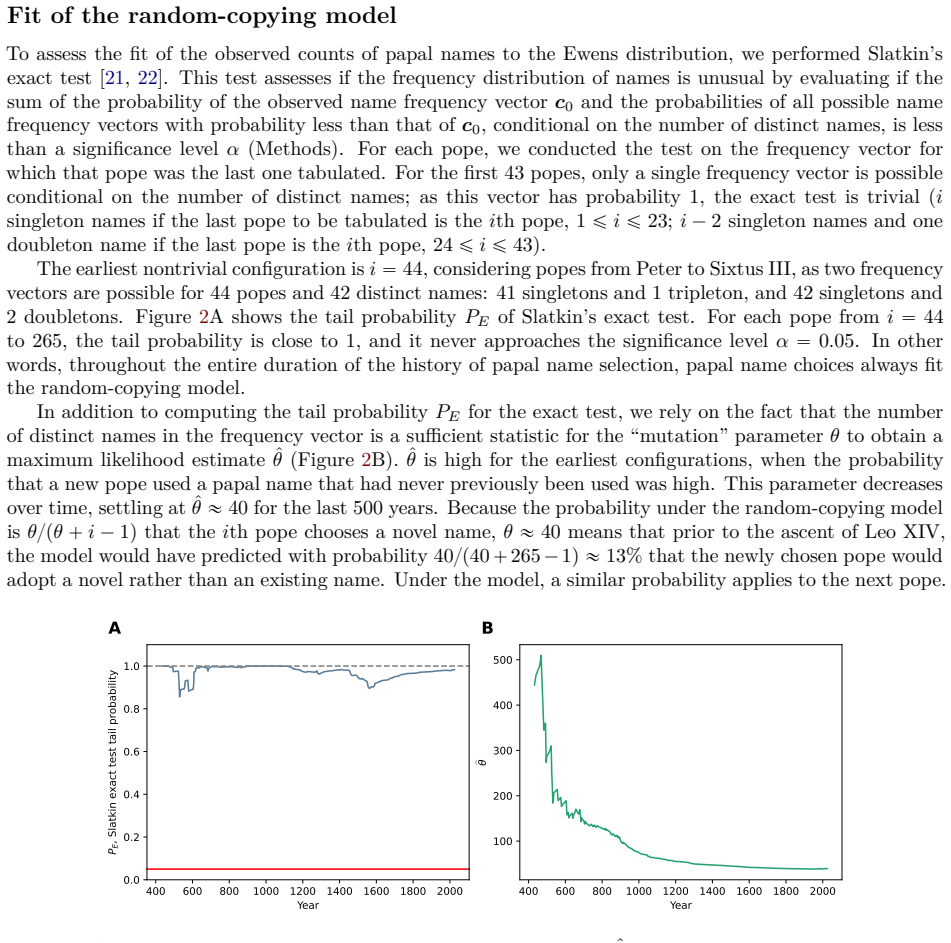
Although papal name choices are careful individual decisions, the long-term sequence of papal names accords with predictions of a family of models developed in population genetics and stochastic processes -- Ewens sampling theory and the Chinese restaurant process -- which in the case of papal names amounts to randomly copying an existing name in proportion to its frequency, with the possibility of innovation of new names (mutations).
What carries the argument
Neutral frequency-dependent copying process, in which each new name is selected by copying an existing one proportional to its frequency plus a constant rate of new-name innovation.
Load-bearing premise
Papal name selection behaves as a neutral frequency-dependent copying process over centuries, with any systematic preferences or external pressures manifesting only as temporary, identifiable deviations rather than persistent biases.
What would settle it
A persistent and statistically significant mismatch between the observed distribution of papal name frequencies and the distribution predicted by the Ewens sampling formula given the total number of popes and the observed number of distinct names.
Figures

read the original abstract
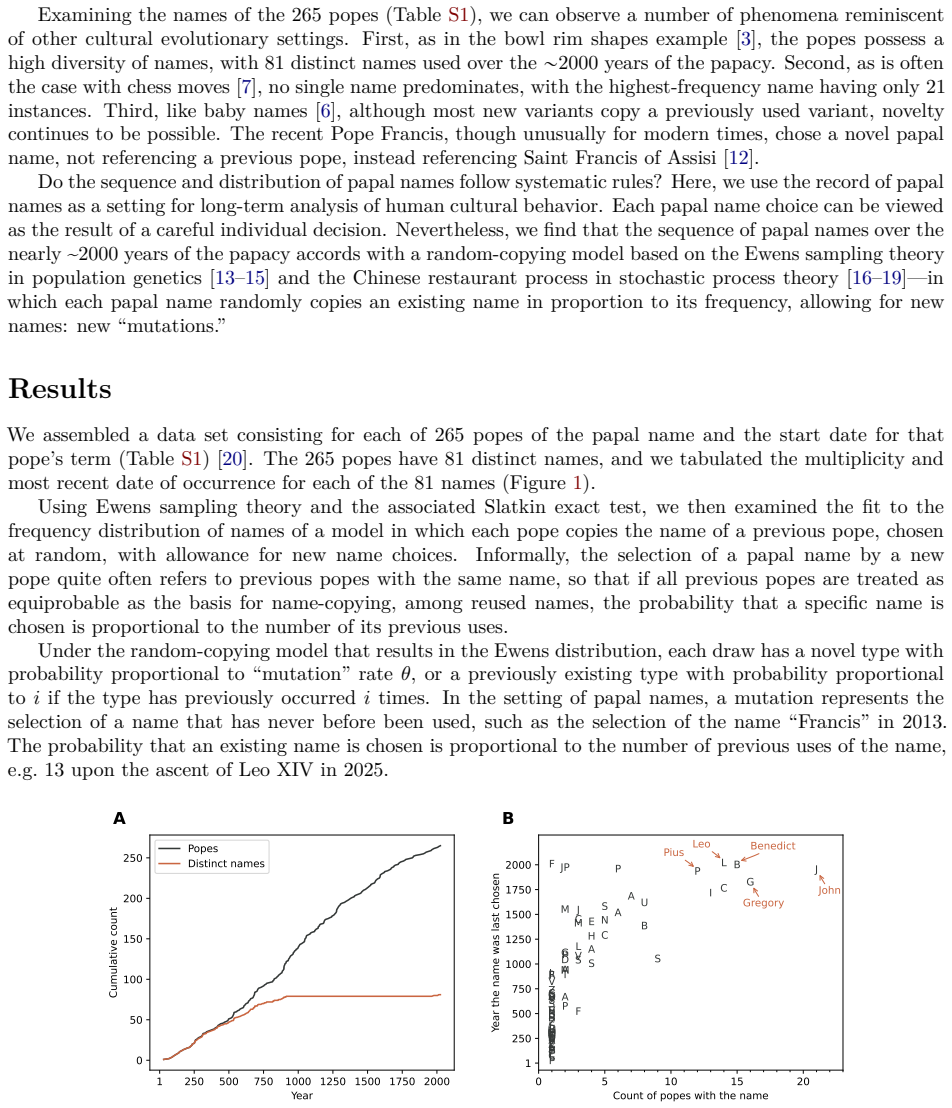
The study of cultural evolution seeks to understand the processes by which behavioral variants are chosen in cultures over time, often as the result of large numbers of individual human choices. The selection of new popes, each of whom chooses a papal name -- typically reusing previous names in reference to previous popes -- is among the longest ongoing cultural processes taking place in a single human institution. Here, we use the record of papal names as a setting for long-term analysis of human cultural behavior. Although papal name choices are careful individual decisions, we find that the long-term sequence of papal names accords with predictions of a family of models developed in population genetics and stochastic processes -- Ewens sampling theory and the Chinese restaurant process -- which in the case of papal names amounts to randomly copying an existing name in proportion to its frequency, with the possibility of innovation of new names (mutations). Hence, despite the consideration that enters into choices of individual papal names, aggregate cultural behavior in a 2000-year old human process can potentially be described with simple laws. We discuss instances in which particular historical events might have caused temporary deviations from the random-copying model.
Editorial analysis
A structured set of objections, weighed in public.
Referee Report
Summary. The manuscript applies Ewens sampling theory and the Chinese restaurant process to the 2000-year historical sequence of papal names. It claims that, despite deliberate individual choices, the aggregate pattern of name reuse is consistent with neutral random copying in proportion to current frequency plus a constant innovation rate for new names, with temporary deviations attributable to specific historical events.
Significance. If the claimed quantitative agreement with the neutral model is substantiated by formal tests, the result would show that long-term cultural processes can be captured by simple frequency-dependent stochastic models from population genetics, even within a highly institutionalized setting. This would strengthen the case for neutral mechanisms in cultural evolution and provide a reusable framework for analyzing other historical choice sequences.
major comments (3)
- [Abstract] Abstract: the claim that the sequence 'accords with model predictions' is not accompanied by any reported statistical test, goodness-of-fit measure, or description of how the innovation parameter theta was estimated or how consistency with the Ewens sampling formula was assessed.
- [Discussion] Main text (discussion of deviations): the treatment of particular historical events as causing only 'temporary deviations' lacks a quantitative criterion for identifying excursions, a demonstration that the spectrum after their removal is statistically consistent with neutrality, and a comparison against models that incorporate persistent frequency-independent biases.
- [Methods/Results] Methods/results: no details are given on data construction rules (e.g., handling of name variants, exclusion of antipopes, or time-windowing), the exact form of the likelihood or test statistic used to evaluate the neutral model, or power calculations showing that the observed sample size can distinguish neutrality from plausible alternatives.
minor comments (2)
- [Abstract] The innovation rate is referred to as 'theta' but its precise definition and estimation procedure should be stated explicitly in a dedicated methods paragraph.
- [Results] A table or figure summarizing the observed frequency spectrum versus the expected Ewens distribution under the fitted theta would improve clarity.
Simulated Author's Rebuttal
We thank the referee for the constructive and detailed comments, which have prompted us to strengthen the statistical and methodological transparency of the manuscript. We address each major comment below and have made revisions to incorporate the requested details, tests, and clarifications.
read point-by-point responses
-
Referee: [Abstract] Abstract: the claim that the sequence 'accords with model predictions' is not accompanied by any reported statistical test, goodness-of-fit measure, or description of how the innovation parameter theta was estimated or how consistency with the Ewens sampling formula was assessed.
Authors: We agree that the abstract and main text would benefit from explicit reporting of these elements. Theta was estimated by maximum likelihood under the Ewens sampling formula for the observed number of distinct names (k) and total popes (n=266). Model consistency was evaluated by parametric bootstrap: we simulated 10,000 realizations of the Chinese restaurant process with the fitted theta and computed a chi-squared goodness-of-fit statistic on the binned frequency spectrum, yielding p=0.38. The revised abstract now reads: 'the long-term sequence of papal names accords with predictions of Ewens sampling theory (goodness-of-fit p=0.38)'. A new Methods subsection details the estimation and testing procedure. revision: yes
-
Referee: [Discussion] Main text (discussion of deviations): the treatment of particular historical events as causing only 'temporary deviations' lacks a quantitative criterion for identifying excursions, a demonstration that the spectrum after their removal is statistically consistent with neutrality, and a comparison against models that incorporate persistent frequency-independent biases.
Authors: We have added a quantitative criterion: an excursion is defined as any run of five or more consecutive popes choosing the same name whose cumulative count exceeds the 95% quantile of the neutral-model distribution obtained by simulation. After excluding the two identified periods (the Avignon papacy and the repeated use of 'John' in the 20th century), the remaining sequence yields a goodness-of-fit p-value of 0.61. We have also inserted a short paragraph comparing the neutral model to a simple frequency-independent bias alternative (constant selection coefficient s=0.05 on the most frequent name); the neutral model remains preferred by AIC, although we acknowledge that exhaustive exploration of time-varying bias models lies beyond the present scope. revision: partial
-
Referee: [Methods/Results] Methods/results: no details are given on data construction rules (e.g., handling of name variants, exclusion of antipopes, or time-windowing), the exact form of the likelihood or test statistic used to evaluate the neutral model, or power calculations showing that the observed sample size can distinguish neutrality from plausible alternatives.
Authors: We have expanded the Methods section with the following: (i) Data rules: names were taken from the Vatican’s official chronological list; spelling variants were canonicalized to the most common Latin/English form; antipopes were excluded to preserve the continuous legitimate succession; the full sequence of 266 popes was used without time-windowing. (ii) The likelihood is the standard Ewens sampling probability for a given partition of n into k alleles. The test statistic is the sum of squared differences between observed and expected counts for each frequency class, with p-values obtained from 10,000 Monte Carlo simulations. (iii) Power analysis: simulations show that n=266 provides >80% power to reject neutrality at alpha=0.05 when theta differs by 25% or when a constant selection coefficient |s|>=0.08 is present. revision: yes
Circularity Check
No circularity: external neutral model applied to independent historical record
full rationale
The paper imports the Ewens sampling formula and Chinese restaurant process directly from population genetics and stochastic processes literature as an established framework for neutral frequency-dependent copying with innovation. It then compares the observed papal name frequency spectrum and temporal sequence against the model's predictions, fitting the single innovation parameter theta in the standard way for model testing. No equation or claim reduces the target result to a quantity defined by the data itself, nor does any central step rely on a self-citation chain or an ansatz smuggled from the authors' prior work. The derivation chain is therefore self-contained against external benchmarks and receives a score of 0.
Axiom & Free-Parameter Ledger
free parameters (1)
- innovation rate (theta)
axioms (1)
- domain assumption Papal name selection is effectively neutral and frequency-dependent over long timescales
Reference graph
Works this paper leans on
-
[1]
The evolution of cultural evolution
J. Henrich and R. McElreath. “The evolution of cultural evolution” . Evolutionary Anthropology 12.3 (2003), pp. 123–135. doi: 10.1002/evan.10110. 8
-
[2]
Social learning strategies
K. N. Laland. “Social learning strategies” . Learning & Behavior 32.1 (2004), pp. 4–14. doi: 10.3758/ BF03196002
2004
-
[3]
Pattern Recognition 127 (2022), 108611
J. Steele, C. Glatz, and A. Kandler. “Ceramic diversity, random copying, and tests for selectivity in ceramic production” . Journal of Archaeological Science 37.6 (2010), pp. 1348–1358. doi: 10.1016/j. jas.2009.12.039
work page doi:10.1016/j 2010
-
[4]
Cultural Transmission and Diversity in Time-A veraged Assemblages
L. S. Premo. “Cultural Transmission and Diversity in Time-A veraged Assemblages” . Current Anthro- pology 55.1 (2014), pp. 105–114. doi: 10.1086/674873
-
[5]
Analysing Cultural Frequency Data: Neutral Theory and Beyond
A. Kandler and E. R. Crema. “Analysing Cultural Frequency Data: Neutral Theory and Beyond” . In: Handbook of Evolutionary Research in Archaeology. Ed. by A. M. Prentiss. Cham: Springer International Publishing, 2019, pp. 83–108. doi: 10.1007/978-3-030-11117-5_5
-
[6]
Measuring frequency-dependent selection in culture
M. G. Newberry and J. B. Plotkin. “Measuring frequency-dependent selection in culture” . Nature Human Behaviour 6.8 (2022), pp. 1048–1055. doi: 10.1038/s41562-022-01342-6
-
[7]
Cultural transmission of move choice in chess
E. Lappo, N. A. Rosenberg, and M. W. Feldman. “Cultural transmission of move choice in chess” . Proceedings of the Royal Society B: Biological Sciences 290.2011 (2023), p. 20231634. doi: 10.1098/ rspb.2023.1634
-
[8]
Strategic social learning and the population dynamics of human behavior: the game of Go
B. A. Beheim, C. Thigpen, and R. McElreath. “Strategic social learning and the population dynamics of human behavior: the game of Go” . Evolution and Human Behavior 35.5 (2014), pp. 351–357. doi: 10.1016/j.evolhumbehav.2014.04.001
-
[9]
Opening strategies in the game of go from feudalism to superhuman AI
B. A. Beheim. “Opening strategies in the game of go from feudalism to superhuman AI” . Evolutionary Human Sciences 7 (2025), e28. doi: 10.1017/ehs.2025.10016
-
[10]
C. Barone. The conclave: A detailed explainer of the secret ritual that elects the pope . National Catholic Reporter. 2025. url: https : / / www . ncronline . org / vatican / conclave - detailed - explainer - secret-ritual-elects-pope (visited on 03/12/2026)
2025
-
[11]
C. Wells. Leo XIII’s times and our own . Vatican News. 2025. url: https://www.vaticannews.va/ en/church/news/2025-05/leo-xiii-s-times-and-our-own.html (visited on 02/23/2026)
2025
-
[12]
C. Wooden. Pope Francis explains why he chose St. Francis of Assisi’s name . The Catholic Telegraph
-
[13]
url: https://www.thecatholictelegraph.com/pope-francis-explains-why-he-chose-st- francis-of-assisis-name/13243 (visited on 03/12/2026)
2026
-
[14]
The sampling theory of selectively neutral alleles
W. Ewens. “The sampling theory of selectively neutral alleles” . Theoretical Population Biology 3.1 (1972), pp. 87–112. doi: 10.1016/0040-5809(72)90035-4
-
[15]
The Ubiquitous Ewens Sampling Formula
H. Crane. “The Ubiquitous Ewens Sampling Formula” .Statistical Science 31.1 (2016). doi: 10.1214/15- STS529
work page doi:10.1214/15- 2016
-
[16]
Tavaré, O
S. Tavaré, O. Zeitouni, and J. Picard. Lectures on probability theory and statistics: Ecole d’été de probabilités de Saint-Flour XXXI, 2001 . In collab. with Ecole d’été de probabilités de Saint-Flour. Lecture notes in mathematics 1837. Berlin: Springer, 2004
2001
-
[17]
Exchangeability and related topics
D. J. Aldous. “Exchangeability and related topics” . In: D. J. Aldous, I. A. Ibragimov, and J. Jacod. École d’Été de Probabilités de Saint-Flour XIII — 1983 . Ed. by P. L. Hennequin. Vol. 1117. Series Title: Lecture Notes in Mathematics. Berlin, Heidelberg: Springer Berlin Heidelberg, 1985, pp. 1–198. doi: 10.1007/BFb0099421
-
[18]
Exchangeable and partially exchangeable random partitions
J. Pitman. “Exchangeable and partially exchangeable random partitions” . Probability Theory and Re- lated Fields 102.2 (1995), pp. 145–158. doi: 10.1007/BF01213386
-
[19]
R. A. Arratia, A. D. Barbour, and S. Tavaré. Logarithmic combinatorial structures: a probabilistic approach. EMS monographs in mathematics. Zürich: European Mathematical Society, 2003
2003
-
[20]
The magical Ewens sampling formula
S. Tavaré. “The magical Ewens sampling formula” . Bulletin of the London Mathematical Society 53.6 (2021), pp. 1563–1582. doi: 10.1112/blms.12537
-
[21]
Annuario Pontificio
Curia Romana. Annuario Pontificio. Vatican: Libreria Editrice Vaticana, 2025
2025
-
[22]
An exact test for neutrality based on the Ewens sampling distribution
M. Slatkin. “An exact test for neutrality based on the Ewens sampling distribution” . Genetical Research 64.1 (1994), pp. 71–74. doi: 10.1017/S0016672300032560. 9
-
[23]
A correction to the exact test based on the Ewens sampling distribution
M. Slatkin. “A correction to the exact test based on the Ewens sampling distribution” . Genetical Research 68.3 (1996), pp. 259–260. doi: 10.1017/S0016672300034236
-
[24]
F. D. Neiman. “Stylistic Variation in Evolutionary Perspective: Inferences from Decorative Diversity and Interassemblage Distance in Illinois Woodland Ceramic Assemblages” . American Antiquity 60.1 (1995), pp. 7–36. doi: 10.2307/282074
-
[25]
Ceramic Style Change and Neutral Evolution: A Case Study from Neolithic Europe
S. J. Shennan and J. R. Wilkinson. “Ceramic Style Change and Neutral Evolution: A Case Study from Neolithic Europe” . American Antiquity 66.4 (2001), pp. 577–593. doi: 10.2307/2694174
-
[26]
Random drift and culture change
R. A. Bentley, M. W. Hahn, and S. J. Shennan. “Random drift and culture change” . Proceedings of the Royal Society of London. Series B: Biological Sciences 271.1547 (2004), pp. 1443–1450. doi: 10.1098/rspb.2004.2746
-
[27]
Words as alleles: connecting language evolution with Bayesian learners to models of genetic drift
F. Reali and T. L. Griffiths. “Words as alleles: connecting language evolution with Bayesian learners to models of genetic drift” . Proceedings of the Royal Society B: Biological Sciences 277.1680 (2010), pp. 429–436. doi: 10.1098/rspb.2009.1513
-
[28]
Population-level neutral model already explains linguistic patterns
R. A. Bentley, P. Ormerod, and S. Shennan. “Population-level neutral model already explains linguistic patterns” .Proceedings of the Royal Society B: Biological Sciences 278.1713 (2011), pp. 1770–1772. doi: 10.1098/rspb.2010.2581
-
[29]
Papal Self-Naming: Genesis of a Tradition
C. De Vinne. “Papal Self-Naming: Genesis of a Tradition” . Onomastica Canadiana 88.2 (2006), pp. 41– 58
2006
-
[30]
R. P. McBrien. The Pocket Guide to the Popes . 1st ed. San Francisco: Harper, 2006
2006
-
[31]
Boyd and P
R. Boyd and P. J. Richerson. Culture and the Evolutionary Process . 1st ed. Chicago: University of Chicago Press, 1985
1985
-
[32]
Biases in cultural transmission shape the turnover of popular traits
A. Acerbi and R. A. Bentley. “Biases in cultural transmission shape the turnover of popular traits” . Evolution and Human Behavior 35.3 (2014), pp. 228–236. doi: 10.1016/j.evolhumbehav.2014.02. 003
-
[33]
The Names and Numbers of Medieval Popes
R. L. Poole. “The Names and Numbers of Medieval Popes” . The English Historical Review 32 (128 1917), pp. 465–478. doi: 10.1093/ehr/XXXII.CXXVIII.465
-
[34]
OEIS Foundation Inc
The On-Line Encyclopedia of Integer Sequences . OEIS Foundation Inc. 2026. url: https://oeis.org
2026
-
[35]
Poisson Process Approximations for the Ewens Sampling Formula
R. Arratia, A. D. Barbour, and S. Tavare. “Poisson Process Approximations for the Ewens Sampling Formula” .The Annals of Applied Probability 2.3 (1992). doi: 10.1214/aoap/1177005647
-
[36]
A simple Markov chain for independent Bernoulli variables condi- tioned on their sum
J. Heng, P. E. Jacob, and N. Ju. “A simple Markov chain for independent Bernoulli variables condi- tioned on their sum” . 2020. doi: 10.48550/arXiv.2012.03103
-
[37]
SciPy 1.0: fundamental algorithms for scientific computing in Python
P. Virtanen et al. “SciPy 1.0: fundamental algorithms for scientific computing in Python” . Nature Methods 17.3 (2020), pp. 261–272. doi: 10.1038/s41592-019-0686-2 . 10 Supplementary information Pope Year 1 Peter *† 30 2 Linus *† 68 3 Cletus *† 80 4 Clement I * 92 5 Evaristus *† 99 6 Alexander I * 108 7 Sixtus I * 117 8 Telesphorus *† 127 9 Hyginus *† 138...
discussion (0)
Sign in with ORCID, Apple, or X to comment. Anyone can read and Pith papers without signing in.