Recognition: 2 theorem links
· Lean TheoremMEMOREPAIR: Barrier-First Cascade Repair in Agentic Memory
Pith reviewed 2026-05-11 01:35 UTC · model grok-4.3
The pith
MemoRepair eliminates exposure to invalidated agentic memory by withdrawing descendants first and solving the republication choice exactly with one min-cut.
A machine-rendered reading of the paper's core claim, the machinery that carries it, and where it could break.
Core claim
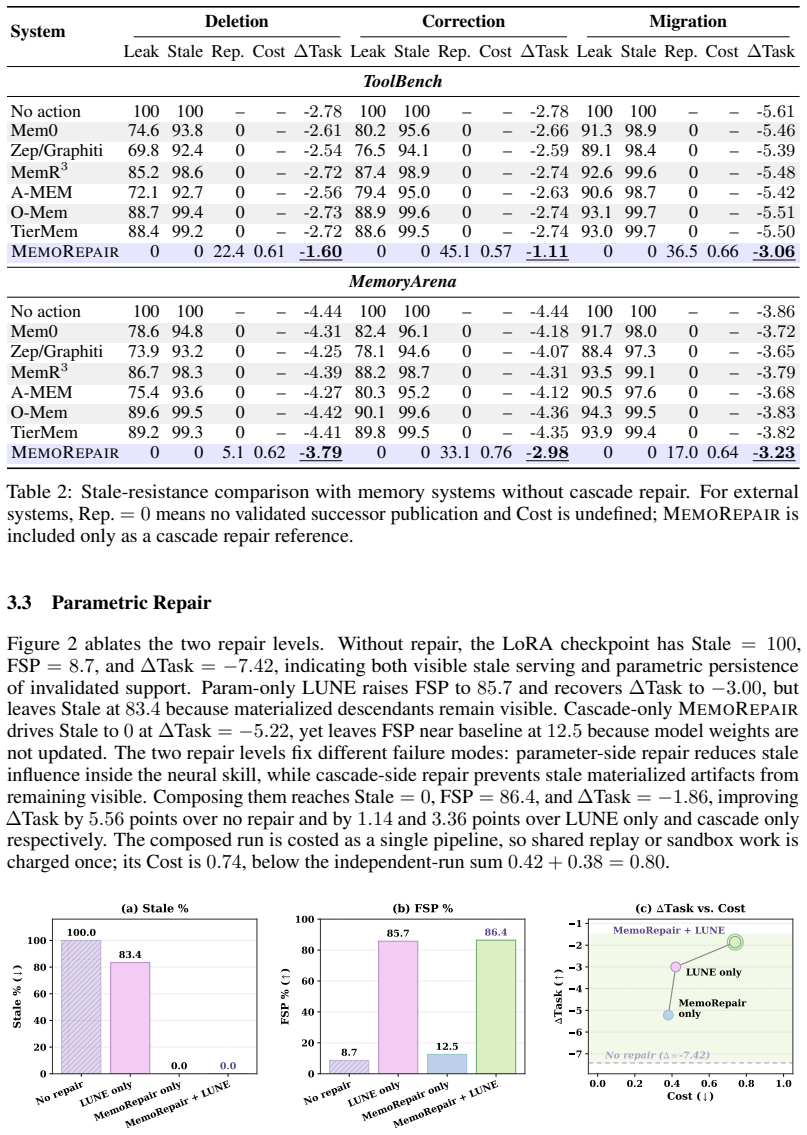
The paper claims that the cascade update problem in agentic memory is addressed by a barrier-first cascade-repair contract. Under this contract the induced publication problem reduces to maximum-weight predecessor closure and can be solved exactly by a single s-t min-cut. With complete influence provenance, MemoRepair reduces invalidated-memory exposure from 69.8-94.3% to 0% while recovering 91.1-94.3% of validated successors at normalized cost 0.57-0.76.
What carries the argument
The barrier-first cascade-repair contract, which withdraws invalidated descendants before constructing successors from retained support and restricts republication to validated predecessor-closed sets; the repair-selection problem reduces to maximum-weight predecessor closure solved by s-t min-cut.
If this is right
- Agentic systems can preserve memory consistency after source changes without recomputing every derived artifact.
- Repair cost can be traded against coverage of validated successors through the scalarized selection formulation.
- Full provenance tracking is sufficient to guarantee zero exposure to invalidated memory.
- The method applies to any memory store holding summaries, caches, embeddings, learned skills, or executable procedures.
Where Pith is reading between the lines
- The same min-cut reduction could be applied to dependency graphs in software builds or data pipelines to obtain exact repair sets.
- When provenance is only partial, MemoRepair could still be run on the known subgraph to lower risk without claiming zero exposure.
- Embedding this contract into agent runtimes might allow memory to persist across many tasks while keeping steering risk bounded.
- An online version of the min-cut step could handle continuous streams of invalidations without restarting from scratch.
Load-bearing premise
The method assumes complete influence provenance is available to identify every descendant affected by a source invalidation.
What would settle it
Run MemoRepair on a memory graph where some influence links are hidden or missing; if invalidated-memory exposure then rises above zero or valid-successor recovery falls substantially below 91%, the complete-provenance assumption is required for the zero-exposure guarantee.
Figures


read the original abstract
Agentic memory evolves across tasks into durable derived artifacts: summaries, cached outputs, embeddings, learned skills, and executable tool procedures. When a source artifact is deleted, corrected, or invalidated by tool or API migration, descendants derived from that source can remain visible and steer future actions with stale support. We formalize this failure mode as the cascade update problem, where repair targets the visible derived state of the memory store. We present MemoRepair, a barrier-first cascade-repair contract for agentic memory. A repair event induces a controlled transition from invalidated descendant state to validated successor state: affected descendants are withdrawn before repair, successors are constructed from retained support and staged repaired predecessors under the current interface, and republication is restricted to validated predecessor-closed successors. This contract induces a scalarized repair-selection problem for a fixed repair-cost tradeoff. We show that the induced publication problem reduces to maximum-weight predecessor closure and can be solved exactly by a single s-t min-cut. Experiments on ToolBench and MemoryArena show that, with complete influence provenance, MemoRepair reduces invalidated-memory exposure from 69.8-94.3% under systems without cascade repair to 0%. Compared with exhaustive Repair all, it recovers 91.1-94.3% of validated successors while reducing normalized repair-operator cost from 1.00 to 0.57-0.76.
Editorial analysis
A structured set of objections, weighed in public.
Referee Report
Summary. The manuscript formalizes the cascade update problem in agentic memory, where invalidation of source artifacts leaves derived descendants (summaries, embeddings, tool procedures) exposed to stale state. It introduces MemoRepair, a barrier-first repair contract that withdraws affected descendants, stages successors from validated predecessors, and restricts republication to predecessor-closed sets. The central technical claim is that the induced scalarized repair-selection problem reduces to maximum-weight predecessor closure and is solvable exactly by a single s-t min-cut. Experiments on ToolBench and MemoryArena, conducted under the assumption of complete influence provenance, report reduction of invalidated-memory exposure from 69.8-94.3% to 0% while recovering 91.1-94.3% of validated successors at normalized operator cost 0.57-0.76 relative to exhaustive repair.
Significance. If the complete influence provenance assumption can be realized or approximated in practice, the work supplies an exact algorithmic reduction for a practically relevant consistency problem in long-horizon agent systems. The reduction to a single s-t min-cut is a clear strength, providing both optimality guarantees and computational tractability. The reported performance deltas versus no-repair and exhaustive baselines indicate meaningful efficiency gains when the provenance graph is fully available.
major comments (2)
- [Abstract and §4] Abstract and §4 (formalization of the publication problem): The exact reduction to maximum-weight predecessor closure solvable by one s-t min-cut, as well as the 0% invalidated-exposure guarantee, are stated to hold only under complete influence provenance. No construction procedure, inference algorithm, or empirical validation is supplied for obtaining this provenance graph from real agent traces, leaving the min-cut instance incomplete and the headline performance numbers unachievable when any descendant link is missing.
- [§5] §5 (experiments): The reported exposure reduction (69.8-94.3% to 0%) and successor recovery (91.1-94.3%) are measured exclusively under the complete-provenance condition; no ablation, sensitivity analysis, or partial-provenance experiments are presented to quantify degradation when the assumption is relaxed, despite this being load-bearing for both the algorithmic exactness claim and the practical utility.
minor comments (2)
- The abstract and experimental section omit implementation details, error bars, and statistical significance tests for the cost and recovery metrics.
- [§3] Notation for the barrier-first contract and the scalarized objective could be introduced earlier with an explicit equation reference to improve readability.
Simulated Author's Rebuttal
We thank the referee for the careful and constructive review. The two major comments both concern the scope and practical implications of the complete influence provenance assumption. We address each below, clarifying the intended contribution while agreeing that additional discussion of the assumption's boundaries would improve the manuscript.
read point-by-point responses
-
Referee: [Abstract and §4] Abstract and §4 (formalization of the publication problem): The exact reduction to maximum-weight predecessor closure solvable by one s-t min-cut, as well as the 0% invalidated-exposure guarantee, are stated to hold only under complete influence provenance. No construction procedure, inference algorithm, or empirical validation is supplied for obtaining this provenance graph from real agent traces, leaving the min-cut instance incomplete and the headline performance numbers unachievable when any descendant link is missing.
Authors: We agree that the exact optimality of the min-cut reduction and the 0% exposure guarantee hold only when the influence graph is complete. The manuscript presents MemoRepair as an exact algorithmic solution to the scalarized repair-selection problem once this graph is available as input, analogous to how dependency graphs are assumed given in build systems or view-maintenance literature. We do not supply a general provenance-inference procedure because the paper's focus is the subsequent optimization problem rather than provenance acquisition, which is an orthogonal systems concern. Many agent frameworks already maintain explicit influence logs for reproducibility. When links are missing, the algorithm can still be run on the observed subgraph to guarantee safety on known dependencies. We will add a clarifying paragraph in §4 on the assumption's scope and note that partial provenance yields a conservative (but not necessarily optimal) repair. revision: partial
-
Referee: [§5] §5 (experiments): The reported exposure reduction (69.8-94.3% to 0%) and successor recovery (91.1-94.3%) are measured exclusively under the complete-provenance condition; no ablation, sensitivity analysis, or partial-provenance experiments are presented to quantify degradation when the assumption is relaxed, despite this being load-bearing for both the algorithmic exactness claim and the practical utility.
Authors: The experiments validate the theoretical claims by measuring performance under the complete-provenance condition that the analysis assumes, thereby establishing an upper bound on the efficiency gains. We acknowledge that quantifying sensitivity to missing links would better illustrate practical robustness. Because no canonical model of partial provenance exists, we did not include such an ablation. In revision we can add a short synthetic study that randomly removes a controlled fraction of edges and reports the resulting exposure and cost, demonstrating that the method remains safe (zero exposure on observed links) even as optimality degrades gracefully. This addition would not change the core claims but would directly address the load-bearing nature of the assumption. revision: partial
Circularity Check
No circularity: formal reduction stands independent of inputs
full rationale
The paper's core derivation states that the induced publication problem reduces to maximum-weight predecessor closure solvable exactly by one s-t min-cut as a direct consequence of the barrier-first cascade-repair contract. This is a graph-theoretic claim, not a fitted quantity or self-referential definition. Experimental performance numbers are explicitly conditioned on the separate assumption of complete influence provenance rather than being used to define or force the reduction itself. No self-citations, ansatzes smuggled via prior work, or renamings of empirical patterns appear as load-bearing steps in the provided derivation chain. The result is therefore self-contained against external min-cut algorithms and does not reduce to its own inputs by construction.
Axiom & Free-Parameter Ledger
axioms (1)
- domain assumption Complete influence provenance is available for every repair event
invented entities (1)
-
Barrier-first cascade-repair contract
no independent evidence
Lean theorems connected to this paper
-
IndisputableMonolith/Cost/FunctionalEquation.leanwashburn_uniqueness_aczel unclear?
unclearRelation between the paper passage and the cited Recognition theorem.
We show that the induced publication problem reduces to maximum-weight predecessor closure and can be solved exactly by a single s-t min-cut.
What do these tags mean?
- matches
- The paper's claim is directly supported by a theorem in the formal canon.
- supports
- The theorem supports part of the paper's argument, but the paper may add assumptions or extra steps.
- extends
- The paper goes beyond the formal theorem; the theorem is a base layer rather than the whole result.
- uses
- The paper appears to rely on the theorem as machinery.
- contradicts
- The paper's claim conflicts with a theorem or certificate in the canon.
- unclear
- Pith found a possible connection, but the passage is too broad, indirect, or ambiguous to say the theorem truly supports the claim.
Reference graph
Works this paper leans on
-
[1]
Springer-Verlag. ISBN 3540414568. Yinzhi Cao and Junfeng Yang. Towards Making Systems Forget with Machine Unlearning. In Proceedings of the 2015 IEEE Symposium on Security and Privacy, SP ’15, page 463–480, USA,
work page 2015
-
[2]
Proceedings of the IEEE Symposium on Security and Privacy , year =
IEEE Computer Society. ISBN 9781467369497. doi: 10.1109/SP.2015.35. URL https://doi.org/10.1109/SP.2015.35. 9 Stefano Ceri and Jennifer Widom. Deriving Production Rules for Incremental View Maintenance. InProceedings of the 17th International Conference on Very Large Data Bases, VLDB ’91, page 577–589, San Francisco, CA, USA,
-
[3]
Mem0: Building Production-Ready AI Agents with Scalable Long-Term Memory
ISSN 1931-7883. doi: 10.1561/ 1900000006. URLhttps://doi.org/10.1561/1900000006. Prateek Chhikara, Dev Khant, Saket Aryan, Taranjeet Singh, and Deshraj Yadav. Mem0: Building Production-Ready AI Agents with Scalable Long-Term Memory.arXiv preprint arXiv:2504.19413,
work page internal anchor Pith review Pith/arXiv arXiv doi:10.1561/1900000006 1931
-
[4]
Memr3: Memory retrieval via reflective reasoning for llm agents.arXiv preprint arXiv:2512.20237,
Xingbo Du, Loka Li, Duzhen Zhang, and Le Song. MemR 3: Memory Retrieval via Reflective Reasoning for LLM Agents.arXiv preprint arXiv:2512.20237,
-
[5]
Simplicity Prevails: Rethinking Negative Preference Optimization for LLM Unlearning
Chongyu Fan, Jiancheng Liu, Licong Lin, Jinghan Jia, Ruiqi Zhang, Song Mei, and Sijia Liu. Simplicity Prevails: Rethinking Negative Preference Optimization for LLM Unlearning. In Neurips Safe Generative AI Workshop 2024,
work page 2024
-
[6]
Chongyang Gao, Lixu Wang, Kaize Ding, Chenkai Weng, Xiao Wang, and Qi Zhu
URL https://openreview.net/forum? id=pVACX02m0p. Chongyang Gao, Lixu Wang, Kaize Ding, Chenkai Weng, Xiao Wang, and Qi Zhu. On Large Language Model Continual Unlearning.arXiv preprint arXiv:2407.10223,
-
[7]
Association for Computing Machinery. ISBN 9781595936851. doi: 10.1145/1265530.1265535. URL https://doi.org/10.1145/1265530. 1265535. Chuan Guo, Tom Goldstein, Awni Hannun, and Laurens Van Der Maaten. Certified Data Removal From Machine Learning Models. InProceedings of the 37th International Conference on Machine Learning, ICML’20. JMLR.org,
-
[8]
StableToolBench: Towards Stable Large-Scale Benchmarking on Tool Learning of Large Language Models
Zhicheng Guo, Sijie Cheng, Hao Wang, Shihao Liang, Yujia Qin, Peng Li, Zhiyuan Liu, Maosong Sun, and Yang Liu. StableToolBench: Towards Stable Large-Scale Benchmarking on Tool Learning of Large Language Models. In Lun-Wei Ku, Andre Martins, and Vivek Srikumar, editors,Findings of the Association for Computational Linguistics: ACL 2024, pages 11143–11156, ...
work page 2024
-
[9]
doi: 10.18653/v1/2024.findings-acl.664
Association for Computational Linguistics. doi: 10.18653/v1/2024.findings-acl.664. URLhttps://aclanthology.org/2024.findings-acl.664/. Zexue He, Yu Wang, Churan Zhi, Yuanzhe Hu, Tzu-Ping Chen, Lang Yin, Ze Chen, Tong Arthur Wu, Siru Ouyang, Zihan Wang, et al. MemoryArena: Benchmarking Agent Memory in Interdependent Multi-Session Agentic Tasks.arXiv prepri...
-
[10]
Yezi Liu, Hanning Chen, Wenjun Huang, Yang Ni, and Mohsen Imani. LUNE: Efficient LLM Unlearning via LORA Fine-Tuning with Negative Examples.arXiv preprint arXiv:2512.07375,
-
[11]
Skill-Pro: Learning Reusable Skills from Experience via Non-Parametric PPO for LLM Agents
URLhttps://arxiv.org/abs/2602.01869. 10 Charles Packer, Sarah Wooders, Kevin Lin, Vivian Fang, Shishir G. Patil, Ion Stoica, and Joseph E. Gonzalez. MemGPT: Towards LLMs as Operating Systems,
work page internal anchor Pith review Pith/arXiv arXiv
-
[12]
MemGPT: Towards LLMs as Operating Systems
URL https://arxiv.org/ abs/2310.08560. Joon Sung Park, Joseph O’Brien, Carrie Jun Cai, Meredith Ringel Morris, Percy Liang, and Michael S. Bernstein. Generative Agents: Interactive Simulacra of Human Behavior. InProceedings of the 36th Annual ACM Symposium on User Interface Software and Technology, UIST ’23, New York, NY , USA,
work page internal anchor Pith review Pith/arXiv arXiv
-
[13]
Association for Computing Machinery. ISBN 9798400701320. doi: 10.1145/3586183.3606763. URLhttps://doi.org/10.1145/3586183.3606763. Shishir G. Patil, Tianjun Zhang, Xin Wang, and Joseph E. Gonzalez. Gorilla: Large Lan- guage Model Connected with Massive APIs. In A. Globerson, L. Mackey, D. Belgrave, A. Fan, U. Paquet, J. Tomczak, and C. Zhang, editors,Adva...
-
[14]
Patil, Tianjun Zhang, Xin Wang, and Joseph E
doi: 10.52202/079017-4020. URL https://proceedings.neurips.cc/paper_files/paper/ 2024/file/e4c61f578ff07830f5c37378dd3ecb0d-Paper-Conference.pdf. Jean-Claude Picard. Maximal Closure of a Graph and Applications to Combinatorial Problems. Manage. Sci., 22(11):1268–1272, July
-
[15]
ISSN 0025-1909. doi: 10.1287/mnsc.22.11.1268. URLhttps://doi.org/10.1287/mnsc.22.11.1268. Yujia Qin, Shihao Liang, Yining Ye, Kunlun Zhu, Lan Yan, Yaxi Lu, Yankai Lin, Xin Cong, Xiangru Tang, Bill Qian, et al. ToolLLM: Facilitating Large Language Models to Master 16000+ Real-World APIs. InThe twelfth international conference on learning representations,
-
[16]
Zep: A Temporal Knowledge Graph Architecture for Agent Memory
Preston Rasmussen, Pavlo Paliychuk, Travis Beauvais, Jack Ryan, and Daniel Chalef. Zep: A Temporal Knowledge Graph Architecture for Agent Memory.arXiv preprint arXiv:2501.13956,
work page internal anchor Pith review arXiv
-
[17]
BLUR : A Bi-Level Optimization Approach for LLM Unlearning
Association for Computational Linguistics. ISBN 979-8-89176-380-7. doi: 10.18653/v1/2026.eacl-long.331. URL https://aclanthology.org/2026.eacl-long.331/. Noah Shinn, Federico Cassano, Ashwin Gopinath, Karthik Narasimhan, and Shunyu Yao. Reflexion: Language Agents with Verbal Reinforcement Learning. InProceedings of the 37th International Conference on Neu...
-
[18]
URL https://arxiv.org/abs/2602.17692. Bo Wang, Weiyi He, Shenglai Zeng, Zhen Xiang, Yue Xing, Jiliang Tang, and Pengfei He. Unveiling Privacy Risks in LLM Agent Memory. In Wanxiang Che, Joyce Nabende, Ekaterina Shutova, and Mohammad Taher Pilehvar, editors,Proceedings of the 63rd Annual Meeting of the Association for Computational Linguistics (Volume 1: L...
-
[19]
ISSN 0360-0300. doi: 10.1145/3603620. URL https://doi.org/10.1145/3603620. 11 Wujiang Xu, Zujie Liang, Kai Mei, Hang Gao, Juntao Tan, and Yongfeng Zhang. A-Mem: Agentic memory for LLM agents. InAdvances in Neural Information Processing Systems,
-
[20]
arXiv preprint arXiv:2404.05868 , year=
Ruiqi Zhang, Licong Lin, Yu Bai, and Song Mei. Negative Preference Optimization: From Catas- trophic Collapse to Effective Unlearning.arXiv preprint arXiv:2404.05868,
-
[21]
From Lossy to Verified: A Provenance-Aware Tiered Memory for Agents.arXiv preprint arXiv:2602.17913,
Qiming Zhu, Shunian Chen, Rui Yu, Zhehao Wu, and Benyou Wang. From Lossy to Verified: A Provenance-Aware Tiered Memory for Agents.arXiv preprint arXiv:2602.17913,
discussion (0)
Sign in with ORCID, Apple, or X to comment. Anyone can read and Pith papers without signing in.