Recognition: 2 theorem links
· Lean TheoremGlobal Analytical Solution of the Identical Kuramoto Model for N=3 via Koopman Eigenfunctions
Pith reviewed 2026-05-11 02:33 UTC · model grok-4.3
The pith
Koopman eigenfunctions provide a global analytical solution for phase trajectories in the identical all-to-all Kuramoto model with three oscillators.
A machine-rendered reading of the paper's core claim, the machinery that carries it, and where it could break.
Core claim
The authors construct Koopman eigenfunctions for the identical N=3 Kuramoto system that relate the phases directly to time, thereby reducing the original nonlinear phase equations to a set of time-dependent quartic equations. The appropriate algebraic branch of the solution is then chosen using the initial conditions to recover the exact phase trajectory for arbitrary starting points.
What carries the argument
Koopman eigenfunctions that relate oscillator phases to time and reduce the coupled nonlinear dynamics to solvable time-dependent quartic equations.
If this is right
- Phase trajectories become available in explicit algebraic form for every initial condition without numerical simulation.
- Synchronization onset and transient behavior can be analyzed by direct manipulation of the quartic solutions.
- The known N=2 closed-form case is extended by the same eigenfunction technique to the next-smallest identical network.
- Nonlinear phase interactions are recovered algebraically once the eigenfunctions are known.
Where Pith is reading between the lines
- The quartic-reduction approach may generalize to other small-N oscillator networks once analogous eigenfunctions are identified.
- Exact trajectories permit direct computation of quantities such as instantaneous frequency differences or synchronization order parameters without integration.
- The method could be tested on non-identical frequencies or different coupling topologies to see whether similar reductions remain feasible.
Load-bearing premise
Suitable Koopman eigenfunctions exist and can be constructed explicitly so that the phase dynamics reduce globally to time-dependent quartic equations whose algebraic branch is unambiguously fixed by the initial condition.
What would settle it
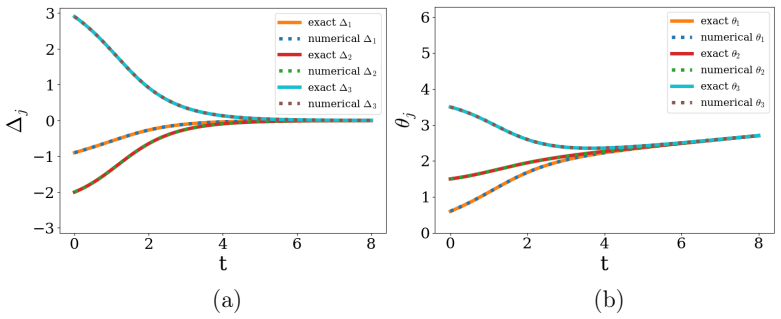
Numerical integration of the N=3 identical Kuramoto equations from a chosen initial condition that produces phase values differing from those obtained by solving and selecting the branch of the corresponding quartic equations at later times.
Figures


read the original abstract
The Kuramoto model is a paradigmatic model of collective synchronization in coupled oscillator systems. Although its mathematical properties have been extensively investigated, exact phase trajectories from arbitrary initial conditions have been available only for the simplest case, N=2. In this study, we provide a global analytical solution for the phase trajectories of the all-to-all coupled Kuramoto model with identical oscillators for N=3. This solution is obtained by constructing Koopman eigenfunctions that relate the phases to time and reducing the phase dynamics to time-dependent quartic equations. The algebraic branch corresponding to the initial condition is then selected to recover the corresponding phase trajectory. This gives an explicit algebraic reconstruction of the nonlinear phase dynamics from Koopman eigenfunctions.
Editorial analysis
A structured set of objections, weighed in public.
Referee Report
Summary. The paper claims to derive a global analytical solution for the phase trajectories of the all-to-all identical Kuramoto model with N=3 oscillators. It constructs Koopman eigenfunctions that map the nonlinear phase dynamics to a set of time-dependent quartic algebraic equations; the physical trajectory is recovered at each time by selecting the algebraic root whose branch is fixed by the initial phases.
Significance. If the construction is rigorous and the branch selection rule is shown to be globally consistent without reference to the vector field at intermediate times, the result would be a substantial advance: the first explicit global solution for N=3 identical Kuramoto beyond the N=2 case. It would also demonstrate a concrete, non-numerical application of Koopman eigenfunctions to a classic nonlinear oscillator system and supply an algebraic benchmark for synchronization studies.
major comments (2)
- [the reduction to time-dependent quartic equations and the branch-selection procedure] The central claim rests on the assertion that the algebraic branch of the time-dependent quartic can be unambiguously selected from the initial condition alone for all t. However, the manuscript does not supply an auxiliary differential condition, monodromy rule, or continuity argument that guarantees the chosen root remains the unique continuation of the initial datum when roots approach, cross, or become multiple near synchronization manifolds or during relative-phase winding. Without such a rule, the reconstruction is not demonstrably global.
- [Koopman eigenfunction construction and verification] The explicit construction of the Koopman eigenfunctions for the N=3 identical all-to-all system is not accompanied by a verification that the resulting quartics are free of spurious roots that would violate the original ODE or the phase-ordering constraints. A concrete check (e.g., substitution back into the Kuramoto vector field or comparison with numerical integration on a dense set of initial conditions) is required to confirm that the selected algebraic solution satisfies the dynamics identically.
minor comments (2)
- [main derivation] Notation for the time-dependent coefficients of the quartic is introduced without a compact summary table; a single table collecting the explicit expressions for each coefficient in terms of the initial phases would improve readability.
- [conclusions] The manuscript would benefit from an explicit statement of the domain of validity (e.g., whether the solution covers the full torus or excludes a measure-zero set of initial conditions where roots collide).
Simulated Author's Rebuttal
We thank the referee for the careful reading and constructive comments, which have identified important points for strengthening the rigor of our global analytical solution. We address each major comment below and will incorporate clarifications and verifications in the revised manuscript.
read point-by-point responses
-
Referee: [the reduction to time-dependent quartic equations and the branch-selection procedure] The central claim rests on the assertion that the algebraic branch of the time-dependent quartic can be unambiguously selected from the initial condition alone for all t. However, the manuscript does not supply an auxiliary differential condition, monodromy rule, or continuity argument that guarantees the chosen root remains the unique continuation of the initial datum when roots approach, cross, or become multiple near synchronization manifolds or during relative-phase winding. Without such a rule, the reconstruction is not demonstrably global.
Authors: We agree that an explicit continuity or monodromy argument is necessary to rigorously establish global consistency of the branch selection. Our Koopman eigenfunction construction encodes the initial phases such that the algebraic branch is fixed at t=0, and the time-dependent coefficients of the quartic are derived from invariants that preserve the ordering of phases under the flow. To address the referee's concern directly, we will add a new subsection providing a continuity argument: the selected root is continued analytically along trajectories by requiring that it matches the initial datum and respects the phase-difference constraints encoded in the eigenfunctions. Near points where roots coalesce (e.g., synchronization manifolds), we show that the physical solution is the unique root that maintains continuous phase evolution without violating the ordering, using the smoothness of the coefficient functions. This will be supplemented by a brief monodromy consideration based on the topology of the configuration space. These additions will make the global character of the reconstruction explicit. revision: yes
-
Referee: [Koopman eigenfunction construction and verification] The explicit construction of the Koopman eigenfunctions for the N=3 identical all-to-all system is not accompanied by a verification that the resulting quartics are free of spurious roots that would violate the original ODE or the phase-ordering constraints. A concrete check (e.g., substitution back into the Kuramoto vector field or comparison with numerical integration on a dense set of initial conditions) is required to confirm that the selected algebraic solution satisfies the dynamics identically.
Authors: We acknowledge that the original manuscript relies on the theoretical properties of the Koopman eigenfunctions without providing explicit verification against spurious roots. Although the eigenfunction construction guarantees that the reduction holds for the branch consistent with the initial condition, we agree that concrete checks are required. In the revised manuscript we will add a verification section containing (i) direct substitution of the algebraic solution into the Kuramoto vector field to verify that the ODE is satisfied identically, and (ii) systematic numerical comparisons of the analytical trajectories against high-precision integrations of the original ODE over a dense grid of initial conditions spanning the full phase space. These checks will confirm the absence of spurious roots and the preservation of phase-ordering constraints. revision: yes
Circularity Check
No significant circularity; derivation is self-contained from standard Kuramoto equations via Koopman construction
full rationale
The paper constructs Koopman eigenfunctions explicitly for the N=3 identical all-to-all Kuramoto system, reduces the flow to time-dependent quartics, and recovers trajectories by algebraic branch selection from initial conditions. This chain is a direct derivation from the governing ODEs without fitted parameters renamed as predictions, self-definitional loops, or load-bearing self-citations that reduce the central claim to unverified inputs. The method is presented as an explicit algebraic reconstruction independent of external benchmarks beyond the standard model, satisfying the criteria for a non-circular analytical solution.
Axiom & Free-Parameter Ledger
axioms (1)
- domain assumption Koopman eigenfunctions exist and can be constructed for the identical all-to-all Kuramoto system on the N=3 torus
Lean theorems connected to this paper
-
IndisputableMonolith/Cost/FunctionalEquation.leanwashburn_uniqueness_aczel unclear?
unclearRelation between the paper passage and the cited Recognition theorem.
reducing the phase dynamics to time-dependent quartic equations... The algebraic branch corresponding to the initial condition is then selected
-
IndisputableMonolith/Foundation/AlexanderDuality.leanalexander_duality_circle_linking unclear?
unclearRelation between the paper passage and the cited Recognition theorem.
off-circle roots appear as a reciprocal-conjugate pair... Xj ↦ conjugate(1/Xj)
What do these tags mean?
- matches
- The paper's claim is directly supported by a theorem in the formal canon.
- supports
- The theorem supports part of the paper's argument, but the paper may add assumptions or extra steps.
- extends
- The paper goes beyond the formal theorem; the theorem is a base layer rather than the whole result.
- uses
- The paper appears to rely on the theorem as machinery.
- contradicts
- The paper's claim conflicts with a theorem or certificate in the canon.
- unclear
- Pith found a possible connection, but the passage is too broad, indirect, or ambiguous to say the theorem truly supports the claim.
Reference graph
Works this paper leans on
-
[1]
Coupled oscillators and biological synchronization.Scientific american, 269(6):102–109, 1993
Steven H Strogatz and Ian Stewart. Coupled oscillators and biological synchronization.Scientific american, 269(6):102–109, 1993
work page 1993
-
[2]
Juan A. Acebrón, Luis L. Bonilla, C. J. Pérez Vicente, Félix Ritort, and Renato Spigler. The Kuramoto model: A simple paradigm for synchronization phenomena.Reviews of Modern Physics, 77(1):137–185, 2005
work page 2005
- [3]
-
[4]
Springer Berlin Heidelberg
-
[5]
Kuramoto.Chemical Oscillations, Waves, and Turbulence
Y. Kuramoto.Chemical Oscillations, Waves, and Turbulence. Springer, Berlin, 1984
work page 1984
-
[6]
Steven H. Strogatz and Renato E. Mirollo. Stability of incoherence in a population of coupled oscillators.Journal of Statistical Physics, 63(3):613–635, May 1991
work page 1991
-
[7]
Thermodynamic limit of the first-order phase transition in the kuramoto model.Phys
Diego Pazó. Thermodynamic limit of the first-order phase transition in the kuramoto model.Phys. Rev. E, 72:046211, Oct 2005
work page 2005
-
[8]
Hayato Chiba. A proof of the kuramoto conjecture for a bifurcation structure of the infinite-dimensional kuramoto model.Ergodic Theory and Dynamical Systems, 35(3):762–834, 2015
work page 2015
-
[9]
E. Ott and T.M. Antonsen. Low dimensional behavior of large systems of globally coupled oscillators.Chaos: An Interdisciplinary Journal of Nonlinear Science, 18(3), September 2008
work page 2008
-
[10]
Dirk Aeyels and Jonathan A. Rogge. Existence of partial entrainment and stability of phase locking behavior of coupled oscillators.Progress of Theoretical Physics, 112(6):921–942, 2004
work page 2004
-
[11]
On the stability of the kuramoto model of coupled nonlinear oscillators
Ali Jadbabaie, Nader Motee, and Mauricio Barahona. On the stability of the kuramoto model of coupled nonlinear oscillators. InProceedings of the 2004 American Control Conference, volume 5, pages 4296–4301, 2004. 17
work page 2004
-
[12]
Y. Maistrenko, O. Popovych, O. Burylko, and P. A. Tass. Mechanism of desynchronization in the finite-dimensional kuramoto model.Phys. Rev. Lett., 93:084102, Aug 2004
work page 2004
-
[13]
YURI L. MAISTRENKO, OLEKSANDR V. POPOVYCH, and PE- TER A. TASS. Chaotic attractor in the kuramoto model.International Journal of Bifurcation and Chaos, 15(11):3457–3466, 2005
work page 2005
-
[14]
Richard Taylor. There is no non-zero stable fixed point for dense net- worksinthehomogeneouskuramotomodel.Journal of Physics A: Math- ematical and Theoretical, 45(5):055102, 2012
work page 2012
-
[15]
Daleo, Florian Dörfler, and Jonathan D
Dhagash Mehta, Noah S. Daleo, Florian Dörfler, and Jonathan D. Hauenstein. Algebraic geometrization of the kuramoto model: Equi- libria and stability analysis.Chaos: An Interdisciplinary Journal of Nonlinear Science, 25(5):053103, 05 2015
work page 2015
-
[16]
Analytical solutions of equilibrium points of the standard kuramoto model: 3 and 4 oscillators
Xin Xin, Takanori Kikkawa, and Yannian Liu. Analytical solutions of equilibrium points of the standard kuramoto model: 3 and 4 oscillators. In2016 American Control Conference (ACC), pages 2447–2452, 2016
work page 2016
-
[17]
Ariane Mihara, Rosa M. Medrano-T., and Igor L. Caldas. Exact dy- namical solution of the kuramoto–sakaguchi model for finite identical oscillators.Chaos, 29(1):013163, 2019
work page 2019
-
[18]
Lyle Muller, Ján Mináč, and Tung T. Nguyen. Algebraic approach to the kuramoto model.Phys. Rev. E, 104:L022201, Aug 2021
work page 2021
-
[19]
Integrabilityofagloballycou- pled oscillator array.Physical Review Letters, 70(16):2391–2394, 1993
ShinyaWatanabeandStevenH.Strogatz. Integrabilityofagloballycou- pled oscillator array.Physical Review Letters, 70(16):2391–2394, 1993
work page 1993
- [20]
-
[21]
Arkady Pikovsky and Michael Rosenblum. Partially integrable dynam- ics of hierarchical populations of coupled oscillators.Physical Review Letters, 101(26):264103, 2008
work page 2008
-
[22]
Seth A. Marvel, Renato E. Mirollo, and Steven H. Strogatz. Identical phase oscillators with global sinusoidal coupling evolve by möbius group action.Chaos, 19(4):043104, 2009. 18
work page 2009
-
[23]
B. O. Koopman. Hamiltonian systems and transformation in hilbert space.Proceedings of the National Academy of Sciences, 17(5):315–318, 1931
work page 1931
-
[24]
B. O. Koopman and J. von Neumann. Dynamical systems of continuous spectra.Proceedings of the National Academy of Sciences, 18(3):255– 263, 1932
work page 1932
-
[25]
Igor Mezić. Spectral properties of dynamical systems, model reduction and decompositions.Nonlinear Dynamics, 41(1–3):309–325, 2005
work page 2005
-
[26]
Marko Budišić, Ryan Mohr, and Igor Mezić. Applied koopmanism. Chaos: An Interdisciplinary Journal of Nonlinear Science, 22(4), 2012
work page 2012
-
[27]
Brunton, Marko Budišić, Eurika Kaiser, and J
Steven L. Brunton, Marko Budišić, Eurika Kaiser, and J. Nathan Kutz. Modern Koopman theory for dynamical systems.SIAM Review, 64(2):229–340, 2022
work page 2022
-
[28]
Springer Science & Business Media, 2013
Andrzej Lasota and Michael C Mackey.Chaos, fractals, and noise: stochastic aspects of dynamics, volume 97. Springer Science & Business Media, 2013
work page 2013
-
[29]
Igor Mezić. Analysis of fluid flows via spectral properties of the koopman operator.Annual review of fluid mechanics, 45(1):357–378, 2013
work page 2013
-
[30]
Alexandre Mauroy, Igor Mezić, and Jeff Moehlis. Isostables, isochrons, and koopman spectrum for the action–angle representation of dynamical systems.Physica D: Nonlinear Phenomena, 261:19–30, 2013
work page 2013
-
[31]
Isostable reduction of periodic orbits
Dan Wilson and Jeff Moehlis. Isostable reduction of periodic orbits. Phys. Rev. E, 94:052213, Nov 2016
work page 2016
- [32]
-
[33]
Hiroya Nakao and Igor Mezić. Spectral analysis of the koopman operator for partial differential equations.Chaos: An Interdisciplinary Journal of Nonlinear Science, 30(11), 2020
work page 2020
-
[34]
Eurika Kaiser, J. Nathan Kutz, and Steven L. Brunton. Data-driven discovery of koopman eigenfunctions for control.Machine Learning: Science and Technology, 2(3):035023, 2021. 19
work page 2021
-
[35]
Keisuke Taga, Yuzuru Kato, Yoshinobu Kawahara, Yoshihiro Yamazaki, and Hiroya Nakao. Koopman spectral analysis of elementary cellular automata.Chaos: An Interdisciplinary Journal of Nonlinear Science, 31(10), 2021
work page 2021
-
[36]
Megan Morrison and J. Nathan Kutz. Solving nonlinear ordinary differ- ential equations using the invariant manifolds and koopman eigenfunc- tions.SIAM Journal on Applied Dynamical Systems, 23(1):924–960, 2024
work page 2024
-
[37]
Yoshihiko Susuki, Igor Mezic, Fredrik Raak, and Takashi Hikihara. Ap- plied koopman operator theory for power systems technology.Nonlinear Theory and Its Applications, IEICE, 7(4):430–459, 2016
work page 2016
-
[38]
Koopman analysis in oscillator synchroniza- tion.Phys
Jing Hu and Yueheng Lan. Koopman analysis in oscillator synchroniza- tion.Phys. Rev. E, 102:062216, Dec 2020
work page 2020
-
[39]
Shiyi Wang and Yueheng Lan. Probing the phase space of coupled oscillators with koopman analysis.Physical Review E, 104(3):034211, 2021
work page 2021
-
[40]
Antonio Mihara, Michael Zaks, Elbert E. N. Macau, and Rene O. Medrano-T. Basin sizes depend on stable eigenvalues in the kuramoto model.Phys. Rev. E, 105:L052202, May 2022
work page 2022
-
[41]
Kuramoto meets koopman: Constants of motion, symme- tries, and network motifs.arXiv:2504.06248, 2025
Vincent Thibeault, Benjamin Claveau, Antoine Allard, and Patrick Desrosiers. Kuramoto meets koopman: Constants of motion, symme- tries, and network motifs.arXiv:2504.06248, 2025
-
[42]
Keisuke Taga and Hiroya Nakao. Watanabe-strogatz invariants in the liouvillian dynamics of coupled phase oscillators via the koopman frame- work.arXiv:2603.18809, 2026
-
[43]
Rok Cestnik and Erik A. Martens. Integrability of a globally coupled complex riccati array: Quadratic integrate-and-fire neurons, phase os- cillators, and all in between.Physical Review Letters, 132(5):057201, 2024
work page 2024
-
[44]
Diego Pazó and Rok Cestnik. Low-dimensional dynamics of globally coupled complex riccati equations: Exact firing-rate equations for spik- ing neurons with clustered substructure.Phys. Rev. E, 111:L052201, May 2025. 20
work page 2025
-
[45]
H. E. Stanley. Dependence of critical properties on dimensionality of spins.Phys. Rev. Lett., 20:589–592, Mar 1968
work page 1968
-
[46]
Sho Shirasaka, Wataru Kurebayashi, and Hiroya Nakao. Phase– amplitude reduction of transient dynamics far from attractors for limit- cycling systems.Chaos, 27(2):023119, 2017
work page 2017
-
[47]
Alexandre Mauroy and Igor Mezić. Global stability analysis using the eigenfunctions of the koopman operator.IEEE Transactions on Auto- matic Control, 61(11):3356–3369, 2016. Appendix A. Proofs Appendix A.1. Proof of Theorem 1 The theorem follows by direct calculation. Λ = Ku u = 1 2[g(cosφ j −cosφ k) +h(sinφ j −sinφ k)] cot φj −φ k 2 =−gsin φj +φ k 2 cos ...
work page 2016
discussion (0)
Sign in with ORCID, Apple, or X to comment. Anyone can read and Pith papers without signing in.