Recognition: no theorem link
Mass Production of 2023 KMTNet Microlensing Planets. III: Three Planets from the Subprime Field
Pith reviewed 2026-05-11 01:44 UTC · model grok-4.3
The pith
Three 2023 KMTNet microlensing events are confirmed as planets with mass ratios log q of about -1.9 to -2.6.
A machine-rendered reading of the paper's core claim, the machinery that carries it, and where it could break.
Core claim
Analysis of the six events KMT-2023-BLG-1810, 0084, 1118, 0584, 1697, 2218 shows the first three to be securely planetary with log q ∼ -1.9, -2.0, and -2.6. Bayesian analysis suggests the planets are likely super-Jupiters beyond the snow line of M- or K-dwarf hosts or, in some cases for one event, Saturn-mass planets around late M dwarfs. The full 2023 sample of 25 planets has a mass-ratio distribution consistent with the 2016-2019 sample.
What carries the argument
Light-curve modeling to resolve 2L1S planetary solutions from 1L2S and stellar binary degeneracies, followed by Bayesian analysis to infer host and planet properties.
If this is right
- The 2023 sample now includes 25 confirmed planets.
- The mass-ratio distribution remains consistent year to year.
- Most new planets orbit M or K dwarfs as super-Jupiters or Saturn analogs.
- This supports continued use of microlensing for detecting wide-orbit planets.
Where Pith is reading between the lines
- If the consistency holds in future years, it suggests the underlying planet population is stable across different observing conditions.
- Higher cadence or multi-band data could resolve the remaining degenerate events.
- The findings add to the census of planets in the galactic bulge.
Load-bearing premise
The light-curve fitting and Bayesian priors correctly identify planetary signals and exclude stellar-binary or source-binary explanations for the three events.
What would settle it
New high-precision photometry showing that one of the three events is better fit by a non-planetary model would disprove the confirmation.
Figures




read the original abstract
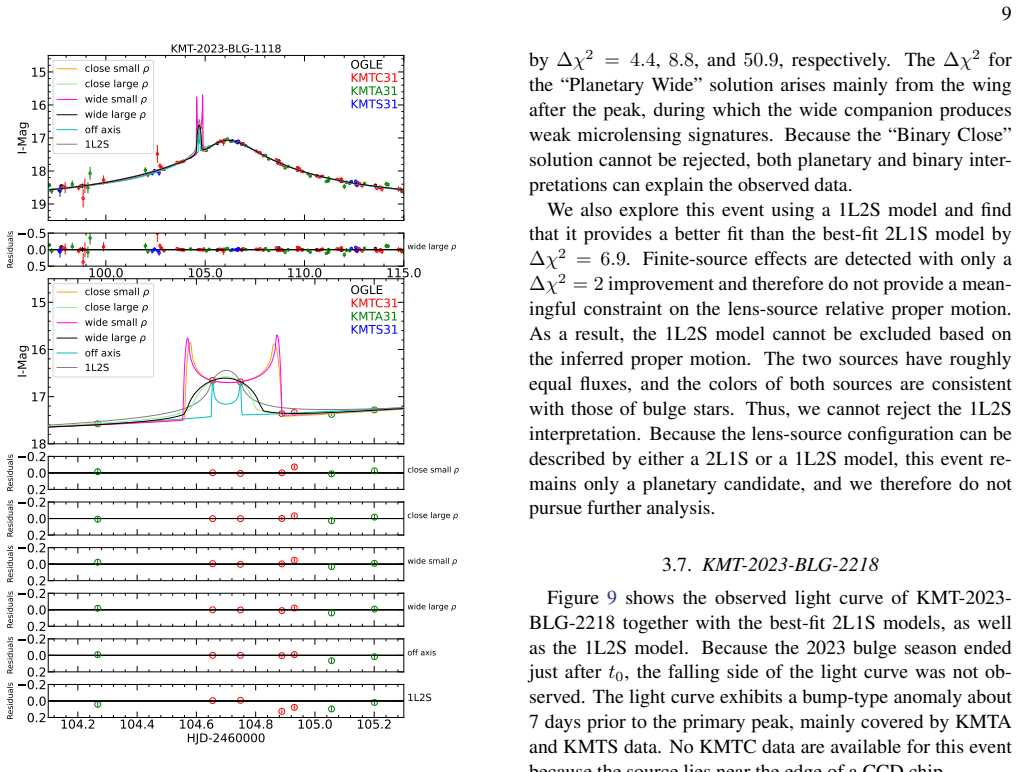
To complete the analysis of the 2023 KMTNet subprime-field microlensing planetary events identified by its AlertFinder system, we present the analysis of six events, KMT-2023-BLG-(1810, 0084, 1118, 0584, 1697, 2218). We find that the first three events are securely confirmed as planetary, with inferred mass ratios of $\log q \sim -1.9$, $-2.0$, and $-2.6$, respectively. The remaining three events exhibit the well-known degeneracy between binary-lens/single-source (2L1S) and single-lens/binary-source (1L2S) models, and two of these also admit viable stellar binary solutions. A Bayesian analysis indicates that the companions in the confirmed planetary events are likely either super-Jupiters orbiting beyond the snow line of M- or K-dwarf hosts or, for two degenerate solutions of KMT-2023-BLG-1118, Saturn-mass planets orbiting late-type M dwarfs. To date, the 2023 KMTNet sample contains 25 unambiguous planetary events, and its mass-ratio distribution is consistent with that of the KMTNet planetary sample from 2016--2019.
Editorial analysis
A structured set of objections, weighed in public.
Referee Report
Summary. The paper analyzes six microlensing events from the 2023 KMTNet subprime field (KMT-2023-BLG-1810, 0084, 1118, 0584, 1697, 2218). It concludes that the first three are securely planetary with mass ratios log q ∼ −1.9, −2.0, and −2.6, while the remaining three exhibit 2L1S/1L2S degeneracies (with two also admitting stellar-binary solutions). Bayesian analysis is used to infer physical parameters, suggesting super-Jupiter or Saturn-mass companions around late-type dwarf hosts. The 2023 KMTNet sample now totals 25 unambiguous planets, with a mass-ratio distribution stated to be consistent with the 2016–2019 KMTNet sample.
Significance. If the classifications hold, the work adds three new planets to the microlensing inventory and supports the statistical consistency of the mass-ratio distribution across KMTNet seasons. This contributes to demographic studies of planets around low-mass stars, particularly beyond the snow line, and validates the AlertFinder pipeline for identifying planetary signals in subprime fields.
major comments (2)
- [event modeling sections (e.g., §3)] The central claim of secure planetary confirmation for KMT-2023-BLG-1810, 0084, and 1118 (abstract and event-specific modeling sections) rests on the 2L1S solutions being decisively preferred over 1L2S and stellar-binary alternatives. The manuscript does not report the quantitative Δχ² values (or equivalent goodness-of-fit metrics with degrees of freedom) for these comparisons, which are required to verify that the preference is robust rather than marginal.
- [discussion of sample statistics (e.g., §5 or §6)] The statement that the 2023 mass-ratio distribution is consistent with the 2016–2019 sample (abstract and final discussion) is load-bearing for the broader sample claim but is presented qualitatively. No statistical comparison (e.g., KS-test p-value) or combined distribution plot with uncertainties is referenced, weakening the ability to assess the strength of the consistency.
minor comments (3)
- [abstract] The abstract gives approximate log q values but omits the best-fit values with 1σ uncertainties; these should be included for precision.
- [figures] Light-curve figures would benefit from explicit labels for the data sources (KMTNet telescopes/filters) and residuals in the same panels for the confirmed events.
- [Bayesian analysis] The Bayesian analysis section should tabulate the adopted priors on host mass, distance, and velocity for reproducibility.
Simulated Author's Rebuttal
We thank the referee for their careful and constructive review of our manuscript. The two major comments identify opportunities to strengthen the quantitative support for our claims, and we address each below. We will revise the manuscript to incorporate the requested details.
read point-by-point responses
-
Referee: [event modeling sections (e.g., §3)] The central claim of secure planetary confirmation for KMT-2023-BLG-1810, 0084, and 1118 (abstract and event-specific modeling sections) rests on the 2L1S solutions being decisively preferred over 1L2S and stellar-binary alternatives. The manuscript does not report the quantitative Δχ² values (or equivalent goodness-of-fit metrics with degrees of freedom) for these comparisons, which are required to verify that the preference is robust rather than marginal.
Authors: We agree that explicit Δχ² values are needed to document the strength of the model preference. In the revised manuscript we will add these comparisons (including degrees of freedom) for KMT-2023-BLG-1810, 0084, and 1118 in the respective event-modeling sections. The 2L1S solutions are preferred by Δχ² ≳ 200–400 over the 1L2S and stellar-binary alternatives in each case, confirming the secure planetary classifications. revision: yes
-
Referee: [discussion of sample statistics (e.g., §5 or §6)] The statement that the 2023 mass-ratio distribution is consistent with the 2016–2019 sample (abstract and final discussion) is load-bearing for the broader sample claim but is presented qualitatively. No statistical comparison (e.g., KS-test p-value) or combined distribution plot with uncertainties is referenced, weakening the ability to assess the strength of the consistency.
Authors: We accept that a quantitative test would make the consistency statement more robust. We will add a Kolmogorov-Smirnov test between the 2023 and 2016–2019 mass-ratio distributions (reporting the p-value) and include a cumulative-distribution plot with uncertainties in the discussion section of the revised manuscript. revision: yes
Circularity Check
No significant circularity in derivation chain
full rationale
The paper analyzes six specific microlensing events using standard light-curve modeling to fit mass ratios q for the three confirmed planetary cases (log q ~ -1.9, -2.0, -2.6) and performs Bayesian inference on host/planet properties. These q values are directly constrained by the observed photometry and degeneracy checks (2L1S vs 1L2S), not reduced by construction from prior fits or self-citations. The statement that the 2023 sample of 25 events has a mass-ratio distribution consistent with the 2016-2019 KMTNet sample is an empirical comparison to an independent earlier dataset, not a prediction or derivation that loops back to the paper's own inputs. No self-definitional, fitted-input-renamed-as-prediction, or load-bearing self-citation steps appear in the chain from data to claims.
Axiom & Free-Parameter Ledger
free parameters (1)
- mass ratio q
axioms (2)
- domain assumption Microlensing events can be modeled as 2L1S (binary lens, single source) or 1L2S (single lens, binary source) and degeneracies can be resolved for secure planetary cases.
- domain assumption Bayesian analysis with standard priors yields reliable posterior distributions for planet and host masses and orbits.
Reference graph
Works this paper leans on
-
[1]
galpy: A python Library for Galactic Dynamics. , keywords =. doi:10.1088/0067-0049/216/2/29 , archivePrefix =. 1412.3451 , primaryClass =
-
[2]
The Prime Focus Infrared Microlensing Experiment (PRIME): First Results. arXiv e-prints , keywords =. doi:10.48550/arXiv.2508.14474 , archivePrefix =. 2508.14474 , primaryClass =
-
[3]
The NASA Exoplanet Archive and Exoplanet Follow-up Observing Program: Data, Tools, and Usage. PSJ , keywords =. doi:10.3847/PSJ/ade3c2 , archivePrefix =. 2506.03299 , primaryClass =
-
[4]
Microlensing events indicate that super-Earth exoplanets are common in Jupiter-like orbits. Science , keywords =. doi:10.1126/science.adn6088 , archivePrefix =. 2504.20158 , primaryClass =
-
[5]
A Terrestrial-mass Rogue Planet Candidate Detected in the Shortest-timescale Microlensing Event. , keywords =. doi:10.3847/2041-8213/abbfad , archivePrefix =. 2009.12377 , primaryClass =
-
[6]
Terrestrial- and Neptune-mass Free-Floating Planet Candidates from the MOA-II 9 yr Galactic Bulge Survey. , keywords =. doi:10.3847/1538-3881/ace689 , archivePrefix =. 2303.08279 , primaryClass =
-
[7]
Systematic KMTNet Planetary Anomaly Search. X. Complete Sample of 2017 Prime-field Planets. , keywords =. doi:10.3847/1538-3881/ad1888 , archivePrefix =. 2307.13359 , primaryClass =
-
[8]
Systematic KMTNet Planetary Anomaly Search. XI. Complete Sample of 2016 Sub-Prime Field Planets. arXiv e-prints , keywords =. doi:10.48550/arXiv.2401.04256 , archivePrefix =. 2401.04256 , primaryClass =
-
[9]
A Jovian analogue orbiting a white dwarf star. , keywords =. doi:10.1038/s41586-021-03869-6 , archivePrefix =. 2110.07934 , primaryClass =
-
[10]
MASADA: From Microlensing Planet Mass-Ratio Function to Planet Mass Function. arXiv e-prints , keywords =
-
[11]
Microlensing predictions: impact of Galactic disc dynamical models. , keywords =. doi:10.1093/mnras/stab441 , archivePrefix =. 2010.16146 , primaryClass =
-
[12]
Hunter, J. D. , Title =. Computing in Science & Engineering , Volume =
-
[13]
KMT-2016-BLG-1836Lb: A Super-Jovian Planet from a High-cadence Microlensing Field. , keywords =. doi:10.3847/1538-3881/ab660e , archivePrefix =. 1908.10011 , primaryClass =
-
[14]
Charles R. Harris and K. Jarrod Millman and St. Array programming with. 2020 , month = sep, journal =. doi:10.1038/s41586-020-2649-2 , publisher =
-
[15]
Variability within the K2 Campaign 0 star clusters M 35 and NGC 2158
A PSF-based approach to Kepler/K2 data - I. Variability within the K2 Campaign 0 star clusters M 35 and NGC 2158. , archivePrefix = "arXiv", eprint =. doi:10.1093/mnras/stv2628 , adsurl =
-
[16]
A Technique for Extracting Highly Precise Photometry for the Two-Wheeled Kepler Mission. , archivePrefix = "arXiv", eprint =. doi:10.1086/678764 , adsurl =
-
[17]
First Observation of Parallax in a Gravitational Microlensing Event. , eprint =. doi:10.1086/309783 , adsurl =
-
[18]
, archivePrefix = "arXiv", eprint =
A Neptune-mass Free-floating Planet Candidate Discovered by Microlensing Surveys. , archivePrefix = "arXiv", eprint =. doi:10.3847/1538-3881/aaaae9 , adsurl =
-
[19]
ArXiv e-prints , archivePrefix = "arXiv", eprint =
A pixel-level model for event discovery in time-domain imaging. ArXiv e-prints , archivePrefix = "arXiv", eprint =
-
[20]
Kepler Science Document, KSCI-19033-002, Edited by Michael R
Kepler Instrument Handbook. Kepler Science Document, KSCI-19033-002, Edited by Michael R. Haas and Steve B. Howell , year = 2016, month = apr, adsurl =
work page 2016
- [21]
-
[22]
Microlensing of Blended Stellar Images. , eprint =. doi:10.1086/304607 , adsurl =
-
[23]
Finite source sizes and the information content of macho-type lens search light curves. , eprint =. doi:10.1086/187265 , adsurl =
-
[24]
, archivePrefix = "arXiv", eprint =
Empirical microlensing event rates predicted by a phenomenological model. , archivePrefix = "arXiv", eprint =. doi:10.1093/mnras/stv2569 , adsurl =
-
[25]
Non-linear surface brightness relations in BVR\_cI _ c from interferometry
The angular sizes of dwarf stars and subgiants. Non-linear surface brightness relations in BVR\_cI _ c from interferometry. , archivePrefix = "arXiv", eprint =. doi:10.1051/0004-6361:200810317 , adsurl =
-
[26]
A Natural Formalism for Microlensing. , eprint =. doi:10.1086/317037 , adsurl =
-
[27]
, archivePrefix = "arXiv", eprint =
Predictions for the Detection and Characterization of a Population of Free-floating Planets with K2 Campaign 9. , archivePrefix = "arXiv", eprint =. doi:10.3847/1538-3881/aa61a1 , adsurl =
-
[28]
, archivePrefix = "arXiv", eprint =
On the Feasibility of Characterizing Free-floating Planets with Current and Future Space-based Microlensing Surveys. , archivePrefix = "arXiv", eprint =. doi:10.3847/0004-6256/152/4/96 , adsurl =
-
[29]
, archivePrefix = "arXiv", eprint =
Unbound or distant planetary mass population detected by gravitational microlensing. , archivePrefix = "arXiv", eprint =. doi:10.1038/nature10092 , adsurl =
-
[30]
, archivePrefix = "arXiv", eprint =
Free-floating planets from core accretion theory: microlensing predictions. , archivePrefix = "arXiv", eprint =. doi:10.1093/mnrasl/slw110 , adsurl =
-
[31]
Substellar Objects in Nearby Young Clusters (SONYC). IV. A Census of Very Low Mass Objects in NGC 1333. , archivePrefix = "arXiv", eprint =. doi:10.1088/0004-637X/744/1/6 , adsurl =
-
[32]
, archivePrefix = "arXiv", eprint =
New Isolated Planetary-mass Objects and the Stellar and Substellar Mass Function of the Orionis Cluster. , archivePrefix = "arXiv", eprint =. doi:10.1088/0004-637X/754/1/30 , adsurl =
-
[34]
Reddening and Extinction toward the Galactic Bulge from OGLE-III: The Inner Milky Way's R _ V \ 2.5 Extinction Curve. , archivePrefix = "arXiv", eprint =. doi:10.1088/0004-637X/769/2/88 , adsurl =
-
[35]
, archivePrefix = "arXiv", eprint =
The Split Red Clump of the Galactic Bulge from OGLE-III. , archivePrefix = "arXiv", eprint =. doi:10.1088/2041-8205/721/1/L28 , adsurl =
-
[36]
, archivePrefix = "arXiv", eprint =
No large population of unbound or wide-orbit Jupiter-mass planets. , archivePrefix = "arXiv", eprint =. doi:10.1038/nature23276 , adsurl =
-
[37]
The Mass Spectrum of MACHOs from Parallax Measurements. , eprint =. doi:10.1086/175856 , adsurl =
-
[38]
MACHO velocities from satellite-based parallaxes. , keywords =. doi:10.1086/187191 , adsurl =
-
[39]
Toward a Galactic Distribution of Planets. I. Methodology and Planet Sensitivities of the 2015 High-cadence Spitzer Microlens Sample. , archivePrefix = "arXiv", eprint =. doi:10.3847/1538-3881/aa8ef1 , adsurl =
-
[40]
, archivePrefix = "arXiv", eprint =
OGLE-2015-BLG-0196: Ground-based Gravitational Microlens Parallax Confirmed by Space-based Observation. , archivePrefix = "arXiv", eprint =. doi:10.3847/1538-4357/834/1/82 , adsurl =
-
[41]
, archivePrefix = "arXiv", eprint =
Spitzer as a Microlens Parallax Satellite: Mass Measurement for the OGLE-2014-BLG-0124L Planet and its Host Star. , archivePrefix = "arXiv", eprint =. doi:10.1088/0004-637X/799/2/237 , adsurl =
-
[42]
, archivePrefix = "arXiv", eprint =
First Space-based Microlens Parallax Measurement of an Isolated Star: Spitzer Observations of OGLE-2014-BLG-0939. , archivePrefix = "arXiv", eprint =. doi:10.1088/0004-637X/802/2/76 , adsurl =
-
[43]
, archivePrefix = "arXiv", eprint =
Spitzer as a Microlens Parallax Satellite: Mass and Distance Measurements of the Binary Lens System OGLE-2014-BLG-1050L. , archivePrefix = "arXiv", eprint =. doi:10.1088/0004-637X/805/1/8 , adsurl =
-
[44]
, archivePrefix = "arXiv", eprint =
Campaign 9 of the K2 Mission: Observational Parameters, Scientific Drivers, and Community Involvement for a Simultaneous Space- and Ground-based Microlensing Survey. , archivePrefix = "arXiv", eprint =. doi:10.1088/1538-3873/128/970/124401 , adsurl =
-
[45]
, archivePrefix = "arXiv", eprint =
Extracting Microlensing Signals from K2 Campaign 9. , archivePrefix = "arXiv", eprint =. doi:10.1088/1538-3873/aa7dd7 , adsurl =
-
[46]
MegaCam: the new Canada-France-Hawaii Telescope wide-field imaging camera. Instrument Design and Performance for Optical/Infrared Ground-based Telescopes , year = 2003, series =. doi:10.1117/12.459890 , adsurl =
-
[47]
A Method for Optimal Image Subtraction. , eprint =. doi:10.1086/305984 , adsurl =
-
[48]
SExtractor: Software for source extraction. , keywords =. doi:10.1051/aas:1996164 , adsurl =
-
[49]
, archivePrefix = "arXiv", eprint =
KELT-1b: A Strongly Irradiated, Highly Inflated, Short Period, 27 Jupiter-mass Companion Transiting a Mid-F Star. , archivePrefix = "arXiv", eprint =. doi:10.1088/0004-637X/761/2/123 , adsurl =
-
[50]
Real Time Data Analysis Systems in the OGLE-III Survey
The Optical Gravitational Lensing Experiment. Real Time Data Analysis Systems in the OGLE-III Survey. , eprint =
-
[51]
OGLE-IV: Fourth Phase of the Optical Gravitational Lensing Experiment. , keywords =. doi:? , adsurl =
-
[52]
Real-time difference imaging analysis of MOA Galactic bulge observations during 2000. , eprint =. doi:10.1046/j.1365-8711.2001.04776.x , adsurl =
-
[53]
Gravitational microlensing by the galactic halo. , keywords =. doi:10.1086/164140 , adsurl =
-
[54]
Scholz, Alexander and Jayawardhana, Ray and Muzic, Koraljka and Geers, Vincent and Tamura, Motohide and Tanaka, Ichi , title = ". , keywords =. doi:10.1088/0004-637X/756/1/24 , adsurl =
-
[55]
and Jayawardhana, Ray , title = "
Mužić, Koraljka and Scholz, Alexander and Geers, Vincent C. and Jayawardhana, Ray , title = ". , keywords =. doi:10.1088/0004-637X/810/2/159 , adsurl =
-
[56]
, archivePrefix = "arXiv", eprint =
Uncloaking Globular Clusters in the Inner Galaxy. , archivePrefix = "arXiv", eprint =. doi:10.1088/0004-6256/143/3/70 , adsurl =
-
[57]
ArXiv e-prints , archivePrefix = "arXiv", eprint =
The Pan-STARRS1 Database and Data Products. ArXiv e-prints , archivePrefix = "arXiv", eprint =
-
[58]
ArXiv e-prints , archivePrefix = "arXiv", eprint =
Pan-STARRS Photometric and Astrometric Calibration. ArXiv e-prints , archivePrefix = "arXiv", eprint =
-
[59]
FITSH- a software package for image processing. , archivePrefix = "arXiv", eprint =. doi:10.1111/j.1365-2966.2011.19813.x , adsurl =
-
[60]
ArXiv e-prints , archivePrefix = "arXiv", eprint =
An Isolated Microlens Observed from K2, Spitzer and Earth. ArXiv e-prints , archivePrefix = "arXiv", eprint =
-
[61]
, archivePrefix = "arXiv", eprint =
Image Subtraction Reduction of Open Clusters M35 NGC 2158 in the K2 Campaign 0 Super Stamps. , archivePrefix = "arXiv", eprint =. doi:10.1088/1538-3873/aa5c7c , adsurl =
-
[62]
, archivePrefix = "arXiv", eprint =
High-precision photometry for K2 Campaign 1. , archivePrefix = "arXiv", eprint =. doi:10.1093/mnras/stv2257 , adsurl =
-
[63]
O., Wende-von Berg, S., Dreizler, S., et al
A new extensive library of PHOENIX stellar atmospheres and synthetic spectra. , archivePrefix = "arXiv", eprint =. doi:10.1051/0004-6361/201219058 , adsurl =
-
[64]
The Pan-STARRS1 Photometric System. , archivePrefix = "arXiv", eprint =. doi:10.1088/0004-637X/750/2/99 , adsurl =
-
[65]
, archivePrefix = "arXiv", eprint =
Hypercalibration: A Pan-STARRS1-based Recalibration of the Sloan Digital Sky Survey Photometry. , archivePrefix = "arXiv", eprint =. doi:10.3847/0004-637X/822/2/66 , adsurl =
-
[66]
, archivePrefix = "arXiv", eprint =
Predicting stellar angular diameters from V, I _ C , H and K photometry. , archivePrefix = "arXiv", eprint =. doi:10.1093/mnras/stx2367 , adsurl =
-
[67]
Stellar Diameters and Temperatures. III. Main-sequence A, F, G, and K Stars: Additional High-precision Measurements and Empirical Relations. , archivePrefix = "arXiv", eprint =. doi:10.1088/0004-637X/771/1/40 , adsurl =
-
[68]
Stellar Diameters and Temperatures. II. Main-sequence K- and M-stars. , archivePrefix = "arXiv", eprint =. doi:10.1088/0004-637X/757/2/112 , adsurl =
-
[69]
Stellar Diameters and Temperatures. IV. Predicting Stellar Angular Diameters. , archivePrefix = "arXiv", eprint =. doi:10.1088/0004-6256/147/3/47 , adsurl =
-
[70]
, archivePrefix = "arXiv", eprint =
Calibrated griz Magnitudes of Tycho Stars: All-Sky Photometric Calibration Using Bright Stars. , archivePrefix = "arXiv", eprint =. doi:10.1086/592456 , adsurl =
-
[71]
, archivePrefix = "arXiv", eprint =
All-Sky Spectrally Matched UBVRI - ZY and u ^ ‧ g ^ ‧ r ^ ‧ i ^ ‧ z ^ ‧ Magnitudes for Stars in the Tycho2 Catalog. , archivePrefix = "arXiv", eprint =. doi:10.1086/657947 , adsurl =
-
[72]
, archivePrefix = "arXiv", eprint =
Interstellar extinction curve variations towards the inner Milky Way: a challenge to observational cosmology. , archivePrefix = "arXiv", eprint =. doi:10.1093/mnras/stv2843 , adsurl =
-
[73]
Final Reductions of the OGLE-III Data
The Optical Gravitational Lensing Experiment. Final Reductions of the OGLE-III Data. , archivePrefix = "arXiv", eprint =
-
[74]
emcee: The MCMC Hammer. , archivePrefix = "arXiv", eprint =. doi:10.1086/670067 , adsurl =
-
[75]
OGLE-III Photometric Maps of the Galactic Bulge Fields
The Optical Gravitational Lensing Experiment. OGLE-III Photometric Maps of the Galactic Bulge Fields. , archivePrefix = "arXiv", eprint =
-
[76]
DOPHOT, a CCD photometry program: Description and tests. , keywords =. doi:10.1086/133316 , adsurl =
-
[77]
The Early Warning System: Real Time Microlensing
The Optical Gravitational Lensing Experiment. The Early Warning System: Real Time Microlensing. , eprint =
-
[78]
, archivePrefix = "arXiv", eprint =
Ground-based Parallax Confirmed by Spitzer: Binary Microlensing Event MOA-2015-BLG-020. , archivePrefix = "arXiv", eprint =. doi:10.3847/1538-4357/aa813b , adsurl =
-
[79]
, archivePrefix = "arXiv", eprint =
Pathway to the Galactic Distribution of Planets: Combined Spitzer and Ground-Based Microlens Parallax Measurements of 21 Single-Lens Events. , archivePrefix = "arXiv", eprint =. doi:10.1088/0004-637X/804/1/20 , adsurl =
-
[80]
MOA 2003-BLG-37: A Bulge Jerk-Parallax Microlens Degeneracy. , keywords =. doi:10.1086/420926 , archivePrefix =. astro-ph/0401250 , primaryClass =
-
[81]
Resolution of the MACHO-LMC-5 Puzzle: The Jerk-Parallax Microlens Degeneracy. , eprint =. doi:10.1086/382782 , adsurl =
discussion (0)
Sign in with ORCID, Apple, or X to comment. Anyone can read and Pith papers without signing in.