Recognition: no theorem link
Origin and evolution of NiI and FeI in the coma of the interstellar comet 3I/ATLAS throughout its trajectory
Pith reviewed 2026-05-11 02:30 UTC · model grok-4.3
The pith
Neutral nickel and iron atoms in interstellar comet 3I/ATLAS are produced by photodissociation of Ni(CO)4 and Fe(CO)5 that sublimate directly from the nucleus.
A machine-rendered reading of the paper's core claim, the machinery that carries it, and where it could break.
Core claim
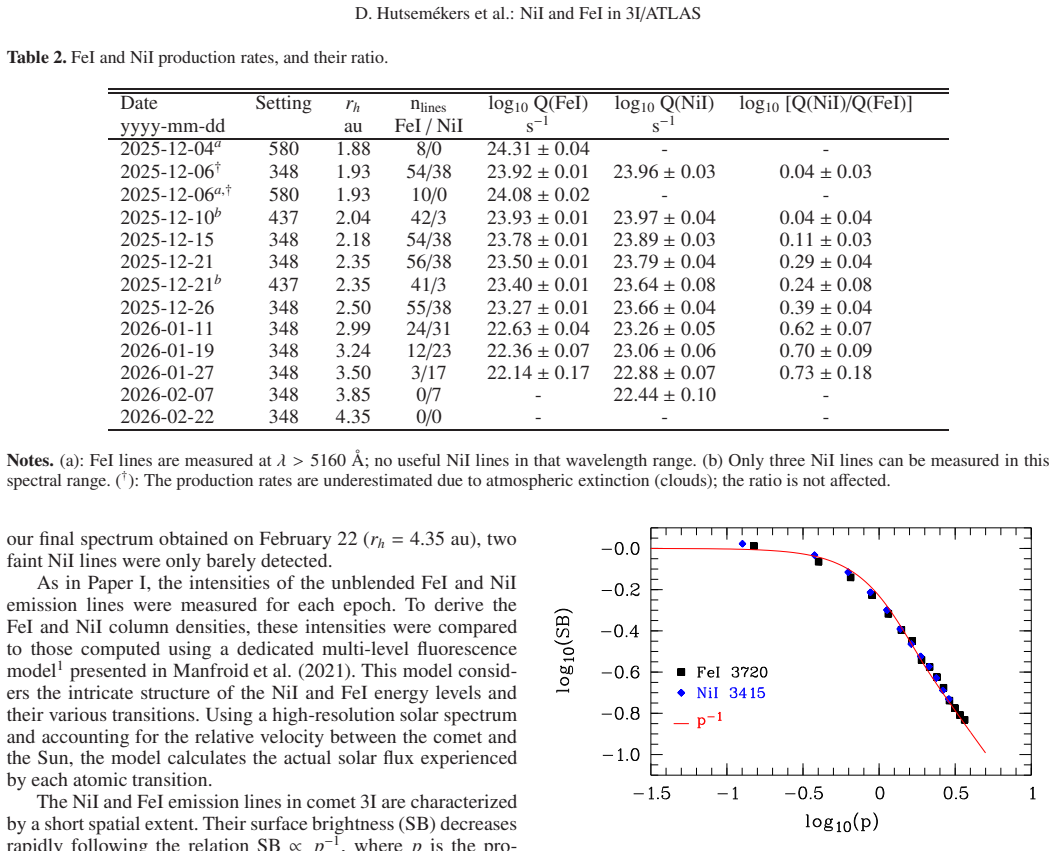
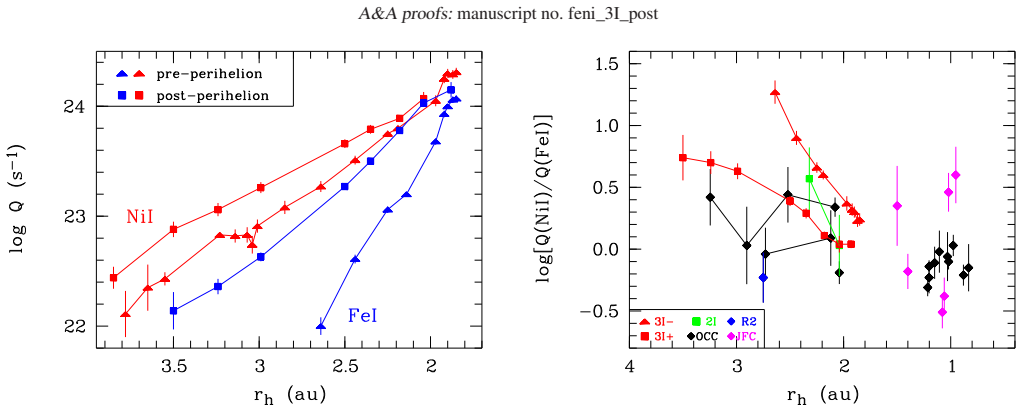
The central claim is that the observed NiI and FeI production rates and their evolving ratio are explained by rapid photodissociation of Fe(CO)5 and Ni(CO)4 that sublimate directly from the nucleus. Fits that include this direct sublimation match both the absolute rates and the high NiI/FeI line ratio, which is set by the greater volatility of Ni(CO)4. The required temperature profiles are shallower than the simple equilibrium relation, indicating sublimation from subsurface layers several centimeters deep, especially post-perihelion, while a transient heat source possibly tied to the amorphous-crystalline ice transition accounts for the pre-perihelion nickel excess.
What carries the argument
The carbonyl hypothesis, in which FeI and NiI are produced by photodissociation of Fe(CO)5 and Ni(CO)4 vaporized directly from the nucleus, with the higher volatility of Ni(CO)4 determining the observed NiI/FeI ratio.
If this is right
- Metal production rates remain at least an order of magnitude above those of solar-system comets at 2 au and persist to large heliocentric distances.
- Post-perihelion production rates exceed pre-perihelion rates and fall off more slowly with increasing distance, with the asymmetry stronger for FeI.
- The NiI/FeI ratio starts high before perihelion and approaches values typical of solar-system comets near 2 au, showing weaker distance dependence afterward.
- Direct sublimation of the carbonyls dominates over desorption from sublimating CO2 and H2O ices.
- Temperature profiles from thermal models require the carbonyls to sublimate from depths of several centimeters, especially after perihelion.
Where Pith is reading between the lines
- If the model is correct, other interstellar comets may exhibit detectable NiI and FeI emission once they reach comparable distances, provided they retain similar volatile inventories.
- The need for subsurface sublimation points to a layered nucleus structure in which heat conduction controls the timing of volatile release.
- The proposed transient heat source at 100-140 K could be searched for in the early activity of future interstellar objects through coordinated infrared and optical monitoring.
- Repeating the analysis on pre-perihelion data for 3I/ATLAS itself might reveal how the surface layers change after the first solar passage.
Load-bearing premise
That FeI and NiI atoms are produced exclusively by photodissociation of Fe(CO)5 and Ni(CO)4 that sublimate directly from the nucleus, with negligible contribution from other sources or desorption from CO2 and H2O ices.
What would settle it
A measurement of NiI and FeI production rates that cannot be reproduced by any temperature profile consistent with thermal models of subsurface sublimation, or a NiI/FeI ratio that does not track the volatility difference between Ni(CO)4 and Fe(CO)5.
Figures


read the original abstract
We present high-resolution UVES+VLT observations of neutral nickel and iron atoms in the coma of the interstellar comet 3I/ATLAS taken after perihelion. Metal emission was strong shortly after perihelion and persisted at large heliocentric distances. At $r_h \sim 2$ au the total metal production rate was found to be at least an order of magnitude larger than that of typical solar-system comets. Post-perihelion production rates exhibit pronounced asymmetry compared to the pre-perihelion behavior: production rates are higher after perihelion and decline more gradually with $r_h$, the difference being stronger for FeI. The NiI/FeI abundance ratio, initially anomalously large before perihelion, evolved toward values comparable to solar-system comets near 2 au, and shows a weaker $r_h$ dependence after perihelion. To interpret these results, we revisited and extended the carbonyl hypothesis in which FeI and NiI are produced by the rapid photodissociation of Fe(CO)$_5$ and Ni(CO)$_4$ vaporized from the nucleus. Fits that include direct sublimation of carbonyls reproduce the observed rates and the high NiI/FeI line ratio, which is determined by the higher volatility of Ni(CO)$_4$. Desorption of carbonyls from sublimating CO$_2$ and H$_2$O ices is found to be negligible. The temperature profiles needed to reproduce the observations were found to be shallower than the equilibrium $T \propto r_h^{-1/2}$ relation, suggesting that the sublimation could occur below the surface of the nucleus. Fits using temperature profiles from thermal models require sublimation from depths of several cm, especially post-perihelion. An additional transient heat source ($T \simeq$ 100-140~K), possibly linked to the amorphous-crystalline ice transition, is proposed to explain the early NiI excess before perihelion.
Editorial analysis
A structured set of objections, weighed in public.
Referee Report
Summary. The manuscript reports UVES+VLT high-resolution observations of NiI and FeI in the coma of interstellar comet 3I/ATLAS, documenting high post-perihelion metal production rates (at least 10x typical solar-system comets at rh~2 au), pronounced post-perihelion asymmetry (stronger for FeI), and an evolving NiI/FeI ratio from anomalously high pre-perihelion values toward solar-system comet levels. The authors extend the carbonyl hypothesis, modeling direct nucleus sublimation of Fe(CO)5 and Ni(CO)4 followed by rapid photodissociation as the source of the observed atoms. Model fits reproduce the rates, asymmetry, and high NiI/FeI ratio (via higher volatility of Ni(CO)4), requiring shallower-than-equilibrium temperature profiles, sublimation from depths of several cm (especially post-perihelion), and a transient 100-140 K heat source pre-perihelion (possibly linked to amorphous-crystalline ice transition). Desorption from CO2 and H2O ices is stated to be negligible.
Significance. If the central interpretation holds, the work strengthens the case for metal carbonyls as a significant source of atomic metals in cometary comae, with particular relevance to interstellar objects. The reproduction of the observed NiI/FeI ratio through differential volatilities and the post-perihelion asymmetry are clear strengths of the modeling. The suggestion of non-equilibrium thermal profiles and a transient heat source offers testable ideas for nucleus structure and outgassing. The observational dataset is valuable, but the significance is tempered by the need to quantitatively bound alternative metal sources before the derived thermal depths and volatility-driven ratio can be considered robust.
major comments (3)
- [Modeling and interpretation (carbonyl hypothesis fits)] The modeling section states that 'desorption of carbonyls from sublimating CO2 and H2O ices is found to be negligible' and that other sources are not required to reproduce the data. This exclusivity is load-bearing for the derived shallower temperature profiles and several-cm sublimation depths (especially post-perihelion), yet no quantitative upper limits or sensitivity tests on contributions from refractory dust, sputtering, or other compounds are provided. If such sources contribute at the 20-30% level, the need for the fitted thermal structure and transient heat source would be reduced or eliminated.
- [Results of the model fits] The temperature profiles and sublimation depths are adjusted to match the observed production rates and NiI/FeI ratio evolution. While the fits reproduce the main features, the paper should demonstrate that the solution is not unique or overly dependent on post-hoc parameter choices; independent thermal constraints or forward modeling with fixed profiles from standard nucleus models would strengthen the claim that direct sublimation from cm depths is required.
- [Discussion of pre-perihelion behavior] The proposed transient heat source (T ≃ 100-140 K) to explain the pre-perihelion NiI excess is introduced to account for the high initial NiI/FeI ratio under the carbonyl model. This addition is ad hoc and tied to the same exclusivity assumption; quantitative exploration of whether modest contributions from other Ni sources could obviate the need for this heat source is missing.
minor comments (2)
- [Figures 2-4 and associated text] Notation for production rates (e.g., Q(NiI), Q(FeI)) and the NiI/FeI ratio should be defined consistently in the text and figure captions to avoid ambiguity between column densities and production rates.
- [Abstract and §4] The abstract and modeling description would benefit from a brief statement of the assumed photodissociation rates or branching ratios for Fe(CO)5 and Ni(CO)4 to allow readers to assess the rapidity of the metal release.
Simulated Author's Rebuttal
We thank the referee for their constructive and detailed comments on our manuscript. We have carefully considered each point and revised the paper to address the concerns regarding quantitative tests, model uniqueness, and alternative explanations. Our responses are provided below.
read point-by-point responses
-
Referee: The modeling section states that 'desorption of carbonyls from sublimating CO2 and H2O ices is found to be negligible' and that other sources are not required to reproduce the data. This exclusivity is load-bearing for the derived shallower temperature profiles and several-cm sublimation depths (especially post-perihelion), yet no quantitative upper limits or sensitivity tests on contributions from refractory dust, sputtering, or other compounds are provided. If such sources contribute at the 20-30% level, the need for the fitted thermal structure and transient heat source would be reduced or eliminated.
Authors: We agree that the lack of explicit quantitative upper limits on alternative sources represents a limitation in the original submission. In the revised manuscript, we have added a dedicated sensitivity analysis subsection. This includes tests assuming 10-30% contributions from refractory dust and sputtering to the metal production rates. The results show that while such contributions can reduce the required carbonyl sublimation rates by up to 25%, the post-perihelion asymmetry, the need for shallower temperature profiles, and sublimation from depths of several cm remain necessary to reproduce the observations. The differential volatility of Ni(CO)4 versus Fe(CO)5 continues to provide the most straightforward explanation for the NiI/FeI ratio evolution. revision: yes
-
Referee: The temperature profiles and sublimation depths are adjusted to match the observed production rates and NiI/FeI ratio evolution. While the fits reproduce the main features, the paper should demonstrate that the solution is not unique or overly dependent on post-hoc parameter choices; independent thermal constraints or forward modeling with fixed profiles from standard nucleus models would strengthen the claim that direct sublimation from cm depths is required.
Authors: We acknowledge the value of demonstrating robustness against parameter choices. The revised manuscript now includes forward modeling runs that employ fixed temperature profiles taken from standard comet nucleus thermal models in the literature (incorporating realistic thermal inertia, porosity, and layering). These independent profiles confirm that matching the observed production rates and their heliocentric evolution requires sublimation from depths of 2-6 cm, especially post-perihelion. We also present a brief exploration of parameter degeneracies, showing that the requirement for shallower-than-equilibrium profiles is robust and not an artifact of our fitting procedure. revision: yes
-
Referee: The proposed transient heat source (T ≃ 100-140 K) to explain the pre-perihelion NiI excess is introduced to account for the high initial NiI/FeI ratio under the carbonyl model. This addition is ad hoc and tied to the same exclusivity assumption; quantitative exploration of whether modest contributions from other Ni sources could obviate the need for this heat source is missing.
Authors: The transient heat source is motivated by the well-documented exothermic transition from amorphous to crystalline water ice, which occurs in the 100-140 K range and has been discussed in multiple cometary studies. We nevertheless agree that a quantitative assessment of alternatives is warranted. In the revision, we have added calculations showing that even allowing for a 20-30% contribution from other Ni sources (e.g., dust or sputtering), a temperature enhancement of 15-25 K above the baseline profile is still required to reproduce the pre-perihelion NiI excess and the initially high NiI/FeI ratio. This supports retaining the transient heat source as a plausible mechanism while clarifying its tentative character. revision: partial
Circularity Check
No significant circularity in the derivation chain
full rationale
The paper reports UVES observations of NiI and FeI in comet 3I/ATLAS, then applies an extended carbonyl sublimation model to interpret the production rates, NiI/FeI ratio, and post-perihelion asymmetry. The abstract states that fits including direct sublimation reproduce the observed rates, with the ratio attributed to Ni(CO)4 volatility and desorption from CO2/H2O ices found negligible. This constitutes standard parameter fitting of a physical model to data rather than any self-definitional loop, fitted input renamed as prediction, or load-bearing self-citation. No equations, uniqueness theorems, or prior-author citations are quoted that reduce the central claims to their own inputs by construction. The thermal-profile and depth inferences follow from the model under the stated assumptions, which remain externally falsifiable against additional observations.
Axiom & Free-Parameter Ledger
free parameters (2)
- sublimation depth
- transient heat source temperature
axioms (2)
- domain assumption Rapid photodissociation of Fe(CO)5 and Ni(CO)4 produces the observed FeI and NiI atoms.
- domain assumption Desorption of carbonyls from sublimating CO2 and H2O ices is negligible.
Reference graph
Works this paper leans on
-
[1]
R., Serra-Ricart , M., Licandro , J., et al
Alarcon , M. R., Serra-Ricart , M., Licandro , J., et al. 2025, The Astronomer's Telegram, 17264, 1
work page 2025
-
[2]
1979, in Liege International Astrophysical Colloquia, ed
Arpigny , C. 1979, in Liege International Astrophysical Colloquia, ed. A. Boury , N. Grevesse , & L. Remy-Battiau , Vol. 22, 189--197
work page 1979
-
[3]
Asplund , M., Grevesse , N., Sauval , A. J., & Scott , P. 2009, , 47, 481
work page 2009
- [4]
-
[5]
Biver , N., Bockel \'e e-Morvan , D., Moreno , R., et al. 2026, , 708, L16
work page 2026
-
[6]
Bloch , M. R. & Wirth , H. L. 1980, Naturwissenschaften, 67, 562
work page 1980
-
[7]
Bromley , S. J., Neff , B., Loch , S. D., et al. 2021, Planetary Science Journal, 2, 228
work page 2021
-
[8]
Cochran , A. L. & Schleicher , D. G. 1993, , 105, 235
work page 1993
-
[9]
R., M \"a kinen , T., Bertaux , J
Combi , M. R., M \"a kinen , T., Bertaux , J. L., et al. 2026, , 998, L17
work page 2026
-
[10]
Copeland , R. & Lohse , J. G. 1882, Copernicus: An International Journal of Astronomy, 2, 225
-
[11]
Cordiner , M., Roth , N. X., Micheli , M., et al. 2026, arXiv e-prints, arXiv:2603.06911
-
[12]
Cordiner , M. A., Roth , N. X., Kelley , M. S. P., et al. 2025, , 991, L43
work page 2025
-
[13]
M., Kuan , Y.-J., Charnley , S
Coulson , I. M., Kuan , Y.-J., Charnley , S. B., et al. 2026, , 546, stag063
work page 2026
-
[14]
Delsemme , A. H. 1982, in IAU Colloq. 61: Comet Discoveries, Statistics, and Observational Selection, ed. L. L. Wilkening , 85--130
work page 1982
- [15]
-
[16]
2016, Computational and Theoretical Chemistry, 1084, 196
Fioroni, M. 2016, Computational and Theoretical Chemistry, 1084, 196
work page 2016
-
[17]
J., Bleuet , P., Borg , J., et al
Flynn , G. J., Bleuet , P., Borg , J., et al. 2006, Science, 314, 1731
work page 2006
-
[18]
Gilbert , A. G. & Sulzmann , K. G. P. 1974, Journal of the Electrochemical Society, 121, 832
work page 1974
- [19]
-
[20]
Hoogendam , W. B., Jones , D. O., Yang , B., et al. 2026, arXiv e-prints, arXiv:2601.16983
-
[21]
Huebner , W. F. 1970, , 5, 286
work page 1970
-
[22]
Hutsem \'e kers , D., Manfroid , J., Jehin , E., Opitom , C., & Moulane , Y. 2021, , 652, L1
work page 2021
-
[23]
Hutsem \'e kers , D., Manfroid , J., Jehin , E., et al. 2026, , 706, A43
work page 2026
-
[24]
Ip , W. H. & Jorda , L. 1998, , 496, L47
work page 1998
- [25]
-
[26]
K., Christoforidis , A., & Kissel , J
Jessberger , E. K., Christoforidis , A., & Kissel , J. 1988, , 332, 691
work page 1988
- [27]
-
[28]
Lisse , C. M., Bach , Y. P., Bryan , S. A., et al. 2026, Research Notes of the American Astronomical Society, 10, 26
work page 2026
- [29]
-
[30]
Opitom , C., Jehin , E., Hutsem \'e kers , D., et al. 2021, , 650, L19
work page 2021
-
[31]
2026, arXiv e-prints, arXiv:2603.07187
Opitom , C., Manfroid , J., Hutsem \'e kers , D., et al. 2026, arXiv e-prints, arXiv:2603.07187
-
[32]
Preston , G. W. 1967, , 147, 718
work page 1967
-
[33]
Prialnik , D., Benkhoff , J., & Podolak , M. 2004, in Comets II, ed. M. C. Festou , H. U. Keller , & H. A. Weaver , 359
work page 2004
-
[34]
Prialnik , D. & Jewitt , D. 2024, in Comets III, ed. K. J. Meech , M. R. Combi , D. Bockel \'e e-Morvan , S. N. Raymond , & M. E. Zolensky , 823--844
work page 2024
-
[35]
Rahatgaonkar , R., Carvajal , J. P., Puzia , T. H., et al. 2025, , 995, L34
work page 2025
-
[36]
X., Cordiner , M., Milam , S., et al
Roth , N. X., Cordiner , M., Milam , S., et al. 2026 a , arXiv e-prints, arXiv:2603.20445
-
[37]
Roth , N. X., Cordiner , M. A., Bockel \'e e-Morvan , D., et al. 2026 b , , 999, L32
work page 2026
-
[38]
Coma Physics of an Interstellar Object: JWST Spatial-Spectral Mapping of 3I/ATLAS
Roth , N. X., Cordiner , M. A., Milam , S. N., et al. 2026 c , arXiv e-prints, arXiv:2603.20460
work page internal anchor Pith review Pith/arXiv arXiv 2026
-
[39]
Rubin , M., Altwegg , K., Berthelier , J.-J., et al. 2022, , 658, A87
work page 2022
-
[40]
Rubin , M., Altwegg , K., Berthelier , J.-J., et al. 2023, , 526, 4209
work page 2023
-
[41]
Water D/H in 3I/ATLAS as a Probe of Formation Conditions in Another Planetary System
Salazar Manzano , L. E., Paneque-Carre \ n o , T., Cordiner , M. A., et al. 2026, arXiv e-prints, arXiv:2603.07026
work page internal anchor Pith review Pith/arXiv arXiv 2026
-
[42]
Slaughter , C. D. 1969, , 74, 929
work page 1969
-
[43]
Stull , D. R. 1947, Ind. Eng. Chem., 39, 517
work page 1947
- [44]
- [45]
-
[46]
Tielens , A. G. G. M., Wooden , D. H., Allamandola , L. J., Bregman , J., & Witteborn , F. C. 1996, , 461, 210
work page 1996
-
[47]
Velampatti Selvaraj , P. & Chandrasekaran , V. 2026, Frontiers in Chemistry, 14, 1774797
work page 2026
- [48]
-
[49]
Post-perihelion Coma Composition of the Interstellar Comet 3I/ATLAS from Optical Spectroscopy
Zhao , R., Zhang , X., Yang , B., et al. 2026, arXiv e-prints, arXiv:2603.07718
work page internal anchor Pith review Pith/arXiv arXiv 2026
-
[50]
Zolensky , M. E., Zega , T. J., Yano , H., et al. 2006, Science, 314, 1735
work page 2006
-
[51]
Comet Bowell 1980b. , keywords =. doi:10.1086/113552 , adsurl =
-
[52]
, year = 1995, month = dec, volume =
The ensemble properties of comets: Results from narrowband photometry of 85 comets, 1976-1992. , year = 1995, month = dec, volume =. doi:10.1006/icar.1995.1190 , adsurl =
-
[53]
urn:nasa:pds:gbo-kpno:hyakutake \_ spectra::1.0, NASA Planetary Data System
Spectra of C/1996 B2 (Hyakutake) for Multiple Offsets from Photocenter. urn:nasa:pds:gbo-kpno:hyakutake \_ spectra::1.0, NASA Planetary Data System
work page 1996
-
[54]
The Astronomer's Telegram , keywords =
Deep g'-band Imaging of Interstellar Comet 3I/ATLAS from the Two-meter Twin Telescope (TTT). The Astronomer's Telegram , keywords =
-
[55]
Chemical highlights from the Rosetta mission. IAU Symposium , keywords =. doi:10.1017/S1743921317007852 , adsurl =
-
[56]
Abundances of the elements: Meteoritic and solar. , keywords =. doi:10.1016/0016-7037(89)90286-X , adsurl =
-
[57]
On the nature of comets. Proceedings of the Robert A. Welch Foundation Conferences on Chemical Research XXI, Cosmochemistry , year = 1978, editor =
work page 1978
-
[58]
Liege International Astrophysical Colloquia , year = 1979, editor =
Relative abundances of the heavy elements in comet Ikeya-Seki /1965 VIII/. Liege International Astrophysical Colloquia , year = 1979, editor =
work page 1965
-
[59]
Production and kinematics of sodium atoms in the coma of comet Hale-Bopp. , keywords =. 1998
work page 1998
-
[60]
Anomalous Nitrogen Isotope Ratio in Comets. Science , keywords =. doi:10.1126/science.1086711 , adsurl =
-
[61]
The Chemical Composition of the Sun. , keywords =. doi:10.1146/annurev.astro.46.060407.145222 , archivePrefix =. 0909.0948 , primaryClass =
-
[62]
The Planetary Science Journal , keywords =
Comprehensive Analyses of the Strongly Carbon-chain Depleted Comets in Lowell Observatory's Narrowband Photometry Database. The Planetary Science Journal , keywords =. doi:10.3847/PSJ/ae03b9 , archivePrefix =. 2509.05499 , primaryClass =
-
[63]
Carbon-rich dust in comet 67P/Churyumov-Gerasimenko measured by COSIMA/Rosetta. , keywords =. doi:10.1093/mnras/stx2640 , adsurl =
-
[64]
The Volatile Inventory of 3I/ATLAS as seen with JWST/MIRI
The Volatile Inventory of 3I/ATLAS as Seen with JWST/MIRI. , keywords =. doi:10.3847/2041-8213/ae5700 , archivePrefix =. 2601.22034 , primaryClass =
work page internal anchor Pith review Pith/arXiv arXiv doi:10.3847/2041-8213/ae5700 2041
-
[65]
, year = 2011, month = jun, volume =
Evidence for aqueous activity on comet 81P/Wild 2 from sulfide mineral assemblages in Stardust samples and CI chondrites. , year = 2011, month = jun, volume =. doi:10.1016/j.gca.2011.03.026 , adsurl =
-
[66]
A Coupled Chemistry-emission Model for Atomic Oxygen Green and Red-doublet Emissions in the Comet C/1996 B2 Hyakutake. , keywords =. doi:10.1088/0004-637X/748/1/13 , archivePrefix =. 1203.0723 , primaryClass =
-
[67]
The extraordinary composition of the blue comet C/2016 R2 (PanSTARRS). , keywords =. doi:10.1051/0004-6361/201833449 , archivePrefix =. 1809.08086 , primaryClass =
-
[68]
Long-term monitoring of the outgassing and composition of comet 67P/Churyumov-Gerasimenko with the Rosetta/MIRO instrument. , keywords =. doi:10.1051/0004-6361/201834960 , adsurl =
-
[69]
Perihelion observations of interstellar comet 3I/ATLAS with the IRAM 30-m telescope. , keywords =. doi:10.1051/0004-6361/202659316 , adsurl =
-
[70]
Naturwissenschaften , year = 1980, month = nov, volume =
Abiotic organic synthesis in space. Naturwissenschaften , year = 1980, month = nov, volume =. doi:10.1007/BF00450669 , adsurl =
-
[71]
The composition of cometary ices. Philosophical Transactions of the Royal Society of London Series A , year = 2017, month = may, volume =. doi:10.1098/rsta.2016.0252 , adsurl =
-
[72]
The carbon monoxide-rich interstellar comet 2I/Borisov. Nature Astronomy , keywords =. doi:10.1038/s41550-020-1095-2 , archivePrefix =. 2004.08972 , primaryClass =
-
[73]
The Unusual Volatile Composition of the Halley-Type Comet 8P/Tuttle: Addressing the Existence of an Inner Oort Cloud. , keywords =. doi:10.1086/591446 , archivePrefix =. 0807.3943 , primaryClass =
-
[74]
Science , year = 1994, month = aug, volume =
Chemically Anomalous, Preaccretionally Irradiated Grains in Interplanetary Dust From Comets. Science , year = 1994, month = aug, volume =. doi:10.1126/science.265.5174.925 , adsurl =
-
[75]
Planetary Science Journal , keywords =
Atomic Iron and Nickel in the Coma of C/1996 B2 (Hyakutake): Production Rates, Emission Mechanisms, and Possible Parents. Planetary Science Journal , keywords =. doi:10.3847/PSJ/ac2dff , archivePrefix =. 2106.04701 , primaryClass =
-
[76]
Atomic iron and nickel in the coma of C/1996 B2 (Hyakutake): production rates, emission mechanisms, and possible parents. arXiv e-prints , keywords =
work page 1996
-
[77]
Annual Review of Earth and Planetary Sciences , year = 2014, month = may, volume =
The Stardust Mission: Analyzing Samples from the Edge of the Solar System. Annual Review of Earth and Planetary Sciences , year = 2014, month = may, volume =. doi:10.1146/annurev-earth-050212-124203 , adsurl =
-
[78]
The Relationship between Infrared, Optical, and Ultraviolet Extinction. , keywords =. doi:10.1086/167900 , adsurl =
-
[79]
, year = 2010, month = jun, volume =
An improved high-resolution solar reference spectrum for earth's atmosphere measurements in the ultraviolet, visible, and near infrared. , year = 2010, month = jun, volume =. doi:10.1016/j.jqsrt.2010.01.036 , adsurl =
-
[80]
, year = 1993, month = sep, volume =
Observational Constraints on the Lifetime of Cometary H _ 2 O. , year = 1993, month = sep, volume =. doi:10.1006/icar.1993.1121 , adsurl =
discussion (0)
Sign in with ORCID, Apple, or X to comment. Anyone can read and Pith papers without signing in.