Recognition: no theorem link
Computing bases in Hermite normal form of lattices of integer relations
Pith reviewed 2026-05-11 03:22 UTC · model grok-4.3
The pith
A Las Vegas randomized algorithm computes the Hermite normal form basis for the lattice of all integer vectors p such that pF lies in the row lattice of M.
A machine-rendered reading of the paper's core claim, the machinery that carries it, and where it could break.
Core claim
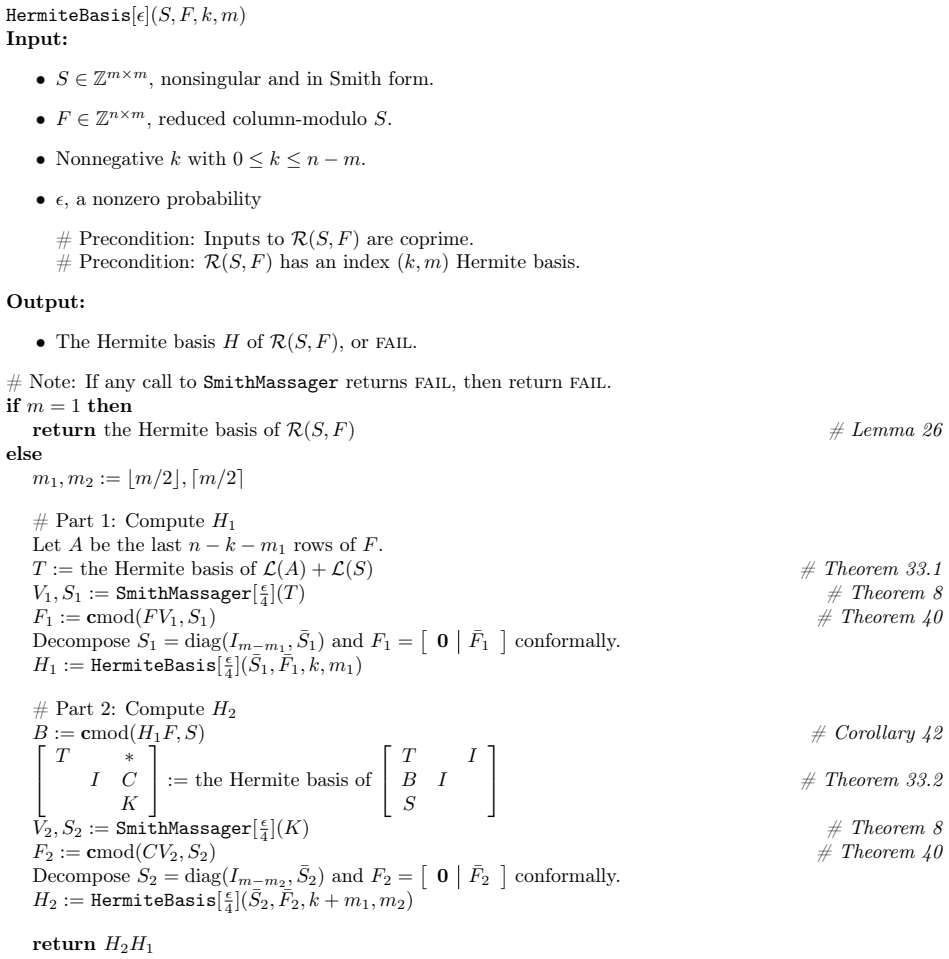
Given a full column rank matrix M in Z^{ℓ×m} and an integer matrix F in Z^{n×m}, the algorithm computes the n×n basis in Hermite form of the integer lattice comprised of all rows p in Z^{1×n} such that pF lies in the integer lattice generated by the rows of M. The procedure is randomized of the Las Vegas type: it either returns failure or produces the correct result, with failure probability at most 1/2. When M is square and F equals the identity, the returned basis is the Hermite normal form of M and the bit operation count matches the cost of multiplying two matrices of the same dimension and entry bit length.
What carries the argument
The Las Vegas randomized procedure that returns a Hermite normal form basis for the preimage lattice defined by the linear condition pF belonging to the row lattice of M.
If this is right
- When M is square and F is the identity matrix the output is exactly the Hermite normal form of M.
- The bit complexity in the square case equals the cost of two matrix multiplications of the input dimensions and entry sizes.
- The algorithm returns a correct basis whenever it does not report failure.
- The method applies directly to rectangular full-column-rank M and to arbitrary auxiliary matrices F.
Where Pith is reading between the lines
- The same reduction could be used inside computer algebra systems to accelerate any routine that currently relies on slower Hermite normal form implementations for integer matrices.
- Applications that repeatedly compute minimal integer relations, such as lattice-based cryptography or exact linear programming, would become feasible at larger scales.
- Direct comparison of the new output against a classical slow algorithm on random small matrices would give immediate empirical confirmation of correctness.
Load-bearing premise
The random choices performed by the algorithm succeed with probability at least one half, and the input matrix M has full column rank.
What would settle it
Run the algorithm on a small square full-rank integer matrix M with F set to the identity, then verify that the output matrix is in Hermite normal form, has the same determinant as M, and that its rows span precisely the same lattice as the classical definition.
Figures
read the original abstract
Given a full column rank $M \in \Z^{\ell \times m}$ and an $F \in \Z^{n \times m}$ we present an algorithm to compute the $n \times n$ basis in Hermite form of the integer lattice comprised of all rows $p \in \Z^{1 \times n}$ such that $pF \in \Z^{1 \times m}$ is in the integer lattice generated by the rows of $M$. The algorithm is randomized of the Las Vegas type, that is, it can fail with probability at most $1/2$, but if fail is not returned it guarantees to produce the correct result. When $M$ is square and $F=I_m$, then the computed basis is the Hermite normal form of $M$, and the algorithm uses about the same number of bit operations as required to multiply together two matrices of the same dimension and size of entries as $M$.
Editorial analysis
A structured set of objections, weighed in public.
Referee Report
Summary. The manuscript presents a Las Vegas randomized algorithm that, given a full-column-rank integer matrix M ∈ ℤ^{ℓ×m} and an arbitrary integer matrix F ∈ ℤ^{n×m}, computes an n×n basis in Hermite normal form for the lattice of all row vectors p ∈ ℤ^{1×n} such that pF lies in the integer row lattice generated by M. The algorithm returns 'fail' with probability at most 1/2 but is guaranteed correct on success. In the special case M square and F = I_m the output is the HNF of M and the bit complexity is asymptotically the same as that of multiplying two matrices of the same dimensions and entry size.
Significance. If the claimed algorithm, correctness proof, and complexity bound hold, the result is a useful generalization of HNF computation to lattices of integer relations. The reduction to matrix-multiplication complexity in the standard case is a notable strength, as it places the procedure on the same footing as the best current HNF algorithms and supplies a concrete, falsifiable complexity statement.
minor comments (3)
- §2.1: the notation for the row lattice generated by M is introduced without an explicit definition of the ambient module; adding one sentence would remove ambiguity for readers unfamiliar with the integer-relation setting.
- Algorithm 1, line 12: the random sampling step is described only at a high level; a brief remark on the bit length of the sampled entries and the precise failure-probability calculation would improve reproducibility.
- Theorem 5.3: the complexity statement is given in terms of matrix multiplication; it would be helpful to state the precise exponent (e.g., the current best ω) used in the O-notation.
Simulated Author's Rebuttal
We thank the referee for their positive summary of our work, recognition of its significance as a generalization of HNF computation, and recommendation for minor revision. No specific major comments were provided in the report.
Circularity Check
No significant circularity detected
full rationale
The manuscript presents an explicit Las Vegas randomized algorithm for computing the n×n HNF basis of the integer lattice {p ∈ Z^{1×n} | pF lies in the row lattice of M}, together with a correctness proof under the stated full-column-rank assumption and a complexity analysis that reduces the special case (M square, F = I) to a constant number of matrix multiplications of matching dimension and entry size. All load-bearing steps are direct algorithmic constructions and standard lattice definitions; no equation or claim reduces by construction to a fitted parameter, self-citation, or renamed input. The complexity reference is an external benchmark (matrix multiplication), not an internal tautology. The derivation is therefore self-contained.
Axiom & Free-Parameter Ledger
axioms (2)
- standard math Hermite normal form exists and is unique for any full column rank integer matrix
- domain assumption The lattice of integer relations p with pF in the row lattice of M is a full-rank Z-module of rank n
Reference graph
Works this paper leans on
-
[1]
J. Alman and V. V. Williams. A refined laser method and faster matrix multiplication. InProc. of 2021 ACM-SIAM Symposium on Discrete Algorithms (SODA), pages 522–539, 2021
work page 2021
-
[2]
B. Beckermann and G. Labahn. A uniform approach for the fast computation of matrix–type Padé approximants.SIAM Journal on Matrix Analysis and Applications, 15(3):804–823, 1994
work page 1994
-
[3]
B. Beckermann and G. Labahn. Recursiveness in matrix rational interpolation problems.Journal of Computational and Applied Math, 77:5–34, 1997
work page 1997
- [4]
-
[5]
S. Birmpilis, G. Labahn, and A. Storjohann. A Las Vegas algorithm for computing the Smith form of a nonsingular integer matrix. InProc. Int’l. Symp. on Symbolic and Algebraic Computation: ISSAC’20, page 38–45, New York, NY, USA, 2020. ACM
work page 2020
-
[6]
S. Birmpilis, G. Labahn, and A. Storjohann. A fast algorithm for computing the Smith normal form with multipliers for a nonsingular integer matrix.Journal of Symbolic Computation, 116:146–182, 2023
work page 2023
-
[7]
S. Birmpilis, G. Labahn, and A. Storjohann. A cubic algorithm for computing the Hermite normal form of a nonsingular integer matrix.ACM Transactions of Algorithms, 19:1–36, 2023
work page 2023
-
[8]
Deterministic reduction of integer nonsin- gular linear system solving to matrix multiplication
Stavros Birmpilis, George Labahn, and Arne Storjohann. Deterministic reduction of integer nonsin- gular linear system solving to matrix multiplication. InProc. Int’l. Symp. on Symbolic and Algebraic Computation: ISSAC’19, page 58–65, New York, NY, USA, 2019. ACM. ISBN 9781450360845
work page 2019
-
[9]
T-W. J. Chou and G. E. Collins. Algorithms for the solutions of systems of linear diophantine equations. SIAM Journal of Computing, 11:687–708, 1982
work page 1982
-
[10]
P. D. Domich, R. Kannan, and L. E. Trotter, Jr. Hermite normal form computation using modulo determinant arithmetic.Mathematics of Operations Research, 12(1):50–59, 1987
work page 1987
- [11]
-
[12]
J. von zur Gathen and J. Gerhard.Modern Computer Algebra. Cambridge University Press, 3rd edition, 2013
work page 2013
- [13]
-
[14]
J. L. Hafner and K. S. McCurley. Asymptotically fast triangularization of matrices over rings.SIAM Journal of Computing, 20(6):1068–1083, December 1991
work page 1991
-
[15]
C. Hermite. Sur l’introduction des variables continues dans la théorie des nombres.J. Reine Angew. Math., 41:191–216, 1851
-
[16]
J. A. Howell. Spans in the module(Zm)s.Linear and Multilinear Algebra, 19:67—77, 1986
work page 1986
- [17]
-
[18]
C. S. Iliopoulos. Worst-case complexity bounds on algorithms for computing the canonical structure of finite abelian groups and the Hermite and Smith normal forms of an integer matrix.SIAM Journal of Computing, 18(4):658–669, 1989. 37
work page 1989
-
[19]
C.-P. Jeannerod, C. Pernet, and A. Storjohann. Rank-profile revealing Gaussian elimination and the CUP matrix decomposition.Journal of Symbolic Computation, 56:56–58, 2013
work page 2013
-
[20]
C.-P. Jeannerod, V. Neiger, É. Schost, and G. Villard. Computing minimal interpolation bases.Journal of Symbolic Computation, 83:272–314, 2017
work page 2017
-
[21]
R. Kannan and A. Bachem. Polynomial algorithms for computing the Smith and Hermite normal forms of and integer matrix.SIAM Journal of Computing, 8(4):499–507, November 1979
work page 1979
-
[22]
O. Knill. A Multivariable Chinese Remainder Theorem, 2012. URLhttps://arxiv.org/abs/1206. 5114
work page 2012
- [23]
- [24]
-
[25]
D. Micciancio and B. Warinschi. A linear space algorithm for computing the Hermite normal form. In B. Mourrain, editor,Proc. Int’l. Symp. on Symbolic and Algebraic Computation: ISSAC’01, pages 231—236. ACM Press, New York, 2001
work page 2001
-
[26]
V. Neiger and T. X. Vu. Computing canonical bases of modules of univariate relations. InProc. Int’l. Symp. on Symbolic and Algebraic Computation: ISSAC’17. ACM Press, New York, 2017
work page 2017
-
[27]
O. Ore. The General Chinese Remainder Theorem.The American Mathematical Monthly., 59:365–370, 1952
work page 1952
-
[28]
C. Pauderis and A. Storjohann. Computing the invariant structure of integer matrices: Fast algorithms into practice. InProc. Int’l. Symp. on Symbolic and Algebraic Computation: ISSAC’13, pages 307–314, New York, NY, USA, 2013. ACM
work page 2013
-
[29]
C. Pernet and W. Stein. Fast computation of Hermite normal forms of integer matrices.Journal of Number Theory, 130(7):1675–1683, 2010
work page 2010
-
[30]
D. Saunders and Zhendong Wan. Smith normal form of dense integer matrices, fast algorithms into practice. In J. Gutierrez, editor,Proc. Int’l. Symp. on Symbolic and Algebraic Computation: ISSAC’04, pages 274–281. ACM Press, New York, 2004
work page 2004
-
[31]
Storjohann.Algorithms for Matrix Canonical Forms
A. Storjohann.Algorithms for Matrix Canonical Forms. PhD thesis, Swiss Federal Institute of Tech- nology, ETH–Zurich, 2000
work page 2000
-
[32]
High–orderlifting.ExtendedAbstract
A.Storjohann. High–orderlifting.ExtendedAbstract. InT.Mora, editor,Proc. Int’l. Symp. on Symbolic and Algebraic Computation: ISSAC’02, pages 246–254. ACM Press, New York, 2002
work page 2002
-
[33]
A. Storjohann. High–order lifting and integrality certification.Journal of Symbolic Computation, 36 (3–4):613–648, 2003. Extended abstract in [32]
work page 2003
-
[34]
A. Storjohann. Notes on computing minimal approximant bases. In W. Decker, M. Dewar, E. Kaltofen, and S. Watt, editors,Challenges in Symbolic Computation Software, number 06271 in Dagstuhl Semi- nar Proceedings. Internationales Begegnungs- und Forschungszentrum fuer Informatik (IBFI), Schloss Dagstuhl, Germany, 2006. URLhttp://drops.dagstuhl.de/opus/vollt...
work page 2006
-
[35]
A. Storjohann and G. Labahn. Asymptotically fast computation of Hermite normal forms of integer matrices. In Y. N. Lakshman, editor,Proc. Int’l. Symp. on Symbolic and Algebraic Computation: ISSAC’96, pages 259–266. ACM Press, New York, 1996. 38
work page 1996
-
[36]
A. Storjohann and T. Mulders. Fast algorithms for linear algebra moduloN. In G. Bilardi, G. F. Italiano, A. Pietracaprina, and G. Pucci, editors,Algorithms — ESA ’98, LNCS 1461, pages 139–150. Springer Verlag, 1998
work page 1998
-
[37]
Multivariable Chinese Remainder Theorem.Resonance, 20:206–216, 2015
B Sury. Multivariable Chinese Remainder Theorem.Resonance, 20:206–216, 2015
work page 2015
-
[38]
Z. Wang, S. Birmpilis, G. Labahn, and A. Storjohann. A C implementation of the Smith massager algorithm, 2026. In progress
work page 2026
-
[39]
W. Zhou and G. Labahn. Efficient computation of order basis. In J. P. May, editor,Proc. Int’l. Symp. on Symbolic and Algebraic Computation: ISSAC’09, pages 375–384. ACM Press, New York, 2009
work page 2009
-
[40]
W. Zhou and G. Labahn. Computing column bases of polynomial matrices. InProc. Int’l. Symp. on Symbolic and Algebraic Computation: ISSAC’13, pages 379–388. ACM Press, Boston, USA, 2013
work page 2013
-
[41]
W. Zhou, G. Labahn, and A. Storjohann. Computing minimal nullspace basis. In J. van der Hoeven and M. van Hoeij, editors,Proc. Int’l. Symp. on Symbolic and Algebraic Computation: ISSAC’12, pages 366–373. ACM Press, New York, 2012
work page 2012
-
[42]
W. Zhou, G. Labahn, and A. Storjohann. A deterministic algorithm for inverting a polynomial matrix. Journal of Complexity, 31:162–173, 2015. 39
work page 2015
discussion (0)
Sign in with ORCID, Apple, or X to comment. Anyone can read and Pith papers without signing in.