Recognition: 2 theorem links
· Lean TheoremSpectra of bi-incomplete Tambara functors
Pith reviewed 2026-05-11 03:31 UTC · model grok-4.3
The pith
The paper defines the spectrum of prime ideals for arbitrary bi-incomplete Tambara functors, generalizing earlier work on Green functors and Tambara functors.
A machine-rendered reading of the paper's core claim, the machinery that carries it, and where it could break.
Core claim
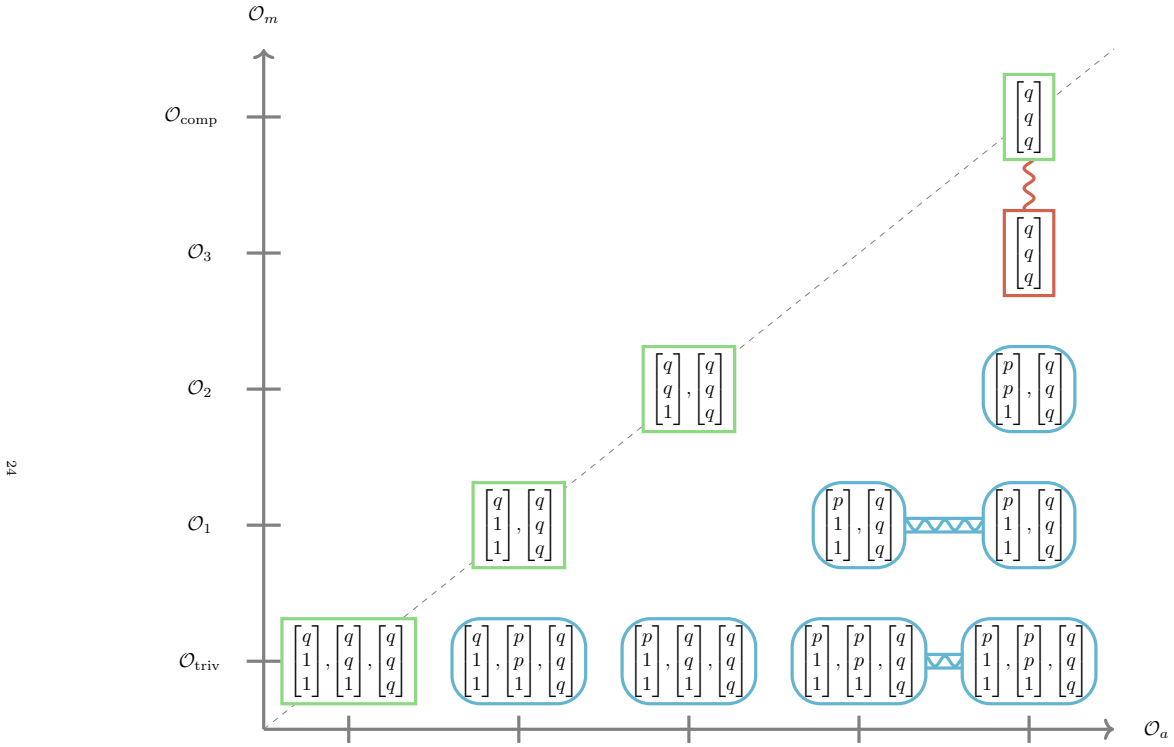
We define the spectrum of prime ideals for an arbitrary bi-incomplete Tambara functor, simultaneously generalizing Lewis and Nakaoka's notions. We then produce many computational tools which we apply to several examples of interest.
What carries the argument
The spectrum of prime ideals for a bi-incomplete Tambara functor, constructed so that it recovers the earlier spectra when restricted to Green functors or Tambara functors.
If this is right
- The spectrum applies uniformly to coefficient systems, Green functors, and Tambara functors.
- Computational tools become available for explicit calculations of these spectra in examples.
- The framework supports further algebraic geometry constructions over bi-incomplete Tambara functors.
- Results from special cases can be compared and extended within one common object.
Where Pith is reading between the lines
- If the spectrum behaves geometrically like classical ones, it could support definitions of dimension or irreducible components in the equivariant setting.
- The tools may transfer techniques from commutative algebra to study fixed-point data in equivariant homotopy.
- Verification on known examples would test whether the unification preserves expected properties such as containment of primes.
Load-bearing premise
The proposed definition of prime ideals is well-defined and consistent across the general bi-incomplete case and its special cases.
What would settle it
A calculation showing that the new spectrum fails to recover Lewis's spectrum when the bi-incomplete Tambara functor is a Green functor, or fails to recover Nakaoka's spectrum when it is a Tambara functor.
Figures


read the original abstract
Bi-incomplete Tambara functors are equivariant generalizations of commutative rings. The most common forms of bi-incomplete Tambara functors are coefficient systems of commutative rings, Green functors, and Tambara functors. In the 1980s, Lewis introduced prime ideals in Green functors, and in the 2010s, Nakaoka introduced prime ideals in Tambara functors. In this work, we define the spectrum of prime ideals for an arbitrary bi-incomplete Tambara functor, simultaneously generalizing Lewis and Nakaoka's notions. We then produce many computational tools which we apply to several examples of interest.
Editorial analysis
A structured set of objections, weighed in public.
Referee Report
Summary. The manuscript defines the spectrum of prime ideals for an arbitrary bi-incomplete Tambara functor. This simultaneously generalizes Lewis's definition for Green functors and Nakaoka's definition for Tambara functors. The paper then develops a collection of computational tools for working with this spectrum and applies them to several examples.
Significance. If the definition is well-posed and the tools are effective, the work supplies a unified framework for prime spectra across the hierarchy of bi-incomplete Tambara functors (coefficient systems, Green functors, Tambara functors). This unification, together with the explicit computational machinery, is a substantive contribution to equivariant algebra and could support new calculations in equivariant homotopy theory.
minor comments (3)
- [Abstract] The abstract states that the definition is applied to 'several examples of interest' but does not name them; a one-sentence list of the main examples in the introduction would improve readability.
- [§2] Notation for the prime ideal spectrum is introduced in §2; a short remark comparing the new notation directly to the Lewis and Nakaoka conventions (even if only by reference) would make the generalization easier to verify at a glance.
- [§4] The computational tools in §4 are presented as lemmas; adding a brief table summarizing which tools apply to which special cases (Green, Tambara, etc.) would help readers navigate the results.
Simulated Author's Rebuttal
We thank the referee for their positive assessment of the manuscript, including the recognition that our definition unifies the notions of Lewis and Nakaoka while supplying useful computational tools. The recommendation for minor revision is noted; however, the report contains no specific major comments requiring response.
Circularity Check
No significant circularity: new definition generalizes prior independent work
full rationale
The paper's central contribution is the introduction of a new definition for the spectrum of prime ideals in arbitrary bi-incomplete Tambara functors, explicitly generalizing the independent notions from Lewis (for Green functors) and Nakaoka (for Tambara functors). This is a definitional extension rather than a derivation, prediction, or first-principles result that reduces to fitted inputs, self-citations, or ansatzes by construction. No load-bearing steps in the abstract or described structure invoke self-referential equations, fitted parameters renamed as predictions, or uniqueness theorems imported from the authors' prior work. The construction is presented as well-defined on its own terms and applied to examples, making the argument self-contained without circular reduction.
Axiom & Free-Parameter Ledger
Lean theorems connected to this paper
-
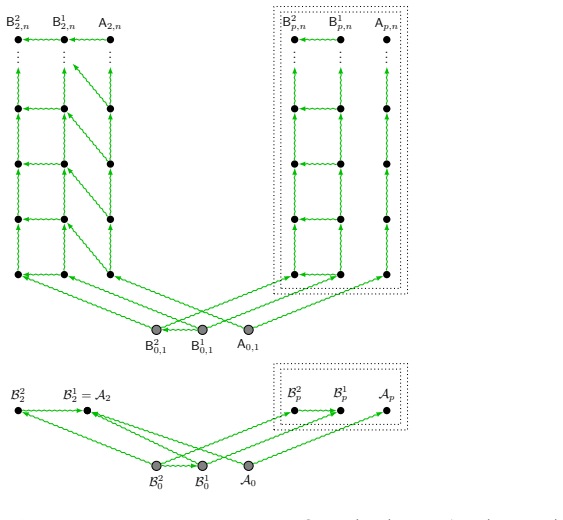
IndisputableMonolith/Foundation/AbsoluteFloorClosure.leanreality_from_one_distinction unclearWe define the spectrum of prime ideals for an arbitrary bi-incomplete Tambara functor, simultaneously generalizing Lewis and Nakaoka's notions... Theorem A (path component decomposition), Theorem B (sub-compatible pairs), Theorem C (multiplicatively cohomological case).
-
IndisputableMonolith/Cost/FunctionalEquation.leanwashburn_uniqueness_aczel unclearBi-incomplete Tambara functors are equivariant generalizations of commutative rings... controlled by compatible pairs of transfer systems (Om, Oa).
Reference graph
Works this paper leans on
-
[1]
S. Balchin, D. Barnes, and C. Roitzheim. “ N∞-operads and associahedra”. In:Pacific J. Math.315.2 (2021), pp. 285–304
work page 2021
-
[2]
Tensor-Triangular Geometry and Interactions
P. Balmer, T. Barthel, J. Greenlees, and J. Pevtsova. “Tensor-Triangular Geometry and Interactions”. In:Oberwolfach Reports20.3 (2023), pp. 2303–2358
work page 2023
-
[3]
Spectra, spectra, spectra—tensor triangular spectra versus Zariski spectra of endomorphism rings
P. Balmer. “Spectra, spectra, spectra—tensor triangular spectra versus Zariski spectra of endomorphism rings”. In:Algebr. Geom. Topol.10.3 (2010), pp. 1521–1563
work page 2010
-
[4]
The spectrum of prime ideals in tensor triangulated categories
P. Balmer. “The spectrum of prime ideals in tensor triangulated categories”. In:J. Reine Angew. Math. 588 (2005), pp. 149–168
work page 2005
-
[5]
Grothendieck–Neeman duality and the Wirthm¨ uller isomorphism
P. Balmer, I. Dell’Ambrogio, and B. Sanders. “Grothendieck–Neeman duality and the Wirthm¨ uller isomorphism”. In:Compos. Math.152.8 (2016), pp. 1740–1776
work page 2016
-
[6]
The spectrum of the equivariant stable homotopy category of a finite group
P. Balmer and B. Sanders. “The spectrum of the equivariant stable homotopy category of a finite group”. In:Invent. Math.208.1 (2017), pp. 283–326
work page 2017
-
[7]
On the Balmer spectrum for compact Lie groups
T. Barthel, J. P. C. Greenlees, and M. Hausmann. “On the Balmer spectrum for compact Lie groups”. In:Compos. Math.156.1 (2020), pp. 39–76
work page 2020
-
[8]
A. Blumberg and M. Hill. “Incomplete Tambara functors”. In:Algebraic & Geometric Topology18.2 (2018), pp. 723–766
work page 2018
-
[9]
Bi-incomplete Tambara functors
A. J. Blumberg and M. A. Hill. “Bi-incomplete Tambara functors”. In:Equivariant topology and derived algebra. Vol. 474. London Math. Soc. Lecture Note Ser. Cambridge Univ. Press, Cambridge, 2022, pp. 276–313
work page 2022
-
[10]
The right adjoint to the equivariant operadic forgetful functor on incomplete Tambara functors
A. J. Blumberg and M. A. Hill. “The right adjoint to the equivariant operadic forgetful functor on incomplete Tambara functors”. In:Homotopy theory: tools and applications. Vol. 729. Contemp. Math. Amer. Math. Soc., [Providence], RI, 2019, pp. 75–92
work page 2019
-
[11]
The spectrum of the Burnside Tambara functor of a cyclic group
M. Calle and S. Ginnett. “The spectrum of the Burnside Tambara functor of a cyclic group”. In:Journal of Pure and Applied Algebra227.8 (2023), p. 107344
work page 2023
-
[12]
The spectrum of the Burnside Tambara functor
M. E. Calle, D. Chan, D. Mehrle, J. D. Quigley, B. Spitz, and D. Van Niel. “The spectrum of the Burnside Tambara functor”. English. In:Int. Math. Res. Not.2026.2 (2026). Id/No rnaf388, p. 26
work page 2026
-
[13]
Bi-incomplete Tambara functors as O-commutative monoids
D. Chan. “Bi-incomplete Tambara functors as O-commutative monoids”. In:Tunis. J. Math.6.1 (2024), pp. 1–47
work page 2024
-
[14]
D. Chan, D. Mehrle, J. D. Quigley, B. Spitz, and D. V. Niel. “On the Tambara affine line”. In:Adv. Math., to appear. Available athttp: // arxiv. org/ abs/ 2410. 23052(2024)
work page 2024
-
[15]
D. Chan and B. Spitz.Radicals and Nilpotents in Equivariant Algebra. 2026. arXiv: 2601 . 23247 [math.AT]
work page 2026
-
[16]
A. W. M. Dress.Notes on the theory of representations of finite groups. Part I: The Burnside ring of a finite group and some AGN-applications. With the aid of lecture notes, taken by Manfred K¨ uchler. Universit¨ at Bielefeld, Fakult¨ at f¨ ur Mathematik, Bielefeld, 1971, iv+158+A28+B31 pp. (loose errata)
work page 1971
-
[17]
On the nonexistence of elements of Kervaire invariant one
M. A. Hill, M. J. Hopkins, and D. C. Ravenel. “On the nonexistence of elements of Kervaire invariant one”. In:Ann. of Math. (2)184.1 (2016), pp. 1–262
work page 2016
-
[18]
Counting compatible indexing systems for Cpn
M. A. Hill, J. Meng, and N. Li. “Counting compatible indexing systems for Cpn”. In:Orbita Math.1.1 (2024), pp. 37–58
work page 2024
-
[19]
L. G. Lewis.The theory of Green functors. Unpublished notes. 1980
work page 1980
-
[20]
Uniquely compatible transfer systems for cyclic groups of order prqs
K. Mazur, A. M. Osorno, C. Roitzheim, R. Santhanam, D. Van Niel, and V. Zapata Castro. “Uniquely compatible transfer systems for cyclic groups of order prqs”. In:Topology and its Applications(2025), p. 109443
work page 2025
-
[21]
H. Nakaoka. “Ideals of Tambara functors”. In:Adv. Math.230.4-6 (2012), pp. 2295–2331
work page 2012
-
[22]
The spectrum of the Burnside Tambara functor on a finite cyclic p-group
H. Nakaoka. “The spectrum of the Burnside Tambara functor on a finite cyclic p-group”. In:Journal of Algebra398 (Jan. 15, 2014), pp. 21–54
work page 2014
-
[23]
Detecting Steiner and linear isometries operads
J. Rubin. “Detecting Steiner and linear isometries operads”. In:Glasg. Math. J.63.2 (2021), pp. 307–342
work page 2021
-
[24]
Spitz.Norms of Generalized Mackey and Tambara Functors
B. Spitz.Norms of Generalized Mackey and Tambara Functors. Sept. 19, 2024. arXiv:2409.13131[math]
-
[25]
N. Strickland.Tambara functors. 2012. arXiv:1205.2516 [math.AT]
-
[26]
The structure of Mackey functors
J. Th´ evenaz and P. Webb. “The structure of Mackey functors”. In:Trans. Amer. Math. Soc.347.6 (1995), pp. 1865–1961. 41 Mathematical Sciences Research Centre, Queen’s University Belfast, UK Email address:s.balchin@qub.ac.uk Department of Mathematics, University of Virginia, Charlottesville, V A, USA Email address:mbp6pj@virginia.edu Department of Mathema...
work page 1995
discussion (0)
Sign in with ORCID, Apple, or X to comment. Anyone can read and Pith papers without signing in.