Recognition: no theorem link
A Changing-Look Seyfert Discovered by eROSITA Reveals a Two-Component Broad-Line Region
Pith reviewed 2026-05-11 03:12 UTC · model grok-4.3
The pith
A changing-look Seyfert's broad Balmer lines split into a virialized Gaussian component at 27 light-days plus an outer diskline that strengthens with rising accretion rate.
A machine-rendered reading of the paper's core claim, the machinery that carries it, and where it could break.
Core claim
The broad Balmer profile decomposes into a broad Gaussian consistent with virialized gas at 27+/-3 light-days plus a double-peaked diskline structure at more than roughly 5 light-days. The diskline component's relative contribution increases as continuum flux rises. X-ray spectra show no obscuration and an infrared dip accompanies the luminosity drop, indicating an intrinsic pause in the accretion rate rather than variable line-of-sight obscuration. Candidates for the mechanism include propagating cold and warm fronts in the accretion disk.
What carries the argument
Two-component broad-line region decomposition, with one virialized Gaussian component and one double-peaked diskline profile whose relative strength varies with continuum flux.
If this is right
- The changing-look transition is driven by a factor-of-seven change in accretion rate relative to Eddington rather than dust or gas crossing the line of sight.
- The diskline broad-line region component gains prominence as the accretion rate rises, possibly because the X-ray corona expands and intercepts a larger fraction of ionizing photons.
- Broad H-beta integrated flux tracks the continuum changes by factors of four to six across both the fade and recovery.
- The observed behavior is consistent with propagating fronts in the accretion disk as the cause of the abrupt luminosity variations.
Where Pith is reading between the lines
- Similar two-component decompositions may appear in other changing-look AGN once multi-epoch spectroscopy is obtained at comparable signal-to-noise.
- The inner edge of the diskline region could serve as a probe of how the corona's size or covering fraction changes with accretion rate.
- Long-term monitoring of the relative strengths of the two components could test whether the diskline region is a stable outer structure that is only illuminated when the accretion rate is high.
Load-bearing premise
The line-profile decomposition cleanly separates two distinct physical gas regions without contamination from outflows or non-Keplerian motions, and the X-ray data rule out all forms of variable obscuration.
What would settle it
High-resolution spectra taken at the bottom of a future luminosity dip that still show the double-peaked diskline component, or X-ray spectra that reveal absorption features during the dip.
Figures





read the original abstract
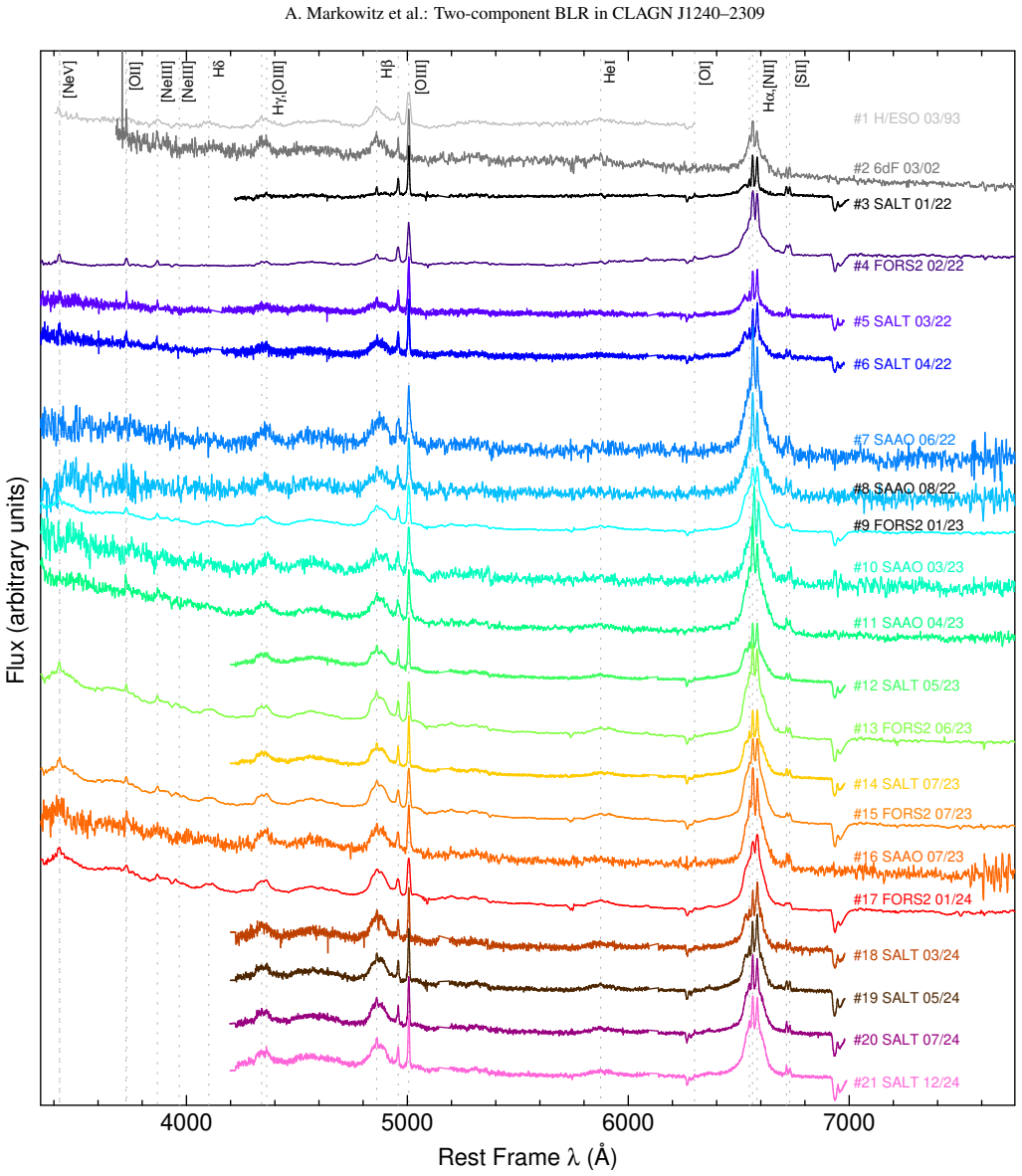
Extreme sudden changes in the flow of accreting gas onto SMBHs manifest themselves via large-amplitude continuum variability and changes to broad Balmer emission profiles, driving changing-look AGN. X-ray flux monitoring with SRG/eROSITA revealed that in the Seyfert AGN HE 1237-2252 the soft X-ray flux dipped abruptly, by a factor of 17 within 18 months. We initiated a follow-up campaign that caught the luminosity recovery after the dip, and enabled us to study how the various accretion components responded during this flux recovery. Our campaign included multiband photometry, X-ray spectroscopy, and optical spectroscopy. We tracked as the accretion rate relative to Eddington increased by a factor of 7 in 3 years. Based on broad Hbeta variability, HE 1237-2252 was subtype 1.0-1.2 in 2002, transitioned to subtype 1.8 by the time of the luminosity dip, and then transitioned back to subtype 1.0 within 3 months as luminosity recovered. Both transitions saw broad Hbeta integrated line flux change by factors of 4-6. The broad Balmer profile is decomposed into a broad Gaussian consistent with virialized gas at 27+/-3 lt-dy, plus a double-peaked profile, consistent with a diskline structure at more than roughly 5 lt-dy. The diskline component's relative contribution to the total profile increases as continuum flux rises. The lack of obscuration in the X-ray spectra, as well as the IR continuum dip, point to an intrinsic pause in the accretion rate as opposed to variable line-of-sight obscuration. Candidates for the underlying mechanisms include propagating cold and warm fronts in the accretion disk. The increased prominence of the diskline BLR component's emission could be due to evolution in the physical extent of the X-ray corona, and in the fraction of >13.6 eV photons intercepted by the diskline, as the accretion rate increases.
Editorial analysis
A structured set of objections, weighed in public.
Referee Report
Summary. The manuscript reports multi-epoch X-ray, optical, and IR observations of the Seyfert AGN HE 1237-2252, which showed an abrupt soft X-ray flux dip by a factor of 17 within 18 months followed by recovery over ~3 years, during which the Eddington ratio increased by a factor of ~7. The source transitioned from Seyfert subtype 1.8 to 1.0 (and back), with integrated broad Hβ flux varying by factors of 4–6. The broad Balmer profile is decomposed into a broad Gaussian component consistent with virialized gas at 27±3 light-days plus a double-peaked diskline component at radii ≳5 light-days, with the diskline fraction increasing as continuum flux recovers. The authors conclude the variability is intrinsic to the accretion flow (supported by lack of X-ray absorption and an IR dip) rather than variable obscuration, and suggest mechanisms such as propagating fronts in the accretion disk.
Significance. If the central claims hold, the work supplies a rare, well-sampled changing-look AGN with coordinated multi-wavelength data that directly ties continuum recovery to BLR profile evolution. The proposed two-component BLR (virialized gas plus diskline) and its flux-dependent weighting would constrain BLR geometry and its response to accretion-rate changes. The explicit exclusion of obscuration via X-ray and IR data strengthens the intrinsic-variability interpretation and adds to the growing sample of accretion-disk instability candidates.
major comments (2)
- [Optical spectroscopy and line-profile analysis] The decomposition of the variable Hβ profile into a single broad Gaussian plus double-peaked diskline is load-bearing for the two-component BLR claim and the quoted radii, yet no quantitative model-comparison statistics (Δχ², F-test, AIC/BIC) or residuals against plausible alternatives (two Gaussians, Gaussian plus power-law wings, or biconical outflow) are presented. Without these, the uniqueness of the fit and the physical separation into distinct regions at 27 lt-dy and ≳5 lt-dy cannot be evaluated.
- [X-ray spectroscopy section] The conclusion that variable obscuration is ruled out rests on the X-ray spectra showing no absorption; however, explicit upper limits on any variable neutral or ionized column density (or partial-covering fraction) across the epochs are not quantified, leaving open the possibility of subtle line-of-sight effects that could mimic the observed flux and line changes.
minor comments (2)
- [Abstract and results] The diskline radius is stated only as 'more than roughly 5 lt-dy'; a specific lower limit with uncertainty or a best-fit value should be reported.
- [Figures] Figure captions and legends for the multi-epoch spectra and light curves should explicitly note the epochs, flux scaling, and any subtracted components to aid reproducibility.
Simulated Author's Rebuttal
We thank the referee for their careful reading of the manuscript and for the constructive comments. We address each major point below and will revise the manuscript to incorporate additional quantitative analyses and clarifications as outlined.
read point-by-point responses
-
Referee: [Optical spectroscopy and line-profile analysis] The decomposition of the variable Hβ profile into a single broad Gaussian plus double-peaked diskline is load-bearing for the two-component BLR claim and the quoted radii, yet no quantitative model-comparison statistics (Δχ², F-test, AIC/BIC) or residuals against plausible alternatives (two Gaussians, Gaussian plus power-law wings, or biconical outflow) are presented. Without these, the uniqueness of the fit and the physical separation into distinct regions at 27 lt-dy and ≳5 lt-dy cannot be evaluated.
Authors: We agree that quantitative model-comparison statistics would strengthen the presentation of the line-profile decomposition. In the revised manuscript we will add AIC and BIC values comparing the adopted broad-Gaussian plus diskline model against the alternatives of two broad Gaussians and a single Gaussian plus power-law wings. The diskline model is preferred by ΔAIC > 40 and ΔBIC > 35. We will also include residual plots for each model to demonstrate the improvement in fit quality, particularly in reproducing the double-peaked structure seen in the high-state spectra. The quoted radii are derived directly from the data: the virial radius of 27 ± 3 light-days follows from the FWHM of the broad Gaussian component together with the measured 5100 Å luminosity, while the diskline component requires emission radii ≳ 5 light-days to match the observed peak separation and wing shape. revision: yes
-
Referee: [X-ray spectroscopy section] The conclusion that variable obscuration is ruled out rests on the X-ray spectra showing no absorption; however, explicit upper limits on any variable neutral or ionized column density (or partial-covering fraction) across the epochs are not quantified, leaving open the possibility of subtle line-of-sight effects that could mimic the observed flux and line changes.
Authors: We accept that explicit upper limits on absorption parameters would make the argument more quantitative. In the revised manuscript we will report the 90 % confidence upper limits on any additional intrinsic neutral column (N_H < 2 × 10^{21} cm^{-2}) and on the covering fraction of any partial-covering absorber, both of which remain consistent with zero and show no significant epoch-to-epoch variation. Limits on ionized absorbers are likewise consistent with no detectable column. These results, together with the observed dip in the infrared continuum, continue to support an intrinsic accretion-rate change rather than variable line-of-sight obscuration. revision: yes
Circularity Check
No significant circularity; results from direct observations and fits
full rationale
The paper's claims rest on multi-epoch X-ray spectra, optical spectroscopy, and photometry tracking the flux dip and recovery in HE 1237-2252. The Hβ decomposition into a broad Gaussian (consistent with 27±3 lt-dy virial gas) plus double-peaked diskline (>5 lt-dy) is obtained by direct fitting to the observed line profiles, with the diskline fraction's increase tied to measured continuum flux changes. Radii follow from variability amplitudes and standard virial estimates applied to the data; the intrinsic accretion-rate interpretation follows from the absence of X-ray obscuration and the IR dip. No self-definitional loops, fitted parameters renamed as predictions, or load-bearing self-citations appear in the derivation chain, which remains self-contained against external benchmarks.
Axiom & Free-Parameter Ledger
free parameters (1)
- BLR radius for Gaussian component =
27 light-days
axioms (2)
- domain assumption Broad emission-line profiles can be decomposed into Gaussian and diskline components that correspond to distinct physical regions
- domain assumption Absence of X-ray absorption features indicates no line-of-sight obscuration
Reference graph
Works this paper leans on
-
[1]
An Expanded Rossi X-Ray Timing Explorer Survey of X-Ray Variability in Seyfert 1 Galaxies. , keywords =. doi:10.1086/425559 , archivePrefix =. astro-ph/0409045 , primaryClass =
-
[2]
Determining Central Black Hole Masses in Distant Active Galaxies and Quasars. II. Improved Optical and UV Scaling Relationships. , keywords =. doi:10.1086/500572 , archivePrefix =. astro-ph/0601303 , primaryClass =
-
[3]
On the Radial Structure of Radiatively Inefficient Accretion Flows with Convection. , keywords =. doi:10.1086/324717 , archivePrefix =. astro-ph/0110371 , primaryClass =
-
[4]
Foundations of Black Hole Accretion Disk Theory. Living Reviews in Relativity , keywords =. doi:10.12942/lrr-2013-1 , archivePrefix =. 1104.5499 , primaryClass =
-
[5]
Selected Papers of Hirotugu Akaike , interhash =
Akaike, Hirotogu , biburl =. Selected Papers of Hirotugu Akaike , interhash =
-
[6]
Abundances of the elements: Meteoritic and solar. , keywords =. doi:10.1016/0016-7037(89)90286-X , adsurl =
-
[7]
Successful commissioning of FORS1 - the first optical instrument on the VLT. The Messenger , keywords =
-
[8]
Investigating a fluctuating-accretion model for the spectral-timing properties of accreting black hole systems. , keywords =. doi:10.1111/j.1365-2966.2006.09989.x , archivePrefix =. astro-ph/0512394 , primaryClass =
-
[9]
Astronomical Data Analysis Software and Systems V , year = 1996, editor =
XSPEC: The First Ten Years. Astronomical Data Analysis Software and Systems V , year = 1996, editor =
work page 1996
-
[10]
The WISE AGN Catalog. , keywords =. doi:10.3847/1538-4365/aaa00a , archivePrefix =. 1706.09901 , primaryClass =
-
[11]
A new Bowen fluorescence flare and extreme coronal line emitter discovered by SRG/eROSITA. , keywords =. doi:10.1051/0004-6361/202554812 , archivePrefix =. 2507.05342 , primaryClass =
-
[12]
Monitoring AGNs with H Asymmetry. III. Long-term Reverberation Mapping Results of 15 Palomar-Green Quasars. , keywords =. doi:10.3847/1538-4365/ac7beb , archivePrefix =. 2207.00297 , primaryClass =
-
[13]
Hot Dust and the Near-Infrared Bump in the Continuum Spectra of Quasars and Active Galactic Nuclei. , keywords =. doi:10.1086/165571 , adsurl =
-
[14]
NGC 5548 in a Low-Luminosity State: Implications for the Broad-Line Region. , keywords =. doi:10.1086/516724 , archivePrefix =. astro-ph/0702644 , primaryClass =
-
[15]
The Radius-Luminosity Relationship for Active Galactic Nuclei: The Effect of Host-Galaxy Starlight on Luminosity Measurements. II. The Full Sample of Reverberation-Mapped AGNs. , keywords =. doi:10.1088/0004-637X/697/1/160 , archivePrefix =. 0812.2283 , primaryClass =
-
[16]
The Low-Luminosity End of the Radius-Luminosity Relationship for Active Galactic Nuclei
The Low-luminosity End of the Radius-Luminosity Relationship for Active Galactic Nuclei. , keywords =. doi:10.1088/0004-637X/767/2/149 , archivePrefix =. 1303.1742 , primaryClass =
work page internal anchor Pith review Pith/arXiv arXiv doi:10.1088/0004-637x/767/2/149
-
[17]
PS16dtm: A Tidal Disruption Event in a Narrow-line Seyfert 1 Galaxy. , keywords =. doi:10.3847/1538-4357/aa77f7 , archivePrefix =. 1703.07816 , primaryClass =
-
[18]
Las Cumbres Observatory Global Telescope Network. , keywords =. doi:10.1086/673168 , archivePrefix =. 1305.2437 , primaryClass =
-
[19]
Modeling Fe II Emission and Revised Fe II (UV) Empirical Templates for the Seyfert 1 Galaxy I Zw 1. , keywords =. doi:10.1086/525557 , adsurl =
-
[20]
The eROSITA Final Equatorial Depth Survey (eFEDS). X-ray catalogue. , keywords =. doi:10.1051/0004-6361/202141266 , archivePrefix =. 2106.14517 , primaryClass =
-
[21]
X-ray spectral and eclipsing model of the clumpy obscurer in active galactic nuclei. , keywords =. doi:10.1051/0004-6361/201834771 , archivePrefix =. 1907.13137 , primaryClass =
-
[22]
Prime Focus Imaging Spectrograph for the Southern African Large Telescope: optical design. Instrument Design and Performance for Optical/Infrared Ground-based Telescopes , year = 2003, editor =. doi:10.1117/12.460312 , adsurl =
-
[23]
The Swift X-Ray Telescope. , keywords =. doi:10.1007/s11214-005-5097-2 , archivePrefix =. astro-ph/0508071 , primaryClass =
-
[24]
doi:10.1111/j.1365-2966.2005.09360.x , eprint =
Photoionized H emission in NGC 5548: it breathes!. , keywords =. doi:10.1111/j.1365-2966.2005.09795.x , archivePrefix =. astro-ph/0510800 , primaryClass =
-
[25]
Tidal Disruption Events in Active Galactic Nuclei. , keywords =. doi:10.3847/1538-4357/ab2b40 , archivePrefix =. 1904.12261 , primaryClass =
-
[26]
Kinematic Evidence for a Relativistic Keplerian Disk: ARP 102B. , keywords =. doi:10.1086/167332 , adsurl =
-
[27]
The narrow-line region of intermediate Seyfet galaxies. , keywords =. doi:10.1086/161386 , adsurl =
-
[28]
Journal of Astronomical Telescopes, Instruments, and Systems , year = 2019, month = apr, volume =
SpUpNIC (Spectrograph Upgrade: Newly Improved Cassegrain): a versatile and efficient low- to medium-resolution, long-slit spectrograph on the South African Astronomical Observatory's 1.9-m telescope. Journal of Astronomical Telescopes, Instruments, and Systems , year = 2019, month = apr, volume =. doi:10.1117/1.JATIS.5.2.024007 , adsurl =
-
[29]
The origin of the broad line region in active galactic nuclei. , keywords =. doi:10.1051/0004-6361/201016025 , archivePrefix =. 1010.6201 , primaryClass =
-
[30]
The role of the reflection fraction in constraining black hole spin. , keywords =. doi:10.1093/mnrasl/slu125 , archivePrefix =. 1408.2347 , primaryClass =
-
[31]
A Wind-based Unification Model for NGC 5548: Spectral Holidays, Nondisk Emission, and Implications for Changing-look Quasars. , keywords =. doi:10.3847/2041-8213/ab3d41 , archivePrefix =. 1908.07686 , primaryClass =
-
[32]
The Typecasting of Active Galactic Nuclei: Mrk 590 no Longer Fits the Role. , keywords =. doi:10.1088/0004-637X/796/2/134 , archivePrefix =. 1404.4879 , primaryClass =
-
[33]
Extreme AGN variability: evidence of magnetically elevated accretion?. , keywords =. doi:10.1093/mnrasl/sly213 , archivePrefix =. 1807.03314 , primaryClass =
-
[34]
Supermassive Black Holes with High Accretion Rates in Active Galactic Nuclei. VI. Velocity-resolved Reverberation Mapping of the H Line. , keywords =. doi:10.3847/0004-637X/820/1/27 , archivePrefix =. 1602.01922 , primaryClass =
-
[35]
Universal bolometric corrections for active galactic nuclei over seven luminosity decades. , keywords =. doi:10.1051/0004-6361/201936817 , archivePrefix =. 2001.09984 , primaryClass =
-
[36]
The First Swift Intensive AGN Accretion Disk Reverberation Mapping Survey. , keywords =. doi:10.3847/1538-4357/aaf3b4 , archivePrefix =. 1811.07956 , primaryClass =
-
[37]
On the Disappearance of the Broad-Line Region in Low-Luminosity Active Galactic Nuclei. , keywords =. doi:10.1088/0004-637X/701/2/L91 , archivePrefix =. 0907.3752 , primaryClass =
-
[38]
Evolution of broad-line emission from active galactic nuclei. , keywords =. doi:10.1093/mnras/stt2445 , archivePrefix =. 1312.4922 , primaryClass =
-
[39]
Completion of a Survey and Detailed Study of Double-peaked Emission Lines in Radio-loud Active Galactic Nuclei. , keywords =. doi:10.1086/379540 , archivePrefix =. astro-ph/0309149 , primaryClass =
-
[40]
Double-peaked Emission Lines in Active Galactic Nuclei. , keywords =. doi:10.1086/191856 , adsurl =
-
[41]
Elliptical Accretion Disks in Active Galactic Nuclei. , keywords =. doi:10.1086/175104 , adsurl =
-
[42]
Radiative Transfer and Acceleration in Magnetocentrifugal Winds. , keywords =. doi:10.1086/432678 , archivePrefix =. astro-ph/0506321 , primaryClass =
-
[43]
A New Approach to the Internal Calibration of Reverberation-Mapping Spectra. , keywords =. doi:10.1088/1538-3873/129/972/024007 , archivePrefix =. 1609.04014 , primaryClass =
-
[44]
A Magnetic Disk-outflow Model for Changing Look Active Galactic Nuclei. , keywords =. doi:10.3847/1538-4357/ac07a6 , archivePrefix =. 2106.00650 , primaryClass =
-
[45]
1999, Publications of the Astronomical Society of the Pacific, 111, 63, doi: 10.1086/316293 33
Correcting for the Effects of Interstellar Extinction. , keywords =. doi:10.1086/316293 , archivePrefix =. astro-ph/9809387 , primaryClass =
-
[46]
A Family Tree of Optical Transients from Narrow-line Seyfert 1 Galaxies. , keywords =. doi:10.3847/1538-4357/ac110f , archivePrefix =. 2010.08554 , primaryClass =
-
[47]
Freudling,et al., Automated data reduction workflows for astronomy
Automated data reduction workflows for astronomy. The ESO Reflex environment. , keywords =. doi:10.1051/0004-6361/201322494 , archivePrefix =. 1311.5411 , primaryClass =
-
[48]
The Gaia mission. , keywords =. doi:10.1051/0004-6361/201629272 , archivePrefix =. 1609.04153 , primaryClass =
-
[49]
Performance verification (Gaia Collaboration, 2022)
VizieR Online Data Catalog: Gaia DR3 Part 6. Performance verification (Gaia Collaboration, 2022)
work page 2022
-
[50]
Summary of the content and survey properties
Gaia Data Release 3. Summary of the content and survey properties. , keywords =. doi:10.1051/0004-6361/202243940 , archivePrefix =. 2208.00211 , primaryClass =
-
[51]
Improved Reflection Models of Black Hole Accretion Disks: Treating the Angular Distribution of X-Rays. , keywords =. doi:10.1088/0004-637X/782/2/76 , archivePrefix =. 1312.3231 , primaryClass =
-
[52]
Structure and kinematics of the broad-line region and torus of Active Galactic Nuclei. , keywords =. doi:10.48550/arXiv.0807.2889 , archivePrefix =. 0807.2889 , primaryClass =
-
[53]
Partial dust obscuration in active galactic nuclei as a cause of broad-line profile and lag variability, and apparent accretion disc inhomogeneities. , keywords =. doi:10.1093/mnras/sty848 , archivePrefix =. 1704.06455 , primaryClass =
-
[54]
Anomalous broad-line region responses to continuum variability in active galactic nuclei - I. H variability. , keywords =. doi:10.1093/mnras/stab2443 , archivePrefix =. 1909.06275 , primaryClass =
-
[55]
Structure and Kinematics of Quasar Broad Line Regions , year = 1999, editor =
The Optical Case for a Disk Component of BLR Emission. Structure and Kinematics of Quasar Broad Line Regions , year = 1999, editor =
work page 1999
-
[56]
Chaotic cold accretion on to black holes. , keywords =. doi:10.1093/mnras/stt692 , archivePrefix =. 1301.3130 , primaryClass =
-
[57]
2004, ApJ, 611, 1005, doi: 10.1086/422091
The Swift Gamma-Ray Burst Mission. , keywords =. doi:10.1086/422091 , archivePrefix =. astro-ph/0405233 , primaryClass =
-
[58]
Space Telescopes and Instrumentation 2016: Ultraviolet to Gamma Ray , year = 2016, editor =
The Neutron star Interior Composition Explorer (NICER): design and development. Space Telescopes and Instrumentation 2016: Ultraviolet to Gamma Ray , year = 2016, editor =. doi:10.1117/12.2231304 , adsurl =
-
[59]
2010, CAMCS, 5, 65, doi: 10.2140/camcos.2010.5.65
Ensemble samplers with affine invariance. Communications in Applied Mathematics and Computational Science , keywords =. doi:10.2140/camcos.2010.5.65 , adsurl =
-
[60]
Dust in the Broad-Line Regions of Seyfert Galaxies. , keywords =. doi:10.1086/175256 , adsurl =
-
[61]
Understanding extreme quasar optical variability with CRTS - II. Changing-state quasars. , keywords =. doi:10.1093/mnras/stz3244 , archivePrefix =. 1905.02262 , primaryClass =
-
[62]
The Time Domain Spectroscopic Survey: Changing-look Quasar Candidates from Multi-epoch Spectroscopy in SDSS-IV. , keywords =. doi:10.3847/1538-4357/ac743f , archivePrefix =. 2201.09123 , primaryClass =
-
[63]
The Structure of the Broad-line Region in Active Galactic Nuclei. I. Reconstructed Velocity-delay Maps. , keywords =. doi:10.1088/0004-637X/764/1/47 , archivePrefix =. 1210.2397 , primaryClass =
-
[64]
Thermal instability as a constraint for warm X-ray coronas in active galactic nuclei. , keywords =. doi:10.1051/0004-6361/202244410 , archivePrefix =. 2303.17384 , primaryClass =
-
[65]
The population of tidal disruption events discovered with eROSITA. , keywords =. doi:10.1051/0004-6361/202553669 , archivePrefix =. 2504.08424 , primaryClass =
-
[66]
Modelling continuum reverberation in active galactic nuclei: a spectral-timing analysis of the ultraviolet variability through X-ray reverberation in Fairall 9. , keywords =. doi:10.1093/mnras/stad504 , archivePrefix =. 2210.04924 , primaryClass =
-
[67]
Systematic collapse of the accretion disc across the supermassive black hole population. , keywords =. doi:10.1093/mnras/stae2272 , archivePrefix =. 2406.06674 , primaryClass =
-
[68]
The thermal-viscous disk instability model in the AGN context. , keywords =. doi:10.1051/0004-6361/200810928 , archivePrefix =. 0901.1229 , primaryClass =
-
[69]
Local Three-dimensional Magnetohydrodynamic Simulations of Accretion Disks. , keywords =. doi:10.1086/175311 , adsurl =
-
[70]
Discovery of the luminous X-ray ignition eRASSt J234402.9 - 352640. I. Tidal disruption event or a rapid increase in accretion in an active galactic nucleus?. , keywords =. doi:10.1051/0004-6361/202245078 , archivePrefix =. 2302.06989 , primaryClass =
-
[71]
Evidence for Two Distinct Broad-line Regions from Reverberation Mapping of PG 0026+129. , keywords =. doi:10.3847/1538-4357/abc2da , archivePrefix =. 2010.09871 , primaryClass =
-
[72]
A physical model for the continuum variability and quasi-periodic oscillation in accreting black holes. , keywords =. doi:10.1111/j.1365-2966.2011.18860.x , archivePrefix =. 1101.2336 , primaryClass =
-
[73]
XMM-Newton observatory. I. The spacecraft and operations. , keywords =. doi:10.1051/0004-6361:20000036 , adsurl =
-
[74]
Global Radiation Magnetohydrodynamic Simulations of sub-Eddington Accretion Disks around Supermassive Black Holes. , keywords =. doi:10.3847/1538-4357/ab4a00 , archivePrefix =. 1904.01674 , primaryClass =
-
[75]
The 6dF Galaxy Survey: final redshift release (DR3) and southern large-scale structures. , keywords =. doi:10.1111/j.1365-2966.2009.15338.x , archivePrefix =. 0903.5451 , primaryClass =
-
[76]
Global MHD Simulations of Accretion Disks in Cataclysmic Variables (CVs). II. The Relative Importance of MRI and Spiral Shocks. , keywords =. doi:10.3847/1538-4357/aa705d , archivePrefix =. 1705.00779 , primaryClass =
-
[77]
An atlas of Seyfert galaxies. , keywords =. doi:10.1086/153093 , adsurl =
-
[78]
On the Scatter in the Radius-Luminosity Relationship for Active Galactic Nuclei. , keywords =. doi:10.1088/0004-637X/801/1/8 , archivePrefix =. 1411.2977 , primaryClass =
-
[79]
Accretion disc viscosity: how big is alpha?. , keywords =. doi:10.1111/j.1365-2966.2007.11556.x , archivePrefix =. astro-ph/0701803 , primaryClass =
-
[80]
Prime focus imaging spectrograph for the Southern African large telescope: operational modes. Instrument Design and Performance for Optical/Infrared Ground-based Telescopes , year = 2003, editor =. doi:10.1117/12.460315 , adsurl =
discussion (0)
Sign in with ORCID, Apple, or X to comment. Anyone can read and Pith papers without signing in.