Recognition: no theorem link
Mazocarta: A Seeded Procedural Deckbuilder for Instrumented Game Development
Pith reviewed 2026-05-12 00:57 UTC · model grok-4.3
The pith
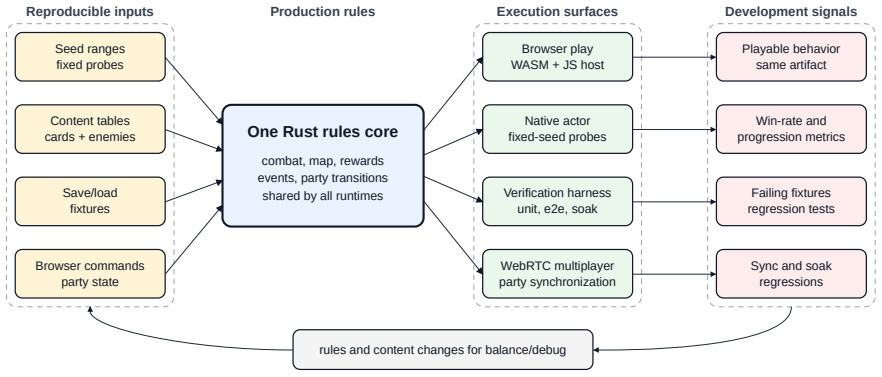
One shared rules engine powers play, simulation, tests, save/load, and local multiplayer in Mazocarta.
A machine-rendered reading of the paper's core claim, the machinery that carries it, and where it could break.
Core claim
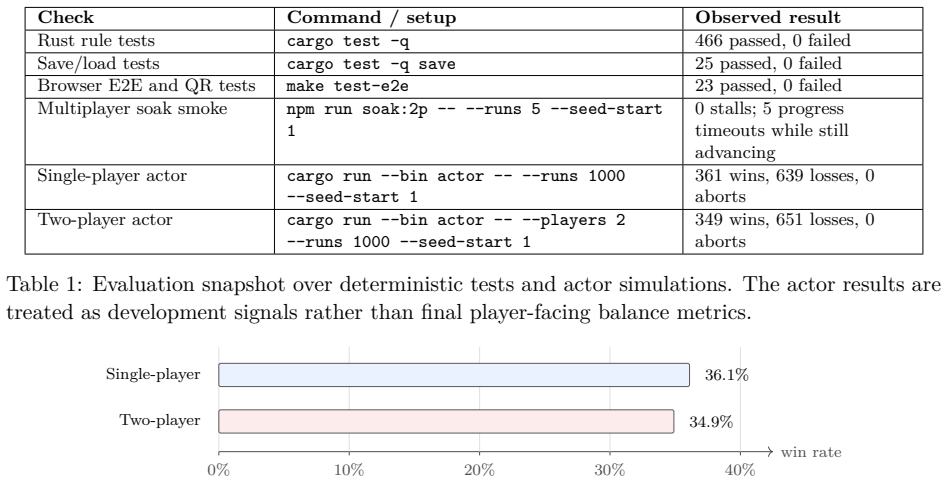
Mazocarta is a seeded procedural tactical deckbuilder whose primary contribution is the construction of an instrumented game-development reference artifact: the same rules engine supports interactive play, native command-line simulation, automated end-to-end tests, save/load fixtures, and local-area multiplayer. An evaluation over 1,000 deterministic seeds produces reproducible signals, with single-player and two-player autoplay win rates of 36.1% and 34.9% respectively, offered as repeatable probes rather than final balance values. All listed interfaces exercise one shared production rules core.
What carries the argument
the shared production rules core written in Rust and compiled to both native executables and WebAssembly
If this is right
- Deterministic regression checks can run against the production rules without maintaining duplicate logic.
- Automated playtesting workflows and balance probes produce signals that match what occurs in interactive sessions.
- Browser-native local multiplayer sessions exercise the same rules engine as single-player simulation.
- Save and load fixtures allow state to transfer cleanly between command-line tools and browser play.
- Reproducible seeds enable repeated measurement of mechanic changes across 1,000 runs.
Where Pith is reading between the lines
- Teams could reduce the maintenance burden of keeping simulation, testing, and live play in sync by adopting a single compiled core.
- The deterministic model might extend to continuous integration pipelines that gate mechanic changes on regression-free seed batches.
- Similar shared-core designs could help other genres maintain consistency when adding AI opponents or remote play features.
- The QR-mediated pairing approach could be tested for low-latency local sessions in other WebAssembly games.
Load-bearing premise
A single shared rules core can practically support interactive play, native simulation, automated tests, save/load, and local multiplayer without hidden tradeoffs in performance, maintainability, or determinism across environments.
What would settle it
Executing the identical seed in the browser client and the native simulator and observing divergent game states or outcomes would disprove that one core supports all interfaces consistently.
Figures


read the original abstract
Mazocarta is a seeded procedural tactical deckbuilder implemented in Rust, compiled to WebAssembly for browser play, and executable natively for simulation. Its primary technical contribution is not the invention of a new deckbuilding genre, but the construction of an instrumented game-development reference artifact: the same rules engine supports interactive play, native command-line simulation, automated end-to-end tests, save/load fixtures, and local-area multiplayer. This paper describes Mazocarta's architecture, deterministic run model, reproducible balance probes, and QR-mediated WebRTC pairing for local multiplayer. An evaluation snapshot over 1,000 deterministic seeds shows that the simulation pipeline can produce reproducible development signals. In the evaluated configuration, single-player and two-player autoplay win rates were 36.1% and 34.9% over 1,000 deterministic seeds, respectively. These rates are not presented as final player-facing balance metrics, but as repeatable probes for future balance shifts and regressions. Mazocarta is positioned as a playable open-source reference artifact for instrumented game development: deterministic regression checks, automated playtesting workflows, balance probes for game mechanics, and browser-native local multiplayer all exercise one shared production rules core.
Editorial analysis
A structured set of objections, weighed in public.
Referee Report
Summary. The manuscript presents Mazocarta, a seeded procedural tactical deckbuilder written in Rust and compiled to WebAssembly. Its primary contribution is an architecture in which a single shared rules engine supports interactive browser-based play, native command-line simulation, automated end-to-end tests, save/load fixtures, and WebRTC local-area multiplayer. The paper describes the deterministic run model, QR-mediated pairing mechanism, and reports an evaluation snapshot over 1,000 deterministic seeds that yields reproducible win rates of 36.1% (single-player) and 34.9% (two-player) under autoplay; these rates are framed as repeatable probes for balance shifts and regressions rather than final metrics.
Significance. If the shared-rules claim holds, the work supplies a concrete, open-source reference artifact for instrumented game development. The ability to exercise the identical production rules core across interactive, simulation, testing, and multiplayer interfaces, together with the fixed-seed reproducibility data, offers a practical template for deterministic regression checks and automated playtesting workflows. The explicit positioning as a playable artifact rather than a new game genre is a strength.
major comments (2)
- [Architecture] Architecture section: the claim that a single rules engine can be shared across interactive, simulation, test, and multiplayer interfaces without material tradeoffs in determinism or maintainability is central but supported only at a high level. No quantitative measurements (e.g., execution-time overhead, memory footprint, or test-maintenance effort) are provided for the native versus WASM targets, leaving the absence of prohibitive costs asserted rather than demonstrated.
- [Evaluation] Evaluation section: the 1,000-seed win-rate results (36.1% and 34.9%) are presented as direct evidence of reproducible simulation signals, yet the manuscript supplies neither the autoplay policy details nor the precise seed-generation procedure. Without these, independent reproduction of the reported signals cannot be verified from the text alone.
minor comments (2)
- [Architecture] The description of QR-mediated WebRTC pairing is mentioned in the abstract and architecture but lacks a step-by-step account or diagram showing how pairing occurs and how game state is synchronized.
- The paper would benefit from a short related-work paragraph situating the deterministic Rust/WASM approach against existing game-engine instrumentation efforts (e.g., other Rust game frameworks or WASM-based simulation platforms).
Simulated Author's Rebuttal
We thank the referee for the positive summary and recommendation for minor revision. The comments identify clear opportunities to strengthen the manuscript's claims on architecture and reproducibility. We address each point below and will incorporate the requested details in the revised version.
read point-by-point responses
-
Referee: [Architecture] Architecture section: the claim that a single rules engine can be shared across interactive, simulation, test, and multiplayer interfaces without material tradeoffs in determinism or maintainability is central but supported only at a high level. No quantitative measurements (e.g., execution-time overhead, memory footprint, or test-maintenance effort) are provided for the native versus WASM targets, leaving the absence of prohibitive costs asserted rather than demonstrated.
Authors: We agree that the architecture claim would be more convincing with quantitative support. In the revised manuscript we will add a dedicated subsection under Architecture that reports benchmark measurements of execution-time overhead and memory footprint for equivalent simulation workloads on native Rust versus the WebAssembly target. These will be collected using standard tools (e.g., criterion for timing and heaptrack for memory) on representative 1,000-seed runs. We will also briefly note our observed maintainability experience with the single shared rules crate. revision: yes
-
Referee: [Evaluation] Evaluation section: the 1,000-seed win-rate results (36.1% and 34.9%) are presented as direct evidence of reproducible simulation signals, yet the manuscript supplies neither the autoplay policy details nor the precise seed-generation procedure. Without these, independent reproduction of the reported signals cannot be verified from the text alone.
Authors: We accept that the current text does not supply sufficient detail for independent reproduction. The revised Evaluation section will describe the autoplay policy (the exact decision heuristic and any tie-breaking rules) and the deterministic seed-generation procedure (including the PRNG and how the 1,000 seeds are derived). In addition, the full seed list and the policy implementation will be committed to the open-source repository so that readers can exactly replicate the reported win rates. revision: yes
Circularity Check
No significant circularity
full rationale
The manuscript presents an implementation artifact (Rust rules engine compiled to native and WASM) together with direct empirical outputs from running that engine over 1,000 deterministic seeds. No equations, first-principles derivations, fitted parameters, or predictions are introduced whose results could be shown to equal their own inputs by construction. The reported win-rate probes (36.1 % and 34.9 %) are simply the measured outcomes of executing the shared core under the stated conditions; reproducibility across interfaces is demonstrated by construction of the artifact itself rather than by any self-referential reduction.
Axiom & Free-Parameter Ledger
axioms (2)
- domain assumption Rust's seeded random number generation produces identical results across platforms and runs
- ad hoc to paper A single rules engine can be shared across interactive, simulation, test, and multiplayer interfaces without prohibitive complexity or performance costs
Reference graph
Works this paper leans on
-
[1]
The Rust Programming Language.https://www.rust-lang.org/, 2026
Rust Team. The Rust Programming Language.https://www.rust-lang.org/, 2026. Project website, accessed 1 May 2026
work page 2026
-
[2]
WebAssembly Core Specification
World Wide Web Consortium. WebAssembly Core Specification. https://www.w3.org/TR/wasm-core-1/, 2019. W3C Recommendation, 5 December 2019
work page 2019
-
[3]
Bringing the web up to speed with webassembly
Andreas Haas, Andreas Rossberg, Derek L Schuff, Ben L Titzer, Michael Holman, Dan Gohman, Luke Wagner, Alon Zakai, and Jean-François Bastien. Bringing the web up to speed with webassembly. In Proceedings of the 38th ACM SIGPLAN conference on programming language design and implementation, pages 185–200, 2017
work page 2017
-
[4]
Mazocarta (GitHub).https://github.com/timcogan/mazocarta, 2026
Timothy Cogan. Mazocarta (GitHub).https://github.com/timcogan/mazocarta, 2026. Software repository, accessed 6 May 2026
work page 2026
-
[5]
Georgios N Yannakakis and Julian Togelius.Artificial intelligence and games, volume 2. Springer, 2018
work page 2018
-
[6]
Christoffer Holmgård, Michael Cerny Green, Antonios Liapis, and Julian Togelius. Automated Playtesting with Procedural Personas through MCTS with Evolved Heuristics.IEEE Transactions on Games, 11(4):352–362, 2018
work page 2018
- [7]
-
[8]
Local-first software: you own your data, in spite of the cloud
Martin Kleppmann, Adam Wiggins, Peter Van Hardenberg, and Mark McGranaghan. Local-first software: you own your data, in spite of the cloud. InProceedings of the 2019 ACM SIGPLAN International Symposium on New Ideas, New Paradigms, and Reflections on Programming and Software, pages 154–178, 2019. 8
work page 2019
-
[9]
WebRTC: Real-Time Communication in Browsers
World Wide Web Consortium. WebRTC: Real-Time Communication in Browsers. https://www.w3.org/TR/webrtc/, 2025. W3C Recommendation, 13 March 2025
work page 2025
-
[10]
A. Keranen, C. Holmberg, and J. Rosenberg. Interactive Connectivity Establishment (ICE): A protocol for NAT traversal. RFC 8445, Internet Engineering Task Force, 2018. https://www.rfc-editor.org/rfc/rfc8445
work page 2018
-
[11]
Getting Started with Peer Connections
WebRTC Project. Getting Started with Peer Connections. https://webrtc.org/getting-started/peer-connections, 2026. Documentation, accessed 1 May 2026
work page 2026
-
[12]
MDN Web Docs. WebRTC Connectivity. https://developer.mozilla.org/en-US/docs/Web/API/WebRTC_API/Connectivity, 2026. Documentation, accessed 1 May 2026
work page 2026
-
[13]
AI-Driven Autoplay Agents for Prelaunch Game Tuning
Igor Borovikov. AI-Driven Autoplay Agents for Prelaunch Game Tuning. In Steve Rabin, editor, Game AI Pro: Online Edition 2021, chapter 10. Game AI Pro, 2021. https://www.gameaipro.com/GameAIProOnlineEdition2021/GameAIProOnlineEdition2021_ Chapter10_AI-Driven_Autoplay_Agents_for_Prelaunch_Game_Tuning.pdf
work page 2021
-
[14]
Julian Togelius, Georgios N Yannakakis, Kenneth O Stanley, and Cameron Browne. Search-based procedural content generation: A taxonomy and survey.IEEE Transactions on Computational Intelligence and AI in Games, 3(3):172–186, 2011
work page 2011
-
[15]
Nelson.Procedural Content Generation in Games
Noor Shaker, Julian Togelius, and Mark J. Nelson.Procedural Content Generation in Games. Springer Cham, Cham, Switzerland, 2016.https://doi.org/10.1007/978-3-319-42716-4
-
[16]
WebRTC without a signaling server
Chris Ball. WebRTC without a signaling server. https://blog.printf.net/articles/2013/05/17/webrtc-without-a-signaling-server/, 2013. Blog post
work page 2013
-
[17]
serverless-webrtc-qrcode.https://github.com/fta2012/serverless-webrtc-qrcode,
fta2012. serverless-webrtc-qrcode.https://github.com/fta2012/serverless-webrtc-qrcode,
-
[18]
Software demo, accessed 8 May 2026. 9
work page 2026
discussion (0)
Sign in with ORCID, Apple, or X to comment. Anyone can read and Pith papers without signing in.