Recognition: no theorem link
Identification of Compact Groups of Galaxies in IllustrisTNG300
Pith reviewed 2026-05-12 00:56 UTC · model grok-4.3
The pith
In the IllustrisTNG-300 simulation, roughly 80 percent of projected compact galaxy groups are line-of-sight contaminants rather than true physical systems.
A machine-rendered reading of the paper's core claim, the machinery that carries it, and where it could break.
Core claim
At redshift zero in TNG300, the algorithm identifies 383 three-dimensional compact groups and 1666 projected-plus-velocity groups. Approximately 80 percent of the latter are not physically compact but are contaminated by line-of-sight interlopers. The scaling relation between total group stellar mass and velocity dispersion serves as an effective diagnostic for identifying these false positives. The groups reside in environments ranging from low-density regions to the central regions of galaxy clusters.
What carries the argument
Friends-of-Friends algorithm with fixed linking lengths of 73 kpc (distance) and 1000 km/s (velocity), together with the total stellar mass versus velocity dispersion scaling relation used as a diagnostic for interlopers.
Load-bearing premise
The chosen linking lengths produce simulated groups whose properties are directly comparable to those identified in real spectroscopic surveys.
What would settle it
Apply the same stellar-mass versus velocity-dispersion cut to a large observed sample of compact groups and check whether the cleaned subsample shows the same physical compactness and environmental trends as the three-dimensional groups in the simulation.
Figures




read the original abstract
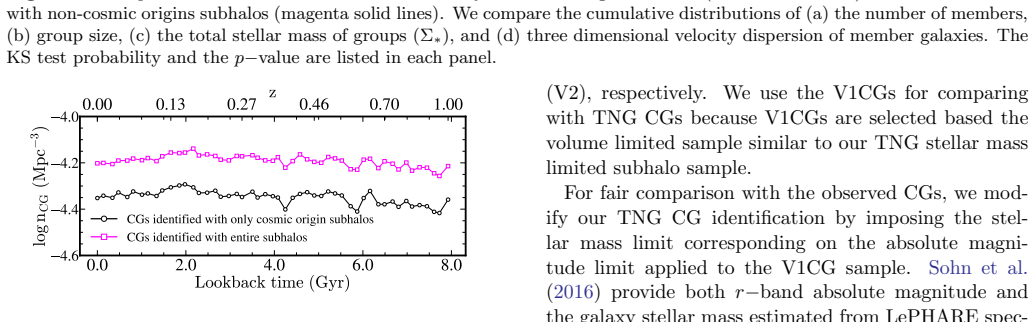
We identify compact groups of galaxies (CGs) in the IllustrisTNG-300 simulation using a Friends-of-Friends (FoF) algorithm. Our approach is designed to be comparable to systematic CG searches based on spectroscopic surveys, while avoiding the conventional Hickson selection criteria, which can bias samples toward relatively low-density environments. We construct two CG catalogs: one based on a three-dimensional distance linking length of 73 kpc (i.e., $50~h^{-1}$ kpc), and another based on projected and radial linking lengths of 73 kpc and $1000~\rm km~s^{-1}$. We refer to these as the position-position-position (PPP) and position-position-velocity (PPV) CG catalogs, respectively. The PPV catalog provides a direct analog to observed CG samples. At $z = 0$ in TNG300, we identify 383 PPP CGs and 1666 PPV CGs. A large fraction ($\sim 80\%$) of PPV CGs are not physically compact systems but are contaminated by line-of-sight interlopers. We demonstrate that the scaling relation between total group stellar mass and velocity dispersion is an effective diagnostic for identifying false positives with line-of-sight interlopers. We further examine the large-scale environments of CGs and show that they reside in a wide range of densities, including the central regions of galaxy clusters. These CG catalogs provide a robust foundation for studying the formation and evolution of CGs in cosmological simulations.
Editorial analysis
A structured set of objections, weighed in public.
Referee Report
Summary. The manuscript applies a Friends-of-Friends algorithm to the IllustrisTNG300 simulation to construct two compact-group catalogs at z=0: a PPP catalog using a 3D linking length of 73 kpc that yields 383 groups, and a PPV catalog using a projected linking length of 73 kpc plus a 1000 km/s radial-velocity linking length that yields 1666 groups. It reports that ~80% of the PPV groups are line-of-sight interlopers by direct membership comparison with the PPP reference, demonstrates that the total stellar-mass versus velocity-dispersion scaling relation separates the two populations, and analyzes the large-scale environments of the identified groups.
Significance. If the reported contamination fraction and diagnostic hold under scrutiny, the work supplies ready-to-use simulation catalogs that directly quantify projection effects in observed CG samples and supplies an observable criterion for identifying false positives. The avoidance of Hickson-style isolation criteria broadens applicability, and the explicit 3D-to-projected comparison provides a clean test of interloper contamination without circularity.
major comments (3)
- [Methods section on FoF implementation] Methods (linking-length justification): The 73 kpc and 1000 km/s values are presented as chosen to produce groups comparable to spectroscopic surveys, yet no quantitative match is shown between the resulting group richness, velocity-dispersion, or size distributions and those measured in existing observed CG catalogs (e.g., Hickson or SDSS-based samples). This comparison is required to substantiate the claim that the PPV catalog is a direct analog.
- [Results on PPV vs PPP comparison] Results (§ on contamination fraction): The ~80% interloper fraction is obtained by comparing PPP and PPV group memberships, but the manuscript does not specify the exact matching criterion (minimum shared members, spatial overlap threshold) or report sensitivity tests when the linking lengths are varied by ±10%. These details are load-bearing for the central numerical claim.
- [Section presenting the mass–dispersion diagnostic] Diagnostic (stellar-mass–velocity-dispersion relation): While the scaling relation is shown to separate true compact systems from interlopers, the paper provides no quantitative performance metric (e.g., purity after a mass–σ cut, ROC area, or reduction in contamination rate) that would allow readers to assess how effective the diagnostic is in practice.
minor comments (2)
- [All figures] Figure captions and legends should explicitly label which curves or points correspond to PPP versus PPV populations and state the exact linking lengths used in each panel.
- [Abstract] The abstract states that CGs reside in a wide range of densities including cluster cores; a brief quantitative statement (e.g., fraction inside R_200 of clusters) would strengthen the summary.
Simulated Author's Rebuttal
We thank the referee for their constructive and detailed comments. We address each major point below and will revise the manuscript to incorporate the requested clarifications, comparisons, and quantitative metrics.
read point-by-point responses
-
Referee: Methods (linking-length justification): The 73 kpc and 1000 km/s values are presented as chosen to produce groups comparable to spectroscopic surveys, yet no quantitative match is shown between the resulting group richness, velocity-dispersion, or size distributions and those measured in existing observed CG catalogs (e.g., Hickson or SDSS-based samples). This comparison is required to substantiate the claim that the PPV catalog is a direct analog.
Authors: We agree that a quantitative comparison with observed catalogs is needed to substantiate the analogy. In the revised manuscript we will add a comparison of group richness, velocity-dispersion, and size distributions from the PPV catalog against published values from the Hickson sample and SDSS-based CG catalogs, including median statistics and distribution tests where appropriate. This material will be placed in the Methods section. revision: yes
-
Referee: Results (§ on contamination fraction): The ~80% interloper fraction is obtained by comparing PPP and PPV group memberships, but the manuscript does not specify the exact matching criterion (minimum shared members, spatial overlap threshold) or report sensitivity tests when the linking lengths are varied by ±10%. These details are load-bearing for the central numerical claim.
Authors: We acknowledge that the precise group-matching criterion and sensitivity tests were not described. We will revise the Results section to state the exact matching procedure used (based on shared membership and positional overlap) and to report sensitivity tests in which the linking lengths are varied by ±10%, confirming that the interloper fraction remains stable near 80%. revision: yes
-
Referee: Diagnostic (stellar-mass–velocity-dispersion relation): While the scaling relation is shown to separate true compact systems from interlopers, the paper provides no quantitative performance metric (e.g., purity after a mass–σ cut, ROC area, or reduction in contamination rate) that would allow readers to assess how effective the diagnostic is in practice.
Authors: We agree that quantitative performance metrics would strengthen the presentation of the diagnostic. In the revised manuscript we will compute and report metrics such as purity and completeness after an optimal mass–σ cut, together with the resulting reduction in contamination rate. These results will be added to the section discussing the stellar-mass versus velocity-dispersion relation. revision: yes
Circularity Check
No significant circularity detected
full rationale
The paper applies a standard Friends-of-Friends algorithm with fixed, pre-chosen linking lengths (73 kpc projected distance and 1000 km/s velocity) directly to TNG300 simulation output, producing explicit counts of 383 PPP and 1666 PPV groups at z=0. The ~80% interloper fraction is obtained by straightforward membership overlap comparison between the 3D PPP reference catalog and the projected PPV catalog, without any parameter fitting or redefinition of inputs. The stellar-mass versus velocity-dispersion scaling is shown as an empirical separator in the resulting populations rather than a quantity derived from or fitted to the same linking parameters. No equations, self-citations, or ansatzes reduce the reported numbers or contamination fraction to the inputs by construction; the derivation chain remains self-contained and externally verifiable against the simulation data.
Axiom & Free-Parameter Ledger
free parameters (3)
- 3D linking length =
73 kpc
- projected linking length =
73 kpc
- radial velocity linking length =
1000 km/s
axioms (2)
- standard math Friends-of-Friends algorithm identifies physically associated groups when linking lengths are chosen appropriately
- domain assumption IllustrisTNG300 simulation provides realistic galaxy positions, velocities, and stellar masses
Reference graph
Works this paper leans on
-
[1]
Arnouts, S., Cristiani, S., Moscardini, L., et al. 1999, MNRAS, 310, 540, doi: 10.1046/j.1365-8711.1999.02978.x
-
[2]
Ashman, K. M., Bird, C. M., & Zepf, S. E. 1994, AJ, 108, 2348, doi: 10.1086/117248
-
[3]
1997, MNRAS, 286, 825, doi: 10.1093/mnras/286.4.825
Athanassoula, E., Makino, J., & Bosma, A. 1997, MNRAS, 286, 825, doi: 10.1093/mnras/286.4.825
-
[4]
Barnes, J. E. 1989, Nature, 338, 123, doi: 10.1038/338123a0
-
[5]
Costa, L. N. 1996, AJ, 112, 871, doi: 10.1086/118060
-
[6]
Beers, T. C., Flynn, K., & Gebhardt, K. 1990, AJ, 100, 32, doi: 10.1086/115487
-
[7]
2016, MNRAS, 459, 957, doi: 10.1093/mnras/stw686
Bitsakis, T., Dultzin, D., Ciesla, L., et al. 2016, MNRAS, 459, 957, doi: 10.1093/mnras/stw686
-
[8]
1981, ApJ, 249, 449, doi: 10.1086/159305
Carnevali, P., Cavaliere, A., & Santangelo, P. 1981, ApJ, 249, 449, doi: 10.1086/159305
-
[9]
Celiz, B. M., Benavides, J. A., & Abadi, M. G. 2025, A&A, 702, A22, doi: 10.1051/0004-6361/202555375 de Carvalho, R. R., Gon¸ calves, T. S., Iovino, A., et al. 2005, AJ, 130, 425, doi: 10.1086/430801
-
[10]
Diaferio, A., Geller, M. J., & Ramella, M. 1994, AJ, 107, 868, doi: 10.1086/116900 18 D´ ıaz-Gim´ enez, E., Mamon, G. A., Pacheco, M., Mendes de
-
[11]
Oliveira, C., & Alonso, M. V. 2012, MNRAS, 426, 296, doi: 10.1111/j.1365-2966.2012.21705.x D´ ıaz-Gim´ enez, E., Taverna, A., Zandivarez, A., & Mamon, G. A. 2020, MNRAS, 492, 2588, doi: 10.1093/mnras/stz3356 D´ ıaz-Gim´ enez, E., & Zandivarez, A. 2015, A&A, 578, A61, doi: 10.1051/0004-6361/201425267 D´ ıaz-Gim´ enez, E., Zandivarez, A., & Taverna, A. 2018...
-
[12]
2013, MNRAS, 433, 3547, doi: 10.1093/mnras/stt985
Alonso, S. 2013, MNRAS, 433, 3547, doi: 10.1093/mnras/stt985
-
[13]
1994, ApJ, 436, 44, doi: 10.1086/174879
Ebeling, H., Voges, W., & Boehringer, H. 1994, ApJ, 436, 44, doi: 10.1086/174879
-
[14]
E., Bialek, J., Busha, M., et al
Evrard, A. E., Bialek, J., Busha, M., et al. 2008, ApJ, 672, 122, doi: 10.1086/521616
-
[15]
2024, MNRAS, 528, 5804, doi: 10.1093/mnras/stae367
Flores-Freitas, R., Trevisan, M., M¨ uckler, M., et al. 2024, MNRAS, 528, 5804, doi: 10.1093/mnras/stae367
-
[16]
1991, ApJL, 371, L15, doi: 10.1086/185991
Governato, F., Bhatia, R., & Chincarini, G. 1991, ApJL, 371, L15, doi: 10.1086/185991
-
[17]
2020, MNRAS, 491, L66, doi: 10.1093/mnrasl/slz171
Hartsuiker, L., & Ploeckinger, S. 2020, MNRAS, 491, L66, doi: 10.1093/mnrasl/slz171
-
[18]
1982, ApJ, 255, 382, doi: 10.1086/159838
Hickson, P. 1982, ApJ, 255, 382, doi: 10.1086/159838
-
[19]
Palumbo, G. G. 1992, ApJ, 399, 353, doi: 10.1086/171932
-
[20]
Huchra, J. P., & Geller, M. J. 1982, ApJ, 257, 423, doi: 10.1086/160000
-
[21]
Accurate photometric redshifts for the CFHT Legacy Survey calibrated using the VIMOS VLT Deep Survey
Ilbert, O., Arnouts, S., McCracken, H. J., et al. 2006, A&A, 457, 841, doi: 10.1051/0004-6361:20065138
-
[22]
2002, AJ, 124, 2471, doi: 10.1086/343059
Iovino, A. 2002, AJ, 124, 2471, doi: 10.1086/343059
-
[23]
Iovino, A., de Carvalho, R. R., Gal, R. R., et al. 2003, AJ, 125, 1660, doi: 10.1086/373999
-
[24]
Lee, B. C., Allam, S. S., Tucker, D. L., et al. 2004, AJ, 127, 1811, doi: 10.1086/382236
-
[25]
Lee, G.-H., Hwang, H. S., Sohn, J., & Lee, M. G. 2017, ApJ, 835, 280, doi: 10.3847/1538-4357/835/2/280
-
[26]
Mamon, G. A. 1986, ApJ, 307, 426, doi: 10.1086/164431
-
[27]
2018, MNRAS, 480, 5113, doi: 10.1093/mnras/sty2206
Marinacci, F., Vogelsberger, M., Pakmor, R., et al. 2018, MNRAS, 480, 5113, doi: 10.1093/mnras/sty2206
-
[28]
Simard, L. 2009, MNRAS, 395, 255, doi: 10.1111/j.1365-2966.2008.14340.x
-
[29]
McConnachie, A. W. 2011, MNRAS, 418, 1409, doi: 10.1111/j.1365-2966.2011.19159.x Mendes de Oliveira, C., & Hickson, P. 1991, ApJ, 380, 30, doi: 10.1086/170559
-
[30]
P., Pillepich, A., Springel, V., et al
Naiman, J. P., Pillepich, A., Springel, V., et al. 2018, MNRAS, 477, 1206, doi: 10.1093/mnras/sty618
-
[31]
First results from the IllustrisTNG simulations: the galaxy color bimodality
Nelson, D., Pillepich, A., Springel, V., et al. 2018, MNRAS, 475, 624, doi: 10.1093/mnras/stx3040
work page internal anchor Pith review doi:10.1093/mnras/stx3040 2018
-
[32]
2019, Computational Astrophysics and Cosmology, 6, 2, doi: 10.1186/s40668-019-0028-x
Nelson, D., Springel, V., Pillepich, A., et al. 2019, Computational Astrophysics and Cosmology, 6, 2, doi: 10.1186/s40668-019-0028-x
-
[33]
2018a, MNRAS, 475, 648, doi: 10.1093/mnras/stx3112
Pillepich, A., Nelson, D., Hernquist, L., et al. 2018, MNRAS, 475, 648, doi: 10.1093/mnras/stx3112
-
[34]
2012, A&A, 539, A106, doi: 10.1051/0004-6361/201118172
Pompei, E., & Iovino, A. 2012, A&A, 539, A106, doi: 10.1051/0004-6361/201118172
-
[35]
Ponman, T. J., Bourner, P. D. J., Ebeling, H., & B¨ ohringer, H. 1996, MNRAS, 283, 690, doi: 10.1093/mnras/283.2.690
-
[36]
Prandoni, I., Iovino, A., & MacGillivray, H. T. 1994, AJ, 107, 1235, doi: 10.1086/116936
-
[37]
Ramella, M., Diaferio, A., Geller, M. J., & Huchra, J. P. 1994, AJ, 107, 1623, doi: 10.1086/116971
-
[38]
Rasmussen, J., Ponman, T. J., Verdes-Montenegro, L., Yun, M. S., & Borthakur, S. 2008, MNRAS, 388, 1245, doi: 10.1111/j.1365-2966.2008.13451.x
-
[39]
Rines, K. J., Geller, M. J., Diaferio, A., & Hwang, H. S. 2016, ApJ, 819, 63, doi: 10.3847/0004-637X/819/1/63
-
[40]
Robotham, A. S. G., Norberg, P., Driver, S. P., et al. 2011, MNRAS, 416, 2640, doi: 10.1111/j.1365-2966.2011.19217.x
-
[41]
Sohn, J., Geller, M. J., Hwang, H. S., et al. 2021, ApJ, 909, 129, doi: 10.3847/1538-4357/abd9be
-
[42]
Sohn, J., Geller, M. J., Hwang, H. S., Zahid, H. J., & Lee, M. G. 2016, ApJS, 225, 23, doi: 10.3847/0067-0049/225/2/23
-
[43]
Sohn, J., Hwang, H. S., Geller, M. J., et al. 2015, Journal of Korean Astronomical Society, 48, 381, doi: 10.5303/JKAS.2015.48.6.381
-
[44]
Sohn, J., Zahid, H. J., & Geller, M. J. 2017, ApJ, 845, 73, doi: 10.3847/1538-4357/aa7de3
-
[45]
Springel, V., White, S. D. M., Tormen, G., & Kauffmann, G. 2001, MNRAS, 328, 726, doi: 10.1046/j.1365-8711.2001.04912.x
-
[46]
2018, MNRAS, 475, 676, doi: 10.1093/mnras/stx3304
Springel, V., Pakmor, R., Pillepich, A., et al. 2018, MNRAS, 475, 676, doi: 10.1093/mnras/stx3304
-
[47]
Stetson, P. B. 1987, PASP, 99, 191, doi: 10.1086/131977
-
[48]
Taverna, A., D´ ıaz-Gim´ enez, E., Zandivarez, A., Mart´ ınez, H. J., & Ruiz, A. N. 2024, MNRAS, 527, 4821, doi: 10.1093/mnras/stad3512
-
[49]
2016, A&A, 588, A14, doi: 10.1051/0004-6361/201527755
Tempel, E., Kipper, R., Tamm, A., et al. 2016, A&A, 588, A14, doi: 10.1051/0004-6361/201527755
-
[50]
S., Perea, J., del Olmo, A., & Ho, P
Verdes-Montenegro, L., Yun, M. S., Perea, J., del Olmo, A., & Ho, P. T. P. 1998, ApJ, 497, 89, doi: 10.1086/305454
-
[51]
Verdes-Montenegro, L., Yun, M. S., Williams, B. A., et al. 2001, A&A, 377, 812, doi: 10.1051/0004-6361:20011127 19
-
[52]
M., Butterfield, N., Johnson, K., et al
Walker, L. M., Butterfield, N., Johnson, K., et al. 2013, ApJ, 775, 129, doi: 10.1088/0004-637X/775/2/129
-
[53]
Zahid, H. J., Geller, M. J., Fabricant, D. G., & Hwang, H. S. 2016, ApJ, 832, 203, doi: 10.3847/0004-637X/832/2/203
-
[54]
2022, MNRAS, 514, 1231, doi: 10.1093/mnras/stac1374
Zandivarez, A., D´ ıaz-Gim´ enez, E., & Taverna, A. 2022, MNRAS, 514, 1231, doi: 10.1093/mnras/stac1374
-
[55]
2024, A&A, 691, A6, doi: 10.1051/0004-6361/202451471
Zandivarez, A., D´ ıaz-Gim´ enez, E., Taverna, A., Rodriguez, F., & Merch´ an, M. 2024, A&A, 691, A6, doi: 10.1051/0004-6361/202451471
-
[56]
2020, ApJS, 246, 12, doi: 10.3847/1538-4365/ab5c26
Zheng, Y.-L., & Shen, S.-Y. 2020, ApJS, 246, 12, doi: 10.3847/1538-4365/ab5c26
discussion (0)
Sign in with ORCID, Apple, or X to comment. Anyone can read and Pith papers without signing in.