Recognition: 2 theorem links
· Lean TheoremStraight-line trajectories on the Mucube
Pith reviewed 2026-05-12 01:36 UTC · model grok-4.3
The pith
Straight-line flow on the Mucube is periodic precisely in directions given by a genus-one quotient and an infinitely generated subgroup of SL(2,Z).
A machine-rendered reading of the paper's core claim, the machinery that carries it, and where it could break.
Core claim
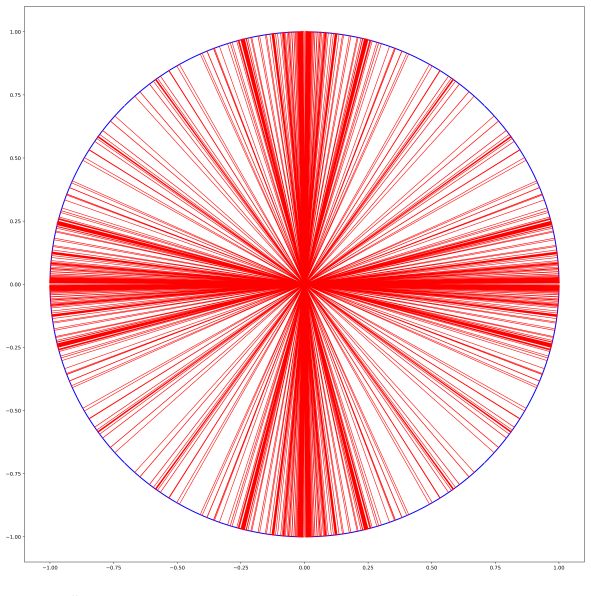
The set of directions in which the straight line flow is periodic on the Mucube is characterized first in terms of a genus one quotient and second in terms of an infinitely generated subgroup of SL_2(Z). The latter characterization determines the Veech group of the Mucube, and the sets of periodic and ergodic directions are both dense.
What carries the argument
The genus-one quotient together with the infinitely generated subgroup of SL_2(Z), which together classify the periodic directions of the straight-line flow using only the Mucube's rigid symmetries.
If this is right
- The Veech group of the Mucube is obtained directly from the subgroup characterization.
- Periodic directions are dense among all possible directions.
- Ergodic directions are dense among all possible directions.
- Periodic and drift orbits admit a geometric description in terms of the Mucube's rigid symmetries.
Where Pith is reading between the lines
- The reduction to a genus-one quotient may apply to other infinite Z^3-periodic half-translation surfaces.
- The subgroup description offers a concrete way to compute affine diffeomorphisms on similar infinite surfaces.
- Density of periodic directions implies that the set of directions with bounded orbits is large in the circle of directions.
Load-bearing premise
The Mucube admits a straight-line flow whose periodic orbits and drift orbits are completely determined by its rigid symmetries and the genus-one quotient, without additional hidden periodic components.
What would settle it
A direction in which the straight-line flow is periodic but is not captured by the periodic directions of the genus-one quotient or by the described subgroup of SL_2(Z) would falsify the characterization.
Figures









read the original abstract
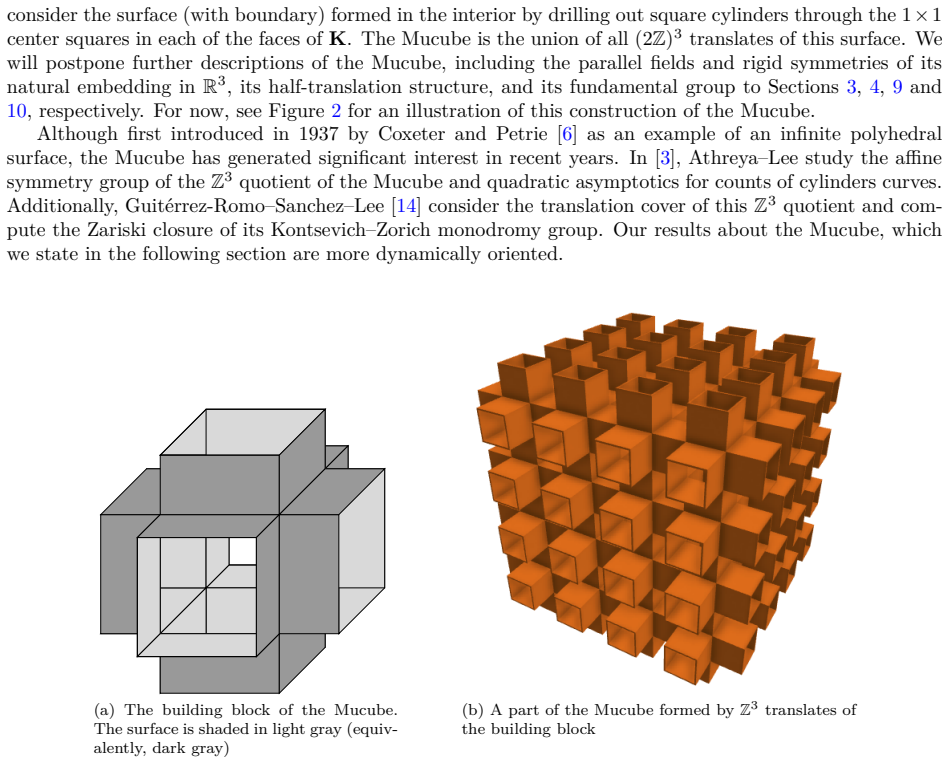
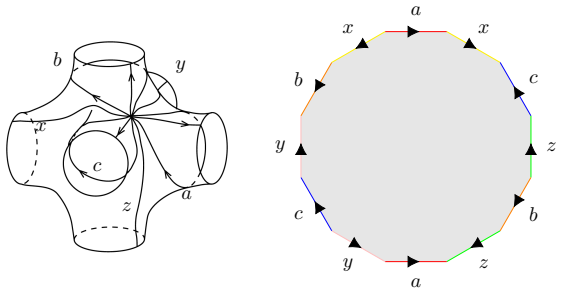
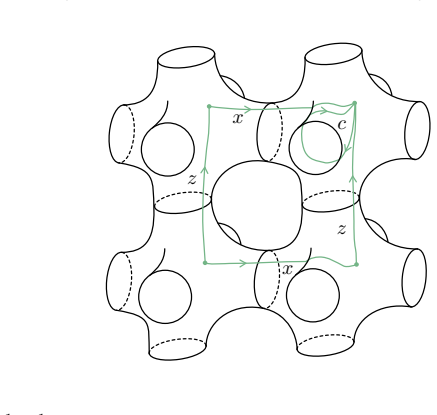
The dynamics of straight line flows on compact half-translation surfaces (surfaces formed by gluing Euclidean polygons edge-to-edge via translations possibly composed with rotation by $\pi$) has been widely studied due to their connections to polygonal billiards and Teichm\"uller theory. However, much less is known when the underlying surface is non-compact or infinite type. In this paper, we consider the straight line flow of the Mucube -- an infinite $\mathbb{Z}^3$-periodic half-translation square-tiled surface -- first written about by Coxeter and Petrie and more recently studied by Athreya--Lee and Guti\'errez-Romo--Lee--S\'anchez. We give a geometric description of the flow's periodic and drift orbits in terms of the Mucube's rigid symmetries, and we give a complete characterization of the set of directions in which the straight line flow is periodic on the Mucube -- first in terms of a genus one quotient and second in terms of an infinitely generated subgroup of $\mathrm{SL}_2(\mathbb{Z})$. We use the latter characterization to obtain the Veech group (i.e. group of derivatives of affine diffeomorphisms) of the Mucube. Finally, we prove density of the sets of periodic and ergodic directions.
Editorial analysis
A structured set of objections, weighed in public.
Referee Report
Summary. The paper studies straight-line flows on the Mucube, an infinite Z^3-periodic half-translation square-tiled surface. It gives a geometric description of periodic and drift orbits via the surface's rigid symmetries, provides complete characterizations of periodic directions first via a genus-one quotient and second via an infinitely generated subgroup of SL_2(Z), derives the Veech group from the subgroup, and proves density of the periodic and ergodic directions.
Significance. If the characterizations and proofs hold, the work provides a valuable explicit example of dynamics on an infinite-type surface, extending results from compact half-translation surfaces. The two explicit characterizations directly address potential concerns about hidden periodic components by reducing via Z^3-periodicity to the quotient while encoding extra directions in the subgroup; the resulting Veech group and density statements offer concrete, falsifiable predictions that can benchmark general theories in Teichmüller dynamics and billiards.
major comments (2)
- [§4] §4 (subgroup characterization): the proof that the subgroup of SL_2(Z) is infinitely generated is load-bearing for the Veech group computation and the density claims, but the manuscript does not explicitly rule out the possibility that the generators arising from the rigid symmetries and quotient lifts could satisfy a finite set of relations that would make the group finitely generated.
- [§6] §6 (density of ergodic directions): the argument that directions outside the subgroup yield ergodic flow relies on the subgroup being a proper subset whose complement is dense, but it is not shown that the infinite-type nature of the Mucube does not introduce additional invariant measures or non-ergodic components for some directions in the complement.
minor comments (3)
- [Introduction] The introduction should clarify how the current characterizations extend the prior results of Athreya--Lee and Gutiérrez-Romo--Lee--Sánchez, with explicit comparison of the periodic direction sets.
- [Notation and §3] Notation for the genus-one quotient and the lifted flow should be made uniform across sections to avoid ambiguity when passing between the Mucube and the quotient.
- [Figures] Figure captions for illustrations of periodic orbits should include explicit direction vectors or slopes to aid verification of the characterizations.
Simulated Author's Rebuttal
We thank the referee for their detailed and constructive report. The comments highlight important points for clarification in the subgroup generation and ergodicity arguments. We address each major comment below and will incorporate revisions to strengthen the exposition while preserving the core results.
read point-by-point responses
-
Referee: [§4] §4 (subgroup characterization): the proof that the subgroup of SL_2(Z) is infinitely generated is load-bearing for the Veech group computation and the density claims, but the manuscript does not explicitly rule out the possibility that the generators arising from the rigid symmetries and quotient lifts could satisfy a finite set of relations that would make the group finitely generated.
Authors: We appreciate the referee drawing attention to the need for explicitness here. Section 4 constructs the subgroup Γ as the group generated by the derivatives of the rigid symmetries of the Mucube together with the lifts of the Veech group of the genus-one quotient surface. The proof that Γ is infinitely generated proceeds by exhibiting an infinite collection of distinct parabolic elements (arising from periodic directions on independent cycles in the quotient) whose fixed points on the circle are pairwise distinct and cannot be obtained from one another by finite words in a finite generating set. This independence is encoded in the action on the homology of the quotient. Nevertheless, to eliminate any ambiguity about possible hidden relations, we will add a short lemma in the revised manuscript that explicitly verifies the generators are not finitely related by comparing their traces and the lengths of the corresponding periodic orbits. This addition will make the infinite generation fully rigorous and self-contained. revision: partial
-
Referee: [§6] §6 (density of ergodic directions): the argument that directions outside the subgroup yield ergodic flow relies on the subgroup being a proper subset whose complement is dense, but it is not shown that the infinite-type nature of the Mucube does not introduce additional invariant measures or non-ergodic components for some directions in the complement.
Authors: We thank the referee for this observation. The argument in §6 first uses the subgroup characterization to identify the periodic directions, then shows that the complement is dense in the circle. For directions outside Γ, the straight-line flow projects to an irrational rotation on the genus-one quotient, which is ergodic with respect to Lebesgue measure. Because the Mucube is a Z^3-periodic cover, any invariant probability measure on the Mucube must descend to an invariant measure on the quotient; the only possibilities are the Lebesgue measure or measures supported on periodic orbits, but the latter are ruled out by the direction lying outside Γ. The infinite-type structure is therefore completely reduced to the finite-type quotient via periodicity, precluding additional ergodic components. To address the concern more explicitly, we will insert a brief paragraph in the revised §6 that spells out this descent argument and notes that any hypothetical extra measure would contradict the density of periodic directions already proved in §5. This will make the reduction from infinite to finite type fully transparent. revision: partial
Circularity Check
No significant circularity; characterizations derived from external geometry and standard facts
full rationale
The paper derives its complete characterization of periodic directions for the straight-line flow on the Mucube first via a genus-one quotient and second via an infinitely generated subgroup of SL_2(Z), then obtains the Veech group and proves density of periodic/ergodic directions. These steps rest on the surface's explicit Z^3-periodicity, rigid symmetries, and standard results from translation surface theory rather than reducing by construction to quantities defined from the claims themselves. No self-definitional loops, fitted inputs renamed as predictions, or load-bearing self-citations appear in the stated derivation chain; the results are self-contained against external geometric benchmarks.
Axiom & Free-Parameter Ledger
Lean theorems connected to this paper
-
IndisputableMonolith/Foundation/AlexanderDuality.leanalexander_duality_circle_linking (D=3 forcing) echoesH = ⟨[1 4; 0 1], [0 -1; 1 0], [5 -8; 2 -3]⟩ ≤ SL_2(Z) and Γ generated by conjugates; continued fractions [4a0;4a1,…]; Z^3-periodic Mucube in R^3; Veech group PΓ; density of periodic directions
-
IndisputableMonolith/Foundation/DimensionForcing.lean (implied by 8-tick and 3D)reality_from_one_distinction (8-tick period, D=3) echoesTheorem 6.1: periodic trajectories decompose M into cylinders of area 4 with π/2 rotational symmetry; non-periodic give bi-infinite strips invariant under (2Z)^3 translations
Reference graph
Works this paper leans on
-
[1]
J. S. Athreya and D. Aulicino. A trajectory from a vertex to itself on the dodecahedron.Amer. Math. Monthly, 126(2):161–162, 2019. 6
work page 2019
-
[2]
J. S. Athreya, D. Aulicino, and W. P. Hooper. Platonic solids and high genus covers of lattice surfaces. Exp. Math., 31(3):847–877, 2022. With an appendix by Anja Randecker. 6
work page 2022
-
[3]
J. S. Athreya and D. Lee. Translation covers of some triply periodic Platonic surfaces.Conform. Geom. Dyn., 25:34–50, 2021. 4, 5
work page 2021
-
[4]
A. Avila and P. Hubert. Recurrence for the wind-tree model.Ann. Inst. H. Poincaré Anal. Non Linéaire, 37(1):1–11, 2020. 7
work page 2020
-
[5]
F. Chapoton, D. Davis, V. Delecroix, O. Fontaine, C. Fougeron, L. Jeffreys, S. Lelièvre, J. Rüth, I. Yakovlev, and C. Zhang. surface-dynamics, Feb. 2025. 30
work page 2025
-
[6]
H. S. M. Coxeter. Regular Skew Polyhedra in Three and Four Dimension, and their Topological Analogues.Proc. London Math. Soc. (2), 43(1):33–62, 1937. 4
work page 1937
- [7]
- [8]
-
[9]
V. Delecroix, P. Hubert, and S. Lelièvre. Diffusion for the periodic wind-tree model.Ann. Sci. Éc. Norm. Supér. (4), 47(6):1085–1110, 2014. 7
work page 2014
- [10]
-
[11]
K. Frączek and P. Hubert. Recurrence and non-ergodicity in generalized wind-tree models.Math. Nachr., 291(11-12):1686–1711, 2018. 7
work page 2018
-
[12]
K. Frączek and C. Ulcigrai. Non-ergodic $\mathbb{z}$-periodic billiards and infinite translation sur- faces.Inventiones mathematicae, 197(2):241–298, 2014. 3
work page 2014
-
[13]
D. Fuchs. Geodesics on regular polyhedra with endpoints at the vertices.Arnold Math. J., 2(2):201–211,
-
[14]
R. Gutiérrez-Romo, D. Lee, and A. Sanchez. Kontsevich–Zorich monodromy groups of translation covers of some platonic solids.Groups Geom. Dyn., 19(3):1129–1163, 2025. 4
work page 2025
-
[15]
W. Hooper. The invariant measures of some infinite interval exchange maps.Geometry & Topology, 19:1895–2038, 2015. 6, 7, 39
work page 2038
-
[16]
W. P. Hooper. An infinite surface with the lattice property I: Veech groups and coding geodesics.Trans. Amer. Math. Soc., 366(5):2625–2649, 2014. 3
work page 2014
-
[17]
W. P. Hooper. An infinite surface with the lattice property II: Dynamics of pseudo-Anosovs.J. Mod. Dyn., 14:243–276, 2019. 3
work page 2019
-
[18]
W. P. Hooper, P. Hubert, and B. Weiss. Dynamics on the infinite staircase.Discrete Contin. Dyn. Syst., 33(9):4341–4347, 2013. 3, 6
work page 2013
-
[19]
W. P. Hooper and P. Javornik. The necker cube surface, 2023. 6
work page 2023
-
[20]
W. P. Hooper and B. Weiss. Generalized staircases: recurrence and symmetry.Ann. Inst. Fourier (Grenoble), 62(4):1581–1600, 2012. 3, 27
work page 2012
- [21]
-
[22]
P. Hubert and T. A. Schmidt. An introduction to Veech surfaces. InHandbook of dynamical systems. Volume 1B, pages 501–526. Amsterdam: Elsevier, 2006. 29
work page 2006
-
[23]
S. Katok.Fuchsian groups. Chicago: The University of Chicago Press, 1992. 29
work page 1992
-
[24]
S. Lelièvre, T. Monteil, and B. Weiss. Everything is illuminated.Geom. Topol., 20(3):1737–1762, 2016. 7
work page 2016
-
[25]
A. Málaga Sabogal and S. Troubetzkoy. Ergodicity of the Ehrenfest wind-tree model.C. R. Math. Acad. Sci. Paris, 354(10):1032–1036, 2016. 3
work page 2016
-
[26]
A. Málaga Sabogal and S. Troubetzkoy. Minimality of the Ehrenfest wind-tree model.J. Mod. Dyn., 10:209–228, 2016. 3
work page 2016
-
[27]
A. Málaga Sabogal and S. E. Troubetzkoy. Infinite ergodic index of the Ehrenfest wind-tree model. Comm. Math. Phys., 358(3):995–1006, 2018. 3
work page 2018
-
[28]
H. Masur. Interval exchange transformations and measured foliations.Annals of Mathematics, 115:169– 200, 1982. 3, 27
work page 1982
-
[29]
H. Masur. Closed trajectories for quadratic differentials with an application to billiards.Duke Math. J., 53(2):307–314, 1986. 3 41
work page 1986
-
[30]
Niven.Diophantine approximations, volume No
I. Niven.Diophantine approximations, volume No. 14 ofInterscience Tracts in Pure and Applied Math- ematics. Interscience Publishers (a division of John Wiley & Sons, Inc.), New York-London, 1963. The Ninth Annual Series of Earle Raymond Hedrick Lectures of The Mathematical Association of America. 22
work page 1963
-
[31]
A. Pardo. Counting problem on wind-tree models.Geom. Topol., 22(3):1483–1536, 2018. 3
work page 2018
-
[32]
A. M. Rockett and P. Szüsz.Continued fractions. World Scientific Publishing Co., Inc., River Edge, NJ, 1992. 21
work page 1992
-
[33]
A. M. Sabogal and S. Troubetzkoy. Unique ergodicity for infinite area translation surfaces.Nonlinearity, 38(6):Paper No. 065014, 18, 2025. 3
work page 2025
-
[34]
W. P. Thurston.Collected works of William P. Thurston with commentary: IV. The geometry and topology of three-manifolds: with a preface by Steven P. Kerckhoff. Edited by Benson Farb, David Gabai and Steven P. Kerckhoff. Providence, RI: American Mathematical Society (AMS), 2022. 29
work page 2022
-
[35]
F. Valdez. Infinite genus surfaces and irrational polygonal billiards.Geom. Dedicata, 143:143–154, 2009. 3
work page 2009
-
[36]
W. A. Veech. Gauss measures for transformations on the space of interval exchange maps.Annals of Mathematics, 115(2):201–242, 1982. 3, 27
work page 1982
-
[37]
A. N. Zemljakov and A. B. Katok. Topological transitivity of billiards in polygons.Mat. Zametki, 18(2):291–300, 1975. 3 42
work page 1975
discussion (0)
Sign in with ORCID, Apple, or X to comment. Anyone can read and Pith papers without signing in.