Recognition: no theorem link
Minimax Optimal Estimation of Transport-Growth Pairs in Unbalanced Optimal Transport
Pith reviewed 2026-05-12 01:09 UTC · model grok-4.3
The pith
Unbalanced optimal transport estimation targets transport-growth pairs with minimax optimal rates.
A machine-rendered reading of the paper's core claim, the machinery that carries it, and where it could break.
Core claim
In unbalanced optimal transport with quadratic cost and Kullback-Leibler marginal penalties, the population target is a transport-growth pair, and estimators for this pair achieve the minimax optimal rate of convergence.
What carries the argument
The value-based stability reduction, which converts perturbations of the UOT objective into transport and growth risks through a UOT gap condition.
If this is right
- The natural population target in unbalanced optimal transport is a transport-growth pair rather than a transport map alone.
- An optimal transport plan-based estimator recovers the pair in general cases.
- A kernel-based estimator recovers the pair when densities are smooth.
- The estimators attain the minimax optimal rate, as confirmed by a matching lower bound.
- The results supply a statistical foundation for Monge-type estimation in unbalanced optimal transport.
Where Pith is reading between the lines
- Similar value-based reductions might apply to unbalanced transport problems that use other divergence penalties.
- In applications the gap condition would need to be checked or ensured before claiming the optimal rate.
- The framework suggests studying minimax rates for transport-growth pairs under costs and penalties beyond the quadratic-KL case.
Load-bearing premise
The UOT gap condition holds for the underlying data distributions, allowing objective perturbations to separate into distinct transport and growth risks.
What would settle it
A data distribution where the UOT gap condition fails and the estimator error rate exceeds the derived lower bound would disprove the general claim.
Figures
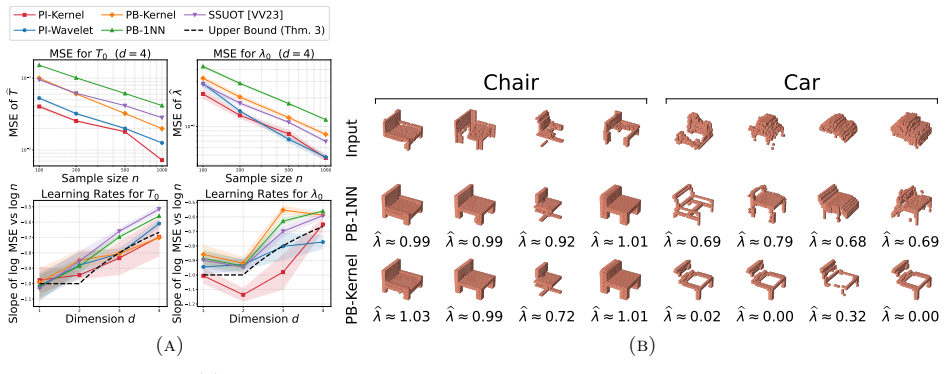
read the original abstract
Unbalanced optimal transport (UOT) extends classical optimal transport to measures with different total masses, but statistical guarantees for Monge-type estimation remain limited. We study unbalanced transport with quadratic cost and Kullback-Leibler marginal penalties and argue that the natural population target is not a map alone, but a transport-growth pair. Consequently, we develop two estimators for the transport-growth pairs under several setups: an optimal transport plan-based estimator for a general case, and a kernel-based estimator for a case with smooth densities. We also show that an error of the estimator achieves the minimax optimal rate by deriving a matching lower bound of the minimax risk. Our main technical contribution is a value-based stability reduction that converts perturbations of the UOT objective into transport and growth risks through a UOT gap condition. These results provide a statistical foundation for Monge-type estimation in unbalanced optimal transport.
Editorial analysis
A structured set of objections, weighed in public.
Referee Report
Summary. The manuscript studies minimax estimation of transport-growth pairs (rather than maps alone) in unbalanced optimal transport with quadratic cost and KL marginal penalties. It introduces an OT-plan-based estimator for the general case and a kernel-based estimator for smooth densities, then claims that the estimation error attains the minimax optimal rate by deriving a matching lower bound. The central technical device is a value-based stability reduction that converts perturbations of the UOT objective into separate transport and growth risks, provided a UOT gap condition holds.
Significance. If the UOT gap condition is verified to hold under the paper's assumptions and is shown to be non-vacuous, the matching upper and lower bounds would supply the first rigorous statistical guarantees for Monge-type estimation in UOT, extending classical OT results to settings with mass creation/destruction. The stability-reduction technique itself could be reusable beyond this model.
major comments (2)
- [Abstract / value-based stability reduction] Abstract and the section presenting the value-based stability reduction: the UOT gap condition is invoked to convert objective perturbations into separate transport and growth risks and thereby obtain the upper bound, yet the manuscript provides neither its precise mathematical statement nor a proof (or even a verification) that the condition holds for the data distributions under consideration or is non-vacuous. Because the upper bound (and therefore the claimed matching minimax rate) depends on this condition while the lower bound is presented as unconditional, the central optimality claim is at present conditional rather than unconditional.
- [Main minimax result] The paragraph stating the main result on minimax optimality: without an explicit derivation showing how the stability reduction produces the claimed rate once the gap condition is imposed, it is impossible to confirm that the upper bound indeed matches the lower bound or to assess the dependence on the gap parameter.
minor comments (1)
- [Abstract] The abstract is dense; a single sentence clarifying the achieved rate (e.g., in terms of sample size n and dimension) would improve readability.
Simulated Author's Rebuttal
We thank the referee for the careful and constructive report. The comments highlight important points about the presentation of the UOT gap condition and the explicit linkage in the minimax result. We address each major comment below and will revise the manuscript to incorporate the requested clarifications and derivations.
read point-by-point responses
-
Referee: [Abstract / value-based stability reduction] Abstract and the section presenting the value-based stability reduction: the UOT gap condition is invoked to convert objective perturbations into separate transport and growth risks and thereby obtain the upper bound, yet the manuscript provides neither its precise mathematical statement nor a proof (or even a verification) that the condition holds for the data distributions under consideration or is non-vacuous. Because the upper bound (and therefore the claimed matching minimax rate) depends on this condition while the lower bound is presented as unconditional, the central optimality claim is at present conditional rather than unconditional.
Authors: We agree that the UOT gap condition requires a precise statement and verification for the claims to be fully rigorous. The value-based stability reduction relies on this condition to decouple the transport and growth components of the risk from perturbations of the UOT objective. In the revised manuscript we will add the exact mathematical definition of the UOT gap condition (a quantitative lower bound on the difference between the UOT value and its linearized approximation) in the dedicated section. We will also include a short verification that the condition holds under the paper's standing assumptions (quadratic cost, KL penalties, and the moment or density bounds used for the estimators), together with a simple example showing that the gap is strictly positive for non-degenerate measures. We will further revise the statement of the main upper bound to make explicit that it holds conditionally on the gap condition, while the lower bound remains unconditional; this will accurately reflect the scope of the optimality result without overstating it. revision: yes
-
Referee: [Main minimax result] The paragraph stating the main result on minimax optimality: without an explicit derivation showing how the stability reduction produces the claimed rate once the gap condition is imposed, it is impossible to confirm that the upper bound indeed matches the lower bound or to assess the dependence on the gap parameter.
Authors: We acknowledge that the current paragraph is too terse. In the revision we will expand the main minimax theorem paragraph (and the surrounding discussion) with an explicit outline of the argument: first apply the value-based stability reduction to bound the sum of transport and growth risks by the UOT objective perturbation plus a term controlled by the gap parameter; then invoke the existing concentration or approximation bounds on the estimator to control the objective perturbation; finally combine with the matching lower bound to obtain the rate. The expanded text will also display the explicit dependence on the gap parameter (typically a multiplicative factor of the form 1/gap or gap^{-1/2} depending on the estimator). This step-by-step derivation will make the matching of upper and lower bounds transparent and allow readers to see the precise role of the gap. revision: yes
Circularity Check
No significant circularity; derivation relies on independent lower bound and explicit assumption
full rationale
The paper presents an upper bound on estimator error via a value-based stability reduction that invokes the UOT gap condition as a prerequisite, paired with a separately derived matching lower bound for the minimax rate. No equations or steps reduce the claimed rate to a quantity defined by the estimator itself, nor do they rename fitted inputs as predictions. The UOT gap condition functions as a stated assumption for the upper bound rather than a self-definitional construct or self-citation load-bearing premise. The lower bound is described as independent, and no self-citation chains or ansatz smuggling are indicated in the abstract or context. This keeps the central minimax optimality claim self-contained against external benchmarks.
Axiom & Free-Parameter Ledger
axioms (1)
- domain assumption Quadratic cost and Kullback-Leibler marginal penalties define a well-posed unbalanced OT problem whose population target is a transport-growth pair.
Reference graph
Works this paper leans on
-
[1]
The MOSEK Python Fusion API manual
MOSEK ApS. The MOSEK Python Fusion API manual. Version 11.0. , 2025
work page 2025
-
[2]
The square root normal field distance and unbalanced optimal transport
Martin Bauer, Emmanuel Hartman, and Eric Klassen. The square root normal field distance and unbalanced optimal transport. Applied Mathematics & Optimization , 85(3), may 2022
work page 2022
-
[3]
Stability bounds for smooth optimal transport maps and their statistical implications
Sivaraman Balakrishnan and Tudor Manole. Stability bounds for smooth optimal transport maps and their statistical implications. arXiv preprint arXiv:2502.12326 , 2025
-
[4]
Scalable wasserstein gradient flow for generative modeling through unbalanced optimal transport
Jaemoo Choi, Jaewoong Choi, and Myungjoo Kang. Scalable wasserstein gradient flow for generative modeling through unbalanced optimal transport. In Proceedings of the 41st International Conference on Machine Learning , ICML'24. JMLR.org, 2024
work page 2024
-
[5]
Sur le transport de mesures p\'eriodiques
Dario Cordero-Erausquin. Sur le transport de mesures p\'eriodiques. Comptes Rendus de l'Acad\'emie des Sciences - Series I - Mathematics , 329(3):199--202, 1999
work page 1999
-
[6]
ShapeNet: An Information-Rich 3D Model Repository
Angel X. Chang, Thomas A. Funkhouser, Leonidas J. Guibas, Pat Hanrahan, Qi - Xing Huang, Zimo Li, Silvio Savarese, Manolis Savva, Shuran Song, Hao Su, Jianxiong Xiao, Li Yi, and Fisher Yu. Shapenet: An information-rich 3d model repository. CoRR , abs/1512.03012, 2015
work page internal anchor Pith review Pith/arXiv arXiv 2015
-
[7]
Unbalanced optimal transport through non-negative penalized linear regression
Laetitia Chapel, R\' e mi Flamary, Haoran Wu, C\' e dric F\' e votte, and Gilles Gasso. Unbalanced optimal transport through non-negative penalized linear regression. In M. Ranzato, A. Beygelzimer, Y. Dauphin, P.S. Liang, and J. Wortman Vaughan, editors, Advances in Neural Information Processing Systems , volume 34, pages 23270--23282. Curran Associates, ...
work page 2021
-
[8]
Youssuff Hussaini, Alfio Quarteroni, and Thomas A
Claudio Canuto, M. Youssuff Hussaini, Alfio Quarteroni, and Thomas A. Zang. Spectral Methods: Fundamentals in Single Domains . Scientific Computation. Springer Berlin Heidelberg, 1 edition, 2006
work page 2006
-
[9]
Unbalanced optimal transport: Dynamic and kantorovich formulations
L \'e na \"i c Chizat, Gabriel Peyr \'e , Bernhard Schmitzer, and Fran c ois-Xavier Vialard. Unbalanced optimal transport: Dynamic and kantorovich formulations. Journal of Functional Analysis , 274(11):3090--3123, 2018
work page 2018
-
[10]
CVXPY : A P ython-embedded modeling language for convex optimization
Steven Diamond and Stephen Boyd. CVXPY : A P ython-embedded modeling language for convex optimization. Journal of Machine Learning Research , 17(83):1--5, 2016
work page 2016
-
[11]
A tumor growth model of hele-shaw type as a gradient flow
Di Marino, Simone and Chizat, Lénaïc . A tumor growth model of hele-shaw type as a gradient flow. ESAIM: COCV , 26:103, 2020
work page 2020
-
[12]
Rates of estimation of optimal transport maps using plug-in estimators via barycentric projections
Nabarun Deb, Promit Ghosal, and Bodhisattva Sen. Rates of estimation of optimal transport maps using plug-in estimators via barycentric projections. In Advances in Neural Information Processing Systems , volume 34, pages 29736--29753, 2021
work page 2021
-
[13]
Optimal transport map estimation in general function spaces
Vincent Divol, Jonathan Niles-Weed, and Aram-Alexandre Pooladian. Optimal transport map estimation in general function spaces. The Annals of Statistics , 53(3):963--988, 2025
work page 2025
-
[14]
Orthogonal series density estimation
Sam Efromovich. Orthogonal series density estimation. WIREs Computational Statistics , 2(4):467--476, 2010
work page 2010
-
[15]
R \'e mi Flamary, Nicolas Courty, Alexandre Gramfort, Mokhtar Z. Alaya, Aur \'e lie Boisbunon, Stanislas Chambon, Laetitia Chapel, Adrien Corenflos, Kilian Fatras, Nemo Fournier, L \'e o Gautheron, Nathalie T.H. Gayraud, Hicham Janati, Alain Rakotomamonjy, Ievgen Redko, Antoine Rolet, Antony Schutz, Vivien Seguy, Danica J. Sutherland, Romain Tavenard, Ale...
work page 2021
-
[16]
On the rate of convergence in wasserstein distance of the empirical measure
Nicolas Fournier and Arnaud Guillin. On the rate of convergence in wasserstein distance of the empirical measure. Probability Theory and Related Fields , 162(3--4):707--738, 2015
work page 2015
-
[17]
Light unbalanced optimal transport
Milena Gazdieva, Arip Asadulaev, Evgeny Burnaev, and Alexander Korotin. Light unbalanced optimal transport. In A. Globerson, L. Mackey, D. Belgrave, A. Fan, U. Paquet, J. Tomczak, and C. Zhang, editors, Advances in Neural Information Processing Systems , volume 37, pages 93907--93938. Curran Associates, Inc., 2024
work page 2024
-
[18]
Regularity theory and geometry of unbalanced optimal transport
Thomas Gallou \"e t, Roberta Ghezzi, and Fran c ois-Xavier Vialard. Regularity theory and geometry of unbalanced optimal transport. Journal of Functional Analysis , page 111042, 2025
work page 2025
-
[19]
Mathematical Foundations of Infinite-Dimensional Statistical Models
Evarist Gin \'e and Richard Nickl. Mathematical Foundations of Infinite-Dimensional Statistical Models . Cambridge Series in Statistical and Probabilistic Mathematics. Cambridge University Press, 2016
work page 2016
-
[20]
Shayan Hundrieser, Florian Heinemann, Marcel Klatt, Marina Struleva, and Axel Munk. Unbalanced kantorovich--rubinstein distance, plan, and barycenter on finite spaces: A statistical perspective. Journal of Machine Learning Research , 26:37:1--37:70, 2025
work page 2025
-
[21]
Minimax estimation of smooth optimal transport maps
Jan-Christian H \"u tter and Philippe Rigollet. Minimax estimation of smooth optimal transport maps. The Annals of Statistics , 49(2):1166, 2021
work page 2021
-
[22]
Matthias Liero, Alexander Mielke, and Giuseppe Savar \'e . Optimal entropy-transport problems and a new hellinger--kantorovich distance between positive measures. Inventiones mathematicae , 211(3):969--1117, 2018
work page 2018
-
[23]
Dong C. Liu and Jorge Nocedal. On the limited memory bfgs method for large scale optimization. Mathematical Programming , 45(1-3):503--528, August 1989
work page 1989
-
[24]
Plugin estimation of smooth optimal transport maps
Tudor Manole, Sivaraman Balakrishnan, Jonathan Niles-Weed, and Larry Wasserman. Plugin estimation of smooth optimal transport maps. The Annals of Statistics , 52(3):966--998, 2024
work page 2024
-
[25]
Minimax estimation of discontinuous optimal transport maps: The semi-discrete case
Aram-Alexandre Pooladian, Vincent Divol, and Jonathan Niles-Weed. Minimax estimation of discontinuous optimal transport maps: The semi-discrete case. In Proceedings of the 40th International Conference on Machine Learning , volume 202 of Proceedings of Machine Learning Research , pages 28128--28150, 2023
work page 2023
-
[26]
Minimax rates of estimation for optimal transport map between infinite-dimensional spaces
Donlapark Ponnoprat and Masaaki Imaizumi. Minimax rates of estimation for optimal transport map between infinite-dimensional spaces. arXiv preprint arXiv:2505.13570 , 2025
-
[27]
On unbalanced optimal transport: An analysis of sinkhorn algorithm
Khiem Pham, Khang Le, Nhat Ho, Tung Pham, and Hung Bui. On unbalanced optimal transport: An analysis of sinkhorn algorithm. In Proceedings of the 37th International Conference on Machine Learning , volume 119 of Proceedings of Machine Learning Research , pages 7673--7682, 2020
work page 2020
-
[28]
arXiv preprint arXiv:2109.12004 , year =
Aram-Alexandre Pooladian and Jonathan Niles-Weed. Entropic estimation of optimal transport maps. CoRR , abs/2109.12004, 2021
-
[29]
Marina Struleva, Shayan Hundrieser, Dominic Schuhmacher, and Axel Munk. Sharp convergence rates of empirical unbalanced optimal transport for spatio-temporal point processes. arXiv preprint arXiv:2509.04225 , 2025
-
[30]
Chapter 12 - unbalanced optimal transport, from theory to numerics
Thibault S \'e journ \'e , Gabriel Peyr \'e , and Fran c ois-Xavier Vialard. Chapter 12 - unbalanced optimal transport, from theory to numerics. In Handbook of Numerical Analysis , volume 24, pages 407--471. Elsevier, 2023
work page 2023
-
[31]
Reconstructing growth and dynamic trajectories from single-cell transcriptomics data
Yutong Sha, Yuchi Qiu, Peijie Zhou, and Qing Nie. Reconstructing growth and dynamic trajectories from single-cell transcriptomics data. Nature Machine Intelligence , 6(1):25--39, November 2023
work page 2023
-
[32]
A relaxation viewpoint to unbalanced optimal transport: Duality, optimality and monge formulation
Giuseppe Savar \'e and Giacomo Enrico Sodini. A relaxation viewpoint to unbalanced optimal transport: Duality, optimality and monge formulation. Journal de Math \'e matiques Pures et Appliqu \'e es , 188:114--178, 2024
work page 2024
-
[33]
Geoffrey Schiebinger, Jian Shu, Marcin Tabaka, Brian Cleary, Vidya Subramanian, Aryeh Solomon, Joshua Gould, Siyan Liu, Stacie Lin, Peter Berube, Lia Lee, Jenny Chen, Justin Brumbaugh, Philippe Rigollet, Konrad Hochedlinger, Rudolf Jaenisch, Aviv Regev, and Eric S. Lander. Optimal-transport analysis of single-cell gene expression identifies developmental ...
work page 2019
-
[34]
Gilbert Strang. The discrete cosine transform. SIAM Review , 41(1):135--147, 1999
work page 1999
-
[35]
Faster unbalanced optimal transport: Translation invariant sinkhorn and 1-d frank-wolfe
Thibault S \'e journ \'e , Fran c ois-Xavier Vialard, and Gabriel Peyr \'e . Faster unbalanced optimal transport: Translation invariant sinkhorn and 1-d frank-wolfe. In International Conference on Artificial Intelligence and Statistics , pages 4995--5021. PMLR, 2022
work page 2022
- [36]
-
[37]
Stability and upper bounds for statistical estimation of unbalanced transport potentials
Adrien Vacher and Fran c ois-Xavier Vialard. Stability and upper bounds for statistical estimation of unbalanced transport potentials. arXiv preprint arXiv:2203.09143 , 2022
-
[38]
Semi-dual unbalanced quadratic optimal transport: fast statistical rates and convergent algorithm
Adrien Vacher and Fran c ois-Xavier Vialard. Semi-dual unbalanced quadratic optimal transport: fast statistical rates and convergent algorithm. In International Conference on Machine Learning , pages 34734--34758. PMLR, 2023
work page 2023
-
[39]
Jonathan Weed and Francis Bach. Sharp asymptotic and finite-sample rates of convergence of empirical measures in wasserstein distance. Bernoulli , 25(4A):2620--2648, 2019
work page 2019
-
[40]
Wentao Yuan, Tejas Khot, David Held, Christoph Mertz, and Martial Hebert. Pcn: Point completion network. In 3D Vision (3DV), 2018 International Conference on , 2018
work page 2018
-
[41]
Karren D. Yang and Caroline Uhler. Scalable unbalanced optimal transport using generative adversarial networks. In International Conference on Learning Representations , 2019
work page 2019
-
[42]
Learning Gaussian mixtures using the Wasserstein–Fisher–Rao gradient flow
Yuling Yan, Kaizheng Wang, and Philippe Rigollet. Learning Gaussian mixtures using the Wasserstein–Fisher–Rao gradient flow . The Annals of Statistics , 52(4):1774 -- 1795, 2024
work page 2024
discussion (0)
Sign in with ORCID, Apple, or X to comment. Anyone can read and Pith papers without signing in.