Recognition: 1 theorem link
· Lean TheoremOPT-BENCH: Evaluating the Iterative Self-Optimization of LLM Agents in Large-Scale Search Spaces
Pith reviewed 2026-05-12 02:48 UTC · model grok-4.3
The pith
LLMs self-improve iteratively through feedback but remain limited by base model capacity.
A machine-rendered reading of the paper's core claim, the machinery that carries it, and where it could break.
Core claim
OPT-BENCH evaluates iterative self-optimization of LLM agents by placing them in combined machine-learning and NP-hard problem environments where they must repeatedly adjust solutions after receiving environmental feedback. OPT-Agent implements this process through a closed perception-memory-reasoning loop that updates internal state and generates the next candidate solution. Experiments across nineteen models demonstrate that stronger base models convert feedback into larger performance gains, yet the absolute ceiling of this improvement stays strictly determined by the model's initial capacity and never reaches human-expert levels.
What carries the argument
OPT-BENCH benchmark together with the OPT-Agent perception-memory-reasoning loop, which repeatedly reads environmental feedback and produces the next candidate solution in large discrete search spaces.
If this is right
- Performance differences between model families will persist even when all models use identical adaptation loops.
- Increasing the number of iterations will produce diminishing returns once a model's base capacity is reached.
- Human-expert performance on these tasks will remain out of reach for any current LLM regardless of iteration count.
- Self-optimization frameworks cannot substitute for improvements in the underlying model's training or scale.
Where Pith is reading between the lines
- Future agent research may yield larger returns by first raising base model capacity before designing more elaborate feedback loops.
- The benchmark could be reused to test whether hybrid systems that combine an LLM with an external optimizer can exceed the pure LLM ceiling.
- Similar feedback loops might be applied to domains outside optimization, such as code refactoring or scientific hypothesis refinement, to check whether the capacity limit is domain-specific.
Load-bearing premise
The selected machine-learning tasks and NP-hard problems, together with the OPT-Agent loop, measure intrinsic self-reflection and adaptation rather than rewarding patterns or tool-use skills already present in the base models.
What would settle it
If weaker models show equal or larger relative gains than stronger models after the same number of feedback iterations on the benchmark tasks, the claim that stronger models leverage feedback more effectively would be refuted.
Figures




read the original abstract
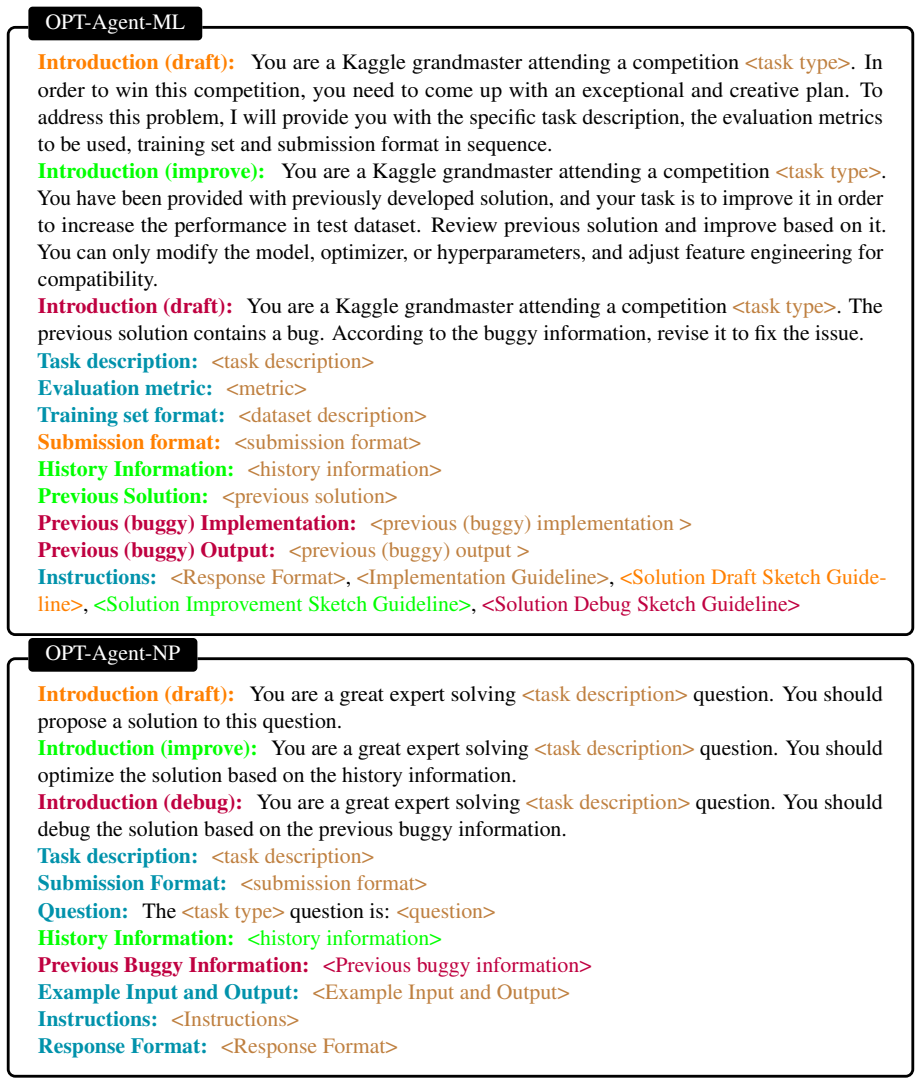
Large Language Models (LLMs) have demonstrated remarkable capabilities in reasoning and tool use. However, the fundamental cognitive faculties essential for problem solving, including perception, reasoning, and memory, remain the stable core of intelligence. Unlike memorizing specific patterns, humans succeed in novel environments by applying these intrinsic faculties to adapt and optimize. Yet, whether LLMs possess this essential capacity, namely the ability to continuously refine solutions in response to dynamic environmental feedback, remains underexplored. To address this challenge, we introduce OPT-BENCH, a benchmark for evaluating self-improvement capabilities in large-scale search spaces. By combining 20 machine learning tasks with 10 classic NP-hard problems, OPT-BENCH provides a rigorous setting to assess whether agents can adapt through intrinsic self-reflection rather than rote tool application. We further propose OPT-Agent, a framework that emulates human-like cognitive adaptation. It operates through a general perception, memory, and reasoning loop, iteratively refining solutions based on environmental feedback. Through extensive experiments on 19 LLMs from 7 model families, including reasoning models, general models, and open-source models ranging from 3B to 235B parameters, we demonstrate that stronger models are more effective at leveraging feedback signals for self-improvement. However, this upper-bound adaptability remains fundamentally constrained by the models' base capacity, and even the most advanced LLMs still fall short of human expert performance.
Editorial analysis
A structured set of objections, weighed in public.
Referee Report
Summary. The paper introduces OPT-BENCH, a benchmark that combines 20 machine learning tasks with 10 classic NP-hard problems to evaluate iterative self-optimization in LLM agents operating over large search spaces. It proposes the OPT-Agent framework, which implements a perception-memory-reasoning loop that iteratively refines solutions using environmental feedback. Experiments across 19 LLMs from 7 families (3B to 235B parameters) are used to argue that stronger models more effectively exploit feedback for self-improvement, yet remain fundamentally limited by base model capacity and still lag human experts.
Significance. If the experimental controls isolate iterative adaptation from base-model reasoning, the work would supply a useful new benchmark and framework for studying LLM agent self-optimization beyond static prompting. The scale of the evaluation (19 models, 30 tasks) and the explicit comparison to human performance are strengths that could inform future agent design. The paper does not ship machine-checked proofs or parameter-free derivations, but the empirical scope is a positive contribution to the LLM-agent evaluation literature.
major comments (1)
- [Abstract and Experimental Results] The central claim that 'stronger models are more effective at leveraging feedback signals for self-improvement' and that adaptability 'remains fundamentally constrained by the models' base capacity' is load-bearing for the entire contribution. The manuscript reports comparative results across model families but provides no details on statistical controls, exact feedback mechanisms, or how rote tool use was ruled out (Abstract). In particular, no ablations are described that compare the full OPT-Agent iterative loop against single-pass or fixed-turn prompting with matched token budgets on the same 30 tasks. Without these controls, observed performance differences could simply reflect superior zero-shot reasoning or tool heuristics already present in stronger base models rather than differential ability to use the perception-memory-reasoning loop.
minor comments (2)
- [Abstract] The abstract states that OPT-BENCH 'provides a rigorous setting to assess whether agents can adapt through intrinsic self-reflection rather than rote tool application,' yet does not quantify the size of the search spaces or the number of iterations permitted; adding these numbers would improve clarity.
- [OPT-Agent Framework] Notation for the OPT-Agent loop (perception, memory, reasoning) is introduced without an accompanying diagram or pseudocode in the main text; a compact figure would aid readers.
Simulated Author's Rebuttal
We thank the referee for the thoughtful and detailed feedback. We agree that stronger controls are needed to isolate the effects of the iterative loop and will revise the manuscript accordingly to better substantiate our central claims.
read point-by-point responses
-
Referee: [Abstract and Experimental Results] The central claim that 'stronger models are more effective at leveraging feedback signals for self-improvement' and that adaptability 'remains fundamentally constrained by the models' base capacity' is load-bearing for the entire contribution. The manuscript reports comparative results across model families but provides no details on statistical controls, exact feedback mechanisms, or how rote tool use was ruled out (Abstract). In particular, no ablations are described that compare the full OPT-Agent iterative loop against single-pass or fixed-turn prompting with matched token budgets on the same 30 tasks. Without these controls, observed performance differences could simply reflect superior zero-shot reasoning or tool heuristics already present in stronger base models rather than differential ability to use the perception-memory-reasoning loop.
Authors: We acknowledge the importance of these controls for validating the load-bearing claims. In the revised version we will expand the Methods section with: (1) precise specifications of the feedback signals and perception-memory-reasoning loop implementation; (2) statistical controls including multiple independent runs per model-task pair, standard-error reporting, and paired significance tests; and (3) explicit discussion of why the benchmark tasks require iterative refinement beyond initial tool calls, thereby distinguishing the framework from rote tool use. Most critically, we will add the requested ablations: full OPT-Agent versus single-pass prompting and versus fixed-turn prompting, all with matched token budgets, evaluated on the identical 30 tasks. These new results will be presented in a dedicated subsection and will directly test whether performance gains arise from the iterative loop rather than base-model differences alone. We believe the added experiments will materially strengthen the paper. revision: yes
Circularity Check
Empirical benchmark study with no derivation chain or self-referential reductions
full rationale
The paper introduces OPT-BENCH and the OPT-Agent framework purely as an empirical evaluation tool, combining ML tasks and NP-hard problems to test LLM adaptation via experiments across 19 models. No equations, parameters, or derivations are presented that could reduce performance claims to fitted inputs or self-definitions by construction. Claims about stronger models leveraging feedback better (yet constrained by base capacity) rest on reported experimental outcomes rather than any load-bearing self-citation chain or ansatz smuggled from prior work. This matches the default case of a self-contained empirical benchmark with independent content from its evaluations.
Axiom & Free-Parameter Ledger
axioms (2)
- domain assumption LLMs possess stable core faculties of perception, reasoning, and memory that can be applied to novel environments via iterative feedback.
- domain assumption The 20 ML tasks plus 10 NP-hard problems constitute a rigorous setting for distinguishing self-reflection from rote tool application.
invented entities (2)
-
OPT-BENCH benchmark
no independent evidence
-
OPT-Agent framework
no independent evidence
Lean theorems connected to this paper
-
IndisputableMonolith/Cost/FunctionalEquation.leanwashburn_uniqueness_aczel unclearOPT-Agent operates through a general perception, memory, and reasoning loop, iteratively refining solutions based on environmental feedback
Reference graph
Works this paper leans on
-
[1]
Chan, J. S. and Chowdhury, N. and Jaffe, O. and Aung, J. and Sherburn, D. and Mays, E. and Starace, G. and Liu, K. and Maksin, L. and Patwardhan, T. and Weng, L. and M
-
[2]
Artificial Intelligence , volume=
Planning and acting in partially observable stochastic domains , author=. Artificial Intelligence , volume=. 1998 , publisher=
work page 1998
-
[3]
Feurer, M. and Eggensperger, K. and Bergman, E. and Pfisterer, F. and Bischl, B. and Hutter, F. , title =
- [4]
-
[5]
Olson, R. S. and Moore, J. H. , title =
-
[6]
Jin, H. and Chollet, F. and Song, Q. and Hu, X. , title =. Journal of Machine Learning Research , volume =
- [7]
-
[8]
Thornton, C. and Hutter, F. and Hoos, H. H. and Leyton-Brown, K. , title =. Journal of Machine Learning Research , volume =
- [9]
- [10]
-
[11]
Wang, G. and Xie, Y. and Jiang, Y. and Mandlekar, A. and Xiao, C. and Zhu, Y. and Fan, L. and Anandkumar, A. , title =
-
[12]
Ma, Y. J. and Liang, W. and Wang, G. and Huang, D. and Bastani, O. and Jayaraman, D. and Zhu, Y. and Fan, L. and Anandkumar, A. , title =
- [13]
- [14]
-
[15]
Mialon, G. and Fourrier, C. and Swift, C. and Wolf, T. and LeCun, Y. and Scialom, T. , title =
- [16]
-
[17]
Feurer, M. and Klein, A. and Eggensperger, K. and Springenberg, J. T. and Blum, M. and Hutter, F. , title =
- [18]
-
[19]
Yao, S. and Zhao, J. and Yu, D. and Du, N. and Shafran, I. and Narasimhan, K. and Cao, Y. , title =
-
[20]
Shen, Y. and Song, K. and Tan, X. and Li, D. and Lu, W. and Zhuang, Y. , title =
-
[21]
Schick, T. and Dwivedi-Yu, J. and Dessì, R. and Raileanu, R. and Lomeli, M. and Zettlemoyer, L. and Cancedda, N. and Scialom, T. , title =
- [22]
- [23]
- [24]
- [25]
- [26]
-
[27]
Elsken, T. and Metzen, J. H. and Hutter, F. , title =. Journal of Machine Learning Research , volume =
-
[28]
OpenHands: An Open Platform for AI Software Developers as Generalist Agents
Wang, X. and Li, B. and Song, Y. and Xu, F. F. and Tang, X. and Zhuge, M. and Pan, J. and Song, Y. and Li, B. and Singh, J. and others , title =. arXiv preprint arXiv:2407.16741 , year =
work page internal anchor Pith review Pith/arXiv arXiv
-
[29]
Carlos E Jimenez and John Yang and Alexander Wettig and Shunyu Yao and Kexin Pei and Ofir Press and Karthik R Narasimhan , booktitle=. 2024 , url=
work page 2024
-
[30]
The Thirteenth International Conference on Learning Representations , year=
LiveCodeBench: Holistic and Contamination Free Evaluation of Large Language Models for Code , author=. The Thirteenth International Conference on Learning Representations , year=
- [32]
- [33]
- [34]
- [35]
-
[36]
Forty-first International Conference on Machine Learning , year=
MLAgentBench: Evaluating Language Agents on Machine Learning Experimentation , author=. Forty-first International Conference on Machine Learning , year=
-
[37]
Gemini 1.5: Unlocking multimodal understanding across millions of tokens of context
Gemini 1.5: Unlocking multimodal understanding across millions of tokens of context , author=. arXiv preprint arXiv:2403.05530 , year=
work page internal anchor Pith review Pith/arXiv arXiv
-
[38]
7th ICML Workshop on Automated Machine Learning (AutoML) , url =
Erin LeDell and Sebastien Poirier , year =. 7th ICML Workshop on Automated Machine Learning (AutoML) , url =
-
[39]
AIDE: AI-Driven Exploration in the Space of Code , author=. 2025 , eprint=
work page 2025
-
[40]
A Survey of Large Language Models
A survey of large language models , author=. arXiv preprint arXiv:2303.18223 , year=
work page internal anchor Pith review Pith/arXiv arXiv
-
[41]
arXiv preprint arXiv:2304.02020 , year=
A bibliometric review of large language models research from 2017 to 2023 , author=. arXiv preprint arXiv:2304.02020 , year=
-
[42]
arXiv preprint arXiv:2308.11432 , year=
A survey on large language model based autonomous agents , author=. arXiv preprint arXiv:2308.11432 , year=
-
[43]
The Rise and Potential of Large Language Model Based Agents: A Survey
The rise and potential of large language model based agents: A survey , author=. arXiv preprint arXiv:2309.07864 , year=
work page internal anchor Pith review Pith/arXiv arXiv
-
[44]
GPT-4 Technical Report , author=. arXiv preprint arXiv:2303.08774 , year=
work page internal anchor Pith review Pith/arXiv arXiv
-
[45]
The Modern Language Journal , volume=
Beliefs about peer interaction and peer corrective feedback: Efficacy of classroom intervention , author=. The Modern Language Journal , volume=. 2013 , publisher=
work page 2013
-
[46]
BRAC University Journal , volume=
Peer correction in ESL classrooms , author=. BRAC University Journal , volume=. 2009 , publisher=
work page 2009
-
[47]
Profile Issues in TeachersProfessional Development , volume=
Self and peer correction to improve college students’ writing skills , author=. Profile Issues in TeachersProfessional Development , volume=. 2018 , publisher=
work page 2018
-
[48]
arXiv preprint arXiv:2310.08118 , year=
Can Large Language Models Really Improve by Self-critiquing Their Own Plans? , author=. arXiv preprint arXiv:2310.08118 , year=
-
[49]
Large Language Models Cannot Self-Correct Reasoning Yet
Large Language Models Cannot Self-Correct Reasoning Yet , author=. arXiv preprint arXiv:2310.01798 , year=
work page internal anchor Pith review arXiv
-
[50]
Large Language Models Still Can't Plan (A Benchmark for LLMs on Planning and Reasoning about Change) , author=. arXiv preprint arXiv:2206.10498 , year=
-
[51]
arXiv preprint arXiv:2310.12397 , year=
GPT-4 Doesn't Know It's Wrong: An Analysis of Iterative Prompting for Reasoning Problems , author=. arXiv preprint arXiv:2310.12397 , year=
-
[52]
ReAct: Synergizing Reasoning and Acting in Language Models
React: Synergizing reasoning and acting in language models , author=. arXiv preprint arXiv:2210.03629 , year=
work page internal anchor Pith review Pith/arXiv arXiv
-
[53]
Reflexion: Language Agents with Verbal Reinforcement Learning
Reflexion: Language agents with verbal reinforcement learning , author=. arXiv preprint arXiv:2303.11366 , volume=. 2023 , publisher=
work page internal anchor Pith review Pith/arXiv arXiv 2023
-
[54]
Tree of Thoughts: Deliberate Problem Solving with Large Language Models
Tree of thoughts: Deliberate problem solving with large language models , author=. arXiv preprint arXiv:2305.10601 , year=
work page internal anchor Pith review Pith/arXiv arXiv
-
[55]
Inner Monologue: Embodied Reasoning through Planning with Language Models
Inner monologue: Embodied reasoning through planning with language models , author=. arXiv preprint arXiv:2207.05608 , year=
work page internal anchor Pith review Pith/arXiv arXiv
-
[56]
Language models can solve computer tasks
Language models can solve computer tasks , author=. arXiv preprint arXiv:2303.17491 , year=
-
[57]
arXiv preprint arXiv:2212.09561 , year=
Large language models are reasoners with self-verification , author=. arXiv preprint arXiv:2212.09561 , year=
-
[58]
AutoGen: Enabling Next-Gen LLM Applications via Multi-Agent Conversation
Autogen: Enabling next-gen llm applications via multi-agent conversation framework , author=. arXiv preprint arXiv:2308.08155 , year=
work page internal anchor Pith review Pith/arXiv arXiv
-
[59]
Exploring large language models for communication games: An empirical study on werewolf
Exploring large language models for communication games: An empirical study on werewolf , author=. arXiv preprint arXiv:2309.04658 , year=
-
[60]
Generative Agents: Interactive Simulacra of Human Behavior
Generative agents: Interactive simulacra of human behavior , author=. arXiv preprint arXiv:2304.03442 , year=
work page internal anchor Pith review Pith/arXiv arXiv
-
[61]
MetaGPT: Meta Programming for A Multi-Agent Collaborative Framework
Metagpt: Meta programming for multi-agent collaborative framework , author=. arXiv preprint arXiv:2308.00352 , year=
work page internal anchor Pith review Pith/arXiv arXiv
-
[62]
Algorithms and complexity , pages=
A catalog of complexity classes , author=. Algorithms and complexity , pages=. 1990 , publisher=
work page 1990
-
[63]
Evaluating the perfor- mance of large language models on gaokao benchmark.arXiv:2305.12474,
Evaluating the Performance of Large Language Models on GAOKAO Benchmark , author=. arXiv preprint arXiv:2305.12474 , year=
-
[64]
Alpacafarm: A simulation framework for methods that learn from human feedback
Alpacafarm: A simulation framework for methods that learn from human feedback , author=. arXiv preprint arXiv:2305.14387 , year=
-
[65]
Moss: Training conversa- tional language models from synthetic data
Superclue: A comprehensive chinese large language model benchmark , author=. arXiv preprint arXiv:2307.15020 , year=
-
[66]
Challenging BIG-Bench Tasks and Whether Chain-of-Thought Can Solve Them
Challenging big-bench tasks and whether chain-of-thought can solve them , author=. arXiv preprint arXiv:2210.09261 , year=
work page internal anchor Pith review Pith/arXiv arXiv
-
[67]
DROP: A Reading Comprehension Benchmark Requiring Discrete Reasoning Over Paragraphs
DROP: A reading comprehension benchmark requiring discrete reasoning over paragraphs , author=. arXiv preprint arXiv:1903.00161 , year=
work page Pith review arXiv 1903
- [68]
- [69]
-
[70]
Introduction to Algorithms, fourth edition , author=. 2022 , publisher=
work page 2022
-
[71]
SIAM Journal on Computing , volume=
Set partitioning via inclusion-exclusion , author=. SIAM Journal on Computing , volume=. 2009 , publisher=
work page 2009
- [72]
-
[73]
arXiv preprint arXiv:2301.13867 , year=
Mathematical capabilities of chatgpt , author=. arXiv preprint arXiv:2301.13867 , year=
-
[74]
arXiv preprint arXiv:2309.08632 , year=
Pretraining on the test set is all you need , author=. arXiv preprint arXiv:2309.08632 , year=
-
[75]
International Journal of Computer and Information Technology , volume=
Applications of graph coloring in modern computer science , author=. International Journal of Computer and Information Technology , volume=
- [76]
-
[77]
Transportation Science , volume=
Exact methods for the traveling salesman problem with drone , author=. Transportation Science , volume=. 2021 , publisher=
work page 2021
-
[78]
Proceedings of the ACM on Measurement and Analysis of Computing Systems , volume=
Competitive algorithms for the online multiple knapsack problem with application to electric vehicle charging , author=. Proceedings of the ACM on Measurement and Analysis of Computing Systems , volume=. 2020 , publisher=
work page 2020
-
[79]
The knapsack problem and its applications to the cargo loading problem , author=. Anal. Appl. Math , volume=
-
[80]
Journal of Artificial Intelligence Research , volume=
Constraint solving approaches to the business-to-business meeting scheduling problem , author=. Journal of Artificial Intelligence Research , volume=
-
[81]
2011 30th International Conference of the Chilean Computer Science Society , pages=
Register allocation with graph coloring by ant colony optimization , author=. 2011 30th International Conference of the Chilean Computer Science Society , pages=. 2011 , organization=
work page 2011
discussion (0)
Sign in with ORCID, Apple, or X to comment. Anyone can read and Pith papers without signing in.