Recognition: 2 theorem links
· Lean TheoremLocational Pricing for Generative-AI Services via Token-Flow Market Clearing
Pith reviewed 2026-05-12 01:58 UTC · model grok-4.3
The pith
A linear program for token flows produces locational prices that dispatch AI workloads across distributed compute and networks.
A machine-rendered reading of the paper's core claim, the machinery that carries it, and where it could break.
Core claim
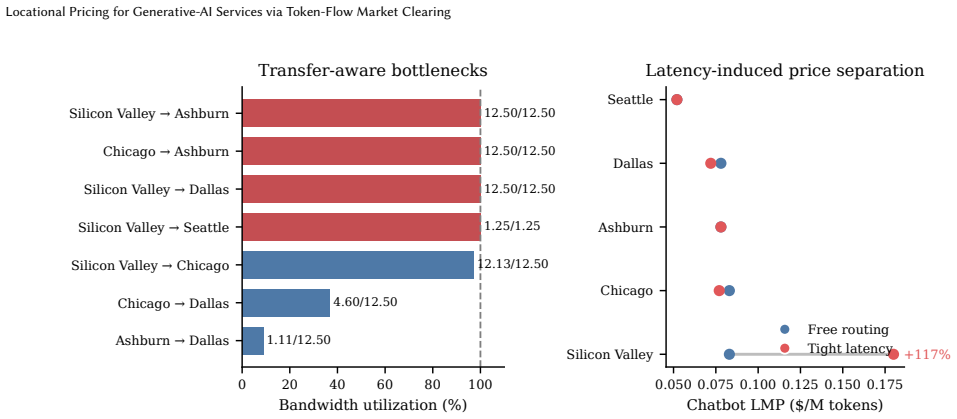
The central claim is that a network-constrained token-flow market clears AI workloads by solving a linear program that co-optimizes routing and processing subject to compute-capacity and bandwidth constraints. Its dual variables supply location- and workload-specific marginal service prices. The transfer-aware extension prices data movement in physical units and separates bandwidth congestion rents. Results from a five-node network identify four saturated backbone links, show a 2.7 percent cost increase relative to the baseline, and demonstrate a 117 percent rise in one locational price when the latency limit drops from 100 ms to 15 ms; the twenty-node scale-up reproduces the same meritorder
What carries the argument
The dual variables of the token-flow linear program, which serve as locational marginal prices reflecting local compute scarcity and network congestion.
If this is right
- Workloads are routed and processed at the combination of nodes and links that minimizes total operating cost given the stated constraints.
- Bandwidth congestion produces identifiable rents that the transfer-aware model isolates from compute charges.
- Tightening latency requirements raises prices sharply at locations that must use congested or distant resources.
- Once demand exceeds aggregate capacity the optimization becomes infeasible, indicating where capacity additions are required.
- The same price signals could later support competitive bidding among providers of AI compute and connectivity.
Where Pith is reading between the lines
- The framework could be linked to electricity locational marginal pricing in regions where AI data centers draw large power loads.
- Real-time versions might adjust prices continuously as user demand and network state change.
- Global AI service economics would then show large regional cost differences driven by both compute density and interconnect quality.
- Network planners could test proposed backbone upgrades by re-running the model and measuring the reduction in congestion rents.
Load-bearing premise
Real generative AI workloads and infrastructure can be represented accurately enough as linear token flows with fixed capacities and bandwidth limits for the resulting dual prices to serve as meaningful operational signals.
What would settle it
Deploy the model on an actual five-node regional network and observe that the computed locational prices do not align with the nodes and links chosen by operators or with the measured costs and latencies that occur in live service.
Figures


read the original abstract
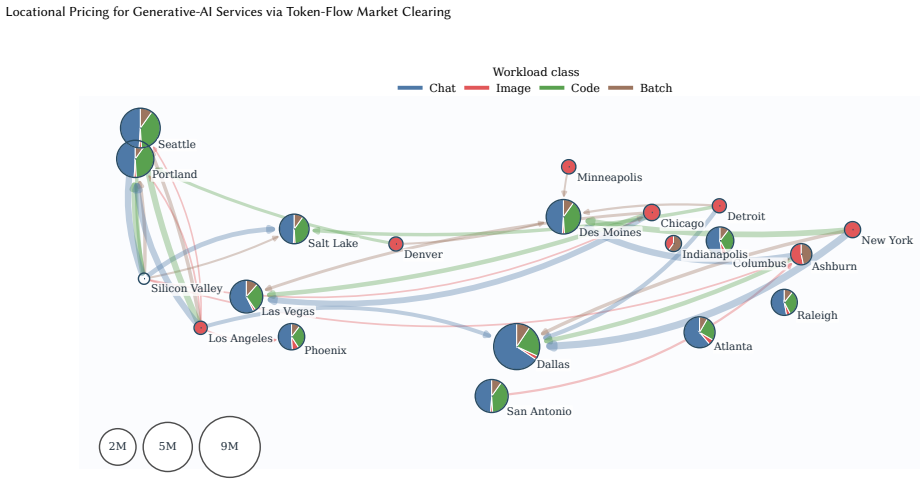
GenAI services are in an early yet fast expanding phase. Providers compete on model capability and service quality, while the underlying infrastructure remains expensive and heterogeneous across regions, workloads, and compute assets. If these services diffuse into routine daily use, the relevant engineering problem becomes not only better models but also efficient dispatch on a geographically distributed AI service infrastructure. To address this, we formulate a network-constrained token-flow market that clears AI workloads across compute nodes and communication links. The baseline model is a linear program that co-optimizes routing and processing subject to compute-capacity and bandwidth constraints; its dual variables define location- and workload-specific marginal service prices. We further introduce a transfer-aware extension that prices data movement in physical units and isolates bandwidth congestion rents. In a 5-node U.S. case study, the transfer-aware model uncovers four saturated backbone links and raises total operating cost by 2.7\% relative to the token-equivalent baseline, while tightening the chatbot latency limit from 100~ms to 15~ms increases one locational price by 117\%. A 20-node scale-up exhibits the same merit-order dispatch logic and becomes infeasible once demand exceeds aggregate capacity. These results suggest that locational pricing is a useful organizing principle for operating an emerging AI service infrastructure and, over time, for designing competitive markets around it.
Editorial analysis
A structured set of objections, weighed in public.
Referee Report
Summary. The paper formulates a network-constrained token-flow market as a linear program that co-optimizes routing and processing of generative-AI workloads subject to compute-capacity and bandwidth constraints; dual variables supply location- and workload-specific marginal prices. A transfer-aware extension prices physical data movement and isolates bandwidth congestion rents. Numerical results from a 5-node U.S. case study show four saturated links, a 2.7% operating-cost increase, and a 117% locational-price jump under a tighter 15 ms latency bound; a 20-node scale-up reproduces the same merit-order logic and becomes infeasible beyond aggregate capacity.
Significance. If the linear token-flow abstraction adequately captures dispatch, the framework supplies a transparent, parameter-free method for extracting marginal prices that could support efficient operation and eventual market design for distributed GenAI infrastructure. The direct use of LP duality for pricing is a methodological strength, as prices emerge endogenously from the stated constraints rather than from external fitting.
major comments (2)
- [5-node U.S. case study] 5-node U.S. case study: the reported 2.7% cost uplift and 117% price increase are presented as direct LP outputs, yet the manuscript supplies no comparison against real GenAI workload traces, batch-level latency measurements, or higher-fidelity non-linear simulators; without such grounding the dual prices' operational relevance for the central claim remains untested.
- [Baseline model] Baseline LP formulation: the model treats token flows as linear with fixed capacities and deterministic bandwidth limits, but real inference exhibits batch-dependent latency, stochastic token rates, and GPU memory contention; this modeling choice is load-bearing for the interpretability of the derived locational prices.
minor comments (1)
- [Abstract] The abstract states that the transfer-aware model 'uncovers four saturated backbone links' but does not identify the links or supply the underlying network topology, limiting reproducibility of the congestion-rent results.
Simulated Author's Rebuttal
We thank the referee for the thoughtful review and constructive feedback on our manuscript. We address each major comment below, clarifying the scope of our modeling choices and the illustrative purpose of the case studies while acknowledging their limitations.
read point-by-point responses
-
Referee: [5-node U.S. case study] 5-node U.S. case study: the reported 2.7% cost uplift and 117% price increase are presented as direct LP outputs, yet the manuscript supplies no comparison against real GenAI workload traces, batch-level latency measurements, or higher-fidelity non-linear simulators; without such grounding the dual prices' operational relevance for the central claim remains untested.
Authors: We agree that the 5-node results rely on stylized network parameters and synthetic demand rather than real GenAI workload traces, empirical batch latency data, or non-linear simulators. The reported 2.7% cost increase and 117% locational price jump are exact dual outputs from the LP under the stated assumptions, intended to demonstrate how congestion and latency bounds endogenously shape prices. We do not claim these figures represent operational forecasts for deployed systems. In the revised manuscript we will add an explicit limitations subsection noting the illustrative character of the case study and outlining pathways for future validation against production traces and higher-fidelity models. revision: partial
-
Referee: [Baseline model] Baseline LP formulation: the model treats token flows as linear with fixed capacities and deterministic bandwidth limits, but real inference exhibits batch-dependent latency, stochastic token rates, and GPU memory contention; this modeling choice is load-bearing for the interpretability of the derived locational prices.
Authors: The linear, deterministic token-flow abstraction is a deliberate modeling decision that enables direct application of LP duality to obtain transparent, constraint-derived marginal prices, following the precedent of linearized network models in electricity markets. While we recognize that actual inference involves batch effects, stochasticity, and memory contention that could alter realized latencies and dispatch, the framework isolates the pricing implications of capacity and bandwidth limits under average-flow assumptions. This choice keeps prices endogenous and parameter-free. We will insert a dedicated limitations paragraph discussing these simplifications and their consequences for price interpretability, without altering the core formulation. revision: yes
Circularity Check
No circularity: prices are standard duals of the formulated LP
full rationale
The paper's core derivation consists of stating a linear program that co-optimizes token routing and processing under capacity and bandwidth constraints, then extracting locational prices directly as the dual variables of those constraints. This is a standard, non-circular extraction of marginal costs from any linear program; the duals are defined by the primal constraints by construction of duality theory, not by fitting, self-definition, or self-citation. The 5-node and 20-node numerical examples simply solve the stated model and report the resulting dual values; no quantity is renamed as a prediction after being fitted to the same data, and no load-bearing premise rests on prior self-citations. The derivation chain is therefore self-contained and independent of its own outputs.
Axiom & Free-Parameter Ledger
axioms (1)
- domain assumption AI workloads can be represented as token flows subject to node compute capacities and link bandwidth limits
Lean theorems connected to this paper
-
IndisputableMonolith/Cost/FunctionalEquation.leanwashburn_uniqueness_aczel unclearThe baseline clearing problem is formulated as the following linear program: min … s.t. A f_k + x_k = d_k … (1b) … dual variables define location- and workload-specific marginal service prices.
-
IndisputableMonolith/Foundation/ArithmeticFromLogic.leanembed_injective unclearFor any active arc … π_i,k − π_j,k = c_ij,k + η_ij (7); … π_j,k = g_j,k + μ_j,k (8)
Reference graph
Works this paper leans on
-
[1]
Ravindra K. Ahuja, Thomas L. Magnanti, and James B. Orlin. 2001. Minimum Cost Flow Problem. InEncyclopedia of Optimization. Springer US, 1382–1392. doi:10.1007/0-306-48332-7_283
-
[2]
Ross Baldick. 2018. Locational Marginal Pricing. Course notes for EE394V: Restructured Electricity Markets: Locational Marginal Pricing. https://users.ece. utexas.edu/~baldick/classes/394V/Locational.pdf Accessed 2026-03-16
work page 2018
-
[3]
Cynthia Barnhart, Niranjan Krishnan, and Pamela H. Vance. 2008. Multicom- modity Flow Problems. InEncyclopedia of Optimization. Springer US, 2354–2362. doi:10.1007/978-0-387-74759-0_407
-
[4]
Stephen P. Bradley, Arnoldo C. Hax, and Thomas L. Magnanti. 1977. Network Models. InApplied Mathematical Programming. Addison-Wesley, Chapter 8. https://web.mit.edu/15.053/www/AMP-Chapter-08.pdf MIT-hosted PDF version, accessed 2026-03-16
work page 1977
-
[5]
California Independent System Operator. 2010. Appendix C: Locational Marginal Price. https://www.caiso.com/documents/appendicesc-f-fifthreplacementcaiso tariff_15-dec-10.pdf Fifth replacement electronic tariff, effective December 15, 2010
work page 2010
-
[6]
Data Center Map. 2026. Data Center Map: USA. https://www.datacentermap.co m/usa/ ; manually curated and accessed 2026-03-27
work page 2026
-
[7]
Deloitte. 2026. The State of AI in the Enterprise - 2026 AI Report. https://ww w.deloitte.com/cz-sk/en/issues/generative-ai/state-of-ai-in-enterprise.html Accessed 2026-04-05
work page 2026
-
[8]
Anish Devasia. 2025. Data Center Operating Costs: Complete Guide (2026). The Network Installers. https://thenetworkinstallers.com/blog/data-center- operating-costs/ Accessed 2026-03-16
work page 2025
-
[9]
Digital China Summit. 2024. National Supercomputing Internet Platform Builds a “Highway” for Digital China. https://www.digitalchina.gov.cn/magazine/4/2 5/technology/1867.html Translated title; article on the Digital China Summit website, accessed 2026-03-16
work page 2024
-
[10]
Stephen Frank and Steffen Rebennack. 2016. An Introduction to Optimal Power Flow: Theory, Formulation, and Examples.IIE Transactions48, 12 (2016), 1172–
work page 2016
-
[11]
doi:10.1080/0740817X.2016.1189626
-
[12]
IAEI Magazine. 2026. How Much Electricity Does a Data Center Use? Complete 2025 Analysis. https://iaeimagazine.org/electrical-fundamentals/how-much- electricity-does-a-data-center-use-complete-2025-analysis/ Page updated 2026-01-01; accessed 2026-03-16
work page 2026
-
[13]
F. P. Kelly, A. K. Maulloo, and D. K. H. Tan. 1998. Rate Control for Communication Networks: Shadow Prices, Proportional Fairness and Stability.Journal of the Operational Research Society49, 3 (1998), 237–252. doi:10.1057/palgrave.jors.26 00523
-
[14]
Steven H. Low and David E. Lapsley. 1999. Optimization Flow Control—I: Basic Algorithm and Convergence.IEEE/ACM Transactions on Networking7, 6 (1999), 861–874. doi:10.1109/90.811451
-
[15]
Ministry of Industry and Information Technology of the People’s Republic of China. 2025. Notice on Issuing the Action Plan for Computing Power Intercon- nection. https://www.miit.gov.cn/zwgk/zcwj/wjfb/tz/art/2025/art_1bbbd7e75dc c4fd8b75d6d2109f2e9ab.html Document No. Gong Xin Bu Xin Guan [2025] 119, accessed 2026-03-16
work page 2025
-
[16]
Ministry of Industry and Information Technology of the PRC. 2026. MIIT Ad- vances the “1+M+N” National Computing Power Interconnection Node System. https://www.miit.gov.cn/jgsj/xgj/gzdt/art/2026/art_0df3c73645a64d7dab09f82 46acf7049.html , accessed 2026-03-16
work page 2026
-
[17]
Daniel P. Palomar and Mung Chiang. 2006. A Tutorial on Decomposition Methods for Network Utility Maximization.IEEE Journal on Selected Areas in Communi- cations24, 8 (2006), 1439–1451. doi:10.1109/JSAC.2006.879350
-
[18]
Fred C. Schweppe, Michael C. Caramanis, Richard D. Tabors, and Roger E. Bohn. 1988.Spot Pricing of Electricity. Springer US. https://books.google.com/books/a bout/Spot_Pricing_of_Electricity.html?id=Sg5zRPWrZ_gC
work page 1988
-
[19]
1984.Urban Transportation Networks: Equilibrium Analysis with Mathematical Programming Methods
Yosef Sheffi. 1984.Urban Transportation Networks: Equilibrium Analysis with Mathematical Programming Methods. Prentice-Hall, Englewood Cliffs, NJ. https: //books.google.com/books/about/Urban_Transportation_Networks.html?id=z x1PAAAAMAAJ
work page 1984
-
[20]
Stanford Institute for Human-Centered Artificial Intelligence. 2025. Economy | The 2025 AI Index Report. https://hai.stanford.edu/ai-index/2025-ai-index- report/economy Accessed 2026-04-05
work page 2025
-
[21]
2002.Power System Economics: Designing Markets for Electricity
Steven Stoft. 2002.Power System Economics: Designing Markets for Electricity. Wiley. https://books.google.com/books/about/Power_System_Economics.html ?id=DrTEsqJRKrYC
work page 2002
-
[22]
Energy Information Administration
U.S. Energy Information Administration. 2026. Electricity Open Data Browser: Retail Sales by State and Sector. https://www.eia.gov/opendata/index.php/bro wser/electricity/retail-sales ; accessed 2026-03-27
work page 2026
discussion (0)
Sign in with ORCID, Apple, or X to comment. Anyone can read and Pith papers without signing in.