Recognition: 3 theorem links
· Lean TheoremLocal Universal Splitting Integrators for Contact Hamiltonian Systems
Pith reviewed 2026-05-12 02:38 UTC · model grok-4.3
The pith
The Lie algebra from strict contactomorphisms and prolonged diffeomorphisms is dense in all smooth contact Hamiltonians, yielding local universal splitting integrators.
A machine-rendered reading of the paper's core claim, the machinery that carries it, and where it could break.
Core claim
The central claim is that the Lie algebra generated by the strict contact Hamiltonians and the prolonged diffeomorphism Hamiltonians contains all polynomial-in-p Hamiltonians and is therefore dense, in the C^r topology on compact sets, in the Lie algebra of smooth contact Hamiltonians. This density yields a local universality result for contact splitting integrators constructed from exact strict and prolonged subflows.
What carries the argument
The splitting framework that composes exact subflows from strict contactomorphisms and prolonged diffeomorphisms, with the Lie algebra they generate serving as the mechanism for density and approximation.
Load-bearing premise
The two classes of subflows must be exactly realizable and must generate a Lie algebra rich enough to reach density in the full space of contact Hamiltonians.
What would settle it
A smooth contact Hamiltonian on a compact set whose flow cannot be approximated to arbitrary accuracy in the C^r sense by finite compositions of strict contact and prolonged flows would falsify the density claim.
Figures
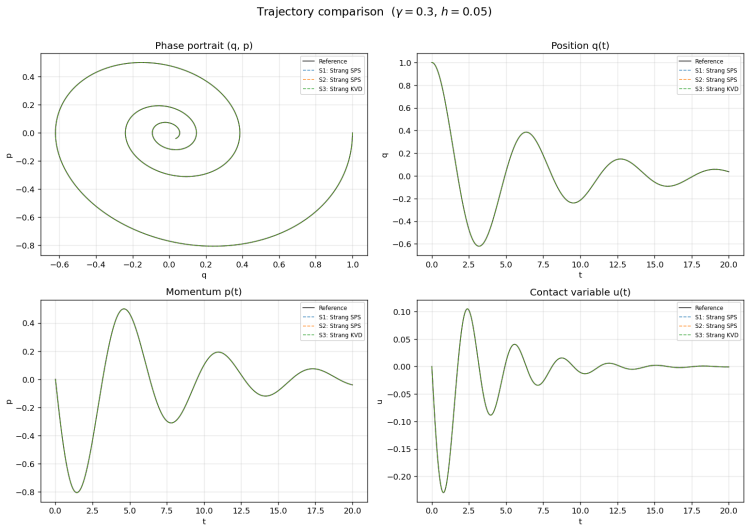
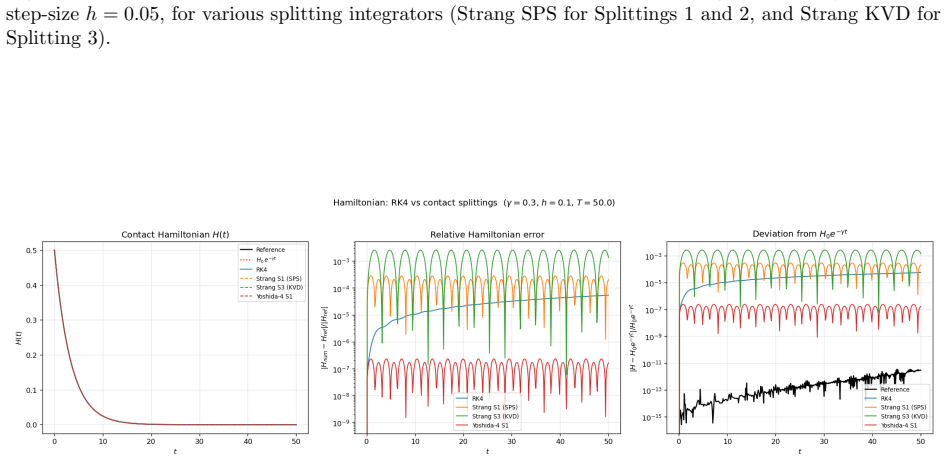
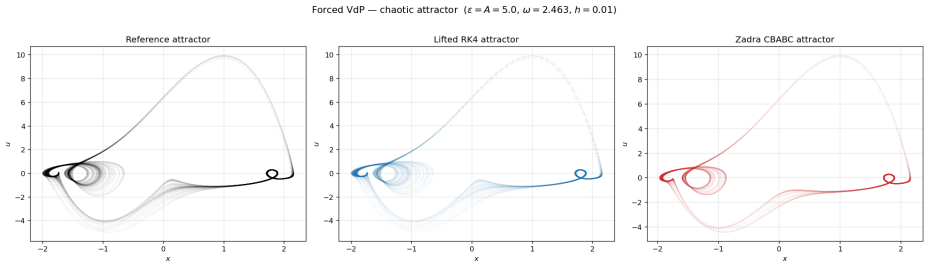
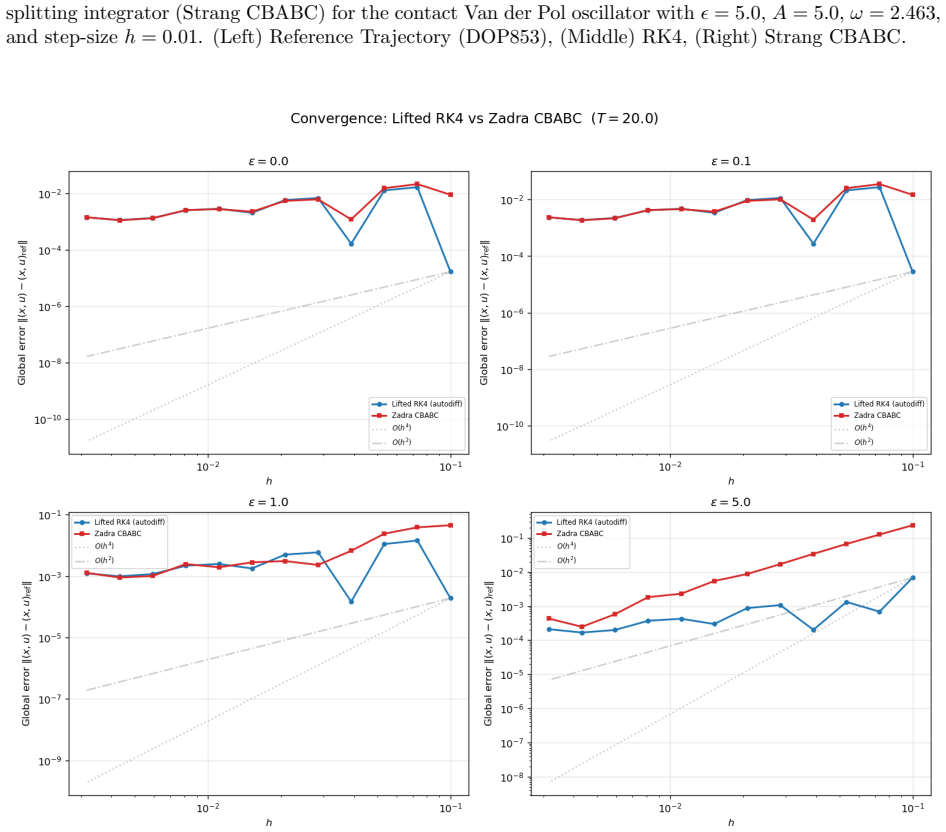


read the original abstract
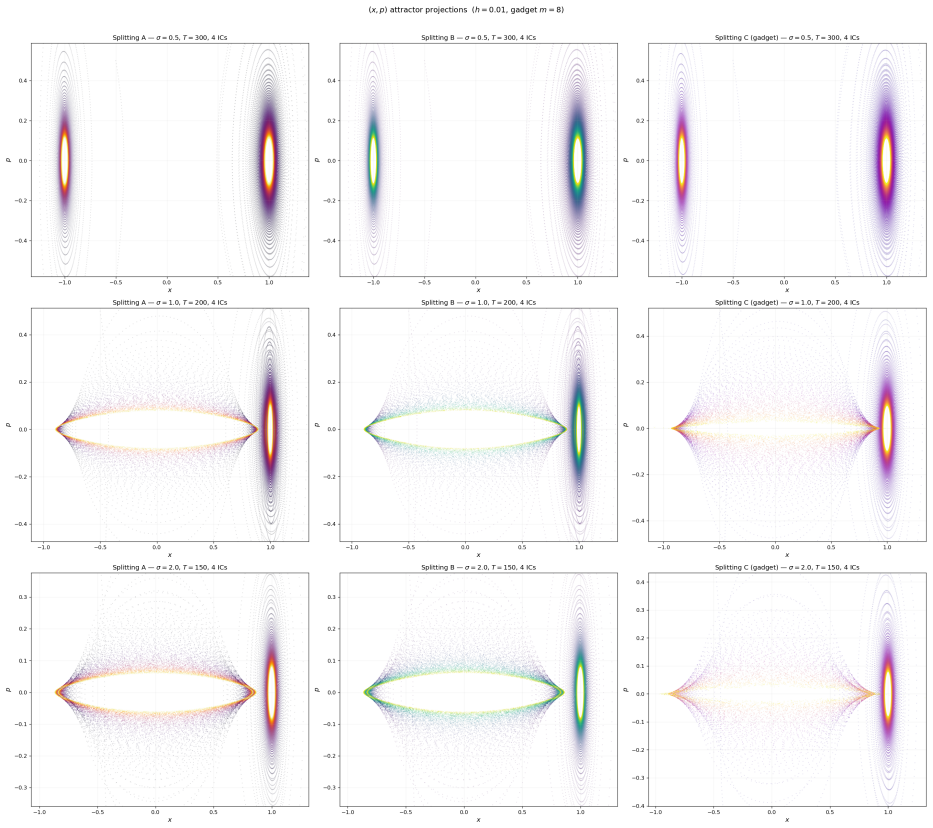
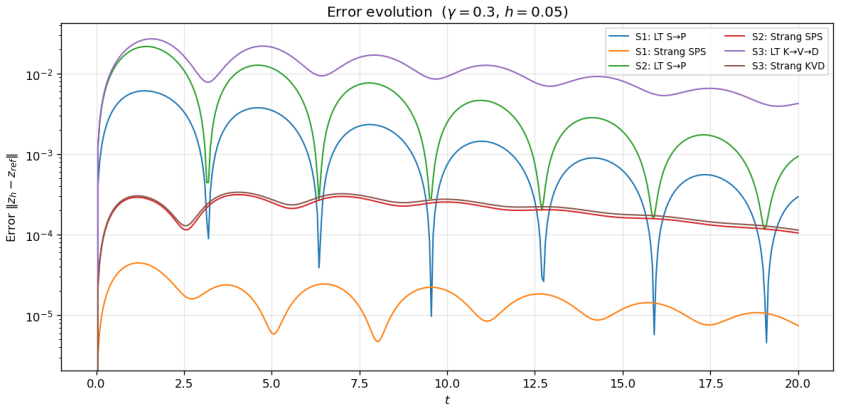
Contact Hamiltonian systems extend symplectic Hamiltonian mechanics to dissipative settings while retaining geometric structure. We develop a structure-preserving splitting framework for contact Hamiltonian systems on $J^1(\mathbb{R}^n)$ based on two tractable classes of exact-contact subflows: strict contactomorphisms and prolonged diffeomorphisms. Our main theoretical result is that the Lie algebra generated by the corresponding strict and prolonged Hamiltonians contains all polynomial-in-$p$ Hamiltonians and is therefore dense, in the $C^r$ topology on compact sets, in the Lie algebra of smooth contact Hamiltonians. This yields a local universality result and contact splitting integrators built from exact strict and prolonged subflows. We then show how these subflows can be realized numerically by lifting symplectic integrators on $T^*\mathbb{R}^n$ and ODE integrators on $\mathbb{R}^n\times\mathbb{R}$. Finally, we illustrate the framework on a sequence of low-dimensional examples.
Editorial analysis
A structured set of objections, weighed in public.
Referee Report
Summary. The manuscript develops a splitting integrator framework for contact Hamiltonian systems on the 1-jet bundle J^1(R^n). It identifies two classes of exact-contact subflows (strict contactomorphisms and prolonged diffeomorphisms), proves that the Lie algebra they generate contains all polynomial-in-p Hamiltonians (hence is dense in the C^r topology on compact sets within the Lie algebra of smooth contact Hamiltonians), constructs local universal splitting integrators from these subflows, realizes the subflows numerically by lifting symplectic integrators on T^*R^n and ODE integrators on R^n x R, and illustrates the method on low-dimensional examples.
Significance. If the density result holds, the work establishes a theoretical basis for structure-preserving numerical methods applicable to dissipative contact systems, extending symplectic splitting techniques in a geometrically consistent way. The lifting construction from existing symplectic and ODE integrators is a practical strength that could facilitate implementation, and the universality claim (if rigorously verified) would be a notable contribution to geometric integration in contact geometry.
major comments (1)
- [Abstract / main theoretical result section] The central claim (abstract and main theoretical result) that the Lie algebra generated by the strict-contact and prolonged Hamiltonians contains every polynomial-in-p Hamiltonian is load-bearing for the density statement and the subsequent universality of the splitting integrators, yet the manuscript provides no explicit Lie-bracket computations, inductive argument, or verification that arbitrary monomials in the p-variables can be obtained from the given generators; this creates a derivation gap that must be closed with concrete algebraic details.
minor comments (2)
- [Introduction / framework definition] The notation for the prolonged diffeomorphisms and their Hamiltonians could be clarified with an explicit coordinate expression or example in low dimension to aid readability.
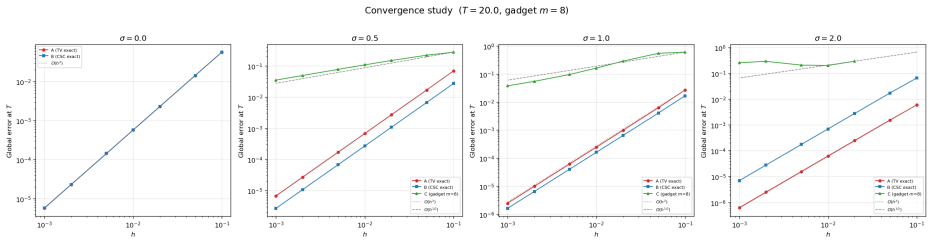
- [Examples section] The numerical examples would benefit from quantitative error tables or convergence plots comparing the splitting method against non-structure-preserving alternatives, rather than qualitative illustrations alone.
Simulated Author's Rebuttal
We thank the referee for their careful reading of the manuscript and for the constructive feedback. We appreciate the positive assessment of the work's potential significance and address the major comment below by committing to strengthen the presentation of the central result.
read point-by-point responses
-
Referee: [Abstract / main theoretical result section] The central claim (abstract and main theoretical result) that the Lie algebra generated by the strict-contact and prolonged Hamiltonians contains every polynomial-in-p Hamiltonian is load-bearing for the density statement and the subsequent universality of the splitting integrators, yet the manuscript provides no explicit Lie-bracket computations, inductive argument, or verification that arbitrary monomials in the p-variables can be obtained from the given generators; this creates a derivation gap that must be closed with concrete algebraic details.
Authors: We agree that the manuscript would benefit from more explicit algebraic verification of the main theoretical result. In the revised version we will expand the relevant section with a detailed inductive argument, including explicit Lie-bracket computations that demonstrate how arbitrary monomials in the momentum variables p are generated from the strict-contact and prolonged Hamiltonians. This will close the identified derivation gap while preserving the overall structure of the proof. revision: yes
Circularity Check
No significant circularity detected
full rationale
The paper's main result is a standard Lie-algebra density theorem: the Lie algebra generated by the strict-contact and prolonged Hamiltonians is shown to contain all polynomial-in-p Hamiltonians, hence to be dense in the C^r topology. This is established by explicit computation of Lie brackets among the chosen generators on J^1(R^n), without any fitted parameters, self-referential definitions, or load-bearing self-citations that collapse the claim back to its inputs. The subsequent numerical realization by lifting symplectic/ODE integrators is an implementation step downstream of the algebraic statement and does not affect the density proof itself. The derivation is therefore self-contained.
Axiom & Free-Parameter Ledger
axioms (2)
- standard math Lie algebra generated by Hamiltonians on the contact manifold J^1(R^n) behaves according to standard differential geometry rules
- domain assumption Strict contactomorphisms and prolonged diffeomorphisms generate exact-contact subflows that are numerically tractable
Lean theorems connected to this paper
-
IndisputableMonolith/Foundation/RealityFromDistinction.leanreality_from_one_distinction unclearOur main theoretical result is that the Lie algebra generated by the corresponding strict and prolonged Hamiltonians contains all polynomial-in-p Hamiltonians and is therefore dense, in the C^r topology on compact sets, in the Lie algebra of smooth contact Hamiltonians.
-
IndisputableMonolith/Cost/FunctionalEquation.leanwashburn_uniqueness_aczel unclearthe Lie algebra generated by strict contact Hamiltonians and prolonged Hamiltonians contains all polynomial-in-p Hamiltonians, i.e. P(k)(J^1(R^n)) ⊂ g for all k ∈ N
-
IndisputableMonolith/Foundation/AlexanderDuality.leanalexander_duality_circle_linking unclearAlexander duality ... non-trivial circle linking ... D = 3
Reference graph
Works this paper leans on
-
[1]
Arkady L Kholodenko.Applications of contact geometry and topology in physics. World Scientific, 2013
work page 2013
-
[2]
Springer Science & Business Media, 2013
Vladimir Igorevich Arnol’d.Mathematical methods of classical mechanics, volume 60. Springer Science & Business Media, 2013
work page 2013
-
[3]
Contact structure in thermodynamic theory.Reports on mathematical physics, 29(1):109–121, 1991
Ryszard Mrugala, James D Nulton, J Christian Sch¨ on, and Peter Salamon. Contact structure in thermodynamic theory.Reports on mathematical physics, 29(1):109–121, 1991
work page 1991
-
[4]
Contact geometry of mesoscopic thermodynamics and dynamics.Entropy, 16(3):1652– 1686, 2014
Miroslav Grmela. Contact geometry of mesoscopic thermodynamics and dynamics.Entropy, 16(3):1652– 1686, 2014
work page 2014
- [5]
-
[6]
Cambridge University Press, 1995
Peter J Olver.Equivalence, invariants and symmetry. Cambridge University Press, 1995
work page 1995
-
[7]
A brief history of contact geometry and topology.Expositiones Mathematicae, 19(1):25–53, 2001
Hansj¨ org Geiges. A brief history of contact geometry and topology.Expositiones Mathematicae, 19(1):25–53, 2001
work page 2001
-
[8]
Hansj¨ org Geiges. Contact geometry. InHandbook of differential geometry, volume 2, pages 315–382. Elsevier, 2006
work page 2006
-
[9]
Patrick Massot. Topological methods in 3-dimensional contact geometry.Contact and symplectic topol- ogy, 26:27–83, 2014
work page 2014
-
[10]
Contact hamiltonian systems.Journal of Mathematical Physics, 60(10), 2019
Manuel de Le´ on and Manuel Lainz Valc´ azar. Contact hamiltonian systems.Journal of Mathematical Physics, 60(10), 2019
work page 2019
-
[11]
Alexandre Anahory Simoes, Manuel de Le´ on, Manuel Lainz Valc´ azar, and David Mart´ ın de Diego. Contact geometry for simple thermodynamical systems with friction.Proceedings of the Royal Society A, 476(2241):20200244, 2020
work page 2020
-
[12]
Time- dependent contact mechanics.Monatshefte f¨ ur Mathematik, 201(4):1149–1183, 2023
Manuel de Le´ on, Jordi Gaset, Xavier Gr` acia, Miguel C Mu˜ noz-Lecanda, and Xavier Rivas. Time- dependent contact mechanics.Monatshefte f¨ ur Mathematik, 201(4):1149–1183, 2023
work page 2023
-
[13]
A contact geometry framework for field theories with dissipation.Annals of Physics, 414:168092, 2020
Jordi Gaset, Xavier Gracia, Miguel C Mu˜ noz-Lecanda, Xavier Rivas, and Narciso Rom´ an-Roy. A contact geometry framework for field theories with dissipation.Annals of Physics, 414:168092, 2020
work page 2020
-
[14]
Contact algorithms for contact dynamical systems
Kang Feng and Mengzhao Qin. Contact algorithms for contact dynamical systems. InSymplectic Geometric Algorithms for Hamiltonian Systems, pages 477–497. Springer, 2010
work page 2010
-
[15]
Kang Feng and Mengzhao Qin.Symplectic geometric algorithms for Hamiltonian systems, volume 449. Springer, 2010
work page 2010
-
[16]
Jacobi Hamiltonian Integrators
Ad´ erito Ara´ ujo, Gon¸ calo Inocˆ encio Oliveira, and Jo˜ ao Nuno Mestre. Jacobi hamiltonian integrators. arXiv preprint arXiv:2507.18573, 2025
work page internal anchor Pith review Pith/arXiv arXiv 2025
-
[17]
Alessandro Bravetti, Marcello Seri, Mats Vermeeren, and Federico Zadra. Numerical integration in ce- lestial mechanics: a case for contact geometry.Celestial Mechanics and Dynamical Astronomy, 132(1):7, 2020
work page 2020
-
[18]
Mats Vermeeren, Alessandro Bravetti, and Marcello Seri. Contact variational integrators.Journal of Physics A: Mathematical and Theoretical, 52(44):445206, 2019
work page 2019
-
[19]
Juliusz Schauder Center for Nonlinear Studies
Ronald B Guenther, Hans Schwerdtfeger, Gustav Herglotz, CM Guenther, and JA Gottsch.The Herglotz lectures on contact transformations and Hamiltonian systems. Juliusz Schauder Center for Nonlinear Studies. Nicholas Copernicus University, 1996
work page 1996
-
[20]
Topics in contact hamiltonian systems: analytical and numerical perspectives.PhD thesis, 2023
Federico Zadra. Topics in contact hamiltonian systems: analytical and numerical perspectives.PhD thesis, 2023
work page 2023
-
[21]
Federico Zadra, Alessandro Bravetti, and Marcello Seri. Geometric numerical integration of li´ enard systems via a contact hamiltonian approach.Mathematics, 9(16):1960, 2021. 22
work page 1960
-
[22]
Splitting methods.Acta Numerica, 11:341–434, 2002
Robert I McLachlan and G Reinout W Quispel. Splitting methods.Acta Numerica, 11:341–434, 2002
work page 2002
-
[23]
Guilherme Fran¸ ca, Michael I Jordan, and Ren´ e Vidal. On dissipative symplectic integration with applications to gradient-based optimization.Journal of Statistical Mechanics: Theory and Experiment, 2021(4):043402, 2021
work page 2021
-
[24]
Alessandro Bravetti, Maria L Daza-Torres, Hugo Flores-Arguedas, and Michael Betancourt. Bregman dynamics, contact transformations and convex optimization.Information Geometry, 6(1):355–377, 2023
work page 2023
-
[25]
Andrea Testa, Søren Hauberg, Tamim Asfour, and Leonel Rozo. Geometric contact flows: Contacto- morphisms for dynamics and control.arXiv preprint arXiv:2506.17868, 2025
-
[26]
American Mathematical Soc., 1997
Andreas Kriegl and Peter W Michor.The convenient setting of global analysis, volume 53. American Mathematical Soc., 1997
work page 1997
-
[27]
Springer Science & Business Media, 2013
Augustin Banyaga.The structure of classical diffeomorphism groups, volume 400. Springer Science & Business Media, 2013
work page 2013
-
[28]
Notes for math 599: contact geometry.Lecture Notes available at http://www-bcf
Ko Honda. Notes for math 599: contact geometry.Lecture Notes available at http://www-bcf. usc. edu/˜ khonda/math599/notes. pdf, 2019
work page 2019
-
[29]
Springer-Verlag, Berlin, second edition, 2006
Ernst Hairer, Christian Lubich, and Gerhard Wanner.Geometric numerical integration, volume 31 of Springer Series in Computational Mathematics. Springer-Verlag, Berlin, second edition, 2006. Structure- preserving algorithms for ordinary differential equations
work page 2006
-
[30]
Raghavan Narasimhan.Analysis on real and complex manifolds, volume 35. Elsevier, 1985
work page 1985
-
[31]
Springer Science & Business Media, 1993
Ronald A DeVore and George G Lorentz.Constructive approximation, volume 303. Springer Science & Business Media, 1993
work page 1993
-
[32]
Masuo Suzuki. Fractal decomposition of exponential operators with applications to many-body theories and monte carlo simulations.Physics Letters A, 146(6):319–323, 1990
work page 1990
-
[33]
Construction of higher order symplectic integrators.Physics letters A, 150(5-7):262–268, 1990
Haruo Yoshida. Construction of higher order symplectic integrators.Physics letters A, 150(5-7):262–268, 1990
work page 1990
-
[34]
Dmitry Turaev. Polynomial approximations of symplectic dynamics and richness of chaos in non- hyperbolic area-preserving maps.Nonlinearity, 16(1):123, 2002
work page 2002
-
[35]
George A Kevrekidis, Daniel A Serino, Alexander Kaltenborn, J Tinka Gammel, Joshua W Burby, and Marc L Klasky. Neural network representations of multiphase equations of state.arXiv preprint arXiv:2406.19957, 2024
-
[36]
Pauli Pihajoki. Explicit methods in extended phase space for inseparable hamiltonian problems.Celestial Mechanics and Dynamical Astronomy, 121(3):211–231, 2015
work page 2015
-
[37]
Ulrich Parlitz and Werner Lauterborn. Period-doubling cascades and devil’s staircases of the driven van der pol oscillator.Physical Review A, 36(3):1428, 1987
work page 1987
-
[38]
Cambridge University Press, 2008
Hansj¨ org Geiges.An introduction to contact topology, volume 109. Cambridge University Press, 2008
work page 2008
-
[39]
Addison-Wesley, Reading, Mass, 2nd edition, 1973
Tom M Apostol.Mathematical analysis: A modern approach to advanced calculus. Addison-Wesley, Reading, Mass, 2nd edition, 1973
work page 1973
- [40]
-
[41]
symplectization of a contact manifold
Ralph Abraham, Jerrold E Marsden, and Tudor Ratiu.Manifolds, tensor analysis, and applications. Springer Science & Business Media, 2012. 23 A Auxiliary Results A.1 Coordinate-Free Contact Hamiltonian Formalism Let (M, ξ= kerα) be a contact manifold, and fix a contact formαdefiningξ. TheReeb vector field Rα ∈X(M) is the unique vector field satisfying α(Rα)...
work page 2012
-
[42]
For anyf∈C ∞(J1(Rn)), iffis homogeneous of degreekin the momentum variablesp, then E[f] = (1−k)f.(65)
-
[43]
Iffis polynomial in the momentum variablesp, then E[f] = dX k=0 (1−k)f k (66) wheref k is the homogeneous component of degreekinp, anddis the highest degree ofpinf. Proof.For (1), the linearity ofEfollows directly from its definition: E[af+bg] = (af+bg)−p ∂(af+bg) ∂p =af+bg−p a ∂f ∂p +b ∂g ∂p =a f−p ∂f ∂p +b g−p ∂g ∂p =aE[f] +bE[g]. For (2), iffis homogen...
-
[44]
Scalar multiplication by a smooth function ofh(x, u), modulo lower degree terms. Proof.Recall that the contact-Jacobi bracket of two functionsg, f∈C ∞(J1(Rn)) is given by [g, f] ={g, f}+ ∂g ∂u E[f]− ∂f ∂u E[g],
-
[45]
Degree raising: Letfbe the monomial as above, and setg=u(1− |α|) −1pi. Then, we have [g, f] = u(1− |α|) −1pi, γpα =γ(1− |α|) −1{upi, pα}+γ(1− |α|) −1 ∂(upi) ∂u E[pα]−0 =γ(1− |α|) −1{upi, pα}+γ(1− |α|) −1pi(1− |α|)p α =γ(1− |α|) −1{upi, pα}+γp ipα Now, we compute the Poisson bracket term: {upi, pα}= X j ∂(upi) ∂pj ∂(pα) ∂xj − ∂(upi) ∂xj ∂(pα) ∂pj =u ∂(pα) ...
-
[46]
Then, we have [g, f] = −xi(αi)−1, γpα =γ(α i)−1{−xi, pα}+ 0−0 =γ(α i)−1 ∂pα ∂pi =γp α−ei
Degree lowering: Letfbe the monomial as above, and setg=−x i(αi)−1, whereα i is thei-th component of the multi-indexα. Then, we have [g, f] = −xi(αi)−1, γpα =γ(α i)−1{−xi, pα}+ 0−0 =γ(α i)−1 ∂pα ∂pi =γp α−ei
-
[47]
Scalar multiplication: Letfbe the monomial as above, with|α|=k≥2, and leth(x, u)∈C ∞(Rn+1) be a smooth function of (x, u). We can express the scalar multiplicationh(x, u)fusing the contact-Jacobi bracket as follows. Letgbe an appropriately scaled antiderivative ofhwith respect tou, i.e.: g(x, u) = 1 1−k Z u u0 h(x, s)ds Then, we have [g, f] = [g, γp α] =γ...
discussion (0)
Sign in with ORCID, Apple, or X to comment. Anyone can read and Pith papers without signing in.