Recognition: 1 theorem link
· Lean TheoremDetect, Localize, and Explain: Interactive Hierarchical Log Anomaly Analytics with LLM Augmentation
Pith reviewed 2026-05-12 02:47 UTC · model grok-4.3
The pith
Krone converts flat log sequences into three-level hierarchical units to support modular anomaly detection, localization, and selective LLM explanations.
A machine-rendered reading of the paper's core claim, the machinery that carries it, and where it could break.
Core claim
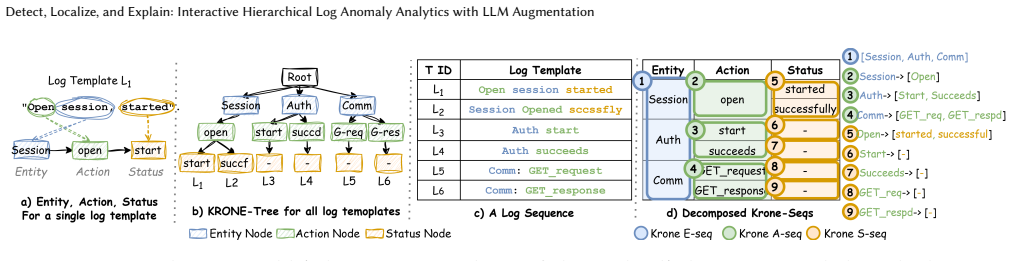
Krone introduces a novel hierarchical log abstraction that transforms flat log sequences into semantically coherent units across entity, action, and status levels. Building on this abstraction, Krone introduces a hierarchical orchestration framework that decomposes flat log sequences into hierarchical execution units and performs modular detection over them. It executes and optimizes the modular detection tasks across levels, enabling precise anomaly detection, localization, and explanation with selective invocation of LLM-based reasoning.
What carries the argument
The three-level hierarchical log abstraction (entity, action, status) paired with the orchestration framework that decomposes sequences and runs modular detection across levels.
If this is right
- Anomaly localization becomes more precise because abnormal segments can be identified at the level where they first appear rather than across an entire sequence.
- LLM usage stays selective, invoking reasoning only for ambiguous or high-stakes cases and thereby controlling cost and latency.
- Human operators can inspect the decomposition, review LLM explanations, and revise generated knowledge through the visualization interface.
- Detection tasks can be optimized and executed independently at each level, improving scalability on large log volumes.
- The approach yields actionable insights on the HDFS benchmark by surfacing both the location and the LLM-supported rationale for each flagged anomaly.
Where Pith is reading between the lines
- The same hierarchical decomposition could be tested on other unstructured event streams such as traces or metrics to see whether modularity transfers beyond logs.
- Adding automated checks for consistency between levels might reduce reliance on human guardrails while preserving the selective-LLM benefit.
- If the entity-action-status split proves stable across domains, it could serve as a reusable intermediate representation for combining log analysis with root-cause tools.
- The interactive revision loop in Krone-viz suggests a broader pattern for human-AI collaboration in monitoring systems where explanations must remain auditable.
Load-bearing premise
The three-level decomposition into entity, action, and status units produces coherent pieces that support accurate modular detection without losing critical information or dependencies from the original flat log sequences.
What would settle it
Running Krone on a log dataset containing anomalies whose detection requires cross-level dependencies that the three-level split would break, then checking whether the modular detector misses those anomalies while a flat-sequence baseline catches them.
Figures


read the original abstract
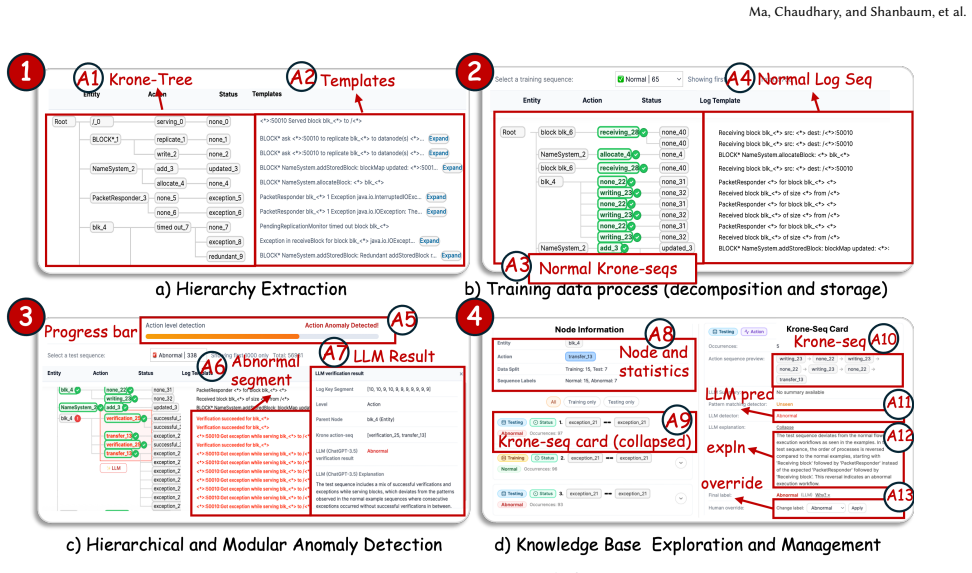
Logs are ubiquitous in modern systems. Unfortunately, their unstructured nature in flat sequences limits understanding of execution behaviors, hindering effective anomaly diagnosis. To address this, Krone introduces a novel hierarchical log abstraction that transforms flat log sequences into semantically coherent units across entity, action, and status levels. Building on this abstraction, Krone introduces a hierarchical orchestration framework that decomposes flat log sequences into hierarchical execution units and performs modular detection over them. It executes and optimizes the modular detection tasks across levels, enabling precise anomaly detection, localization, and explanation with selective invocation of LLM-based reasoning. In this work, we present Krone-viz, an interactive visualization system based on Krone, which makes hierarchical log analysis interpretable and actionable for software engineers and system operators. Demonstrated on the widely used HDFS benchmark dataset, Krone-viz supports: 1) examining hierarchical decompositions of flat log sequences, 2) inspecting detection results and abnormal segments identified by Krone with LLM-generated explanations, and 3) reusing, reviewing, and revising knowledge generated by LLMs with human-in-the-loop guardrails. The code of Krone-viz is available at https://github.com/LeiMa0324/KRONE_Demo_official, and we deploy a live demo at https://leima0324.github.io/KRONE_Demo_official.
Editorial analysis
A structured set of objections, weighed in public.
Referee Report
Summary. The paper claims to introduce Krone, a novel hierarchical log abstraction that converts flat log sequences into semantically coherent units at entity, action, and status levels. It proposes a hierarchical orchestration framework that decomposes logs into these units for modular anomaly detection, localization, and explanation, selectively using LLM-based reasoning. The work also presents Krone-viz, an interactive visualization system that allows users to examine decompositions, inspect results with LLM explanations, and revise LLM-generated knowledge via human-in-the-loop guardrails. The system is demonstrated on the HDFS dataset with code and demo available.
Significance. If the proposed hierarchy maintains critical dependencies and the modular approach proves effective, this could represent a significant advancement in log anomaly analytics by providing more structured and explainable detection in complex systems. The interactive visualization with LLM augmentation and guardrails offers practical value for software engineers and operators. The open availability of the code and live demo facilitates reproducibility and further research in the field.
major comments (2)
- [Hierarchical Orchestration Framework] The central claim relies on the entity-action-status hierarchy producing coherent units for modular detection. However, the framework description does not detail how cross-entity or cross-action dependencies are reconciled across levels, which could lead to missed anomalies in cases like resource contention or cascading failures.
- [Evaluation on HDFS] No quantitative metrics, comparisons to baselines, or ablation results are reported for the detection performance, undermining the ability to verify the claimed precision and effectiveness of the approach.
minor comments (2)
- [Abstract] Consider adding a sentence on the empirical outcomes from the HDFS demonstration to provide readers with immediate evidence of the system's utility.
- Ensure all figures in Krone-viz are clearly labeled and that the human-in-the-loop process is illustrated with an example workflow.
Simulated Author's Rebuttal
We thank the referee for their constructive feedback on our manuscript. We address each major comment point by point below, indicating where revisions will be made to strengthen the presentation of the hierarchical orchestration framework and the evaluation.
read point-by-point responses
-
Referee: [Hierarchical Orchestration Framework] The central claim relies on the entity-action-status hierarchy producing coherent units for modular detection. However, the framework description does not detail how cross-entity or cross-action dependencies are reconciled across levels, which could lead to missed anomalies in cases like resource contention or cascading failures.
Authors: We agree that additional detail on cross-level dependency handling would improve clarity. The orchestration framework processes units level-by-level while propagating contextual information from parent entities and actions to child status units, allowing modular detectors to consider interdependencies. In the revised manuscript we will add an explicit subsection describing the reconciliation mechanisms, with concrete examples of resource contention and cascading failures, and how selective LLM reasoning is invoked to resolve ambiguities across levels. revision: yes
-
Referee: [Evaluation on HDFS] No quantitative metrics, comparisons to baselines, or ablation results are reported for the detection performance, undermining the ability to verify the claimed precision and effectiveness of the approach.
Authors: We acknowledge that the current manuscript centers on the design of the Krone abstraction, orchestration framework, and Krone-viz system, presenting a demonstration on HDFS rather than a full quantitative benchmark. To address the concern, we will add a dedicated evaluation section that reports precision, recall, and F1 metrics on HDFS, includes comparisons to established log anomaly detection baselines, and presents ablation studies on the hierarchical components. These additions will be supported by the publicly available code. revision: yes
Circularity Check
No circularity: system presentation grounded in external code and demo
full rationale
The paper describes a hierarchical log abstraction and orchestration framework for anomaly detection, localization, and explanation, with LLM augmentation and an interactive visualization tool. No equations, fitted parameters, derivations, or load-bearing self-citations appear in the provided text. The central claims rest on the released code, live demo, and HDFS demonstration rather than any self-referential reduction of outputs to inputs. This is a standard system paper whose novelty is in the design and implementation, not in a closed mathematical chain.
Axiom & Free-Parameter Ledger
axioms (1)
- domain assumption Flat log sequences can be reliably decomposed into semantically coherent hierarchical units at entity, action, and status levels without loss of diagnostic information.
Lean theorems connected to this paper
-
IndisputableMonolith/Foundation/AlexanderDuality.leanalexander_duality_circle_linking unclearKrone defines a three-level semantic hierarchy: Entities correspond to system components, Actions capture operations, and Statuses reflect the outcome of each action... decomposes log sequences into atomic and reusable execution segments
Reference graph
Works this paper leans on
-
[1]
KRONE: Hierarchical and Modular Log Anomaly Detection , author=. 2026 , howpublished=
work page 2026
-
[2]
Sui, Yicheng and Wang, Xiaotian and Cui, Tianyu and Xiao, Tong and He, Chenghao and Zhang, Shenglin and Zhang, Yuzhi and Yang, Xiao and Sun, Yongqian and Pei, Dan , booktitle=. Bridging the Gap: LLM-Powered Transfer Learning for Log Anomaly Detection in New Software Systems , year=
-
[3]
Egersdoerfer, Chris and Zhang, Di and Dai, Dong , title =. 2023 , isbn =. doi:10.1145/3588195.3595943 , booktitle =
-
[4]
LLM-based event log analysis techniques: A survey , author=. 2025 , eprint=
work page 2025
-
[5]
Lingzhe Zhang and Tong Jia and Mengxi Jia and Yifan Wu and Hongyi Liu and Ying Li , booktitle=. 2025 , url=
work page 2025
-
[6]
Large Language Models for Forecasting and Anomaly Detection: A Systematic Literature Review , author=. 2024 , eprint=
work page 2024
-
[7]
LLMParser: An Exploratory Study on Using Large Language Models for Log Parsing , url=
Ma, Zeyang and Chen, An Ran and Kim, Dong Jae and Chen, Tse-Hsun and Wang, Shaowei , year=. LLMParser: An Exploratory Study on Using Large Language Models for Log Parsing , url=. doi:10.1145/3597503.3639150 , booktitle=
-
[8]
LibreLog: Accurate and Efficient Unsupervised Log Parsing Using Open-Source Large Language Models , author=. 2024 , eprint=
work page 2024
-
[9]
HELP: Hierarchical Embeddings-based Log Parsing , author=. 2024 , eprint=
work page 2024
-
[10]
AIOps for log anomaly detection in the era of LLMs: A systematic literature review , journal =
Miguel. AIOps for log anomaly detection in the era of LLMs: A systematic literature review , journal =. 2025 , issn =. doi:https://doi.org/10.1016/j.iswa.2025.200608 , url =
-
[11]
RAGLog: Log Anomaly Detection using Retrieval Augmented Generation , author=. 2023 , eprint=
work page 2023
-
[12]
Self-Attentive Classification-Based Anomaly Detection in Unstructured Logs , year=
Nedelkoski, Sasho and Bogatinovski, Jasmin and Acker, Alexander and Cardoso, Jorge and Kao, Odej , booktitle=. Self-Attentive Classification-Based Anomaly Detection in Unstructured Logs , year=
-
[13]
Proceedings of the 2017 ACM SIGSAC Conference on Computer and Communications Security , pages =
Du, Min and Li, Feifei and Zheng, Guineng and Srikumar, Vivek , title =. Proceedings of the 2017 ACM SIGSAC Conference on Computer and Communications Security , pages =. 2017 , isbn =. doi:10.1145/3133956.3134015 , abstract =
-
[14]
Proceedings of the 27th ACM SIGKDD conference on knowledge discovery & data mining , pages=
Multi-scale one-class recurrent neural networks for discrete event sequence anomaly detection , author=. Proceedings of the 27th ACM SIGKDD conference on knowledge discovery & data mining , pages=
-
[15]
Proceedings of the ACM on Management of Data , volume=
Robust and Transferable Log-based Anomaly Detection , author=. Proceedings of the ACM on Management of Data , volume=. 2023 , publisher=
work page 2023
-
[16]
2021 international joint conference on neural networks (IJCNN) , pages=
Logbert: Log anomaly detection via bert , author=. 2021 international joint conference on neural networks (IJCNN) , pages=. 2021 , organization=
work page 2021
- [17]
-
[18]
Black Box Fairness Testing of Machine Learning Models , booktitle =
Zhang, Xu and Xu, Yong and Lin, Qingwei and Qiao, Bo and Zhang, Hongyu and Dang, Yingnong and Xie, Chunyu and Yang, Xinsheng and Cheng, Qian and Li, Ze and Chen, Junjie and He, Xiaoting and Yao, Randolph and Lou, Jian-Guang and Chintalapati, Murali and Shen, Furao and Zhang, Dongmei , title =. 2019 , isbn =. doi:10.1145/3338906.3338931 , booktitle =
-
[19]
Proceedings of the 38th International Conference on Software Engineering Companion , pages=
Log clustering based problem identification for online service systems , author=. Proceedings of the 38th International Conference on Software Engineering Companion , pages=
-
[20]
Zhang, Shengming and Liu, Yanchi and Zhang, Xuchao and Cheng, Wei and Chen, Haifeng and Xiong, Hui , title =. 2022 , isbn =. doi:10.1145/3534678.3539155 , booktitle =
-
[21]
Ma, Lei and Cao, Lei and VanNostrand, Peter M. and Hofmann, Dennis M. and Su, Yao and Rundensteiner, Elke A. , title =. 2024 , issue_date =. doi:10.1145/3677139 , journal =
-
[22]
Proceedings of the 28th ACM SIGKDD Conference on Knowledge Discovery and Data Mining , pages=
Augmenting log-based anomaly detection models to reduce false anomalies with human feedback , author=. Proceedings of the 28th ACM SIGKDD Conference on Knowledge Discovery and Data Mining , pages=
- [23]
-
[24]
Interpretable Online Log Analysis Using Large Language Models with Prompt Strategies , author=. 2024 , eprint=
work page 2024
-
[25]
A comprehensive study of machine learning techniques for log-based anomaly detection , volume=
Ali, Shan and Boufaied, Chaima and Bianculli, Domenico and Branco, Paula and Briand, Lionel , year=. A comprehensive study of machine learning techniques for log-based anomaly detection , volume=. Empirical Software Engineering , publisher=. doi:10.1007/s10664-025-10669-3 , number=
-
[26]
Communications of the ACM , volume=
Advances and challenges in log analysis , author=. Communications of the ACM , volume=. 2012 , publisher=
work page 2012
-
[27]
Jia, Tong and Wu, Yifan and Hou, Chuanjia and Li, Ying , booktitle=. LogFlash: Real-time Streaming Anomaly Detection and Diagnosis from System Logs for Large-scale Software Systems , year=
-
[28]
LogSed: Anomaly Diagnosis through Mining Time-Weighted Control Flow Graph in Logs , year=
Jia, Tong and Yang, Lin and Chen, Pengfei and Li, Ying and Meng, Fanjing and Xu, Jingmin , booktitle=. LogSed: Anomaly Diagnosis through Mining Time-Weighted Control Flow Graph in Logs , year=
-
[29]
IEEE transactions on knowledge and data engineering , volume=
Anomaly detection for discrete sequences: A survey , author=. IEEE transactions on knowledge and data engineering , volume=. 2010 , publisher=
work page 2010
-
[30]
Machine Learning with Applications , volume=
Deep learning for anomaly detection in log data: A survey , author=. Machine Learning with Applications , volume=. 2023 , publisher=
work page 2023
-
[31]
A Survey on Log Anomaly Detection using Deep Learning , year=
Yadav, Rakesh Bahadur and Kumar, P Santosh and Dhavale, Sunita Vikrant , booktitle=. A Survey on Log Anomaly Detection using Deep Learning , year=
-
[32]
Proceedings of the 44th International Conference on Software Engineering , pages=
Log-based anomaly detection with deep learning: How far are we? , author=. Proceedings of the 44th International Conference on Software Engineering , pages=
-
[33]
2021 36th IEEE/ACM International Conference on Automated Software Engineering (ASE) , pages=
Log-based anomaly detection without log parsing , author=. 2021 36th IEEE/ACM International Conference on Automated Software Engineering (ASE) , pages=. 2021 , organization=
work page 2021
-
[34]
2016 IEEE 27th international symposium on software reliability engineering (ISSRE) , pages=
Experience report: System log analysis for anomaly detection , author=. 2016 IEEE 27th international symposium on software reliability engineering (ISSRE) , pages=. 2016 , organization=
work page 2016
-
[35]
Tools and Benchmarks for Automated Log Parsing , author=. 2019 , eprint=
work page 2019
-
[36]
2017 IEEE international conference on web services (ICWS) , pages=
Drain: An online log parsing approach with fixed depth tree , author=. 2017 IEEE international conference on web services (ICWS) , pages=. 2017 , organization=
work page 2017
-
[37]
2016 IEEE 16th International Conference on Data Mining (ICDM) , pages=
Spell: Streaming parsing of system event logs , author=. 2016 IEEE 16th International Conference on Data Mining (ICDM) , pages=. 2016 , organization=
work page 2016
-
[38]
Proceedings of the ACM SIGOPS 22nd symposium on Operating systems principles , pages=
Detecting large-scale system problems by mining console logs , author=. Proceedings of the ACM SIGOPS 22nd symposium on Operating systems principles , pages=
-
[39]
37th annual IEEE/IFIP international conference on dependable systems and networks (DSN'07) , pages=
What supercomputers say: A study of five system logs , author=. 37th annual IEEE/IFIP international conference on dependable systems and networks (DSN'07) , pages=. 2007 , organization=
work page 2007
-
[40]
Proceedings of the IEEE , volume=
A unifying review of deep and shallow anomaly detection , author=. Proceedings of the IEEE , volume=. 2021 , publisher=
work page 2021
-
[41]
ACM computing surveys (CSUR) , volume=
Anomaly detection: A survey , author=. ACM computing surveys (CSUR) , volume=. 2009 , publisher=
work page 2009
-
[42]
Weller-Fahy, David J. and Borghetti, Brett J. and Sodemann, Angela A. , journal=. A Survey of Distance and Similarity Measures Used Within Network Intrusion Anomaly Detection , year=
-
[43]
Li, Sainan and Yin, Qilei and Li, Guoliang and Li, Qi and Liu, Zhuotao and Zhu, Jinwei , title =. 2022 , isbn =. doi:10.1145/3514221.3517861 , booktitle =
-
[44]
Advances in Neural Information Processing Systems , volume=
Adbench: Anomaly detection benchmark , author=. Advances in Neural Information Processing Systems , volume=
-
[45]
Jian Pei and Jiawei Han and Mortazavi-Asl, B. and Pinto, H. and Qiming Chen and Dayal, U. and Mei-Chun Hsu , booktitle=. PrefixSpan,: mining sequential patterns efficiently by prefix-projected pattern growth , year=
-
[46]
Han, Jiawei and Cheng, Hong and Xin, Dong and Yan, Xifeng , title =. 2007 , issue_date =. doi:10.1007/s10618-006-0059-1 , journal =
-
[47]
SPADE: An efficient algorithm for mining frequent sequences , author=. Machine learning , volume=. 2001 , publisher=
work page 2001
-
[48]
The source code of Loglizer , howpublished =
-
[49]
The source code of Deep-Loglizer , howpublished =
-
[50]
The source code of OC4Seq , howpublished =
-
[51]
The source code of LogBERT , howpublished =
-
[52]
The source code of LogPrompt , howpublished =
-
[53]
Log-based Anomaly Detection Without Log Parsing , year=
Le, Van-Hoang and Zhang, Hongyu , booktitle=. Log-based Anomaly Detection Without Log Parsing , year=
-
[54]
Hansen, Stephen E. and Atkins, E. Todd , title =. Proceedings of the 7th USENIX Conference on System Administration , pages =. 1993 , publisher =
work page 1993
- [55]
-
[56]
He, Pinjia and Zhu, Jieming and He, Shilin and Li, Jian and Lyu, Michael R. , booktitle=. An Evaluation Study on Log Parsing and Its Use in Log Mining , year=
-
[57]
Fu, Ying and Yan, Meng and Xu, Zhou and Xia, Xin and Zhang, Xiaohong and Yang, Dan , title =. 2022 , issue_date =. doi:10.1007/s10664-022-10214-6 , journal =
discussion (0)
Sign in with ORCID, Apple, or X to comment. Anyone can read and Pith papers without signing in.