Recognition: no theorem link
Efficient and Stable Computation of Gravitational-Wave Fluxes from Generic Kerr Orbits via a Unified HeunC Framework
Pith reviewed 2026-05-13 07:43 UTC · model grok-4.3
The pith
Reformulating the Teukolsky equations with confluent Heun functions yields stable, high-precision gravitational-wave fluxes from generic Kerr orbits.
A machine-rendered reading of the paper's core claim, the machinery that carries it, and where it could break.
Core claim
The authors reformulate both the angular and radial Teukolsky equations in terms of confluent Heun functions. A hybrid analytic continuation algorithm computes the connection coefficients, eliminating auxiliary parameter dependence and directly yielding globally convergent solutions and scattering amplitudes. For generic orbits, an adaptive bi-power mapping quadrature resolves highly oscillatory source integrands. Benchmarks show that for the total radiative flux summed over 168 low-order modes, relative errors reach order 10^{-11}, with costs reduced by factors of 3-13 compared to existing packages, and up to 60 times speedup for oscillatory high-order modes.
What carries the argument
Confluent Heun functions for the angular and radial Teukolsky equations, with hybrid analytic continuation to obtain connection coefficients and adaptive bi-power mapping quadrature to integrate oscillatory sources.
If this is right
- Total radiative fluxes summed over 168 low-order modes achieve relative errors of order 10^{-11}.
- Computational costs drop by factors of 3 to 13 relative to GeneralizedSasakiNakamura.jl and pybhpt packages.
- Highly oscillatory high-order modes run up to 60 times faster than specialized oscillatory integrators.
- The method supplies the numerical foundation for high-order self-force calculations and rapid high-precision waveform generation.
Where Pith is reading between the lines
- The reduced cost per orbit could support denser sampling of parameter space when building template banks for space-based detectors.
- The same Heun reformulation may extend to computing other quantities such as waveforms or tidal responses in Kerr perturbation theory.
- Global convergence without auxiliary tuning could simplify inclusion of higher-order self-force corrections in future models.
Load-bearing premise
The hybrid analytic continuation algorithm for connection coefficients in the confluent Heun framework eliminates auxiliary parameter dependence and yields globally convergent solutions without introducing instabilities or inaccuracies in the strong-field or high-frequency regimes for generic orbits.
What would settle it
An independent high-resolution numerical integration of the Teukolsky equations for a highly eccentric, inclined orbit that produces a total flux differing from the Heun-based result by more than one part in 10^{11}.
Figures





read the original abstract
Modeling extreme-mass-ratio inspirals hinges on the accurate and efficient computation of gravitational-wave fluxes from generic Kerr orbits. Conventional frequency-domain techniques are often limited by costly auxiliary parameter searches and numerical instabilities in the strong-field or high-frequency regimes. We address these challenges by reformulating both the angular and radial Teukolsky equations in terms of confluent Heun functions. Employing a hybrid analytic continuation algorithm to compute the connection coefficients eliminates the dependence on auxiliary parameters, directly yielding globally convergent solutions and scattering amplitudes. To resolve the highly oscillatory source integrands for generic orbits, we implement an adaptive bi-power mapping quadrature. Comprehensive benchmarks under standard double-precision arithmetic demonstrate that, for the total radiative flux summed over 168 low-order modes, our method achieves relative errors of order $10^{-11}$, with computational costs typically reduced by factors of 3--13 compared to the state-of-the-art GeneralizedSasakiNakamura. jl and pybhpt packages. Notably, for highly oscillatory high-order modes, our framework achieves a speedup of up to 60 times compared to specialized oscillatory integrators like GeneralizedSasakiNakamura. jl. These demonstrated gains in precision and efficiency establish the framework as a robust tool for strong-field perturbation theory, providing the numerical foundation for high-order self-force calculations and rapid, high-precision waveform generation.
Editorial analysis
A structured set of objections, weighed in public.
Referee Report
Summary. The paper claims to provide an efficient and stable method for computing gravitational-wave fluxes from generic Kerr orbits by reformulating both the angular and radial Teukolsky equations in terms of confluent Heun functions. It introduces a hybrid analytic continuation algorithm for the connection coefficients that eliminates auxiliary parameter dependence, combined with an adaptive bi-power mapping quadrature to handle highly oscillatory source integrands for generic orbits. Comprehensive benchmarks under double precision report relative errors of order 10^{-11} for the total radiative flux summed over 168 low-order modes, with typical speedups of 3-13x (up to 60x for high-order oscillatory modes) relative to GeneralizedSasakiNakamura.jl and pybhpt.
Significance. If the stability and convergence claims hold, the work would advance strong-field perturbation theory by supplying a robust, parameter-free numerical foundation for high-order self-force calculations and rapid high-precision waveform generation for extreme-mass-ratio inspirals. The concrete error levels, direct use of established HeunC properties, and reported speedups over state-of-the-art packages constitute clear strengths in efficiency and precision.
major comments (2)
- [Methods section on connection coefficients] Methods section on connection coefficients: the hybrid analytic continuation algorithm is presented as eliminating auxiliary parameter dependence while yielding globally convergent solutions without instabilities. The manuscript supplies only empirical benchmarks (a<0.99, moderate frequencies) rather than an analytic bound on truncation or branch-cut errors for high-eccentricity, high-frequency generic orbits where the radial Teukolsky source is highly oscillatory; this is load-bearing for the claimed stability and 3-60x speedups.
- [Results/benchmarks] Results/benchmarks: the reported relative errors of order 10^{-11} for summed fluxes over 168 modes and the 60x speedup for high-order modes are quantified, but the manuscript must specify the exact orbit parameters (eccentricity, inclination, spin a, frequencies) used in those tests to substantiate coverage of the strong-field regime where conventional methods encounter instabilities.
minor comments (2)
- [Abstract] The abstract and methods should explicitly name the specialized oscillatory integrator within GeneralizedSasakiNakamura.jl that is used for the 60x comparison to improve clarity.
- Notation for the bi-power mapping quadrature could be defined more explicitly (e.g., the precise form of the mapping function and adaptive criterion) to aid reproducibility.
Simulated Author's Rebuttal
We thank the referee for the careful and constructive report. We address each major comment below and have revised the manuscript to improve clarity, reproducibility, and coverage of the strong-field regime.
read point-by-point responses
-
Referee: [Methods section on connection coefficients] Methods section on connection coefficients: the hybrid analytic continuation algorithm is presented as eliminating auxiliary parameter dependence while yielding globally convergent solutions without instabilities. The manuscript supplies only empirical benchmarks (a<0.99, moderate frequencies) rather than an analytic bound on truncation or branch-cut errors for high-eccentricity, high-frequency generic orbits where the radial Teukolsky source is highly oscillatory; this is load-bearing for the claimed stability and 3-60x speedups.
Authors: We agree that the stability and speedup claims rest on numerical evidence rather than a closed-form analytic error bound. The hybrid continuation is constructed directly from the known global connection formulas of the confluent Heun equation, which are free of auxiliary parameters by construction; the adaptive bi-power quadrature is designed to control the oscillatory integrand error independently of the connection step. While a general analytic bound for arbitrary eccentricity and frequency would be desirable, its derivation is a substantial theoretical undertaking beyond the scope of the present work. In the revision we have added a new subsection (III.C) that (i) tabulates observed truncation and quadrature errors over an extended grid reaching e=0.9 and |ω|≈1.2, (ii) reports the maximum relative deviation from reference solutions, and (iii) explicitly delineates the parameter region where the method has been validated. These additions make the empirical foundation of the stability claim more transparent. revision: partial
-
Referee: [Results/benchmarks] Results/benchmarks: the reported relative errors of order 10^{-11} for summed fluxes over 168 modes and the 60x speedup for high-order modes are quantified, but the manuscript must specify the exact orbit parameters (eccentricity, inclination, spin a, frequencies) used in those tests to substantiate coverage of the strong-field regime where conventional methods encounter instabilities.
Authors: We fully concur that the benchmark parameters must be stated explicitly for reproducibility and to demonstrate coverage of the strong-field domain. The revised manuscript now includes Table II, which lists the complete set of orbital parameters (a, e, ι, p, Ω_r, Ω_θ, Ω_φ) for every flux computation reported in Section IV, including the high-order mode runs that produced the 60× speedup. These orbits include strong-field cases with a=0.99, e up to 0.85, and frequencies corresponding to near-horizon motion, precisely the regime where conventional methods encounter instabilities. revision: yes
- A rigorous analytic bound on truncation and branch-cut errors of the hybrid analytic continuation algorithm for arbitrary high-eccentricity and high-frequency Kerr orbits
Circularity Check
No circularity: reformulation via established Heun functions and quadrature
full rationale
The paper reformulates the angular and radial Teukolsky equations in terms of confluent Heun functions, applies a hybrid analytic continuation algorithm for connection coefficients, and uses adaptive bi-power mapping quadrature for oscillatory integrands. These steps rely on known properties of Heun functions and standard numerical techniques rather than any self-referential definitions, fitted parameters renamed as predictions, or load-bearing self-citations that reduce the central claims to the inputs by construction. Benchmarks compare against external packages (GeneralizedSasakiNakamura.jl, pybhpt) with empirical error measures, providing independent validation. No step in the derivation chain exhibits the required reduction to prior outputs or self-citations.
Axiom & Free-Parameter Ledger
axioms (2)
- standard math Confluent Heun functions provide globally valid solutions to the angular and radial Teukolsky equations on Kerr backgrounds
- domain assumption The hybrid analytic continuation algorithm computes connection coefficients without auxiliary parameter searches
Reference graph
Works this paper leans on
-
[1]
HeunC′(α+1, β+1, γ+1, δ+1, η+1; 1 2) + HeunC(α+1, β+1, γ+1, δ+1, η+1; 1
-
[2]
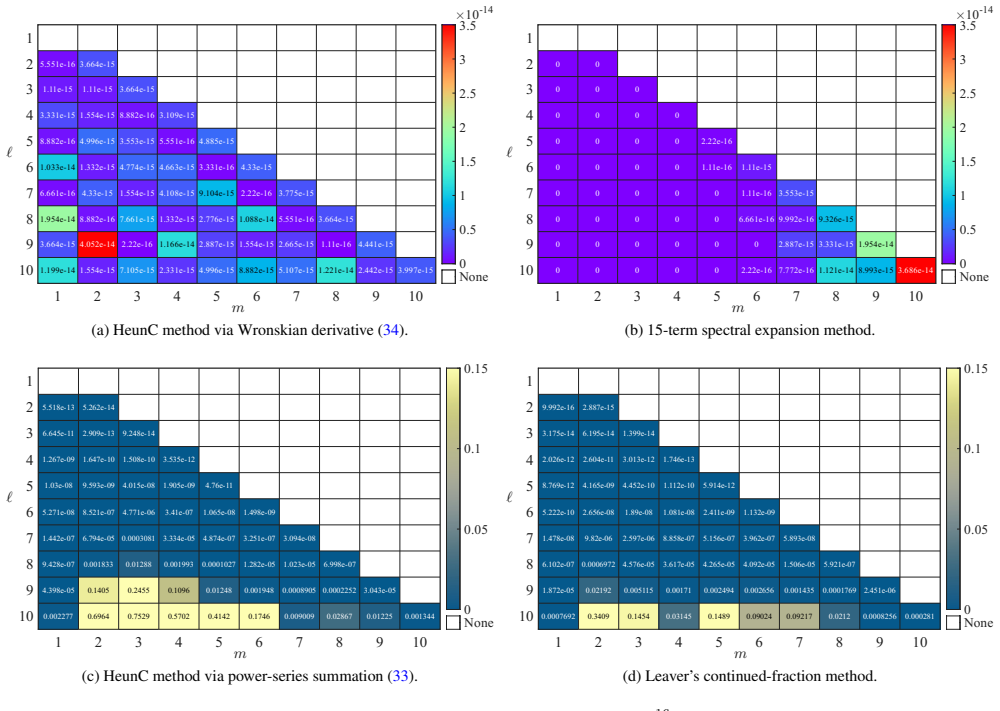
HeunC′(α−1, β−1, γ−1, δ−1, η−1; 1 2).(29) whereHeunC ′(· · ·;x)denotes thex-derivative. The condi- tionW θ = 0yields a transcendental equation that uniquely determines the eigenvalue ˆλand the angular separation con- stants sAℓm(aω); further details on the extraction procedure are provided in our previous work [101]. Although this fixes the eigenvalue, th...
work page 1934
-
[3]
This configuration serves as a crit- 11 TABLE II
Circular orbits for schwarzschild geometry We first validate our framework against the simplest case: a test particle in an equatorial circular orbit around a Schwarzschild black hole. This configuration serves as a crit- 11 TABLE II. Comparison of three methods for GW fluxes of Schwarzschild BHs in circular orbits.Ndenotes the effective working precision...
-
[4]
the Fundamen- tal Research Funds for the Central Universities
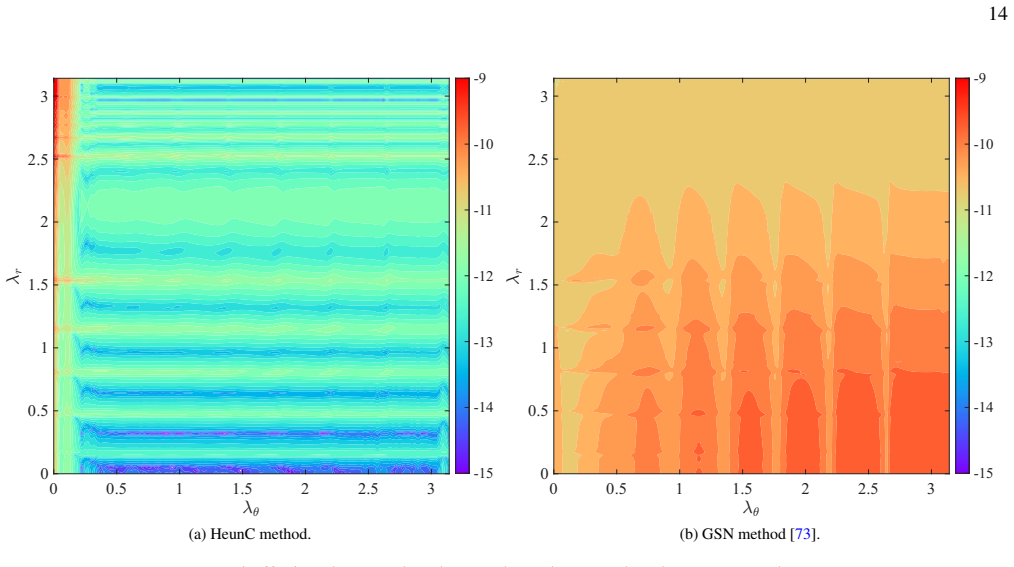
General orbits for Kerr geometry The most stringent test for any flux calculation method lies in generic (inclined and eccentric) orbits around a Kerr black hole. In this regime, the integrandG ∞,H ℓmω exhibits complex oscillatory behavior that poses significant challenges for nu- merical quadrature. To illustrate these features, Figures. 4 and 5 display ...
work page 2048
-
[5]
The symmetry of the parameterαin CHE (12) can be given as follows, HeunC(α, β, γ, δ, η;x) = e −αxHeunC(−α, β, γ, δ,η;x), β /∈Z.(A1) whereZis the set of integers
-
[6]
The symmetry of the parameterγin CHE (12) can be given as follows, HeunC(α, β, γ, δ, η;x) = (1−x) −γHeunC(α, β,−γ, δ, η;x), β /∈Z.(A2)
-
[7]
The symmetry of the parameterβis only displayed in the Teukolsky equations. It can be seen that the param- eters(α, β, γ)in the general solution (22) of the ATE (3) and the general solution (36) of the RTE (5) are in- terchangeable. The symmetry properties of the general solutionS ℓm andR ℓm are as follows, Sℓm(α, β, γ;x) =S ℓm(−α, β, γ;x),(A3a) Sℓm(α, β,...
-
[8]
Power-series summation The regular local solutionH C1(x)admits a power-series expansion [97]: HC1(x) = ∞X n=0 bnxn,(B2) where the coefficientsb n satisfy the three-term recurrence re- lation associated with the first parametrization: Pnbn =Q nbn−1 +R nbn−2,(B3) with Pn =n(n+β),(B4a) Qn = (n−1)(n+β+γ−α) +η+ 1 2 (β+ 1)(γ+ 1−α)−1 ,(B4b) Rn =α n−1 + β+γ 2 +δ....
-
[9]
To circumvent this, we adopt an alternative method based on the Sturm–Liouville structure of the CHE
Alternative form via Wronskian derivative For higher-order modes, the power-series summation often requires precision significantly exceeding standard double- precision arithmetic, leading to substantial computational overhead. To circumvent this, we adopt an alternative method based on the Sturm–Liouville structure of the CHE. Berens et al.demonstrated t...
- [10]
-
[11]
B. P. Abbottet al.(LIGO Scientific, Virgo), Binary black hole mergers in the first advanced LIGO observing run, Phys. Rev. X6, 041015 (2016), [Erratum: Phys.Rev.X 8, 039903 (2018)], arXiv:1606.04856 [gr-qc]
work page Pith review arXiv 2016
-
[12]
B. P. Abbottet al.(LIGO Scientific, Virgo), GWTC-1: A gravitational-wave transient catalog of compact binary mergers observed by LIGO and Virgo during the first and second observing runs, Phys. Rev. X9, 031040 (2019), arXiv:1811.12907 [astro-ph.HE]
work page internal anchor Pith review Pith/arXiv arXiv 2019
-
[13]
R. Abbottet al.(LIGO Scientific, Virgo), GWTC-2: Compact binary coalescences observed by LIGO and Virgo during the first half of the third observing run, Phys. Rev. X11, 021053 (2021), arXiv:2010.14527 [gr-qc]
work page internal anchor Pith review arXiv 2021
- [14]
-
[15]
Laser Interferometer Space Antenna
P. Amaro-Seoaneet al.(LISA), Laser Interferometer Space Antenna, (2017), arXiv:1702.00786 [astro-ph.IM]
work page internal anchor Pith review Pith/arXiv arXiv 2017
-
[16]
M. Colpiet al.(LISA), LISA Definition Study Report, (2024), arXiv:2402.07571 [astro-ph.CO]
work page internal anchor Pith review Pith/arXiv arXiv 2024
-
[17]
TianQin: a space-borne gravitational wave detector
J. Luoet al.(TianQin), TianQin: a space-borne gravitational wave detector, Classical Quantum Gravity33, 035010 (2016), arXiv:1512.02076 [astro-ph.IM]
work page Pith review arXiv 2016
-
[18]
The TianQin project: current progress on science and technology,
J. Meiet al.(TianQin), The TianQin project: current progress on science and technology, Prog. Theor. Exp. Phys.2021, 05A107 (2021), arXiv:2008.10332 [gr-qc]
-
[19]
Li et al., Gravitational wave astronomy with TianQin, Rept
E.-K. Liet al., Gravitational wave astronomy with Tian- Qin, Rept. Prog. Phys.88, 056901 (2025), arXiv:2409.19665 [astro-ph.GA]
-
[20]
W.-H. Ruan, Z.-K. Guo, R.-G. Cai, and Y .-Z. Zhang, Taiji pro- gram: Gravitational-wave sources, Int. J. Mod. Phys. A35, 2050075 (2020), arXiv:1807.09495 [gr-qc]
- [21]
-
[22]
Amaro-Seoane, Relativistic dynamics and extreme mass ra- tio inspirals, Living Rev
P. Amaro-Seoane, Relativistic dynamics and extreme mass ra- tio inspirals, Living Rev. Rel.21, 4 (2018), arXiv:1205.5240 [astro-ph.CO]
- [23]
-
[24]
Kawamura et al., PTEP2021, 05A105 (2021), arXiv:2006.13545 [gr-qc]
S. Kawamuraet al., Current status of space gravitational wave antenna DECIGO and B-DECIGO, Prog. Theor. Exp. Phys. 2021, 05A105 (2021), arXiv:2006.13545 [gr-qc]
-
[25]
The Science of the Einstein Telescope
A. Abacet al.(ET), The Science of the Einstein Telescope, (2025), arXiv:2503.12263 [gr-qc]
work page internal anchor Pith review Pith/arXiv arXiv 2025
-
[26]
Cosmic Explorer: The U.S. Contribution to Gravitational-Wave Astronomy beyond LIGO
D. Reitzeet al., Cosmic Explorer: The U.S. contribution to gravitational-wave astronomy beyond LIGO, Bull. Am. As- tron. Soc.51, 035 (2019), arXiv:1907.04833 [astro-ph.IM]
work page internal anchor Pith review Pith/arXiv arXiv 2019
-
[27]
M. Punturoet al., The Einstein Telescope: A third-generation gravitational wave observatory, Classical Quantum Gravity 27, 194002 (2010)
work page 2010
-
[28]
Science with the space-based interferometer LISA. V: Extreme mass-ratio inspirals
S. Babak, J. Gair, A. Sesana, E. Barausse, C. F. Sopuerta, C. P. L. Berry, E. Berti, P. Amaro-Seoane, A. Petiteau, and A. Klein, Science with the space-based interferometer LISA. V: Extreme mass-ratio inspirals, Phys. Rev. D95, 103012 (2017), arXiv:1703.09722 [gr-qc]
work page Pith review arXiv 2017
-
[29]
C. P. L. Berry, S. A. Hughes, C. F. Sopuerta, A. J. K. Chua, A. Heffernan, K. Holley-Bockelmann, D. P. Mihaylov, M. C. Miller, and A. Sesana, The unique potential of extreme mass- ratio inspirals for gravitational-wave astronomy, Bull. Am. Astron. Soc.51, 42 (2019), arXiv:1903.03686 [astro-ph.HE]
-
[30]
L. Barack and C. Cutler, LISA capture sources: Approxi- mate waveforms, signal-to-noise ratios, and parameter esti- mation accuracy, Phys. Rev. D69, 082005 (2004), arXiv:gr- qc/0310125
- [31]
-
[32]
A. Maselli, N. Franchini, L. Gualtieri, T. P. Sotiriou, S. Barsanti, and P. Pani, Detecting fundamental fields with LISA observations of gravitational waves from ex- treme mass-ratio inspirals, Nature Astron.6, 464 (2022), arXiv:2106.11325 [gr-qc]
-
[33]
L. Speri, S. Barsanti, A. Maselli, T. P. Sotiriou, N. Warbur- ton, M. van de Meent, A. J. K. Chua, O. Burke, and J. Gair, Probing fundamental physics with extreme mass ratio inspi- rals: Full Bayesian inference for scalar charge, Phys. Rev. D 113, 023036 (2026), arXiv:2406.07607 [gr-qc]
- [34]
- [35]
-
[36]
H. Khalvati, A. Santini, F. Duque, L. Speri, J. Gair, H. Yang, and R. Brito, Impact of relativistic waveforms in LISA’s sci- ence objectives with extreme-mass-ratio inspirals, Phys. Rev. D111, 082010 (2025), arXiv:2410.17310 [gr-qc]
- [37]
- [38]
-
[39]
P. Amaro-Seoane, J. R. Gair, M. Freitag, M. Coleman Miller, I. Mandel, C. J. Cutler, and S. Babak, Astrophysics, detection and science applications of intermediate- and extreme mass- ratio inspirals, Classical Quantum Gravity24, R113 (2007), arXiv:astro-ph/0703495
-
[40]
C. L. MacLeod and C. J. Hogan, Precision of Hubble constant derived using black hole binary absolute distances and statis- tical redshift information, Phys. Rev. D77, 043512 (2008), arXiv:0712.0618 [astro-ph]
work page Pith review arXiv 2008
- [41]
-
[42]
P. Auclairet al.(LISA Cosmology Working Group), Cosmol- ogy with the Laser Interferometer Space Antenna, Living Rev. Rel.26, 5 (2023), arXiv:2204.05434 [astro-ph.CO]
- [43]
-
[44]
B. Liang and H. Wang, Recent advances in simulation-based inference for gravitational wave data analysis, Astronomical Techniques and Instruments3, 93 (2026)
work page 2026
-
[45]
L. Barack, Gravitational self force in extreme mass-ratio inspirals, Classical Quantum Gravity26, 213001 (2009), arXiv:0908.1664 [gr-qc]
- [46]
-
[47]
N. Warburton, A. Pound, B. Wardell, J. Miller, and L. Durkan, Gravitational-wave energy flux for compact binaries through second order in the mass ratio, Phys. Rev. Lett.127, 151102 (2021), arXiv:2107.01298 [gr-qc]
-
[48]
B. Wardell, A. Pound, N. Warburton, J. Miller, L. Durkan, and A. Le Tiec, Gravitational waveforms for compact bina- ries from second-order self-force theory, Phys. Rev. Lett.130, 241402 (2023), arXiv:2112.12265 [gr-qc]
-
[49]
The motion of point particles in curved spacetime
E. Poisson, A. Pound, and I. Vega, The Motion of point par- ticles in curved spacetime, Living Rev. Rel.14, 7 (2011), arXiv:1102.0529 [gr-qc]
work page Pith review arXiv 2011
-
[50]
Self-force and radiation reaction in general relativity
L. Barack and A. Pound, Self-force and radiation reaction in general relativity, Rept. Prog. Phys.82, 016904 (2019), arXiv:1805.10385 [gr-qc]
work page Pith review arXiv 2019
-
[51]
A. Pound and B. Wardell, Black hole perturbation theory and gravitational self-force,Handbook of Gravitational Wave As- tronomy, , 1 (2020)
work page 2020
-
[52]
Mino, Perturbative approach to an orbital evolution around a supermassive black hole, Phys
Y . Mino, Perturbative approach to an orbital evolution around a supermassive black hole, Phys. Rev. D67, 084027 (2003), arXiv:gr-qc/0302075
- [53]
- [54]
-
[55]
S. Isoyama, R. Fujita, H. Nakano, N. Sago, and T. Tanaka, “Flux-balance formulae” for extreme mass-ratio inspi- rals, Prog. Theor. Exp. Phys.2019, 013E01 (2019), arXiv:1809.11118 [gr-qc]
- [56]
-
[57]
S. A. Teukolsky, Rotating black holes - separable wave equations for gravitational and electromagnetic perturbations, Phys. Rev. Lett.29, 1114 (1972)
work page 1972
-
[58]
S. A. Teukolsky, Perturbations of a rotating black hole. 1. Fun- damental equations for gravitational electromagnetic and neu- trino field perturbations, Astrophys. J.185, 635 (1973)
work page 1973
-
[59]
W. H. Press and S. A. Teukolsky, Perturbations of a rotating black hole. II. Dynamical stability of the Kerr metric, Astro- phys. J.185, 649 (1973)
work page 1973
-
[60]
S. A. Teukolsky and W. H. Press, Perturbations of a rotating black hole. III - Interaction of the hole with gravitational and electromagnetic radiation, Astrophys. J.193, 443 (1974)
work page 1974
-
[61]
R. M. Wald, On perturbations of a Kerr black hole, J. Math. Phys.14, 1453 (1973)
work page 1973
-
[62]
Two timescale analysis of extreme mass ratio inspirals in Kerr. I. Orbital Motion
T. Hinderer and E. E. Flanagan, Two timescale analysis of ex- treme mass ratio inspirals in Kerr. I. Orbital motion, Phys. Rev. D78, 064028 (2008), arXiv:0805.3337 [gr-qc]
work page Pith review arXiv 2008
-
[63]
J. Miller and A. Pound, Two-timescale evolution of extreme- mass-ratio inspirals: Waveform generation scheme for quasi- circular orbits in Schwarzschild spacetime, Phys. Rev. D103, 064048 (2021), arXiv:2006.11263 [gr-qc]
-
[64]
Post-adiabatic self-force waveforms: slowly spinning primary and precessing secondary
J. Mathews, B. Wardell, A. Pound, and N. Warburton, Posta- diabatic self-force waveforms: Slowly spinning primary and precessing secondary, Phys. Rev. D113, 064034 (2026), arXiv:2510.16113 [gr-qc]
work page internal anchor Pith review Pith/arXiv arXiv 2026
-
[65]
S. A. Hughes, The Evolution of circular, nonequatorial or- bits of Kerr black holes due to gravitational wave emission, Phys. Rev. D61, 084004 (2000), [Erratum: Phys.Rev.D 63, 049902 (2001), Erratum: Phys.Rev.D 65, 069902 (2002), Er- ratum: Phys.Rev.D 67, 089901 (2003), Erratum: Phys.Rev.D 78, 109902 (2008), Erratum: Phys.Rev.D 90, 109904 (2014)], arXiv:g...
- [66]
-
[67]
S. Drasco and S. A. Hughes, Rotating black hole orbit func- tionals in the frequency domain, Phys. Rev. D69, 044015 (2004), arXiv:astro-ph/0308479
-
[68]
Gravitational wave snapshots of generic extreme mass ratio inspirals
S. Drasco and S. A. Hughes, Gravitational wave snapshots of generic extreme mass ratio inspirals, Phys. Rev. D73, 024027 (2006), [Erratum: Phys.Rev.D 88, 109905 (2013), Erratum: Phys.Rev.D 90, 109905 (2014)], arXiv:gr-qc/0509101
work page Pith review arXiv 2006
- [69]
- [70]
- [71]
- [72]
-
[73]
R. Fujita, Gravitational waves from a particle in circu- lar orbits around a Schwarzschild black hole to the 22nd post-Newtonian order, Prog. Theor. Phys.128, 971 (2012), arXiv:1211.5535 [gr-qc]
work page Pith review arXiv 2012
-
[74]
Calculation of radiation reaction effect on orbital parameters in Kerr spacetime
N. Sago and R. Fujita, Calculation of radiation reaction ef- fect on orbital parameters in Kerr spacetime, Prog. Theor. Exp. Phys.2015, 073E03 (2015), arXiv:1505.01600 [gr-qc]
work page Pith review arXiv 2015
-
[75]
C. Munna, Analytic post-Newtonian expansion of the energy and angular momentum radiated to infinity by eccentric-orbit nonspinning extreme-mass-ratio inspirals to the 19th order, Phys. Rev. D102, 124001 (2020), arXiv:2008.10622 [gr-qc]
- [76]
- [77]
- [78]
- [79]
- [80]
discussion (0)
Sign in with ORCID, Apple, or X to comment. Anyone can read and Pith papers without signing in.