Recognition: 2 theorem links
· Lean TheoremHigh-Spin BBH Subpopulation from AGN Accretion
Pith reviewed 2026-05-12 02:32 UTC · model grok-4.3
The pith
Data from 166 black hole mergers show roughly 10 percent belong to an accretion subpopulation with primary spins near 0.9.
A machine-rendered reading of the paper's core claim, the machinery that carries it, and where it could break.
Core claim
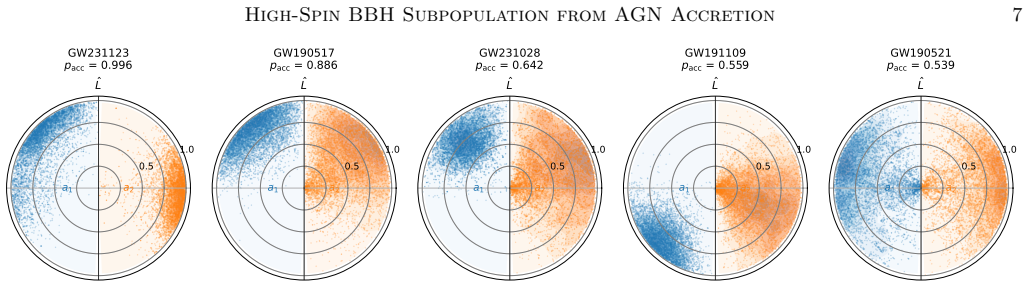
When a three-component mixture model is applied to the primary spin magnitudes of 166 detected binary black hole mergers, with component shapes fixed from theory, the data yield strong evidence (ln B = 5.7) that approximately 10 percent (90 percent credible interval [1 percent, 14 percent]) belong to an accretion subpopulation whose primary spins cluster near 0.9. The same analysis decisively disfavors locating the high-spin subpopulation at 0.7 as predicted for hierarchical mergers. The accretion-favored events also display higher primary masses and more aligned effective spins on average, and include systems both above and below the pair-instability mass gap.
What carries the argument
A Bayesian three-component mixture model for primary spin magnitudes whose shapes are fixed to theoretical predictions for the standard, hierarchical-merger, and accretion channels, with only the mixing fractions allowed to vary.
If this is right
- Accretion spin-up produces mergers both inside and outside the pair-instability mass gap.
- Accretion candidates exhibit systematically higher primary masses (median 58 solar masses) and effective spins (median 0.33).
- Some events previously attributed to hierarchical mergers, such as GW190521, receive comparable support under the accretion model.
- The high-spin subpopulation is not confined to the most massive systems.
Where Pith is reading between the lines
- Future catalogs could test whether the accretion fraction changes with redshift or host-galaxy properties.
- Joint modeling of spins together with mass ratios or misalignment angles might sharpen separation among channels.
- If the accretion fraction holds, it would raise the expected contribution of dense gas environments to the overall black-hole merger rate.
Load-bearing premise
The spin-magnitude distributions predicted by theory for the three channels are treated as fixed and accurate, without significant unmodeled selection effects or measurement biases that would change the inferred mixing fractions.
What would settle it
Detection of many additional mergers whose primary-spin posteriors show no excess near 0.9, or a drop of the Bayes factor for the accretion component below 1 when the same fixed-shape model is refit, would falsify the claimed subpopulation.
Figures


read the original abstract
The formation environments of merging binary black holes remain uncertain. While hierarchical assembly in dense stellar clusters has been widely explored as an explanation for black holes exceeding the stellar-mass limit, growth through gas accretion in active galactic nucleus (AGN) disks is an alternative that has received less observational scrutiny. Here we search for an accretion-origin subpopulation using only spin magnitudes, fitting a three-component mixture model to 166 binary black hole mergers from LIGO--Virgo--KAGRA with component shapes fixed from theoretical predictions and only the mixing fractions inferred from the data. We find strong evidence ($ln B = 5.7$) that $\sim 10\%$ (90% credible interval $[1\%, 14\%]$) of detected mergers belong to a subpopulation with primary spins clustered near $a_1 \approx 0.9$, consistent with the theoretical prediction for accretion spin-up. The hierarchical-merger prediction of $a_1 \approx 0.7$ is decisively disfavored as the location of the high-spin subpopulation ($ln B = 5.7$). Post hoc validation reveals that the accretion candidates have systematically higher masses (median $m_1 = 58\,M_\odot$) and aligned spins (median $\chi_{\rm eff} = 0.33$, vs. $0.04$ for standard-dominated events). The accretion subpopulation is not limited to systems above the pair-instability mass gap: GW190517 ($m_1 \approx 39 M_\odot$) is among the top candidates, demonstrating that accretion spin-up operates across a range of masses. GW190521, previously interpreted as a hierarchical merger, shows comparable support for an accretion origin. These results provide the first population-level observational evidence for an accretion-origin subpopulation in black hole mergers.
Editorial analysis
A structured set of objections, weighed in public.
Referee Report
Summary. The manuscript analyzes 166 binary black hole mergers from LIGO-Virgo-KAGRA, fitting a three-component mixture model to spin magnitudes alone. Component shapes are fixed from external theoretical predictions for the standard, hierarchical-merger, and AGN-accretion channels, with only mixing fractions inferred from the data. It reports ln B = 5.7 evidence for ~10% (90% credible interval [1%, 14%]) of events in a high-spin subpopulation with primary spin a1 ≈ 0.9, consistent with accretion spin-up, while decisively disfavoring the hierarchical prediction of a1 ≈ 0.7. Post-hoc checks indicate accretion candidates have higher primary masses (median m1 = 58 M⊙) and aligned spins (median χeff = 0.33).
Significance. If the central result holds, the work supplies the first population-level observational evidence for an AGN-accretion subpopulation among detected BBH mergers. The quantitative Bayes factor, credible interval on the mixing fraction, and explicit disfavoring of the hierarchical channel provide clear, falsifiable support. The post-hoc validation with mass and χeff distributions adds interpretive weight and demonstrates that the high-spin subpopulation is not confined to the pair-instability gap.
major comments (2)
- [mixture-model setup (prior to results)] The three-component mixture model fixes the spin-magnitude distributions for each channel from external theory and infers only mixing fractions. This assumption is load-bearing for the reported ln B = 5.7 and the 10% fraction, because any mismatch between the assumed narrow peak at a1 ≈ 0.9 (accretion) or 0.7 (hierarchical) and the true distributions—including possible high-spin tails in the standard channel—directly affects the evidence. No marginalization over shape uncertainties or sensitivity tests to shape variations are described.
- [hierarchical inference and likelihood construction] The hierarchical inference does not appear to jointly model selection effects on spin measurement or to propagate individual-event spin uncertainties into the population-level likelihood. Because the central claim rests on the separation of the high-spin component from the data, the lack of these steps limits quantitative assessment of robustness.
minor comments (1)
- [Abstract] The abstract uses “ln B” without specifying that it denotes the natural logarithm of the Bayes factor; a brief clarification would aid readers.
Simulated Author's Rebuttal
We thank the referee for their careful and constructive review of our manuscript. We address each of the major comments in detail below, providing clarifications on our methodology and indicating where revisions will be incorporated to address the concerns raised.
read point-by-point responses
-
Referee: The three-component mixture model fixes the spin-magnitude distributions for each channel from external theory and infers only mixing fractions. This assumption is load-bearing for the reported ln B = 5.7 and the 10% fraction, because any mismatch between the assumed narrow peak at a1 ≈ 0.9 (accretion) or 0.7 (hierarchical) and the true distributions—including possible high-spin tails in the standard channel—directly affects the evidence. No marginalization over shape uncertainties or sensitivity tests to shape variations are described.
Authors: We agree that the fixed component shapes are central to our analysis, as the goal is to test whether the data support subpopulations with spin distributions matching specific theoretical predictions for the AGN accretion and hierarchical merger channels. By fixing the shapes, we directly infer the mixing fractions and compute the Bayes factor for the presence of such components. We acknowledge that the manuscript does not include explicit sensitivity tests to variations in these shapes or marginalization over shape uncertainties. To address this, we will add a new section or appendix in the revised manuscript performing sensitivity tests by perturbing the peak spin values and widths within theoretically motivated ranges (e.g., varying the accretion peak between 0.8-0.95 and hierarchical between 0.6-0.8) and report the resulting range of Bayes factors and mixing fractions. This will quantify the robustness of our conclusions to the assumed shapes. revision: yes
-
Referee: The hierarchical inference does not appear to jointly model selection effects on spin measurement or to propagate individual-event spin uncertainties into the population-level likelihood. Because the central claim rests on the separation of the high-spin component from the data, the lack of these steps limits quantitative assessment of robustness.
Authors: We appreciate this point regarding the construction of the likelihood. Our analysis employs a mixture model where the population-level likelihood is constructed by marginalizing over the individual event spin posterior samples from the GWTC catalog, which does propagate the measurement uncertainties to some extent. However, we did not jointly model selection effects specific to spin measurements in the hierarchical framework, nor did we perform a full reweighting for selection biases. This is a valid concern for the robustness of the subpopulation separation. In the revised manuscript, we will expand the methods section to explicitly describe the likelihood construction and include a discussion of potential selection effects on spin. Additionally, we will perform a post-hoc check by comparing the inferred subpopulation properties with and without approximate selection corrections based on available sensitivity estimates, if such data permit. revision: partial
Circularity Check
No significant circularity; external theory shapes fixed, data-driven fractions only
full rationale
The derivation fixes spin-magnitude component shapes from external theoretical predictions and infers only the mixing fractions (and Bayes factor) from the 166-event catalog. The ln B = 5.7 comparison between the a1 ≈ 0.9 and a1 ≈ 0.7 models is a direct likelihood ratio on the observed spins under those fixed shapes; no equation or step reduces the output fraction or evidence value to a re-expression of the input shapes. No self-citation load-bearing step, ansatz smuggling, or renaming of a known result is exhibited in the provided text. The result remains falsifiable by any mismatch between the assumed theoretical shapes and the true distributions.
Axiom & Free-Parameter Ledger
free parameters (1)
- mixing fractions
axioms (1)
- domain assumption Theoretical predictions accurately give the spin-magnitude distributions for accretion, hierarchical-merger, and standard channels, allowing them to be fixed as component shapes.
Lean theorems connected to this paper
-
IndisputableMonolith/Cost/FunctionalEquation.leanwashburn_uniqueness_aczel unclearthree-component mixture model … component shapes fixed from theoretical predictions and only the mixing fractions inferred
-
IndisputableMonolith/Foundation/AlphaCoordinateFixation.leanalpha_pin_under_high_calibration uncleara1 ∼ TN(0.7,0.1) … a1,a2 ∼ TN(0.9,0.1)
Reference graph
Works this paper leans on
-
[1]
Aasi , J., Abbott , B. P., Abbott , R., et al. 2015, Classical and Quantum Gravity, 32, 074001, 10.1088/0264-9381/32/7/074001
-
[2]
Abbott , B. P. e. 2020, Phys.\ Rev.\ Lett., 125, 101102, 10.1103/PhysRevLett.125.101102
-
[3]
2015, Classical and Quantum Gravity, 32, 024001, doi: 10.1088/0264-9381/32/2/024001
Acernese, F., et al. 2015, Class. Quant. Grav., 32, 024001, 10.1088/0264-9381/32/2/024001
-
[4]
Adamcewicz , C., Guttman , N., Lasky , P. D., & Thrane , E. 2025, , 994, 261, 10.3847/1538-4357/ae1370
-
[5]
Adamcewicz, C., Thrane, E., Smith, R., Callister, T. A., et al. 2022, Mon.\ Not.\ R.\ Astron.\ Soc., 517, 3928–3937, 10.1093/mnras/stac2961
-
[6]
2025, , 112, 023531, 10.1103/7zc2-g9vq
Afroz , S., & Mukherjee , S. 2025, , 112, 023531, 10.1103/7zc2-g9vq
-
[7]
Akutsu, T., et al. 2019, Nature Astron., 3, 35, 10.1038/s41550-018-0658-y
-
[8]
2026, ApJL, 996, L44, doi:10.3847/2041-8213/ae2bff
Bartos , I., & Haiman , Z. 2026, , 996, L44, 10.3847/2041-8213/ae2bff
-
[9]
Rapid and Bright Stellar-mass Binary Black Hole Mergers in Active Galactic Nuclei
Bartos , I., Kocsis , B., Haiman , Z., & M \'a rka , S. 2017, , 835, 165, 10.3847/1538-4357/835/2/165
-
[10]
Belczynski, K., et al. 2020, , 636, A104, 10.1051/0004-6361/201936528
-
[11]
Bogdanovi \'c , T., Reynolds , C. S., & Miller , M. C. 2007, , 661, L147, 10.1086/518769
-
[12]
Callister, T. A., Haster, C.-J., Ng, K. K. Y., Vitale, S., & Farr, W. M. 2021, Astrophys.\ J.\ Lett., 922, L5, 10.3847/2041-8213/ac2ccc
-
[13]
The Astrophysical Journal , author =
Duffell , P. C., D'Orazio , D., Derdzinski , A., et al. 2020, , 901, 25, 10.3847/1538-4357/abab95
-
[14]
Farmer, R. e. 2019, Astrophys.\ J., 887, 53
work page 2019
-
[15]
Fishbach, M., Holz, D. E., & Farr, B. 2017, , 840, L24, 10.3847/2041-8213/aa7045
-
[16]
Ford, K. E. S., & McKernan, B. 2022, , 517, 5827, 10.1093/mnras/stac2861
-
[17]
2019, ApJL, 881, L1, doi: 10.3847/2041-8213/ab339b
Fuller, J., & Ma, L. 2019, , 881, L1, 10.3847/2041-8213/ab339b
-
[18]
Gammie, C. F., Shapiro, S. L., & McKinney, J. C. 2004, , 602, 312, 10.1086/380996
-
[19]
2021, , 920, L42, 10.3847/2041-8213/ac2cc1
Gayathri , V., Yang , Y., Tagawa , H., Haiman , Z., & Bartos , I. 2021, , 920, L42, 10.3847/2041-8213/ac2cc1
-
[20]
2017, Phys.\ Rev.\ D, 95, 124046
Gerosa, D., & Berti, E. 2017, Phys.\ Rev.\ D, 95, 124046
work page 2017
-
[21]
Heger, A., & Woosley, S. E. 2002, Astrophys.\ J., 567, 532
work page 2002
- [22]
-
[23]
2026, ApJ, 996, 71, doi: 10.3847/1538-4357/ae1574 Kishore Roy, S., van Son, L
Hussain , A., Isi , M., & Zimmerman , A. 2026, , 996, 71, 10.3847/1538-4357/ae1574
- [24]
-
[25]
doi:10.1111/j.1365-2966.2005.09360.x , eprint =
King , A. R., Lubow , S. H., Ogilvie , G. I., & Pringle , J. E. 2005, , 363, 49, 10.1111/j.1365-2966.2005.09378.x
-
[26]
Levin , Y. 2007, , 374, 515, 10.1111/j.1365-2966.2006.11155.x
-
[27]
GWTC-4.0: Population Properties of Merging Compact Binaries
LIGO , The Virgo Collaboration , & The KAGRA Collaboration . 2025 a , arXiv e-prints, arXiv:2508.18083, 10.48550/arXiv.2508.18083
work page internal anchor Pith review Pith/arXiv arXiv doi:10.48550/arxiv.2508.18083 2025
-
[28]
LIGO , Virgo Collaboration , & KAGRA Collaboration . 2023, , 13, 041039, 10.1103/PhysRevX.13.041039
-
[29]
---. 2024, , 109, 022001, 10.1103/PhysRevD.109.022001
-
[30]
GW231123: A Binary Black Hole Merger with Total Mass 190–265M ⊙,
---. 2025 b , Astrophys.\ J.\ Lett., 923, L15. 2507.08219
-
[31]
2020b, ApJL, 900, L13, doi: 10.3847/2041-8213/aba493
LIGO Scientific Collaboration , & Virgo Collaboration . 2020, , 900, L13, 10.3847/2041-8213/aba493
-
[32]
O., Nakano, H., Zlochower, Y., & Campanelli, M
Lousto, C. O., Nakano, H., Zlochower, Y., & Campanelli, M. 2010, Phys. Rev. D, 81, 084023, 10.1103/PhysRevD.81.084023
-
[33]
Mandel, I., Farr, W. M., & Gair, J. R. 2019, , 486, 1086, 10.1093/mnras/stz896
-
[34]
McKernan, B., Ford, K. E. S., Callister, T., et al. 2022, Mon.\ Not.\ R.\ Astron.\ Soc., 514, 3886–3893, 10.1093/mnras/stac1570
-
[35]
McKernan, B., Ford, K. E. S., & O'Shaughnessy, R. 2020, , 498, 4088, 10.1093/mnras/staa2681
-
[36]
McKernan , B., Ford , K. E. S., Bellovary , J., et al. 2018, , 866, 66, 10.3847/1538-4357/aadae5
-
[37]
The spin magnitude of stellar-mass black holes evolves with the mass
Pierra, G., et al. 2024, , 10.1051/0004-6361/202452545
-
[38]
Evolution of binary black-hole spacetimes
Pretorius , F. 2005, , 95, 121101, 10.1103/PhysRevLett.95.121101
-
[39]
Ray, A., & Kalogera, V. 2025, arXiv e-prints, arXiv:2510.18867, 10.48550/arXiv.2510.18867
- [40]
-
[41]
Rodriguez, C. L. e. 2019, Phys.\ Rev.\ D, 100, 043027
work page 2019
-
[42]
2024, arXiv e-prints, arXiv:2412.12086, 10.48550/arXiv.2412.12086
Rowan , C., Whitehead , H., & Kocsis , B. 2024, arXiv e-prints, arXiv:2412.12086, 10.48550/arXiv.2412.12086
-
[43]
2020, , 903, L21, 10.3847/2041-8213/abc253
Safarzadeh , M., & Haiman , Z. 2020, , 903, L21, 10.3847/2041-8213/abc253
-
[44]
Siwek , M., Weinberger , R., Mu \ n oz , D. J., & Hernquist , L. 2023, , 518, 5059, 10.1093/mnras/stac3263
-
[45]
Stone , N. C., Metzger , B. D., & Haiman , Z. 2017, , 464, 946, 10.1093/mnras/stw2260
-
[46]
2020, , 899, 26, 10.3847/1538-4357/aba2cc
Tagawa , H., Haiman , Z., Bartos , I., & Kocsis , B. 2020, , 899, 26, 10.3847/1538-4357/aba2cc
-
[47]
2021, , 507, 3362, 10.1093/mnras/stab2315
Tagawa , H., Haiman , Z., Bartos , I., Kocsis , B., & Omukai , K. 2021, , 507, 3362, 10.1093/mnras/stab2315
-
[48]
Thorne, K. S. 1974, Astrophys.\ J., 191, 507
work page 1974
-
[49]
2019, PASA, 36, e010, doi: 10.1017/pasa.2019.2
Thrane, E., & Talbot, C. 2019, PASA, 36, e010, 10.1017/pasa.2019.2
-
[50]
Varma,et al., Surrogate models for precessing binary black hole simulations with unequal masses.Phys
Varma, V., Field, S. E., Scheel, M. A., et al. 2019, Physical Review Research, 1, 033015, 10.1103/PhysRevResearch.1.033015
-
[51]
2026, arXiv e-prints, arXiv:2601.03457, 10.48550/arXiv.2601.03457
Vijaykumar, A., & Fishbach, M. 2026, arXiv e-prints, arXiv:2601.03457, 10.48550/arXiv.2601.03457
-
[52]
Woosley, S. E. 2017, Astrophys.\ J., 836, 244
work page 2017
-
[53]
Xia , F.-X.-Y., Wang , Y.-Z., & Qin , Y. 2026, arXiv e-prints, arXiv:2605.05563, 10.48550/arXiv.2605.05563
work page internal anchor Pith review Pith/arXiv arXiv doi:10.48550/arxiv.2605.05563 2026
-
[54]
2020 a , , 896, 138, 10.3847/1538-4357/ab91b4
Yang , Y., Bartos , I., Haiman , Z., et al. 2020 a , , 896, 138, 10.3847/1538-4357/ab91b4
-
[55]
Yang , Y., Gayathri , V., Bartos , I., et al. 2020 b , , 901, L34, 10.3847/2041-8213/abb940
-
[56]
2019, , 123, 181101, 10.1103/PhysRevLett.123.181101
Yang , Y., Bartos , I., Gayathri , V., et al. 2019, , 123, 181101, 10.1103/PhysRevLett.123.181101
-
[57]
Yi , S.-X., Cheng , K. S., & Taam , R. E. 2018, , 859, L25, 10.3847/2041-8213/aac649
-
[58]
Young , M. D., & Clarke , C. J. 2015, , 452, 3085, 10.1093/mnras/stv1512
discussion (0)
Sign in with ORCID, Apple, or X to comment. Anyone can read and Pith papers without signing in.